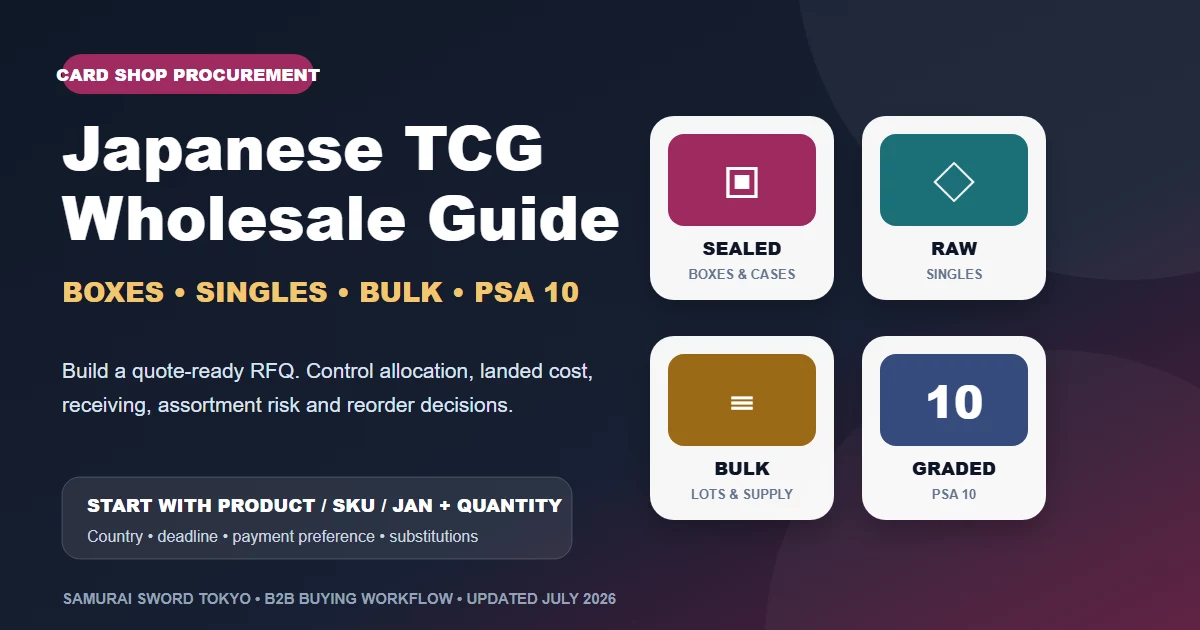
Les demandes d’approvisionnement passent par Commande rapide, et les prix AR Bulk et SR Bulk ci-dessous sont les prix affichés au moment de cette mise à jour. Les montants en USD sont convertis au taux de ¥154/USD et sont approximatifs. Les conditions relatives à la demande de devis, à l’expédition, aux douanes, au paiement, au stock et à l’allocation doivent être revérifiées avant chaque commande. Guides associés : comment acheter des cartes Pokemon japonaises en gros, guide d’achat en gros de cartes One Piece japonaises et guide des tarifs de gros des cartes Pokemon PSA 10 ; consultez le répertoire des listes de cartes pour parcourir les extensions. La mise à jour du 15 octobre 2026 vérifie les liens, les prix et le traitement douanier propre à chaque destination ; les autres informations de cet article ont été vérifiées pour la dernière fois le 14 juillet 2026.
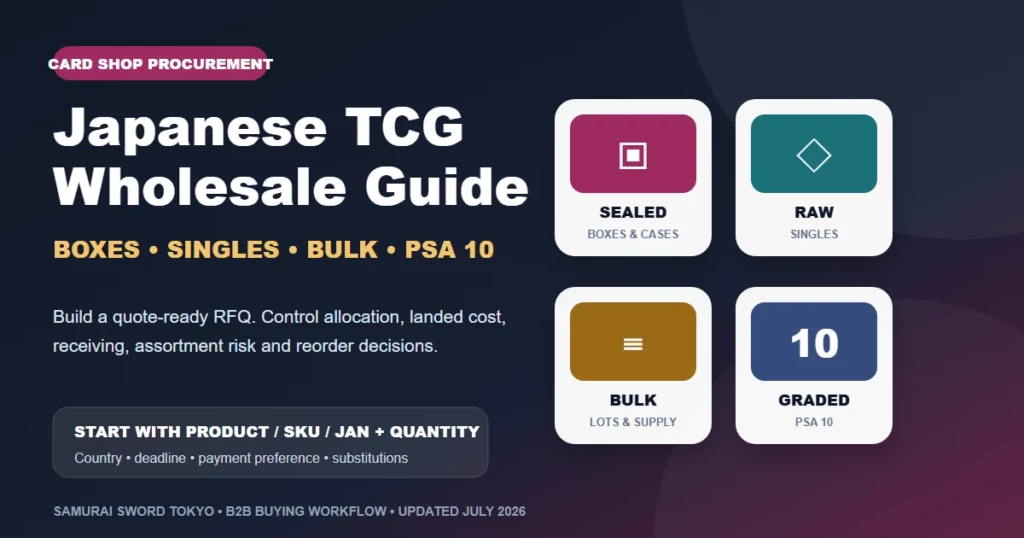
Les demandes d’achat en gros de TCG japonais sont plus faciles à évaluer lorsque la boutique fournit une description précise des produits. Indiquez le produit, son SKU ou JAN, la quantité et l’unité, la destination, la date limite et le mode de paiement souhaité. Avant de décider d’acheter, demandez à Samurai Sword Tokyo de confirmer le produit disponible, son prix, les éventuelles conditions d’allocation ou de réservation, l’expiration du devis, les instructions de paiement et les hypothèses d’expédition.
Pour les boîtes de boosters, les cartons, les cartes non gradées à l’unité, les lots en vrac, les cartes gradées ou les futures sorties, décrivez séparément chaque ligne demandée. Demandez si les produits et quantités exacts peuvent être fournis et commandés ensemble. Fondez votre décision d’achat sur l’offre confirmée, le coût rendu et les données d’écoulement propres à votre boutique.
1. Fonctionnement du processus de demande de devis de gros chez SST
Utilisez la demande de devis lorsqu’un point doit être confirmé avant l’achat
Utilisez Commande rapide pour une demande d’approvisionnement lorsque le produit, la quantité ou la disponibilité nécessite une vérification. Pour une commande existante, utilisez le canal d’assistance indiqué dans votre compte ou sur la page de contact. Décrivez chaque produit demandé en précisant clairement son identité, sa quantité et son unité.
Pour les articles dont le prix suit le marché, fournissez des identifiants japonais exacts plutôt qu’un simple surnom anglais. Demandez si un article épuisé peut être de nouveau approvisionné au prix actuel, ou si une allocation est disponible pour une future sortie. Pour les articles absents du catalogue de la boutique, indiquez les codes d’extension, les JAN, les noms de cartes, les numéros de certification et les images de référence pertinentes.
| Situation d’achat | Ce qu’il faut demander | Ce qu’il faut vérifier |
|---|---|---|
| Produit actuellement affiché | Quantité disponible, prix et modalités d’expédition actuels | Si la quantité demandée est réservée, et à quel moment |
| Article épuisé | Une vérification des possibilités d’approvisionnement | La disponibilité et le prix actuels avant de vous engager |
| Précommande ou extension à venir | L’allocation disponible pour le produit exact | Les conditions de confirmation et le calendrier estimé |
| Ligne ASK ou au prix du marché | Un devis actuel pour l’article spécifié | L’expiration et les éventuelles conditions de blocage du prix |
| Carte à l’unité, lot ou carte sous boîtier de gradation non répertorié | La disponibilité selon les identifiants exacts et les exigences d’état | Si l’article proposé répond à toutes les exigences |
Comprendre les quatre étapes
Premièrement, identifiez ce que votre boutique souhaite acheter. Deuxièmement, indiquez la quantité, l’unité, la destination et la date limite. Troisièmement, demandez la disponibilité, le prix, les possibilités de substitution et les modalités d’expédition. Quatrièmement, comparez la réponse à votre demande et obtenez toute confirmation manquante avant le paiement. Conservez la demande et la réponse ensemble dans un même dossier d’achat.
La distinction entre demande et réponse est importante. La demande exprime un besoin ; la réponse définit l’offre actuelle. Si une exigence change—quantité, destination, date limite, assortiment de produits, tolérance aux substitutions ou mode de paiement—le devis initial peut ne plus correspondre à la transaction. Demandez une confirmation actualisée plutôt que de modifier les hypothèses en interne.
Confirmer le statut du stock et de l’allocation
Demandez si le stock est réservé, à quel moment l’allocation est garantie et quelles conditions de paiement ou de facturation s’appliquent. Le seul envoi d’une demande ne suffit pas pour promettre à vos clients l’arrivée de marchandises. Conservez en interne le statut « demandé » pour la ligne concernée jusqu’à réception de la confirmation nécessaire à cet achat.
2. Préparer une demande permettant d’établir un devis avec les bons champs
Identité du produit : nom, SKU, JAN ou autre identifiant stable
Un identifiant fiable est le moyen le plus rapide d’éviter les confusions entre extensions et variantes. Pour les produits scellés, utilisez le nom exact de l’extension japonaise, son code, le SKU ou le JAN, le lien du produit, et précisez si vous souhaitez une boîte standard, une boîte sans film, un carton, un deck, un coffret spécial ou un article promotionnel. Pour les cartes à l’unité, indiquez la langue, l’extension, le numéro de carte, la rareté et la finition. Pour les PSA 10, précisez l’organisme de gradation, la note, l’identité exacte de la carte et le certificat lorsqu’un exemplaire sous boîtier précis est requis.
Ne vous fiez pas uniquement au nom du personnage. Un même personnage de Pokemon ou One Piece peut apparaître sur de nombreuses cartes japonaises, réimpressions, raretés, illustrations alternatives et cartes promotionnelles, avec des numéros de carte différents. « Pikachu PSA 10 » ou « carte Luffy » est une requête de recherche, pas une description suffisamment précise pour acheter. Si l’article n’est pas répertorié, joignez une capture d’écran uniquement comme justificatif complémentaire et saisissez les identifiants exploitables par machine dans le texte.
Quantité et unité : définissez ce qui constitue une unité
Une quantité sans unité crée une ambiguïté coûteuse. Précisez s’il s’agit de boîtes, de cartons scellés, de cartes, de cartes gradées sous boîtier, de lots de 100 cartes, de kilogrammes, de collections complètes ou d’une autre unité définie. Pour un carton, indiquez le nombre de boîtes attendu uniquement s’il est confirmé pour ce produit exact ; ne reprenez pas une hypothèse provenant d’un autre jeu ou d’une autre sortie. Pour le vrac, précisez si les doublons sont autorisés, si l’assortiment est aléatoire, la langue, la rareté, l’état et si la photo montre le lot réel ou un exemple représentatif.
Destination, date limite, mode de paiement souhaité et substitutions
Indiquez le pays de destination et distinguez la date limite d’expédition de la date limite d’arrivée. La politique d’expédition actuelle mentionne le paiement par Wise ou PayPal. Précisez le mode souhaité et suivez les instructions fournies pour la commande ; confirmez les éventuels frais et échéances avant de payer.
Enfin, définissez les substitutions. Une règle utile pourrait autoriser un autre conditionnement scellé tout en refusant une extension différente ; autoriser différents certificats PSA tout en refusant une autre note ; ou n’autoriser un produit de remplacement qu’en dessous d’un prix unitaire maximal. La mention « substitutions acceptées » sans limites impose de reprendre la décision par e-mail et retarde le devis.
Attribuez à la demande une référence interne, par exemple un numéro de lot d’achat, et consignez la version envoyée. Si la boutique modifie ensuite les quantités, supprime une ligne, augmente un budget, change la destination ou repousse la date limite, envoyez une demande clairement révisée au lieu de supposer que la réponse initiale couvre ces changements. Le suivi des versions est particulièrement utile lorsque plusieurs acheteurs, un entrepôt et une équipe de comptabilité fournisseurs interviennent : chacun peut comparer les mêmes lignes de produits, la même validité de devis et les mêmes instructions de paiement.
Avant l’envoi, demandez à une deuxième personne de vérifier les identifiants et les unités. Une erreur d’un seul caractère dans un code d’extension ou une confusion entre carton et boîte peut modifier sensiblement la commande. Cette vérification doit aussi confirmer que la date limite est réaliste, que la destination correspond à l’entité importatrice et que chaque règle de substitution comporte une limite commerciale. Ce contrôle simple coûte moins cher que la résolution d’un litige sur une variante après une expédition internationale.
| Champ de la demande de devis | Précisions minimales utiles | Erreur fréquente |
|---|---|---|
| Produit | Nom accompagné du SKU, du JAN, du code d’extension, du numéro de carte, de l’URL ou du certificat | Utiliser un surnom vague correspondant à plusieurs articles |
| Quantité | Nombre accompagné d’un type d’unité explicite | Écrire « 10 » sans préciser s’il s’agit de boîtes, de cartons, de cartes ou de lots |
| Destination | Pays et code postal/région de livraison lorsque ces informations sont demandées | Demander des frais d’expédition sans indiquer de destination |
| Date limite | Date limite d’expédition ou d’arrivée, clairement désignée | Présenter une estimation comme une date de livraison garantie |
| Paiement | Mode souhaité et solution de remplacement acceptable | Supposer que tous les modes ont des conditions identiques |
| Budget | Prix unitaire maximal ou budget total de marchandises, le cas échéant | Demander le « meilleur prix » sans seuil de décision |
| Substitutions | Modifications autorisées et interdites | Accepter des substitutions sans délimiter les produits admissibles |
3. Achat en gros de boîtes de boosters et de cartons scellés
Précisez le conditionnement scellé, pas seulement l’extension
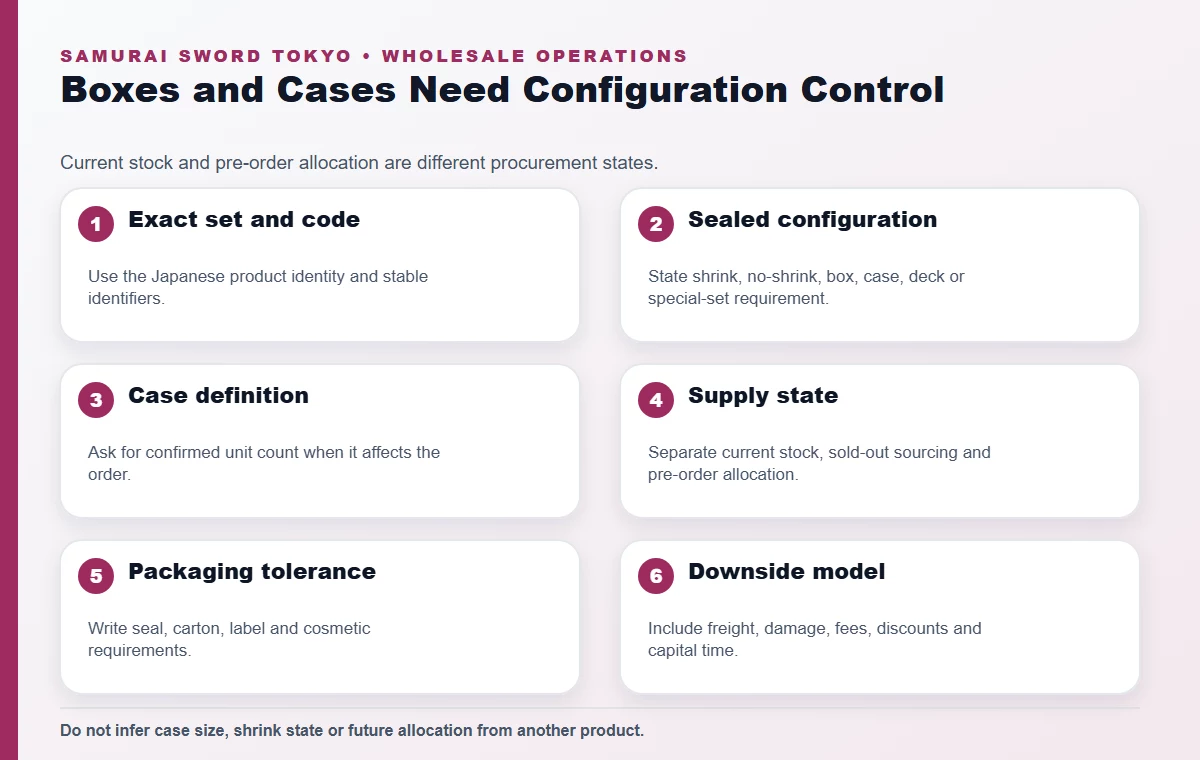
Les boosters japonais peuvent être proposés en boîtes scellées standard, en unités sans film, en cartons scellés, en coffrets spéciaux, en decks ou sous d’autres conditionnements. Leur rentabilité unitaire, leur public de revente, leur efficacité logistique et les attentes concernant leur état diffèrent. Une boutique de cartes doit préciser exactement le conditionnement acceptable et indiquer si l’état du film, le scellé du carton, les étiquettes du carton ou les critères esthétiques des boîtes comptent pour son activité.
Pour un carton scellé, demandez le produit exact et précisez que l’unité commandée est le carton. Ne supposez pas que le nombre de boîtes est standard d’un jeu ou d’une sortie à l’autre. Demandez que la réponse confirme la composition du carton lorsqu’elle influe sur votre achat. Si vous acceptez des boîtes séparées en remplacement, indiquez la quantité maximale et le niveau de protection de l’emballage requis.
Distinguer le stock actuel de l’allocation en précommande
Les lignes de stock actuel et les allocations en précommande correspondent à des états d’approvisionnement différents. Le stock actuel peut encore évoluer avant la confirmation du paiement. L’approvisionnement en précommande peut changer en fonction de l’allocation du fournisseur, du calendrier de sortie, de l’inspection ou d’autres conditions. Utilisez des statuts internes comme demandé, devis reçu, payé/confirmé, reçu et rapproché. Ne considérez pas le stock comme attendu à réception lorsqu’il a seulement été demandé.
| Option d’approvisionnement | Particulièrement adapté à | Spécification | Principal risque à maîtriser |
|---|---|---|---|
| Boîtes de boosters individuelles | Tester un assortiment et conserver une souplesse de revente | Extension, conditionnement, quantité, exigences concernant le film | Frais de transport plus élevés par boîte ou états hétérogènes |
| Cartons scellés | Constituer le stock de lancement et organiser des ouvertures de produits | Composition exacte du carton, scellés, exigences relatives au carton | Allocation, concentration du capital et dommages au carton |
| Boîtes sans film | Acheteurs acceptant l’état d’emballage annoncé | Produit exact sans film et formulation utilisée pour la revente | Confusion avec un conditionnement sous film scellé en usine |
| Demande de précommande | Lancements à venir | Produit, sortie prévue, unité boîte/carton, destination, date limite | L’approvisionnement et le calendrier de sortie ne sont pas garantis |
| Approvisionnement récurrent | Planification des réapprovisionnements | Fréquence souhaitée, fourchette de quantités et règles de substitution | Supposer qu’un devis donne droit à une allocation future |
Modéliser le stock scellé sans supposer de marge garantie
Un prix de gros ne garantit pas un écart favorable avec le prix de détail. Comparez le coût des marchandises indiqué dans le devis avec les frais de transport à réception, les coûts d’importation, les frais de paiement, la provision pour dommages, les commissions des places de marché, la préparation et l’expédition des commandes clients, les remises et la durée d’immobilisation du capital. Retenez une estimation prudente du produit net et plusieurs scénarios d’écoulement. Ne fondez pas une commande de carton sur l’engouement du lancement, un prix d’annonce isolé ou les résultats d’une extension précédente.
4. Cartes non gradées à l’unité en gros : priorité à l’identité et à l’état
Rendre chaque carte demandée vérifiable par machine
Pour les cartes non gradées à l’unité, indiquez le jeu, la langue, l’extension, le numéro de carte, la rareté, l’impression ou la finition, la quantité et la plage d’états souhaitée. Pour une carte promotionnelle, indiquez son numéro promotionnel et l’identifiant de distribution s’il est connu. Le nom du personnage, la description de l’illustration ou le nom traduit de l’extension peuvent compléter la demande, mais ne doivent pas remplacer le numéro de carte et les éléments permettant d’identifier l’extension.
Une demande portant sur plusieurs cartes doit comporter une ligne par carte distincte ou une pièce jointe structurée. Évitez un collage composé uniquement de captures d’écran qui oblige l’équipe d’approvisionnement à déduire les numéros de carte. Si vous acceptez d’autres impressions, énumérez-les explicitement par ordre de priorité et précisez si le plafond de prix change.
Décrire l’état avec des critères applicables en pratique
Des termes comme « quasi neuf » peuvent varier selon les places de marché et les boutiques. Précisez les défauts inacceptables pour votre canal de vente : enfoncements, plis, blanchiment important, rayures, lignes d’impression, taches, éclats sur les bords, inscriptions, déformation ou modification possible. Pour les cartes de valeur élevée, demandez quelles photos ou confirmations de l’état peuvent être fournies avant le paiement. Pour les cartes à l’unité de faible valeur achetées en vrac, n’utilisez une norme applicable au lot que si les deux parties en comprennent les limites.
| Champ pour les cartes à l’unité | Exemple de saisie précise | Pourquoi c’est important |
|---|---|---|
| Identité | Jeu, extension japonaise, numéro de carte, rareté | Distingue les réimpressions et les finitions alternatives |
| Quantité | Nombre exact d’exemplaires pour chaque référence | Évite qu’un nombre total de cartes masque la composition de l’assortiment |
| État | Liste écrite des défauts acceptables et rédhibitoires | Adapte les critères de réception au canal de revente |
| Substitution | Autre impression précisément désignée ou aucune substitution | Évite qu’une carte différente soit considérée comme répondant à la demande |
| Justificatif | URL du produit, lien vers une base de données de cartes ou capture d’écran | Complète les identifiants fournis sous forme de texte |
| Plafond de prix | Maximum par carte ou pour la ligne entière | Établit une règle de décision commerciale |
Orienter les cartes à l’unité reçues selon leur rentabilité réelle
Après réception, vérifiez le nombre, l’identité et l’état des cartes avant de les mettre en vente. La meilleure option peut être la vente à l’unité, un lot par personnage, un lot destiné à compléter une extension, un stock pour les ventes en direct, une évaluation en vue d’une gradation ou la conservation en stock. L’approvisionnement en gros fournit des marchandises ; il ne détermine pas le canal de revente. Suivez le produit net par lot reçu afin que les demandes futures reposent sur des données plutôt que sur des impressions générales.
5. Cartes et lots en vrac : définir le contrat d’assortiment
Le vrac désigne une unité d’achat, pas une promesse de qualité
Pour des exemples actuels de vente au détail, consultez les offres SST AR Bulk – 100-Card Set, affichée à ¥26,999 (~$175) et SR Bulk – 100-Card Set, affichée à ¥34,999 (~$227), puis utilisez la demande de devis de gros pour des besoins plus importants, récurrents ou mixtes. Le prix et la disponibilité sur les pages produits restent des données évolutives en temps réel, et non une promesse de conditions de gros.
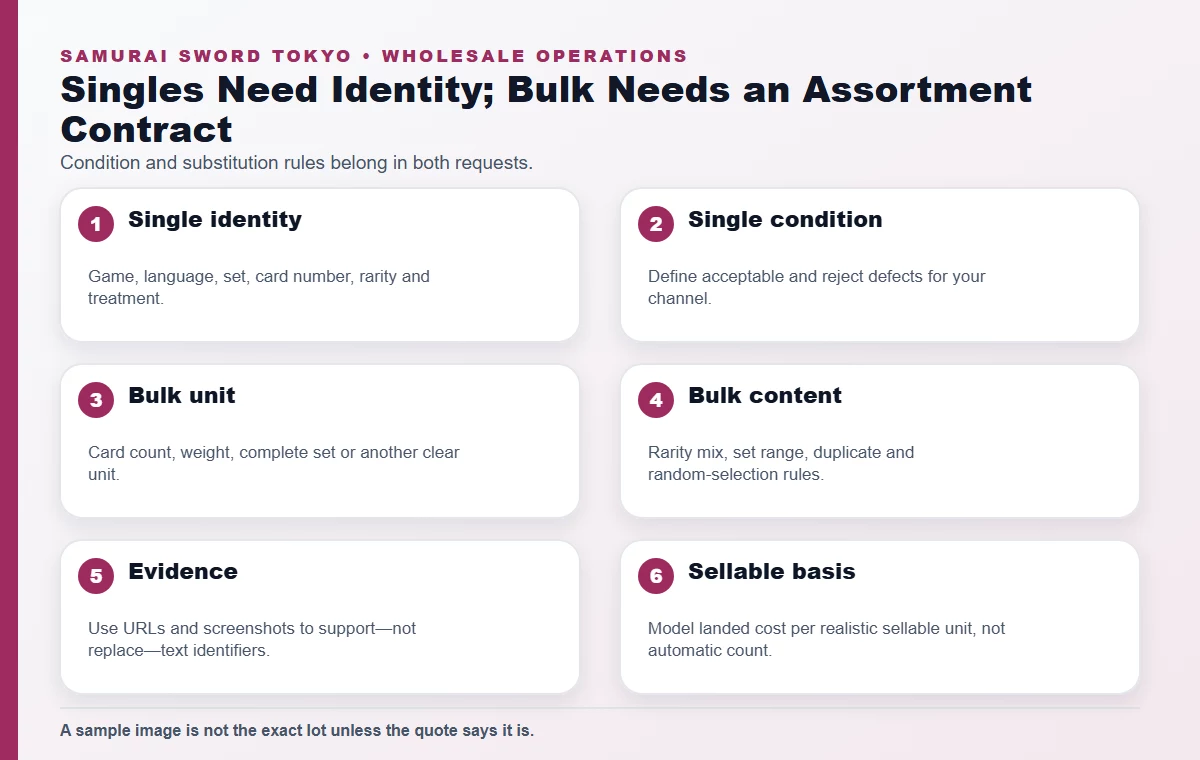
Le « vrac » peut désigner 100 cartes Art Rare, des cartes communes et peu communes de faible rareté, des lots de cartes holographiques, un assortiment de cartes japonaises à l’unité, un stock comportant beaucoup de doublons, des cartes triées par extension ou un approvisionnement au poids. Chaque interprétation entraîne des coûts de travail, d’expédition et de revente différents. Définissez le nombre de cartes ou le poids, le jeu, la langue, la répartition des raretés, les extensions incluses, les règles relatives aux doublons et à la sélection aléatoire, l’état, et précisez si les images d’exemple représentent la catégorie ou le lot réel.
Si le vendeur s’engage à faire son possible pour réduire les doublons, consignez cet engagement comme une obligation de moyens plutôt que comme une garantie d’absence de doublons. Si votre lot destiné aux clients promet l’absence de doublons, vos propres procédures de réception et de préparation doivent permettre de tenir et de vérifier cette promesse. Ne reprenez pas de formulation plus engageante que ce que permettent les conditions d’approvisionnement.
Calculer le coût par unité vendable, pas automatiquement par carte reçue
Le prix des marchandises divisé par le nombre de cartes reçues n’est qu’un point de départ. Ajoutez le transport à réception, les droits ou taxes, les frais de paiement, les fournitures, le tri, le catalogage, la photographie, la mise en vente, les frais de vente, les retours et le stock invendu. Divisez ensuite par le nombre de cartes ou de lots que vos canaux peuvent raisonnablement vendre. Les cartes endommagées, la concentration de doublons et le stock peu demandé peuvent réduire le dénominateur effectif.
| Spécification du vrac | Décision à consigner | Risque en cas d’omission |
|---|---|---|
| Unité | 100 cartes, 1,000 cartes, kilogramme, collection complète ou autre unité | Impossible de comparer les quantités ou de les vérifier précisément à réception |
| Rareté/contenu | AR, holographique, commune/peu commune, assortiment mixte ou liste exacte | L’acheteur et le vendeur envisagent des stocks différents |
| Doublons | Autorisés, plafonnés, réduits dans la mesure du possible ou absence garantie | Une concentration excessive compromet la diversité prévue |
| Sélection | Aléatoire, sélectionnée, triée par extension ou composée des cartes réellement montrées | Les images d’exemple sont prises pour le contenu exact |
| État | Norme applicable au lot et défauts rédhibitoires | Le travail nécessaire et le nombre de cartes vendables sont mal estimés |
| Substitutions | Limites autorisées concernant la rareté, l’extension, la langue et le prix | Un approvisionnement différent est considéré comme répondant à une demande imprécise |
Tester un lot pilote avant d’augmenter les volumes récurrents
Mesurez le nombre de références distinctes, la concentration de doublons, le nombre de cartes vendables, les heures de tri, le produit net moyen, le taux d’écoulement à 30/60 jours, le taux de retour et l’ancienneté du stock. N’augmentez les volumes qu’une fois vos seuils atteints par la cohorte. Un lot plus important peut réduire le transport par carte tout en augmentant le travail, les fonds engagés et le risque de stock à rotation lente.
6. Cartes gradées PSA 10 : des exemplaires précis sous boîtier, pas un stock générique défini par une note
Préciser l’identité de la carte et les certificats acceptables
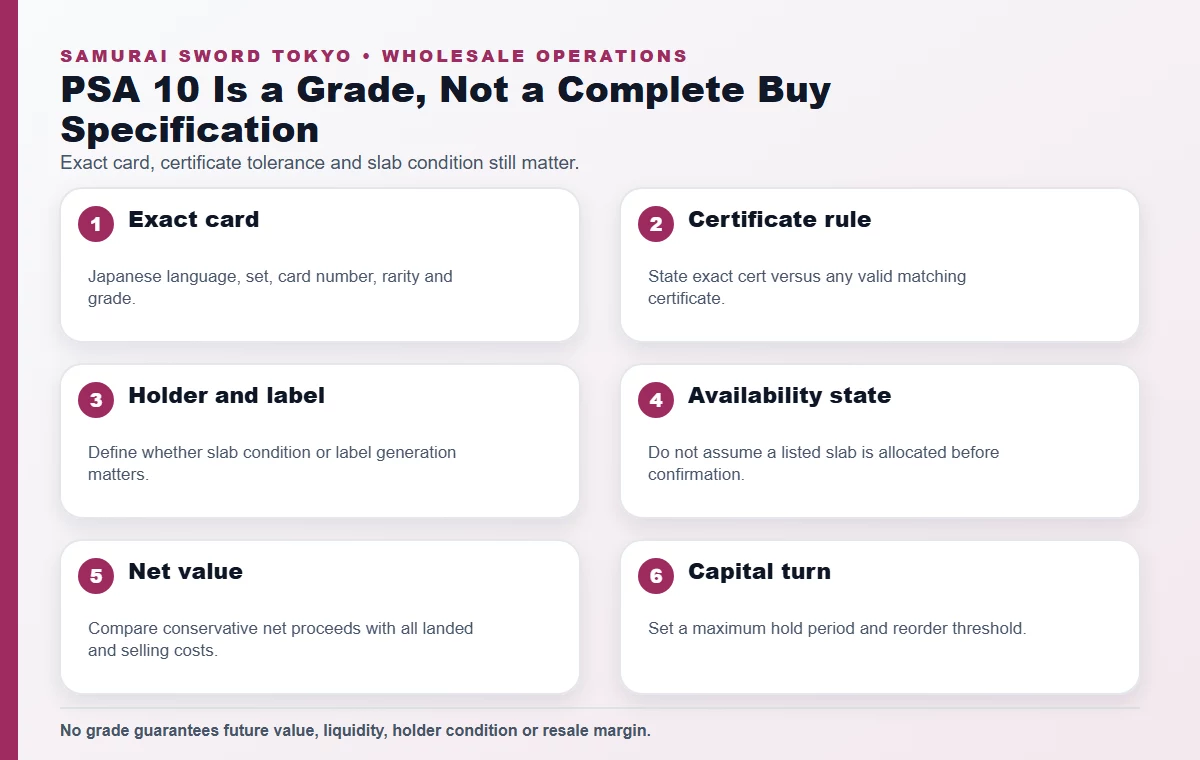
Une demande PSA 10 doit préciser l’identité exacte de la carte, la langue japonaise, l’extension, le numéro de carte, la rareté ou la finition, la note, la quantité et si tout certificat valide est acceptable. Si la boutique souhaite l’exemplaire exact montré sous boîtier, indiquez le numéro de certification. Si différents certificats sont acceptables, précisez les éventuelles règles d’acceptation concernant la génération de l’étiquette, l’état du boîtier ou l’aspect visuel.
La note seule ne rend pas tous les exemplaires sous boîtier commercialement équivalents. La demande pour le personnage, l’illustration, la population de cartes gradées, l’extension, la certification, le centrage, l’étiquette, l’état du boîtier et votre clientèle influent sur la facilité de revente. Aucune demande de devis ne peut garantir la valeur future de revente ni la rapidité de vente.
Contrôler la disponibilité simultanée en ligne et en boutique physique
La politique d’expédition de SST précise que les cartes gradées PSA peuvent aussi être vendues dans sa boutique physique : un article affiché en ligne peut donc y être vendu avant que son allocation soit assurée. Pour les demandes de gros, considérez l’exemplaire sous boîtier comme non confirmé tant que la réponse et le processus convenu ne l’ont pas réservé de manière ferme. Si un certificat précis est indispensable, exprimez clairement cette contrainte et n’acceptez pas de remplacement générique sans vérification.
Établir un modèle de marge pour les cartes gradées incluant un scénario défavorable
| Contrôle | Question | Conséquence de l’absence de garantie |
|---|---|---|
| Identité exacte | L’extension, le numéro de carte, la rareté et la langue sont-ils corrects ? | Une carte similaire du personnage ne constitue pas un remplacement |
| Certificat | Tout certificat convient-il ou faut-il un certificat précis ? | La disponibilité peut changer avant que l’allocation soit assurée |
| Boîtier/étiquette | L’état du boîtier et la génération de l’étiquette sont-ils déterminants ? | La note PSA 10 ne garantit pas un boîtier sans défaut |
| Données de produit net à la revente | Quelle estimation prudente du produit net retenir sur votre marché ? | Le prix affiché dans une annonce n’est pas la marge réalisée |
| Rotation du stock | Combien de temps le capital peut-il rester immobilisé dans un exemplaire sous boîtier ? | Une valeur nominale élevée peut néanmoins correspondre à une conversion lente en trésorerie |
| Substitutions | Quelle autre carte, quel autre certificat ou quel autre prix est acceptable ? | Une souplesse mal définie retarde les validations |
7. Contrôler les prix, les stocks, les allocations et la validité des devis
Lire le devis comme une offre datée reposant sur des hypothèses
La réponse à la demande de devis doit préciser les articles pouvant faire l’objet d’une offre, les prix, la disponibilité, la validité, le mode de paiement, les modalités de facturation et les prochaines étapes. Conservez-la avec la demande initiale. Vérifiez que le produit, la quantité, l’unité, la destination, la date limite, les substitutions et les hypothèses d’expédition correspondent toujours. Si une donnée a changé, demandez si le devis reste valable.
Demandez une date ou une heure d’expiration explicite ainsi que les conditions susceptibles d’influer sur le prix ou la disponibilité. Si vous modifiez la quantité, la destination ou les exigences relatives au produit, demandez confirmation que le devis s’applique toujours. Faites reconfirmer tout devis expiré avant d’envoyer le paiement.
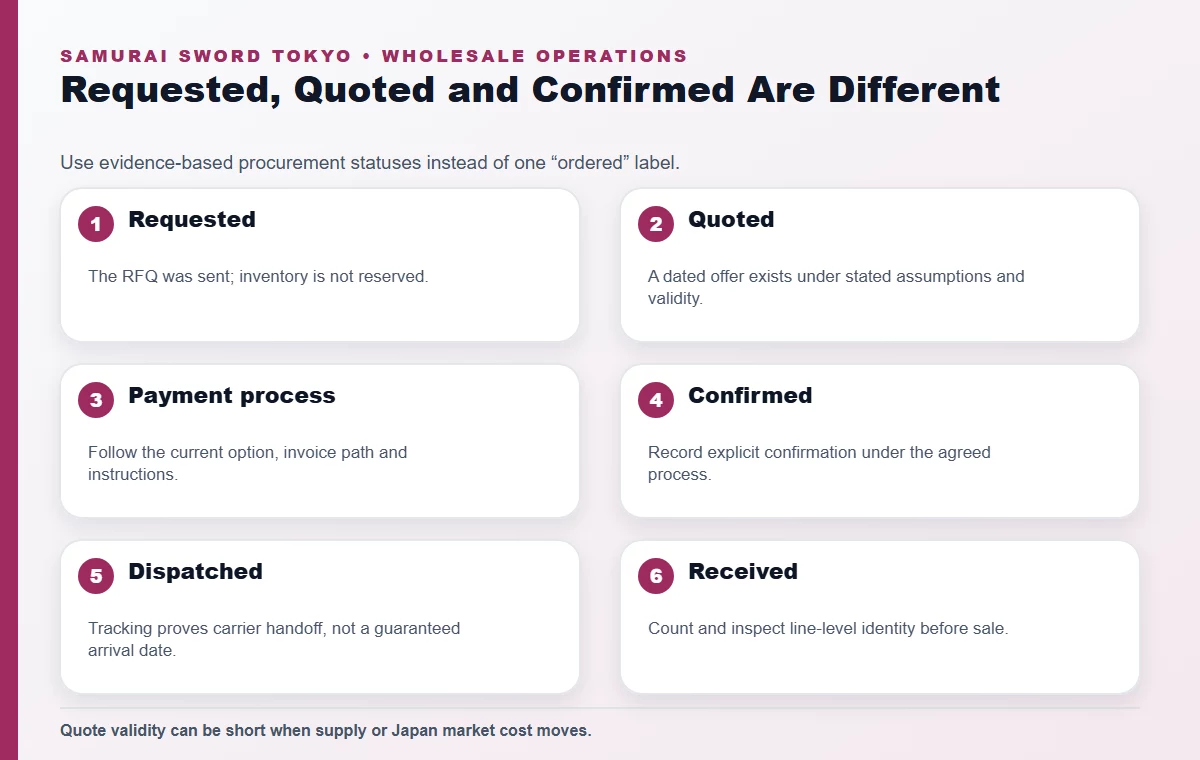
Utiliser des statuts d’approvisionnement explicites
| Statut | Justificatif | Ce que la boutique peut considérer comme acquis en interne |
|---|---|---|
| Demandé | Demande d’approvisionnement envoyée | Attendre une confirmation explicite du stock et de la réservation |
| Devis reçu | Réponse actuelle précisant sa validité | Offre disponible selon les hypothèses indiquées |
| Paiement/facturation en cours | Modalités et instructions convenues | Ne pas considérer l’approvisionnement comme assuré avant confirmation |
| Confirmé | Confirmation de SST selon le processus convenu | Approvisionnement à venir reconnu comme confirmé |
| Expédié | Remise au transporteur et suivi | En transit ; la date d’arrivée reste estimative |
| Reçu/rapproché | Contrôle du nombre, de l’identité et de l’état | Stock disponible après enregistrement des anomalies |
L’approbation des substitutions appartient à l’acheteur
Lorsque l’approvisionnement évolue, un produit de remplacement peut permettre de respecter une date limite ou une fourchette de prix, mais uniquement s’il répond aux besoins de la boutique. Définissez les substitutions préapprouvées dans la demande de devis. Toute autre modification doit être soumise à l’approbation de l’acheteur, en précisant l’article révisé, la quantité, le prix et l’incidence sur l’expédition. Ne laissez jamais une mention générale « substitutions acceptées » prendre le pas sur l’identité des cartes, le conditionnement scellé, la note ou les exigences d’assortiment.
8. Expédition, droits de douane, taxes et coût rendu
Le montant du devis et le coût rendu ne sont pas automatiquement identiques
La politique douanière actuelle de SST indique que les commandes à destination des États-Unis et des territoires américains sont expédiées en DDP : les frais d’importation applicables sont perçus lors du paiement, sans paiement douanier supplémentaire à la livraison. Les autres destinations sont desservies en DAP, les droits, taxes et frais de transporteur applicables étant payables au transporteur avant ou lors de la livraison. Confirmez la destination et la politique actuelle lors du calcul du coût rendu.
Calculez le coût rendu à partir des marchandises, du transport international, de l’assurance, des frais de paiement et de change, des droits, de la TVA/GST ou d’autres taxes, des frais de courtage ou de transporteur, de la manutention à réception, de la provision pour dommages et du transport local. Demandez si les frais d’expédition sont définitifs ou estimatifs. Pour le classement douanier et les obligations de l’importateur, consultez l’autorité du pays de destination ou un conseiller qualifié ; ni un blog ni un devis fournisseur ne garantit le traitement applicable.
Ne pas promettre de dates de livraison sur la base d’estimations
La politique d’expédition de SST présente les délais de traitement et d’acheminement du transporteur comme des estimations et non comme des dates garanties. Elle énumère les conditions liées à l’allocation, à l’inspection, aux douanes, au transporteur et à la destination susceptibles de provoquer des retards. Une boutique doit suivre séparément les dates demandées, estimées et réelles. Ne vendez pas à l’avance avec une date client garantie, sauf si votre entreprise peut la respecter indépendamment des variations du fournisseur et du transporteur.
| Poste du coût rendu | Source justificative | Contrôle |
|---|---|---|
| Marchandises | Devis/facture en cours | Vérifier la concordance du produit, de la quantité, de l’unité et de la devise |
| Transport international | Devis, informations au passage de commande ou justificatif du transporteur | Confirmer si le montant est estimatif ou définitif et le répartir de façon cohérente |
| Paiement/change | Mode de paiement réellement utilisé | Consigner séparément les frais et le taux de conversion effectif |
| Droits/taxes | Devis, traitement DDP et autorité douanière | Vérifier le DDP au passage de commande pour les États-Unis/territoires américains et les frais à destination en DAP pour les autres pays |
| Courtage/manutention | Transporteur ou courtier | Inclure les frais d’avance de fonds et de dédouanement, le cas échéant |
| Anomalies à réception | Contrôle de réception | Prévoir une provision pour les dommages, les manquants, les problèmes d’état et les retards |
| Coûts de vente | Votre canal de vente | Ajouter les frais de place de marché, le travail, l’emballage, les retours et les remises |
Répartir de façon cohérente les coûts des expéditions mixtes
Les boîtes, les cartes en vrac et les cartes PSA sous boîtier représentent des poids, volumes et valeurs assurées différents. Choisissez une méthode de répartition documentée—poids, volume emballé, valeur ou méthode hybride—et appliquez-la à toutes les cohortes. Une répartition arbitraire à parts égales peut faire paraître une catégorie rentable alors qu’une autre supporte ses frais de transport. Rapprochez les frais estimés et réels après la livraison.
9. Contrôles de réception, de marge et de réapprovisionnement
Contrôler la réception par rapport au devis et au manifeste détaillé par ligne
Avant l’ouverture, photographiez les dommages visibles sur les cartons et conservez les étiquettes. Comptez les cartons, puis les lignes de produits, puis les unités. Vérifiez la concordance des identifiants produits, du conditionnement scellé, des numéros de carte, des certificats, des règles d’assortiment du vrac et de l’état. Consignez les manquants, substitutions, dommages et incertitudes avant la dispersion du stock. La valeur totale de la commande ne suffit pas ; l’identité et la quantité de chaque ligne comptent.
Pour les cartons scellés, inspectez le carton et les éléments attestant le scellé selon les spécifications convenues. Pour les boîtes, consignez la présence ou l’absence de film et les anomalies esthétiques. Pour les cartes à l’unité, appliquez les critères d’état écrits. Pour le vrac, vérifiez la quantité de l’unité et procédez à un échantillonnage ou à une inspection selon le contrat. Pour les PSA 10, vérifiez la concordance du certificat et l’état du boîtier lorsque cela est requis.
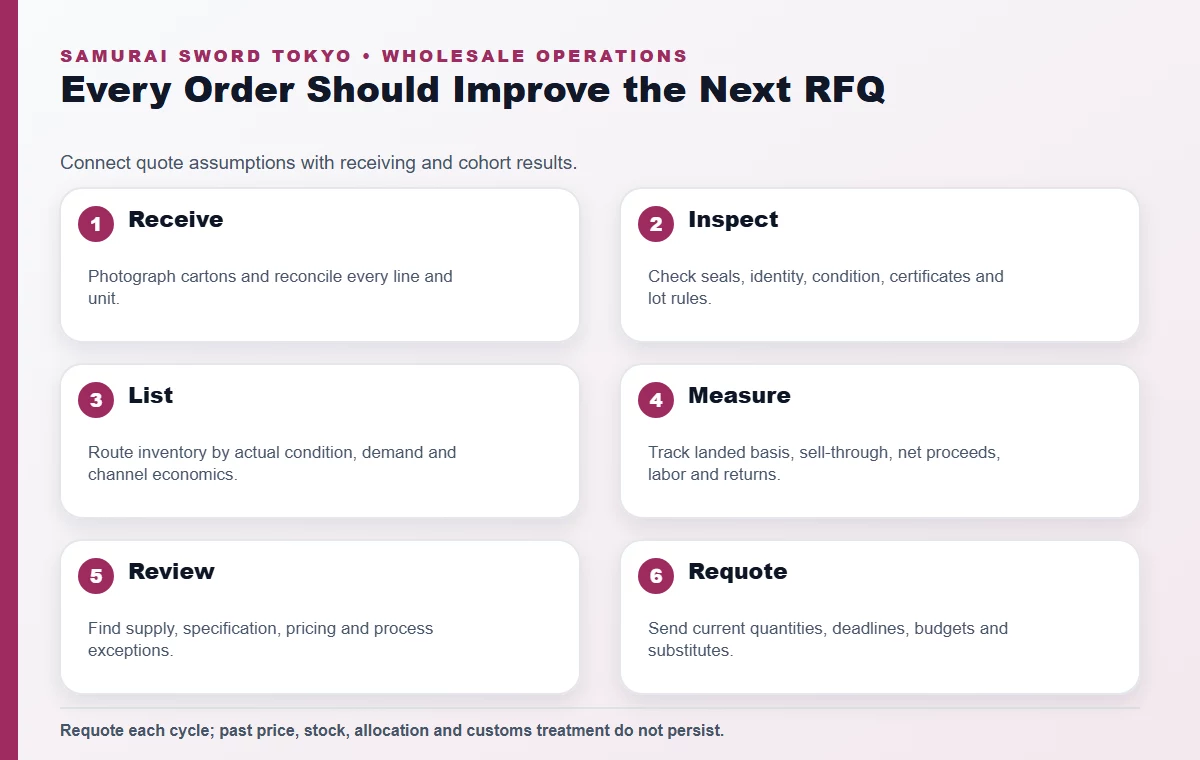
Mesurer la contribution nette et la conversion en trésorerie
N’évaluez pas une commande de gros sur le seul chiffre d’affaires brut. Suivez le coût rendu, les frais de vente, les remises, le travail, les retours, les dommages, l’ancienneté du stock et le produit net. Distinguez les cohortes par date de commande et par ligne de produits. Les boîtes peuvent s’écouler rapidement tout en étant exposées à la volatilité du lancement ; les cartes à l’unité peuvent dégager des taux de marge brute plus élevés tout en nécessitant du travail ; le vrac peut exiger du tri et impliquer d’accepter des doublons ; les PSA 10 peuvent concentrer le capital sur un plus petit nombre d’unités.
| Indicateur clé de performance | Pourquoi c’est important | Question avant réapprovisionnement |
|---|---|---|
| Taux de satisfaction des lignes de commande | Indique ce qui a été confirmé et reçu | Le circuit d’approvisionnement convient-il à l’assortiment prévu ? |
| Coût rendu par unité | Évite d’omettre le transport et les taxes | Le nouveau devis respecte-t-il toujours le seuil requis ? |
| Taux d’écoulement à 30/60/90 jours | Mesure la rotation du stock | Une nouvelle commande renforcera-t-elle utilement le stock ou créera-t-elle un surstock ? |
| Produit net | Prend en compte les sommes conservées après les coûts variables | La cohorte a-t-elle dégagé une contribution après les frais de vente ? |
| Heures de travail | Met en évidence le coût du tri, de la mise en vente et du service | Le processus peut-il absorber davantage de volume sans perdre en précision ? |
| Retours/anomalies | Évalue les contrôles des spécifications et de l’état | Que faut-il modifier dans la prochaine demande de devis ? |
| Ancienneté du stock | Mesure le capital immobilisé | La boutique doit-elle se réapprovisionner, constituer des lots, réduire les prix ou arrêter ? |
Redemander un devis à chaque cycle
Une première commande réussie ne garantit pas durablement un prix, un niveau de stock, une allocation, un tarif d’expédition, un traitement douanier ou une marge. Envoyez ou actualisez la demande de devis avec la quantité, la destination, la date limite et les règles de substitution actuelles. Comparez la nouvelle offre à la cohorte précédente, plutôt qu’à vos souvenirs. N’augmentez les volumes que lorsque la fiabilité de l’approvisionnement, le coût rendu, la précision de la réception, l’écoulement et la conversion en trésorerie le justifient.
Effectuez une brève revue des achats avant d’approuver la commande suivante. L’acheteur commercial doit confirmer la demande et les seuils de prix ; l’équipe opérationnelle doit confirmer les capacités de stockage, d’inspection et de mise en vente ; l’équipe financière doit confirmer les hypothèses de coût rendu et le calendrier de trésorerie ; et l’importateur officiel doit confirmer les exigences douanières actuelles. Un produit peut séduire les clients tout en constituant un mauvais achat si l’équipe ne peut pas le réceptionner avec précision, le financer pendant sa durée de détention ou le vendre sans remises excessives.
Consignez la décision finale même lorsque la réponse est « ne pas acheter ». Enregistrer le devis refusé, le motif et la date de revue crée une mémoire du marché utile sans considérer les anciens chiffres comme des données actuelles. Lorsque l’approvisionnement change, la boutique peut réexaminer la ligne avec une nouvelle demande de devis et comparer des hypothèses équivalentes, plutôt que de reconstruire la décision à partir de messages dispersés.
10. FAQ : achat en gros de TCG japonais pour les boutiques de cartes
Quelles informations une boutique de cartes doit-elle inclure dans une demande de devis pour l’achat en gros de TCG japonais ?
Indiquez le nom du produit et un identifiant fiable, comme un SKU, un JAN, un code d’extension, un lien produit, un numéro de carte, un numéro de certification ou une capture d’écran ; la quantité et le type d’unité ; le pays de destination ; la date limite de livraison ; le mode de paiement souhaité ; le budget ou le prix unitaire maximal, le cas échéant ; et si les substitutions sont acceptables.
L’envoi d’une demande d’approvisionnement réserve-t-il le stock ?
Demandez à SST si le stock est réservé, à quel moment l’allocation est assurée et quelles conditions de paiement ou de facturation s’appliquent. Conservez le statut « demandé » pour une demande d’approvisionnement Quick Order jusqu’à confirmation des modalités d’achat concernées. Ne promettez pas l’arrivée de marchandises aux clients sur la seule base d’un accusé de réception de la demande.
Puis-je demander des produits épuisés ou non répertoriés ?
Oui, pour vérifier les possibilités d’approvisionnement. Pour un produit épuisé, identifiez l’article exact et la quantité nécessaire. Pour un article non répertorié, fournissez les codes d’extension, les JAN, les noms de cartes, les numéros de certification, des captures d’écran ou des précisions. Une demande ne garantit ni que le produit pourra être approvisionné ni que son prix correspondra à votre objectif.
Puis-je demander une allocation en précommande pour des boîtes de boosters ou des cartons ?
Oui. Indiquez le produit, la sortie prévue, la quantité de boîtes ou de cartons demandée, la destination et la date limite. La demande ne garantit pas l’allocation, qui peut dépendre des disponibilités du fournisseur, des conditions du marché, du calendrier de paiement et de la confirmation de l’équipe.
Combien de temps un devis de gros de TCG japonais est-il valable ?
Demandez que la réponse précise la date ou l’heure d’expiration ainsi que les conditions de prix ou de disponibilité. Faites reconfirmer le devis après son expiration ou après modification de vos exigences, plutôt que de vous appuyer sur une indication antérieure de prix ou de stock.
Une commande de gros peut-elle combiner boîtes, cartes à l’unité, lots en vrac et cartes PSA 10 ?
Énumérez séparément les produits demandés, chacun avec ses quantités, ses unités et ses règles d’acceptation. Demandez s’ils peuvent faire l’objet d’un devis commun, être achetés ensemble et être expédiés ensemble. La politique d’expédition de SST indique que les commandes distinctes sont expédiées séparément ; confirmez donc l’organisation de la commande avant de la valider.
Les marges bénéficiaires sont-elles garanties sur les cartes japonaises achetées en gros ?
Non. Un devis est une offre d’approvisionnement, pas une garantie de prix de revente ou de bénéfice. Votre marge dépend du coût rendu, des frais de change et de paiement, des taxes, de l’expédition, des frais, du travail, de l’état, de l’assortiment, de l’écoulement, des retours, des variations de prix et du marché sur lequel vous vendez.
Qui paie les droits de douane et les taxes à l’importation ?
Les commandes à destination des États-Unis et des territoires américains sont expédiées en DDP : les frais d’importation applicables sont perçus lors du paiement, sans paiement douanier supplémentaire à la livraison. Les autres destinations sont desservies en DAP, les droits, taxes et frais de transporteur applicables étant payables au transporteur avant ou lors de la livraison. Vérifiez la politique douanière actuelle avant de payer.
Que dois-je préciser pour les demandes d’achat en gros de PSA 10 ?
Indiquez l’identité exacte de la carte, la langue, l’extension et le numéro de carte, la note, l’organisme de gradation, la quantité et—lorsque vous souhaitez un exemplaire précis sous boîtier—le numéro de certification. Précisez si différents certificats ou des cartes de remplacement sont acceptables. La note seule ne garantit pas une valeur de marché, une facilité de revente ou un aspect visuel équivalents.
Quand une boutique de cartes doit-elle se réapprovisionner ?
Ne vous réapprovisionnez qu’après avoir comparé le nouveau devis aux résultats réels de la cohorte : écoulement, produit net, travail, ancienneté du stock, retours, concentration de doublons, anomalies d’état et conversion en trésorerie. Reconfirmez à chaque cycle le prix, la disponibilité, l’allocation, les hypothèses d’expédition, les taxes et la validité du devis.
Avant de payer, confirmez les produits exacts, les quantités, l’état, le prix, la disponibilité, l’expiration du devis et les instructions de paiement. Consultez les politiques d’expédition et de douane actuelles pour la destination, et conservez ces informations avec l’offre acceptée.
Sélectionné pour cet article
📩 Promos et coupons réservés aux membres
Alertes soldes, coupons et réassorts par email, depuis Tokyo.