
如何识别假的日版宝可梦卡牌
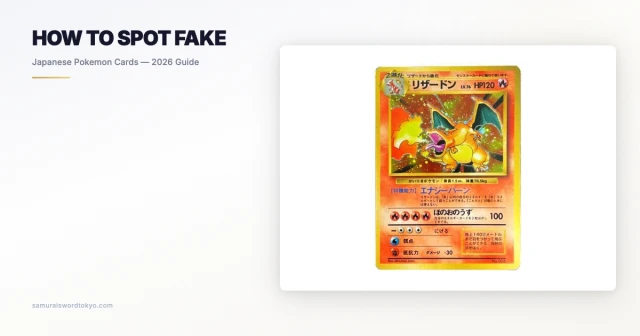
Fake Japanese Pokemon cards are showing up more often on international resale platforms. In a 2023 survey by SNKRDUNK, 59.3% of Japanese trading card buyers reported encountering counterfeit or repackaged products through secondary markets. As Japanese Pokemon cards gain popularity worldwide — driven by exclusive art, higher pull rates, and premium print quality — counterfeiters are keeping pace.
This guide covers 10 specific methods to identify fake Japanese Pokemon cards, whether you are checking a single card or inspecting a sealed booster box. We also explain how to spot resealed boxes, verify PSA slabs, and choose sellers you can trust.
Our team at Samurai Sword INC processes over ¥1 billion (approximately $7 million) in Japanese Pokemon card inventory every month. Across that volume, we detect counterfeit or resealed products only once or twice per month — a rate below 0.01%. Every box receives a serial number tied to its source, and a single confirmed fake is enough to permanently ban that supplier. That hands-on inspection process is the foundation of this guide.
The card back is your single most reliable tell — check the blue gradient in the Poke Ball area first. For sealed boxes, factory shrink wrap air holes are the strongest indicator of authenticity. But the best defense is buying from specialized sellers with inspection and serial-tracking processes.
30-Second Quick Authentication Check
Five checks, no tools, half a minute — this catches roughly 90% of fake Japanese Pokemon cards.
| # | Check | Real | Fake |
|---|---|---|---|
| 1 | Card back color | Deep, rich blue with subtle gradient in the Poke Ball area | Lighter or flat blue, single-shade Poke Ball |
| 2 | Text sharpness | Crisp edges on every character — kanji strokes are clean | Blurry, fuzzy, or pixelated text; ink bleeding |
| 3 | Card feel | Slight glossy finish, firm but flexible | Overly matte, flimsy, or unusually stiff |
| 4 | Holo pattern | Shifts smoothly with light angle; layered depth | Static shimmer, cloudy, or “rainbow oil slick” effect |
| 5 | Overall weight | Balanced, consistent thickness | Noticeably lighter or thinner than other cards from the same set |
If a card fails even one of these checks, proceed to the detailed tests below.
Card Authentication — 10 Detailed Tests
Combining multiple tests is the most reliable way to identify fake Japanese Pokemon cards. Each test below includes a difficulty rating and reliability score so you can choose the right method for your situation.
1. Card Back Color and Pattern
Difficulty: Easy | Reliability: High
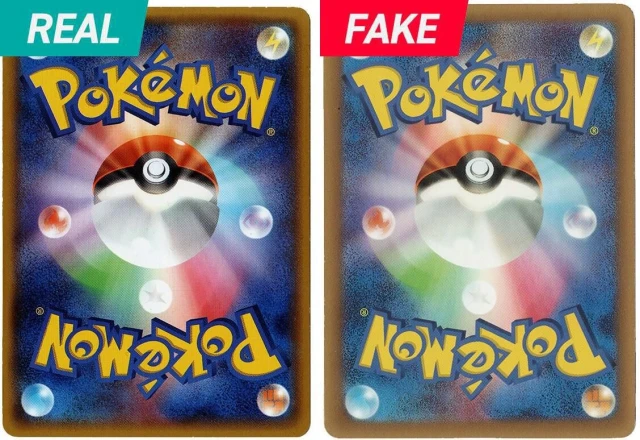
The card back is your single most reliable starting point for identifying fake Japanese Pokemon cards. Authentic cards share the same back design used globally — a Poke Ball centered on a blue swirl pattern — but the print quality differs between genuine and counterfeit copies.
On a real card, the top-right area of the Poke Ball features multiple shades of blue blending into each other. Counterfeit cards typically fill this area with a single flat shade. The overall blue is also noticeably lighter on most fakes, and the white border may be uneven or too wide on one side.
Compare the suspect card against a card you know is genuine from the same era. Side-by-side comparison under consistent lighting reveals differences that are invisible when examining a card alone.
2. Print Quality and Resolution
Difficulty: Easy | Reliability: High
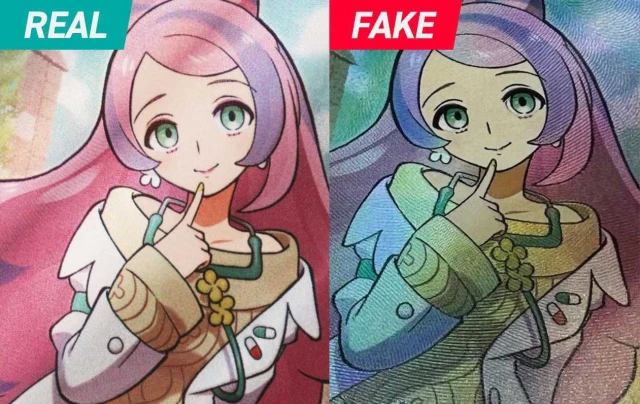
Hold the card at arm’s length and look at the artwork and text. Genuine Japanese cards are printed at high resolution with vibrant, saturated colors. Counterfeits often show:
- Fuzzy or pixelated artwork, especially at the edges of character outlines
- Ink bleeding where colors meet (red bleeding into adjacent white areas)
- Color that appears washed out or oversaturated compared to the original
- Micro-text (set numbers, copyright lines) that is unreadable or missing
Japanese text quality is a strong tell. Kanji and katakana characters require precise stroke rendering. Even minor blurriness in Japanese text stands out more than in English because the character structures are more complex.
3. Texture and Paper Feel
Difficulty: Easy | Reliability: Medium-High
Authentic cards use multi-layer cardstock with a smooth, slightly glossy surface. When you run your finger across the face, there is a subtle sheen without being slippery. Fakes frequently feel:
- Overly matte or completely lacking gloss
- Thinner and flimsier — they bend without resistance
- Rougher or “plasticky” on the surface
The card should have a natural spring-back when gently flexed. If it creases easily or stays bent, the paper composition is wrong.
4. Holographic and Relief Details
Difficulty: Medium | Reliability: High
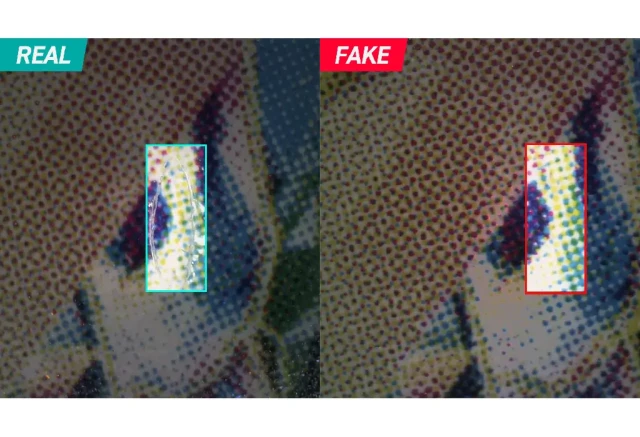
Japanese holographic cards — particularly SAR (Special Art Rare), SR (Super Rare), and UR (Ultra Rare) — feature intricate foil patterns and embossed relief textures. Under a bright light at an angle:
- Real relief: Run your fingertip across the card face. You will feel fine grooves in a diagonal pattern. Under magnification, these grooves form consistent parallel lines.
- Fake relief: The surface is flat and smooth. There are no physical grooves — any texture you see is printed, not embossed.
The holographic foil on genuine Japanese cards shifts cleanly between colors as you tilt the card. Counterfeits either lack holo entirely on cards that should have it, or display a generic “rainbow oil” effect that does not match the official pattern for that specific card.
5. Card Dimensions and Weight
Difficulty: Easy | Reliability: Medium
Standard Japanese Pokemon card dimensions: 63mm x 88mm with a thickness of approximately 0.30mm. A caliper can confirm these measurements precisely.
Counterfeits are frequently off by 1-2mm in either direction. The corners should have a uniform, smooth radius — fakes sometimes have sharper or uneven corners where the cutting die was imprecise.
If you have a kitchen scale accurate to 0.1g, a standard card weighs between 1.7g and 1.9g. Holographic cards sit at the higher end. Significant deviations indicate non-standard cardstock.
6. Font and Text Accuracy
Difficulty: Medium | Reliability: High
Japanese Pokemon cards use specific fonts for card names, HP, attack descriptions, and flavor text. Cross-reference against the official Pokemon Card Database — search by set number to see the authentic version.
Red flags:
- Incorrect kanji or simplified Chinese characters substituted for Japanese
- Misaligned text that does not sit in the correct position within text boxes
- Wrong font weight (too bold or too thin compared to the original)
- Missing or incorrect set symbols, rarity marks, or regulation marks
This check is particularly effective for catching fake Japanese Pokemon cards because replicating Japanese typography accurately requires access to the exact fonts — most counterfeit operations do not invest in this detail.
7. The Light Test
Difficulty: Easy | Reliability: Medium
Hold the card up to a strong light source (phone flashlight works). Genuine Pokemon cards are constructed with a dark opaque layer sandwiched between two white layers. When backlit:
- Real: Very little light passes through. You may see a faint dark layer with a slight bluish tint.
- Fake: Significantly more light passes through. The card appears translucent, and you cannot see a defined dark core.
This test is less conclusive for Japanese holographic cards, as the foil layer affects light transmission. Use it primarily on non-holo cards, commons, and uncommons.
8. Edge and Corner Quality
Difficulty: Easy | Reliability: Medium
Examine the card edges from the side. A genuine card shows a clean, layered cross-section: white outer layers with a thin dark line in the center. If the edge appears as a single solid color (all white or all gray), the card lacks the standard multi-layer construction.
Corner rounding should be smooth and consistent across all four corners. Counterfeits often have one corner slightly sharper or more rounded than the others — a sign of inconsistent die-cutting.
How to Spot a Resealed Booster Box
Resealed booster boxes are one of the most common threats facing Japanese Pokemon card buyers. Rewrapping an opened box in new shrink wrap makes the packaging look real — but valuable packs may have been removed and replaced with lower-value ones.
Shrink Wrap Inspection
Authentic Japanese booster box shrink wrap has these characteristics:
| Feature | Genuine | Resealed |
|---|---|---|
| Surface | Tight, glossy, cling-wrap texture | Loose, dull, or overly thick plastic |
| Seam lines | Centered on top and bottom; smooth | Off-center, wrinkled, or with visible folds |
| Air inside | Minimal — wrap conforms tightly to box | Trapped air pockets; wrap slides when pressed |
| Air holes | Small, irregular holes in the plastic (factory ventilation) | No air holes, or holes that appear punched manually |
| Pokemon Company logo | White logo printed on the wrap itself | No logo, or logo on a separate sticker |
The most reliable single indicator: factory shrink wrap has small air holes that are created during the automated wrapping process. Resealed boxes wrapped with a heat gun do not have these holes.
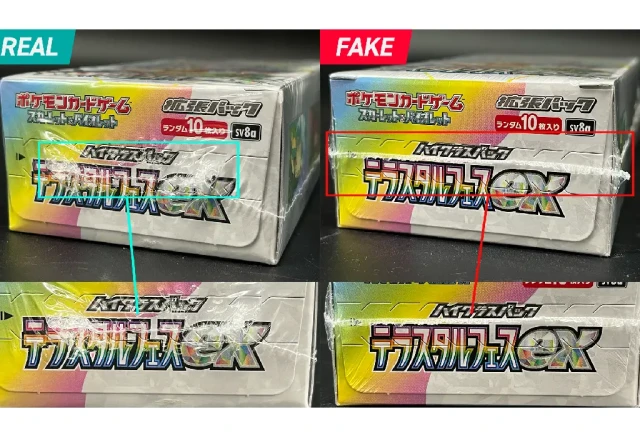
Box 状态 Clues
Even under fresh shrink wrap, the box itself can reveal tampering:
- Perforated opening tab: If the box has already been opened, the perforated dotted line along the top will show creasing or separation. Look through the shrink wrap for any gap between the tab and the box top.
- Corner wear: A box that has been opened and resealed may show wear at the corners where the cardboard was flexed.
- Pack alignment: Factory-sealed boxes have packs arranged in consistent rows. If packs appear shifted or unevenly stacked, the box may have been opened.
JAN Code and Lot Number Verification
Japanese booster boxes carry a JAN (Japanese Article Number) barcode — the equivalent of UPC in the US. Each set has a specific JAN code that can be cross-referenced online. If the JAN code does not match the set printed on the box, it is a counterfeit.
Lot numbers indicate manufacturing batches. While there is no public database for lot number verification, consistent lot numbers across a suspiciously large number of “sealed” boxes from the same seller can indicate repackaging from a single opened case.
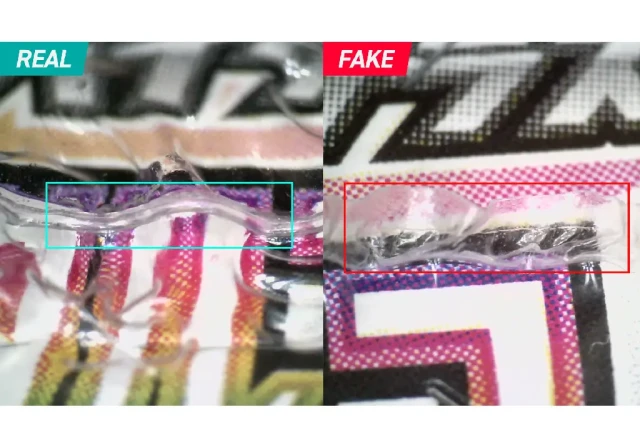
If you are buying multiple boxes from the same seller, check that they do not all share an identical lot number. Legitimate sellers sourcing from different batches will have varying lot numbers.
Fake PSA Slabs — A Growing Threat
Counterfeit PSA-graded cards are now a documented problem in the Japanese Pokemon card market. In January 2026, a US seller was convicted of wire fraud for selling cards with forged PSA grading labels — a scheme worth approximately $2 million.
How to Verify a PSA Slab
- Check the cert number: Enter the certification number on PSA’s official verification page. The database returns the card name, set, grade, and an image. If the result does not match the card in front of you, the slab is fake.
- Inspect the label: Genuine PSA labels use a specific font, holographic stripe, and barcode placement. Compare against verified examples.
- Feel the case: Authentic PSA cases have a consistent weight and a clean, sharp edge along the seal line. Counterfeit cases often feel lighter or have rough edges.
If you are purchasing high-value PSA-graded Japanese cards, using the certification verification tool is non-negotiable.
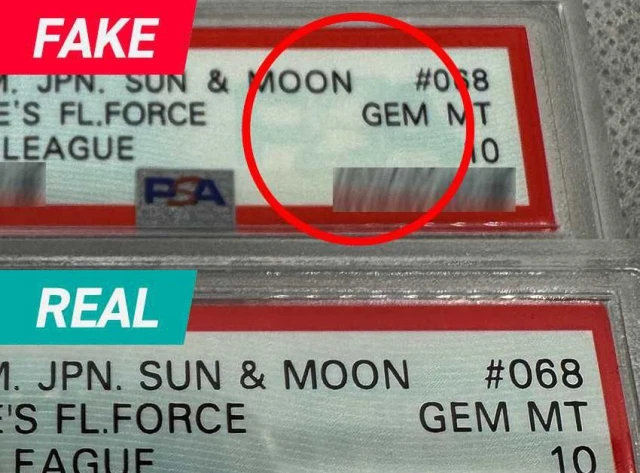
$2 million — the value of the forged PSA label fraud case convicted in January 2026. Always verify cert numbers at psacard.com/cert before purchasing graded cards.
Are Japanese Pokemon Cards Less Likely to Be Fake?
Yes — but not immune. Japanese Pokemon cards carry a lower counterfeit risk compared to English-language cards for three reasons:
- Print complexity: Japanese text (kanji, katakana, hiragana) is significantly harder to replicate accurately than English text. Minor font errors are immediately visible to readers familiar with the language.
- Domestic distribution control: The Japanese market has tighter distribution through Pokemon Centers, convenience stores, and authorized retailers. This limits the volume of counterfeits entering the primary market.
- Premium production quality: The embossing, foil patterns, and cardstock used in Japanese printing are technically difficult and expensive to reproduce.
Our own numbers support this. Samurai Sword INC processes over ¥1 billion ($7 million) in Japanese Pokemon card inventory per month. Across that volume, we encounter counterfeit or resealed products only once or twice — a detection rate below 0.01%. The fakes that do surface almost always originate from secondary-market sourcing channels, not from authorized domestic distribution.
The risk increases in secondary markets — particularly international resale platforms, auction sites, and social media sellers. Buying from established businesses that specialize in Japanese Pokemon cards significantly reduces this risk.
Where to Buy Japanese Pokemon Cards Safely
Your choice of seller is the strongest defense against fake Japanese Pokemon cards — stronger than any individual test.
What to Look for in a Trusted Seller
- Specialization: Shops focused exclusively on Japanese Pokemon cards have stronger quality control than general marketplaces
- Inspection process: Ask whether the seller inspects boxes before shipping. Vague answers are a red flag
- Return policy: Legitimate sellers offer returns for authenticity issues without hesitation
- Track record: Check reviews on third-party platforms like Trustpilot — not just the seller’s own website
- Sealed product sourcing: Sellers who can explain where their inventory comes from are more trustworthy than those who cannot
Our Approach at Samurai Sword INC
We ship shrink-wrapped booster boxes from Tokyo to collectors worldwide. With over ¥1 billion in monthly inventory, our inspection process is built for scale:
- Serial tracking: Each box is assigned a unique serial number linked to its supplier. If a resealed or searched box is ever reported, we trace it to the source and permanently remove that supplier from our network. This one-strike policy is why our counterfeit detection rate sits below 0.01%.
- Shrink wrap verification: We check for factory-standard shrink wrap characteristics — air holes, logo placement, seam alignment — on every box before it enters our catalog.
- Tracked shipping: All orders ship with full tracking from Tokyo, so you know exactly where your box is at every stage.
For deeper coverage on buying Japanese Pokemon cards, check our how to buy Japanese Pokemon cards from Japan guide, our best Japanese booster boxes in 2026 ranking, the Japanese vs English Pokemon cards comparison, our best Japanese Pokemon card shops directory, and our Pokemon TCG Pocket to real Japanese cards transition guide.
All orders ship from Japan with tracking and insurance. View shipping policy → | Customs & duties info →
Questions? Contact us → | Return policy →
What to Do If You Receive a Fake
Act immediately — the faster you respond, the stronger your case for a refund.
- Document everything: Photograph the card (front, back, edges) and packaging under good lighting. Include close-ups of any suspicious details.
- Contact the seller: Legitimate sellers will offer a refund or replacement. If the seller becomes evasive or unresponsive, escalate.
- File a dispute: On platforms like eBay, Mercari, or PayPal, open a buyer protection case with your photo evidence.
- Report the listing: Flag the seller’s listing on the platform to protect other buyers.
- Share with the community: Forums like r/PokemonTCG and collector Discord servers help others avoid the same seller.
Do not destroy the card or discard packaging until the dispute is fully resolved — you may need to return the item or provide additional evidence.
Frequently Asked Questions
How can you tell if Japanese Pokemon cards are fake?
Check the card back first — genuine cards have a deep blue gradient in the Poke Ball area, while fakes use a lighter, flatter shade. Then examine text sharpness (Japanese characters should be crisp with no bleeding), card texture (slight gloss, firm paper), and holographic patterns (smooth color shift vs. static shimmer). These four checks catch the majority of fake Japanese Pokemon cards without any tools.
Are Japanese Pokemon cards less likely to be counterfeit?
Yes. Japanese cards carry lower counterfeit risk because the complex Japanese text is harder to replicate, domestic distribution is tightly controlled, and the print quality (embossing, foil, cardstock) is expensive to reproduce. However, risk increases on secondary markets and international resale platforms.
What does the back of a real Japanese Pokemon card look like?
Identical to English cards in design — a Poke Ball on a blue swirl background — but printed with sharper resolution. The key detail: the top-right of the Poke Ball features multiple blue shades blending together. On fakes, this area is a single flat color. The border is even on all four sides and the blue is deep, not washed-out.
How do you do the light test on Pokemon cards?
Hold the card up to a strong light source like a phone flashlight. Genuine cards have a dark opaque core layer that blocks most light — you will see very little transmission with a faint bluish tint. Fake cards let significantly more light through and appear translucent. This test works best on non-holographic cards; foil layers on holo cards affect the result.
Can fake Pokemon cards pass PSA grading?
Rarely with the actual card, but counterfeit PSA slabs (cases with forged labels) are a real problem. Always verify the certification number at psacard.com/cert before purchasing any graded card. A 2026 fraud case involving forged PSA labels resulted in a $2 million conviction, underscoring the importance of verification.
How can I tell if a Japanese booster box has been resealed?
Check for factory shrink wrap characteristics: tight fit, glossy surface, small irregular air holes, and a printed Pokemon Company logo on the plastic. Resealed boxes typically lack air holes, have loose or wrinkled plastic, and may show creasing along the box’s perforated opening tab. Also verify the JAN barcode matches the set printed on the box.
Where is the safest place to buy Japanese Pokemon cards online?
Specialized Japanese Pokemon card retailers with transparent inspection processes are your safest option. Look for sellers who explain their sourcing, offer authenticity guarantees, and have third-party reviews. Avoid individual sellers on marketplace platforms unless they have extensive positive feedback specifically for Japanese sealed products.
Bottom Line
Three things to remember about fake Japanese Pokemon cards:
- The card back is your best friend. A quick check of the blue shade, Poke Ball gradient, and border consistency catches most fakes in seconds.
- Sealed boxes need physical inspection. Shrink wrap air holes, box perforations, and JAN codes are your primary defenses against resealed products.
- Your seller matters more than any test. Buying from specialized, transparent sellers with inspection processes eliminates most risk before it reaches you.
Japanese Pokemon cards remain among the safest in the hobby thanks to their print complexity and quality standards. Armed with the methods in this guide, you can buy with confidence.
⚡ Shop Japanese Pokemon Booster Boxes
Authentic sealed products shipped directly from Tokyo, Japan with tracking & insurance via FedEx.