OP-15日版与英文版:该买哪个版本
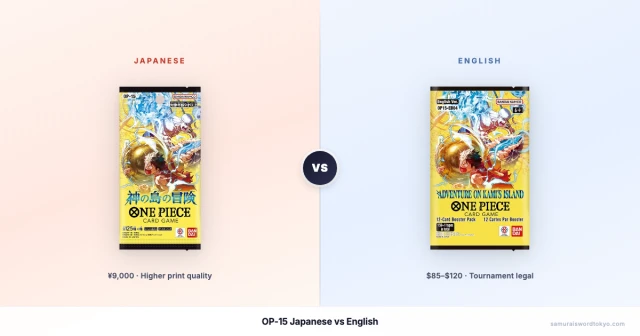
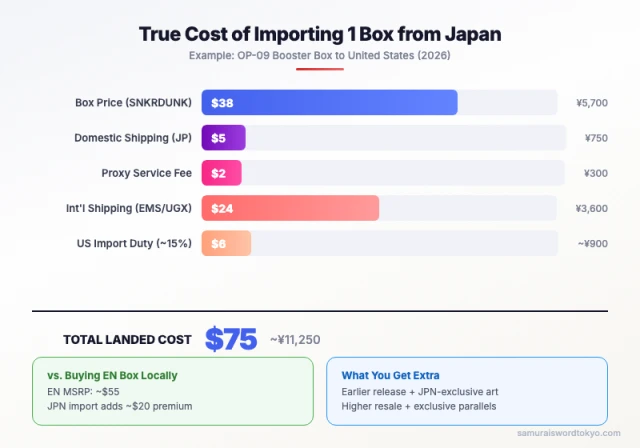
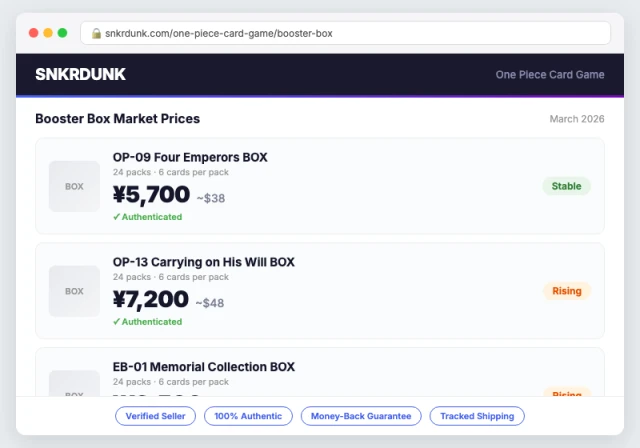
The Japanese OP-15 box is trading at ¥9,000 (~$58). The English box pre-orders are running $85–$120. Same cards, same pull rates — but the JPN version costs roughly 40–50% less, shipped from Japan.
So why would anyone wait for English?
Because tournament legality, card language, and resale markets all differ between versions. And with OP-15 “Adventure on KAMI’s Island” possibly being one of the last sets with staggered release dates — Bandai plans to unify global launches sometime in 2026 — the JPN-vs-EN question matters more right now than it ever has.
We ship OP-15 boxes from Tokyo every week. Here’s the data-backed breakdown: box prices, card-level price comparisons, print quality differences, tournament rules, and a clear recommendation based on what you’re actually trying to do with these cards.
| Your Goal | Buy | Why |
|---|---|---|
| Collecting / display | Japanese | 40% cheaper boxes, superior print quality, earlier access |
| Competitive play (US/EU) | English | Tournament-legal in Western regions |
| Both collecting and playing | JPN now + EN singles later | JPN for collection, EN singles for your deck |
| Grading investment | Japanese | Thicker cardstock, higher PSA 10 rates |
OP-15 at a Glance — JPN vs EN Specs
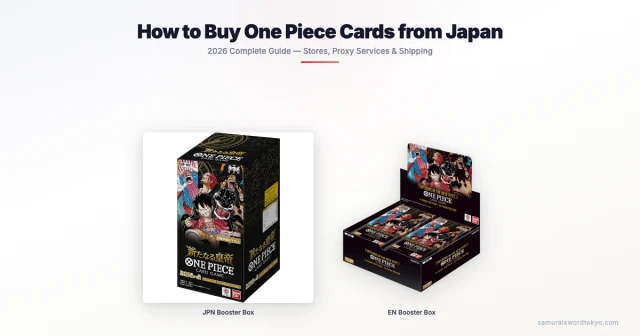
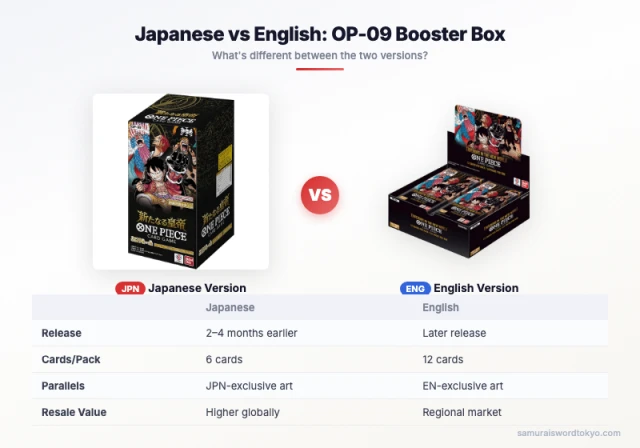
Two versions of the same set, but the packaging and timing differ significantly.
Release Timeline & Pack Structure
| Spec | Japanese | English |
|---|---|---|
| Release Date | February 28, 2026 | April 3, 2026 |
| Pre-Release | — | March 27, 2026 |
| MSRP (BOX) | ¥5,280 (~$34) | ~$119.99 |
| Market Price (BOX) | ¥9,000 (~$58) | $85–$120 (pre-order) |
| Packs per BOX | 24 | 24 |
| Cards per Pack | 6 | 12 (includes EB-04) |
| Total Card Types | 125 + 1 DON!! | 159+ (OP-15 + EB-04) |
| Card Language | Japanese | English |
Prices as of March 2026. JPN market price from SNKRDUNK. EN pre-order prices from major US retailers. USD at ~¥155.
A key structural difference: the English release merges OP-15 with EB-04 (Extra Booster) content, resulting in more card types per box. The Japanese version keeps them separate.
What’s in the Set — Skypiea’s Biggest Moments
OP-15 covers the Skypiea arc — Enel, the golden bell, and the first time the Straw Hats faced something godlike. Six new Leaders including Purple Enel (already dominating Japanese tournaments) and the first-ever Brook Leader card.
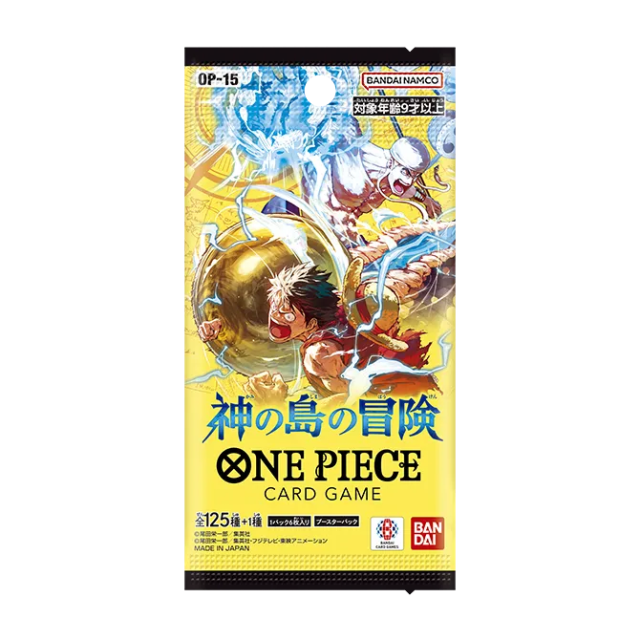
The chase cards are headlined by the Enel Comic Parallel at ¥138,000–160,000 (~$890–$1,030) and a Devil Fruit Pattern SP series featuring six characters with their actual Devil Fruit texture across the card face.
For the complete card rankings and pull rate data, see our OP-15 Pull Rates, Best Cards & Box Value guide.
Price Comparison — How Much Does Each Version Actually Cost?
JPN boxes cost 32–52% less than EN pre-orders. The gap is even wider on singles.
Box Prices: JPN vs EN
| Metric | Japanese | English | Difference |
|---|---|---|---|
| MSRP | ¥5,280 (~$34) | ~$119.99 | — |
| Current Market Price | ¥9,000 (~$58) | $85–$120 | JPN is 32–52% cheaper |
| Price per Pack | ~$2.42 | ~$3.54–$5.00 | JPN is 32–52% cheaper |
| Sealed Case (12 boxes) | ~$696 | ~$1,020–$1,440 | JPN saves $324–$744 |
The JPN box at $58 is one of the better deals in the current OPTCG sealed market. For context, OP-14 JPN boxes traded at ¥7,500–8,500 (~$48–$55) during the same post-launch window.
Single Card Prices — Same Card, Different Price Tag
Based on the JPN market data we track daily and historical JPN-to-EN price ratios from recent sets (OP-13, OP-14), here’s what to expect:
| Card | Rarity | JPN Price (¥) | JPN (~USD) | EN Est. ($) | JPN Savings |
|---|---|---|---|---|---|
| Enel (Comic Parallel) | SEC/SP | ¥138,000–160,000 | $890–$1,030 | $1,500–$3,000+ | 50–70% |
| Boa Hancock (Devil Fruit Pattern) | SP | ¥52,800 | $341 | $500–$800 | 32–57% |
| Monkey D. Luffy (Devil Fruit Pattern) | SP | ¥37,800 | $244 | $400–$700 | 38–65% |
| Gum Gum Golden Rifle (Alt Art) | R/P | ¥32,800 | $212 | $300–$500 | 29–58% |
| Roronoa Zoro (Alt Art) | SR/P | ¥11,800 | $76 | $100–$200 | 24–62% |
JPN prices: SNKRDUNK / Fuji Card Shop, February–March 2026. EN estimates based on OP-13/OP-14 JPN-to-EN ratios where EN cards typically command 1.5–3x the JPN price for high-rarity cards.
Why the gap? Two factors. First, Japan prints more volume — the domestic supply chain is shorter and more abundant. Second, English-speaking markets concentrate demand on a single language version, pushing EN prices higher. The OP-13 Manga Rare Ace went from ~$1,200 JPN to $4,000+ EN. That 2–3x multiplier is consistent across recent sets.
If you want OP-15 chase cards for your collection and don’t need English text, buying JPN singles now saves 30–70% compared to waiting for EN release.
Card Quality & Print Differences
The manufacturing process differs between regions — and the results are measurable.
Cardstock, Texture & Foil
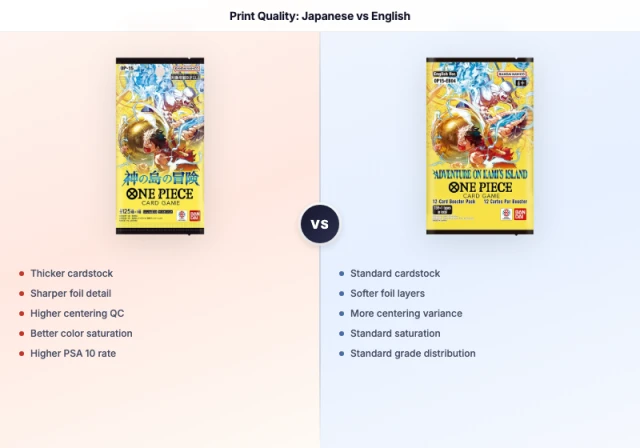
Japanese OPTCG cards use a thicker, more rigid cardstock that resists warping better than the English print run. The difference is noticeable when you handle both versions side by side:
- Cardstock thickness: JPN cards feel sturdier. English cards tend to curve more easily in humid conditions
- Foil application: JPN foil layers are more precise — the metallic effects on parallels and SPs have sharper definition
- Color saturation: JPN prints show higher contrast, especially on dark illustrations like the Enel Comic Parallel
- Centering consistency: JPN quality control produces more evenly centered cards out of the pack
Grading Potential (PSA 10 Rates)
For collectors who submit to PSA or CGC, the cardstock difference translates directly to grades. Japanese cards arrive in better condition from the factory — fewer edge nicks, less surface wear, tighter centering. While neither Bandai nor PSA publishes official grade distributions by region, the community consensus (and our own submission experience) points to JPN cards achieving PSA 10 at a meaningfully higher rate.
If you’re planning to grade an Enel Comic Parallel or a Hancock SP, the JPN version gives you better odds of hitting Gem Mint 10 — and PSA 10 premiums run 3–5x over PSA 9.
Tournament Legality — Can You Play JPN Cards in the West?
Short answer: not in official Bandai tournaments. The official tournament rules specify language requirements by region.
Regional Rules at a Glance
| Region | Tournament-Legal Version | Notes |
|---|---|---|
| Japan, Hong Kong, Taiwan, Singapore, Indonesia, Thailand | Japanese | JPN is the native version |
| US, Canada, Latin America | English | JPN cards cannot be used |
| Europe, UK | English | JPN cards cannot be used |
| Australia, New Zealand | English | JPN cards cannot be used |
No exceptions at official Bandai events. If competitive play is your primary reason for buying cards, you need the English version for Western tournaments.
The “Practice Deck” Strategy
Here’s what competitive players actually do: buy JPN cards for testing, then pick up EN versions for tournament play.
OP-15 launched in Japan on February 28. The English release isn’t until April 3. That’s a five-week window where JPN cards are the only way to physically test the new meta. Purple Enel is already the most-winning Leader in Japanese tournaments — players who build and practice with JPN cards now will have a serious edge when EN drops.
A playable Purple Enel build using JPN singles runs roughly $30–$60 for the core cards. That’s a small investment for five weeks of meta knowledge. Check Limitless for OP-15 decklists.
Who Should Buy Japanese? Who Should Buy English?
The answer depends entirely on what you’re doing with these cards.
Buy Japanese If…
You’re a collector focused on art and quality. JPN cards look better, feel better, and cost less. The Devil Fruit Pattern SPs in particular are showcase cards — the texture work on Hancock’s Mero Mero no Mi and Luffy’s Gomu Gomu no Mi is more vivid on the JPN print. You’re paying less for a higher-quality product.
You want the best value per dollar. At $58 per box versus $85–$120, JPN boxes give you more product for less money. If you’re opening multiple boxes, the savings compound fast — a sealed case (12 boxes) saves $324–$744 compared to EN.
You’re a grading investor. The cardstock advantage directly affects PSA 10 rates. JPN versions of chase cards also carry a “first printing” premium for some collectors, and the earlier release date means you lock in prices before EN hype pushes demand higher.
Buy English If…
You play in Western tournaments. Non-negotiable. You need EN cards for official Bandai events in the US, Canada, Europe, and Oceania. No amount of savings justifies owning cards you can’t play.
You prefer reading the card text. OPTCG card effects can be complex — if you’re learning the game or don’t want to reference translations mid-match, English text removes that friction.
Your local community plays EN. Casual play groups and local game stores in the West typically use English cards. Matching your community makes trading and borrowing easier.
Buy Both If…
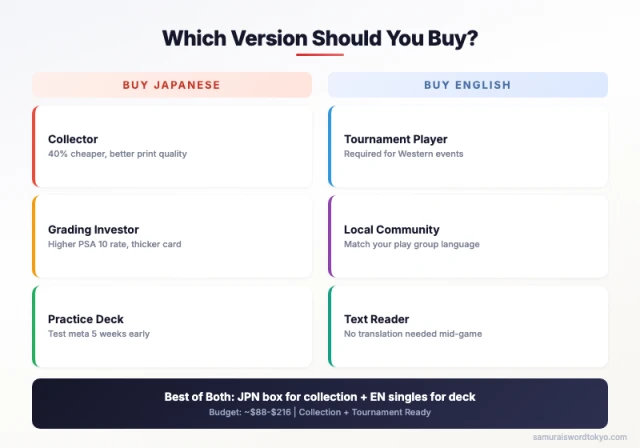
You want the best of both worlds. The optimal strategy for a collector-player hybrid: buy a JPN box or JPN singles for your display collection and grading submissions, then pick up EN singles for the specific cards you need in your competitive deck.
| Persona | Version | Budget Estimate | What You Get |
|---|---|---|---|
| Collector | JPN box x 1-2 | $58–$116 | Superior quality, earlier access, better value |
| Competitive Player | EN singles | $30–$100 | Tournament-legal deck cards only |
| Collector + Player | JPN box + EN singles | $88–$216 | Collection + competitive deck |
| Grading Investor | JPN singles (chase cards) | $200–$1,000+ | Higher PSA 10 odds, lower entry cost |
The 2026 Factor — Will Simultaneous Releases Change Everything?
Bandai announced that all ONE PIECE CARD GAME products will release simultaneously worldwide starting at some point in 2026. The exact starting set hasn’t been confirmed.
What “Simultaneous Release” Actually Means
No more five-week gaps between JPN and EN launches. When the switch happens, both versions will hit shelves on the same day globally. The EN card pool will catch up to JPN in real time.
OP-15 may be one of the last sets — possibly the last — with a staggered release. OP-16 (Paramount War, June 12) is also expected to have a gap, but the simultaneous launch could begin as early as OP-17 in late 2026.
Why JPN Cards Keep Their Edge
Even after simultaneous releases begin, the core advantages of JPN cards remain:
- Print quality: Manufacturing happens at different facilities. JPN cardstock and foil quality won’t change because the release date aligns
- Price advantage: JPN’s larger domestic supply and shorter distribution chain keep prices lower. This is structural, not timing-related
- JPN-exclusive products: Anniversary sets, promo cards, and certain parallel variants remain Japan-only regardless of release synchronization
- Grading edge: Cardstock quality is a manufacturing difference, not a timing one
The simultaneous release eliminates the “early access” advantage. Everything else stays the same. If you’ve been buying JPN cards for quality and price, nothing changes.
One more factor: April 2026 introduces Standard Rotation, removing Block 1 cards (OP-01 through OP-04) from competitive play. OP-15 sits in Block 4, meaning it has a long competitive lifespan ahead.
Our Verdict
Three facts drive the decision:
- JPN boxes cost 32–52% less and contain the same cards at higher print quality
- EN cards are required for competitive play in the US, Europe, Canada, and Oceania
- OP-15 may be one of the last staggered releases — the early-access window is closing
If collecting is your priority, buy Japanese. The quality is better, the price is lower, and the chase cards (especially the Enel Comic Parallel and Devil Fruit Pattern SPs) look their best on JPN cardstock.
If competing is your priority, buy English — but consider grabbing JPN singles now to practice the OP-15 meta before the April 3 EN launch.
If you want both, the hybrid approach works: JPN box for your collection, EN singles for your tournament deck. Total cost: roughly $88–$216 depending on how deep you go.
OP-15 brings the Skypiea arc to OPTCG for the first time. Purple Enel is already rewriting the competitive format in Japan. The Devil Fruit Pattern SPs are some of the most visually distinctive cards the game has produced. Whichever version you choose, this is a set worth owning.
Frequently Asked Questions
Are Japanese One Piece cards worth more than English?
Generally, no — Japanese cards are cheaper for the same card due to higher domestic supply. English versions often trade at 1.5–3x the JPN price because Western demand concentrates on a single language version. However, for graded cards (PSA 10), Japanese versions can command premiums due to superior cardstock quality.
Can I use Japanese OP-15 cards in English tournaments?
No. Official Bandai tournaments in North America, Europe, and Oceania require English-language cards. Japanese cards are legal only in Japan, Hong Kong, Taiwan, Singapore, Indonesia, and Thailand. Casual play groups may allow mixed languages — check with your local community.
Is the card quality different between Japanese and English OP-15?
Yes. Japanese cards use thicker cardstock with tighter quality control on centering and foil application. The difference is especially visible on parallel and SP cards where foil layers are more precisely applied on JPN prints. This quality gap has been consistent across all OPTCG sets.
Should I buy OP-15 Japanese now or wait for the English release?
It depends on your goal. Collectors save 30–70% buying JPN now. Competitive players need EN cards but can buy JPN for practice during the five-week gap. Grading investors benefit from JPN’s higher PSA 10 potential. There’s no wrong answer — just different strategies for different goals.
Will OP-15 be the last set with separate JPN and EN release dates?
Possibly. Bandai announced simultaneous worldwide releases starting in 2026, but hasn’t confirmed which set begins the change. OP-16 (June 2026) is expected to still have a gap. The switch may happen with OP-17 or later.
How much cheaper is a Japanese OP-15 box compared to English?
As of March 2026, JPN boxes trade at ¥9,000 (~$58) while EN pre-orders run $85–$120. That’s a 32–52% savings on the JPN side. For a sealed case of 12 boxes, you’d save approximately $324–$744 by going Japanese.
Does OP-15 have different pull rates in Japanese vs English?
Bandai doesn’t publish official pull rates for either version. Community opening data suggests comparable rates for both, though the English version merges OP-15 and EB-04 card pools, which affects the distribution of specific cards within each pack. For detailed JPN pull rate estimates, see our OP-15 Pull Rates guide.
🏴☠️ Ready to Open Packs?
Get the OP-15 Island of God booster box — shipped directly from Tokyo, Japan with tracking & insurance.
Buy OP-15 Island of God Box
Browse All One Piece Booster Boxes →