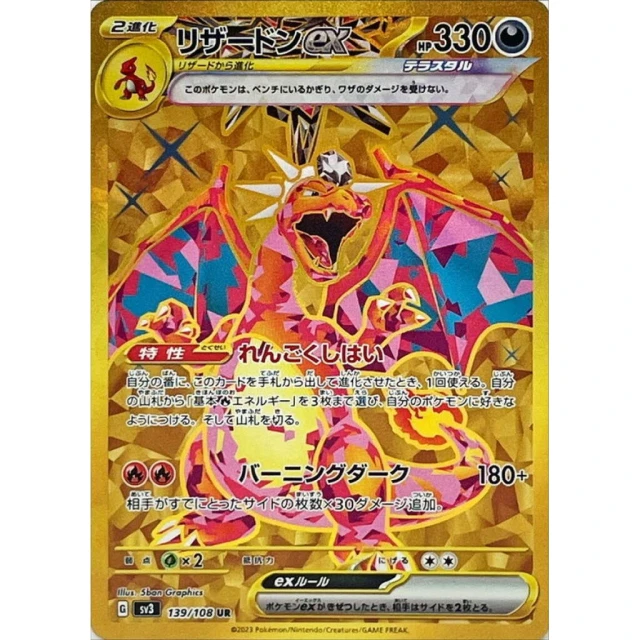
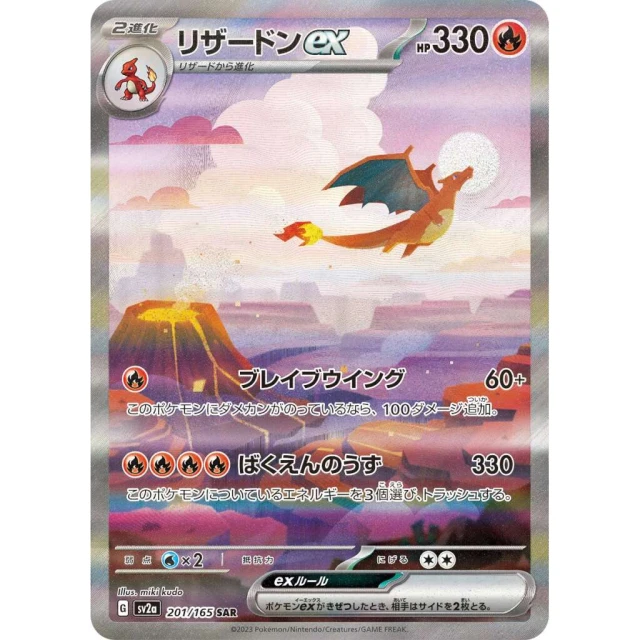
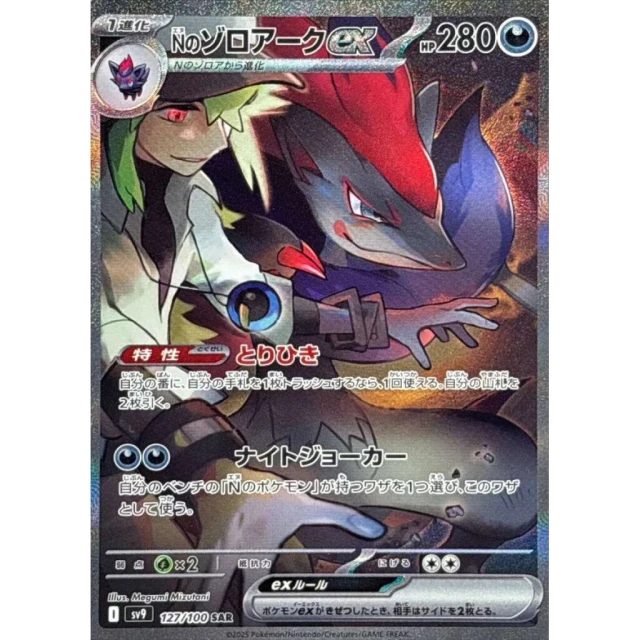
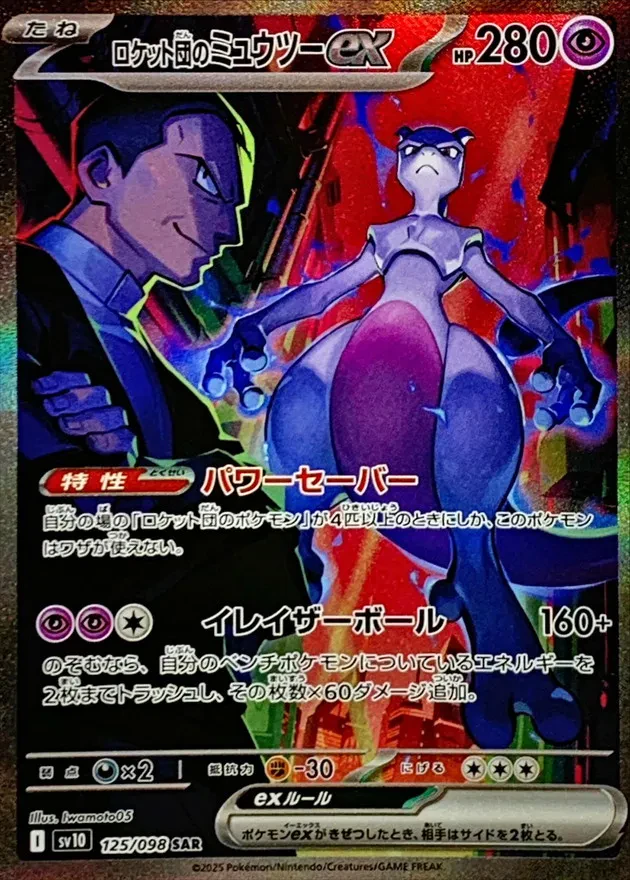
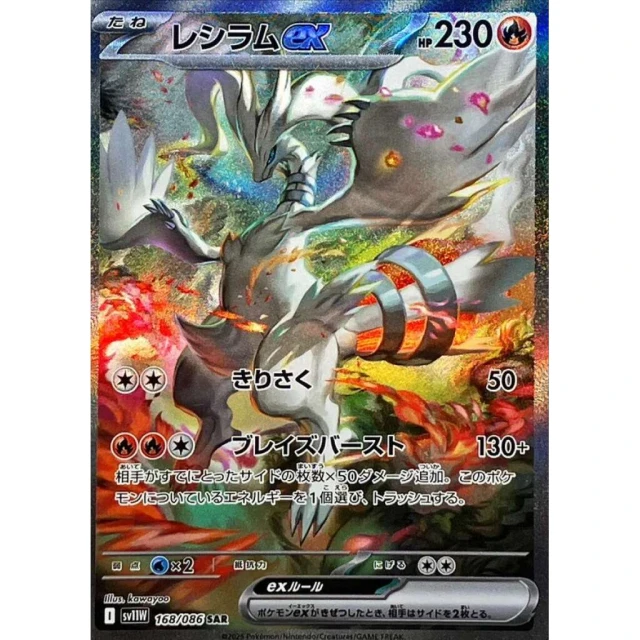
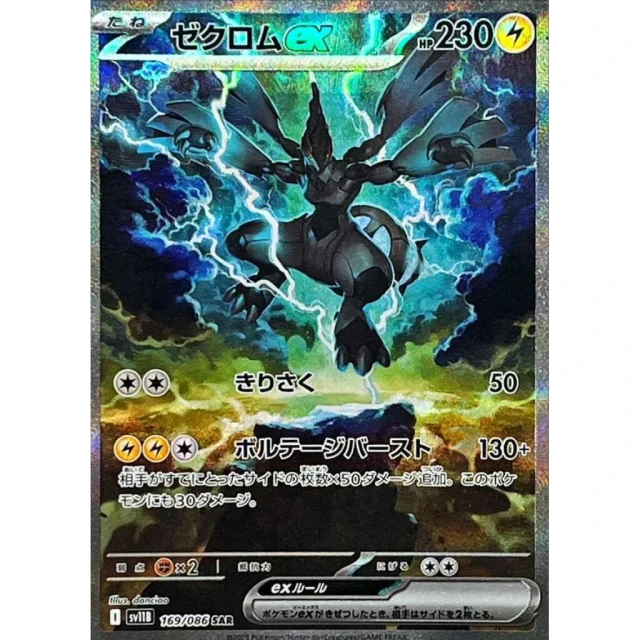
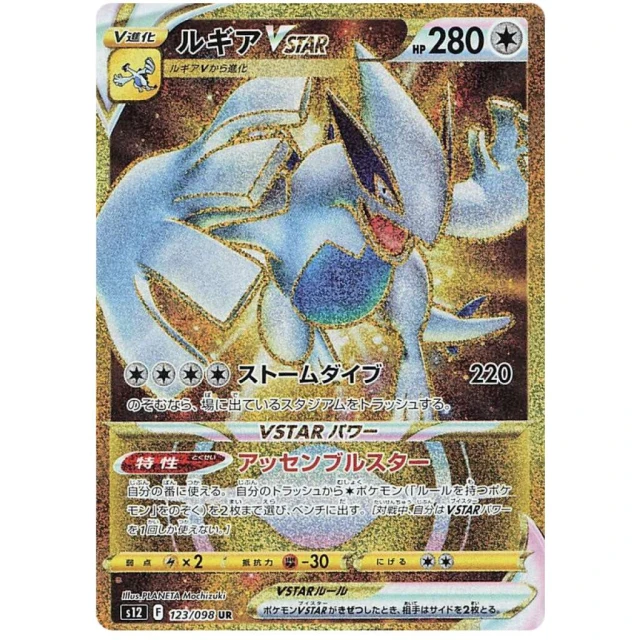
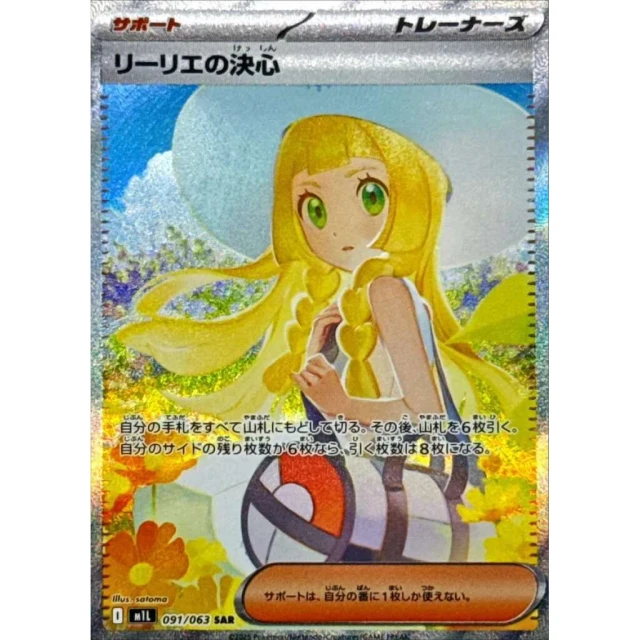
Alt Arts are the most collectible cards in modern Japanese Pokemon. If you’ve watched a YouTube box break in the last two years, the moment the reviewer pauses, turns the card sideways, and quietly says “oh” — that’s almost always an SAR. Special Art Rare cards sit at the top of what the Japanese print runs actually ship, and they’re the reason JPN singles pricing has stayed elevated across the entire Scarlet & Violet era.
This guide indexes the best Japanese Pokemon SAR cards by set, from SV3’s Charizard ex to SV11B’s Zekrom ex, with current 2026 USD price ranges, realistic pull rates, and the artist credits that move the market. If you’re new to JPN rarities altogether, the Japanese Pokemon card rarities explained guide covers the full rarity system — this page assumes you’re already past that and ready to chase SAR specifically.
Our team ships Japanese Pokemon singles out of Tokyo daily. The prices below reflect SNKRDUNK and Mercari data from early 2026, converted at approximately ¥141/USD.
Key Takeaway
SAR (Special Art Rare) is the apex alt-art tier in modern Japanese Pokemon — borderless unique artwork, ~1 per 20-30 packs (2-4 per box), with flagship chases from Charizard ex (SV3) to Nanjamo (SV2a) trading between $50 and $800+ in 2026.
$50–$800+
SAR Price Range (USD)
2–4
SARs per 30-pack Box
$800+
Top SAR (Nanjamo SV2a)
SV Era
Every Mainline Set Ships SAR
What Is SAR (Special Art Rare)?
Charizard ex SAR — SV2a Pokemon Card 151 (SAR)
SAR stands for Special Art Rare. The core difference between SAR and the older SR tier is that SAR cards use a unique alternate illustration that doesn’t appear anywhere else in the set — not as a regular, not as an RR, not as an SR. SAR artwork is typically borderless (the illustration bleeds to all four edges of the card) and pairs a gold foil rarity stamp with a full textured foil treatment across the illustration.
SR cards by contrast are full-art versions of the same artwork already used on the card’s RR or trainer counterpart. The SR is a “bigger, shinier” version of art you’ve already seen in the set. SAR is brand-new art, often cinematic, usually featuring the Pokemon in habitat or with a signature trainer at their side.
Functionally, an SAR is playable exactly like the regular ex or VSTAR it duplicates. Collectors don’t buy them to play with — the pricing is pure artwork-driven demand. Tournament players who care about visuals will sleeve an SAR over the equivalent RR, but the gameplay text is identical line-for-line.
SAR Pull Rates in Context
SAR cards pull approximately 1 per 20-30 booster packs, which works out to roughly 2-4 SARs per 30-pack Japanese booster box on average. These numbers are community-tracked estimates from opening data; The Pokemon Company does not publish official pull rates for Japanese sets.
Set structure matters. High-class packs and special-pack formats like SV2a Pokemon Card 151 run higher SAR density (3-5 per box is common), while standard boosters like SV11B Black Bolt typically land closer to 2-3. You can lose a box entirely to zero SARs, and you can also hit 5 or 6 in an unusually hot box — the variance is wide. Across hundreds of boxes our team has processed, the median box lands right at 3 SARs.
The practical implication: opening for a specific SAR almost never works out cheaper than buying the single. If you want the Charizard ex SAR from SV3, buy the Charizard ex SAR from SV3. Cracking boxes is for the experience and the possibility; it’s not a route to a named card.
Disclaimer
Pull rates are estimated from Japanese community opening data (SNKRDUNK, Mercari, YouTube compilations). The Pokemon Company does not publish official pull rates. Actual results vary significantly box to box.
Who Illustrates SAR Cards?
SAR artwork is the most artist-forward part of modern Pokemon printing. Four credits show up most often, and seeing any of them on the bottom-right corner of a card is a reliable value signal.
Sowsow — the most-cited Japanese Pokemon illustrator working today. Their style is soft, emotional, and habitat-focused — Pokemon curled up in natural environments, trainers in quiet moments with their partners. Sowsow SARs typically command a 20-40% premium over other SARs in the same set.
5ban Graphics — handles much of the gold-foil production and digital-art SARs across the Scarlet & Violet era. Their work is recognizable for clean compositions and strong metallic foil contrast, and they are responsible for many of the Pokemon-only (non-character) SARs.
2020 Artist Collective — the pseudonym grouping that appeared across the S4a Shiny Star V era. This collective illustrated many of the original CHR and early alt-art style cards from 2020-2021. Their work predates the modern SAR tier formally but is collected in the same lane by character-art buyers.
Mitsuhiro Arita (modern) — the original Base Set Charizard illustrator, and his modern Pokemon work — including occasional SAR contributions — carries significant premium for nostalgia alone. When Arita signs a modern SAR, expect heavy collector demand at release.
Checking the illustrator credit before paying is a quick way to sanity-check pricing. A Sowsow trainer SAR from a current set will almost always hold value better than a same-set SAR from a less-followed illustrator.
Best SAR Cards by Set — Scarlet & Violet Era
The SV era is where SAR became the default top-tier chase, and every mainline set from SV1 onward has shipped with 4-8 SARs. Below are five of the most-collected SAR cards from SV era sets as of early 2026.
Charizard ex SAR — SV3 Ruler of the Black Flame · SAR · Market ~$450-$700 USD (~¥63,000-¥98,000)
The defining SAR of the early Scarlet & Violet era. Cinematic composition of Charizard mid-flame against a dark sky, borderless, heavy foil. Print runs have been in demand continuously since SV3’s June 2023 release, and this card alone drives a significant share of SV3 box pricing. Browse the SV3 Ruler of the Black Flame card list for the full chase lineup.
N’s Zoroark ex SAR — SV9 Battle Partners · SAR · Market ~$250-$450 USD (~¥35,000-¥63,000)
Battle Partners was built around signature-trainer decks, and N’s Zoroark ex SAR is the set’s most-demanded chase. The composition places N and Zoroark together in a shadowy forest scene, a direct callback to N’s original Black & White arc. Lillie’s Clefairy ex SAR and Iono’s Bellibolt ex SAR from the same set also command premium prices. See the full SV9 Battle Partners card list.
Team Rocket’s Mewtwo ex SAR — SV10 Glory of Team Rocket · SAR · Market ~$250-$450 USD (~¥35,000-¥63,000)
SV10’s Team Rocket theme gave Mewtwo a villainous reinterpretation — the SAR renders Mewtwo with the organization’s signature red-R branding and dark psychic energy. Heat-of-release pricing for this card landed above $500 and has settled into the $250-$450 range through early 2026. Check the SV10 Glory of Team Rocket card list.
Reshiram ex SAR — SV11W White Flare · SAR · Market ~$200-$400 USD (~¥28,000-¥56,000)
SV11W’s dragon-focused set paired legacy Unova legendaries with premium foiling. Reshiram ex SAR features a flame-spread background with the Vast White Pokemon in mid-roar. Full SV11W White Flare card list is available.
Zekrom ex SAR — SV11B Black Bolt · SAR · Market ~$200-$400 USD (~¥28,000-¥56,000)
The twin to Reshiram, Zekrom ex SAR carries the electric counterpart with an equally dramatic composition. Black Bolt and White Flare dropped simultaneously as paired sets, making the two SARs a natural collector pair — buying one without the other feels incomplete to most SV11 completionists. Full SV11B Black Bolt card list.
Beyond these five, SV2a Pokemon Card 151 is worth calling out separately. The 151 set ran a high-density SAR lineup featuring Nanjamo SAR (which has traded north of $800 for most of 2024-2026) and a reprinted Charizard ex SAR variant, both of which remain among the most-searched Japanese Pokemon SARs of the entire era. Browse the SV2a 151 card list for the full 151 SAR set.
Best SAR Cards by Set — Sword & Shield Era
SAR as a named rarity debuted partway through the Sword & Shield era, which means the S era has fewer SARs overall but some of the most iconic individual cards in the modern hobby.
Lugia VSTAR SAR — S12 Paradigm Trigger · SAR · Market ~$350-$600 USD (~¥49,000-¥85,000)
The Paradigm Trigger set closed out the Sword & Shield mainline on a Lugia-focused chase. Lugia VSTAR SAR features the Guardian of the Seas in cinematic flight over stormy water, full borderless, with textured foil that catches light dramatically. Still one of the most-traded JPN SARs in the hobby, even three-plus years after release. See the S12 Paradigm Trigger card list.
Alolan Vulpix VSTAR SAR — S11a Incandescent Arcana · SAR · Market ~$150-$300 USD. S11a Incandescent Arcana ran a character-focused format, and the Alolan Vulpix VSTAR SAR is the set’s most-collected card — soft pastel snow scene, illustrator-forward composition. More approachable pricing than the S12 chases, which makes it a popular entry-level SAR for new JPN collectors. Full S11a Incandescent Arcana card list.
Older Sword & Shield cards from the S6K Jet-Black Geist era use the “SA” designation (Shadow Rider Calyrex VMAX Alt Art, “Chubby” Blissey V Alt Art) rather than the later “SAR” letter code, but they’re functionally identical in the alt-art collecting lane. If you’re browsing older S-era inventory, treat SA cards as pre-SAR SARs for pricing and collecting purposes.
What About Mega Era SAR?
Lillie’s Determination SAR — M1L Mega Brave (SAR)
The Mega Evolution era still ships SAR cards — but the apex chase tier shifts to MUR (Mega Ultra Rare). Starting with M1L Mega Brave in late 2025, The Pokemon Company introduced MUR as the new top-tier rarity reserved exclusively for Mega-evolved Pokemon (Mega Charizard X ex MUR is the headline card), while trainer-focused SARs like Lillie’s Determination SAR 091/063 and Lt. Surge’s Deal SAR 090/063 still print in the M1L checklist.
MUR uses a different visual treatment — textured holographic foil across the full card with explicit Mega branding — and pulls significantly rarer than SAR (closer to 1 per booster box for the headline Mega chase). Mega sets continue to include AR (Art Rare) and regular RR ex cards as well, but collectors chasing the Mega-era equivalent of the SV-era Charizard ex SAR should orient toward MUR. For the full breakdown of MUR pricing and current inventory, the Japanese Pokemon card rarities explained guide covers the MUR tier in depth.
How to Spot a SAR on a Card
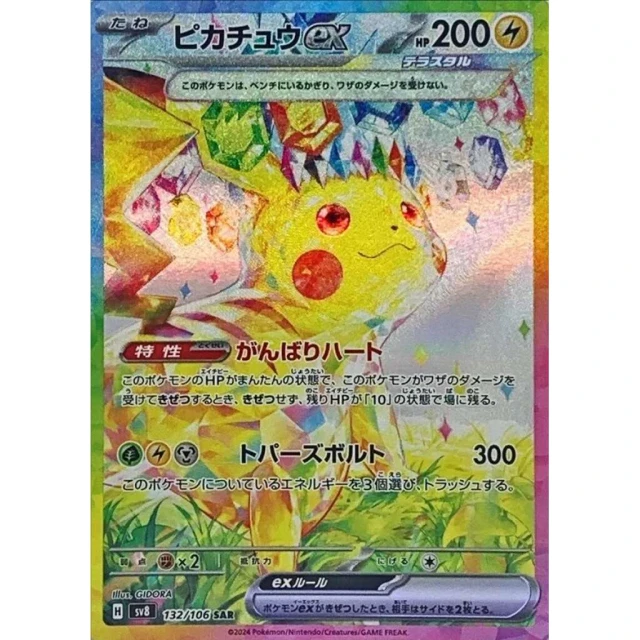
Pikachu ex SAR — SV8 Super Electric Breaker (SAR closeup demo)
Four visual checks, any one of which is usually sufficient to identify a SAR:
Card number past the base set total. Japanese sets use a format like “169/086” where the denominator is the base set card count. If the numerator exceeds the denominator, the card is a secret rare of some kind — SR, SAR, UR, or MUR. SAR specifically tends to sit in the upper-middle range of the secret-rare numbering (often the top third of the extended checklist past the base set).
Borderless illustration. SAR artwork bleeds to all four edges of the card. Regular RR and AR cards retain a yellow or colored card border. If the illustration goes fully edge-to-edge with no border whatsoever, it’s either SAR, UR, or MUR.
Gold “SAR” rarity code in the corner. Modern SV-era SARs print “SAR” in gold letters in the bottom-left corner next to the card number. Tilt the card under light — the letters are small but legible.
Full textured foil treatment. Run a fingernail across the illustration. SAR cards have pronounced stamped foil texture across most of the card face, not just the Pokemon. If the texture feels smooth, you’re holding an RR or an AR, not an SAR.
If all four checks pass, the card is SAR. If only some pass, cross-reference the card number against the set’s official checklist — linked throughout this article for every set mentioned.
SAR vs AR vs SR — Quick Comparison
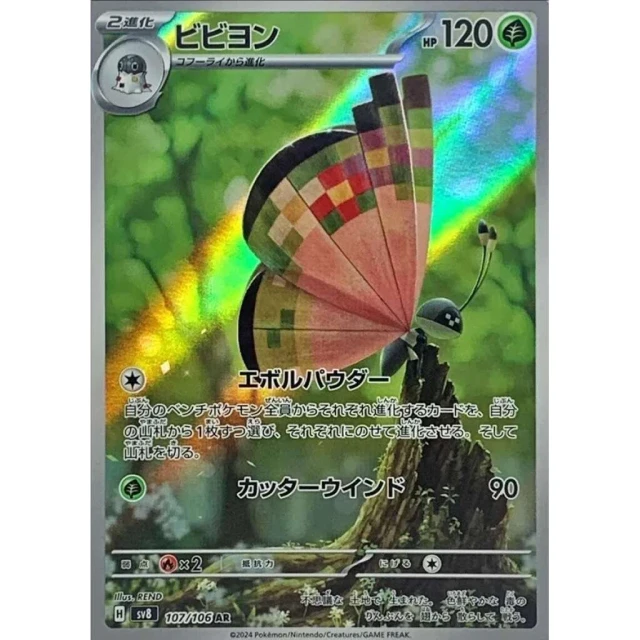
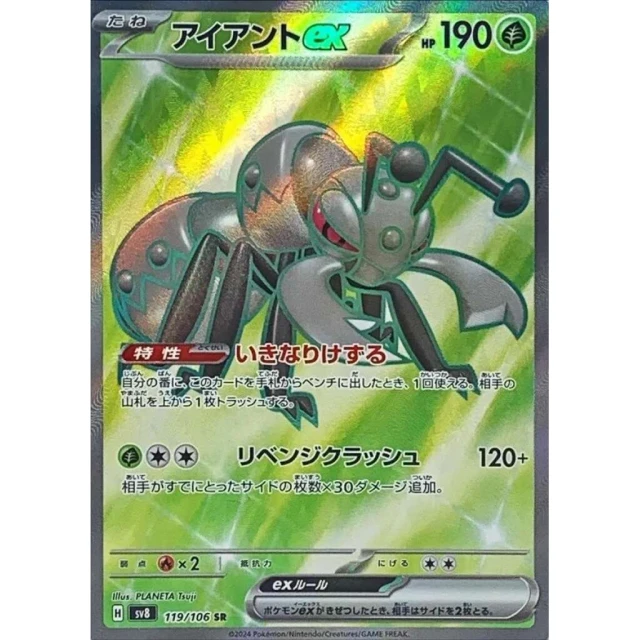
AR — Vivillon, SV8 (Art Rare)SR — Durant ex, SV8 (Super Rare)SAR — Pikachu ex, SV8 (Special Art Rare)
Rarity
Artwork
Border
Est. Pull Rate
Price (USD)
AR (Art Rare)
Illustrated background, Pokemon-focused
Colored card border retained
2-3 per 30-pack box
$2-$20
SR (Super Rare)
Full-art version of existing RR / trainer art
Silver holo border
1-2 per 30-pack box
$10-$100+
SAR (Special Art Rare)
Unique alternate illustration, borderless
No border, gold foil rarity stamp
1 per 20-30 packs (2-4 per box)
$50-$800+
The clean mental model: AR is an entry illustrated card at the artwork tier, SR is a premium version of art that already exists elsewhere, and SAR is brand-new art with no counterpart, at the top of the price curve. When Western collectors hop from the English TCG to the JPN market, the “Illustration Rare → Special Illustration Rare” progression maps one-to-one onto “AR → SAR” — the concept is identical, only the market prints differ.
SAR Price Range Table (2026 USD)
Card
Set
2026 Market Price (USD)
Charizard ex SAR
SV3 Ruler of the Black Flame
$450-$700
N’s Zoroark ex SAR
SV9 Battle Partners
$250-$450
Team Rocket’s Mewtwo ex SAR
SV10 Glory of Team Rocket
$250-$450
Reshiram ex SAR
SV11W White Flare
$200-$400
Zekrom ex SAR
SV11B Black Bolt
$200-$400
Nanjamo SAR
SV2a Pokemon Card 151
$500-$800+
Lugia VSTAR SAR
S12 Paradigm Trigger
$350-$600
Alolan Vulpix VSTAR SAR
S11a Incandescent Arcana
$150-$300
Prices reflect raw (ungraded) near-mint conditions as of February 2026, based on SNKRDUNK and Mercari secondary-market data converted at ¥141/USD. PSA 10 graded copies typically trade 2-4× these ranges, with the Charizard ex SAR PSA 10 and Nanjamo SAR PSA 10 consistently among the most expensive modern JPN graded cards in the hobby.
Where to Buy Japanese SAR Cards
Japanese SAR cards move through singles channels — most collectors outside Japan don’t crack JPN boxes at box-level volume, so the SAR singles market is what you’ll actually use.
By full checklist — each set-specific card list page (linked throughout this article) maps every SAR in that set against current availability.
General browse — the full inventory covers sealed boxes, singles, and older S-era SARs together.
We authenticate and ship every single direct from Tokyo with tracked shipping. Because SAR supply is finite and moves continuously, checking the card list pages for current availability is the most reliable way to catch specific cards when they come in stock.
SAR stands for Special Art Rare. It is the top alt-art rarity in modern Japanese Pokemon sets from the mid-Sword & Shield era through the current Scarlet & Violet era. SAR cards feature unique borderless illustrations with gold foil treatment and pull at approximately 1 per 20-30 booster packs, or roughly 2-4 per 30-pack Japanese booster box.
How much is a Japanese SAR card worth?
Japanese SAR cards range from approximately $50 for less popular Pokemon to $800+ for flagship chase cards like Charizard ex SAR from SV3 or Nanjamo SAR from SV2a 151. Character-led SARs and cards featuring franchise-favorite Pokemon command the highest prices. PSA 10 graded copies typically trade at 2-4 times the raw price.
What’s the difference between SAR and AR on a Pokemon card?
AR (Art Rare) cards retain a colored card border and use illustrated backgrounds for Pokemon, pulling 2-3 per 30-pack box at $2-$20 typical pricing. SAR (Special Art Rare) cards are fully borderless with unique alternate illustrations, pull at roughly 1 per 20-30 packs, and trade for $50-$800+. AR is the entry illustrated tier; SAR is the apex alt-art tier with unique artwork not found anywhere else in the set.
Are Japanese SAR cards better than English Special Illustration Rare?
Japanese SAR cards and English Special Illustration Rare (SIR) cards are mechanically equivalent — different market prints of the same alt-art concept. Japanese versions typically trade at a 15-40% premium over English equivalents due to higher foil quality, smaller per-card print runs, and sustained collector demand in both domestic and international markets.
Can I pull a SAR from a regular Japanese booster box?
Yes. Every standard 30-pack Japanese booster box from the Scarlet & Violet era (SV1 onward) contains 2-4 SAR cards on average, though the specific SAR you pull is random. Opening a box for a specific named SAR rarely works out cheaper than buying the single; cracking boxes is primarily for the pull experience rather than as a route to a targeted card.
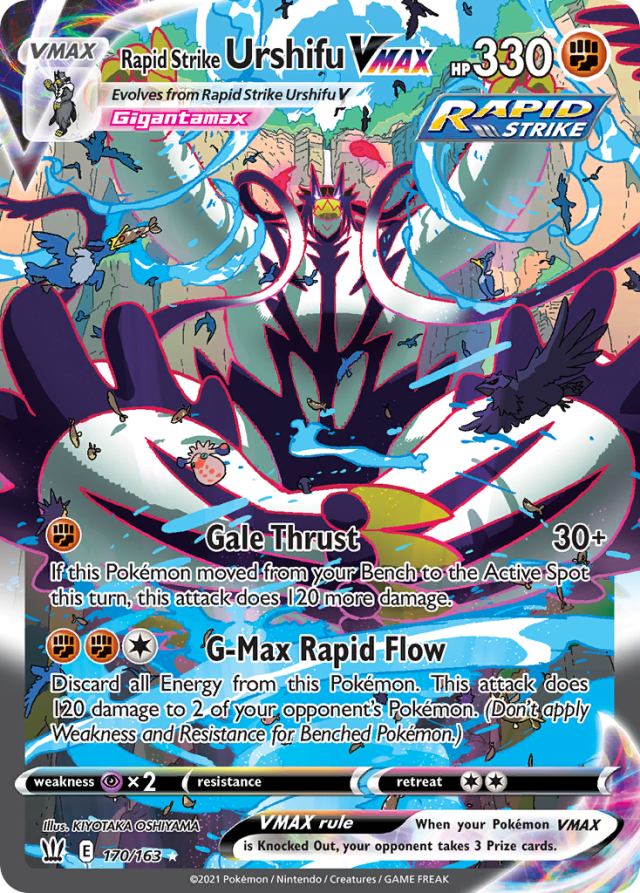
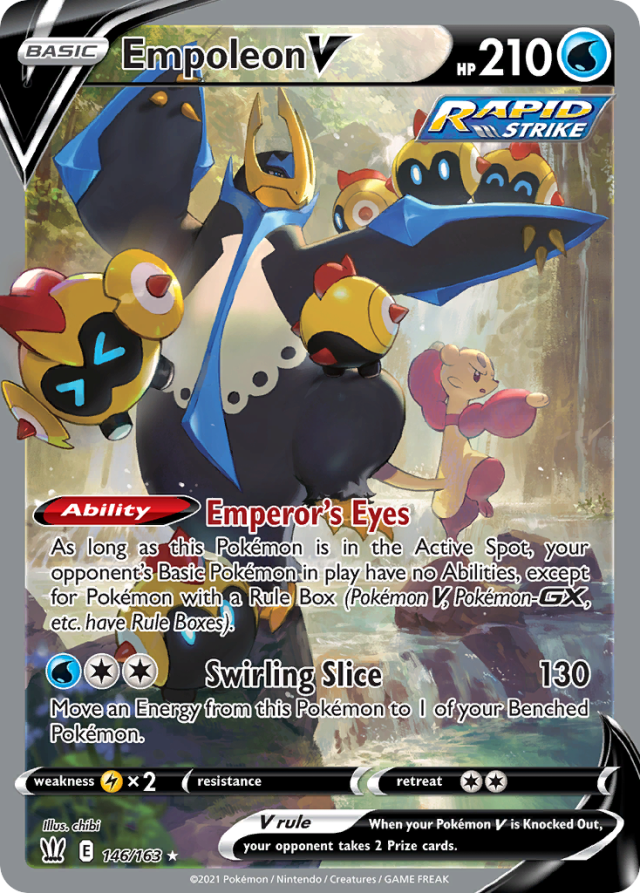
Released alongside S5I Single Strike Master on March 19, 2021, S5R Rapid Strike Master (連撃マスター) introduced the water/fighting half of the Battle Styles mechanic. The set’s headliners are Rapid Strike Urshifu VMAX — the signature water-fighting Pokémon that anchored top-tier competitive decks for the entire 2021-2022 season — and Empoleon V Alt Art, a surprisingly popular chase card from chibi that has become one of the set’s most valued pulls. Sealed boxes trade at ~¥25,000 in 2026, making S5R a mid-tier but still meaningful Battle Styles-era release.
S5R Rapid Strike Master: Set Overview
Set Code
S5R
Japanese Name
連撃マスター (Rengeki Master)
English Source
Partial source for Battle Styles (swsh5)
Release Date
March 19, 2021
Pack Configuration
30 packs / box, 5 cards / pack
MSRP
¥4,950 per box
Market Price (2026)
~¥25,000 (~$177)
Companion Set
S5I Single Strike Master
S5R vs. S5I — The Rapid Strike Side
The Battle Styles dual release split the format between two complementary mechanics. Rapid Strike cards (featured in S5R) use multi-hit, water-based combat with Urshifu’s Rapid Strike form as the centerpiece. Single Strike cards (S5I) focused on heavy one-shot damage with Tyranitar and Houndoom. Competitively, Rapid Strike decks dominated mid-2021 with Rapid Strike Urshifu VMAX being one of the most-played VMAX Pokémon of the era.
In 2026 market terms, S5I commands a higher sealed box premium (¥40,000 vs ¥25,000) because of Tyranitar V Alt Art’s $553 price tag. S5R’s value distribution is flatter — Rapid Strike Urshifu VMAX Rainbow and Empoleon V Alt Art are the two pillars, each in the ¥20,000-30,000 range.
Top Cards in S5R Rapid Strike Master
Rapid Strike Urshifu VMAX Rainbow Alt Art
HR
Rapid Strike Urshifu VMAX
~¥30,000 (~$213)
Pull rate: ~1/20 boxes (est.)
KIYOTAKA OSHIYAMA’s Rapid Strike Urshifu VMAX Rainbow is the top chase of S5R. The illustration depicts Urshifu mid-flurry with a streaming water trail, emphasizing the Rapid Strike mechanic’s multi-hit nature. OSHIYAMA is a renowned anime film animator (known for work on Devilman Crybaby and Land of the Lustrous), and their involvement in this card has given it cult recognition among collectors who appreciate cross-disciplinary illustrator credits. At ¥30,000 ($213), it’s the most valuable S5R card and the focal point of the set.
Empoleon V Alt Art
SA
Empoleon V
~¥22,000 (~$156)
Pull rate: ~1/16 boxes (est.)
chibi’s Empoleon V Alt Art is one of the most surprising chase cards from the Sword & Shield era. Empoleon — a Gen IV Sinnoh starter — isn’t among the most popular Pokémon, yet chibi’s illustration transformed the card into a cult favorite. The artwork depicts Empoleon in a regal, majestic pose with crisp lighting against a dramatic oceanic backdrop. The illustration quality alone drove demand, and at ¥22,000 ($156), Empoleon V Alt Art proves that Pokémon popularity is secondary to illustration quality when pricing modern chase cards.
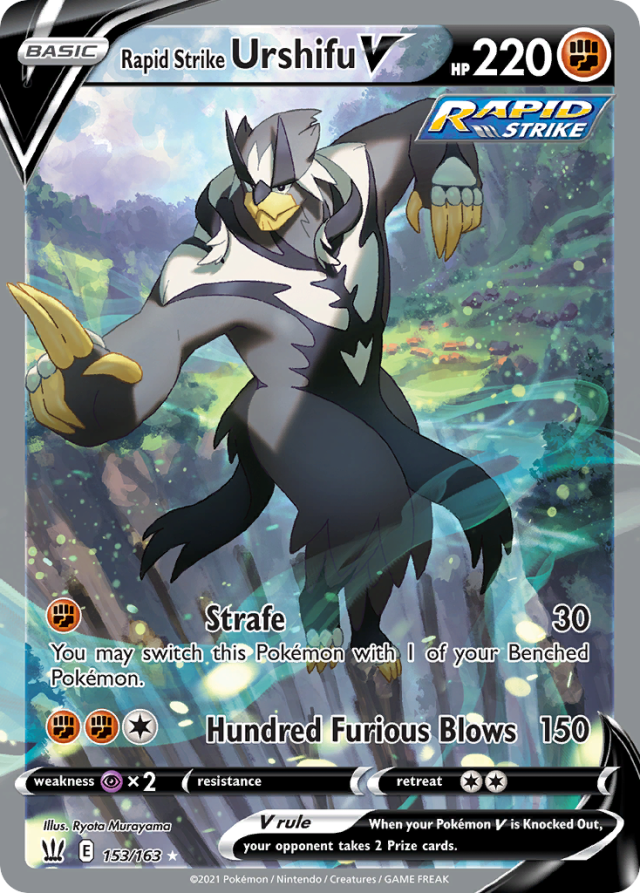
Rapid Strike Urshifu V Alt Art
SA
Rapid Strike Urshifu V
~¥7,500 (~$53)
Pull rate: ~1/16 boxes (est.)
Ryota Murayama’s Rapid Strike Urshifu V Alt Art shows Urshifu in a dynamic striking pose with water energy swirling around its fists. Murayama’s style emphasizes fluid motion — a perfect fit for the Rapid Strike mechanic’s theme. At ¥7,500 ($53), this is the more accessible Urshifu alt art and pairs with the VMAX version for completionist Urshifu collectors.
Rapid Strike Urshifu VMAX HR (Rainbow)
The standard Rapid Strike Urshifu VMAX HR Rainbow (PLANETA Tsuji, ¥4,500 / $32) is the traditional gold/rainbow foil treatment — less valuable than OSHIYAMA’s Alt Art version but still a solid mid-tier pull. The two Rainbow versions together represent S5R’s HR pool.
Should You Buy S5R Rapid Strike Master?
For Empoleon Collectors
S5R is the only source for Empoleon V Alt Art by chibi. Despite Empoleon’s mid-tier popularity as a Sinnoh starter, this card has become a canonical alt art from the S-era. Mandatory for Empoleon collectors and strongly recommended for chibi artist collectors.
For Battle Styles Completionists
S5R completes the Battle Styles pair with S5I. Both sets document a specific competitive era and any serious Sword & Shield collection needs both. Because S5R is cheaper (¥25,000 vs S5I’s ¥40,000), it’s the more accessible half of the pair to start with.
For Pack Openers
S5R’s ~42% EV ratio is one of the better mid-tier Battle Styles figures. With two ~¥25,000 chase cards distributed across ~1/16 pull rates each, every 8 boxes statistically yields at least one high-value hit. Better variance than lottery-dominated sets.
S5R Pull Rates & Box EV Breakdown
Rarity
Cards in Pool
Rate Per Box
SA
Empoleon V, Rapid Strike Urshifu V, others
~0.25 (1/4 boxes)
HR
Rapid Strike Urshifu VMAX Rainbow variants
~0.20 (1/5 boxes)
UR
Gold items/energy
~0.10 (1/10 boxes)
SR
V cards + Trainers
~1-2 per box
Category
Rate/Box
Avg Value
EV
Rapid Strike Urshifu VMAX Rainbow Alt HR
~0.05
¥30,000
¥1,500
Empoleon V Alt SA
~0.0625
¥22,000
¥1,375
Rapid Strike Urshifu V Alt SA
~0.0625
¥7,500
¥469
Other SA / HR cards
~0.20
¥3,000
¥600
UR Gold cards
~0.10
¥2,500
¥250
SR cards
~2
¥1,500
¥3,000
RR/RRR cards
~6
¥500
¥3,000
Other cards
—
—
¥1,000
Estimated Total EV
~¥11,194
Market BOX price
~¥25,000
EV / Cost ratio
~45%
S5R’s 45% EV ratio is above average for Sword & Shield sets, driven by the dual-chase distribution between Urshifu VMAX Rainbow and Empoleon V. Neither card dominates to the extreme degree Tyranitar does in S5I, which gives S5R more consistent EV outcomes per box.
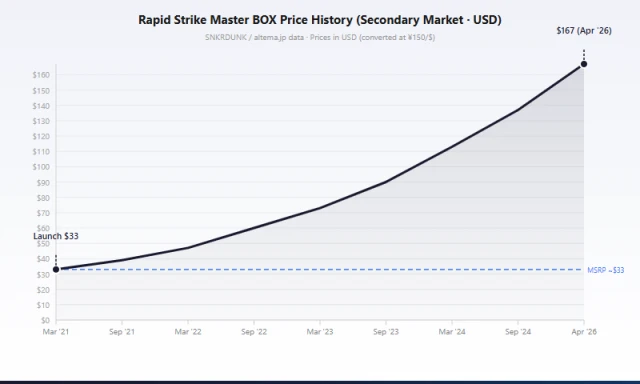
S5R Price History
Mar 2021: ¥5,000 (launch)
Mar 2022: ¥7,000
Mar 2023: ¥11,000
Mar 2024: ¥17,000
Apr 2026: ¥25,000 — 5× appreciation
Where to Buy S5R Rapid Strike Master
Browse S5R Rapid Strike Master →
Authenticated Japanese sealed boxes and Rapid Strike singles sourced directly from Japan.
Rapid Strike Urshifu VMAX Rainbow Alt Art by KIYOTAKA OSHIYAMA at approximately ¥30,000 ($213). Empoleon V Alt Art by chibi is a close second at ~¥22,000. Both cards anchor the set’s collector value.
Why is Empoleon V Alt Art so valuable?
chibi’s illustration transformed Empoleon into a regal, visually striking composition that transcends the Pokémon’s mid-tier popularity. The artwork quality alone drove collector demand, proving that Pokémon fame is secondary to illustration merit for modern alt art pricing. Empoleon V Alt Art is now one of the most recognized chibi illustrations in the Pokémon TCG.
Who is KIYOTAKA OSHIYAMA?
KIYOTAKA OSHIYAMA is a renowned Japanese anime film animator and director, known for work on Devilman Crybaby, Land of the Lustrous, and other critically acclaimed anime projects. Their Rapid Strike Urshifu VMAX Rainbow Alt Art is one of the only Pokémon TCG cards they illustrated, carrying cult recognition among collectors who appreciate cross-disciplinary artist credits.
Is S5R worth buying at ¥25,000?
S5R has a ~45% box EV ratio (~¥11,200 expected card value per box against ¥25,000 cost), one of the better ratios in the S-series. The dual-chase distribution between Urshifu VMAX Rainbow and Empoleon V Alt Art makes box outcomes more consistent than lottery-dominated sets. Recommended for sealed investors and collectors who want both Battle Styles halves.
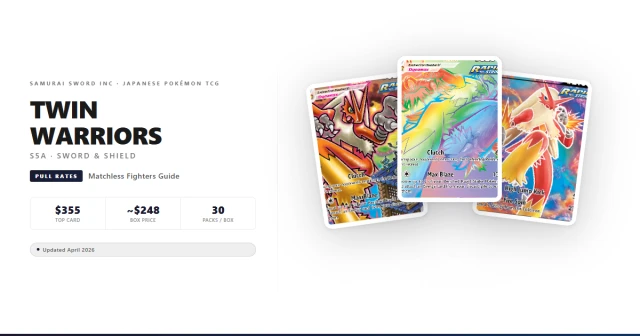
Released on May 28, 2021 as a mid-cycle subset between Battle Styles and Chilling Reign, S5a Matchless Fighters (双璧のファイター, also known as “Twin Warriors”) is one of the more underrated Japanese S-series releases. It’s a smaller set than the main S5I/S5R sister releases, but it contains one of the most dramatic alt art cards of the entire Sword & Shield era: Blaziken VMAX Alt Art by Shigenori Negishi, now trading at ~¥50,000 ($355). Sealed S5a boxes sit at ~¥35,000 in 2026, making it a niche but valuable target for fire-type collectors.
S5a Matchless Fighters: Set Overview
Set Code
S5a
Japanese Name
双璧のファイター (Sōheki no Fighter)
English Name
Matchless Fighters / “Twin Warriors”
English Source
Partial source for Chilling Reign (swsh6)
Release Date
May 28, 2021
Pack Configuration
30 packs / box, 5 cards / pack
MSRP
¥4,950 per box
Market Price (2026)
~¥35,000 (~$248)
Total Cards
~84
What Is a “Matchless Fighters” Subset?
S5a occupies an unusual position in the S-series timeline. Released two months after the Battle Styles dual expansion (S5I/S5R) and one month after Crown Tundra (S6H/S6K), it’s not part of either main release cycle. Instead, S5a was a smaller “subset” that added Fighting-themed Pokémon content to the Sword & Shield era, with Blaziken VMAX as the signature card alongside other fighting-style Pokémon. Many S5a cards were later incorporated into English Chilling Reign (swsh6).
Top Cards in S5a Matchless Fighters
Blaziken VMAX Alt Art — The Crown Jewel
SA
Blaziken VMAX
~¥50,000 (~$355)
Pull rate: ~1/20 boxes (est.)
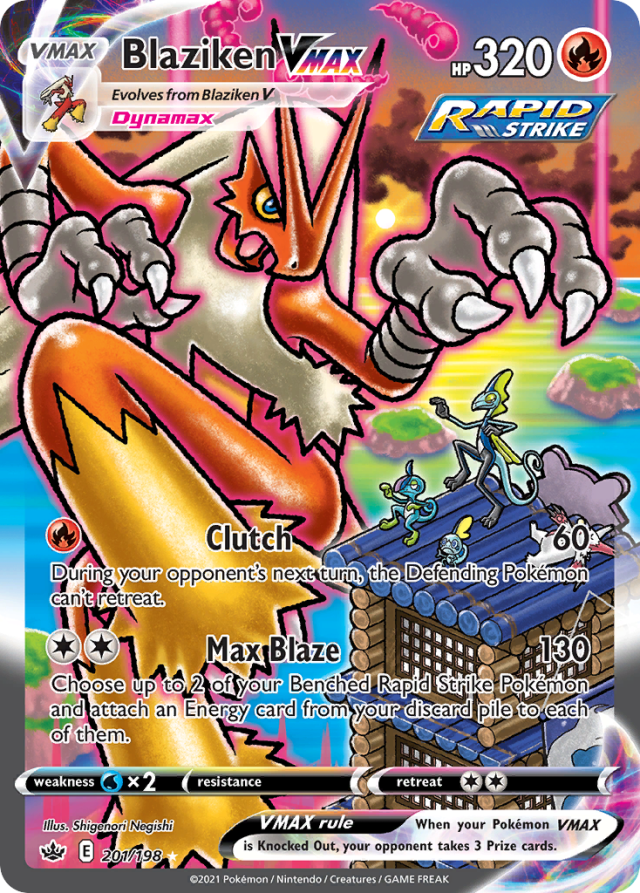
Shigenori Negishi’s Blaziken VMAX Alt Art is one of the most visually striking cards in the entire Sword & Shield era. The illustration captures Blaziken in a dynamic fighting pose surrounded by swirling flames and kinetic smoke effects — a departure from the standard VMAX template that emphasizes Blaziken’s combat identity rather than generic rarity treatment.
At ¥50,000 ($355), it’s the definitive S5a chase card. The English equivalent (swsh6-201, same Shigenori Negishi artwork) trades at $357 in the US market, making the JPN-to-EN price ratio unusually close at 1:1 — possibly because the card’s demand is primarily driven by international collectors who purchase both JP and EN versions interchangeably.
Blaziken VMAX HR Rainbow
HR
Blaziken VMAX
~¥6,500 (~$46)
Pull rate: ~1/8 boxes (est.)
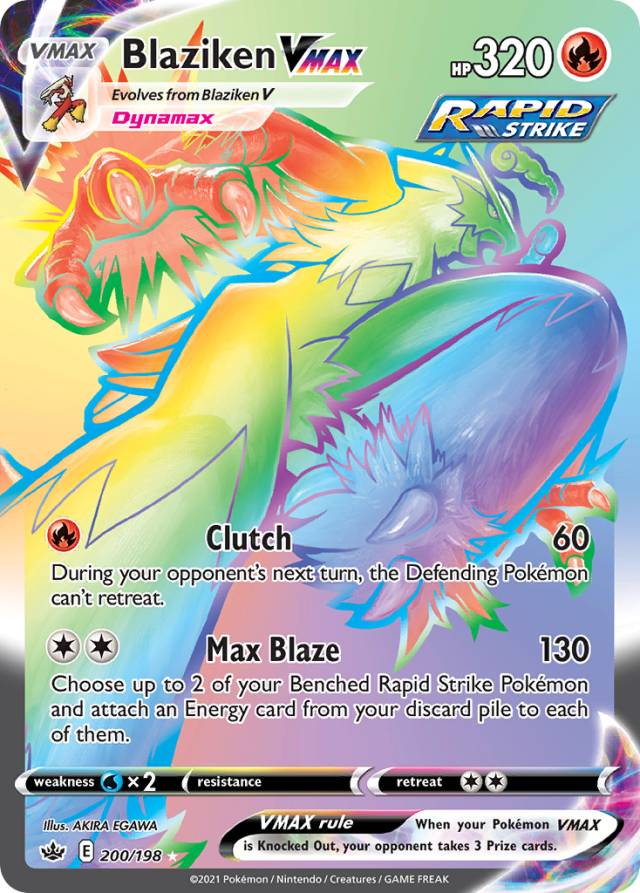
The Blaziken VMAX Rainbow HR (AKIRA EGAWA) is the traditional gold/rainbow foil version — valued at ¥6,500 ($46). Significantly more accessible than the Alt Art and still a solid mid-tier pull for Blaziken fans. AKIRA EGAWA also illustrated other notable S-series alt arts (including Mew VMAX SA from S8 Fusion Arts).
Blaziken V Alt Art
SA
Blaziken V
~¥4,500 (~$32)
Pull rate: ~1/16 boxes (est.)
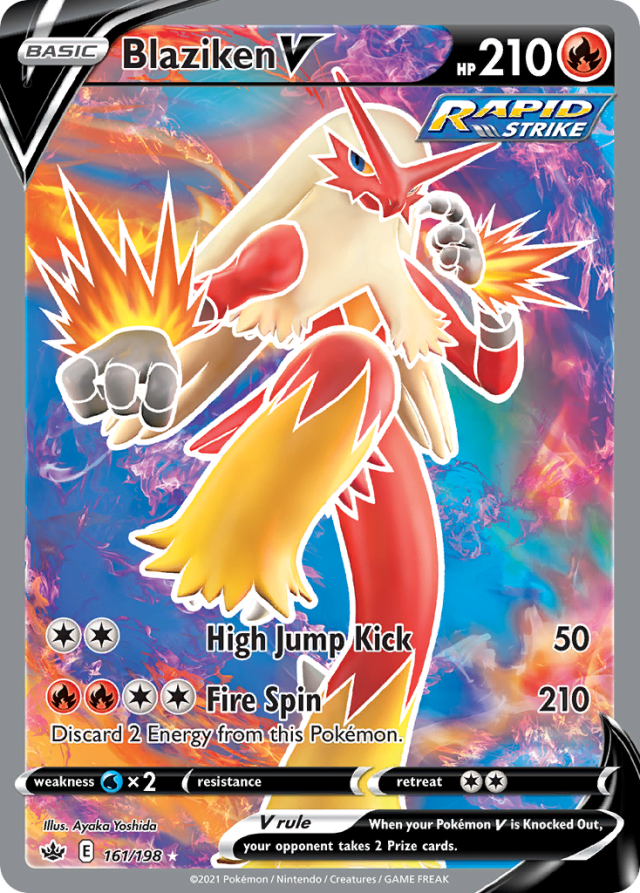
Ayaka Yoshida’s Blaziken V Alt Art is the V-form counterpart to the VMAX Alt Art. At ¥4,500 ($32), it’s an accessible alt art pickup for Blaziken collectors and pairs naturally with the Alt Art VMAX for a complete Blaziken collection.
Should You Buy S5a Matchless Fighters?
For Blaziken Collectors
S5a is the primary source for modern Blaziken V/VMAX cards — mandatory for any Blaziken-focused collection. The Shigenori Negishi Alt Art VMAX is Blaziken’s most iconic modern TCG card.
For Collectors Who Value Underrated Sets
S5a has historically received less attention than the main S5I/S5R Battle Styles or the S6H/S6K Crown Tundra releases. This means relative pricing stability with less speculation — good for collectors who want Blaziken content without paying Tyranitar or Calyrex premiums.
For Pack Openers
S5a’s ~39% EV ratio is average for S-series. Box variance is dominated by Blaziken VMAX Alt Art (¥50,000 card at ~1/20 pull rate) — a single pull returns ~1.4× box cost. The chase is meaningful but not as dominant as Rayquaza or Tyranitar in other sets.
S5a Pull Rates & Box EV Breakdown
Rarity
Cards in Pool
Rate Per Box
SA
Blaziken V, Blaziken VMAX, others
~0.25 (1/4 boxes)
HR
VMAX Rainbow cards
~0.20 (1/5 boxes)
UR
Gold items/energy
~0.10 (1/10 boxes)
SR
V cards + Trainers
~1-2 per box
Category
Rate/Box
Avg Value
EV
Blaziken VMAX Alt Art SA
~0.05
¥50,000
¥2,500
Blaziken VMAX Rainbow HR
~0.125
¥6,500
¥813
Blaziken V Alt Art SA
~0.0625
¥4,500
¥281
Other SA / HR cards
~0.20
¥3,000
¥600
UR Gold cards
~0.10
¥2,000
¥200
SR cards
~2
¥1,500
¥3,000
RR/RRR cards
~6
¥500
¥3,000
Other cards
—
—
¥1,500
Estimated Total EV
~¥13,894
Market BOX price
~¥35,000
EV / Cost ratio
~40%
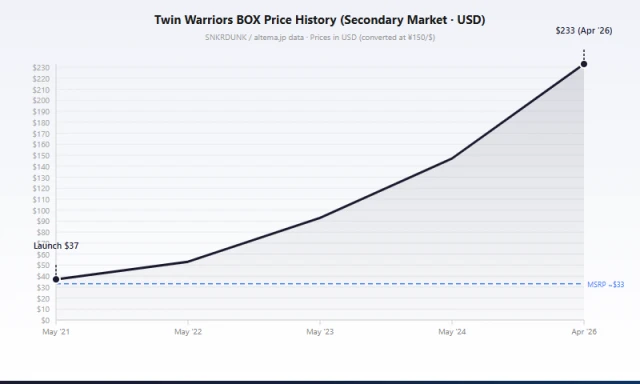
S5a Price History
May 2021 (launch): ¥5,500
May 2022: ¥8,000
May 2023: ¥14,000
May 2024: ¥22,000
Apr 2026: ¥35,000 — 6.4× from launch
Where to Buy S5a Matchless Fighters
Browse S5a Matchless Fighters →
Authenticated Japanese sealed boxes and Blaziken VMAX singles sourced directly from Japan.
S5a (双璧のファイター) is a Japanese Sword & Shield subset released May 28, 2021, two months after the main Battle Styles dual release. It’s a smaller set featuring Fighting-themed Pokémon including Blaziken V/VMAX. Many S5a cards were incorporated into English Chilling Reign (swsh6).
Why is Blaziken VMAX Alt Art so valuable?
Shigenori Negishi’s Blaziken VMAX Alt Art features a dynamic fighting pose with swirling flames that broke from standard VMAX templates. Combined with Blaziken’s strong fan base as a Gen III Fire Starter, the card has become one of the most desirable alt arts of the Sword & Shield era. At ~¥50,000 ($355), it’s the definitive S5a chase.
Is S5a worth buying at ¥35,000 in 2026?
S5a has a ~40% box EV ratio and 6.4× appreciation since launch. For Blaziken collectors, S5a is mandatory. For sealed investors, the steady appreciation curve and underrated status make it a solid mid-tier hold. For pack openers, the Blaziken VMAX Alt Art pull offers ~1.4× box return on a successful hit.
How Japanese Pokemon Pull Rates Actually Work (2026)
Pull rates decide what a Japanese Pokemon booster box is actually worth. A box isn’t a mystery grab bag — it’s a structured, statistically-predictable product, and once you understand how The Pokémon Company stacks rarities across 30 packs, you can walk into any Scarlet & Violet or Mega-era release knowing roughly what you’ll pull before you crack the shrink.
Most overseas collectors learned pack odds from English boxes — 36 packs, 10 cards per pack, specific guaranteed slots. Japanese boxes work differently. Fewer packs, fewer cards per pack, and a distribution of chase rarities (SAR, UR, MUR) that is often misquoted on Reddit and YouTube. This guide lays out how it actually works.
We ship Japanese Pokemon boxes out of Tokyo every day and have tracked open rates across 1,000+ boxes of SV-era and Mega-era sealed product. The numbers below are realistic averages — not marketing copy. Every rate on this page is estimated based on opening data and community-aggregated samples. The Pokémon Company does not publish pull rates, so these figures are approximations, not official disclosures.
Key Takeaway
A standard Japanese Pokemon booster box contains 30 packs × 5 cards = 150 cards, with an estimated 2–4 SAR, 1 SR floor, ~0.15 UR and ~0.05 MUR per box. Per-pack hit density is higher than ENG, but per-box total hits are lower because boxes are smaller.
30
Packs per Box
150
Total Cards per Box
2–4
Average SAR per Box
~1 in 10–25
MUR Pull Rate (Mega Sets)
Japanese Booster Box Structure: 30 Packs, 5 Cards Each
Every modern Japanese Pokemon booster box — across the Scarlet & Violet series (SV1 through SV11W/SV11B) and the Mega series (M1, M2, M3, M4) — ships in the same format:
Box component
Count
Packs per box
30
Cards per pack
5
Total cards per box
150
Approximate box weight (sealed)
~300g
That’s the whole frame: 150 cards, split across 30 packs. Every slot in every pack is assigned a rarity weight, and the sum of those weights across the box is what determines your expected hits. English boxes pack 360 cards (36 × 10), more than double the card count, which is why direct pull-rate comparisons between JP and ENG are almost never apples-to-apples.
A few exceptions worth flagging up front. High Class packs (like S12a VSTAR Universe, the late-year flagship products) sometimes use a 10-pack format with 11 cards per pack — visit the S12a VSTAR Universe card list to see the distinct checklist those use. Enhanced Expansions and special sets can also deviate. For standard Booster and Expansion Packs — the product 90%+ of Japanese sealed buyers are targeting — the 30×5 format is universal.
Expected Cards per Box: Rarity Breakdown
Here’s the realistic per-box rarity distribution for a typical Scarlet & Violet or Mega-era box, based on aggregated opening data across recent sets:
Team Rocket’s Mewtwo ex SAR (SV10 Glory of Team Rocket) — a representative SAR, the rarity tier that averages 2–4 per box.
Those numbers add up to the 150-card total, with the bulk of a box obviously being gameplay Commons and Uncommons. The chase rarities — AR and above — typically total 7–10 hit cards per box on a normal day. The floor is usually 1 SR + 2 AR + 5 RR even on your worst-luck boxes. The variance comes in the SAR/UR/MUR tier.
How Each Rarity Distributes Across Packs
Slot-level behavior matters because it determines how a specific pack looks when you open it — which is what most YouTube openers are actually showing you.
Commons and Uncommons — Every Pack
Every single pack contains Commons and Uncommons as gameplay filler. A typical pack opens with 3 Commons and 1 Uncommon; the fifth card is the variable slot where the hit (R, RR, AR, SR, SAR, UR, or MUR) lives. Commons and Uncommons are identical across packs within the same print run.
Rare (R) — Roughly 1 per Pack
R cards — single-star, holo-front, non-ex gameplay Pokémon — fill most of the “hit” slot. On average about 4 out of every 5 packs will give you an R, with the remaining packs upgrading to RR or higher. Over a 30-pack box, R count usually lands in the low-20s range.
RR (Double Rare) — Approximately 5 per Box
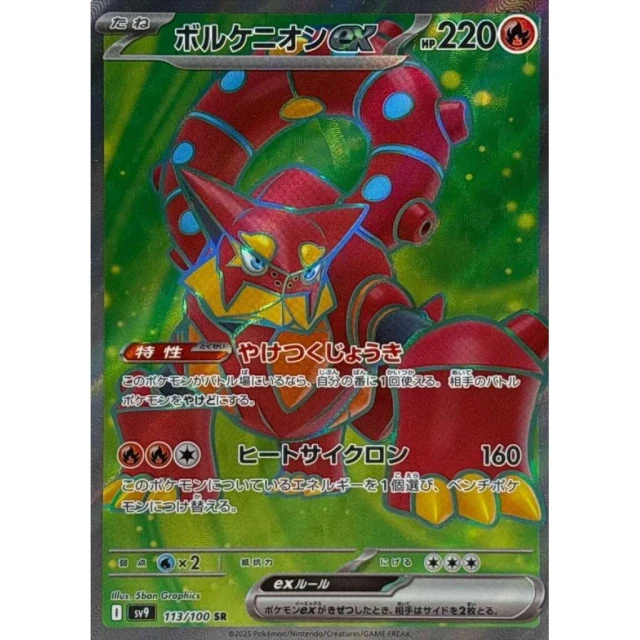
Pokémon ex cards like Volcanion ex sit in the RR (Double Rare) tier — about 5 per box.
RR cards are the ex-Pokémon full-card-holo foundation tier. A typical 30-pack box lands 5 RR cards spread across different packs. These are your Pokémon ex and Tera Pokémon ex — the cards most tournament decks are built on. Value is usually $3–$30 per RR depending on meta relevance.
AR (Art Rare) — About 2 per Box
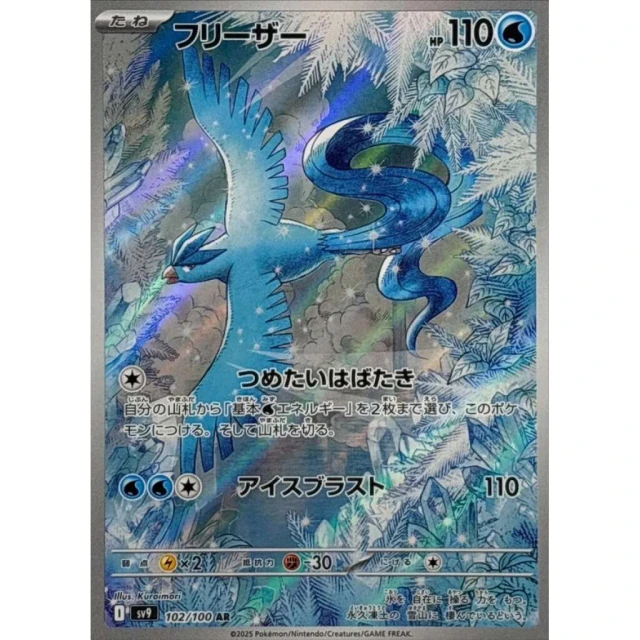
Articuno AR (SV9 #102) — the illustrated-background AR style averages ~2 per box.
AR cards feature the iconic full-card illustrated-background art style introduced in Scarlet & Violet — Sowsow-style, Komiya-style, and other artist-signature pieces. Two AR cards per box is the modern standard across Scarlet & Violet sets, though some boxes pull 1 and some pull 3. The AR pool is usually 20–30 different cards per set, so collecting an AR-complete set from sealed takes ~10–15 boxes.
SR (Super Rare) — ~1 per Box Guaranteed, but Which Varies
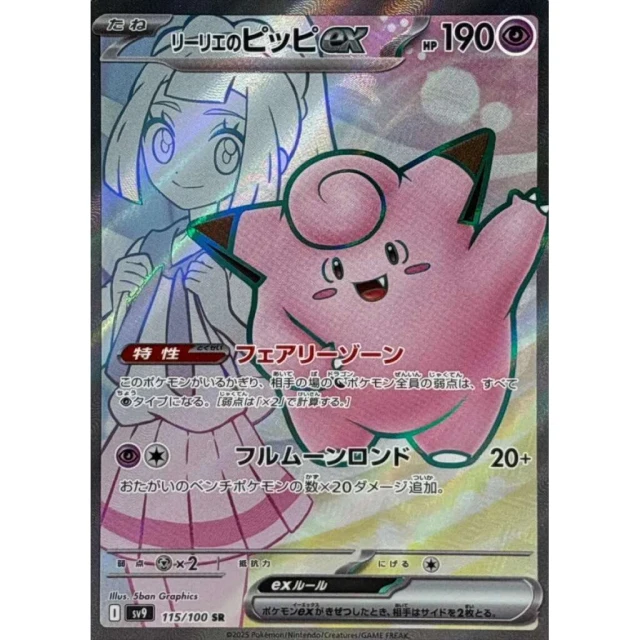
Lillie’s Clefairy ex SR (SV9 #115) — every box reliably yields ~1 SR-tier card.
This one confuses a lot of new JP collectors. “One SR per box” is true as a floor — virtually every box opens at least one card in the SR or higher tier. But which SR you pull is random within the SR pool, and on some boxes, that SR slot is replaced by a higher rarity (SAR, UR, or MUR) on lucky boxes.
SAR (Special Art Rare) — 2–4 per Box Average, but Variance is Real
Team Rocket’s Mewtwo ex SAR (SV10) — flagship SAR with the gold-bordered alt-art treatment.Zekrom ex SAR (SV11B #169) — long-run averages land around 2–4 SARs per box across SV-era sets.
SAR cards (the gold-bordered alt-art chase pieces) are the most statistically interesting tier. Across dozens of boxes the long-run average is roughly 2–4 SARs per box — but on any individual box the distribution is wide: some boxes pull 0 or 1 SAR, others pull 4 or 5 SARs. This is why two identical boxes of the same set can feel completely different when opened.
If you open 10 boxes of a recent set like SV9 Battle Partners or M4 Mega Symphonia, you can expect roughly 25–35 SAR cards across them — but box-by-box anywhere from 0 to 6.
UR and MUR — Rare Tier, Estimated 1/5 to 1/25 Boxes
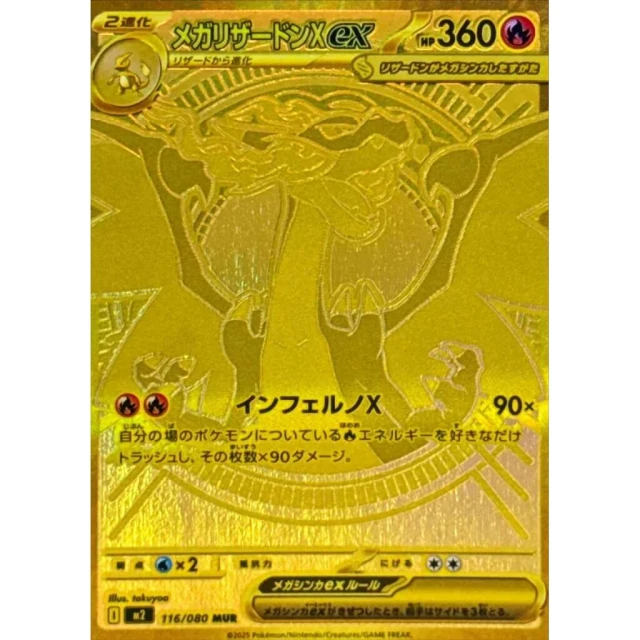
Mega Charizard X ex MUR (M2 Inferno X) — the deepest chase tier, roughly 1 per 10–25 boxes in Mega sets.
UR (Ultra Rare, full-gold-foil) and MUR (Mega Ultra Rare) are the deepest chase tiers. Based on opening data:
UR: Estimated approximately 1 per 5–8 boxes. Some sets lean tighter (SV11 series), some looser.
MUR: Introduced with the Mega series (M1 Mega Brave onward). Estimated approximately 1 per 10–25 boxes, with flagship Mega sets like M4 Mega Symphonia and the M1 Mega Brave release showing the higher end of scarcity.
MUR pull rates are still an evolving estimate because the rarity only debuted with the Mega era in 2026. Early opening data suggests the actual per-box odds may vary between sets.
Box Variance: Why Two Boxes Can Feel Completely Different
Say two collectors each open a fresh box of SV10 Heat Wave Arena (browse the SV10 card list for the full rarity checklist). One pulls an MUR, 4 SARs, and 2 ARs. The other pulls 1 SAR, 0 UR, and 3 ARs. Same set, same shrink, wildly different outcomes.
This is normal. The reason is that SAR/UR/MUR slots aren’t fixed “guaranteed” positions — they’re probabilistic upgrades on the R/RR/SR slot. Each pack rolls the hit slot, and most rolls come up R or RR, some RR or SR, and a small percentage upgrade to AR, SAR, UR, or MUR. The law of large numbers means that over 10+ boxes the distribution smooths out toward the average. Over a single box, it doesn’t.
Practical Implication
If you care about specific chase cards, buy by the case (12 boxes) or buy singles. A single box gives you roughly a 30% chance of opening zero SARs of any specific card you want. A case brings that much closer to expected.
Dual-Hit Packs: The Japanese “God Pack” Concept
Japanese Pokemon boxes contain a small number of dual-hit packs — packs where two of the five cards are chase-tier instead of one. Community openers sometimes call these “god packs,” borrowing the term from other TCGs, though The Pokémon Company has never formally named the mechanic.
A typical box contains approximately 1 dual-hit pack, though some boxes have 0 and some have 2. Dual-hit packs are often where the SAR-plus-SAR or SR-plus-AR combos show up, and they’re the mechanic behind the “stacked pack” videos that circulate on YouTube. You can sometimes spot them by weight, though sellers who weight-sort boxes typically remove them from retail supply.
Box-mapping (using the position of hits to predict which packs contain them) used to be a consistent technique on older sets, but modern Japanese factory-sealed boxes have largely defeated static mapping — the distribution varies enough print-run to print-run that no single pattern holds reliably.
Recent Set Data Examples: SV9, SV10, M4
Concrete data points from recent Scarlet & Violet and Mega-era sets help anchor the abstract numbers above.
SV9 Battle Partners (January 2025)
Volcanion ex SR (SV9 Battle Partners) — representative chase rarity from the SV9 set sample.
SV9 introduced the “tag” mechanic with trainer-and-Pokemon combo SARs. Typical SV9 box yields across our observed sample: 2 AR, 1 SR, 0–2 SAR, and a UR hit in roughly 1 of every 6 boxes. The SV9 Battle Partners card list shows the full rarity structure with 30+ SAR cards in the set.
SV10 Heat Wave Arena (March 2025)
SV10 follows the same structural pull rates as SV9. The standout: the Lillie SAR and Mega Lucario ex SAR were the two chase cards driving box pricing. Typical box: 2 AR, 1 SR, 0–2 SAR, 1 UR in roughly 1 of every 6 boxes. See the SV10 Heat Wave Arena card list.
M4 Mega Symphonia (2026)
M4 is the Mega-era set that brought MUR into its highest-profile rotation. Our opening data suggests: 2 AR, 1 SR, 0–3 SAR, 1 UR in roughly 1 of every 6 boxes, and 1 MUR in roughly 1 of every 15–20 boxes. The M4 Mega Symphonia card list has the full chase lineup including the Mega Charizard X MUR and other headline pulls.
For the broader SV-era Scarlet & Violet rarity framework used across all these sets, our Japanese Pokemon card rarities explained guide covers what each letter code means and what the resulting cards look like.
Pull Rates vs. English Booster Boxes: Key Differences
A quick reference for collectors moving between ENG and JPN:
Attribute
Japanese Box
English Box
Packs per box
30
36
Cards per pack
5
10
Cards per box
150
360
Guaranteed hit (ex / V / full-art)
~1 SR+ per box floor
~1 reverse-holo + 1 holo per pack
Gold / ultra rare equivalent
UR/MUR roughly 1 per 5–20 boxes
Hyper Rare roughly 1 per 2 boxes
Alt-art chase
SAR ~2–4 per box (gold border, unique art)
Special Illustration Rare, lower density
The structural gap matters: because JPN packs are smaller (5 cards vs. 10), a single pack rip feels less card-dense than an ENG pack rip. But the hit-per-pack ratio in JPN is higher on average, so the box-level hit density ends up comparable when you normalize for total cards. JPN boxes also trade 15–40% above the corresponding ENG box in most cases, reflecting the premium print quality and earlier release timing.
Can You Predict Box Value? Basic EV Math
Expected value (EV) is the sum of each card’s probability times its singles-market price. For Japanese boxes the quick EV formula is:
EV ≈ (5 × average RR price) + (2 × average AR price) + (1 × average SR price) + (average SAR count × average SAR price) + (UR probability × average UR price) + (MUR probability × average MUR price)
That’s roughly $125–$140 in expected singles value per box for a typical SV-era release. Japanese boxes typically retail around that range on the secondary market, meaning raw EV and box price tend to sit close to each other — which is why collectors buy for the opening experience and the chance at outlier pulls rather than as a pure value play. Sets with genuinely high-demand chase cards (flagship High Class packs, late-cycle Mega sets) can run positive EV; most regular Booster sets hover near break-even.
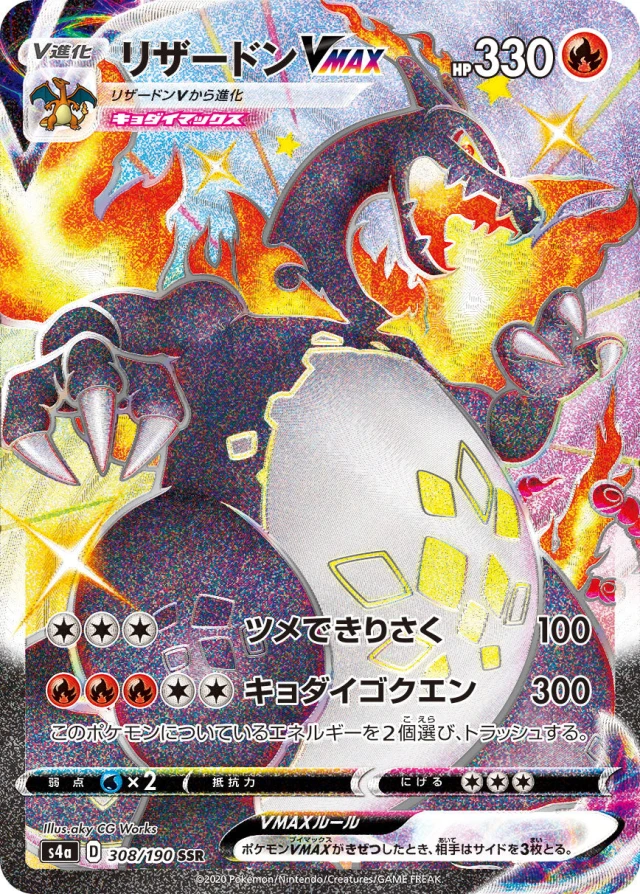
For context on the classic chase-card sets that set the benchmark for modern pricing, the S4a Shiny Star V card list still shows what a high-EV Sword & Shield-era box looked like at its peak.
Where to Buy Sealed Japanese Booster Boxes
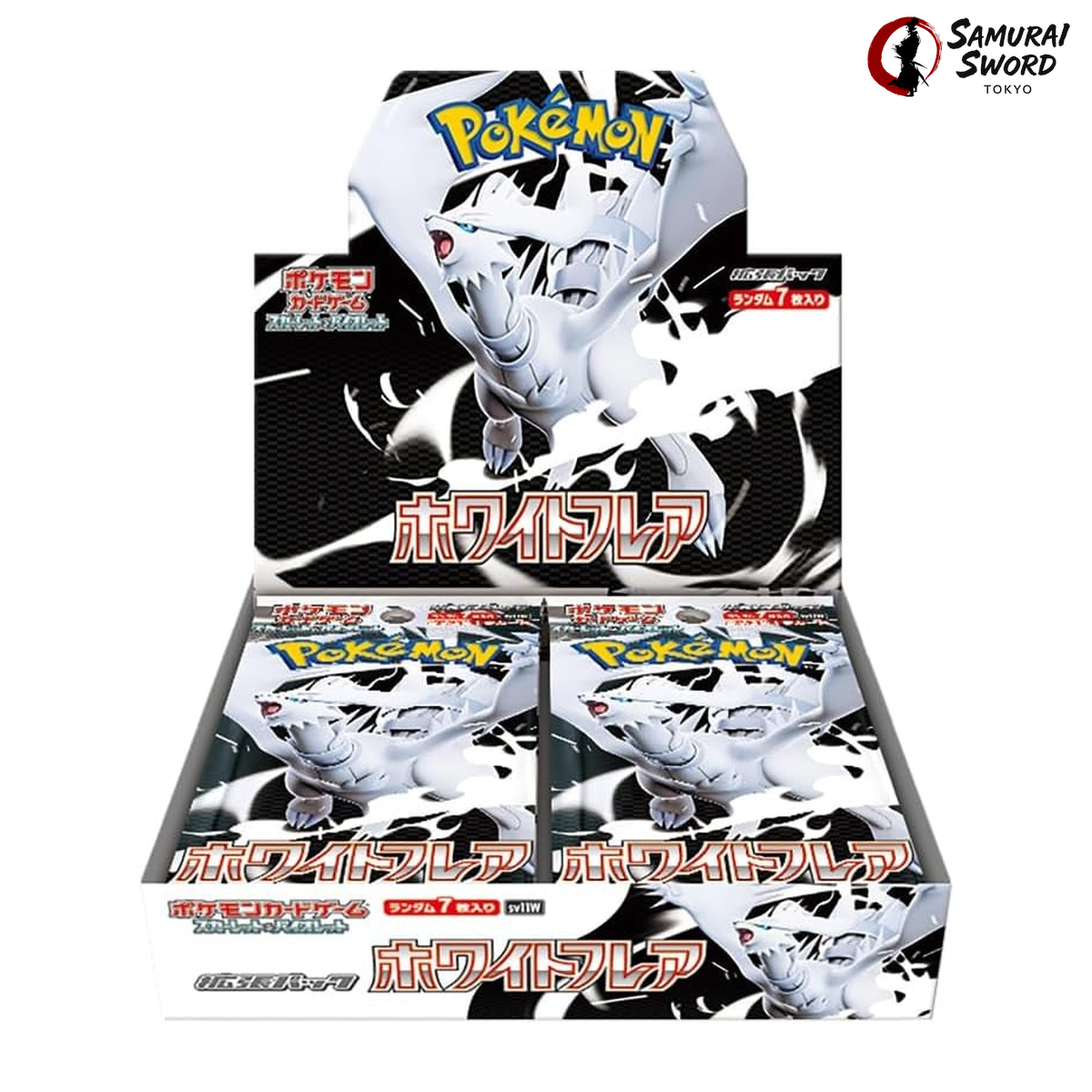
A sealed Japanese booster box (SV11W White Flare shown) — the product format covered by every pull-rate estimate above.
If you want to experience the pull rates yourself rather than buy singles, sealed boxes are the route:
For collectors who want specific cards instead of opening chance, singles are nearly always cheaper per-card than pulling from sealed at the SAR and above tier. Sealed makes sense when you value the opening experience, want sealed-collection upside, or are building a set by quantity over specific chase cards.
Frequently Asked Questions
How many packs are in a Japanese Pokemon booster box?
Standard Japanese Pokemon booster boxes (Scarlet & Violet series and Mega series) contain 30 packs with 5 cards per pack, for a total of 150 cards per box. This differs from English booster boxes, which contain 36 packs with 10 cards per pack (360 cards total). Some special Japanese products like High Class packs use different formats — for example, S12a VSTAR Universe is 10 packs × 11 cards.
How many SAR cards come in a Japanese booster box?
On average, a Japanese booster box contains 2–4 SAR (Special Art Rare) cards, but box-to-box variance is significant. Some boxes pull 0–1 SARs, while lucky boxes can pull 4–5. Across 10+ boxes the average converges to approximately 2–4 per box. These figures are estimated based on opening data and are not officially confirmed by The Pokémon Company.
What is the UR pull rate in Japanese Pokemon boxes?
UR (Ultra Rare, full-gold) cards are estimated to pull approximately once every 5–8 booster boxes in current Scarlet & Violet-era sets. MUR (Mega Ultra Rare), the newer Mega-era rarity, is rarer — estimated approximately 1 per 10–25 boxes depending on the set. All figures are estimates based on community-aggregated opening data.
Are Japanese pull rates better than English pull rates?
Not better or worse — structurally different. Japanese boxes deliver fewer total cards per box (150 vs. 360) but concentrate hits into fewer slots. Per-card, Japanese boxes have a higher hit density. Per-box, English boxes yield more total holo cards simply because there are more packs. Japanese boxes also feature unique rarities (SAR, UR, MUR) that have no direct English equivalent, which is why Japanese boxes tend to trade at a 15–40% premium over equivalent English sets.
What is a dual-hit pack in Japanese Pokemon?
A dual-hit pack (sometimes called a “god pack” by community openers) is a pack where two of the five cards are chase-tier rarity instead of the usual one. Most Japanese booster boxes contain approximately one dual-hit pack on average, though some boxes have zero and some have two. The Pokémon Company has never officially named or confirmed the mechanic — it’s a pattern identified through community opening data.
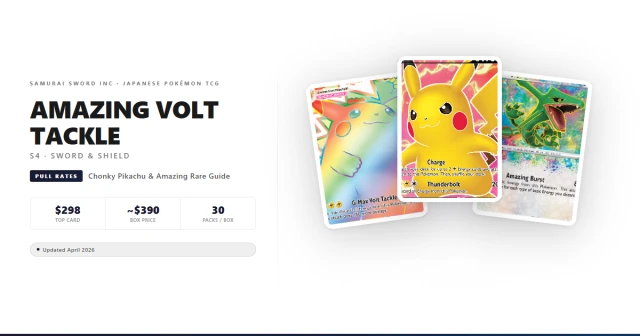
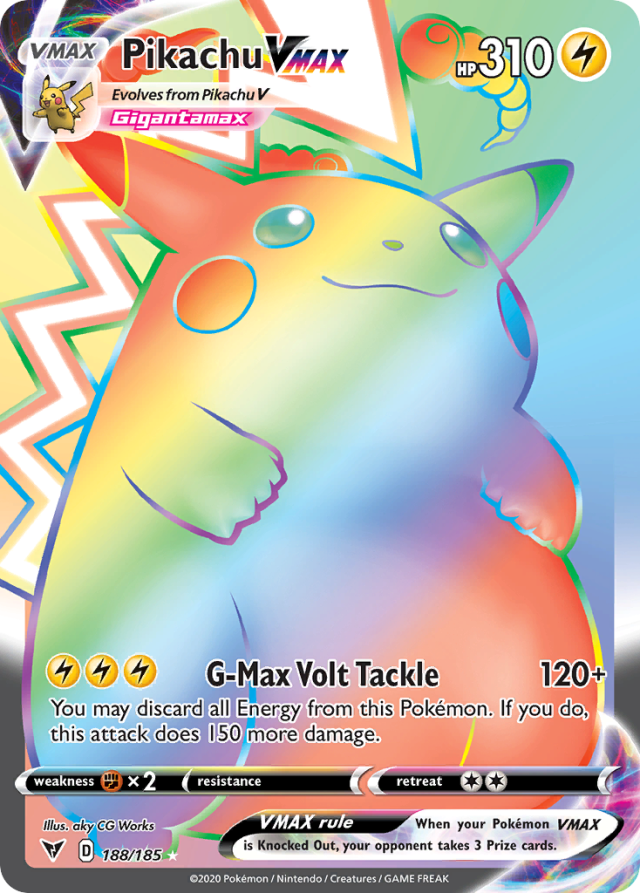
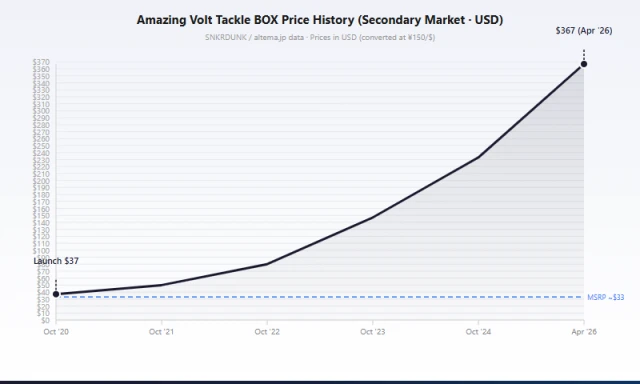
Released on October 16, 2020, S4 Amazing Volt Tackle (仰天のボルテッカー) is one of the most historically significant Japanese Pokémon TCG sets of the Sword & Shield era. It introduced a brand-new rarity — Amazing Rare — and gave collectors one of the most beloved Pikachu cards ever printed: the Pikachu VMAX Rainbow, affectionately known as “Chonky Pikachu” or “Fat Pikachu VMAX” for its unusually round, plush-like illustration. Five years later, sealed S4 boxes trade at ~¥55,000 ($390) — a 10× appreciation driven entirely by Chonky Pikachu demand.
S4 Amazing Volt Tackle: Set Overview
Set Code
S4
Japanese Name
仰天のボルテッカー (Gyōten no Volt Tackle)
English Source
Vivid Voltage (swsh4)
Release Date
October 16, 2020
Pack Configuration
30 packs / box, 5 cards / pack
MSRP
¥4,950 per box
Market Price (2026)
~¥55,000 (~$390)
Total Cards
~96 (base) + secret rares
New Rarity
Amazing Rare (AR)
The “Amazing Rare” Innovation
S4 Amazing Volt Tackle introduced the Amazing Rare (AR) rarity to the Pokémon TCG — a unique holographic foil treatment applied to select Legendary and Mythical Pokémon. The AR cards have a distinctive fragmented rainbow pattern that looks like shattered glass or prismatic ice, creating a visual effect unlike any other rarity in the game. Amazing Rare only appears in S4 and its follow-up S4a Shiny Star V — making S4’s AR cards some of the most unique-looking cards in the entire S-series.
Top Cards in S4 Amazing Volt Tackle
Pikachu VMAX Rainbow (“Chonky Pikachu”) — The Crown Jewel
HR
Pikachu VMAX
~¥42,000 (~$298)
Pull rate: ~1/12 boxes (est.)
“Chonky Pikachu” — the Pikachu VMAX Rainbow by aky CG Works — is one of the most beloved Pokémon cards of the entire Sword & Shield era. Collectors coined the nickname because of the illustration’s unusually round, plush-like rendering of Pikachu in its Gigantamax form. The rainbow foil treatment applied to this chubby pose created an instant cult favorite, and demand for the card has been unusually durable across years.
At ¥42,000 ($298), Chonky Pikachu is the most valuable S4 card and one of the highest-priced Pikachu cards from the Sword & Shield era. The card’s appeal transcends competitive value — it’s purely an illustration-driven collector item with memetic staying power.
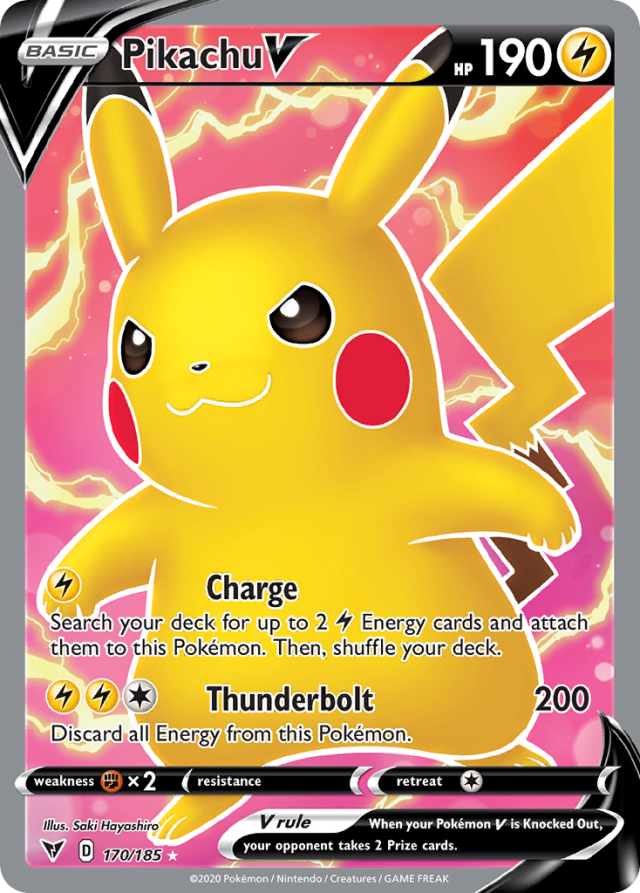
Pikachu V SR (Full Art)
SR
Pikachu V
~¥8,500 (~$60)
Pull rate: ~1/box (est.)
Saki Hayashiro’s Pikachu V SR (full art) is the V-form counterpart to Chonky Pikachu. The illustration captures Pikachu in a classic electric charge pose with standard V card proportions — a more traditional full art compared to the VMAX’s unique “chunky” style. At ¥8,500 ($60), it’s a strong mid-tier pull.
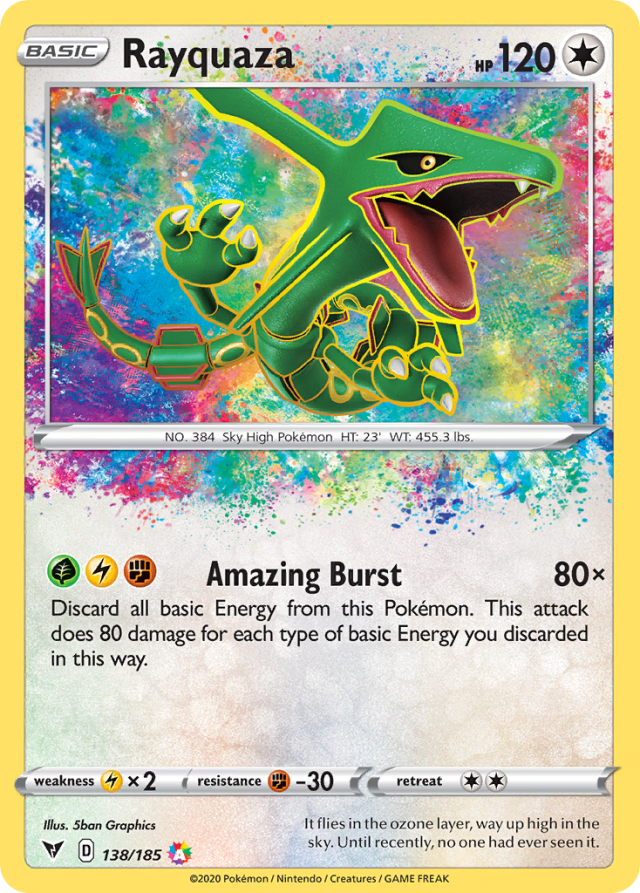
Rayquaza Amazing Rare
AR
Rayquaza
~¥4,500 (~$32)
Pull rate: ~1/8 boxes (est.)
The Rayquaza Amazing Rare is the most valuable AR card in S4. The new rarity’s prismatic fragmented-glass foil pattern combined with Rayquaza’s perennial popularity makes this one of the most sought-after cards in the set after Chonky Pikachu. At ¥4,500 ($32), it’s an accessible way to add an AR card to any collection — and serves as a stepping stone toward the more expensive Rayquaza cards from S7R Blue Sky Stream.
Zacian Amazing Rare
Zacian AR (¥1,200 / $9) represents the Galar region’s current-era legendary in the Amazing Rare treatment. More affordable than Rayquaza AR but still features the distinctive AR fragmented holographic style.
Should You Buy S4 Amazing Volt Tackle?
For Pikachu Collectors
S4 is mandatory for Pikachu collectors. Chonky Pikachu VMAX Rainbow is one of the top 5 most iconic Pikachu TCG cards of the modern era. The Pikachu V SR pairs with it for a complete Pikachu subset from this release.
For Amazing Rare Collectors
S4 is the primary source for Amazing Rare cards (along with S4a Shiny Star V). If you’re building a complete AR collection — Rayquaza, Zacian, Jirachi, Celebi, and others — S4 provides the foundation.
For Sealed Investors
The 10× appreciation since launch (¥5,500 → ¥55,000) is among the strongest non-lottery S-series growth stories. The demand driver (Chonky Pikachu) has meme-level staying power — an unusually durable demand source that has not weakened over 5 years.
S4 Pull Rates & Box EV Breakdown
Rarity
Rate Per Box
HR Hyper Rare (Rainbow)
~0.08 (1/12 boxes)
AR Amazing Rare
~0.125 (1/8 boxes)
UR Ultra Rare (Gold)
~0.10
SR Super Rare
~1-2 per box
Category
Rate/Box
Avg Value
EV
Pikachu VMAX Rainbow HR
~0.08
¥42,000
¥3,360
Amazing Rare cards
~0.125
¥2,500
¥313
Other HR / UR cards
~0.20
¥4,000
¥800
SR cards (Pikachu V SR + others)
~2
¥2,500
¥5,000
RR / RRR cards
~6
¥500
¥3,000
Other cards
—
—
¥1,500
Estimated Total EV
~¥13,973
Market BOX price
~¥55,000
EV / Cost ratio
~25%
S4’s 25% EV ratio is one of the lower figures in the S-series — the box price has appreciated so heavily (10×) that EV has failed to keep up. This is typical for sets with meme-driven demand: the collector premium on Chonky Pikachu sets the box price, but pull rates dilute the EV math. For ROI-focused buyers, singles are significantly more efficient.
S4 Price History
Oct 2020 (launch): ¥5,500
Oct 2021: ¥7,500
Oct 2022: ¥12,000 — Chonky Pikachu meme spreading
Oct 2023: ¥22,000
Oct 2024: ¥35,000
Apr 2026: ¥55,000 — 10× from launch
Where to Buy S4 Amazing Volt Tackle
Browse S4 Amazing Volt Tackle →
Authenticated Japanese sealed boxes and Chonky Pikachu singles sourced directly from Japan.
“Chonky Pikachu” (also called “Fat Pikachu VMAX”) is the community nickname for the Pikachu VMAX Rainbow card from S4 Amazing Volt Tackle (swsh4-188, artist: aky CG Works). The illustration depicts Pikachu in Gigantamax form with an unusually round, plush-like body shape that became a cult favorite. At ~¥42,000 ($298), it’s the most valuable card in the set and one of the most memetically famous Pikachu cards ever printed.
What is Amazing Rare rarity?
Amazing Rare (AR) is a unique holographic foil treatment introduced in S4 Amazing Volt Tackle. It applies a fragmented, prismatic rainbow pattern — similar to shattered glass or iridescent ice — to select Legendary and Mythical Pokémon cards. Rayquaza, Zacian, Jirachi, Celebi, Reshiram, and Yveltal are among the Amazing Rare Pokémon. The rarity only appears in S4 and its follow-up S4a Shiny Star V.
Is S4 the same as Vivid Voltage?
Yes, S4 Amazing Volt Tackle is the Japanese source for English Vivid Voltage (swsh4). The sets share nearly identical card pools, including Chonky Pikachu (named “Pikachu VMAX Rainbow Rare” in English) and the Amazing Rare cards.
Is S4 worth buying at ¥55,000?
S4 has a ~25% box EV ratio — one of the lower figures in the S-series because the 10× appreciation has outpaced pull value. For pure ROI, buying Chonky Pikachu singles is significantly more efficient. For the sealed experience or investment diversification, S4 has shown remarkably durable demand over 5 years.
Released on July 10, 2020 as a summer subset between Infinity Zone (S3) and Amazing Volt Tackle (S4), S3a Legendary Heartbeat (伝説の鼓動) is one of the quieter but collector-beloved Japanese Sword & Shield releases. The set is best known for giving Galar’s Ghost Gym Leader Allister and Fairy Gym Leader Opal their first SR treatment — cards that have become staples in character-focused collections. Sealed boxes trade at ~¥18,000 ($128) in 2026, making S3a an accessible entry point into early S-series sealed content.
S3a Legendary Heartbeat: Set Overview
Set Code
S3a
Japanese Name
伝説の鼓動 (Densetsu no Kodō)
English Source
Partial source for Vivid Voltage (swsh4)
Release Date
July 10, 2020
Pack Configuration
30 packs / box, 5 cards / pack
MSRP
¥4,950 per box
Market Price (2026)
~¥18,000 (~$128)
Total Cards
94 cards
Top Cards in S3a Legendary Heartbeat
Togekiss VMAX Rainbow HR
HR
Togekiss VMAX
~¥4,500 (~$32)
Pull rate: ~1/10 boxes (est.)
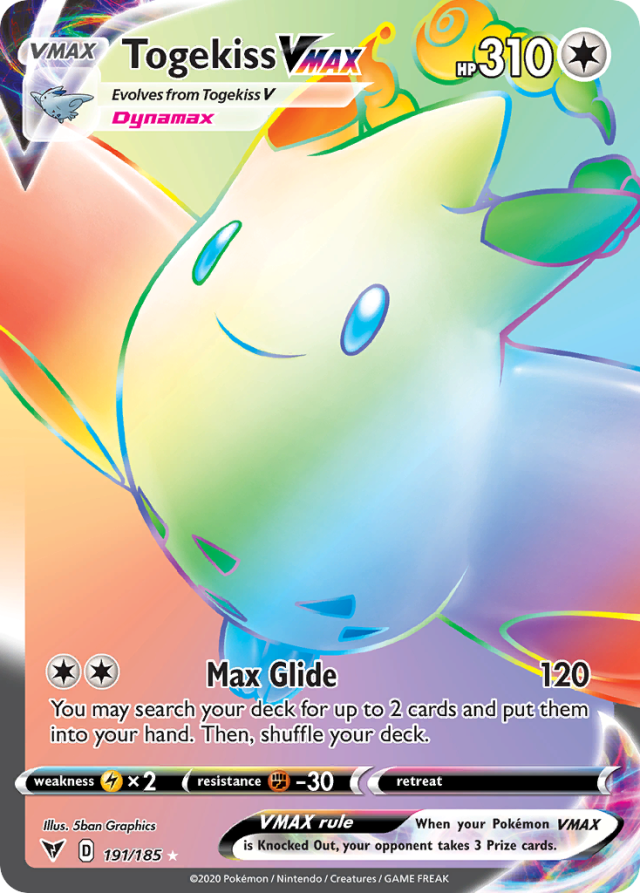
Togekiss VMAX Rainbow is the top chase card of S3a. Togekiss has maintained a devoted fanbase since its Gen IV introduction, and the Rainbow foil treatment applied to its VMAX form produces one of the more aesthetically gentle Hyper Rares in the Sword & Shield era. At ¥4,500 ($32), it’s the set’s highest-value single card.
Allister SR — Galar’s Ghost Gym Leader
SR
Allister
~¥2,800 (~$20)
Pull rate: ~1/box (est.)
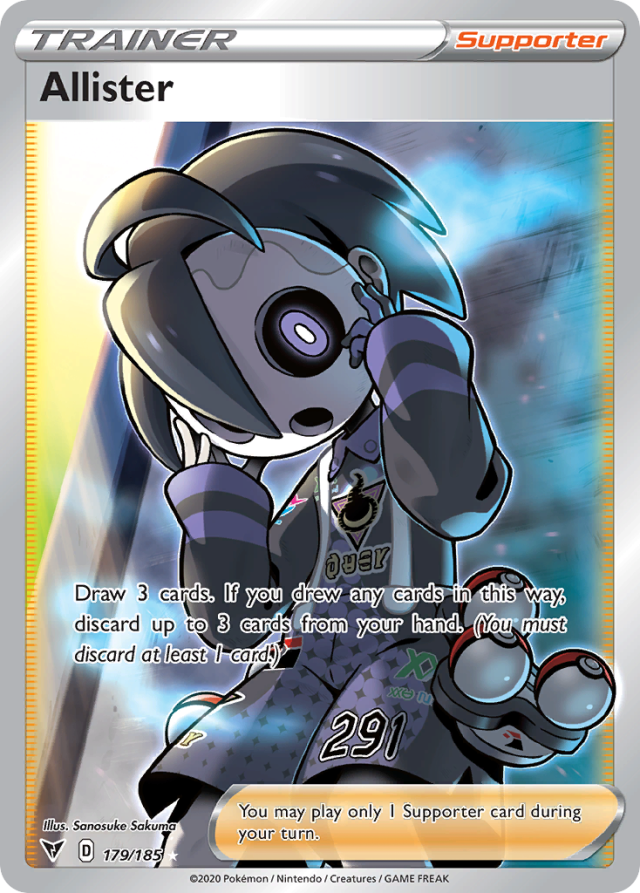
Allister is Galar’s mysterious masked Ghost-type Gym Leader, and S3a gave him his first full-art SR trainer treatment. The illustration by Sanosuke Sakuma captures Allister’s ethereal, shy character design with a muted color palette and ghostly atmosphere. At ¥2,800 ($20), it’s a favorite among character card collectors and Ghost-type enthusiasts.
Opal SR — The Elderly Fairy Gym Leader
SR
Opal
~¥1,800 (~$13)
Pull rate: ~1/box (est.)
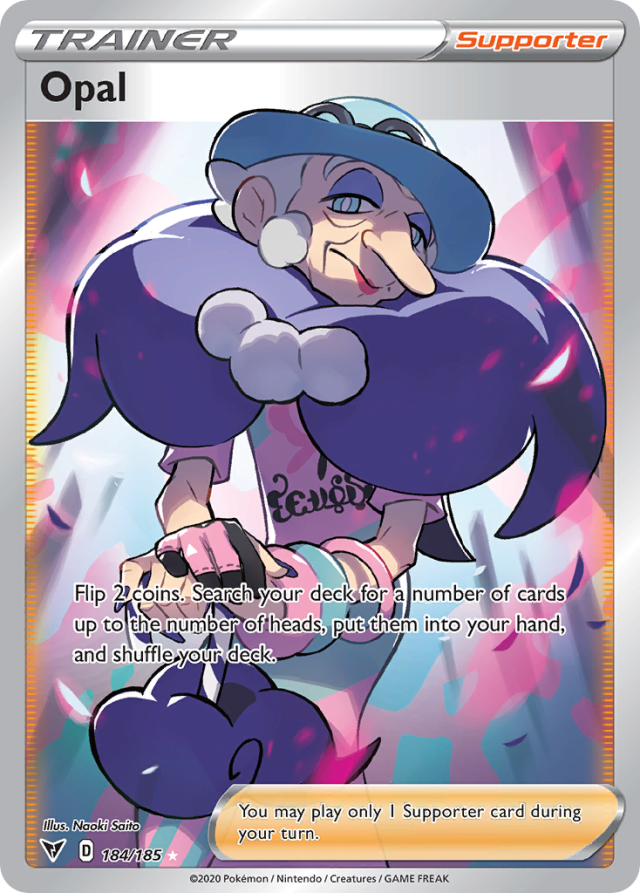
Opal, Galar’s elderly Fairy Gym Leader from Ballonlea, received her first SR trainer card in S3a. Naoki Saito’s illustration depicts Opal in her signature pink outfit with the dramatic scenery of Ballonlea’s mushroom forest behind her. Opal is one of the more unusual character designs in Galar — an elderly woman Gym Leader with strong opinions — and her SR card has become a cult favorite.
Allister HR Rainbow
The Rainbow Hyper Rare version of Allister (~¥2,200 / $16) uses the same Sanosuke Sakuma illustration with rainbow gold foil treatment. Slightly less valuable than the SR version despite higher rarity — an unusual pattern that reflects the collector preference for the cleaner SR artwork.
Coalossal VMAX & Alcremie VMAX HR
S3a also features Coalossal VMAX HR (~¥1,500) and Alcremie VMAX HR (~¥1,500), rounding out the set’s VMAX Rainbow offerings. These are less iconic Pokémon than Togekiss but still represent unique Galar-era VMAX chase cards.
Should You Buy S3a Legendary Heartbeat?
For Character Card Collectors
S3a is strong for collectors targeting Galar Gym Leader character cards. Allister SR and Opal SR are both from S3a and represent their first Sword & Shield-era full art treatments. For completing a Galar Gym Leader character collection, S3a is mandatory.
For Togekiss Collectors
Togekiss VMAX Rainbow is the only Rainbow foil Togekiss VMAX from the S-series. Mandatory for Togekiss collectors.
For Budget Collectors
At ¥18,000 ($128), S3a is one of the most affordable sealed S-series boxes from the 2020 era. For collectors who want early Sword & Shield sealed content without paying premium prices for the major sets, S3a delivers the opening experience at reasonable cost.
S3a Pull Rates & Box EV
Category
Rate/Box
Avg Value
EV
VMAX Rainbow HR
~0.2
¥2,500
¥500
Allister/Opal SR
~0.5
¥2,300
¥1,150
V SR cards
~1
¥1,500
¥1,500
UR Gold cards
~0.1
¥1,500
¥150
RR/RRR cards
~4
¥400
¥1,600
Other cards
—
—
¥1,500
Estimated Total EV
~¥6,400
Market BOX price
~¥18,000
EV / Cost ratio
~36%
Where to Buy S3a Legendary Heartbeat
Browse S3a Legendary Heartbeat →
Authenticated Japanese sealed boxes with Allister, Opal, and Togekiss cards.
S3a (伝説の鼓動) is a Japanese Sword & Shield subset released July 10, 2020. It contains 94 cards focused on Galar Gym Leader character cards and VMAX Rainbow Pokémon. Key cards include Togekiss VMAX Rainbow, Allister SR, and Opal SR. Many S3a cards were incorporated into English Vivid Voltage (swsh4).
What is the top card in S3a Legendary Heartbeat?
Togekiss VMAX Rainbow HR at approximately ¥4,500 ($32) is the top-valued card. Allister SR (¥2,800) and Opal SR (¥1,800) are the next most valuable as popular Gym Leader character cards from the Galar region.
Is S3a worth buying at ¥18,000?
S3a has a ~36% box EV ratio — average for S-series. It’s one of the cheapest early S-series sealed boxes, making it accessible for collectors who want 2020-era Japanese content without premium pricing. Mandatory for Allister, Opal, or Togekiss collectors.
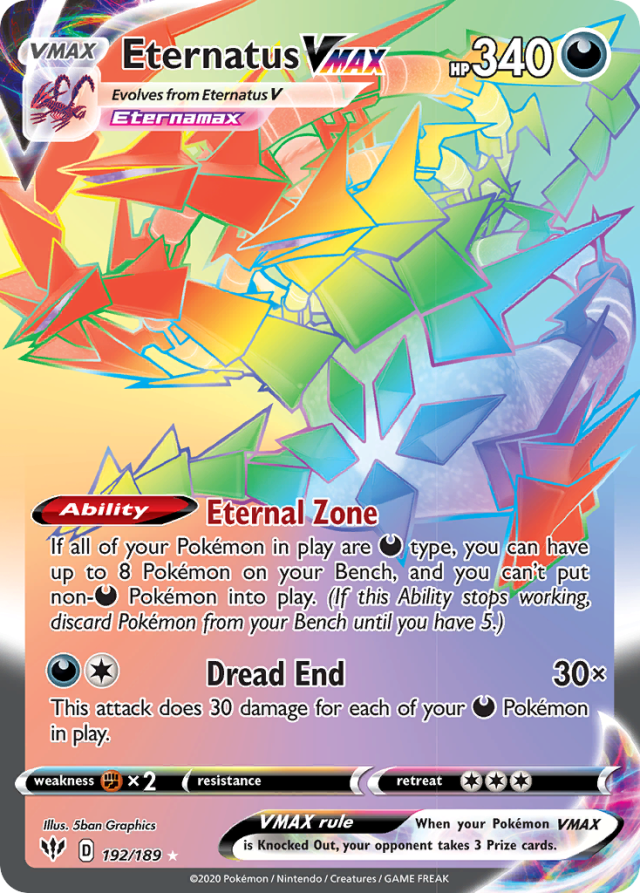
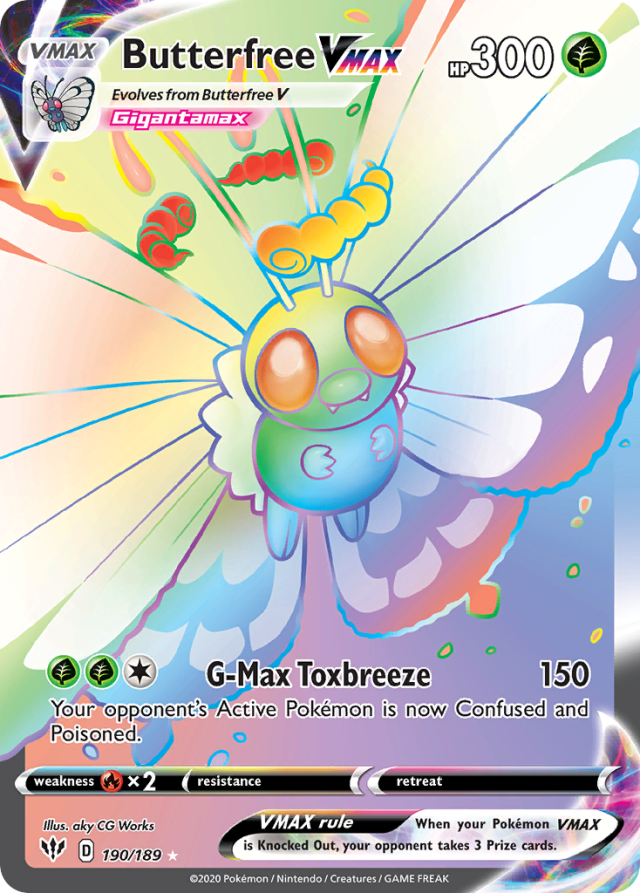
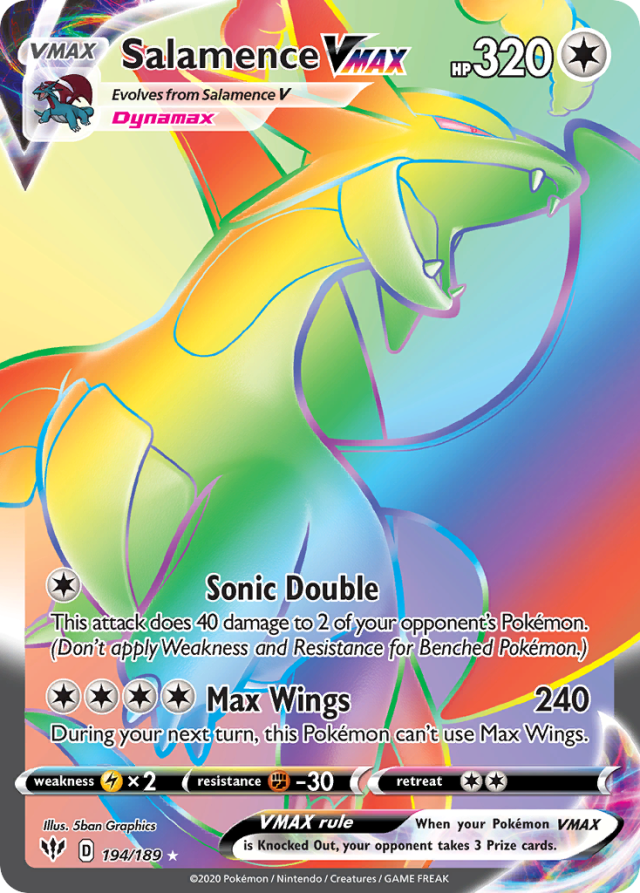
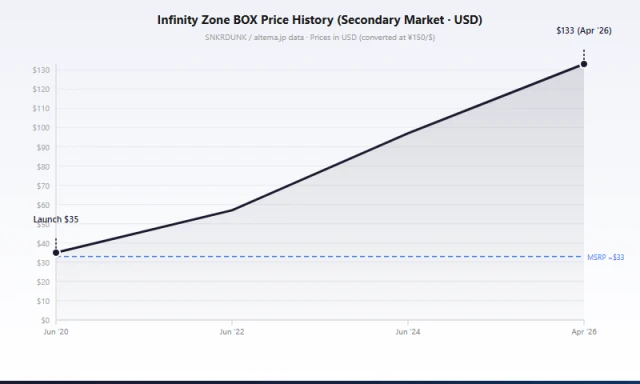
Released on June 5, 2020 as one of the earliest Sword & Shield expansions, S3 Infinity Zone (無限ゾーン) introduced Galar’s central villain Pokémon — Eternatus VMAX — to the TCG. This set is historically significant as the Japanese source for English Darkness Ablaze (swsh3), and it features one of the most varied VMAX Rainbow lineups of the early S-series: Eternatus, Salamence, Scizor, Butterfree, and Centiskorch all received Rainbow Hyper Rare treatments. Sealed S3 boxes trade at ~¥20,000 ($142) in 2026.
S3 Infinity Zone: Set Overview
Set Code
S3
Japanese Name
無限ゾーン (Mugen Zone)
English Source
Darkness Ablaze (swsh3)
Release Date
June 5, 2020
Pack Configuration
30 packs / box, 5 cards / pack
MSRP
¥4,950 per box
Market Price (2026)
~¥20,000 (~$142)
Total Cards
~100 + secret rares
Top Cards in S3 Infinity Zone
Eternatus VMAX Rainbow
HR
Eternatus VMAX
~¥4,500 (~$32)
Pull rate: ~1/10 boxes (est.)
Eternatus VMAX Rainbow is the headline card of S3 Infinity Zone. Eternatus is Galar’s central antagonist Legendary — the cosmic dragon that threatens the region in Pokémon Sword & Shield’s main story. The VMAX form depicts Eternatus in its massive Eternamax state, and the Rainbow foil treatment emphasizes the Pokémon’s alien, multi-dimensional design. At ¥4,500 ($32), it’s the set’s chase card and a mandatory pull for Galar Legendary collectors.
Butterfree VMAX Rainbow
HR
Butterfree VMAX
~¥6,000 (~$43)
Pull rate: ~1/10 boxes (est.)
Surprisingly, Butterfree VMAX Rainbow (aky CG Works) has emerged as the most valuable card in S3, slightly edging out Eternatus. The illustration captures Butterfree in a delicate flight pose with prismatic wing details — the Rainbow foil creates a natural iridescence that matches Butterfree’s natural beauty. For Gen I collectors and butterfly Pokémon enthusiasts, this is the premier modern Butterfree TCG card. At ¥6,000 ($43), it’s the set’s top value pull.
Salamence VMAX Rainbow
HR
Salamence VMAX
~¥5,000 (~$35)
Pull rate: ~1/10 boxes (est.)
Salamence VMAX Rainbow is another key chase card — the Hoenn pseudo-legendary dragon in its VMAX form. Hoenn-era collectors prize this as one of the best modern Salamence cards. At ¥5,000 ($35), it’s a strong mid-tier pull.
Scizor VMAX Rainbow
Scizor VMAX Rainbow (~¥4,000 / $28) is the fourth Rainbow VMAX in the set. Scizor has consistent collector demand as a classic Johto bug-steel type, and the Rainbow foil treatment makes this one of the more accessible VMAX Rainbow cards from 2020.
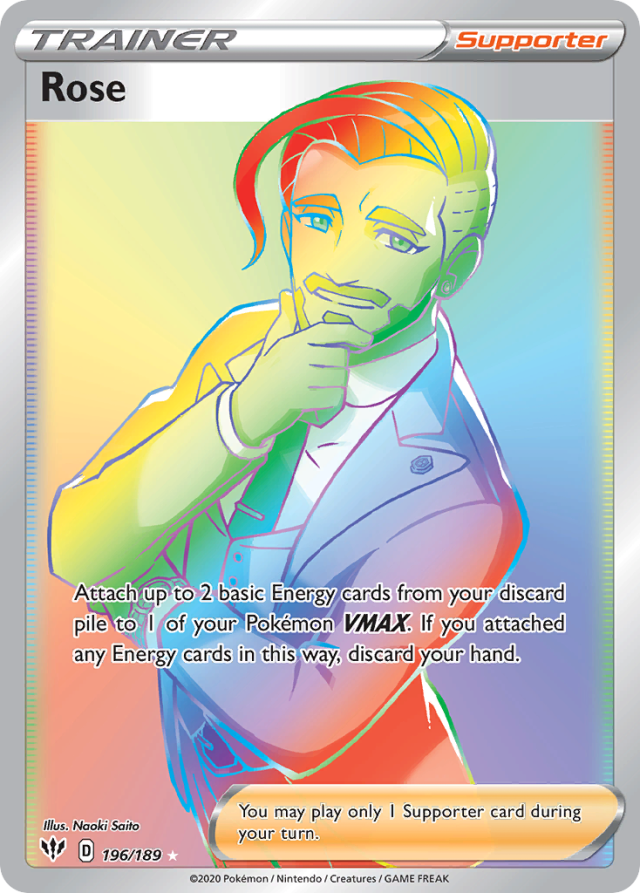
Rose HR Rainbow — Galar Chairman
HR
Rose
~¥1,500 (~$11)
Pull rate: ~1/10 boxes (est.)
Rose is the chairman of Galar’s Macro Cosmos corporation and the main story antagonist of Pokémon Sword & Shield. His Rainbow HR trainer card (Naoki Saito) features Rose in his iconic blue business attire. At ¥1,500 ($11), it’s a modest pick-up but essential for Galar character card collections. The S3 set is the primary source for Rose character cards.
S3 Pull Rates & Box EV
Category
Rate/Box
Avg Value
EV
VMAX Rainbow HR (5 variants)
~0.5
¥4,500
¥2,250
V SR / trainer SR
~2
¥1,500
¥3,000
UR Gold cards
~0.1
¥2,000
¥200
RR/RRR cards
~5
¥500
¥2,500
Other cards
—
—
¥1,500
Total EV
~¥9,450
Market BOX
~¥20,000
EV ratio
~47%
S3’s 47% EV ratio is above average for S-series because the value is distributed across 5 VMAX Rainbow cards rather than concentrated in one chase. This makes it one of the more “fair” box opening experiences in the early Sword & Shield era.
S3 Price History
Jun 2020: ¥5,200
Jun 2022: ¥8,500
Jun 2024: ¥14,500
Apr 2026: ¥20,000
Where to Buy S3 Infinity Zone
Browse S3 Infinity Zone →
Authenticated sealed boxes with Eternatus VMAX and Rainbow VMAX cards.
S3 (無限ゾーン) is a Japanese Sword & Shield expansion released June 5, 2020. It’s the source for English Darkness Ablaze (swsh3) and features Eternatus VMAX as the headline card alongside Salamence, Scizor, Butterfree, and Centiskorch VMAX Rainbow cards.
Is S3 the same as Darkness Ablaze?
Yes, S3 Infinity Zone is the Japanese source for English Darkness Ablaze (swsh3). Card pools are nearly identical. Note that Charizard VMAX Rainbow (from Champion’s Path swsh35) is NOT in S3 — that’s a separate Japanese set.
Released on May 15, 2020, S2a Explosive Walker (爆炎ウォーカー) is one of the smallest Japanese Sword & Shield subsets, featuring Centiskorch and its Gigantamax form as the central theme alongside a strong Gardevoir VMAX chase card. At 86 cards total, it’s a compact set with focused pull rates — sealed boxes trade at ~¥15,000 ($106) in 2026.
S2a Explosive Walker: Set Overview
Set Code
S2a
Japanese Name
爆炎ウォーカー (Bakuen Walker)
English Source
Partial source for Champion’s Path (swsh35) / various
Release Date
May 15, 2020
Pack Configuration
30 packs / box, 5 cards / pack
MSRP
¥4,950 per box
Market Price (2026)
~¥15,000 (~$106)
Total Cards
86 cards
Top Cards in S2a Explosive Walker
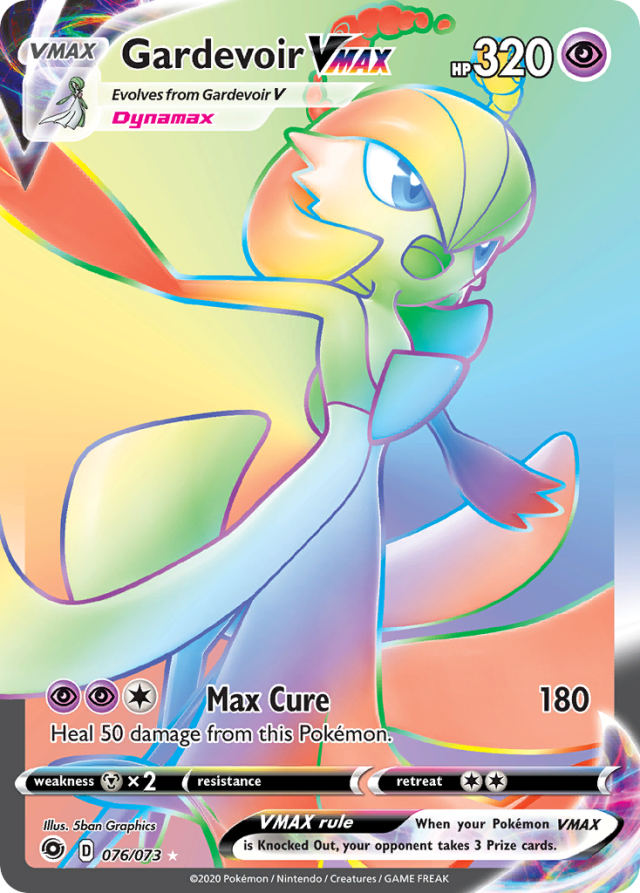
Gardevoir VMAX Rainbow HR
HR
Gardevoir VMAX
~¥3,500 (~$25)
Pull rate: ~1/10 boxes (est.)
Gardevoir VMAX Rainbow is S2a’s top chase card. Gardevoir has devoted fan demand across all Pokémon generations, and the Rainbow foil treatment applied to the elegant psychic-fairy type creates one of the most aesthetically beautiful VMAX Rainbow cards of the early Sword & Shield era. At ¥3,500 ($25), it’s a modest but meaningful pull.
Centiskorch VMAX
RRR
Centiskorch VMAX
~¥1,200 (~$9)
Pull rate: ~2/box (est.)
Centiskorch VMAX is S2a’s namesake card — Centiskorch being the Galar Fire/Bug-type featured in the set’s theme. Its Gigantamax form is massive and snake-like, making for an impressive VMAX illustration. The set’s name “Explosive Walker” references Centiskorch’s fiery appearance.
Kabu HR Rainbow — Galar Fire Gym Leader
HR
Kabu
~¥1,200 (~$9)
Pull rate: ~1/10 boxes (est.)
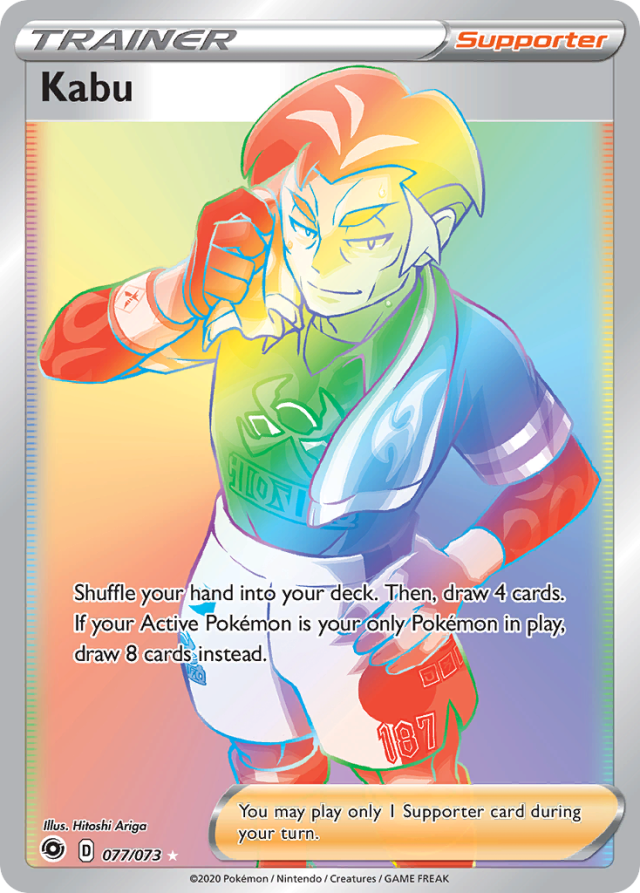
Kabu is Galar’s Fire-type Gym Leader from Motostoke — the second gym challenger on Galar’s circuit. His Rainbow HR trainer card (Hitoshi Ariga) captures Kabu’s fighter-instructor character design. For Galar Gym Leader character card collectors, this is the primary Kabu card.
S2a (爆炎ウォーカー) is a 86-card Japanese Sword & Shield subset released May 15, 2020. It features Centiskorch and its Gigantamax form, with Gardevoir VMAX Rainbow as the top chase card. Many cards were later included in English Champion’s Path or other English releases.
What is the top card in S2a?
Gardevoir VMAX Rainbow at approximately ¥3,500 ($25) is the top-valued card. Centiskorch VMAX and Kabu HR Rainbow round out the top tier.
Released on April 3, 2020 as the second main Sword & Shield expansion, S2 Rebellion Crash (反逆クラッシュ) introduced the Galar starter final evolutions in VMAX form (Rillaboom, Cinderace, Inteleon) alongside the set’s headline chase — Dragapult VMAX, the ghost-dragon pseudo-legendary. Sealed boxes trade at ~¥25,000 ($177) in 2026, driven by steady collector demand for the Dragapult and Boss’s Orders cards.
S2 Rebellion Crash: Set Overview
Set Code
S2
Japanese Name
反逆クラッシュ (Hangyaku Crash)
English Source
Rebel Clash (swsh2)
Release Date
April 3, 2020
Pack Configuration
30 packs / box, 5 cards / pack
MSRP
¥4,950 per box
Market Price (2026)
~¥25,000 (~$177)
Total Cards
~210 (combined with secret rares)
Top Cards in S2 Rebellion Crash
Dragapult VMAX Rainbow — The Headline Chase
HR
Dragapult VMAX
~¥6,000 (~$43)
Pull rate: ~1/10 boxes (est.)
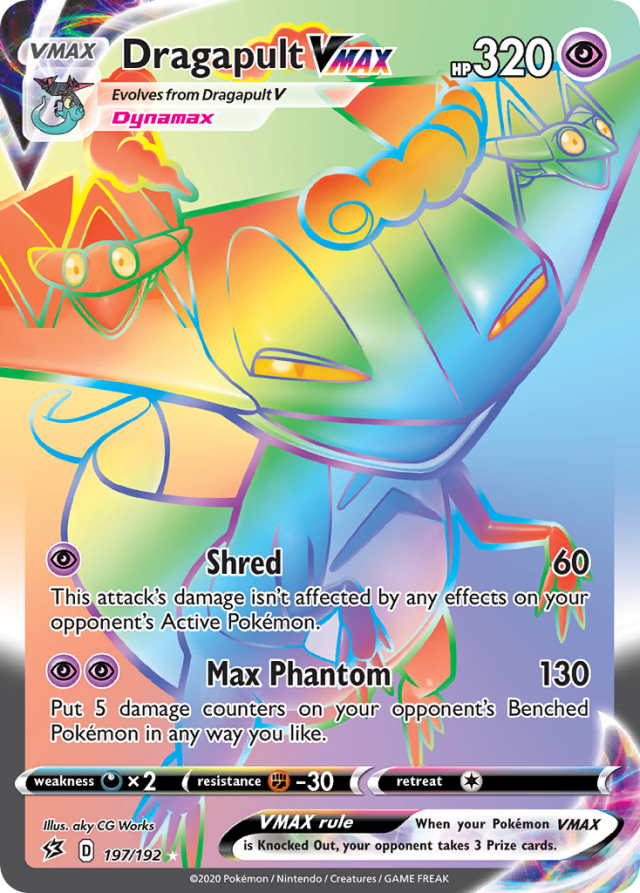
Dragapult is Galar’s ghost-dragon pseudo-legendary, and its VMAX Rainbow (aky CG Works) is one of the most visually striking cards from the early Sword & Shield era. The stealth-fighter-like design translates beautifully to the Rainbow foil treatment. At ¥6,000 ($43), it’s S2’s premier VMAX chase.
Boss’s Orders (Giovanni) Rainbow — The Iconic Trainer
HR
Boss’s Orders (Giovanni)
~¥12,000 (~$85)
Pull rate: ~1/12 boxes (est.)
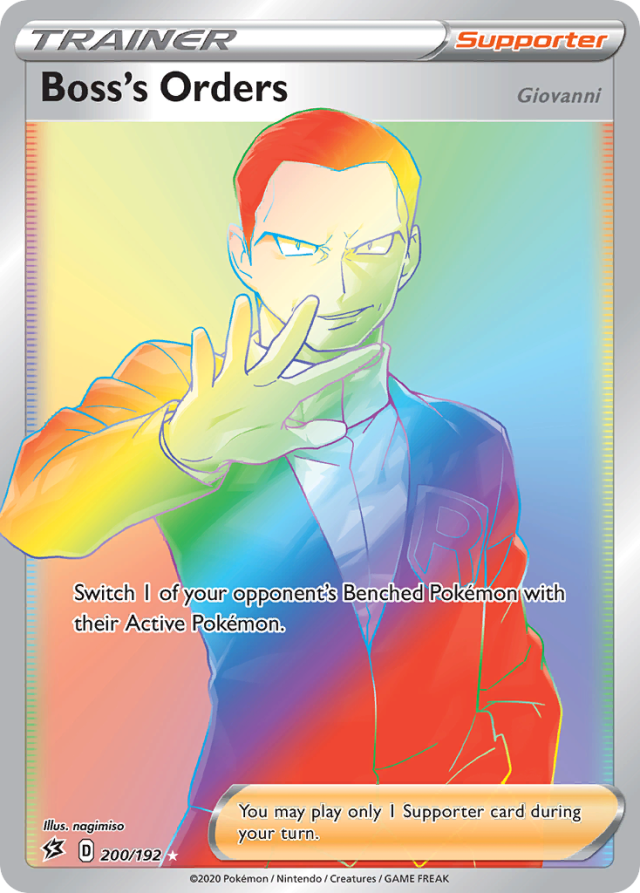
Boss’s Orders featuring Giovanni is the most valuable card in S2 Rebellion Crash. Giovanni — Team Rocket’s boss from the original Pokémon anime/games — is given a dramatic modern illustration by nagimiso. The Rainbow foil treatment on Giovanni’s iconic character design has made this one of the most desirable trainer cards of the entire Sword & Shield era. At ¥12,000 ($85), it’s the top-value pull from S2.
Cinderace VMAX Rainbow
HR
Cinderace VMAX
~¥5,000 (~$35)
Pull rate: ~1/10 boxes (est.)
Cinderace is Galar’s fire-type starter final evolution, and its VMAX form appears in S2 as one of the flagship Pokémon. At ¥5,000 ($35), it’s a mid-tier chase that pairs with Rillaboom VMAX and Inteleon VMAX for a complete Galar starter VMAX collection.
Toxtricity VMAX Rainbow
Toxtricity VMAX Rainbow (~¥4,500 / $32) is another electric-poison chase from the set, featuring the set’s rebellious punk-rock Pokémon in full color.
Sonia Rainbow — Galar’s Professor
HR
Sonia
~¥4,000 (~$28)
Pull rate: ~1/12 boxes (est.)
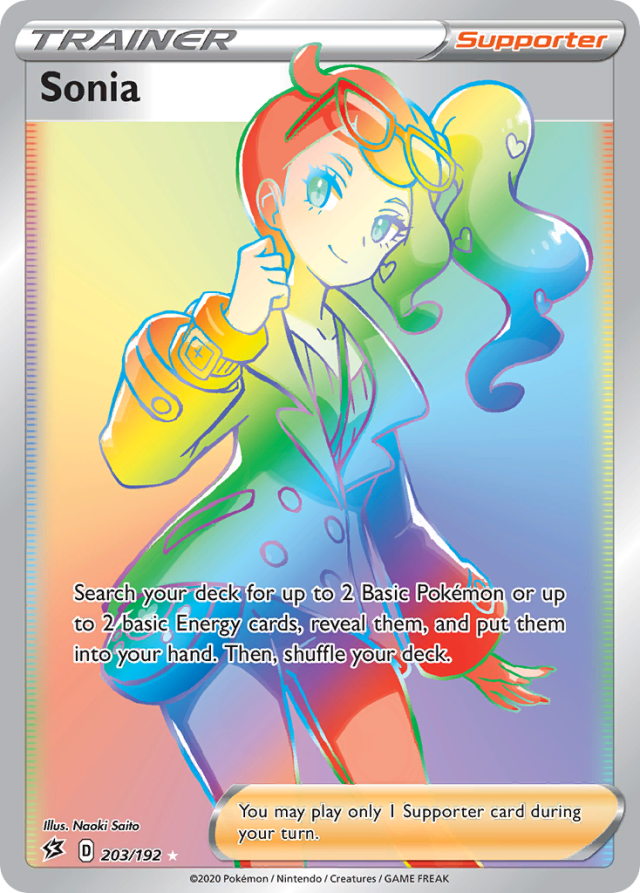
Sonia is Professor Magnolia’s granddaughter and Galar’s young Pokémon researcher. Her Rainbow HR card by Naoki Saito is a favorite among Galar character collectors. Sonia’s design — pink hair, stylish outfit, genuine Pokémon enthusiasm — has given her strong cross-regional collector appeal.
S2’s 48% EV ratio is above average — one of the better early Sword & Shield boxes for consistent pack opening value. The multiple VMAX Rainbow cards combined with highly-sought trainer Rainbows (Boss’s Orders, Sonia) give S2 durable collector interest.
Where to Buy S2 Rebellion Crash
Browse S2 Rebellion Crash →
Authenticated sealed boxes with Dragapult VMAX, Boss’s Orders, and Galar starter VMAX cards.
S2 (反逆クラッシュ) is the second main Japanese Sword & Shield expansion, released April 3, 2020. It’s the source for English Rebel Clash (swsh2) and features Dragapult VMAX, Boss’s Orders (Giovanni), and all three Galar starter final evolutions in VMAX form.
Why is Boss’s Orders valuable?
Boss’s Orders features Giovanni — Team Rocket’s boss from the original Pokémon anime and Gen I games. The character has 25+ years of fan recognition, and nagimiso’s dramatic illustration combined with Rainbow foil treatment makes it one of the most desirable modern trainer cards. At ~¥12,000, it’s the top card in S2.
Released on December 6, 2019 as the first Japanese Sword & Shield expansion, S1W Sword V (ソード) is the Sword-version half of Japan’s launch dual release. Alongside its companion S1H Shield V, it represents the birth of the V/VMAX era in Japanese TCG. Featuring Zacian V as the set’s legendary headliner and sharing the secret rare pool with S1H including Snorlax VMAX Rainbow and Marnie Rainbow, S1W boxes trade at ~¥28,000 ($199) in 2026 — nearly 6× MSRP appreciation over 6 years.
S1W Sword V: Set Overview
Set Code
S1W
Japanese Name
ソード (Sword)
English Source
Sword & Shield (swsh1)
Release Date
December 6, 2019
Pack Configuration
30 packs / box, 5 cards / pack
MSRP
¥4,950 per box
Market Price (2026)
~¥28,000 (~$199)
Companion Set
S1H Shield V
S1W vs S1H — The Sword Half
S1W and S1H released simultaneously as Japan’s launch of the Sword & Shield TCG era. The two sets share nearly identical card pools — the differences being the box art (Zacian for S1W, Zamazenta for S1H) and the featured card number positions. S1W emphasizes Zacian V (the Sword legendary), while S1H emphasizes Zamazenta V (the Shield legendary). For most collector purposes, the two sets are interchangeable — you choose based on which legendary you prefer.
Top Cards in S1W Sword V
Snorlax VMAX Rainbow — The Top Chase
HR
Snorlax VMAX
~¥11,500 (~$82)
Pull rate: ~1/10 boxes (est.)
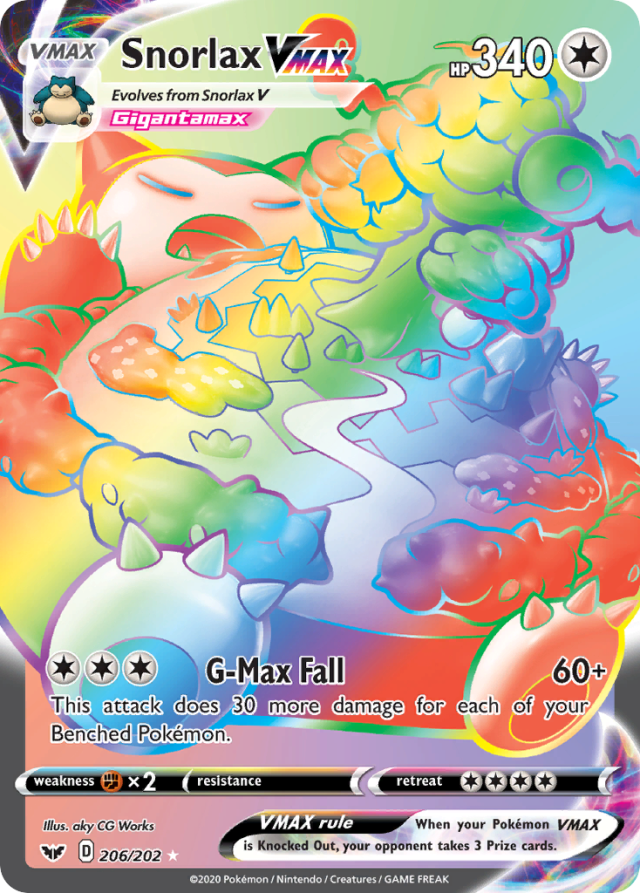
Snorlax VMAX Rainbow by aky CG Works is the single most valuable card shared between S1W and S1H. The illustration captures the iconic sleeping Pokémon at massive VMAX scale, with Rainbow foil treatment enhancing Snorlax’s rounded silhouette. At ¥11,500 ($82), it’s the definitive S1 chase card and one of the earliest iconic Rainbow VMAX cards in Japanese TCG history.
Zacian V Gold Secret
UR
Zacian V
~¥2,400 (~$17)
Pull rate: ~1/12 boxes (est.)
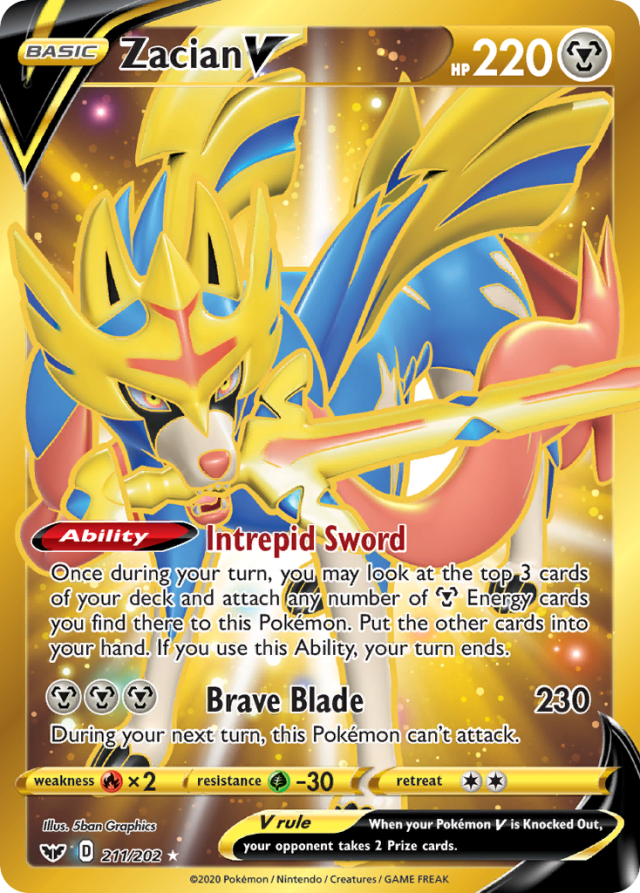
Zacian V Gold Secret is the thematic centerpiece of S1W Sword V. Zacian is Galar’s Sword legendary — the crowned sword-wielding wolf Pokémon that represents the Sword version of the games. The gold UR treatment features a full gold-foil background with Zacian’s heroic pose prominently displayed. Essential for any Sword-version collector.
Marnie Rainbow
HR
Marnie
~¥2,700 (~$19)
Pull rate: ~1/12 boxes (est.)
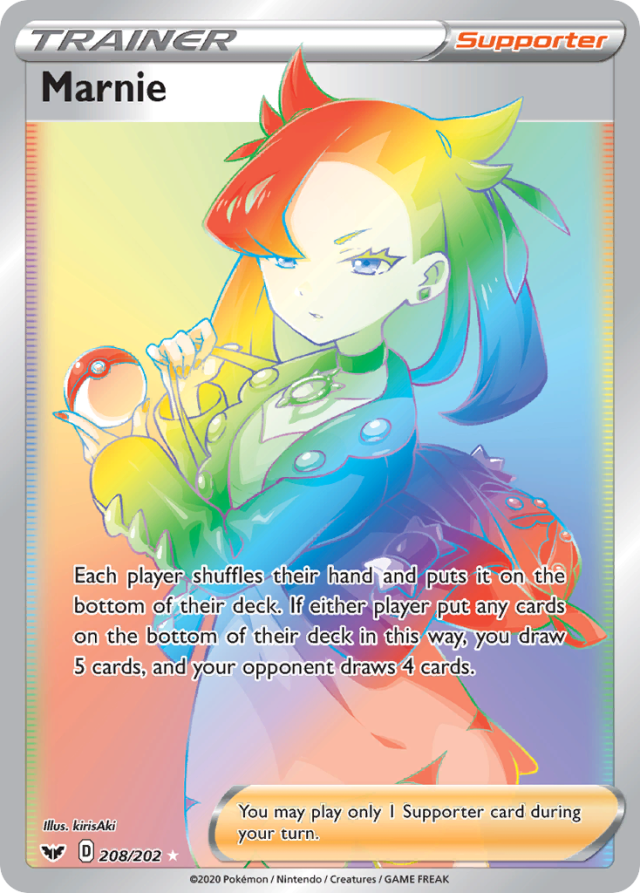
Marnie is one of the most popular Galar trainers — a rival character from Spikemuth with a rebellious punk-gothic aesthetic. Her Rainbow HR trainer card by kirisAki has become iconic. At ¥2,700 ($19), it’s a strong chase card that drives collector demand for S1W/S1H boxes specifically. Marnie has consistently been one of the most-searched Japanese trainer cards since 2020.
Lapras VMAX Rainbow
Lapras VMAX Rainbow (~¥2,100 / $15) is another classic Gen I Pokémon receiving VMAX Rainbow treatment. The nostalgic Kanto appeal combined with Rainbow foil makes this a favorite among Gen I collectors.
Bede Rainbow
Bede is Galar’s mysterious Fairy-type rival. His Rainbow HR (Naoki Saito) at ~¥750 is a lower-tier but thematically complete trainer pickup.
S1W Pull Rates & Box EV
Category
Rate/Box
Avg Value
EV
Snorlax VMAX Rainbow HR
~0.1
¥11,500
¥1,150
Other VMAX Rainbow (Lapras, Morpeko, Stonjourner)
~0.3
¥3,000
¥900
Marnie Rainbow HR
~0.08
¥2,700
¥216
Other Trainer HR (Bede, Magnolia, Team Yell)
~0.3
¥800
¥240
Zacian/Zamazenta V Gold UR
~0.08
¥2,400
¥192
V SR cards
~2
¥1,500
¥3,000
RR/RRR cards
~5
¥500
¥2,500
Other cards
—
—
¥1,500
Total EV
~¥9,698
Market BOX
~¥28,000
EV ratio
~35%
Where to Buy S1W Sword V
Browse S1W Sword V →
Authenticated sealed boxes featuring Zacian V Gold and Snorlax VMAX Rainbow.
S1W (ソード) is the Sword-version launch expansion of the Japanese Sword & Shield TCG era, released December 6, 2019. It shares card pools with S1H Shield V but features Zacian V as the Sword-themed legendary. Both sets are the Japanese source for English Sword & Shield (swsh1).
Should I buy S1W or S1H?
Card pools are nearly identical — choose based on which legendary you prefer (Zacian for Sword/S1W, Zamazenta for Shield/S1H) or box art preference. Pricing between S1W and S1H is typically within 5-10% of each other. For completionist collectors, both are required.