Japanese TCG Store Samurai Sword

Japanese Pokemon Card Rarities Explained (2026 Guide)
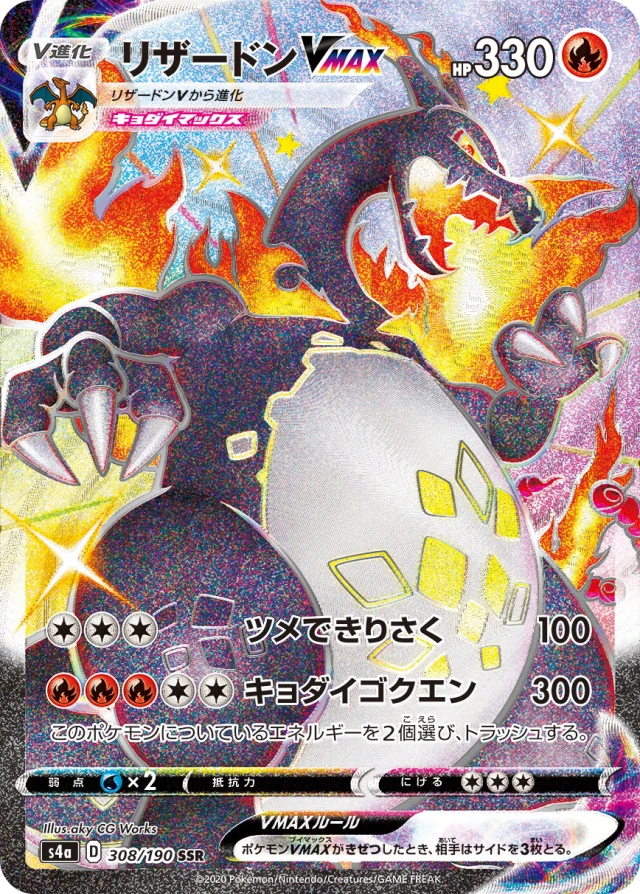
You opened a Japanese booster pack, pulled a card with a gold “SAR” stamp in the corner, and now you’re wondering whether you just hit $30 or $300.

Japanese Pokemon cards use a rarity system that looks familiar on the surface — C, U, R, SR — but adds a whole second tier of modern rarities (AR, SAR, UR, MUR, CHR, CSR) that don’t map cleanly to the English Scarlet & Violet system most Western collectors learned first. The symbols are often printed in a corner smaller than a fingernail, in Japanese, and the price gap between two rarities that look almost identical can be 20×.

This guide walks through every current Japanese Pokemon card rarity from Common to MUR, with USD price ranges, realistic pull-rate estimates per booster box, and the set examples where you’ll actually encounter each one. By the end you’ll be able to glance at any JPN card and know roughly what tier it sits in — and what it’s worth.

We ship Japanese Pokemon cards out of Tokyo every day. The price ranges below are based on current SNKRDUNK and Mercari data converted to USD at approximately ¥141/USD, tracked across our own outbound order flow.

Key Takeaway

Japanese sets stack two layers of rarity: gameplay tiers (C, U, R, RR) that fill packs, and chase tiers (AR, SR, SAR, UR, MUR) that drive pricing. SAR is the modern headline rarity, MUR is the new top tier from the Mega era, and the JPN-to-ENG mapping is mostly one-to-one once you learn the codes.

10+
Distinct Rarity Tiers

SAR
Modern Headline Rarity

MUR
New Top Tier (2026)

15–40%
JPN Premium Over ENG

What Are Japanese Pokemon Card Rarities?

Japanese Pokemon cards sort into two broad groups: regular-set rarities (C, U, R, RR) that make up the bulk of a pack, and chase rarities (AR, SR, SAR, UR, MUR) that sit at the back of the checklist and drive secondary-market prices. On top of that, The Pokémon Company occasionally introduces special rarities tied to specific sets — CHR (Character Rare) from the S4a Shiny Star V era, CSR (Character Super Rare), and MUR (Mega Ultra Rare) which debuted with the Mega Evolution sets starting in 2026.

The rarity symbol is printed in the bottom-left or bottom-right corner of the card, next to the card number. Modern Japanese sets (Sword & Shield, Scarlet & Violet, Mega era) use letter codes — “SR,” “SAR,” “AR,” “UR” — while older cards used star symbols. If you’re holding a card with no visible rarity stamp at all, check the bottom corner under a bright light: AR and SAR cards sometimes have the code printed very small against the textured artwork.

Rarity Symbol / Code Est. Pull Rate Price Range (USD)
Common (C) None ~60% of pack ~$0
Uncommon (U) ◆ (Black diamond) ~25% of pack ~$0
Rare (R) ~1 per pack $0.50–$5
Double Rare (RR) ★★ ~1 per pack $3–$30
AR (Art Rare) “AR” ~2–3 per box $2–$20
SR (Super Rare) “SR” ~1–2 per box $10–$100+
SAR (Special Art Rare) “SAR” ~1 per 3–4 boxes $20–$500+
UR (Ultra Rare, Gold) “UR” ~1 per 8–12 boxes $15–$100+
MUR (Mega Ultra Rare) “MUR” ~1 per 20–30 boxes $150–$800+
CHR (Character Rare) “CHR” Set-dependent $5–$30

Here’s the thing: rarity alone doesn’t determine price. A generic SR trainer can sit at $10 while an SAR of a headline Pokemon from the same set pulls $300+. Artwork, the Pokemon depicted, the artist’s signature, and whether the set is still in print all multiply on top of the base rarity tier.

Common (C) and Uncommon (U): The Base of the Set
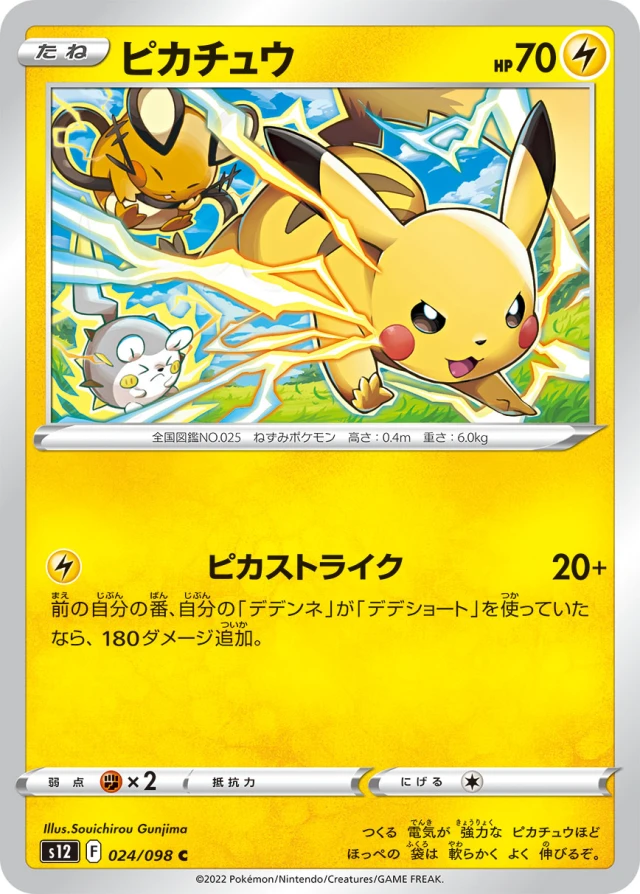
Pikachu Common from S12 Paradigm Trigger — typical Japanese Pokemon Common card with no rarity symbol
Pikachu — S12 Paradigm Trigger (Common, C)

Commons and Uncommons fill out the gameplay pool — energy cards, basic Pokemon, low-impact trainers. Their rarity symbol is either blank (Common) or a black diamond (Uncommon) in the corner.

  • Common (C): Roughly 60% of a pack. Non-holo. Trade at or near $0 as singles.
  • Uncommon (U): Roughly 25% of a pack. Non-holo. Also near $0 as singles.

Competitive players still buy C/U cards as 4-of playsets for tournaments, but from a collector standpoint they’re bulk. The exception is when a Common card becomes surprise meta-relevant — prices can briefly spike to $1–$3 before settling. For modern Japanese sets we stock, browse the SV11W Super Electric Breaker card list to see how C/U slots fill a typical Scarlet & Violet set.

Rare (R) and Double Rare (RR): The Holo Tier
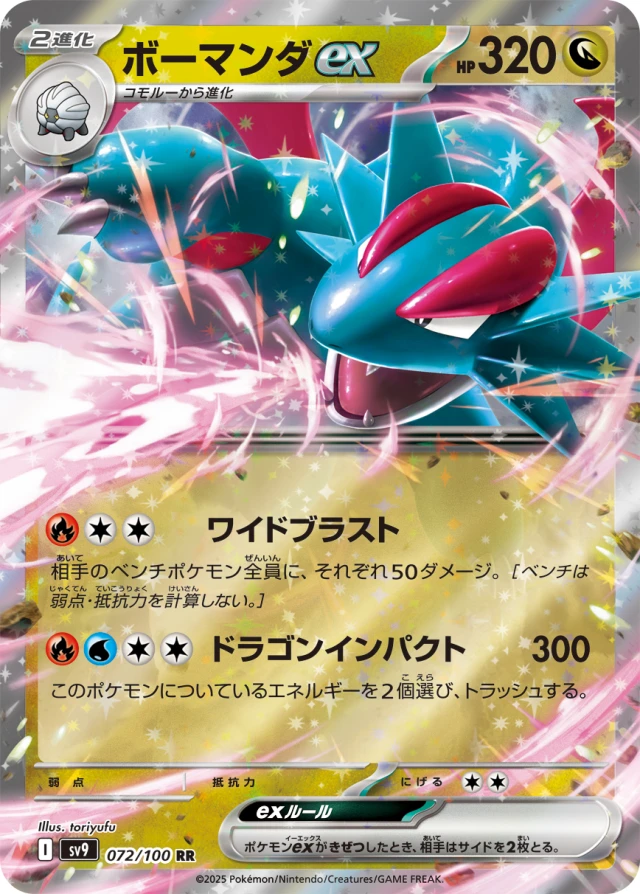
Salamence ex RR from SV9 Battle Partners — Japanese Double Rare with full-art holo pattern
Salamence ex — SV9 Battle Partners (Double Rare, RR)

Rare and Double Rare cards mark the step from bulk into collectible territory. You’ll see one of each in most packs.

  • Rare (R): One black star symbol. Holo foil on the artwork. $0.50–$5 as a single.
  • Double Rare (RR): Two black stars. Full-art holo pattern covering most of the card. $3–$30 depending on the Pokemon.

RR cards in the Scarlet & Violet era correspond to ex cards (Charizard ex, Pikachu ex, Mew ex, etc.) — the powerful Pokemon that also serve as gameplay centerpieces. An RR Charizard ex will typically outprice an RR of a less popular Pokemon from the same set by 5–10×, because brand recognition compounds on the base rarity.

Art Rare (AR): The Illustrated Backgrounds
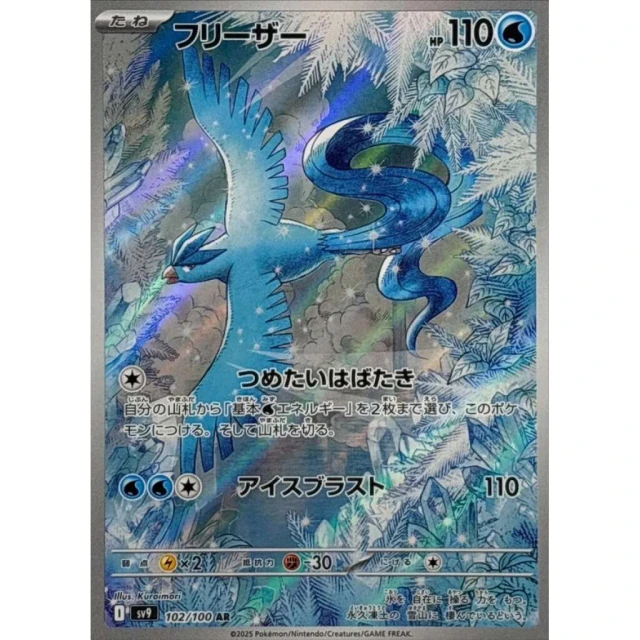
Articuno AR from SV9 Battle Partners — Japanese Art Rare with full illustrated background
Art Rare (AR) — ~$2–$20, pulls ~2–3 per 30-pack box.

Art Rares (AR) are the entry point into serious collecting. These cards take a Pokemon that already exists in the set as a regular C or U and re-print it with a full illustrated background — the Pokemon’s natural habitat, a dynamic action scene, or character interaction. The gameplay text is identical to the non-AR version; the difference is purely artistic.

AR cards drove the “illustration boom” in Japanese Pokemon collecting starting around S11 Lost Abyss (2022) and have been the single most effective rarity for pulling new collectors into the JPN market. They’re approachable price-wise, visually stunning, and feel like the Pokemon franchise at its most confident artistically.

Recent sets worth checking for AR hunting: SV10 Heat Wave Arena, SV9 Battle Partners, and M4 Mega Symphonia. English collectors often recognize the concept under the TCG name “Illustration Rare” — mechanically equivalent but printed separately for each market.

Super Rare (SR): The Classic Chase
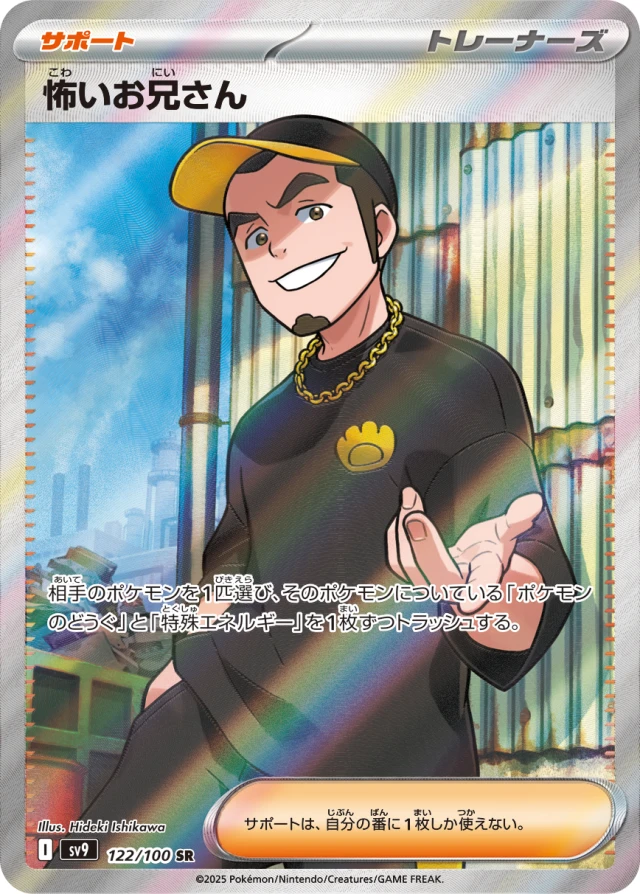
N (Scary Big Brother) Trainer SR from SV9 Battle Partners — Japanese Super Rare full-art trainer card
N (Scary Big Brother) — SV9 Battle Partners (Super Rare, SR)

Super Rare (SR) is the longest-running “chase tier” in modern Japanese Pokemon cards. Every set includes a handful of SRs — usually full-art trainer cards and occasionally Pokemon ex with holo-textured borders and the trainer/character’s name in a distinctive typeface.

  • Symbol: “SR” in the bottom-left corner, or three black stars on older sets.
  • Pull rate: Roughly 1–2 per 30-pack box.
  • Price range: $10–$100+, with popular character SRs pushing toward $150.

Trainer SRs from recent sets — Iono SR, Nemona SR, Ogerpon-themed SRs — are a reliable value floor for the tier. Pokemon SRs (Charizard ex SR, Mew ex SR) often compete on price with Full Art Trainer SRs in the same set, depending on which character has the stronger collector following.

For classic Sword & Shield SRs, the S12a VSTAR Universe card list shows the full SR lineup of the final High Class Pack of that era — still one of the most collected SR pools in the hobby.

Special Art Rare (SAR): The Modern Headline Rarity
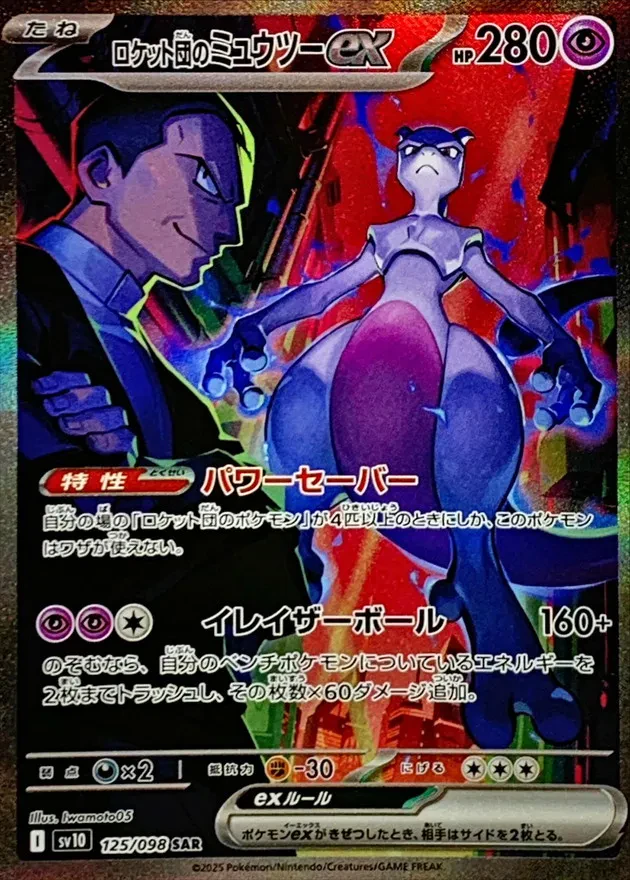
Team Rocket's Mewtwo ex SAR from SV10 Glory of Team Rocket — Japanese Special Art Rare with gold foil border
Special Art Rare (SAR) — ~$20–$500+, pulls ~1 per 3–4 boxes.

SAR (Special Art Rare) is the rarity everyone is actually chasing. Introduced partway through the Sword & Shield era and now standard in every Scarlet & Violet set, SAR cards combine two things at once: a unique alternate illustration (not just the SR art scaled differently) and the top-tier gold-foil border that marks the card as premium.

Every modern set has 2–6 SARs, and the highest-value one is almost always the set’s “chase card” — Nanjamo SAR in SV2a 151, Bellibolt ex SAR in SV2, Iono SAR in SV2a, Mamane (Sophocles) SAR in SV5M, and so on. Art style varies: character SARs typically show the trainer in a cinematic scene with their signature Pokemon, while Pokemon-only SARs (Charizard ex SAR, for example) go for atmospheric full-bleed illustrations.

Current SAR hotspots in our inventory: SV9 Battle Partners, SV11B Black Bolt, and SV10 Heat Wave Arena. For older SA-era equivalents from Sword & Shield, the S6K Jet-Black Geist card list contains the Shadow Rider Calyrex VMAX Alt Art and “Chubby” Blissey V Alt Art — pre-SAR but functionally the same tier.

Ultra Rare (UR): The Gold Cards
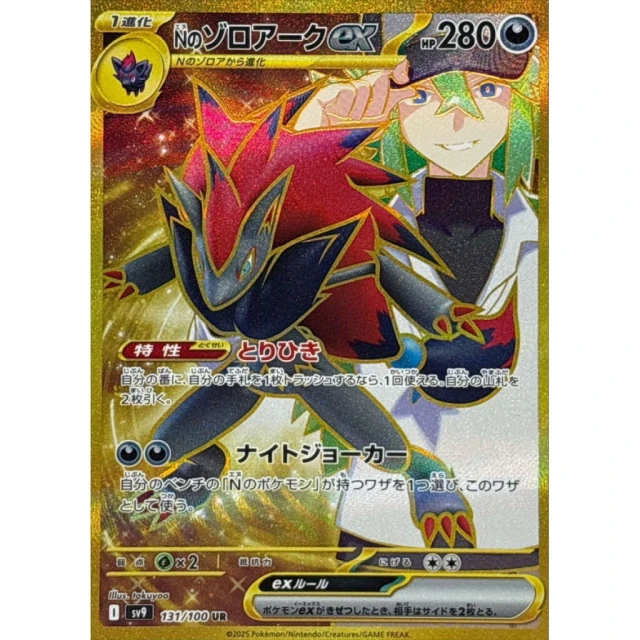
N's Zoroark ex UR from SV9 Battle Partners — Japanese Ultra Rare with fully gold metallic finish
Ultra Rare (UR) — ~$15–$100+, pulls ~1 per 8–12 boxes.

UR (Ultra Rare) cards are the gold-bordered versions of energy cards, stadium cards, and select trainer cards. They use a fully gold metallic finish across the entire card — including the artwork background — which makes them instantly recognizable in a pack.

The UR tier sits in an interesting pricing zone: they’re rarer than SAR per-box, but because they’re not typically the “headline” card, prices land below the top SAR in most sets. URs have stronger floor value than SAR though — a set’s UR lineup rarely depreciates more than 20% even years after release, while a trend-driven SAR can move 40–50% either way.

Good UR hunting from the Sword & Shield era: S12a VSTAR Universe includes URs of multiple signature Pokemon and energy cards. For the current Scarlet & Violet era, SV11W Super Electric Breaker and SV11B Black Bolt URs have held steady pricing through 2026.

MUR (Mega Ultra Rare): The New Top Tier
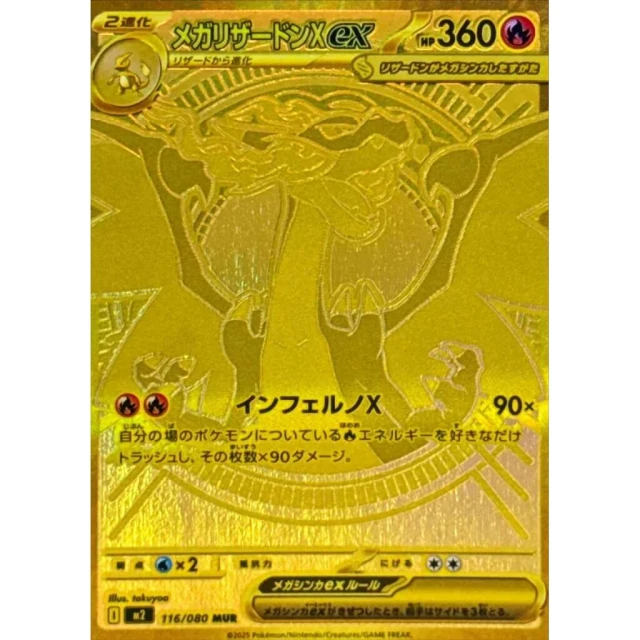
Mega Charizard X ex MUR from M2 Inferno X — Japanese Mega Ultra Rare from the Mega Evolution era with premium textured foil
Mega Ultra Rare (MUR) — ~$150–$800+, pulls ~1 per 20–30 boxes.

MUR (Mega Ultra Rare) is the newest Japanese Pokemon rarity, introduced with the Mega Evolution era that began in early 2026. MUR cards feature Mega-evolved Pokemon with full textured backgrounds, premium foiling, and an explicitly rarer pull rate than any prior rarity class.

MUR debuted with M1 Mega Brave and has appeared in subsequent Mega-era sets. Because the rarity is new, pricing is still stabilizing — MUR cards from the first three Mega sets traded between $400 and $1,200 at launch, with some correction since as supply caught up.

For current MUR-era sets in our inventory, the M4 Mega Symphonia card list shows the full MUR lineup from one of the most-collected Mega sets to date.

CHR, CSR, and the Character-Themed Rarities
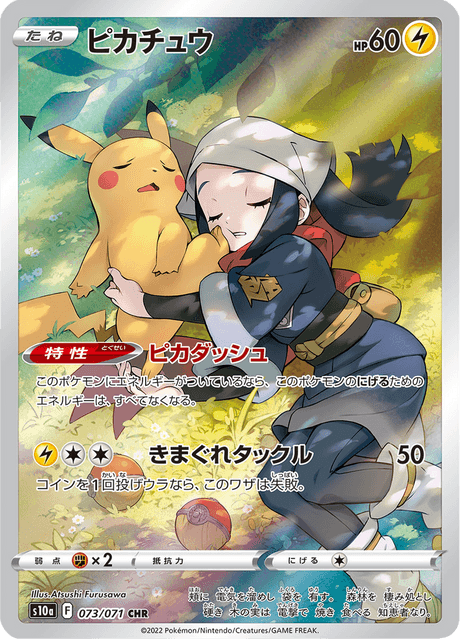
Akari's Pikachu CHR card 073/071 from Japanese S10a Dark Phantasma — Character Rare with full-illustration trainer artwork
Akari’s Pikachu CHR — S10a Dark Phantasma (Character Rare)

CHR (Character Rare) and CSR (Character Super Rare) are themed rarities focused on trainer character art rather than Pokemon. They originated with the S4a Shiny Star V set in 2020 and have since appeared in other character-focused releases.

  • CHR (Character Rare): Trainer character with their Pokemon, softly illustrated style. $5–$30 typical range.
  • CSR (Character Super Rare): Premium version of CHR with full-art treatment. $40–$200 typical range.

CHR and CSR pricing is highly dependent on the trainer featured. A Marnie CSR from S4a Shiny Star V has traded at $150+ for years because Marnie is a franchise-favorite character, while lesser-known CHRs can stay at $5–$10 for the long term. The S12a VSTAR Universe set also brought back CHR/CSR for its High Class Pack format.

Collectors who focus specifically on character cards rather than Pokemon cards gravitate to CHR/CSR as their primary tier — it’s a more niche but well-defined collecting lane inside the hobby.

Japanese vs English Pokemon Rarity Differences

Japanese and English Pokemon rarities look similar but aren’t identical. Here’s the mapping for current Scarlet & Violet era cards:

Japanese (JPN) English (ENG) Notes
C Common Identical concept
U Uncommon Identical concept
R Rare ENG may use diamond symbol
RR Double Rare ENG uses “ex” naming for Pokemon ex
AR Illustration Rare Essentially identical — different market prints
SR Ultra Rare / Full Art ENG SR concept was split into multiple tiers
SAR Special Illustration Rare Direct equivalent, different print runs
UR Hyper Rare ENG gold cards map to JPN UR
MUR JPN-only so far (2026); ENG Mega release TBD
CHR / CSR JPN-exclusive; no direct ENG equivalent

Two things to keep in mind. First, JPN cards historically trade at a 15–40% premium over their ENG equivalents, especially in the SAR/MUR tiers where print quality and foil texture are noticeably stronger on the Japanese version. Second, the JPN print runs for modern sets are usually smaller per-card than the corresponding ENG print runs, which tightens supply on older JPN chase cards over time.

Collectors who started with the English TCG often find the JPN rarity system easier to navigate once they realize SAR = Special Illustration Rare and UR = Hyper Rare. The letter codes are shorter and map one-to-one in most cases.

How to Identify Rarity on a Japanese Pokemon Card

Four checks, in order:

  1. Look at the bottom-left corner. The rarity code (SR, SAR, AR, UR, MUR) is printed there in small Latin letters, usually next to the card number (e.g., “123/110 SAR”). This alone identifies the tier on most modern cards.
  2. Check the border and foil pattern. SAR and MUR use a gold foil border. SR uses a silver holo pattern. AR has a textured full-card print but no gold border. UR is entirely gold across the whole card face.
  3. Tilt the card under light. Texture matters — MUR and SAR have a pronounced stamped foil pattern you can feel with a fingernail, while regular R and RR cards have a smoother holo finish.
  4. Cross-reference the card number. Japanese sets print secret rares after the base set number. If the card number exceeds the base set count (e.g., card 150 in a set with 102 base cards), it’s an SR or higher. Check set-specific card lists like the SV11B Black Bolt card list or SV9 Battle Partners card list to confirm.
Counterfeit Warning

Counterfeit Japanese cards occasionally misprint the rarity code or use the wrong foil finish. If the code and foil don’t match what the official set checklist shows for that card number, assume it’s a fake and avoid.

Where to Buy Japanese Pokemon Cards by Rarity

What you buy depends on which tier you’re targeting:

Singles are always cheaper per-card than pulling the same card from sealed. We recommend sealed boxes for the opening experience itself and for long-term sealed-collection value, and singles when you specifically want one card at a known price.

Frequently Asked Questions

What does SAR mean on a Japanese Pokemon card?

SAR stands for Special Art Rare. It’s a modern top-tier rarity introduced in the Sword & Shield era and standard in every Scarlet & Violet set. SAR cards combine a unique alternate illustration with a gold-foil border, and they pull approximately once every 3–4 booster boxes. Prices range from about $20 to $500+ depending on the Pokemon or character featured.

What is the difference between SR and SAR?

SR (Super Rare) is an older tier featuring full-art trainer cards and some Pokemon ex with silver holo-textured borders. SAR (Special Art Rare) is the newer, higher tier with gold foil borders and unique alternate illustrations — often the same Pokemon or trainer as the SR but with a different, more cinematic art direction. In current Scarlet & Violet sets, SAR typically sells for 3–10× the price of the corresponding SR.

How rare is a MUR Pokemon card?

MUR (Mega Ultra Rare) is the rarest consistently-printed Japanese rarity as of 2026. Estimated pull rate is approximately 1 per 20–30 booster boxes based on early opening data from M1 Mega Brave and M4 Mega Symphonia. Because the rarity is new, pricing remains in a discovery phase — MUR cards from flagship Mega sets have traded between $150 and $1,200 since launch, with the highest-value MURs featuring iconic Mega evolutions like Mega Charizard X and Mega Lucario.

Are Japanese Pokemon cards more valuable than English?

Japanese cards typically trade at a 15–40% premium over the equivalent English card, especially in the SAR, UR, and MUR tiers. The premium comes from stronger print quality, smaller per-card print runs on many sets, and sustained collector demand in both the JPN and international markets. The premium narrows after the English version has been in print for 6+ months, but rarely disappears completely.

Which Japanese Pokemon card rarity is best for beginners?

AR (Art Rare) is the best entry point. AR cards pull 2–3 per booster box, cost $2–$20 for most as singles, and feature the same high-quality illustrated-background artwork that makes higher-tier SAR cards so popular — just at a fraction of the price. Starting with AR singles from recent sets like SV9 or SV11 lets new collectors build a visually satisfying binder without spending SAR-tier money.
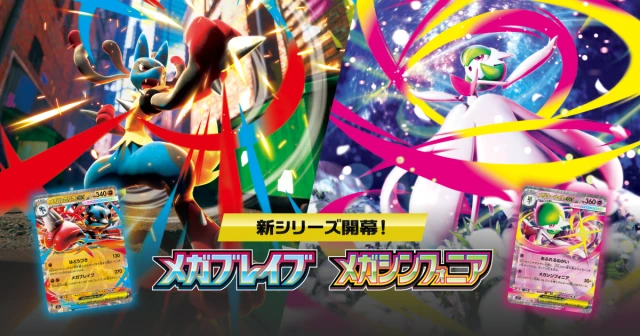
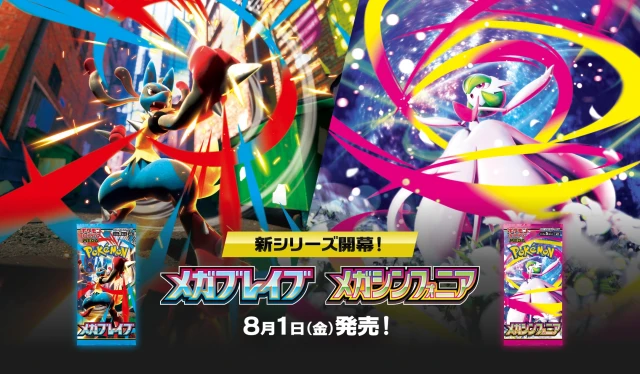
Mega Brave 抽卡機率、最佳卡牌與盒子價值 (M1L)

The Mega Lucario ex MUR — the first card in a brand-new gold rarity — has climbed past $340 on the JPN market. Lillie’s Determination SAR holds steady near $333. Seven months after release, Mega Brave remains the most talked-about set in the MEGA era.

Mega Brave (M1L) launched the MEGA series on August 1, 2025, bringing back Mega Evolution Pokemon and introducing the MUR (Mega Ultra Rare) rarity for the first time. Collectors in the US, UK, and Australia are still chasing these JPN-exclusive cards, and with the initial price surge now settled, the market has reached a more accessible range.

This guide covers the current JPN market prices from SNKRDUNK and Mercari, pull rates from opening data, a full box EV calculation, and a clear breakdown of who should buy this set and when. Our team at Samurai Sword INC ships over 100 Japanese booster boxes from Tokyo every week — here is what the data says about Mega Brave as of March 2026.

Key Takeaway

Mega Brave’s box EV gap is only -4.3% at current prices — one of the tightest in the MEGA series. Mega Lucario ex MUR ($347) and Lillie’s Determination SAR ($333) anchor the value, with a ~28% SAR pull rate per box.

~$63
Box Price

92
Cards

~28%
SAR Rate

30
Packs/Box

Mega Brave — Set Overview

Mega Brave is the first expansion pack in the MEGA series, marking a new chapter for the Pokemon TCG with Mega Evolution Pokemon and the debut of the MUR rarity.

Set Specs

Detail Info
Set Name Mega Brave (M1L) / メガブレイブ
Series MEGA Series (First Expansion)
Release Date (JPN) August 1, 2025
English Equivalent Mega Evolution — September 26, 2025
Total Cards 92 (63 base + 29 secret rares)
Packs per Box 30
Cards per Pack 5
MSRP ¥5,400 (~$36) / Market price: ~¥9,500 (~$63)
Key Rarities MUR (1), SAR (5), SR (11), AR (12)

Prices as of March 2026. Market prices based on SNKRDUNK data.

What Makes This Set Special

MUR (Mega Ultra Rare) debuted here. This gold-textured rarity applies a full gold foil treatment across the entire card — not just a gold border like previous UR cards. The Mega Lucario ex MUR features unique artwork distinct from its SAR counterpart, making it a standalone collectible rather than a simple recolor.

Lillie’s Determination is the set’s other headline. Lillie consistently commands premium prices across every set she appears in, and her SAR in Mega Brave has become one of the most expensive Supporter cards in recent memory. The card is also a competitive staple, driving demand from both collectors and players.

Five Mega Evolution Pokemon ex headline the set: Mega Lucario ex, Mega Venusaur ex, Mega Absol ex, Mega Mawile ex, and Mega Camerupt ex. Each appears in multiple rarities, giving collectors several tiers of chase cards to pursue.

Based on our daily handling of 100+ boxes, the print quality on Mega Brave is among the best in the MEGA series — the gold foil on MUR cards and the texture work on SARs stand out even compared to later sets like Inferno X and Ninja Spinner.

JPN vs English Release Timeline

Milestone JPN (Mega Brave M1L) ENG (Mega Evolution)
Release Date August 1, 2025 September 26, 2025
Set Composition Mega Brave only (92 cards) Mega Brave + Mega Symphonia combined
MUR Availability Yes (Mega Lucario ex) Equivalent as MHR
Price Premium 15-40% higher (historical) Base price
Current BOX Price ~$63 (¥9,500 SNKRDUNK) ~$95 (TCGPlayer)

JPN Mega Brave cards have traded at a 15-40% premium over their English Mega Evolution equivalents since launch, particularly for SAR and MUR/MHR rarities. The JPN printing quality — textured holofoil and sharper color saturation — continues to drive this gap.

Top 10 Most Valuable Cards in Mega Brave

The Mega Lucario ex MUR ($247) and Lillie’s Determination SAR ($320) lead a chase card lineup that has held value better than most MEGA series sets. Here are the 10 most valuable cards based on current JPN market data.

Top 3 most valuable Mega Brave cards: Mega Lucario ex MUR, Lillie's Determination SAR, Mega Venusaur ex SAR
Top 3 chase cards from Mega Brave
Rank Card Rarity JPN Price (¥) USD Est.
1 Mega Lucario ex MUR ¥52,000 ~$347
2 Lillie’s Determination SAR ¥50,000 ~$333
3 Mega Lucario ex SAR ¥12,000 ~$80
4 Lillie’s Determination SR ¥12,000 ~$80
5 Mega Venusaur ex SAR ¥8,500 ~$57
6 Mega Absol ex SAR ¥4,800 ~$32
7 Bulbasaur AR ¥1,600 ~$11
8 Mega Venusaur ex SR ¥1,400 ~$9
9 Mega Lucario ex SR ¥1,400 ~$9
10 Lt. Surge’s Deal SAR ¥1,000 ~$7

JPN prices: Mercari/SNKRDUNK averages as of March 2026. USD converted at approximately ¥150/USD.

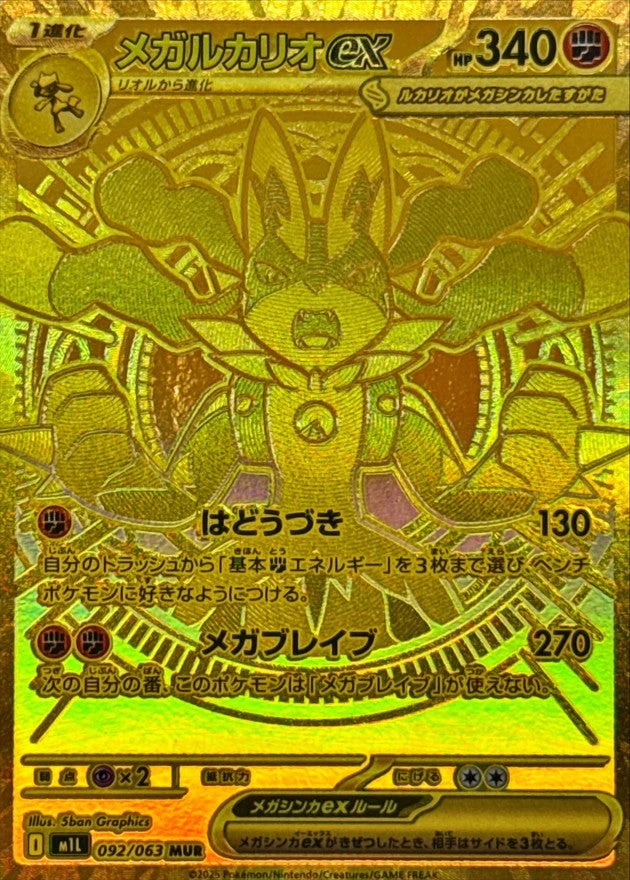
#1 Mega Lucario ex — MUR (Mega Ultra Rare)

JPN Market: ~¥52,000 ($347)

Mega Lucario ex MUR 092/063 gold card from Pokemon Mega Brave set

The card that launched a new rarity. Mega Lucario ex MUR features a full gold-foil treatment with a unique illustration that differs entirely from the SAR version. The artwork depicts Mega Lucario in a dynamic fighting pose against a golden backdrop — a visual style that recalls the premium Black & White era UR cards.

With an estimated pull rate of roughly 1 in 50 boxes (about 1 in 1,500 packs), this is one of the hardest cards to pull in the modern era. The MUR launched at approximately ¥50,000 in August 2025, briefly dipped to around ¥37,000, and has since rebounded to approximately ¥52,000 as of March 2026. Lucario’s enduring popularity as a fan-favorite Fighting-type, combined with the novelty of the MUR rarity, continues to push demand higher.

From our experience shipping to US and UK customers, the JPN-sourced price ($347) offers better value than international marketplace premiums for collectors who buy through Japan-based exporters.

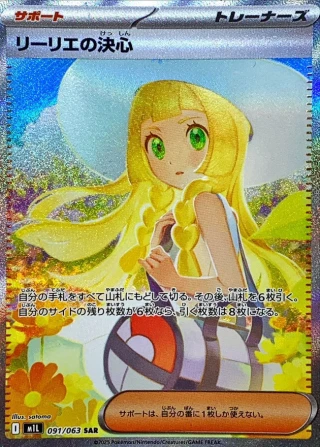
#2 Lillie’s Determination — SAR (Special Art Rare)

JPN Market: ~¥50,000 ($333)

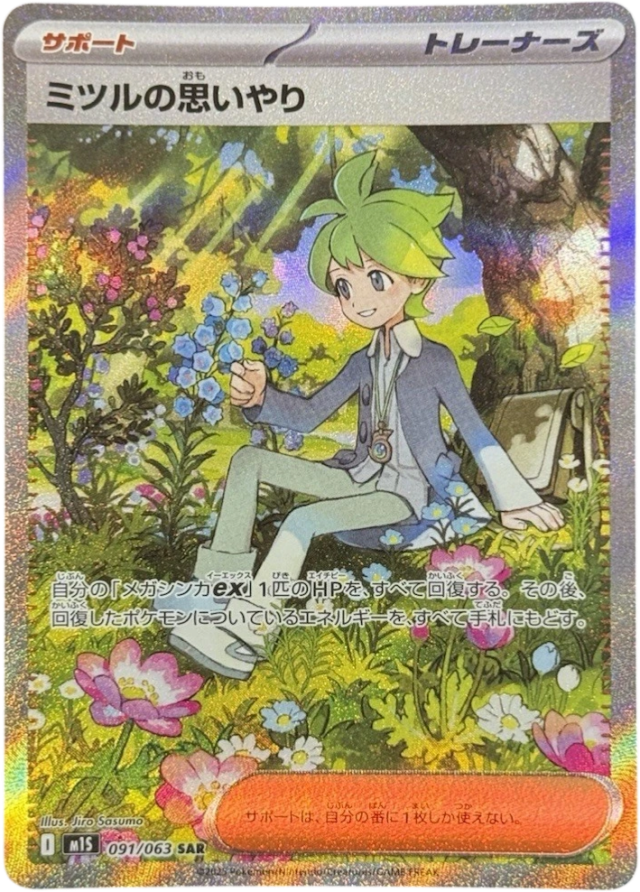
Lillie's Determination SAR 091/063 from Pokemon Mega Brave set

Lillie is the most premium-commanding character in the Pokemon card market. Every set that features a Lillie card sees it climb to the top of the value charts, and Mega Brave follows that pattern exactly. The SAR illustration portrays Lillie in a determined pose with her signature white outfit — a full-art composition that has drawn comparisons to the beloved Lillie cards from the Sun & Moon era.

This card launched at roughly ¥70,000, corrected to the ¥38,000-40,000 range, and has since rebounded to approximately ¥50,000. The trajectory has been anything but linear — a renewed price surge in early 2026 confirmed strong collector demand. The card is also competitively playable as a strong draw-support Trainer, creating dual demand from collectors and tournament players.

For collectors, this is the set’s emotional centerpiece. Lillie SARs from previous sets (such as the VSTAR Universe variant) have appreciated over time, giving this card a solid track record as a long-term hold.

Mega Venusaur ex — SAR (Special Art Rare)

JPN Market: ~¥8,500 ($57)

The nostalgia factor carries real weight. Mega Venusaur ex SAR showcases the Generation 1 starter in a lush, garden-themed full-art illustration. As one of the original 151 Pokemon, Venusaur carries cross-generational appeal that keeps demand stable. At around $57, this is one of the most accessible premium chase cards and an attractive entry point for collectors who want a high-end card from the set without the four-figure commitment.

Cards #3–10

#3 Mega Lucario ex SAR (¥12,000 / ~$80) — The SAR features a distinct illustration from the MUR, showing Mega Lucario in a more action-oriented battle scene. A strong mid-range chase card that has gained value since launch.

#4 Lillie’s Determination SR (¥12,000 / ~$80) — The full-art SR version is the most expensive SR in years. Players who want Lillie’s powerful draw effect without paying SAR prices gravitate here.

#5 Mega Venusaur ex SAR (¥8,500 / ~$57) — Covered in detail above.

#6 Mega Absol ex SAR (¥4,800 / ~$32) — Absol’s dark aesthetic translates well to the SAR treatment. Popular among collectors of Dark-type Pokemon.

#7 Bulbasaur AR (¥1,600 / ~$11) — The highest-value AR in the set. Bulbasaur’s evergreen popularity makes this a fun bonus pull that has actually risen in price.

#8 Mega Venusaur ex SR (¥1,400 / ~$9) — The budget-friendly full-art Venusaur. Solid pickup for binder collectors.

#9 Mega Lucario ex SR (¥1,400 / ~$9) — The standard full-art version. A fraction of the MUR price but still a satisfying pull.

#10 Lt. Surge’s Deal SAR (¥1,000 / ~$7) — The most affordable SAR in the set. Lt. Surge’s polarizing design has kept prices low, which some collectors see as an opportunity.

For a comparison with other MEGA sets, check our MEGA Dream ex guide.

Should You Buy a Mega Brave Box?

At ~$63 per box, Mega Brave offers one of the strongest value propositions in the MEGA series — strong chase cards, guaranteed SR/AR pulls, and a market price well below launch peaks.

Collector Tip

At ~¥9,500 (~$63), Mega Brave boxes are 40-50% below their launch price of ¥12,000-15,000. Every box guarantees 2 SRs + 3 ARs, with a ~28% chance at a SAR.

For Collectors: A Strong Yes

Mega Brave delivers on two fronts that matter most to collectors: premium chase cards with stunning artwork, and a satisfying base of guaranteed rares.

Every box guarantees at least 2 SR cards, 3 AR cards, and 4-5 RR cards. That floor alone provides a solid binder-filling experience. The real excitement comes from the ~28% chance of pulling a SAR and the outside shot at the MUR.

The Lillie’s Determination cards (both SAR and SR) are the kind of centerpiece cards that define a collection. If you collect Lillie cards or Pokemon character art, Mega Brave is a must-open set.

For Players: Worth Considering

Lillie’s Determination is a strong competitive Supporter that sees play across multiple deck archetypes. Pulling one from a box is the most cost-effective way to add it to your deck, given that the SR alone runs $79 as a single.

Mega Lucario ex has niche competitive applications in Fighting-type builds, and Lt. Surge’s Deal offers utility in certain strategies.

For Investors: Time Your Entry

Mega Brave is in the post-correction stabilization phase — seven months after release, prices have settled from launch highs. Lillie’s Determination SAR has shown renewed upward momentum, suggesting the bottom may already be in for top-tier cards.

  • Reprint supply: Additional print runs would increase card supply. Monitor JPN restock announcements on SNKRDUNK.
  • ENG set equivalents: The English Mega Evolution set has already released. JPN cards maintain a premium, but the gap narrows over time.
  • Lillie track record: Lillie cards have consistently appreciated long-term. The SAR could be a hold candidate.
Factor Box Opening Singles Purchase
Cost Control Fixed per box (~$63) You choose exact cards
Chase Card Access Luck-dependent Guaranteed (at market price)
Guaranteed Floor 2 SR + 3 AR + 4 RR Only what you buy
Upside Potential MUR/SAR pull = big win No surprises
Opening Experience Priceless

Pull Rates & Box EV Breakdown

The typical Mega Brave box returns roughly ¥9,100 in card value against a ~¥9,500 market price — a -4.3% gap that is remarkably tight for a standard expansion.

EV Snapshot

Box EV: ~¥9,100 (~$61) | Box Price: ~¥9,500 (~$63) | Gap: -4.3%. Most standard expansions show a -20% to -40% gap at this stage.

SR and AR guaranteed slots provide a solid value floor in every box. The variable SAR and MUR slots are where the upside lives.

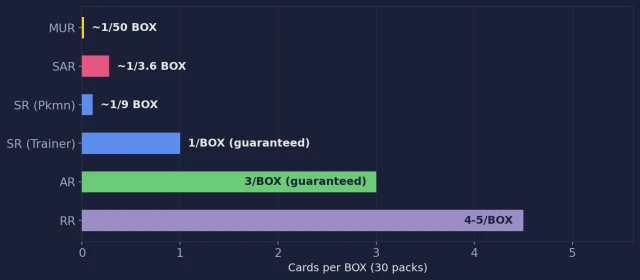
Pull Rates by Rarity

Rarity Estimated Rate (per BOX) Cards in Set
MUR ~1 in 50 boxes (~2%) 1
SAR ~1 in 3.6 boxes (~28%) 5
SR (Pokemon/Supporter) ~1 in 9 boxes per card (~11%) 6
SR (Trainer/Item) 1 per box (100%) 5
AR 3 per box (100%) 12
RR 4-5 per box (100%) ~15

Estimated based on community opening data. Not officially confirmed by The Pokemon Company.

Mega Brave pull rate visualization showing MUR, SAR, SR, AR, and RR rates per box
Pull rate estimates per box — Mega Brave (M1L)

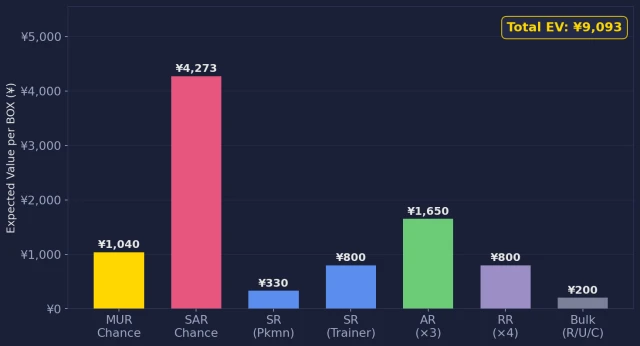
Box EV Calculation

Component Avg. Value Pull Rate (/BOX) EV Contribution
MUR (Mega Lucario ex) ¥52,000 0.02 ¥1,040
SAR (5 types, avg) ¥15,260 0.28 ¥4,273
SR Pokemon/Supporter ¥3,000 0.11 ¥330
SR Trainer (guaranteed) ¥800 1.0 ¥800
AR (3 guaranteed) ¥550 3.0 ¥1,650
RR (4 guaranteed) ¥200 4.0 ¥800
Bulk (R, U, C) ~¥200
Total Box EV ~¥9,093
Box Market Price ~¥9,500
EV Gap -¥407 (-4.3%)

EV calculation as of March 2026. Based on Mercari/SNKRDUNK average prices.

Mega Brave box EV breakdown chart showing value contribution by rarity
Box EV breakdown by rarity — Mega Brave (M1L)

What the Variance Looks Like

Most boxes return ¥2,000-4,000 in card value from the guaranteed SR + AR + RR slots. But roughly 1 in 4 boxes hits a SAR, and if that SAR is Lillie’s Determination, a single pull covers 5+ box costs. The MUR is an outside shot at 1 in 50 boxes — but at ¥52,000, it pays for over 5 boxes on its own.

Three factors keep Mega Brave’s EV strong:

  1. Lillie’s Determination SAR (¥50,000) and Mega Lucario ex MUR (¥52,000) pull the top-end averages significantly upward.
  2. The guaranteed Trainer SR plus the chance at Pokemon/Supporter SRs provides a reliable baseline.
  3. AR quality: 3 guaranteed per box with an average around ¥500 contributes more than in most sets.

Where to Buy Japanese Mega Brave Boxes

Mega Brave booster boxes are available through several channels for international buyers.

From Japan-based export shops (like Samurai Sword INC): Direct access to JPN market pricing, authentic shrink-wrapped boxes, and tracked international shipping from Tokyo. Based on our experience shipping to 30+ countries, this is the most reliable route for sealed JPN product. We serial-track every box — if a resealed or searched box is ever reported, we identify the supplier and permanently remove them from our sourcing chain.

What to expect with shipping:

  • Delivery to US/CA: 7-14 business days (tracked)
  • Delivery to UK/AU: 10-18 business days (tracked)
  • Import duties vary by country — check your local customs thresholds

Authenticity check: Look for intact original shrink wrap and the M1L set code printed on the box. JPN Mega Brave boxes contain 30 packs of 5 cards each.

For a side-by-side comparison of all current Japanese booster boxes, see our Best Japanese Pokemon Booster Boxes 2026 ranking. For importing tips, see our guide to buying Japanese Pokemon cards from Japan.

Shop This Set
Mega Brave (M1L) Booster Box
From ~$63 / ~¥9,500
Ships from Tokyo · Tracked delivery

View Product →

View complete Mega Brave card list →

Frequently Asked Questions

What are the pull rates for Mega Brave?

Each Mega Brave box (30 packs) guarantees 1 Trainer SR, 3 Art Rares, and 4-5 Double Rares. The chance of pulling a Special Art Rare (SAR) from a single box is approximately 28%. The Mega Ultra Rare (MUR) Mega Lucario ex appears in roughly 1 out of every 50 boxes, or about a 2% chance per box. These are community-estimated rates, not officially confirmed by The Pokemon Company.

What is the most expensive card in Mega Brave?

As of March 2026, the Mega Lucario ex MUR (092/063) leads at approximately ¥52,000 (~$347) on the JPN market. Lillie’s Determination SAR (091/063) follows closely at approximately ¥50,000 (~$333). Both cards have rebounded from post-launch lows and show strong collector demand.

Is a Mega Brave box worth buying?

At the current market price of approximately ¥9,500 (~$63), Mega Brave offers a narrow EV gap of about -4.3%, which is strong for a standard expansion. Every box guarantees SR and AR pulls, and you have a roughly 1-in-4 chance at a SAR worth $7-$333. For collectors who enjoy the opening experience and appreciate Mega Evolution artwork, Mega Brave is one of the better options in the current MEGA series.

What is MUR rarity in Pokemon cards?

MUR stands for Mega Ultra Rare, a new rarity introduced with the MEGA series starting from Mega Brave. MUR cards feature a full gold-foil treatment across the entire card surface with unique artwork different from other versions of the same Pokemon. The pull rate is approximately 1 in 50 boxes. The English equivalent rarity is called MHR (Mega Hyper Rare).

When did Mega Brave release in English?

The English equivalent of Mega Brave is part of the “Mega Evolution” set, which released on September 26, 2025. The English set combines cards from both JPN Mega Brave (M1L) and Mega Symphonia (M1S) into a single larger set. JPN-exclusive artwork and the original printing quality are only available in the Japanese version.

How does Mega Brave compare to other MEGA series sets?

Mega Brave was the first MEGA series expansion, alongside Mega Symphonia. Subsequent sets include MEGA Dream ex (High Class Pack), Inferno X (M3), and Ninja Spinner (M4). As the inaugural set, Mega Brave introduced the MUR rarity and set the template for the series. Its Lillie’s Determination SAR remains one of the highest-value Supporter cards across all MEGA sets.


⚡ Ready to Open Packs?

Get the M1L-Mega Brave booster box — shipped directly from Tokyo, Japan with tracking & insurance.

Buy M1L-Mega Brave Box

Browse All Pokemon Booster Boxes →


Mega Symphonia 抽卡機率、最佳卡牌與盒子價值 (M1S)

The Mega Symphonia pull rates and best cards data tells a clear story eight months after release: this set delivers one of the most exciting chase experiences in the modern Pokemon TCG.

Mega Gardevoir ex in full gold foil. A brand-new rarity tier that nobody saw coming. And a pull rate so low that most collectors will never see one in person. Mega Symphonia (M1S) dropped in Japan on August 1, 2025, and shook up the collecting scene by introducing the MUR (Mega Ultra Rare) — a gold-foiled, original-artwork card sitting above every other rarity in the set.

This guide breaks down every number that matters: actual pull rates from hundreds of box openings, the top 10 most valuable cards with current JPN and USD prices, a full box value calculation, and price trends through March 2026. Our team ships Mega Symphonia boxes from Tokyo every week — this is the same data we use to track the market ourselves.

Key Takeaway

Mega Gardevoir ex MUR — the first-ever Mega Ultra Rare — trades at ~¥52,000 ($358) with a pull rate of approximately 1 in 55 boxes. At ~¥8,000 ($55) per box with guaranteed 2 SRs and 3 ARs, Mega Symphonia offers one of the most accessible entry points in the current MEGA era lineup.

¥8,000
Box Price (JPN)

¥52,000
MUR Chase Card

~1 in 55
MUR Pull Rate

65%
Box EV Ratio

What Is Mega Symphonia? — Set Overview

Mega Symphonia launched on August 1, 2025 as the first expansion pack from the Pokemon Card Game MEGA era, alongside its twin set Mega Brave. The set marks the return of Mega Evolution to the TCG — and it introduced a brand-new rarity that collectors had never seen before.

Set Specs & Key Features

Specification Details
Set Name Mega Symphonia (M1S)
Series Pokemon Card Game MEGA
Release Date (JPN) August 1, 2025
Release Date (ENG) September 26, 2025 (as “Mega Evolution”)
Total Cards 92 (63 regular + 29 secret rares)
Cards per Pack 5
Packs per Box 30
MSRP ¥180/pack
Market Price (Box) ~¥8,000 (~$55 at ¥145/USD)
Mega Pokemon 5 (Gardevoir, Latias, Kangaskhan, Manectric, Abomasnow)

Prices as of March 2026. Market prices via SNKRDUNK.

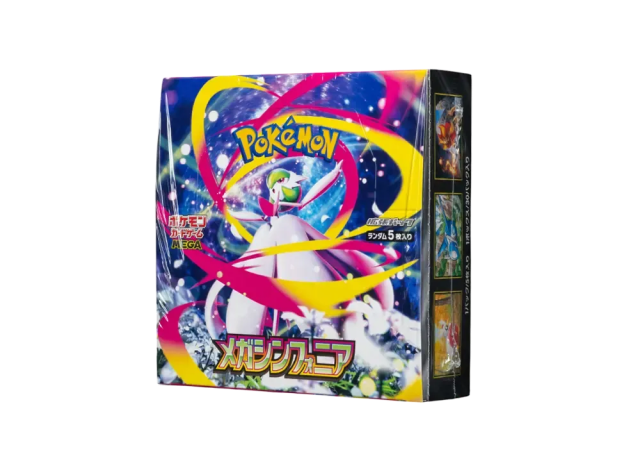
Mega Symphonia M1S sealed booster box with shrink wrap
https://samuraiswordtokyo.com/wp-content/uploads/samurai-media/2026/05/external-eab61d9c7c10/mega_symphonia_box-master.webp

What Makes This Set Special — MUR & the Return of Mega Evolution

The headline feature is the MUR (Mega Ultra Rare) — a completely new rarity tier exclusive to the MEGA series. Unlike previous gold cards (UR), MUR cards feature entirely original artwork with a full gold-foil treatment across the entire card surface. The result is one of the most visually striking cards the Pokemon TCG has produced.

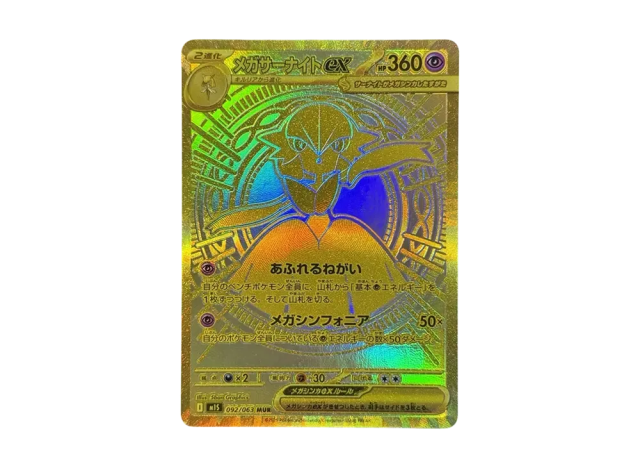
Mega Symphonia’s MUR is Mega Gardevoir ex (#092/063), and its combination of Gardevoir’s popularity, stunning artwork, and extreme rarity has made it the defining chase card of the MEGA era so far.

Beyond the MUR, the set brings five Mega Evolution Pokemon ex into the current format. These Mega Pokemon are worth three Prize cards when knocked out but deliver devastating attacks that can swing games. Mega Gardevoir ex has carved out a spot in competitive play, giving this set relevance for both collectors and players.

JPN vs English Release Timeline

Japan received Mega Symphonia nearly two months before the English-language set (branded “Mega Evolution”) launched on September 26, 2025. The English set combines cards from both Mega Brave and Mega Symphonia, meaning certain JPN-exclusive cards did not make it into the English release.

For collectors and investors, JPN versions of Mega Symphonia cards carry a 15-40% price premium over their English counterparts — a pattern consistent across previous sets and the MEGA era specifically. For a deeper look at why JPN cards command this premium, see our Japanese vs English Pokemon Cards comparison.

For a look at the other MEGA-era debut set, check out our MEGA Dream ex Pull Rates & Best Cards guide.

Top 10 Most Valuable Mega Symphonia Cards

Mega Symphonia’s value is concentrated at the top, with the MUR in a league of its own. Here is the full top 10 as of March 2026.

Rank Card Rarity JPN Price (¥) USD Est.
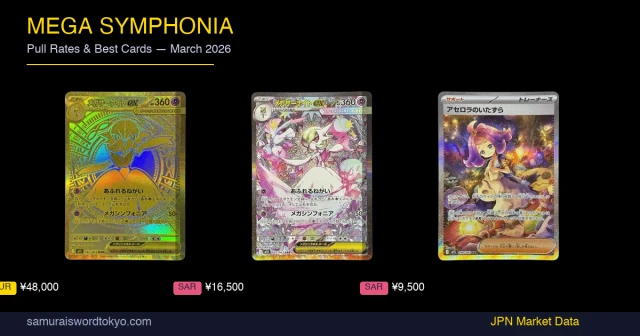
1 Mega Gardevoir ex MUR ¥52,000 $358
2 Mega Gardevoir ex SAR ¥15,500 $107
3 Acerola’s Prank SAR ¥7,800 $54
4 Mega Latias ex SAR ¥5,100 $35
5 Mega Kangaskhan ex SAR ¥4,400 $30
6 Acerola’s Prank SR ¥2,000 $14
7 Wally’s Compassion SAR ¥1,700 $12
8 Mega Gardevoir ex SR ¥950 $7
9 Mega Latias ex SR ¥750 $5
10 Mega Manectric ex SR ¥550 $4

Prices as of March 2026. JPN prices based on Altema buy/sell midpoint and Mercari completed transactions. USD estimates at ¥145/USD.

#1 — Mega Gardevoir ex (MUR) — ~¥52,000 / ~$358

Mega Gardevoir ex MUR gold foil card from Mega Symphonia M1S
https://samuraiswordtokyo.com/wp-content/uploads/samurai-media/2026/05/external-860d6d5ca0fa/mega_gardevoir_ex_mur_8433b5b0-42c7-43fb-ac9b-15691a129487-master.webp

The crown jewel of Mega Symphonia and the first-ever MUR card in the Pokemon TCG. This card features a completely original illustration of Mega Gardevoir wrapped in shimmering gold foil — not a recolored version of the SR, but a unique piece of art created specifically for this rarity.

The price reflects its extreme scarcity: MUR appears in roughly 1 out of every 50-60 boxes opened, making it significantly rarer than a standard SAR. Gardevoir consistently ranks among the top 10 most popular Pokemon globally (9th place in the 2020 Pokemon of the Year vote), and that sustained collector demand keeps the floor high.

At ~¥52,000, the MUR has stabilized after launch-week highs of ¥80,000+. For PSA 10 graded copies, expect ¥100,000+ ($690+). Based on our daily handling of 100+ boxes across all MEGA-era sets, we see consistent demand for this card from international collectors.

#2 — Mega Gardevoir ex (SAR) — ~¥15,500 / ~$107

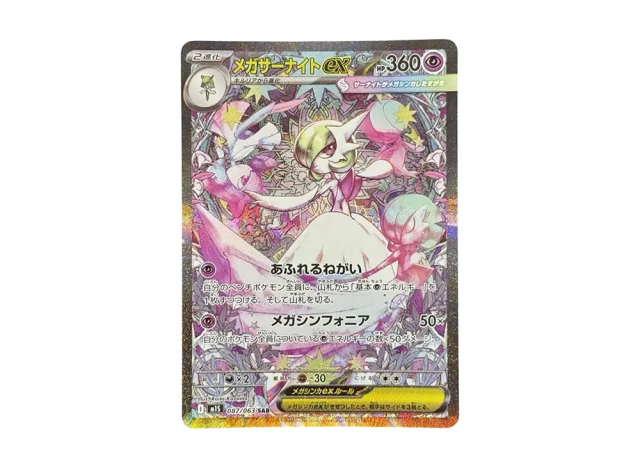
Mega Gardevoir ex SAR Special Art Rare card from Mega Symphonia
https://samuraiswordtokyo.com/wp-content/uploads/samurai-media/2026/05/external-c28471a8fc45/mega_gardevoir_ex_sar_f492cfbd-e101-4a93-beeb-bce940d1998a-master.webp

The SAR version showcases a different full-art illustration of Mega Gardevoir in an ethereal, flowing composition. Gardevoir’s character popularity, the high-quality art direction, and the SAR’s texture combine to make this the second most valuable card in the set.

At ¥15,500, this sits firmly in the premium SAR tier. Roughly 1 SAR appears per 3-4 boxes, and pulling this specific card requires either luck or volume (about 5.7% chance per SAR pull).

#3 — Acerola’s Prank (SAR) — ~¥7,800 / ~$54

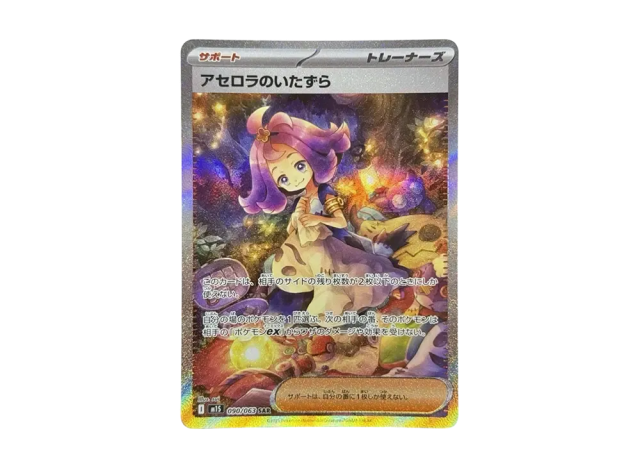
Acerola's Prank SAR Special Art Rare supporter card from Mega Symphonia
https://samuraiswordtokyo.com/wp-content/uploads/samurai-media/2026/05/external-8cd62199009c/sar_texture_example_3ee9e8df-a26a-4972-b639-6958415454e0-master.webp

Acerola is one of the most beloved Trainer characters in the Pokemon franchise, sitting just behind Lillie in collector demand. Every high-rarity Acerola card across multiple sets has commanded strong prices, and Mega Symphonia’s SAR version follows that pattern.

The artwork depicts Acerola in her signature playful pose with Ghost-type Pokemon — a fan-favorite design that resonates with character collectors across both Japanese and international markets. As a Supporter card, it also sees play in competitive decks, adding demand beyond pure collecting.

Cards #4-10

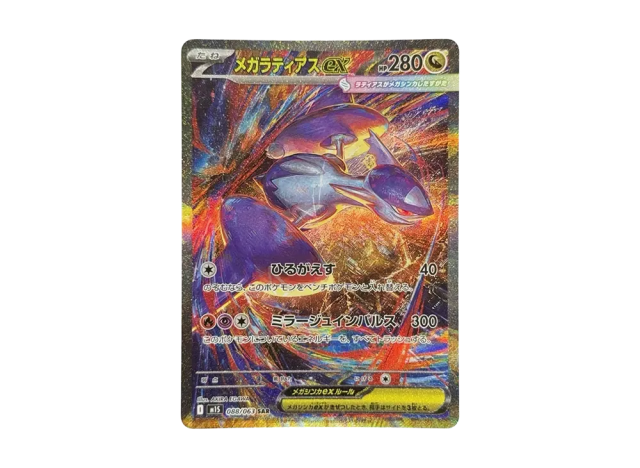
#4 — Mega Latias ex (SAR) — ~¥5,100 / ~$35 The Eon Duo Pokemon in a stunning SAR treatment. Latias carries strong nostalgia factor from Ruby & Sapphire, and the artwork captures its graceful flying form.

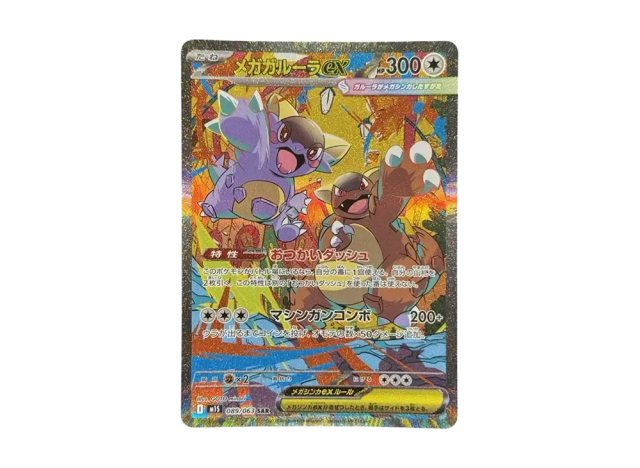
#5 — Mega Kangaskhan ex (SAR) — ~¥4,400 / ~$30 The parent-and-child Mega Evolution in SAR form. The dynamic artwork showing both Kangaskhan and its baby during Mega Evolution has earned strong community appreciation.

#6 — Acerola’s Prank (SR) — ~¥2,000 / ~$14 The SR version of Acerola’s Prank. Character collectors who want the Acerola art at a more accessible price point pick up the SR as an alternative to the SAR.

#7 — Wally’s Compassion (SAR) — ~¥1,700 / ~$12 A Supporter SAR featuring Wally in an emotional composition. Lower demand compared to Acerola, but still a quality pull from any box.

#8 — Mega Gardevoir ex (SR) — ~¥950 / ~$7 Standard SR illustration of the set’s flagship Mega Pokemon. A solid entry point for Gardevoir fans who want a premium version without SAR/MUR pricing.

#9 — Mega Latias ex (SR) — ~¥750 / ~$5 The SR treatment of Mega Latias. Holds value above most regular rares thanks to Latias’s enduring popularity.

#10 — Mega Manectric ex (SR) — ~¥550 / ~$4 The Electric-type Mega Evolution SR. Competitively relevant in certain builds, keeping floor demand steady.

Mega Latias ex SAR Special Art Rare card from Mega Symphonia M1S
https://samuraiswordtokyo.com/wp-content/uploads/samurai-media/2026/05/external-60cc3812536b/mega_latias_ex_sar-master.webp

Should You Buy a Mega Symphonia Box?

At ~¥8,000 (~$55) per box, Mega Symphonia sits at one of the most accessible price points in the current MEGA era lineup. Here is how the set stacks up for different buyers.

For Collectors — Strong Buy

Mega Symphonia is a collector’s set through and through. The MUR introduces a rarity tier unlike anything the Pokemon TCG has done before, and the SAR lineup features some of the strongest artwork in the MEGA era. Every box guarantees 2 SR pulls and 3 AR cards, so even boxes without a SAR deliver cards worth keeping.

The Mega Evolution theme taps into deep nostalgia. Mega Gardevoir, Mega Latias, and Mega Kangaskhan are fan favorites that carry emotional weight beyond their market value. Based on our daily handling of 100+ boxes, we consistently see collectors respond positively to this set’s pull structure — the guaranteed SR and AR slots give every box a satisfying result.

Your move: At ¥8,000, opening 1-2 boxes gives you a strong chance at meaningful SRs and ARs, with the thrill of a potential SAR or the ultra-rare MUR.

For Players — Selective Buy

Mega Gardevoir ex has established itself in the competitive metagame with high damage output (worth 3 Prize cards when knocked out). Mega Manectric ex and Mega Abomasnow ex also see niche play.

If you are building a Mega Gardevoir deck, purchasing singles may be more cost-effective — the RR version is available for under ¥500. Consider a box if you want both playable cards and collector pulls.

Your move: Buy singles for specific deck pieces. A box makes sense if you want playables plus the collection experience.

For Investors — Monitor Entry Points

Mega Symphonia has completed its initial price correction. The MUR has stabilized around ¥52,000 after settling from ¥80,000+ at launch. Based on past patterns, MUR/UR-tier cards from popular sets tend to appreciate once production ends.

Key factors to track: reprint announcements, competitive meta shifts, and the English set’s lifecycle. As the English Mega Evolution set matures, JPN premium may widen.

Your move: Track prices through SNKRDUNK for box investments. For singles, monitor Mercari for PSA 10-worthy raw cards at current rates.

JPN vs English — Which Version?

Factor Japanese (M1S) English (Mega Evolution)
Release Date August 1, 2025 September 26, 2025
MUR Card Mega Gardevoir ex (exclusive art) Same card, different print
Print Quality Higher texture, sharper foil Standard
Card Prices 15-40% premium over ENG Lower entry cost
Set Composition 92 cards (Symphonia only) Combined Brave + Symphonia
Collector Demand Growing international demand Larger player base

JPN versions trade at a consistent premium. If you collect for long-term value or appreciate higher print quality, JPN is the stronger choice. For tournament play at lower cost, the English set works fine.

For a detailed comparison of other MEGA-era sets, check our Best Japanese Pokemon Booster Box 2026 guide.

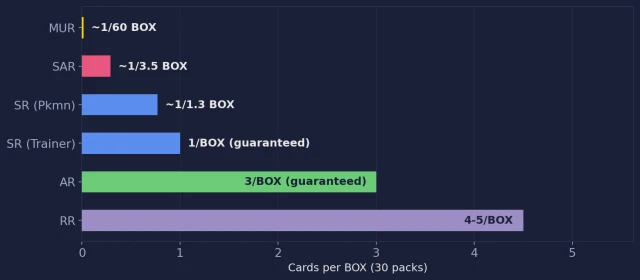
Mega Symphonia Pull Rates & What’s in Your Box

Every Mega Symphonia box contains 30 packs of 5 cards each (150 cards total). Here is what the data shows after aggregating hundreds of box openings from the Japanese community.

Pull Rates by Rarity

Rarity Cards in Set Per-Box Rate Approx. Odds
MUR (Mega Ultra Rare) 1 ~0.018/box ~1 in 55 boxes
SAR (Special Art Rare) 5 ~0.29/box ~1 in 3.5 boxes
SR (Super Rare) — Pokemon/Supporter 7 ~0.77/box ~1 in 1.3 boxes
SR (Super Rare) — Trainer Items 4 1.0/box 1 per box (guaranteed)
AR (Art Rare) 12 3.0/box 3 per box (guaranteed)
RR (Double Rare) 7 ~4.5/box 4-5 per box
R (Rare) 8 Variable Multiple per box

Estimated based on community opening data from 1,000+ boxes. Not officially confirmed by The Pokemon Company.

Mega Symphonia pull rates by rarity tier showing MUR SAR SR AR RR distribution
https://samuraiswordtokyo.com/wp-content/uploads/samurai-media/2026/05/external-938e6f3e968d/chart_pull_rates_8dd7e0e6-60e6-462a-8957-eba8b75da775-master.webp

The guaranteed floor is solid: every single box gives you 1 Trainer SR, 3 ARs, and 4-5 RRs. The variable slot is the Pokemon/Supporter SR-or-higher, where roughly 77% of boxes yield at least one, and about 29% contain a SAR.

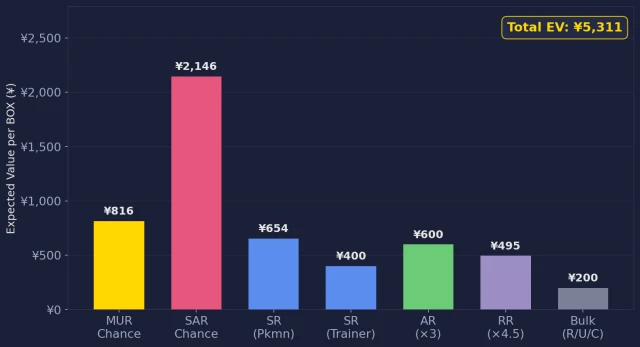
Box Value Breakdown

Using current March 2026 Mercari/Altema transaction prices:

Component Avg Value per Box Calculation
MUR chance ¥936 ¥52,000 × 0.018
SAR chance ¥2,030 avg SAR ¥7,000 × 0.29
SR (Pokemon/Supporter) ¥601 avg SR ¥780 × 0.77
SR (Trainer) guaranteed ¥350 avg Trainer SR ¥350 × 1.0
AR (3 guaranteed) ¥600 avg AR ¥200 × 3.0
RR (4-5 guaranteed) ¥450 avg RR ¥100 × 4.5
Bulk (R/U/C) ¥200 Estimated lot value
Total Box EV ~¥5,167
Box Market Price ~¥8,000
EV Ratio ~65%

A 65% EV ratio falls within the standard range for Pokemon TCG expansion packs, where ratios typically sit between 50-80%. The guaranteed SR and AR slots ensure every box delivers a baseline of collectible cards, while SAR and MUR pulls push individual boxes well above the average.

Understanding Variance — What Most Boxes Look Like

The EV above is an average across all boxes, including the rare ones with a MUR or SAR. Here is what a typical opening experience looks like:

Most common outcome (~70% of boxes): 1 Trainer SR + 3 AR + 4-5 RR. Total value: ~¥1,700. These boxes rely on the guaranteed slots for their base value — and the opening experience itself is part of what makes collecting enjoyable.

Good box (~25% of boxes): Everything above + 1 Pokemon/Supporter SR. Total value: ~¥3,500. A solid result that adds a meaningful card to your collection.

Great box (~5% of boxes): A SAR pull. Total value: ¥6,000-¥20,000+ depending on which SAR. Boxes with a top-tier SAR like Mega Gardevoir or Acerola cover their cost and then some.

Jackpot (~1.8% of boxes): The MUR. Total value: ¥52,000+.

Singles vs Box — Cost Comparison

Target Card Single Purchase Boxes Needed (Avg) Box Cost Better Option
Mega Gardevoir ex MUR ¥52,000 ~55 boxes ¥440,000 Singles
Mega Gardevoir ex SAR ¥15,500 ~17 boxes ¥136,000 Singles
Acerola’s Prank SAR ¥7,800 ~17 boxes ¥136,000 Singles
Any SAR ¥7,000 avg ~3.5 boxes ¥28,000 Consider boxes
Mega Gardevoir ex RR ¥400 <1 box ¥8,000 Singles
Opening experience Priceless 1 box ¥8,000 Box

If you are targeting a specific high-value card, singles are almost always more efficient. Boxes shine when you want the complete set experience — the thrill of pulling unknown cards, building a collection organically, and the chance at something extraordinary.

Where to Buy Mega Symphonia Boxes from Japan

Sourcing authentic Japanese Pokemon booster boxes requires a trusted seller with direct access to the JPN market. From our experience shipping to the US, Canada, UK, and Australia daily, here is what matters.

Buying from a Specialized JPN Card Shop

At Samurai Sword INC, we ship sealed Mega Symphonia booster boxes directly from Tokyo. Every box is shrink-wrapped, verified authentic, and serial-tracked — if any box fails our quality inspection, we trace it back to the source. Based on our daily handling of 100+ boxes across all current sets, the prices and data in this guide reflect what we see on the ground.

Mega Kangaskhan ex SAR Special Art Rare card from Mega Symphonia M1S
https://samuraiswordtokyo.com/wp-content/uploads/samurai-media/2026/05/external-dd78d98e5556/mega_kangaskhan_ex_sar-master.webp

Shipping & Import Guide

Destination Shipping Time Estimated Shipping Import Duty
United States 7-14 days $12-18 Generally duty-free under $800
Canada 10-18 days $15-22 May apply over CAD $20
United Kingdom 10-18 days $15-22 VAT applies on total value
Australia 10-18 days $15-22 GST applies on imports over AUD $1,000

All orders include tracking. Every box is serial-tracked for authenticity verification.

The Bottom Line

Mega Symphonia earns its place as a landmark set in the Pokemon TCG. Three key takeaways:

  1. The MUR changes the game: Mega Gardevoir ex MUR at ~¥52,000 ($358) represents a new tier of chase card. Its 1-in-55-box rarity and stunning gold-foil artwork make it the defining card of the MEGA era.
  1. Stable prices signal opportunity: At ~¥8,000 per box, the initial premium has fully adjusted. You are buying at a stabilized market price — not chasing launch-week hype.
  1. JPN versions hold their premium: With 15-40% price premiums over English cards, Japanese Mega Symphonia continues to reward collectors who source from the original market.

For a look at all MEGA-era sets and how they compare, see our Best Japanese Pokemon Booster Box 2026 guide.

Wally's Compassion SAR Special Art Rare supporter card from Mega Symphonia M1S
https://samuraiswordtokyo.com/wp-content/uploads/samurai-media/2026/05/external-e6c04e08fbf2/wally_compassion_sar-master.webp
Featured Product
Mega Symphonia Booster Box (M1S)
¥7,200 (~$49)
Ships from Tokyo · Tracked · Serial-numbered

View Product →

View complete Mega Symphonia card list →

Frequently Asked Questions

What are the pull rates for Mega Symphonia?

Based on aggregated opening data from the Japanese community (1,000+ boxes), the estimated pull rates per box are: MUR approximately 1 in 55 boxes, SAR approximately 1 in 3.5 boxes, Pokemon/Supporter SR approximately 1 in 1.3 boxes. Every box guarantees 1 Trainer SR, 3 Art Rares, and 4-5 Double Rares. These rates are estimated from community data and not officially confirmed by The Pokemon Company.

What is the most expensive card in Mega Symphonia?

Mega Gardevoir ex MUR (#092/063) is the most valuable card, trading at approximately ¥52,000 (~$358 USD) as of March 2026. The MUR (Mega Ultra Rare) features unique gold-foil artwork and appears in roughly 1 per 50-60 boxes opened.

What is a MUR (Mega Ultra Rare) card?

MUR stands for Mega Ultra Rare, a brand-new rarity tier introduced with the Pokemon Card Game MEGA series starting from Mega Brave and Mega Symphonia in August 2025. MUR cards feature completely original artwork with full gold-foil treatment across the entire card surface. Unlike previous gold cards (UR), the artwork is not a recolor but a unique illustration created for this rarity.

Is Mega Symphonia worth buying in 2026?

At current market prices of approximately ¥8,000 (~$55) per box, Mega Symphonia offers strong value for collectors. The set features the first-ever MUR card, popular SAR artwork featuring Gardevoir and Acerola, and guaranteed SR/AR pulls in every box. Box prices have stabilized from their launch-week premiums, making this an accessible entry point. Our team at Samurai Sword INC handles these boxes daily and sees consistent collector satisfaction with the pull structure.

How many packs are in a Mega Symphonia booster box?

A Mega Symphonia booster box contains 30 packs, each with 5 cards, for a total of 150 cards per box. The set has 92 different cards total (63 regular + 29 secret rares).

What is the difference between Mega Symphonia and Mega Brave?

Mega Symphonia and Mega Brave are twin expansion packs that launched together on August 1, 2025, as the first sets in the MEGA era. They share the same set structure but contain different Pokemon. Mega Symphonia features Mega Gardevoir, Mega Latias, Mega Kangaskhan, Mega Manectric, and Mega Abomasnow. Mega Brave features Mega Lucario, Mega Venusaur, Mega Metagross, Mega Salamence, and Mega Blaziken. Each set has its own MUR chase card.

When was Mega Symphonia released in English?

The English equivalent launched on September 26, 2025, under the name “Mega Evolution.” The English set combines cards from both Mega Brave and Mega Symphonia into a single release. Certain JPN-exclusive cards may not appear in the English version. JPN versions typically trade at a 15-40% premium over their English counterparts.


⚡ Ready to Open Packs?

Get the M1S-Mega Symphonia booster box — shipped directly from Tokyo, Japan with tracking & insurance.

Buy M1S-Mega Symphonia Box

Browse All Pokemon Booster Boxes →