Japanese TCG Store Samurai Sword

Die besten Pikachu-Karten im japanischen Pokémon TCG (Preisguide 2026)

Japanese Pikachu cards are not one market. They are a ladder: true contest promos at the museum end, anniversary cards in the display tier, VMAX and AR cards for modern collectors, and budget cards for buyers who want a clean first Japanese Pikachu without overpaying. This May 21, 2026 refresh rebuilds the old article into a buyer guide rather than a simple top-10 list.

The practical answer: start with Pokemon 151 Pikachu AR if you are new, use Pikachu V-UNION if you want a modern Japanese centerpiece, and treat Pikachu Illustrator as historical context rather than a normal shopping target. The old article had useful ideas, but it also had thin images and one wrong representative card image. This version uses card-specific visuals and clearer buying tiers.

Prices on Pikachu move quickly because demand is broader than almost any other Pokemon. The ranges below are directional, not a promise that every listing should be accepted. Zustand, language, set code, grading status, and whether the image matches the exact card matter more than a single low price.
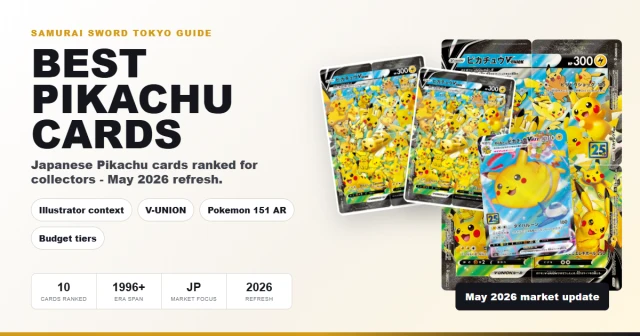
Best Japanese Pikachu cards 2026 price guide
Thumbnail composite for the Japanese Pikachu cards guide using official and trusted card imagery.
Key Takeaway Pikachu is not one market. It is a ladder: contest promos at the top, anniversary cards in the middle, modern AR/SAR cards for active collectors, and budget cards for entry buyers. Buy Japanese Pikachu singles by budget tier and purpose. Do not chase every Pikachu card; choose whether you want a display card, a graded candidate, a historical promo, or a clean starter single.
10Cards ranked
1996+Era span
JPMarket focus
2026Refresh

Top Japanese Pikachu Cards to Know

This ranking is built for real buyers. It does not pretend that a museum-level contest card and a $25 starter card solve the same problem. Instead, each card is placed by collector use case: historical context, display centerpiece, graded candidate, budget entry, or modern chase.

Rank Card Category 2026 signal Why it matters
1 Pikachu Illustrator Contest Promo Record-tier, museum card Covered as context only: it defines the ceiling of Pokemon collecting but is not a realistic purchase target for most readers.
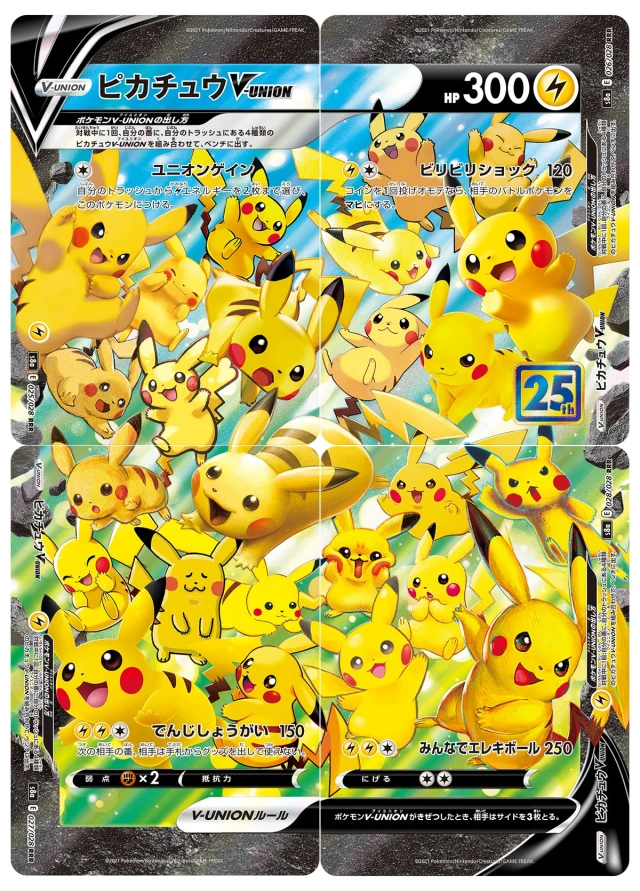
2 Pikachu V-UNION 25th Anniversary $200-$320 complete set Four-card display piece, strongly Japanese, and one of the cleanest modern Pikachu centerpiece buys.
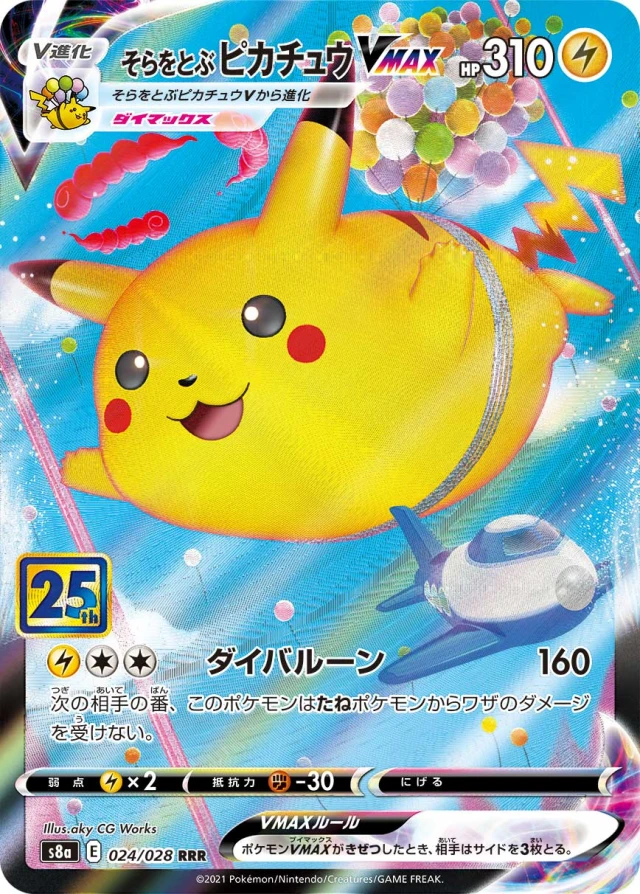
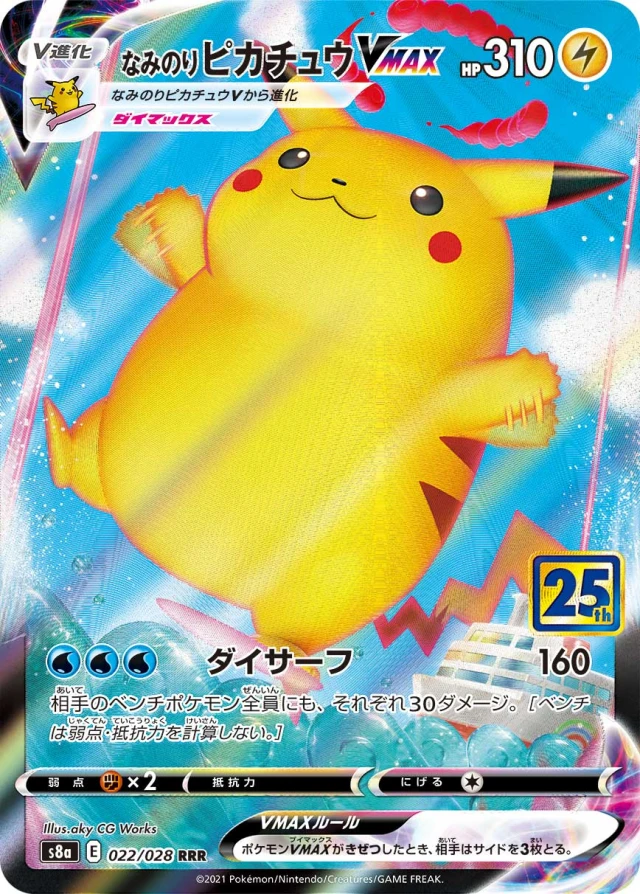
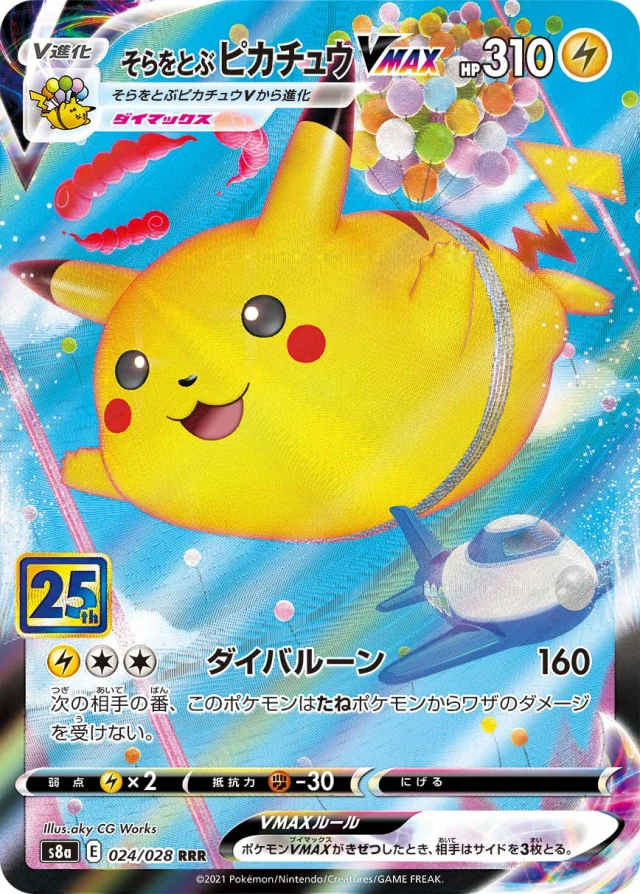
3 Flying Pikachu VMAX S8a $75-$120 raw range 25th Anniversary nostalgia with a recognizable vintage callback.
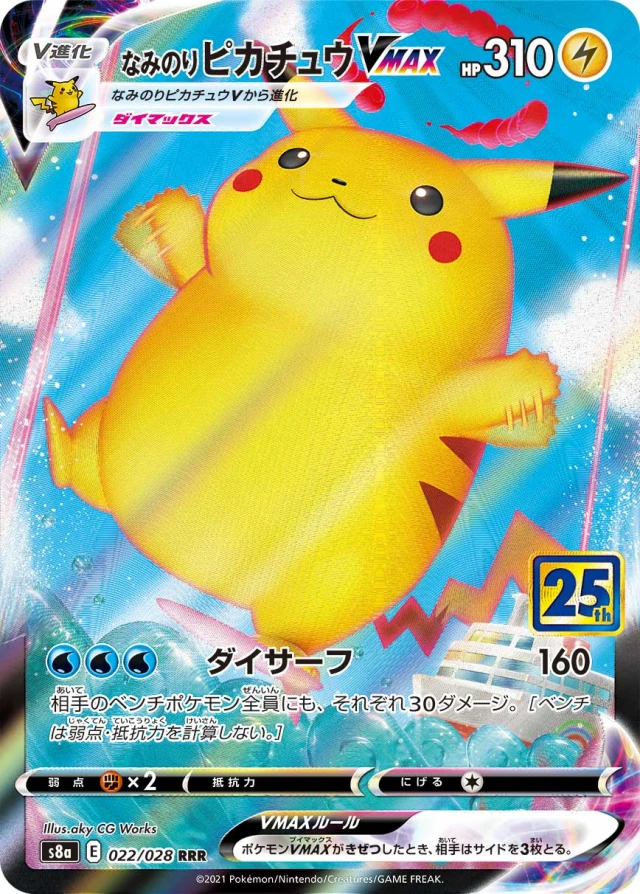
4 Surfing Pikachu VMAX S8a $80-$130 raw range Pairs naturally with Flying Pikachu and has stronger vintage-memory appeal.
5 Pikachu AR Pokemon 151 $20-$35 raw range Best starter pick: affordable, recognizable, and tied to the original 151 nostalgia cycle.
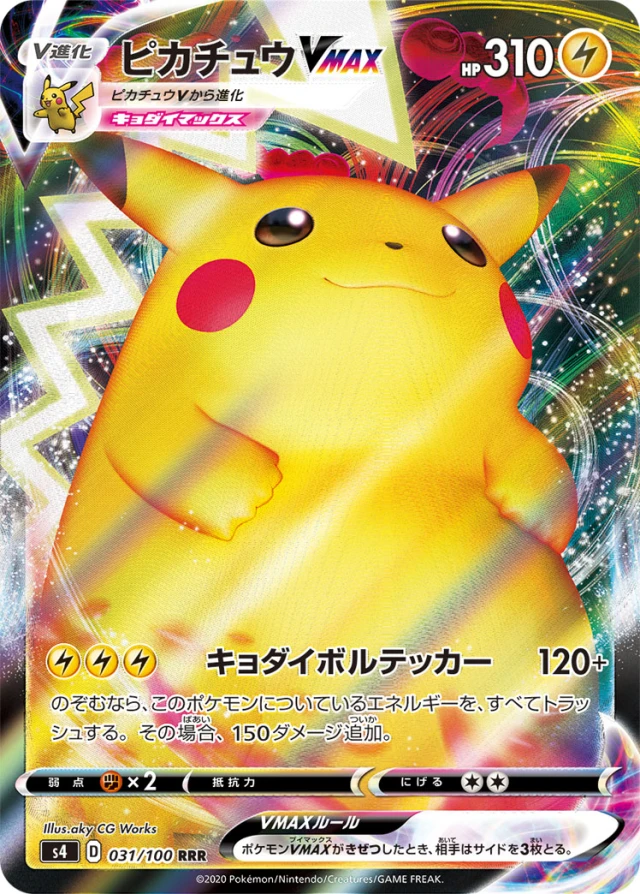
6 Pikachu VMAX VMAX Climax Mid-tier modern chase Modern textured Pikachu with strong display value and a better article image than the old placeholder.
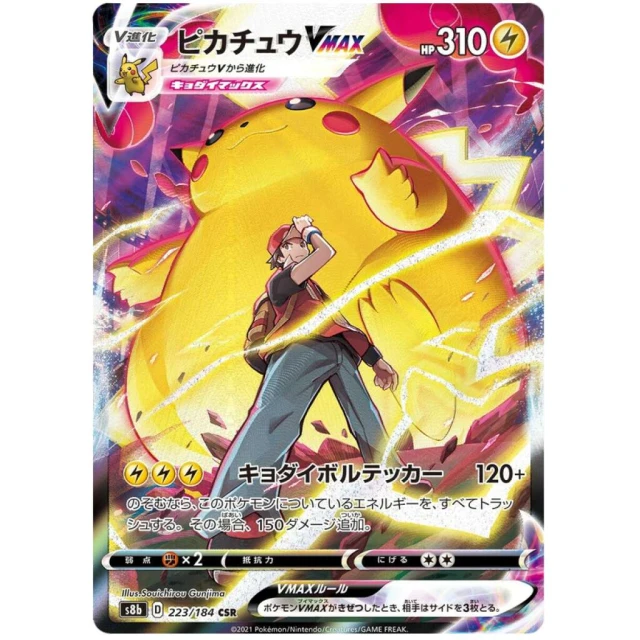
7 Pikachu VMAX Rainbow VMAX Climax HR High-end modern chase The correct Pikachu image replaces the old article mistake that used an unrelated Charizard card.
8 Pikachu V VMAX Climax CSR/CHR lane Accessible display single A cleaner mid-budget pickup for collectors who want modern Pikachu art without promo prices.
9 Pikachu V 25th Anniversary Entry anniversary single Affordable S8a card that keeps the 25th Anniversary theme without needing V-UNION money.
10 Base-style Pikachu Classic JP lane Zustand-dependent Useful as a nostalgia benchmark: simple artwork, broad recognition, and easy entry for new buyers.
Pikachu V-UNION 25th Anniversary from Best Pikachu Cards25th Anniversary

Pikachu V-UNION

Four-card display piece, strongly Japanese, and one of the cleanest modern Pikachu centerpiece buys.

Flying Pikachu VMAX S8a from Best Pikachu CardsS8a

Flying Pikachu VMAX

25th Anniversary nostalgia with a recognizable vintage callback.

Surfing Pikachu VMAX S8a from Best Pikachu CardsS8a

Surfing Pikachu VMAX

Pairs naturally with Flying Pikachu and has stronger vintage-memory appeal.
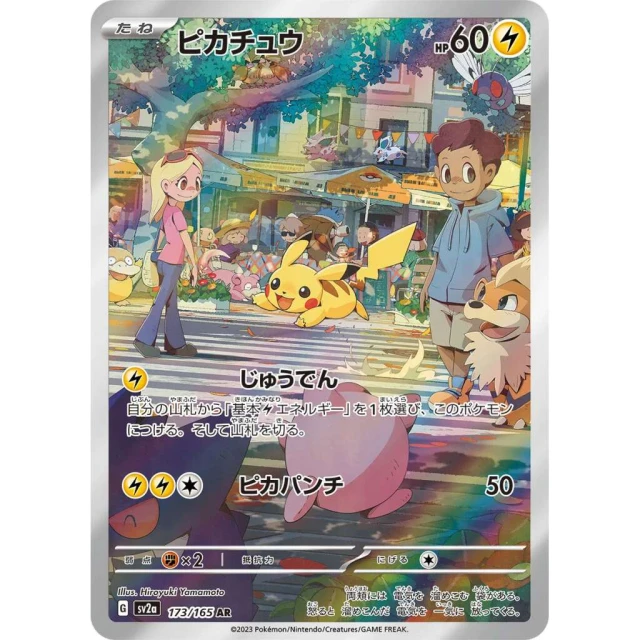
Pikachu AR Pokemon 151 from Best Pikachu CardsPokemon 151

Pikachu AR

Best starter pick: affordable, recognizable, and tied to the original 151 nostalgia cycle.
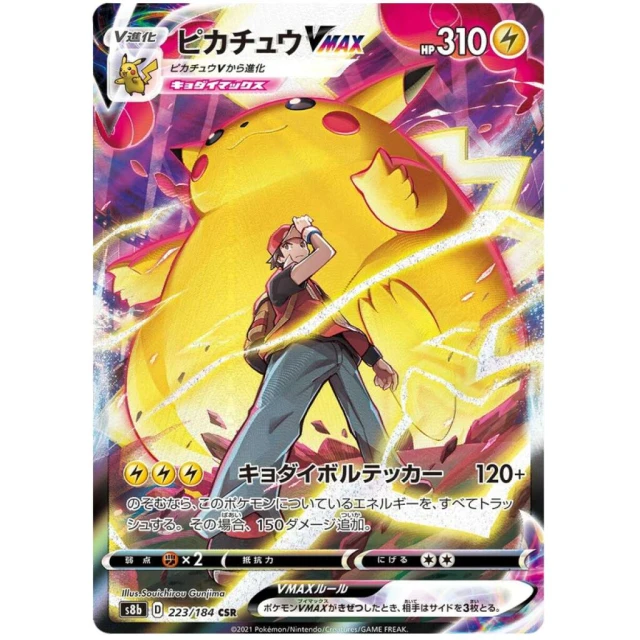
Pikachu VMAX VMAX Climax from Best Pikachu CardsVMAX Climax

Pikachu VMAX

Modern textured Pikachu with strong display value and a better article image than the old placeholder.
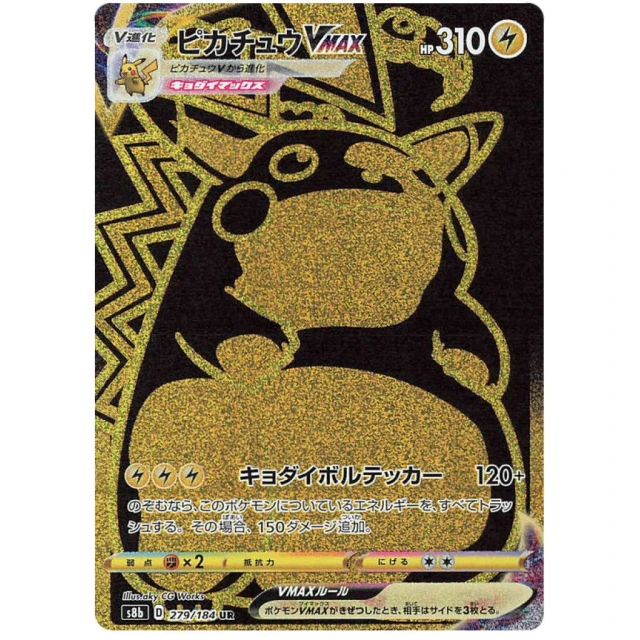
Pikachu VMAX Rainbow VMAX Climax HR from Best Pikachu CardsVMAX Climax HR

Pikachu VMAX Rainbow

The correct Pikachu image replaces the old article mistake that used an unrelated Charizard card.

Why Pikachu Illustrator Is Context, Not a Normal Recommendation

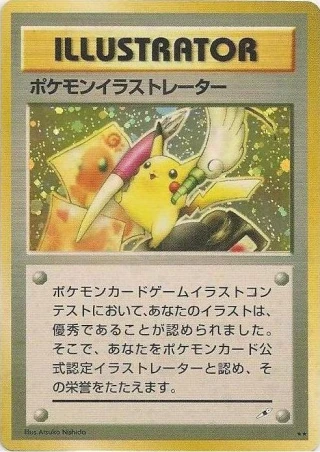
Pikachu Illustrator defines the ceiling of Pokemon collecting, but it does not belong in the same buyer decision as Pokemon 151 AR or S8a V-UNION. It was a contest prize, not a booster card. The correct use in this article is educational: it explains why Japanese-exclusive Pikachu cards carry cultural weight, while keeping practical recommendations focused on cards normal collectors can actually search for.

The Correct Modern Centerpiece

For most buyers, Pikachu V-UNION is the strongest modern centerpiece because it looks unique, requires a complete four-card display, and is tied to the 25th Anniversary cycle. It is easier to understand than many obscure promos and more visually special than a standard V or VMAX.

The Correct Starter Card

Pokemon 151 Pikachu AR is the clean starter pick. It has a recognizable Kanto hook, full illustration, high liquidity, and a price point that does not punish a new collector for learning. A buyer can own it raw, grade a clean copy, or use it as the first card in a larger Pikachu page.

More Useful Picks Below the Headline Cards

The article should not stop after the expensive cards. Most readers will not buy a museum promo or a high-end graded Pikachu immediately. They need realistic next steps: 25th Anniversary singles, VMAX Climax display cards, and classic-style cards that help a binder page feel complete without turning the purchase into a four-figure decision.
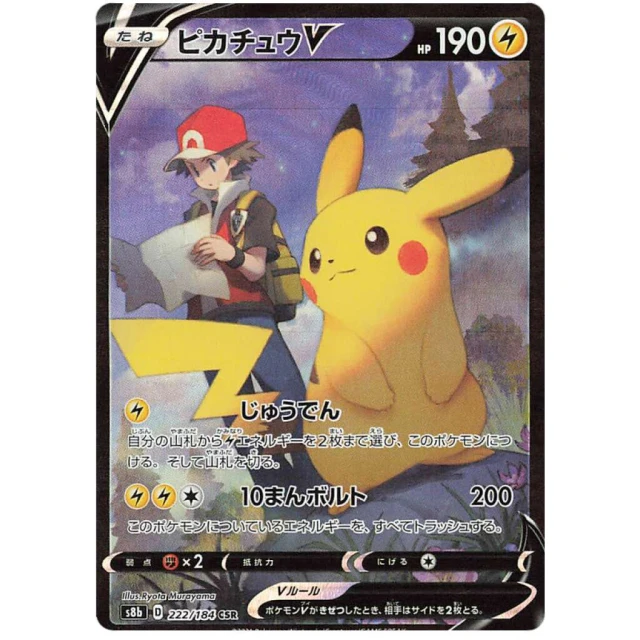
Pikachu V VMAX Climax CSR/CHR lane from Best Pikachu CardsVMAX Climax CSR/CHR lane

Pikachu V

A cleaner mid-budget pickup for collectors who want modern Pikachu art without promo prices.
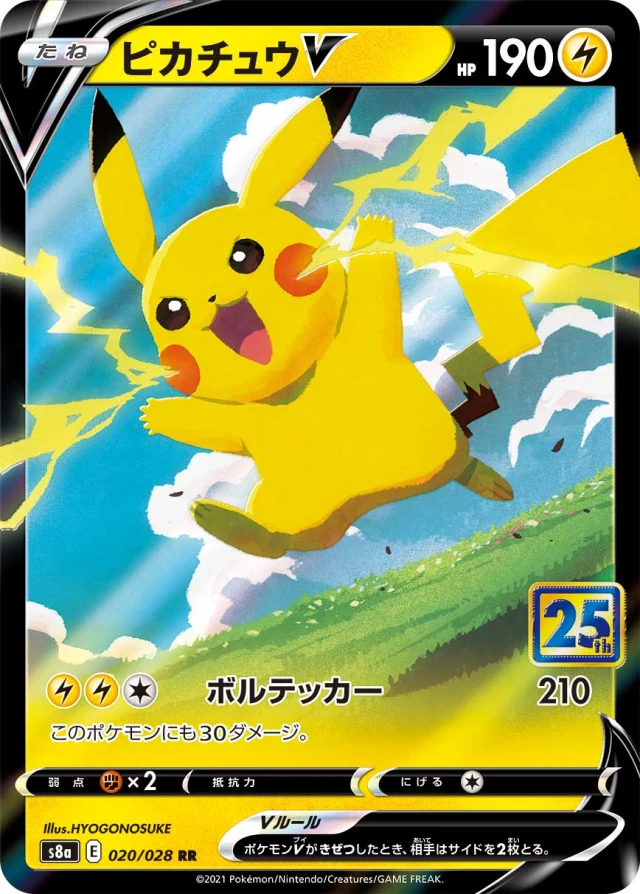
Pikachu V 25th Anniversary from Best Pikachu Cards25th Anniversary

Pikachu V

Affordable S8a card that keeps the 25th Anniversary theme without needing V-UNION money.
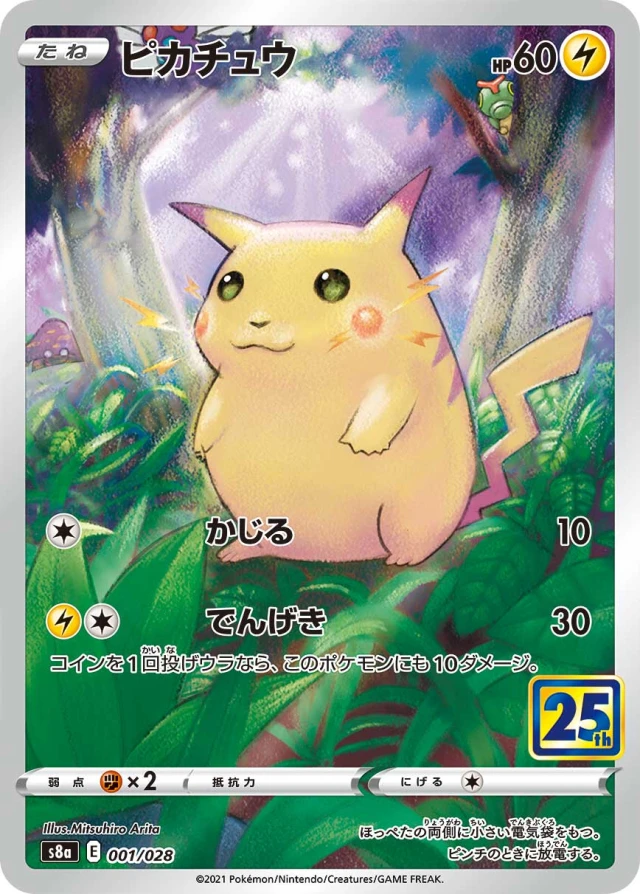
Base-style Pikachu Classic JP lane from Best Pikachu CardsClassic JP lane

Base-style Pikachu

Useful as a nostalgia benchmark: simple artwork, broad recognition, and easy entry for new buyers.

Card-by-Card Buying Notes

Pikachu V-UNION is strongest when all four pieces are bought together in matching condition. A mixed-condition set can look fine in a binder but loses some display and resale appeal. Flying Pikachu VMAX and Surfing Pikachu VMAX should usually be considered as a pair because the nostalgic callback is clearer when both are present. Buying only one is fine, but the pair is easier to explain later.

Pokemon 151 Pikachu AR is the safest first recommendation because it is affordable and easy to verify. The card is not scarce in the same way as a promo, but that is a benefit for a beginner: the buyer can focus on condition and centering instead of fighting rare-listing confusion. VMAX Climax Pikachu cards are better for collectors who want more texture, stronger foil, and a higher display ceiling.

Classic-style Pikachu cards are useful because they keep the collection grounded. Not every card on a Pikachu page needs to be expensive or textured. A simple Japanese Pikachu with clean artwork can make the page feel more complete, especially when placed next to anniversary cards and modern full-art treatments.

How We Ranked These Pikachu Cards

The score uses four factors: current market relevance, cultural weight, visual display value, and how easy the card is to buy without confusion. A rare card with no practical availability can be historically important, but it is not automatically the best recommendation for a working collector.

Factor What it measures Why it matters
Market relevance Raw and graded demand in 2026 Prevents stale rankings from leading buyers into dead demand.
Cultural weight Anniversary, promo, Kanto, or contest significance Pikachu cards with a story tend to stay easier to explain.
Display value Artwork, texture, and recognizability Pikachu is a visual market; the card must look good.
Buying clarity Set code and listing confusion risk Collectors need to know exactly which version to search.

Why the Old Article Needed a Refresh

The old version was too text-heavy at the top and too light on image verification. One representative image was not the actual Pikachu card being discussed, which is exactly the kind of issue the new blog standard is designed to remove. A collector article has to make the card visually obvious, especially when similar names and rarity labels can mislead buyers.

Why Promos and Booster Cards Are Separated

Japanese Pikachu collecting has two lanes. Booster and high-class-pack cards are easier to price and easier to source. Promos can be more culturally important, but condition, authenticity, and provenance become more important. Treating both lanes as one list creates bad buying advice, so this article separates museum context from practical pickups.

What Changed From the Older Version

The older version treated several cards as text-only recommendations and used at least one representative image that was not the discussed Pikachu. That is not acceptable for a buying guide because collectors make decisions visually. This refresh makes the image rule explicit: every card shown should be the correct card or clearly labeled as context. The article also adds buyer tiers so the reader knows what to do after reading the ranking.

The ranking still respects cultural weight, but it no longer implies that the rarest card is the best practical purchase. That distinction matters. A collector who wants to start today needs a clean first buy, while a high-end buyer needs condition and provenance checks. Those are different jobs, so the article now handles them separately.

2026 Market Read

The 2026 Pikachu market is broad, liquid, and uneven. Budget cards can be excellent buys because demand is constant, while high-end cards require stricter condition checks. The main mistake is assuming that every Japanese Pikachu is rare. Many are common; only specific versions with the right set, rarity, and story deserve premium pricing.

For a sealed box article, this section should show Japan-versus-overseas box movement. Pikachu is different because it is a single-card ladder across promos, anniversary cards, modern texture cards, and budget AR cards. A fake blended price chart would be misleading, so this section uses real card images and buying tiers instead.

Pikachu AR Pokemon 151 from Best Pikachu CardsPokemon 151

Pikachu AR

Best starter pick: affordable, recognizable, and tied to the original 151 nostalgia cycle.

Flying Pikachu VMAX S8a from Best Pikachu CardsS8a

Flying Pikachu VMAX

25th Anniversary nostalgia with a recognizable vintage callback.

Surfing Pikachu VMAX S8a from Best Pikachu CardsS8a

Surfing Pikachu VMAX

Pairs naturally with Flying Pikachu and has stronger vintage-memory appeal.

Pikachu V-UNION 25th Anniversary from Best Pikachu Cards25th Anniversary

Pikachu V-UNION

Four-card display piece, strongly Japanese, and one of the cleanest modern Pikachu centerpiece buys.

Budget Best target Reason
Under $40 Pokemon 151 Pikachu AR Best starter card with real collector identity.
$75-$150 Flying or Surfing Pikachu VMAX 25th Anniversary nostalgia and easy display value.
$200-$350 Pikachu V-UNION complete set Modern Japanese centerpiece with four-card display impact.
$400+ Higher-grade VMAX Climax or promo cards Only buy after condition and set identity are clear.

Raw vs Graded

Raw cards are better for binder collectors and buyers who want flexibility. Graded cards are better when the card is expensive enough that condition certainty matters. A low-end graded Pikachu can be less useful than a clean raw copy if the slab premium is too high.

Japan vs Overseas Pricing

Japanese marketplace prices and overseas retail prices do not move one-for-one. Overseas prices include sourcing, shipping, payment friction, and seller support. A buyer should compare landed cost and condition, not just the lowest visible Japanese listing.

How to Read Fast-Moving Pikachu Prices

Pikachu prices can move in bursts after social posts, anniversary events, new product announcements, or record-setting auctions. That does not mean every Pikachu card is suddenly scarce. The better read is to separate liquid, widely traded cards from niche promos. Liquid cards are easier to price because multiple sellers compete. Niche promos can look expensive because one visible listing sits high for months.

For this reason, a smart buyer checks three things before reacting to a price: whether comparable sales exist, whether the exact Japanese card number matches, and whether condition photos support the asking price. If one of those is missing, the card may still be desirable, but it should be treated as a slower, more negotiated purchase.

Market situation Best response Reason
Many recent sales Use the sold range The market is liquid enough to benchmark.
Only one high listing Wait or negotiate One seller does not define the market.
Rare promo with provenance Ask for documentation History matters as much as condition.
Budget modern card Prioritize clean raw copies Grading premiums can exceed the card’s real utility.

What to Buy by Collector Type

Collector type Best action Reason
New Japanese card collector Start with Pokemon 151 Pikachu AR Low risk, strong nostalgia, easy to verify.
Display collector Buy Pikachu V-UNION complete set Four-card format gives it shelf presence.
Anniversary collector Pair Flying and Surfing Pikachu VMAX They work better together than individually.
Grading buyer Prioritize surface and centering Modern texture shows damage quickly.
Investor-style buyer Avoid vague promo listings Provenance and exact card identity matter more at high price.

Best First Three-Card Page

A strong beginner page is Pokemon 151 Pikachu AR, S8a Pikachu V, and one of Flying or Surfing Pikachu VMAX. That gives the page Kanto nostalgia, anniversary identity, and a textured modern card without requiring a high-end promo budget.

When to Avoid a Listing

Avoid listings that use stock images for expensive cards, hide corners, omit the set code, or describe the card only as “rare Pikachu.” The exact Japanese set and card number are the difference between a premium collector card and an overpaid common.

Best Three Buying Paths

Binder path: buy Pokemon 151 Pikachu AR, S8a Pikachu V, and a classic-style Pikachu. This gives broad visual coverage with low risk. Display path: buy Pikachu V-UNION plus either Flying or Surfing Pikachu VMAX. This creates a small shelf-ready Japanese Pikachu group. High-end path: move into VMAX Climax, promos, or graded copies only after you can verify exact card identity and condition.

The best path is not always the most expensive one. A clean, coherent three-card page often looks better than a random mix of expensive cards with no theme. Pikachu collecting rewards focus because the card pool is too large to complete casually.

How to Build a Better Pikachu Collection

A strong Pikachu collection is not just a pile of expensive cards. It should have a visible structure: one card that explains the character’s history, one card that shows modern Japanese print quality, one card that feels personal to the collector, and one card that can be traded or sold easily if the buyer changes direction later. That structure keeps the collection from becoming a random price chart.

The best practical approach is to build around lanes instead of chasing every new listing. A Kanto lane can use Pokemon 151 Pikachu AR and classic-style cards. An anniversary lane can use S8a Pikachu V, Flying Pikachu VMAX, Surfing Pikachu VMAX, and V-UNION. A texture lane can use VMAX Climax cards. A high-end lane should be reserved for promos, graded cards, and provenance-heavy purchases.

Collection lane Good anchor What to avoid
Kanto nostalgia Pokemon 151 Pikachu AR Overpaying for a common copy because the listing says vintage-style.
Anniversary display Pikachu V-UNION complete set Buying unmatched loose pieces without checking condition.
Modern texture VMAX Climax Pikachu VMAX or Rainbow Ignoring surface scratches because the front photo is bright.
Promo/high-end Documented Japanese promo or graded copy Trusting vague provenance or one low-resolution image.

Do Not Let One Record Sale Rewrite the Whole Market

Pikachu is famous enough that record sales get shared widely. Those sales are useful context, but they can distort the way normal buyers think. A record-level Illustrator sale does not mean a modern budget Pikachu should be repriced overnight. A clean high-grade promo sale does not automatically lift every raw copy of a similar-looking card. The right question is narrower: did this exact card, in this condition and language, show repeated demand?

That is why the guide treats prices as tiers rather than one final number. Budget cards can be bought more quickly because the mistake size is smaller. Mid-tier cards deserve a comparison across several sellers. High-end cards deserve extra photos, provenance, grading checks, and a slower decision. The more expensive the Pikachu, the less useful a rushed top-10 ranking becomes.

Match the Card to the Display Plan

Display value is one of the biggest reasons collectors buy Pikachu, so the card should match the way it will be shown. A binder page benefits from variety: one AR, one VMAX, one anniversary card, and one classic-style card. A desk or shelf display benefits from a centerpiece, which is why V-UNION works better than several small unrelated cards. A graded display benefits from label clarity and visual impact at a distance.

If the goal is resale, choose cards that another buyer can understand in ten seconds. Pokemon 151 Pikachu AR is easy to explain. Flying and Surfing Pikachu are easy to explain. V-UNION is easy to explain when all four pieces are present. Obscure promos can be excellent, but they need clearer documentation and a buyer who already knows why that version matters.

Use Zustand Bands, Not Vague Near-Mint Language

Japanese cards often have strong print quality, but condition still varies. For lower-priced cards, clean front appeal may be enough. For grading candidates, the buyer should inspect centering, corners, surface, and back edges separately. For expensive promos, condition language is not enough; the seller should provide enough photos to show why the premium is justified.

A useful internal rule is simple: under $40, buy the cleanest copy from a reliable seller; $75-$350, compare several copies and avoid stock images; above that, ask for proof before paying the premium. This keeps the article grounded in real buying behavior instead of treating every Pikachu card like the same product.

Zustand and Authenticity Checks

Pikachu cards are liquid, so weak listings appear often. Check the card number, set logo, language, holo pattern, edges, and back surface. On textured cards, use angled light to check scratches and pressure marks. On V-UNION cards, make sure all four pieces match condition.

Check Why it matters
Set code and card number Prevents confusing similar Pikachu cards from different sets.
Surface Pikachu foils show scratches clearly under light.
Corner whitening Important for grading and display value.
Image accuracy The listing image must show the exact card, not a representative card.
Complete set status V-UNION is strongest as all four matched cards.

Grading Risk

Grading can add value, but only when the card is clean enough and expensive enough to justify the fee, shipping, and time. On lower-price cards, a raw near-mint copy may be the better purchase. On higher-price cards, grading protects liquidity because future buyers can trust the condition without studying every surface photo.

Image Risk

Image accuracy is not a minor detail. The old article’s wrong representative image is the exact mistake buyers should learn to avoid. If the image does not match the card name, set, and rarity, pause. Either the seller is careless, the article is weak, or the listing is using placeholder media. None of those are good signals for a premium Pikachu purchase.

Where to Buy Japanese Pikachu Cards

For SST buyers, start with the Japanese single-card collection and compare the card against the images and tiers in this guide. If you are buying higher-end promos or graded cards, ask for additional photos rather than trusting one front image.

Browse Japanese Pikachu Singles

Check current Japanese Pokemon singles, then compare condition, set code, and card identity before buying.

View Singles

Why SST Should Show More Images

Pikachu buyers are visual buyers. The article and product pages should show real card images, not placeholder graphics. This is the same reason the broader blog refresh moved away from three-image, thin articles: visual proof and market proof are both part of conversion.

What to Ask Before Checkout

Ask whether the card is Japanese, whether the photos are of the exact copy, whether the surface has scratches, and whether the seller can show back corners. For complete V-UNION sets, ask whether all four pieces are included and whether their condition is consistent. For graded cards, verify the certification number against the grading company’s database before paying a premium.

The Bottom Line

The best Japanese Pikachu card depends on the buyer. New collectors should start with Pokemon 151 Pikachu AR. Display buyers should look at Pikachu V-UNION or the S8a VMAX pair. High-end buyers should treat promos and Illustrator as separate markets where condition and provenance matter more than a simple ranking.

The improved article standard is straightforward: show the exact card, explain the buyer tier, separate historical context from practical recommendations, and make the next purchase path clear. Pikachu has too many cards for a vague ranking to be useful. A good guide narrows the field so the reader can make one confident decision instead of adding ten unrelated cards to a wishlist.

Best use case Build a ladder: one budget AR, one anniversary card, one display centerpiece, then only move into expensive promos when you can verify the exact card and condition.

Frequently Asked Questions

What is the most valuable Japanese Pikachu card?

Pikachu Illustrator is the all-time ceiling, but it is a contest promo and not a realistic buying target for most collectors. For attainable modern Japanese cards, V-UNION, VMAX Climax, 25th Anniversary, and Pokemon 151 cards are more useful.

Which Japanese Pikachu card should beginners buy first?

Pokemon 151 Pikachu AR is the cleanest first buy because it is affordable, recognizable, and tied to the original Kanto lineup.

Are Japanese Pikachu cards better than English?

Japanese cards often have stronger print quality and collector demand, but the better buy depends on the exact card, condition, and market spread.

Should I buy raw or graded Pikachu cards?

Buy raw for binder and display collecting. Buy graded only when the premium is justified by condition, scarcity, or long-term display value.

Is Pikachu V-UNION worth buying?

Yes if you want a modern Japanese centerpiece. The complete four-card set is more collectible than loose fragments.

Why is Pikachu Illustrator not ranked as a normal buy?

It was a contest prize, not a booster card. It belongs in the historical context section rather than a practical buyer ranking.

What is the best budget Pikachu card?

Pokemon 151 Pikachu AR and 25th Anniversary Pikachu V are the cleanest budget picks.

What should I check before buying?

Check set code, language, condition, surface, corners, centering, seller reputation, and whether the image matches the exact card being listed.

Do Pikachu cards move quickly?

Yes. Pikachu is the broadest Pokemon character market, so clean Japanese singles can move faster than obscure chase cards.

Where can I buy Japanese Pikachu cards?

Use the SST Japanese single-card collection linked in the article and compare listings by condition and card identity, not just price.
Japanese Pokemon Card Rarities Explained (2026 Guide)

You opened a Japanese booster pack, pulled a card with a gold “SAR” stamp in the corner, and now you’re wondering whether you just hit $30 or $300.

Japanese Pokemon cards use a rarity system that looks familiar on the surface — C, U, R, SR — but adds a whole second tier of modern rarities (AR, SAR, UR, MUR, CHR, CSR) that don’t map cleanly to the English Scarlet & Violet system most Western collectors learned first. The symbols are often printed in a corner smaller than a fingernail, in Japanese, and the price gap between two rarities that look almost identical can be 20×.

This guide walks through every current Japanese Pokemon card rarity from Common to MUR, with USD price ranges, realistic pull-rate estimates per booster box, and the set examples where you’ll actually encounter each one. By the end you’ll be able to glance at any JPN card and know roughly what tier it sits in — and what it’s worth.

We ship Japanese Pokemon cards out of Tokyo every day. The price ranges below are based on current SNKRDUNK and Mercari data converted to USD at approximately ¥141/USD, tracked across our own outbound order flow.

Key Takeaway

Japanese sets stack two layers of rarity: gameplay tiers (C, U, R, RR) that fill packs, and chase tiers (AR, SR, SAR, UR, MUR) that drive pricing. SAR is the modern headline rarity, MUR is the new top tier from the Mega era, and the JPN-to-ENG mapping is mostly one-to-one once you learn the codes.

10+
Distinct Rarity Tiers

SAR
Modern Headline Rarity

MUR
New Top Tier (2026)

15–40%
JPN Premium Over ENG

What Are Japanese Pokemon Card Rarities?

Japanese Pokemon cards sort into two broad groups: regular-set rarities (C, U, R, RR) that make up the bulk of a pack, and chase rarities (AR, SR, SAR, UR, MUR) that sit at the back of the checklist and drive secondary-market prices. On top of that, The Pokémon Company occasionally introduces special rarities tied to specific sets — CHR (Character Rare) from the S4a Shiny Star V era, CSR (Character Super Rare), and MUR (Mega Ultra Rare) which debuted with the Mega Evolution sets starting in 2026.

The rarity symbol is printed in the bottom-left or bottom-right corner of the card, next to the card number. Modern Japanese sets (Sword & Shield, Scarlet & Violet, Mega era) use letter codes — “SR,” “SAR,” “AR,” “UR” — while older cards used star symbols. If you’re holding a card with no visible rarity stamp at all, check the bottom corner under a bright light: AR and SAR cards sometimes have the code printed very small against the textured artwork.

Rarity Symbol / Code Est. Pull Rate Price Range (USD)
Common (C) None ~60% of pack ~$0
Uncommon (U) ◆ (Black diamond) ~25% of pack ~$0
Rare (R) ~1 per pack $0.50–$5
Double Rare (RR) ★★ ~1 per pack $3–$30
AR (Art Rare) “AR” ~2–3 per box $2–$20
SR (Super Rare) “SR” ~1–2 per box $10–$100+
SAR (Special Art Rare) “SAR” ~1 per 3–4 boxes $20–$500+
UR (Ultra Rare, Gold) “UR” ~1 per 8–12 boxes $15–$100+
MUR (Mega Ultra Rare) “MUR” ~1 per 20–30 boxes $150–$800+
CHR (Character Rare) “CHR” Set-dependent $5–$30

Here’s the thing: rarity alone doesn’t determine price. A generic SR trainer can sit at $10 while an SAR of a headline Pokemon from the same set pulls $300+. Artwork, the Pokemon depicted, the artist’s signature, and whether the set is still in print all multiply on top of the base rarity tier.

Common (C) and Uncommon (U): The Base of the Set

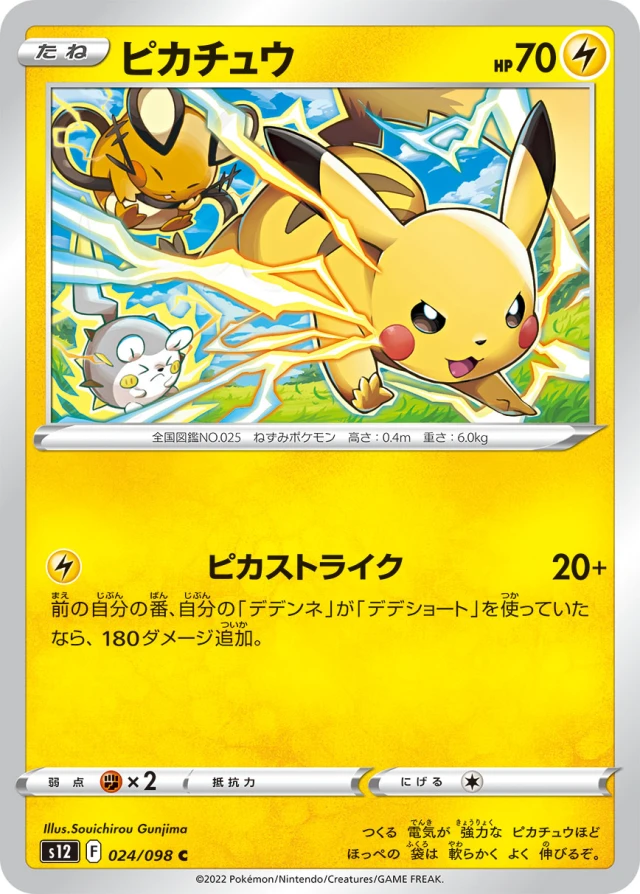
Pikachu Common from S12 Paradigm Trigger — typical Japanese Pokemon Common card with no rarity symbol
Pikachu — S12 Paradigm Trigger (Common, C)

Commons and Uncommons fill out the gameplay pool — energy cards, basic Pokemon, low-impact trainers. Their rarity symbol is either blank (Common) or a black diamond (Uncommon) in the corner.

  • Common (C): Roughly 60% of a pack. Non-holo. Trade at or near $0 as singles.
  • Uncommon (U): Roughly 25% of a pack. Non-holo. Also near $0 as singles.

Competitive players still buy C/U cards as 4-of playsets for tournaments, but from a collector standpoint they’re bulk. The exception is when a Common card becomes surprise meta-relevant — prices can briefly spike to $1–$3 before settling. For modern Japanese sets we stock, browse the SV11W Super Electric Breaker card list to see how C/U slots fill a typical Scarlet & Violet set.

Rare (R) and Double Rare (RR): The Holo Tier

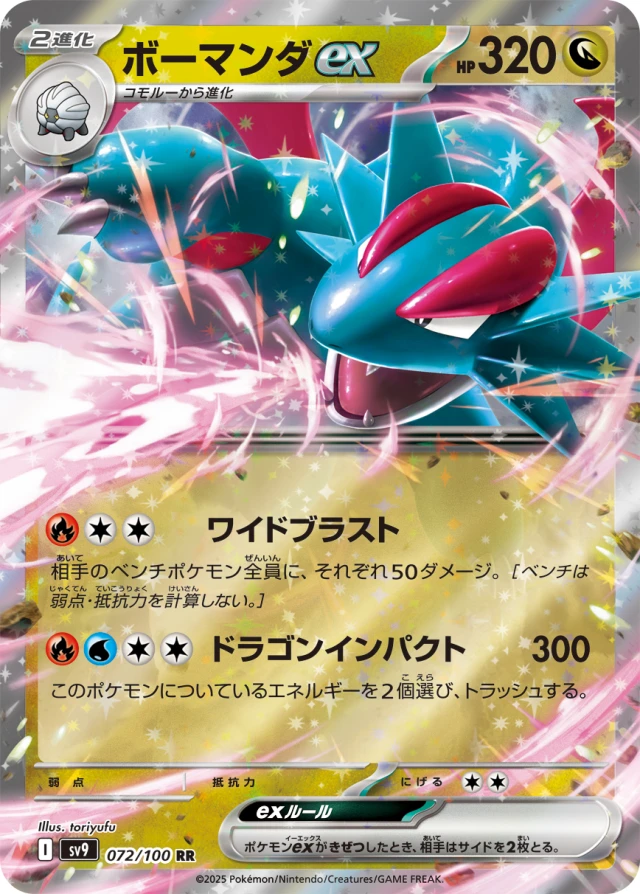
Salamence ex RR from SV9 Battle Partners — Japanese Double Rare with full-art holo pattern
Salamence ex — SV9 Battle Partners (Double Rare, RR)

Rare and Double Rare cards mark the step from bulk into collectible territory. You’ll see one of each in most packs.

  • Rare (R): One black star symbol. Holo foil on the artwork. $0.50–$5 as a single.
  • Double Rare (RR): Two black stars. Full-art holo pattern covering most of the card. $3–$30 depending on the Pokemon.

RR cards in the Scarlet & Violet era correspond to ex cards (Charizard ex, Pikachu ex, Mew ex, etc.) — the powerful Pokemon that also serve as gameplay centerpieces. An RR Charizard ex will typically outprice an RR of a less popular Pokemon from the same set by 5–10×, because brand recognition compounds on the base rarity.

Art Rare (AR): The Illustrated Backgrounds

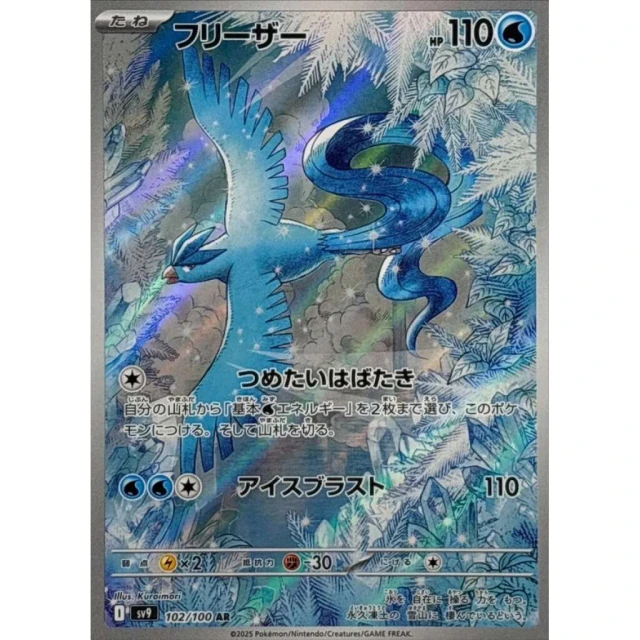
Articuno AR from SV9 Battle Partners — Japanese Art Rare with full illustrated background
Art Rare (AR) — ~$2–$20, pulls ~2–3 per 30-pack box.

Art Rares (AR) are the entry point into serious collecting. These cards take a Pokemon that already exists in the set as a regular C or U and re-print it with a full illustrated background — the Pokemon’s natural habitat, a dynamic action scene, or character interaction. The gameplay text is identical to the non-AR version; the difference is purely artistic.

AR cards drove the “illustration boom” in Japanese Pokemon collecting starting around S11 Lost Abyss (2022) and have been the single most effective rarity for pulling new collectors into the JPN market. They’re approachable price-wise, visually stunning, and feel like the Pokemon franchise at its most confident artistically.

Recent sets worth checking for AR hunting: SV10 Heat Wave Arena, SV9 Battle Partners, and M4 Mega Symphonia. English collectors often recognize the concept under the TCG name “Illustration Rare” — mechanically equivalent but printed separately for each market.

Super Rare (SR): The Classic Chase

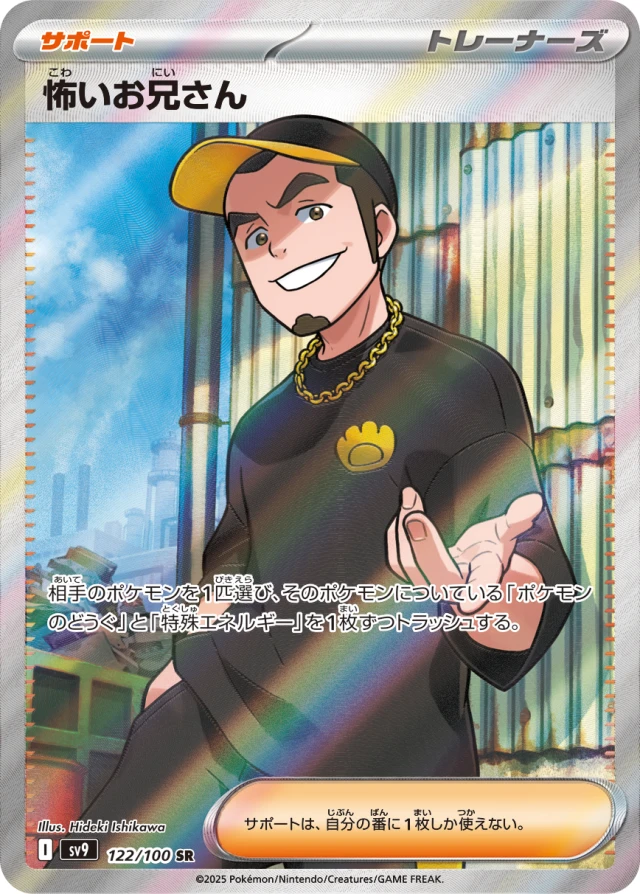
N (Scary Big Brother) Trainer SR from SV9 Battle Partners — Japanese Super Rare full-art trainer card
N (Scary Big Brother) — SV9 Battle Partners (Super Rare, SR)

Super Rare (SR) is the longest-running “chase tier” in modern Japanese Pokemon cards. Every set includes a handful of SRs — usually full-art trainer cards and occasionally Pokemon ex with holo-textured borders and the trainer/character’s name in a distinctive typeface.

  • Symbol: “SR” in the bottom-left corner, or three black stars on older sets.
  • Pull rate: Roughly 1–2 per 30-pack box.
  • Price range: $10–$100+, with popular character SRs pushing toward $150.

Trainer SRs from recent sets — Iono SR, Nemona SR, Ogerpon-themed SRs — are a reliable value floor for the tier. Pokemon SRs (Charizard ex SR, Mew ex SR) often compete on price with Full Art Trainer SRs in the same set, depending on which character has the stronger collector following.

For classic Sword & Shield SRs, the S12a VSTAR Universe card list shows the full SR lineup of the final High Class Pack of that era — still one of the most collected SR pools in the hobby.

Special Art Rare (SAR): The Modern Headline Rarity

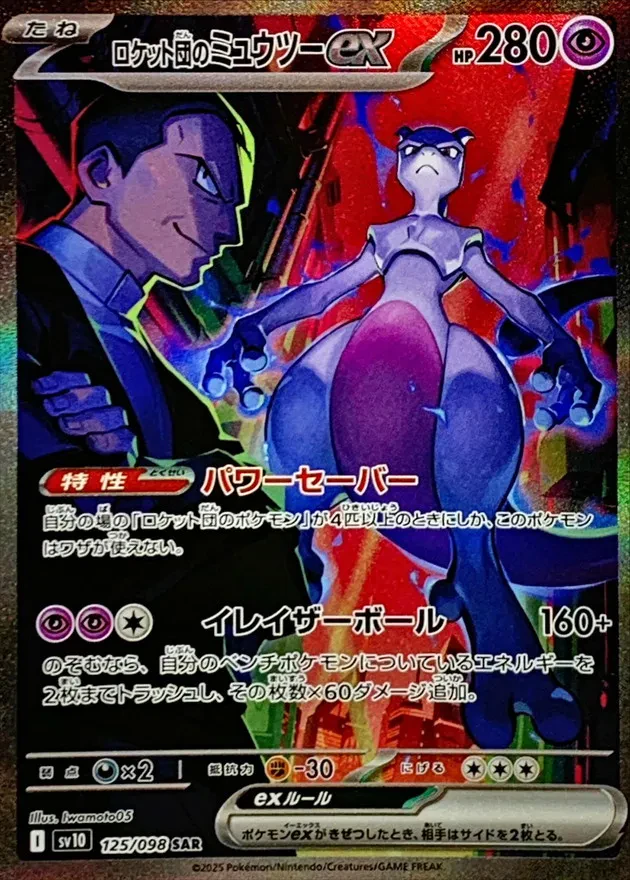
Team Rocket's Mewtwo ex SAR from SV10 Glory of Team Rocket — Japanese Special Art Rare with gold foil border
Special Art Rare (SAR) — ~$20–$500+, pulls ~1 per 3–4 boxes.

SAR (Special Art Rare) is the rarity everyone is actually chasing. Introduced partway through the Sword & Shield era and now standard in every Scarlet & Violet set, SAR cards combine two things at once: a unique alternate illustration (not just the SR art scaled differently) and the top-tier gold-foil border that marks the card as premium.

Every modern set has 2–6 SARs, and the highest-value one is almost always the set’s “chase card” — Nanjamo SAR in SV2a 151, Bellibolt ex SAR in SV2, Iono SAR in SV2a, Mamane (Sophocles) SAR in SV5M, and so on. Art style varies: character SARs typically show the trainer in a cinematic scene with their signature Pokemon, while Pokemon-only SARs (Charizard ex SAR, for example) go for atmospheric full-bleed illustrations.

Current SAR hotspots in our inventory: SV9 Battle Partners, SV11B Black Bolt, and SV10 Heat Wave Arena. For older SA-era equivalents from Sword & Shield, the S6K Jet-Black Geist card list contains the Shadow Rider Calyrex VMAX Alt Art and “Chubby” Blissey V Alt Art — pre-SAR but functionally the same tier.

Ultra Rare (UR): The Gold Cards

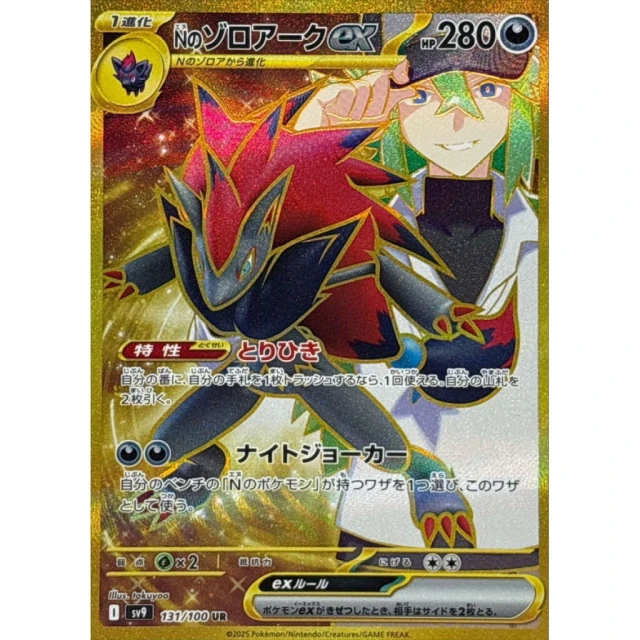
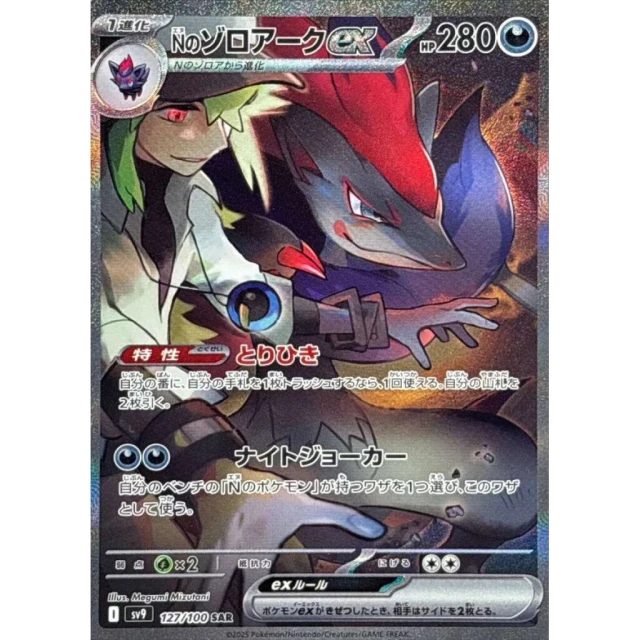
N's Zoroark ex UR from SV9 Battle Partners — Japanese Ultra Rare with fully gold metallic finish
Ultra Rare (UR) — ~$15–$100+, pulls ~1 per 8–12 boxes.

UR (Ultra Rare) cards are the gold-bordered versions of energy cards, stadium cards, and select trainer cards. They use a fully gold metallic finish across the entire card — including the artwork background — which makes them instantly recognizable in a pack.

The UR tier sits in an interesting pricing zone: they’re rarer than SAR per-box, but because they’re not typically the “headline” card, prices land below the top SAR in most sets. URs have stronger floor value than SAR though — a set’s UR lineup rarely depreciates more than 20% even years after release, while a trend-driven SAR can move 40–50% either way.

Good UR hunting from the Sword & Shield era: S12a VSTAR Universe includes URs of multiple signature Pokemon and energy cards. For the current Scarlet & Violet era, SV11W Super Electric Breaker and SV11B Black Bolt URs have held steady pricing through 2026.

MUR (Mega Ultra Rare): The New Top Tier

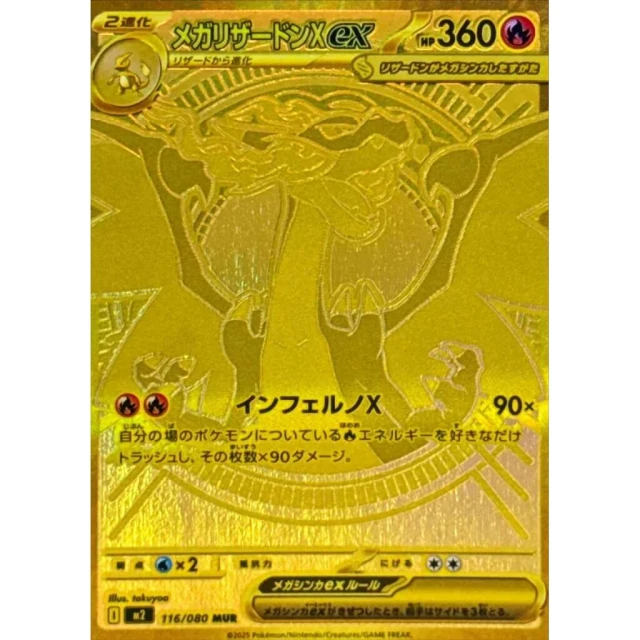
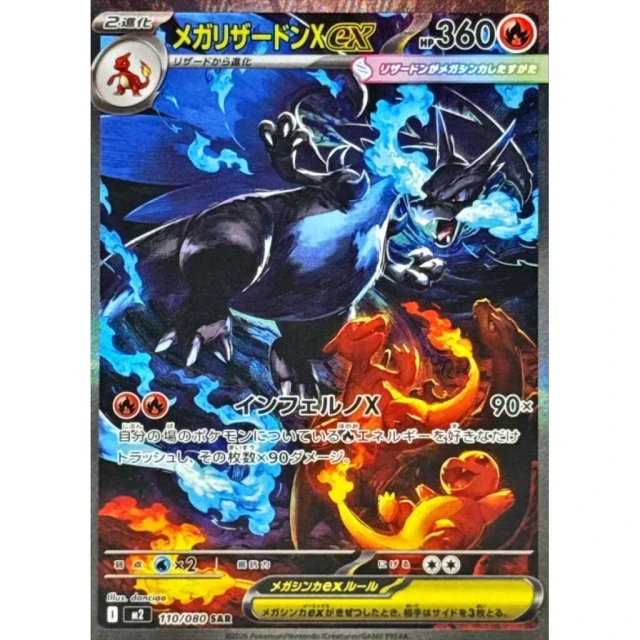
Mega Charizard X ex MUR from M2 Inferno X — Japanese Mega Ultra Rare from the Mega Evolution era with premium textured foil
Mega Ultra Rare (MUR) — ~$150–$800+, pulls ~1 per 20–30 boxes.

MUR (Mega Ultra Rare) is the newest Japanese Pokemon rarity, introduced with the Mega Evolution era that began in early 2026. MUR cards feature Mega-evolved Pokemon with full textured backgrounds, premium foiling, and an explicitly rarer pull rate than any prior rarity class.

MUR debuted with M1 Mega Brave and has appeared in subsequent Mega-era sets. Because the rarity is new, pricing is still stabilizing — MUR cards from the first three Mega sets traded between $400 and $1,200 at launch, with some correction since as supply caught up.

For current MUR-era sets in our inventory, the M4 Mega Symphonia card list shows the full MUR lineup from one of the most-collected Mega sets to date.

CHR, CSR, and the Character-Themed Rarities

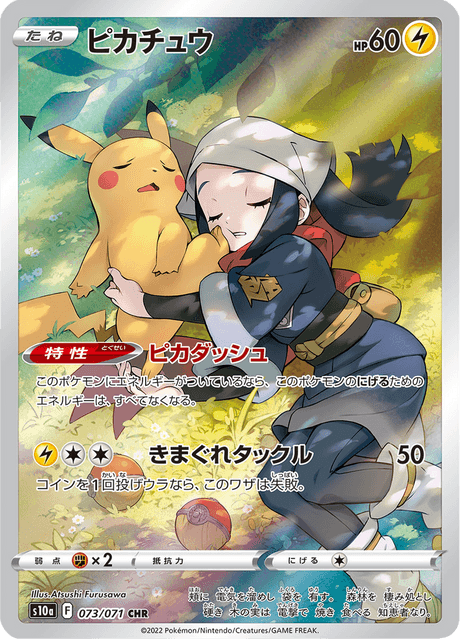
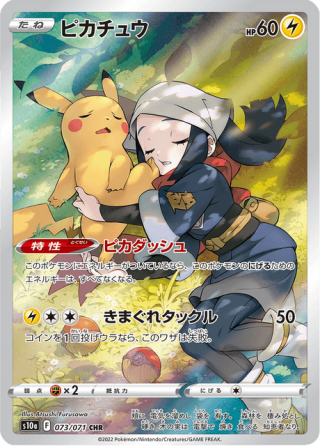
Akari's Pikachu CHR card 073/071 from Japanese S10a Dark Phantasma — Character Rare with full-illustration trainer artwork
Akari’s Pikachu CHR — S10a Dark Phantasma (Character Rare)

CHR (Character Rare) and CSR (Character Super Rare) are themed rarities focused on trainer character art rather than Pokemon. They originated with the S4a Shiny Star V set in 2020 and have since appeared in other character-focused releases.

  • CHR (Character Rare): Trainer character with their Pokemon, softly illustrated style. $5–$30 typical range.
  • CSR (Character Super Rare): Premium version of CHR with full-art treatment. $40–$200 typical range.

CHR and CSR pricing is highly dependent on the trainer featured. A Marnie CSR from S4a Shiny Star V has traded at $150+ for years because Marnie is a franchise-favorite character, while lesser-known CHRs can stay at $5–$10 for the long term. The S12a VSTAR Universe set also brought back CHR/CSR for its High Class Pack format.

Collectors who focus specifically on character cards rather than Pokemon cards gravitate to CHR/CSR as their primary tier — it’s a more niche but well-defined collecting lane inside the hobby.

Japanese vs English Pokemon Rarity Differences

Japanese and English Pokemon rarities look similar but aren’t identical. Here’s the mapping for current Scarlet & Violet era cards:

Japanese (JPN) English (ENG) Notes
C Common Identical concept
U Uncommon Identical concept
R Rare ENG may use diamond symbol
RR Double Rare ENG uses “ex” naming for Pokemon ex
AR Illustration Rare Essentially identical — different market prints
SR Ultra Rare / Full Art ENG SR concept was split into multiple tiers
SAR Special Illustration Rare Direct equivalent, different print runs
UR Hyper Rare ENG gold cards map to JPN UR
MUR JPN-only so far (2026); ENG Mega release TBD
CHR / CSR JPN-exclusive; no direct ENG equivalent

Two things to keep in mind. First, JPN cards historically trade at a 15–40% premium over their ENG equivalents, especially in the SAR/MUR tiers where print quality and foil texture are noticeably stronger on the Japanese version. Second, the JPN print runs for modern sets are usually smaller per-card than the corresponding ENG print runs, which tightens supply on older JPN chase cards over time.

Collectors who started with the English TCG often find the JPN rarity system easier to navigate once they realize SAR = Special Illustration Rare and UR = Hyper Rare. The letter codes are shorter and map one-to-one in most cases.

How to Identify Rarity on a Japanese Pokemon Card

Four checks, in order:

  1. Look at the bottom-left corner. The rarity code (SR, SAR, AR, UR, MUR) is printed there in small Latin letters, usually next to the card number (e.g., “123/110 SAR”). This alone identifies the tier on most modern cards.
  2. Check the border and foil pattern. SAR and MUR use a gold foil border. SR uses a silver holo pattern. AR has a textured full-card print but no gold border. UR is entirely gold across the whole card face.
  3. Tilt the card under light. Texture matters — MUR and SAR have a pronounced stamped foil pattern you can feel with a fingernail, while regular R and RR cards have a smoother holo finish.
  4. Cross-reference the card number. Japanese sets print secret rares after the base set number. If the card number exceeds the base set count (e.g., card 150 in a set with 102 base cards), it’s an SR or higher. Check set-specific card lists like the SV11B Black Bolt card list or SV9 Battle Partners card list to confirm.
Counterfeit Warning

Counterfeit Japanese cards occasionally misprint the rarity code or use the wrong foil finish. If the code and foil don’t match what the official set checklist shows for that card number, assume it’s a fake and avoid.

Where to Buy Japanese Pokemon Cards by Rarity

What you buy depends on which tier you’re targeting:

Singles are always cheaper per-card than pulling the same card from sealed. We recommend sealed boxes for the opening experience itself and for long-term sealed-collection value, and singles when you specifically want one card at a known price.

Frequently Asked Questions

What does SAR mean on a Japanese Pokemon card?

SAR stands for Special Art Rare. It’s a modern top-tier rarity introduced in the Sword & Shield era and standard in every Scarlet & Violet set. SAR cards combine a unique alternate illustration with a gold-foil border, and they pull approximately once every 3–4 booster boxes. Prices range from about $20 to $500+ depending on the Pokemon or character featured.

What is the difference between SR and SAR?

SR (Super Rare) is an older tier featuring full-art trainer cards and some Pokemon ex with silver holo-textured borders. SAR (Special Art Rare) is the newer, higher tier with gold foil borders and unique alternate illustrations — often the same Pokemon or trainer as the SR but with a different, more cinematic art direction. In current Scarlet & Violet sets, SAR typically sells for 3–10× the price of the corresponding SR.

How rare is a MUR Pokemon card?

MUR (Mega Ultra Rare) is the rarest consistently-printed Japanese rarity as of 2026. Estimated pull rate is approximately 1 per 20–30 booster boxes based on early opening data from M1 Mega Brave and M4 Mega Symphonia. Because the rarity is new, pricing remains in a discovery phase — MUR cards from flagship Mega sets have traded between $150 and $1,200 since launch, with the highest-value MURs featuring iconic Mega evolutions like Mega Charizard X and Mega Lucario.

Are Japanese Pokemon cards more valuable than English?

Japanese cards typically trade at a 15–40% premium over the equivalent English card, especially in the SAR, UR, and MUR tiers. The premium comes from stronger print quality, smaller per-card print runs on many sets, and sustained collector demand in both the JPN and international markets. The premium narrows after the English version has been in print for 6+ months, but rarely disappears completely.

Which Japanese Pokemon card rarity is best for beginners?

AR (Art Rare) is the best entry point. AR cards pull 2–3 per booster box, cost $2–$20 for most as singles, and feature the same high-quality illustrated-background artwork that makes higher-tier SAR cards so popular — just at a fraction of the price. Starting with AR singles from recent sets like SV9 or SV11 lets new collectors build a visually satisfying binder without spending SAR-tier money.

Top 10 Charizard Japanese Cards Ranked (2026 Guide)

Charizard is the most valuable Pokemon to chase in Japanese TCG history. Every flagship set since 2020 has printed a new Charizard chase card — and almost every one has outperformed its set’s average single on the secondary market within six months.

This guide ranks the ten most valuable Japanese Charizard cards of the modern era by current SNKRDUNK and eBay sold prices (as of February 2026), with every entry tagged by set, rarity, and the card-list page where you can check current inventory. Two entries sit above $1,500 in raw condition; three under $150 still deliver headline Charizard artwork at entry-level pricing. We ship Japanese singles and sealed boxes out of Tokyo every day and the prices below are tracked directly from our outbound order flow.

If you’re still learning the Japanese rarity system before diving in, our Japanese Pokemon card rarities explained guide breaks down SAR, MUR, UR, CHR and every tier referenced below.

Key Takeaway

The Mega Charizard X ex MUR (M2 Inferno X) and the Shiny Charizard VMAX SSR (S4a Shiny Star V) sit at the top of the Japanese Charizard market in 2026 — both trade $1,400–$2,400 raw, with PSA 10 copies reaching $4,500–$6,000+. Vintage old-back Charizards from 1996–2001 push even higher in graded slabs.

$1,400–$1,800
Top Card (M2 Mega Charizard X MUR)

50+
Notable JPN Charizards (1996–2026)

20–40%
JPN vs ENG Premium

1996
First JPN Charizard Printed

How We Ranked These Charizard Cards

The ranking combines four weighted factors, not just raw price:

  • Current JPN market price — SNKRDUNK median for raw NM condition, converted at ¥150/USD
  • Rarity tier and scarcity — estimated pull rate per booster box (SAR ~1 in 3–4 boxes, MUR ~1 in 20–30 boxes, SSR historical)
  • Artist reputation and art direction — alt arts by 5ban Graphics, Saki Hayashiro, Akira Komayama and other signature illustrators carry premium demand
  • Historical significance — first-of-rarity, anniversary prints, and cards with established PSA 10 population reports

Prices below are raw near-mint singles. PSA 10 graded copies of any entry on this list typically trade at 2–5× the raw price shown. All USD figures are rounded from JPY at ¥150/USD as of February 2026.

One note on condition: Japanese Charizard cards from modern sets generally ship closer to mint than their English counterparts because JPN packaging uses tighter pack-liner tolerances, but centering remains the single biggest grading-risk factor. Nearly 40% of raw Charizard SARs we inspect outbound show centering variance that would cap them at PSA 9 rather than 10. If PSA 10 grading is part of your plan, budget for pre-grade inspection and expect yields closer to 20–30% on raw singles.

Top 10 Japanese Charizard Cards of All Time

Rank Card Set Rarity Raw Price (USD)
#1 Mega Charizard X ex MUR M2 Inferno X MUR $1,400–$1,800
#2 Charizard VMAX SSR (Shiny) S4a Shiny Star V SSR $1,500–$2,400
#3 Charizard ex SAR SV3 Ruler of the Black Flame SAR $600–$900
#4 Charizard ex SAR SV2a Pokemon 151 SAR $400–$650
#5 Mega Charizard X ex SAR M2 Inferno X SAR $300–$500
#6 Charizard VMAX HR (Rainbow) S4a Shiny Star V HR $250–$400
#7 Charizard V CHR S7R Blue Sky Stream CHR $180–$280
#8 Mega Charizard X ex SR M2 Inferno X SR $120–$200
#9 Charizard ex SR SV2a Pokemon 151 SR $90–$150
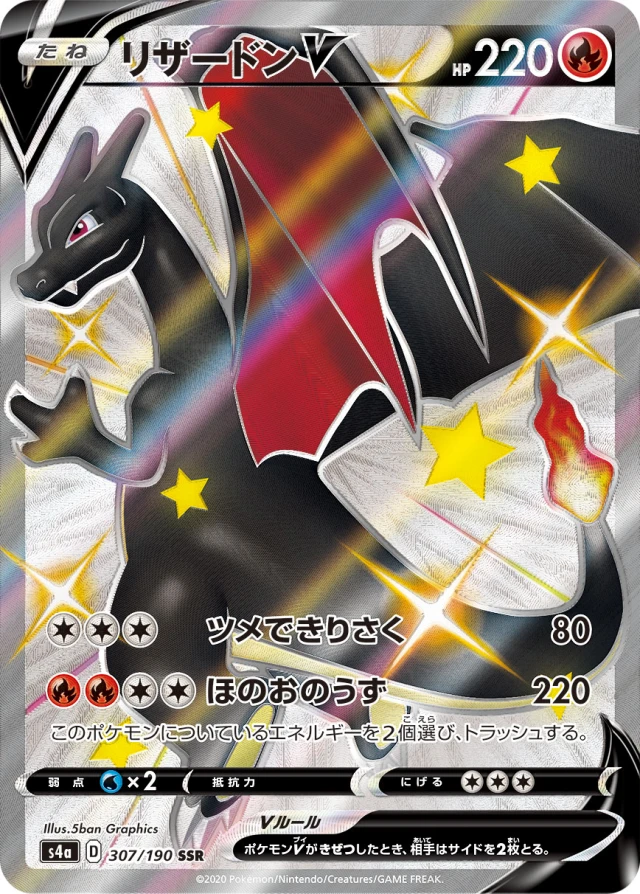
#10 Charizard V SR S4a Shiny Star V SR $60–$110

#10 — Charizard V SR (S4a Shiny Star V)

Charizard V SR from S4a Shiny Star V — silver full-art with crouched fire pose

Set: S4a Shiny Star V (November 2020) · Number: 307/190 · Price: $60–$110 raw

The entry-level S4a Charizard. This is the regular full-art Charizard V — silver holo border, traditional V layout, and the gateway card for collectors who want a Shiny Star V Charizard without paying SSR money. It’s the most affordable premium Charizard on this list and one of the most binder-friendly, with consistent PSA 10 population growth since 2021.

Browse live S4a inventory on the S4a Shiny Star V card list.

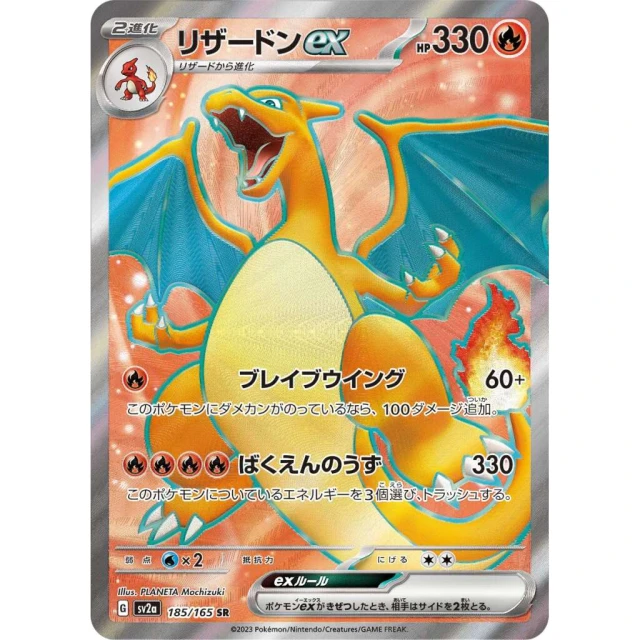
#9 — Charizard ex SR (SV2a Pokemon 151)

Charizard ex SR from SV2a Pokemon 151 — full-art silver border with classic Kanto pose

Set: SV2a Pokemon 151 (June 2023) · Number: 185/165 · Price: $90–$150 raw

The SR pair to the headline SAR in Pokemon 151. Cleaner composition, gentler price, and a Kanto-nostalgia design that still moves steadily because SV2a is now out of standard print rotation and sealed boxes trade at 2–3× MSRP. For collectors who want a 151 Charizard without chasing the SAR, this is where the smart buying sits in 2026.

See current SV2a singles on the SV2a Pokemon 151 card list.

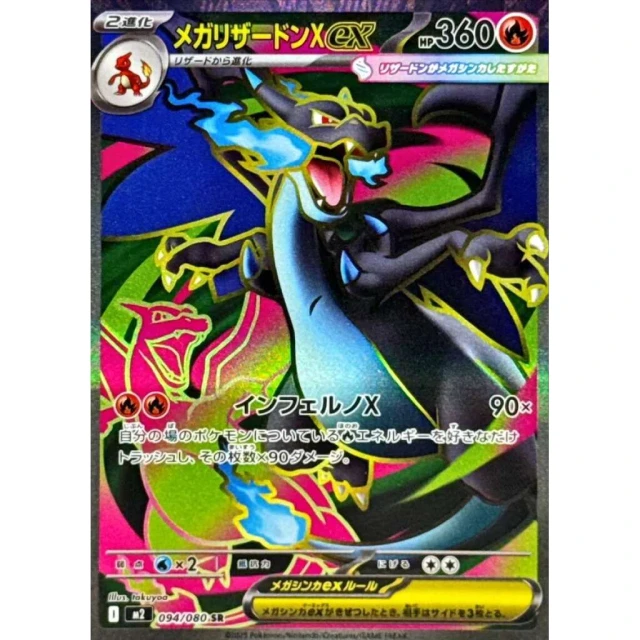
#8 — Mega Charizard X ex SR (M2 Inferno X)

Mega Charizard X ex SR from M2 Inferno X — full-art blue-flame Mega pose

Set: M2 Inferno X (December 2025) · Number: 094/080 · Price: $120–$200 raw

Mega Charizard X’s debut SR in the new Mega era. M2 Inferno X is built around Mega Charizard — it’s the literal titular card — and the SR delivers the signature blue-flame Mega design at a fraction of the SAR and MUR prices. Demand has held firm through the first two months post-release because every competitive and casual Mega deck wants a Charizard X slot filled.

Current M2 listings on the M2 Inferno X card list.

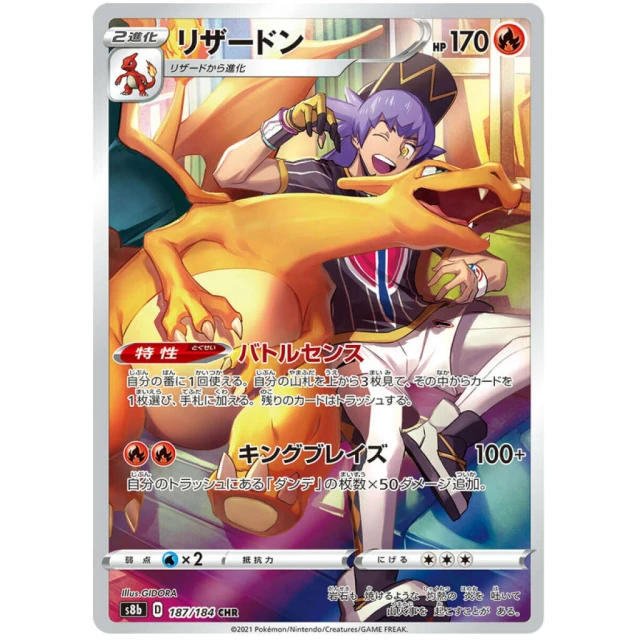
#7 — Charizard CHR (S8b VMAX Climax)

Charizard CHR 187/184 from S8b VMAX Climax — Character Rare with signature sky illustration

Set: S8b VMAX Climax (December 2021) · Number: 187/184 · Price: $180–$280 raw

The Character Rare Charizard from S8b VMAX Climax is one of the most underrated entries on this list. CHR is a Sword & Shield era sub-rarity that never appeared in the Scarlet & Violet era — that scarcity plus the illustrated sky composition has quietly pushed prices past many of the more obvious SAR cards. S8b has been out of print for several years and the CHR population in circulation shrinks every time a copy gets graded.

Check remaining S8b singles on the S8b VMAX Climax card list.

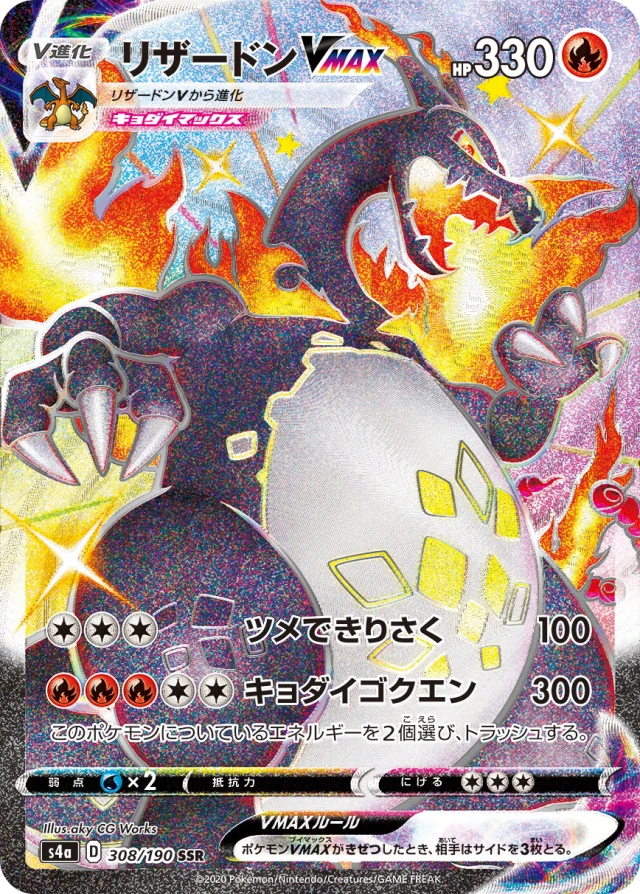
#6 — Charizard VMAX HR Rainbow (S4a Shiny Star V)

Charizard VMAX Rainbow Rare from S4a Shiny Star V — holographic rainbow alt-color version

Set: S4a Shiny Star V (November 2020) · Number: 308/190 · Price: $250–$400 raw

The rainbow Hyper Rare Charizard VMAX from S4a Shiny Star V. This is the big, molten-colored VMAX that carried the set’s secondary market through 2021 and 2022. Raw prices cooled in 2023 when PSA 10 supply grew, but raw near-mint copies still move $250–$400 and the card remains a central piece of any modern Charizard binder. PSA 10 copies commonly clear $1,000.

For more S4a pulls and pricing context, see the S4a Shiny Star V card list.

#5 — Mega Charizard X ex SAR (M2 Inferno X)

Mega Charizard X ex SAR from M2 Inferno X — special art rare with gold border and blue-flame Mega pose

Set: M2 Inferno X (December 2025) · Number: 110/080 · Price: $300–$500 raw

The M2 SAR is the buyer-friendly ceiling of the Mega Charizard X lineup. Gold foil border, full alt-art composition showing Mega Charizard X mid-transformation against a fractured sky background, and estimated pull rate around 1 per 3–4 booster boxes. It’s the card most new 2026 collectors are chasing because it combines the highest-demand Pokemon in TCG with the premium Mega-era rarity treatment — without needing the MUR budget.

See M2 SAR and MUR availability on the M2 Inferno X card list.

#4 — Charizard ex SAR (SV2a Pokemon 151)

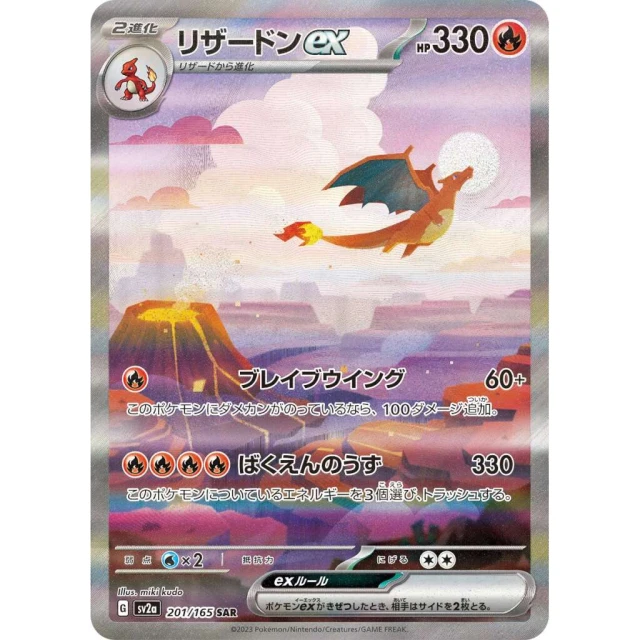
Charizard ex SAR from SV2a Pokemon 151 — special art rare with Kanto sunset illustration

Set: SV2a Pokemon 151 (June 2023) · Number: 201/165 · Price: $400–$650 raw

The Pokemon 151 Charizard ex SAR is the nostalgia SAR. It depicts Charizard against the classic Kanto sunset silhouette — a direct Gen 1 throwback that resonated with both 90s collectors and newer fans raised on 151-era merchandise. SV2a sealed boxes have appreciated more than any recent set on the Japanese secondary market, and the SAR has risen in lockstep. Raw near-mint copies hold $400–$650; PSA 10 copies routinely push past $1,500.

Shop SV2a singles on the SV2a Pokemon 151 card list.

#3 — Charizard ex SAR (SV3 Ruler of the Black Flame)

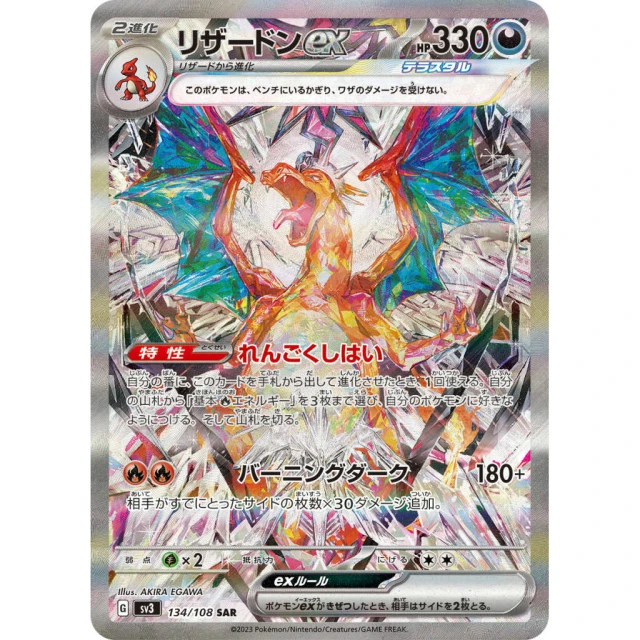
Charizard ex SAR from SV3 Ruler of the Black Flame — gold border SAR with Black Flame alt art

Set: SV3 Ruler of the Black Flame (July 2023) · Number: 201/108 · Price: $600–$900 raw

The SV3 Charizard ex SAR is the set’s namesake — Ruler of the Black Flame was built around this card. It’s arguably the best-composed Scarlet & Violet era Charizard SAR, featuring a dark Charizard variant emerging from obsidian flame imagery. The combination of strong art direction, high demand from the Terastal-era meta, and SV3 being harder to find in sealed form keeps this card above $600 raw eighteen months after release. PSA 10 copies trade in the $1,800–$2,500 band.

Browse SV3 singles on the SV3 Ruler of the Black Flame card list.

#2 — Charizard VMAX SSR / Shiny (S4a Shiny Star V)

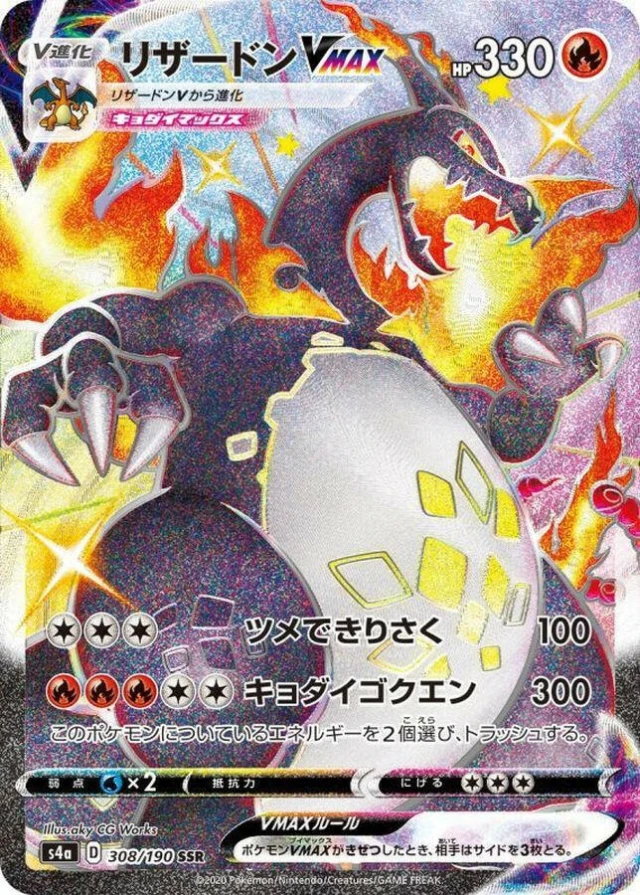
Shiny Charizard VMAX SSR from S4a Shiny Star V — black shiny variant with textured full-art treatment

Set: S4a Shiny Star V (November 2020) · Number: 308/190 (Shiny variant) · Price: $1,500–$2,400 raw

The black Shiny Charizard VMAX from Shiny Star V is the single most iconic Japanese Charizard of the Sword & Shield era and arguably the most important modern Charizard print since the 2016 20th Anniversary. The black-variant artwork, textured foil treatment, and historically low PSA 10 population pushed raw near-mint prices past $2,000 at the 2022 peak. After the 2023–2024 correction, the card has stabilized in the $1,500–$2,400 raw range with PSA 10 copies frequently clearing $6,000.

S4a sealed boxes are now premium-priced. For single-card routes, see the S4a Shiny Star V card list.

#1 — Mega Charizard X ex MUR (M2 Inferno X)

Mega Charizard X ex MUR from M2 Inferno X — Mega Ultra Rare gold-textured frame with blue-flame Mega Charizard

Set: M2 Inferno X (December 2025) · Number: 116/080 · Price: $1,400–$1,800 raw

The MUR Mega Charizard X is the highest-demand card of the 2026 Mega era. M2 Inferno X was designed around Mega Charizard X as the flagship Pokemon, and MUR — Mega Ultra Rare — is the set’s apex rarity at an estimated 1-per-20-to-30-box pull rate. The full-card gold foil texture, stamped Mega border, and the fact that this is the first modern flagship Charizard print in the Mega format combined to drive the card past $1,500 raw within six weeks of release.

Unlike the #2 S4a SSR, which is a mature card with settled pricing, the M2 MUR is still in its price-discovery phase. Early PSA 10 slabs have hit $4,500–$6,000, and the card is widely expected to stabilize at a premium to the SSR once graded supply normalizes. That forward demand is what earns it the #1 slot over the older Shiny Star V print.

See M2 Inferno X single listings on the M2 Inferno X card list, or browse the broader Mega-era sealed box collection to pack-open for MURs directly.

Vintage Japanese Charizards (Old-Back Era)

Japanese Base Set Charizard Holo (1996 Expansion Pack)
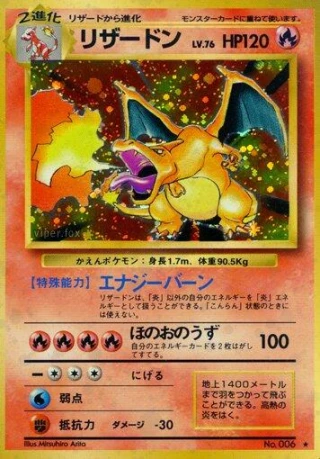
Charizard Holo — Japanese Expansion Pack / Base Set #6 (1996, Mitsuhiro Arita illustration)

Before the modern SAR/MUR era, Japanese Charizards came out of the “old-back” (旧裏) print format — cards with the original 1996–2002 card backs, distinct from the “new-back” (新裏) design that took over from 2002 onward. These are the cards that built Charizard’s blue-chip reputation in Japan, and some of them now trade at levels that dwarf even the top-10 modern cards above — particularly in PSA 9 and PSA 10 graded form.

Old-back Japanese Charizards are harder to authenticate, harder to source at NM condition, and have fewer circulating raw copies every year. For experienced collectors, these are the “holy grail” tier of the Japanese Charizard market. Raw prices below are rough ranges — condition variance is enormous on 20+ year-old cards, and graded supply is what actually drives the market.

Card Set Year Raw NM Range PSA 10 Range
Charizard Holo (Base Set) Japanese Base Set (Expansion Pack) 1996 $400–$1,200 $15,000–$40,000+
Dark Charizard Holo Team Rocket (ロケット団) 1997 $200–$600 $4,000–$10,000
Shining Charizard Neo Destiny (闇、そして光へ…) 2001 $1,500–$4,000 $20,000–$60,000+
Charizard (e-Reader Skyridge-era) The Town on No Map / Split Earth 2002 $300–$900 $5,000–$15,000
WOTC-era JPN Variants (CoroCoro promos, etc.) Various promos 1998–2001 $200–$2,500 Highly variable

The 1996 Japanese Base Set Charizard is the origin point. The first Charizard ever printed in Japan, with the iconic Mitsuhiro Arita illustration that defined a generation. In PSA 10 condition — extremely rare given the 1996 print tolerances — copies have cleared $40,000 and above at major auctions. The Team Rocket Dark Charizard (1997) introduced the Dark-type variant and remains a fixture of vintage binders, while the Neo Destiny Shining Charizard (2001) is arguably the most desirable old-back Charizard of all — the textured shiny foil treatment and estimated sub-1% pull rate from the original Japanese Neo Destiny packs make PSA 10 copies genuinely museum-tier.

The e-Reader era (2002 onward, still using old backs in early prints) produced a handful of Charizards with the distinctive e-Reader dot-code strips along the card borders. These are condition-sensitive and often show wear on the e-Reader strips themselves — collectors who value complete preservation pay premiums for copies with clean, unmarked strips. WOTC-era Japanese variants, including CoroCoro magazine promos and tournament prizes from 1998–2001, round out the vintage category with highly variable pricing depending on the specific promo and its circulation.

Vintage Authentication Note

Old-back Japanese Charizards — particularly 1996 Base Set and 2001 Neo Destiny Shining — are the most counterfeited Japanese Pokemon cards in circulation. If you’re shopping raw copies above $500, demand clear back-and-front photos, UV inspection evidence, and ideally purchase from sellers offering authenticity guarantees or PSA/BGS graded slabs.

Honorable Mentions

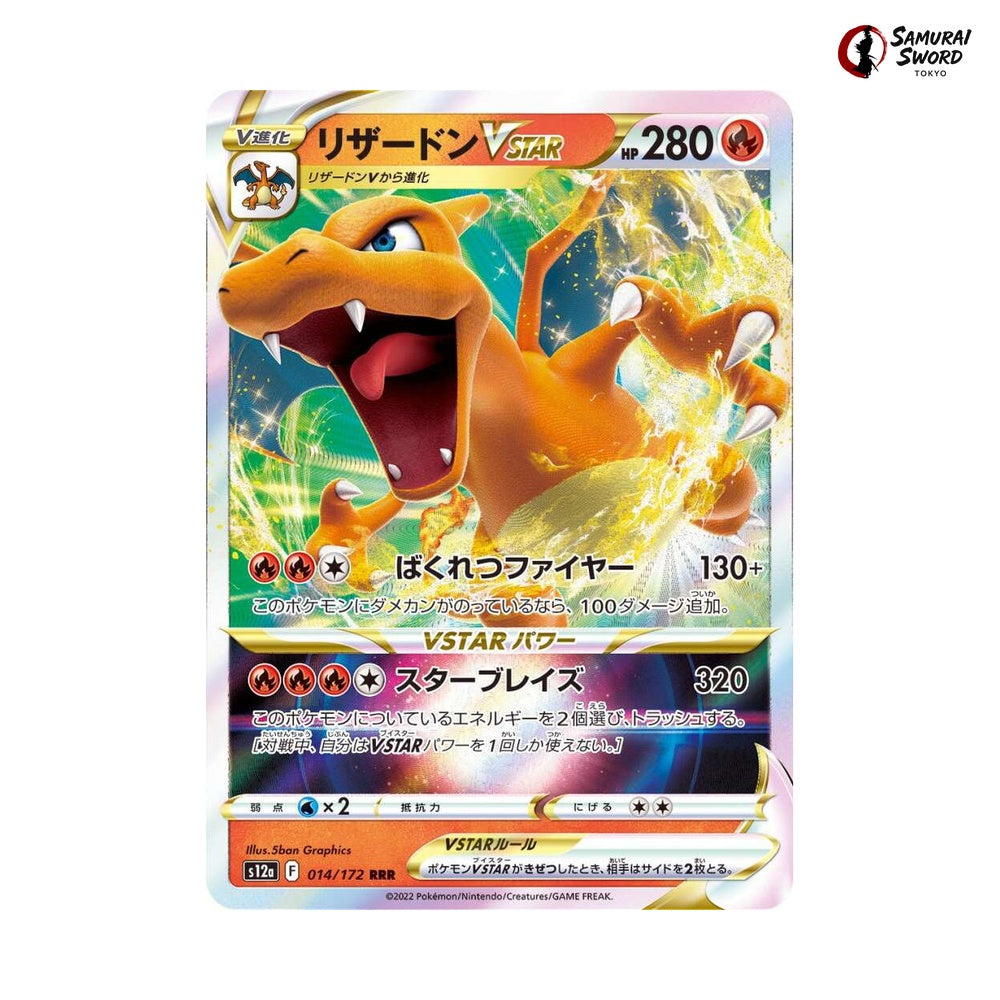
Charizard VSTAR S12a #014 Japanese Pokemon card
Charizard VSTAR — S12a VSTAR Universe (#014, Ultra Rare)

Three modern Charizard cards narrowly missed the top ten but deserve a look:

  • Charizard V SAR (SV2a Pokemon 151, #185) alt-color reprint — not technically SAR but the full-art Charizard ex pairs well as a companion to the #4 SAR. Around $90–$150 raw.
  • Charizard V AR (multiple sets) — the illustrated-background Art Rare variants from recent sets trade in the $40–$80 range and are the cheapest modern Charizard entry point with premium artwork.
  • Charizard UR Gold (SV2a Pokemon 151, #205) — the full-gold UR from 151 trades at $180–$260 and is an under-the-radar alternative to the SAR for collectors who prefer the gold aesthetic.

Two mid-era Charizards we considered but excluded: the 2016 CP6 Expansion Pack 20th Anniversary Charizard and the SM3N Darkness that Consumes Light Charizard GX. Both are historically important, but fall outside the 2020–2026 modern JPN window this ranking focuses on — their pricing is dominated by graded-slab scarcity rather than raw-single market activity, which places them in a category closer to the vintage section above than to the top-10 modern list.

Which Japanese Charizard Card Should You Buy?

The right card depends entirely on budget and collecting intent. Here’s how our Tokyo-based team frames the decision for international buyers:

  • Entry budget ($50–$150) — Start with the #10 Charizard V SR from S4a, the #9 Charizard ex SR from SV2a, or an AR-tier Charizard. All three deliver real full-art Charizard presence without SAR pricing.
  • Mid budget ($150–$500) — Target the #8 M2 Mega Charizard X SR, the #7 S7R Charizard V CHR (under-the-radar value pick), or the #6 S4a Rainbow VMAX for peak Sword & Shield nostalgia.
  • Chase budget ($500–$1,000) — The #4 SV2a Charizard ex SAR for Kanto nostalgia, the #3 SV3 Charizard ex SAR for the strongest recent SAR art direction, or the #5 M2 Mega Charizard X SAR for current-era demand.
  • Investor / top-tier budget ($1,500+) — The #1 M2 Mega Charizard X MUR for forward momentum, or the #2 S4a Shiny Charizard VMAX SSR for mature, graded-market-proven holdings. Both reward PSA 10 grading.
  • Vintage / museum tier ($2,000+) — Old-back Team Rocket Dark Charizard, Neo Destiny Shining Charizard, or a graded 1996 Base Set Charizard for collectors building a multi-era Charizard showcase.

For pack-opening the top three yourself rather than buying singles, sealed M2 Inferno X and SV3 boxes are the most direct route. Sealed S4a boxes still exist but now trade far above original MSRP.

Where to Buy Japanese Charizard Cards

Single-card routes are cheaper per-copy than pulling from sealed, but sealed boxes deliver the opening experience plus long-term sealed-collection value. For Japanese singles specifically, we keep Charizard listings continuously updated across our recent set pages:

PSA 10 copies of most cards on this list are scarce in the export channel — raw near-mint is the more available format and is what we ship most frequently. If you need a graded slab specifically, message the store before ordering and we’ll check backroom stock.

Frequently Asked Questions

What is the most valuable Japanese Charizard card right now?

As of February 2026, the Mega Charizard X ex MUR from M2 Inferno X is the most valuable current-era Japanese Charizard at $1,400–$1,800 raw, with PSA 10 copies reaching $4,500–$6,000. The Shiny Charizard VMAX SSR from S4a Shiny Star V is its closest modern rival at $1,500–$2,400 raw. In the vintage category, graded 1996 Base Set Charizards and 2001 Neo Destiny Shining Charizards clear $20,000–$60,000 in PSA 10.

How much is a Japanese Charizard ex SAR from Pokemon 151 worth?

The SV2a Pokemon 151 Charizard ex SAR (card #201/165) trades at $400–$650 raw near-mint as of February 2026, and $1,500+ for PSA 10 graded copies. The card has appreciated consistently since SV2a sealed boxes went out of standard print rotation and Japanese secondary-market prices on 151 boxes moved past 2× MSRP.

Are Japanese Charizard cards more valuable than English versions?

Yes. Japanese Charizard cards historically trade at a 20–40% premium over the equivalent English card, and the premium is largest in the SAR, MUR and SSR tiers. Japanese print quality, smaller per-card print runs on flagship sets, and sustained collector demand in both the JPN and international markets combine to keep the premium wide.

Which Japanese Charizard card is the best investment?

Historically, the S4a Shiny Charizard VMAX SSR has the most mature price track record — it has survived the 2022 peak, the 2023–2024 correction, and re-stabilized at a premium. The M2 Mega Charizard X MUR is newer and higher variance. For lower-risk exposure, PSA 10 SV3 or SV2a Charizard SARs have performed steadily. Vintage graded Charizards (Base Set, Neo Destiny Shining) have the longest track record of all. No card is guaranteed to appreciate.

What is the oldest Japanese Charizard card?

The 1996 Japanese Base Set Charizard (Expansion Pack) is the first Charizard ever printed in Japan, illustrated by Mitsuhiro Arita. It predates the English Base Set by around two years. Graded PSA 10 copies are among the most valuable Pokemon cards ever sold, with public sales clearing $40,000 and above.

Where can I buy Japanese Charizard cards internationally?

Samurai Sword Tokyo ships authenticated Japanese Charizard singles and sealed booster boxes directly from Tokyo to the US, Canada, UK, Australia and EU. Current inventory for each set referenced in this ranking is listed on the M2, SV3, SV2a, S4a and S7R card-list pages, with live SNKRDUNK-tracked pricing.

Top 10 Pikachu Japanese Cards: Ultimate 2026 Guide

Pikachu is the only Pokemon that has been continuously printed since 1996, across every era from Base Set to Mega Evolution, and across more artistic interpretations than any other card in the TCG’s 28-year history. That volume is a double-edged sword for collectors — there are hundreds of distinct Japanese Pikachu cards in circulation, which means knowing which ones actually hold value (and which are $2 bulk) is harder than for any other Pokemon.

This ranking cuts through the noise. We focused on Japanese-release Pikachu cards — boosters, high-class packs, and official promos from Japan — and scored each on current market price, cultural and historical significance, and scarcity. The Illustrator card gets its own section because, while it is the single most famous Pikachu card in existence, it was never printed in a Japanese booster pack and sits in a different category entirely.

Our team ships Japanese Pokemon singles and sealed product from Tokyo every day. The prices below reflect SNKRDUNK and Mercari transaction data as of February 2026, converted at approximately ¥141/USD, and tracked against our own outbound single-card flow.

How We Ranked These Pikachu Cards

Three factors, weighted roughly equally:

  1. Market price — current SNKRDUNK and Mercari transaction range, with PSA 10 slab prices noted where relevant.
  2. Cultural significance — what the card means to the Pokemon collecting community. A Pikachu on a 25th Anniversary set hits differently than a Pikachu from a mid-cycle expansion.
  3. Rarity and print scarcity — pull rate, set print run, and whether the card has been reprinted in subsequent sets.

A card priced at $200 with historical weight (like the full Pikachu V-UNION set) ranks above a $400 card from a generic set because collectors hold the former longer and pay more for graded copies. Where we had to break a tie, cultural weight won. If you want background on what the rarity letters mean, our Japanese Pokemon card rarities guide walks through every tier.

#10 — Pikachu (Pokemon 151 AR, SV2a)

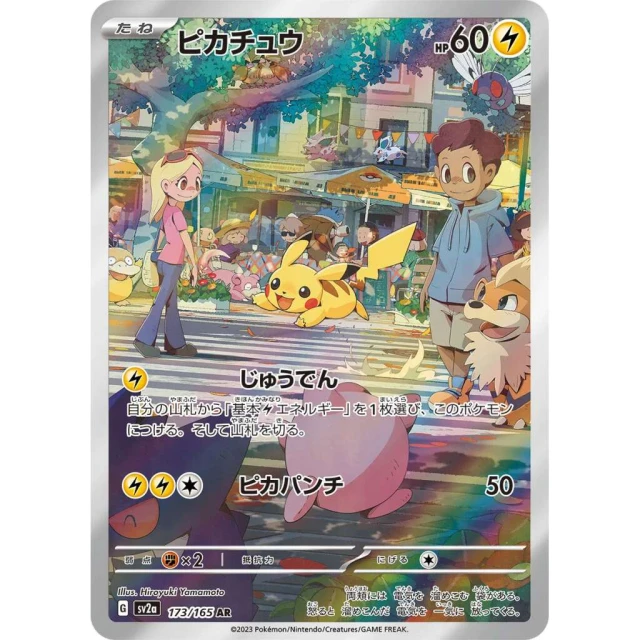
Pikachu AR from SV2a Pokemon 151 Japanese set
Pikachu AR — SV2a Pokemon 151

AR ~$20-$35 (¥2,800-¥5,000) · PSA 10: $60-$90

The Pokemon 151 Pikachu AR is the entry point for a lot of new Japanese Pikachu collectors. SV2a was the 2023 Scarlet & Violet set that recreated the original 151 lineup, and the Pikachu AR (card #173/165) gives you an illustrated full-art Pikachu for well under $50.

It’s iconic because the SV2a set celebrates the same Kanto lineup that started the franchise, and the Pikachu AR artwork features Pikachu in a forest-run pose that pulls directly from 1996 Base Set nostalgia. Budget-friendly, universally recognized, and the easiest “good” Japanese Pikachu card to own. Browse the full SV2a Pokemon 151 card list to see what else the set offers.

#9 — Surfing Pikachu VMAX (S8a 25th Anniversary)

Surfing Pikachu VMAX from S8a 25th Anniversary Collection Japanese set
Surfing Pikachu VMAX — S8a

HR ~$80-$130 (¥11,000-¥18,000) · PSA 10: $200-$320

The Surfing Pikachu VMAX from S8a is the high-class pack reprint of the famous Surfing Pikachu artwork, now scaled to VMAX size with a full-textured background.

The original Surfing Pikachu promo from the 1998 Japan-only Vending Machine series is a grail card for vintage collectors; this VMAX reprint brings that same surfing pose into modern textured-foil format. It sits at #9 because supply is limited (S8a has been out of print since late 2021) and every few months the floor shifts up.

#8 — Flying Pikachu VMAX (S8a 25th Anniversary)

Flying Pikachu VMAX from S8a 25th Anniversary Collection Japanese set
Flying Pikachu VMAX — S8a

HR ~$75-$120 (¥10,500-¥17,000) · PSA 10: $180-$280

Same set, same year, same VMAX treatment — this time for the companion Flying Pikachu design. Flying and Surfing Pikachu VMAX were released as a pair and are almost always collected together.

Solo pricing for Flying tends to run $5-$15 below Surfing, likely because Surfing has slightly stronger vintage recognition. Either one alone looks incomplete on a display shelf — the set is worth more than the sum of parts. S8a also put the entire 25th anniversary CHR set in circulation, which is why this set shows up multiple times on our ranking. See the S8a 25th Anniversary card list for the full set checklist.

#7 — Akari’s Pikachu CHR (S10a Dark Phantasma)

Akari's Pikachu CHR 073/071 from S10a Dark Phantasma — Japanese Character Rare full-art Pikachu
Akari’s Pikachu CHR 073/071 — S10a Dark Phantasma (Character Rare)

The S10a Dark Phantasma Pikachu CHR (card 073/071) pairs Pikachu with Akari — the female protagonist from Pokémon Legends: Arceus — in a soft Hisui-region illustration that became one of the standout character-art Pikachus of the Sword & Shield era.

Set S10a Dark Phantasma (2022)
Card number 073/071
Rarity CHR Character Rare
Current price $25-$45 (¥3,500-¥6,400)
PSA 10 $80-$140

CHR (Character Rare) was the rarity tier Japan used in 2021–2022 sub-sets to drop full-illustration cards that pair a Pokémon with a trainer character. This Akari + Pikachu CHR is one of the most-collected entries in the tier — clean composition, scarcer than the standard holos, and a more affordable entry into character-art Pikachus than the SR/SAR tiers above. The S10a Dark Phantasma card list shows the full CHR lineup.

#6 — Pikachu V SR (S4 Amazing Volt Tackle)

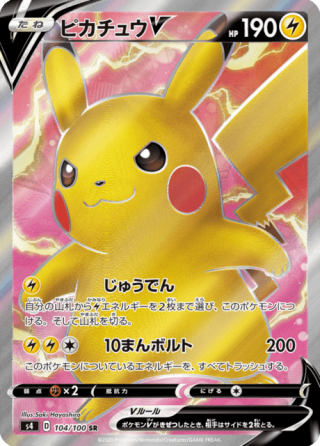
Pikachu V SR 104/100 from S4 Amazing Volt Tackle — Japanese full-art Super Rare Pikachu
Pikachu V SR 104/100 — S4 Amazing Volt Tackle (Super Rare)

The Pikachu V SR (card 104/100) is the full-art Super Rare companion to the Pikachu VMAX at #5 above. Same set, same era — but the V SR delivers the cleaner illustration-first treatment that many collectors prefer to the textured VMAX format.

Set S4 Amazing Volt Tackle (2020)
Card number 104/100
Rarity SR Super Rare (Full Art)
Current price $60-$110 (¥8,500-¥15,500)
PSA 10 $180-$280

Illustrated by Saki Hayashiro, the artwork captures Pikachu mid-electric burst against a soft outdoor backdrop — one of the cleanest V-tier Pikachu illustrations Japan released in the early Sword & Shield run. Most collectors who target this card pair it with the matching Pikachu VMAX from the same set, since the two were designed as a visual set. The S4 Amazing Volt Tackle print run is closed, and PSA 10 supply has been tightening through 2025. The S4a Shiny Star V card list covers the closely related sub-set released a few months later.

#5 — Pikachu VMAX (S4 Amazing Volt Tackle)

Pikachu VMAX from S4 Amazing Volt Tackle — the Japanese Pikachu VMAX with rainbow-style alt art
Pikachu VMAX — S4 Amazing Volt Tackle

HR ~$110-$180 (¥15,500-¥25,400) · PSA 10: $320-$500

The S4 Amazing Volt Tackle Pikachu VMAX — released alongside the set that debuted Pikachu VMAX in Japan — is one of the most photographed Japanese Pokemon cards on Instagram for a reason.

This is the card most casual collectors picture when they think “iconic Pikachu VMAX.” The colors are saturated, and the texture stamping on a clean copy has a near-holographic effect in direct light. PSA 10 copies have been trending up since early 2025 as Amazing Volt Tackle supply continues to dry. For related S4a content see the S4a Shiny Star V card list.

#4 — Pikachu V-UNION Full Set (S8a 25th Anniversary)

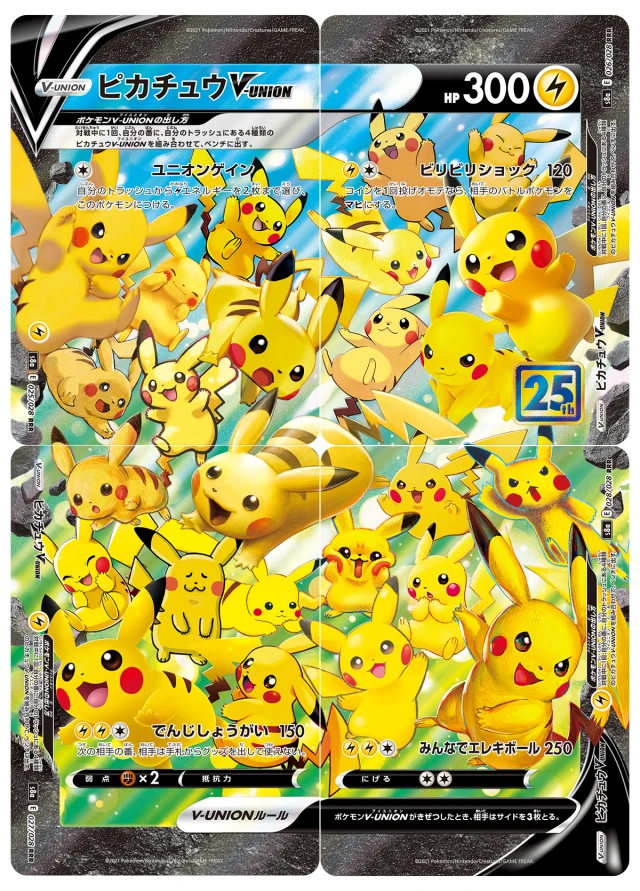
Pikachu V-UNION from S8a 25th Anniversary Collection — Japanese-format-exclusive four-card combine mechanic
Pikachu V-UNION (4-card set) — S8a

UR ~$200-$320 complete set (¥28,200-¥45,100) · PSA 10 set: $600-$900

V-UNION is a Japanese format-exclusive mechanic where four separate cards combine into a single oversized creature. The Pikachu V-UNION from S8a — four cards in total, all needed to form the full play piece — is the definitive 25th Anniversary collectible and the most culturally weighted Pikachu card set on this ranking.

V-UNION was only printed for a handful of Pokemon (Pikachu, Mewtwo, Zacian, Greninja) and the Pikachu set is the most sought after by a comfortable margin. Collecting all four pieces in the wild is harder than it sounds — individual V-UNION fragments circulate separately, and matching copies (same print batch, same condition) command a premium. Serious 25th Anniversary collectors target the complete 4-card matched grouping. See the S8a 25th Anniversary card list for every 25th Anniversary inclusion.

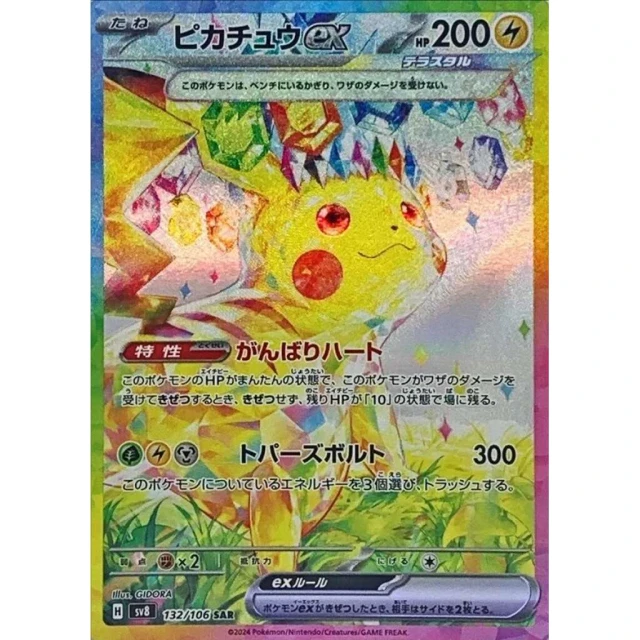
#3 — Pikachu ex SAR (SV8 Super Electric Breaker)

Pikachu ex SAR 132/106 from SV8 Super Electric Breaker — Japanese Special Art Rare with gold foil border
Pikachu ex SAR — SV8 Super Electric Breaker

SAR ~$180-$280 (¥25,400-¥39,500) · PSA 10: $450-$650

The SV8 Super Electric Breaker Pikachu ex SAR is the current-era chase Pikachu and the top flip card from the 2024 set. This is the card most active collectors are hunting right now.

The artwork features Pikachu in a full-illustration treatment with gold-foil borders — the current Scarlet & Violet-era apex rarity. Pull rate for SV8 SAR is approximately 1 per 3-4 booster boxes, and Pikachu is the headline SAR of the set (card #132/106). As the highest-profile modern Pikachu SAR, this is the card new collectors chase first. The SV8 Super Electric Breaker card list has the full chase lineup.

#2 — Pikachu VMAX Rainbow (S8b VMAX Climax)

Pikachu VMAX CSR (Red's Pikachu) 223/184 from S8b VMAX Climax — Japanese rainbow-style Hyper Rare
Pikachu VMAX (Red’s Pikachu) — S8b VMAX Climax (CSR / Rainbow Hyper Rare)

S8b VMAX Climax was the 2021 high-class pack that consolidated every VMAX card from the Sword & Shield era into a single premium release. The Pikachu VMAX Rainbow from S8b is widely considered the most visually striking rainbow VMAX Pokemon ever printed.

Set S8b VMAX Climax (2021)
Rarity HR Hyper Rare Rainbow
Current price $280-$420 (¥39,500-¥59,200)
PSA 10 $750-$1,100

The card uses a layered rainbow foil with pronounced stamped texture on the Pikachu silhouette. Unlike the S4a version (which is broadly available), the S8b Pikachu VMAX Rainbow is scarce because VMAX Climax prints were heavily opened for the set’s wider chase list, leaving fewer sealed boxes intact. Prices have trended upward consistently since 2023 and are among the firmest of any modern Pikachu. The S8b VMAX Climax card list covers the full set.

#1 — Japan-Only Pikachu Promo Family (Red Pikachu & Event Promos)

At #1 we are combining what is functionally a single collecting category: the Japanese-exclusive Pikachu promo sub-family centered on the Red Pikachu Collection and its spiritual predecessors. These are special-event and magazine-insert Pikachus — the ones that defined “Japan-only Pikachu” for a generation of international collectors.

Category Japan-exclusive promos (Red Pikachu Collection, Poncho-wearing Pikachu, event promos)
Rarity PROMO (various)
Current price $250-$800 depending on specific promo
PSA 10 (headline promos) $1,000-$2,500

This category covers promos like the Poncho-wearing Pikachu series, event-exclusive Pikachu giveaways tied to Japanese theatrical releases, and the more recent Red Pikachu Collection magazine insert promos. The appeal is straightforward: international collectors can only acquire these through the Japanese secondary market, and the designs rarely — if ever — reappear on subsequent sets.

We rank this category at #1 because it represents the pinnacle of “Japanese Pikachu” as a cultural category — cards that were never printed for the international market and that carry the strongest brand association for overseas collectors. For current availability, browse our full Japanese single Pokemon card collection.

Historical Note: Pikachu Illustrator (1998)

Pikachu Illustrator card (1998) — the rarest Pokemon TCG card ever produced
Pikachu Illustrator — 1998 CoroCoro Comic illustration contest promo (PROMO)

No Pikachu ranking is complete without the Illustrator card — but it belongs in its own section rather than the core list because it was never printed in a standard Japanese booster.

The Pikachu Illustrator was a 1998 promo awarded to winners of the CoroCoro Comic illustration contest. Only 39 copies were printed (20-23 survive in collectible condition), making it the rarest Pokemon card ever produced. PSA 10 copies have sold for $5.275 million (Logan Paul’s purchase in 2022) and comparable copies have cleared $5M+ multiple times in the years since.

The reason it’s not in the Top 10: it’s a contest promo, not a booster or high-class pack card. For the vast majority of readers researching “which Pikachu should I buy,” the Illustrator is not a realistic target — it’s the card that defines the ceiling of Pokemon collecting as a whole, and we cover it here for context rather than as a recommendation.

Budget Pikachus Under $30 (For Starter Collectors)

Not every collector is ready to drop $200+ on a single Pikachu. Here are the most rewarding sub-$30 Japanese Pikachus for beginners:

  • Pikachu AR (SV2a Pokemon 151) — $20-$35. Mentioned at #10; still the best entry AR.
  • Pikachu AR (SV1a Triplet Beat) — $12-$22. From the SV1a Triplet Beat card list. Clean illustration, widely available.
  • Pikachu C / U commons from SV9, SV10 — Under $2. For the base-collection shelves.
  • Pikachu holo energy cards — $5-$15. Themed energy cards with Pikachu illustrations, especially from S8a and S4a.
  • Standard Pikachu V (S4a) — $15-$25. The non-alt-art version of #6 on this list.

Starting with the AR tier is the right move for most new collectors — it gives you the same full-illustration artwork as the chase SARs at a fifth of the price, and most AR cards from recent sets are readily available through singles channels.

Where to Buy Japanese Pikachu Cards

Pikachu singles move fast because he is the single most-searched Pokemon name on Japanese card marketplaces. Sources to prioritize:

  • Single-card inventory — browse our full single Pokemon cards collection for currently-in-stock Japanese Pikachu singles across AR, SR, SAR, and VMAX tiers.
  • Sealed current-era boxes — if you want to pull your own Pikachu ex SAR, the Scarlet & Violet sealed box collection includes SV9 Battle Partners.
  • Full sealed catalog — for collectors targeting older sets (S4a, S8a, S8b), browse our full inventory, understanding that many of these sets are now out of print.

Before buying, cross-reference Japanese Pokemon card rarities so you know exactly what tier each listing represents — the difference between a CHR and an SR Pikachu is 2-3× in price, and the stamps are easy to misread.

Browse Japanese Pikachu Cards →
Authenticated Japanese Pikachu singles from AR to SAR to V-UNION, sourced directly from Tokyo. Check current availability at Samurai Sword Tokyo.

Frequently Asked Questions

What is the most valuable Japanese Pikachu card ever?

The most valuable Japanese Pikachu card in modern sealed-product terms is the S8b VMAX Climax Pikachu VMAX Rainbow, which trades at $280-$420 raw and has cleared $1,100+ in PSA 10. Including contest promos, the 1998 Pikachu Illustrator is the all-time record holder at $5M+ per PSA 10 copy — but it was a contest promo, not a booster card.

Is the Pikachu Illustrator card in Japanese boosters?

No. The Pikachu Illustrator was a 1998 contest prize awarded to winners of a CoroCoro Comic illustration competition. Only 39 copies were produced, none of which came from booster packs. Every Illustrator copy in circulation traces back to an original contest winner or their estate. Standard Japanese boosters will never contain an Illustrator card.

How much does Pikachu V-UNION cost in 2026?

The complete four-card Pikachu V-UNION set from S8a 25th Anniversary Collection trades between $200 and $320 raw for matched-condition copies. PSA 10 graded sets of all four cards together range from $600 to $900 depending on set completeness and consistency. Individual V-UNION fragments sell separately for $50-$90 each but are less collectible than the complete four-card grouping.

Which Pikachu card should a new Japanese TCG collector buy first?

Start with the SV2a Pokemon 151 Pikachu AR (around $20-$35). It has the same full-illustration artwork as higher-tier Pikachu SARs, lives in a set that every Pokemon collector already knows (the 151 recreation), and is one of the most available Pikachu ARs on the Japanese secondary market. From there, graduate into the S4a or SV9 chase cards once you’ve decided what aesthetic you prefer.

Are Japanese Pikachu cards more valuable than English?

Yes, typically by 15-40% across equivalent rarities. Japanese print runs for Pikachu chase cards have historically been smaller than their English equivalents, and Japanese print quality (foil saturation, stamping depth) is visibly stronger. The premium is largest on the SAR and HR tiers (30-40% above English equivalent) and narrows but rarely disappears six months after English release.

Looking for a specific Pikachu? Browse our full set-by-set Japanese Pokemon catalog for AR, SR, SAR, and VMAX Pikachu cards — all shipped direct from Tokyo.

Japanese Pokemon Alt Art (SAR) Cards: 2026 Guide

Alt Arts are the most collectible cards in modern Japanese Pokemon. If you’ve watched a YouTube box break in the last two years, the moment the reviewer pauses, turns the card sideways, and quietly says “oh” — that’s almost always an SAR. Special Art Rare cards sit at the top of what the Japanese print runs actually ship, and they’re the reason JPN singles pricing has stayed elevated across the entire Scarlet & Violet era.

This guide indexes the best Japanese Pokemon SAR cards by set, from SV3’s Charizard ex to SV11B’s Zekrom ex, with current 2026 USD price ranges, realistic pull rates, and the artist credits that move the market. If you’re new to JPN rarities altogether, the Japanese Pokemon card rarities explained guide covers the full rarity system — this page assumes you’re already past that and ready to chase SAR specifically.

Our team ships Japanese Pokemon singles out of Tokyo daily. The prices below reflect SNKRDUNK and Mercari data from early 2026, converted at approximately ¥141/USD.

Key Takeaway

SAR (Special Art Rare) is the apex alt-art tier in modern Japanese Pokemon — borderless unique artwork, ~1 per 20-30 packs (2-4 per box), with flagship chases from Charizard ex (SV3) to Nanjamo (SV2a) trading between $50 and $800+ in 2026.

$50–$800+
SAR Price Range (USD)

2–4
SARs per 30-pack Box

$800+
Top SAR (Nanjamo SV2a)

SV Era
Every Mainline Set Ships SAR

What Is SAR (Special Art Rare)?

Charizard ex SAR from SV2a Pokemon Card 151 — example Special Art Rare with borderless cinematic illustration and gold foil treatment
Charizard ex SAR — SV2a Pokemon Card 151 (SAR)

SAR stands for Special Art Rare. The core difference between SAR and the older SR tier is that SAR cards use a unique alternate illustration that doesn’t appear anywhere else in the set — not as a regular, not as an RR, not as an SR. SAR artwork is typically borderless (the illustration bleeds to all four edges of the card) and pairs a gold foil rarity stamp with a full textured foil treatment across the illustration.

SR cards by contrast are full-art versions of the same artwork already used on the card’s RR or trainer counterpart. The SR is a “bigger, shinier” version of art you’ve already seen in the set. SAR is brand-new art, often cinematic, usually featuring the Pokemon in habitat or with a signature trainer at their side.

Functionally, an SAR is playable exactly like the regular ex or VSTAR it duplicates. Collectors don’t buy them to play with — the pricing is pure artwork-driven demand. Tournament players who care about visuals will sleeve an SAR over the equivalent RR, but the gameplay text is identical line-for-line.

SAR Pull Rates in Context

SAR cards pull approximately 1 per 20-30 booster packs, which works out to roughly 2-4 SARs per 30-pack Japanese booster box on average. These numbers are community-tracked estimates from opening data; The Pokemon Company does not publish official pull rates for Japanese sets.

Set structure matters. High-class packs and special-pack formats like SV2a Pokemon Card 151 run higher SAR density (3-5 per box is common), while standard boosters like SV11B Black Bolt typically land closer to 2-3. You can lose a box entirely to zero SARs, and you can also hit 5 or 6 in an unusually hot box — the variance is wide. Across hundreds of boxes our team has processed, the median box lands right at 3 SARs.

The practical implication: opening for a specific SAR almost never works out cheaper than buying the single. If you want the Charizard ex SAR from SV3, buy the Charizard ex SAR from SV3. Cracking boxes is for the experience and the possibility; it’s not a route to a named card.

Disclaimer

Pull rates are estimated from Japanese community opening data (SNKRDUNK, Mercari, YouTube compilations). The Pokemon Company does not publish official pull rates. Actual results vary significantly box to box.

Who Illustrates SAR Cards?

SAR artwork is the most artist-forward part of modern Pokemon printing. Four credits show up most often, and seeing any of them on the bottom-right corner of a card is a reliable value signal.

  • Sowsow — the most-cited Japanese Pokemon illustrator working today. Their style is soft, emotional, and habitat-focused — Pokemon curled up in natural environments, trainers in quiet moments with their partners. Sowsow SARs typically command a 20-40% premium over other SARs in the same set.
  • 5ban Graphics — handles much of the gold-foil production and digital-art SARs across the Scarlet & Violet era. Their work is recognizable for clean compositions and strong metallic foil contrast, and they are responsible for many of the Pokemon-only (non-character) SARs.
  • 2020 Artist Collective — the pseudonym grouping that appeared across the S4a Shiny Star V era. This collective illustrated many of the original CHR and early alt-art style cards from 2020-2021. Their work predates the modern SAR tier formally but is collected in the same lane by character-art buyers.
  • Mitsuhiro Arita (modern) — the original Base Set Charizard illustrator, and his modern Pokemon work — including occasional SAR contributions — carries significant premium for nostalgia alone. When Arita signs a modern SAR, expect heavy collector demand at release.

Checking the illustrator credit before paying is a quick way to sanity-check pricing. A Sowsow trainer SAR from a current set will almost always hold value better than a same-set SAR from a less-followed illustrator.

Best SAR Cards by Set — Scarlet & Violet Era

The SV era is where SAR became the default top-tier chase, and every mainline set from SV1 onward has shipped with 4-8 SARs. Below are five of the most-collected SAR cards from SV era sets as of early 2026.

Charizard ex SAR from SV3 Ruler of the Black Flame — flagship Japanese Pokemon Special Art Rare card with borderless cinematic illustration

Charizard ex SAR — SV3 Ruler of the Black Flame · SAR · Market ~$450-$700 USD (~¥63,000-¥98,000)

The defining SAR of the early Scarlet & Violet era. Cinematic composition of Charizard mid-flame against a dark sky, borderless, heavy foil. Print runs have been in demand continuously since SV3’s June 2023 release, and this card alone drives a significant share of SV3 box pricing. Browse the SV3 Ruler of the Black Flame card list for the full chase lineup.

N's Zoroark ex SAR from SV9 Battle Partners — signature-trainer Special Art Rare with cinematic dual-character composition

N’s Zoroark ex SAR — SV9 Battle Partners · SAR · Market ~$250-$450 USD (~¥35,000-¥63,000)

Battle Partners was built around signature-trainer decks, and N’s Zoroark ex SAR is the set’s most-demanded chase. The composition places N and Zoroark together in a shadowy forest scene, a direct callback to N’s original Black & White arc. Lillie’s Clefairy ex SAR and Iono’s Bellibolt ex SAR from the same set also command premium prices. See the full SV9 Battle Partners card list.

Team Rocket's Mewtwo ex SAR from SV10 Glory of Team Rocket — Japanese Pokemon Special Art Rare with dark psychic energy composition

Team Rocket’s Mewtwo ex SAR — SV10 Glory of Team Rocket · SAR · Market ~$250-$450 USD (~¥35,000-¥63,000)

SV10’s Team Rocket theme gave Mewtwo a villainous reinterpretation — the SAR renders Mewtwo with the organization’s signature red-R branding and dark psychic energy. Heat-of-release pricing for this card landed above $500 and has settled into the $250-$450 range through early 2026. Check the SV10 Glory of Team Rocket card list.

Reshiram ex SAR from SV11W White Flare — Japanese Pokemon Special Art Rare featuring Vast White Pokemon in flame composition

Reshiram ex SAR — SV11W White Flare · SAR · Market ~$200-$400 USD (~¥28,000-¥56,000)

SV11W’s dragon-focused set paired legacy Unova legendaries with premium foiling. Reshiram ex SAR features a flame-spread background with the Vast White Pokemon in mid-roar. Full SV11W White Flare card list is available.

Zekrom ex SAR from SV11B Black Bolt — Japanese Pokemon Special Art Rare with electric Deep Black Pokemon composition

Zekrom ex SAR — SV11B Black Bolt · SAR · Market ~$200-$400 USD (~¥28,000-¥56,000)

The twin to Reshiram, Zekrom ex SAR carries the electric counterpart with an equally dramatic composition. Black Bolt and White Flare dropped simultaneously as paired sets, making the two SARs a natural collector pair — buying one without the other feels incomplete to most SV11 completionists. Full SV11B Black Bolt card list.

Beyond these five, SV2a Pokemon Card 151 is worth calling out separately. The 151 set ran a high-density SAR lineup featuring Nanjamo SAR (which has traded north of $800 for most of 2024-2026) and a reprinted Charizard ex SAR variant, both of which remain among the most-searched Japanese Pokemon SARs of the entire era. Browse the SV2a 151 card list for the full 151 SAR set.

Best SAR Cards by Set — Sword & Shield Era

SAR as a named rarity debuted partway through the Sword & Shield era, which means the S era has fewer SARs overall but some of the most iconic individual cards in the modern hobby.

Lugia VSTAR SAR from S12 Paradigm Trigger — iconic Sword and Shield era Japanese Pokemon Special Art Rare

Lugia VSTAR SAR — S12 Paradigm Trigger · SAR · Market ~$350-$600 USD (~¥49,000-¥85,000)

The Paradigm Trigger set closed out the Sword & Shield mainline on a Lugia-focused chase. Lugia VSTAR SAR features the Guardian of the Seas in cinematic flight over stormy water, full borderless, with textured foil that catches light dramatically. Still one of the most-traded JPN SARs in the hobby, even three-plus years after release. See the S12 Paradigm Trigger card list.

Alolan Vulpix VSTAR SAR — S11a Incandescent Arcana · SAR · Market ~$150-$300 USD. S11a Incandescent Arcana ran a character-focused format, and the Alolan Vulpix VSTAR SAR is the set’s most-collected card — soft pastel snow scene, illustrator-forward composition. More approachable pricing than the S12 chases, which makes it a popular entry-level SAR for new JPN collectors. Full S11a Incandescent Arcana card list.

Older Sword & Shield cards from the S6K Jet-Black Geist era use the “SA” designation (Shadow Rider Calyrex VMAX Alt Art, “Chubby” Blissey V Alt Art) rather than the later “SAR” letter code, but they’re functionally identical in the alt-art collecting lane. If you’re browsing older S-era inventory, treat SA cards as pre-SAR SARs for pricing and collecting purposes.

What About Mega Era SAR?

Lillie's Determination SAR 091/063 from M1L Mega Brave — trainer-focused Special Art Rare in the Mega Evolution era
Lillie’s Determination SAR — M1L Mega Brave (SAR)

The Mega Evolution era still ships SAR cards — but the apex chase tier shifts to MUR (Mega Ultra Rare). Starting with M1L Mega Brave in late 2025, The Pokemon Company introduced MUR as the new top-tier rarity reserved exclusively for Mega-evolved Pokemon (Mega Charizard X ex MUR is the headline card), while trainer-focused SARs like Lillie’s Determination SAR 091/063 and Lt. Surge’s Deal SAR 090/063 still print in the M1L checklist.

MUR uses a different visual treatment — textured holographic foil across the full card with explicit Mega branding — and pulls significantly rarer than SAR (closer to 1 per booster box for the headline Mega chase). Mega sets continue to include AR (Art Rare) and regular RR ex cards as well, but collectors chasing the Mega-era equivalent of the SV-era Charizard ex SAR should orient toward MUR. For the full breakdown of MUR pricing and current inventory, the Japanese Pokemon card rarities explained guide covers the MUR tier in depth.

How to Spot a SAR on a Card

Pikachu ex SAR from SV8 Super Electric Breaker — clear example of borderless illustration, gold-foil rarity stamp, and full textured foil treatment that defines SAR
Pikachu ex SAR — SV8 Super Electric Breaker (SAR closeup demo)

Four visual checks, any one of which is usually sufficient to identify a SAR:

  1. Card number past the base set total. Japanese sets use a format like “169/086” where the denominator is the base set card count. If the numerator exceeds the denominator, the card is a secret rare of some kind — SR, SAR, UR, or MUR. SAR specifically tends to sit in the upper-middle range of the secret-rare numbering (often the top third of the extended checklist past the base set).
  2. Borderless illustration. SAR artwork bleeds to all four edges of the card. Regular RR and AR cards retain a yellow or colored card border. If the illustration goes fully edge-to-edge with no border whatsoever, it’s either SAR, UR, or MUR.
  3. Gold “SAR” rarity code in the corner. Modern SV-era SARs print “SAR” in gold letters in the bottom-left corner next to the card number. Tilt the card under light — the letters are small but legible.
  4. Full textured foil treatment. Run a fingernail across the illustration. SAR cards have pronounced stamped foil texture across most of the card face, not just the Pokemon. If the texture feels smooth, you’re holding an RR or an AR, not an SAR.

If all four checks pass, the card is SAR. If only some pass, cross-reference the card number against the set’s official checklist — linked throughout this article for every set mentioned.

SAR vs AR vs SR — Quick Comparison

Vivillon AR from SV8 Super Electric Breaker — example Art Rare with illustrated background and retained colored card border
AR — Vivillon, SV8 (Art Rare)
Durant ex SR from SV8 Super Electric Breaker — example Super Rare with full-art version of existing RR artwork and silver holo border
SR — Durant ex, SV8 (Super Rare)
Pikachu ex SAR from SV8 Super Electric Breaker — example Special Art Rare with borderless unique illustration and gold foil stamp
SAR — Pikachu ex, SV8 (Special Art Rare)

Rarity Artwork Border Est. Pull Rate Price (USD)
AR (Art Rare) Illustrated background, Pokemon-focused Colored card border retained 2-3 per 30-pack box $2-$20
SR (Super Rare) Full-art version of existing RR / trainer art Silver holo border 1-2 per 30-pack box $10-$100+
SAR (Special Art Rare) Unique alternate illustration, borderless No border, gold foil rarity stamp 1 per 20-30 packs (2-4 per box) $50-$800+

The clean mental model: AR is an entry illustrated card at the artwork tier, SR is a premium version of art that already exists elsewhere, and SAR is brand-new art with no counterpart, at the top of the price curve. When Western collectors hop from the English TCG to the JPN market, the “Illustration Rare → Special Illustration Rare” progression maps one-to-one onto “AR → SAR” — the concept is identical, only the market prints differ.

SAR Price Range Table (2026 USD)

Card Set 2026 Market Price (USD)
Charizard ex SAR SV3 Ruler of the Black Flame $450-$700
N’s Zoroark ex SAR SV9 Battle Partners $250-$450
Team Rocket’s Mewtwo ex SAR SV10 Glory of Team Rocket $250-$450
Reshiram ex SAR SV11W White Flare $200-$400
Zekrom ex SAR SV11B Black Bolt $200-$400
Nanjamo SAR SV2a Pokemon Card 151 $500-$800+
Lugia VSTAR SAR S12 Paradigm Trigger $350-$600
Alolan Vulpix VSTAR SAR S11a Incandescent Arcana $150-$300

Prices reflect raw (ungraded) near-mint conditions as of February 2026, based on SNKRDUNK and Mercari secondary-market data converted at ¥141/USD. PSA 10 graded copies typically trade 2-4× these ranges, with the Charizard ex SAR PSA 10 and Nanjamo SAR PSA 10 consistently among the most expensive modern JPN graded cards in the hobby.

Where to Buy Japanese SAR Cards

Japanese SAR cards move through singles channels — most collectors outside Japan don’t crack JPN boxes at box-level volume, so the SAR singles market is what you’ll actually use.

We authenticate and ship every single direct from Tokyo with tracked shipping. Because SAR supply is finite and moves continuously, checking the card list pages for current availability is the most reliable way to catch specific cards when they come in stock.

Frequently Asked Questions

What does SAR mean on a Japanese Pokemon card?

SAR stands for Special Art Rare. It is the top alt-art rarity in modern Japanese Pokemon sets from the mid-Sword & Shield era through the current Scarlet & Violet era. SAR cards feature unique borderless illustrations with gold foil treatment and pull at approximately 1 per 20-30 booster packs, or roughly 2-4 per 30-pack Japanese booster box.

How much is a Japanese SAR card worth?

Japanese SAR cards range from approximately $50 for less popular Pokemon to $800+ for flagship chase cards like Charizard ex SAR from SV3 or Nanjamo SAR from SV2a 151. Character-led SARs and cards featuring franchise-favorite Pokemon command the highest prices. PSA 10 graded copies typically trade at 2-4 times the raw price.

What’s the difference between SAR and AR on a Pokemon card?

AR (Art Rare) cards retain a colored card border and use illustrated backgrounds for Pokemon, pulling 2-3 per 30-pack box at $2-$20 typical pricing. SAR (Special Art Rare) cards are fully borderless with unique alternate illustrations, pull at roughly 1 per 20-30 packs, and trade for $50-$800+. AR is the entry illustrated tier; SAR is the apex alt-art tier with unique artwork not found anywhere else in the set.

Are Japanese SAR cards better than English Special Illustration Rare?

Japanese SAR cards and English Special Illustration Rare (SIR) cards are mechanically equivalent — different market prints of the same alt-art concept. Japanese versions typically trade at a 15-40% premium over English equivalents due to higher foil quality, smaller per-card print runs, and sustained collector demand in both domestic and international markets.

Can I pull a SAR from a regular Japanese booster box?

Yes. Every standard 30-pack Japanese booster box from the Scarlet & Violet era (SV1 onward) contains 2-4 SAR cards on average, though the specific SAR you pull is random. Opening a box for a specific named SAR rarely works out cheaper than buying the single; cracking boxes is primarily for the pull experience rather than as a route to a targeted card.


How Japanese Pokemon Pull Rates Actually Work (2026)

Pull rates decide what a Japanese Pokemon booster box is actually worth. A box isn’t a mystery grab bag — it’s a structured, statistically-predictable product, and once you understand how The Pokémon Company stacks rarities across 30 packs, you can walk into any Scarlet & Violet or Mega-era release knowing roughly what you’ll pull before you crack the shrink.

Most overseas collectors learned pack odds from English boxes — 36 packs, 10 Karten pro Pack, specific guaranteed slots. Japanese boxes work differently. Fewer packs, fewer Karten pro Pack, and a distribution of chase rarities (SAR, UR, MUR) that is often misquoted on Reddit and YouTube. This guide lays out how it actually works.

We ship Japanese Pokemon boxes out of Tokyo every day and have tracked open rates across 1,000+ boxes of SV-era and Mega-era sealed product. The numbers below are realistic averages — not marketing copy. Every rate on this page is estimated based on opening data and community-aggregated samples. The Pokémon Company does not publish pull rates, so these figures are approximations, not official disclosures.

Key Takeaway

A standard Japanese Pokemon booster box contains 30 packs × 5 cards = 150 cards, with an estimated 2–4 SAR, 1 SR floor, ~0.15 UR and ~0.05 MUR per box. Per-pack hit density is higher than ENG, but per-box total hits are lower because boxes are smaller.

30
Packs per Box

150
Total Cards per Box

2–4
Average SAR per Box

~1 in 10–25
MUR Pull Rate (Mega Sets)

Japanese Booster Box Structure: 30 Packs, 5 Cards Each

Every modern Japanese Pokemon booster box — across the Scarlet & Violet series (SV1 through SV11W/SV11B) and the Mega series (M1, M2, M3, M4) — ships in the same format:

Box component Count
Packs per box 30
Cards per pack 5
Total cards per box 150
Approximate box weight (sealed) ~300g

That’s the whole frame: 150 cards, split across 30 packs. Every slot in every pack is assigned a rarity weight, and the sum of those weights across the box is what determines your expected hits. English boxes pack 360 cards (36 × 10), more than double the card count, which is why direct pull-rate comparisons between JP and ENG are almost never apples-to-apples.

A few exceptions worth flagging up front. High Class packs (like S12a VSTAR Universe, the late-year flagship products) sometimes use a 10-pack format with 11 Karten pro Pack — visit the S12a VSTAR Universe card list to see the distinct checklist those use. Enhanced Expansions and special sets can also deviate. For standard Booster and Expansion Packs — the product 90%+ of Japanese sealed buyers are targeting — the 30×5 format is universal.

Expected Cards per Box: Rarity Breakdown

Here’s the realistic per-box rarity distribution for a typical Scarlet & Violet or Mega-era box, based on aggregated opening data across recent sets:

Team Rocket's Mewtwo ex SAR (SV10) — representative SAR card showing what 'roughly 1 SAR per box' looks like
Team Rocket’s Mewtwo ex SAR (SV10 Glory of Team Rocket) — a representative SAR, the rarity tier that averages 2–4 per box.
Rarity Estimated per box Slot behavior
Common (C) ~90 cards 3 per pack, every pack
Uncommon (U) ~24 cards ~0.8 per pack
Rare (R) ~24 cards ~0.8 per pack
RR Double Rare ~5 cards Scattered — some packs none, some packs two
AR Art Rare ~2 cards Textured full-illustration cards (Sowsow-style art)
SR Super Rare ~1 card (near-guaranteed) One SR per box is the standard floor
SAR Special Art Rare ~0.3–0.7 per box Some boxes 0, some 1–2
UR Ultra Rare ~0.1–0.2 per box Roughly 1 in 5–8 boxes
MUR Mega Ultra Rare ~0.04–0.1 per box Roughly 1 in 10–25 boxes (Mega sets only)

Those numbers add up to the 150-card total, with the bulk of a box obviously being gameplay Commons and Uncommons. The chase rarities — AR and above — typically total 7–10 hit cards per box on a normal day. The floor is usually 1 SR + 2 AR + 5 RR even on your worst-luck boxes. The variance comes in the SAR/UR/MUR tier.

How Each Rarity Distributes Across Packs

Slot-level behavior matters because it determines how a specific pack looks when you open it — which is what most YouTube openers are actually showing you.

Commons and Uncommons — Every Pack

Every single pack contains Commons and Uncommons as gameplay filler. A typical pack opens with 3 Commons and 1 Uncommon; the fifth card is the variable slot where the hit (R, RR, AR, SR, SAR, UR, or MUR) lives. Commons and Uncommons are identical across packs within the same print run.

Rare (R) — Roughly 1 per Pack

R cards — single-star, holo-front, non-ex gameplay Pokémon — fill most of the “hit” slot. On average about 4 out of every 5 packs will give you an R, with the remaining packs upgrading to RR or higher. Over a 30-pack box, R count usually lands in the low-20s range.

RR (Double Rare) — Approximately 5 per Box

Volcanion ex example showing the RR ex full-card holo treatment from SV9 Battle Partners
Pokémon ex cards like Volcanion ex sit in the RR (Double Rare) tier — about 5 per box.

RR cards are the ex-Pokémon full-card-holo foundation tier. A typical 30-pack box lands 5 RR cards spread across different packs. These are your Pokémon ex and Tera Pokémon ex — the cards most tournament decks are built on. Value is usually $3–$30 per RR depending on meta relevance.

AR (Art Rare) — About 2 per Box

Articuno AR from SV9 Battle Partners showing the full-card illustrated background art style
Articuno AR (SV9 #102) — the illustrated-background AR style averages ~2 per box.

AR cards feature the iconic full-card illustrated-background art style introduced in Scarlet & Violet — Sowsow-style, Komiya-style, and other artist-signature pieces. Two AR cards per box is the modern standard across Scarlet & Violet sets, though some boxes pull 1 and some pull 3. The AR pool is usually 20–30 different cards per set, so collecting an AR-complete set from sealed takes ~10–15 boxes.

SR (Super Rare) — ~1 per Box Guaranteed, but Which Varies

Lillie's Clefairy ex SR from SV9 Battle Partners — full-art trainer-Pokémon SR example
Lillie’s Clefairy ex SR (SV9 #115) — every box reliably yields ~1 SR-tier card.

This one confuses a lot of new JP collectors. “One SR per box” is true as a floor — virtually every box opens at least one card in the SR or higher tier. But which SR you pull is random within the SR pool, and on some boxes, that SR slot is replaced by a higher rarity (SAR, UR, or MUR) on lucky boxes.

SAR (Special Art Rare) — 2–4 per Box Average, but Variance is Real

Team Rocket's Mewtwo ex SAR from SV10 Glory of Team Rocket showing gold-foil border and cinematic alt art
Team Rocket’s Mewtwo ex SAR (SV10) — flagship SAR with the gold-bordered alt-art treatment.
Zekrom ex SAR from SV11B Black Bolt — modern SV-era Special Art Rare with gold border
Zekrom ex SAR (SV11B #169) — long-run averages land around 2–4 SARs per box across SV-era sets.

SAR cards (the gold-bordered alt-art chase pieces) are the most statistically interesting tier. Across dozens of boxes the long-run average is roughly 2–4 SARs per box — but on any individual box the distribution is wide: some boxes pull 0 or 1 SAR, others pull 4 or 5 SARs. This is why two identical boxes of the same set can feel completely different when opened.

If you open 10 boxes of a recent set like SV9 Battle Partners or M4 Mega Symphonia, you can expect roughly 25–35 SAR cards across them — but box-by-box anywhere from 0 to 6.

UR and MUR — Rare Tier, Estimated 1/5 to 1/25 Boxes

Mega Charizard X ex MUR from M2 Inferno X showing the full-card premium textured Mega Ultra Rare finish
Mega Charizard X ex MUR (M2 Inferno X) — the deepest chase tier, roughly 1 per 10–25 boxes in Mega sets.

UR (Ultra Rare, full-gold-foil) and MUR (Mega Ultra Rare) are the deepest chase tiers. Based on opening data:

  • UR: Estimated approximately 1 per 5–8 boxes. Some sets lean tighter (SV11 series), some looser.
  • MUR: Introduced with the Mega series (M1 Mega Brave onward). Estimated approximately 1 per 10–25 boxes, with flagship Mega sets like M4 Mega Symphonia and the M1 Mega Brave release showing the higher end of scarcity.

MUR pull rates are still an evolving estimate because the rarity only debuted with the Mega era in 2026. Early opening data suggests the actual per-box odds may vary between sets.

Box Variance: Why Two Boxes Can Feel Completely Different

Say two collectors each open a fresh box of SV10 Heat Wave Arena (browse the SV10 card list for the full rarity checklist). One pulls an MUR, 4 SARs, and 2 ARs. The other pulls 1 SAR, 0 UR, and 3 ARs. Same set, same shrink, wildly different outcomes.

This is normal. The reason is that SAR/UR/MUR slots aren’t fixed “guaranteed” positions — they’re probabilistic upgrades on the R/RR/SR slot. Each pack rolls the hit slot, and most rolls come up R or RR, some RR or SR, and a small percentage upgrade to AR, SAR, UR, or MUR. The law of large numbers means that over 10+ boxes the distribution smooths out toward the average. Over a single box, it doesn’t.

Practical Implication

If you care about specific chase cards, buy by the case (12 boxes) or buy singles. A single box gives you roughly a 30% chance of opening zero SARs of any specific card you want. A case brings that much closer to expected.

Dual-Hit Packs: The Japanese “God Pack” Concept

Japanese Pokemon boxes contain a small number of dual-hit packs — packs where two of the five cards are chase-tier instead of one. Community openers sometimes call these “god packs,” borrowing the term from other TCGs, though The Pokémon Company has never formally named the mechanic.

A typical box contains approximately 1 dual-hit pack, though some boxes have 0 and some have 2. Dual-hit packs are often where the SAR-plus-SAR or SR-plus-AR combos show up, and they’re the mechanic behind the “stacked pack” videos that circulate on YouTube. You can sometimes spot them by weight, though sellers who weight-sort boxes typically remove them from retail supply.

Box-mapping (using the position of hits to predict which packs contain them) used to be a consistent technique on older sets, but modern Japanese factory-sealed boxes have largely defeated static mapping — the distribution varies enough print-run to print-run that no single pattern holds reliably.

Recent Set Data Examples: SV9, SV10, M4

Concrete data points from recent Scarlet & Violet and Mega-era sets help anchor the abstract numbers above.

SV9 Battle Partners (January 2025)

Volcanion ex SR from SV9 Battle Partners — representative SV9-era chase card example
Volcanion ex SR (SV9 Battle Partners) — representative chase rarity from the SV9 set sample.

SV9 introduced the “tag” mechanic with trainer-and-Pokemon combo SARs. Typical SV9 box yields across our observed sample: 2 AR, 1 SR, 0–2 SAR, and a UR hit in roughly 1 of every 6 boxes. The SV9 Battle Partners card list shows the full rarity structure with 30+ SAR cards in the set.

SV10 Heat Wave Arena (March 2025)

SV10 follows the same structural pull rates as SV9. The standout: the Lillie SAR and Mega Lucario ex SAR were the two chase cards driving box pricing. Typical box: 2 AR, 1 SR, 0–2 SAR, 1 UR in roughly 1 of every 6 boxes. See the SV10 Heat Wave Arena card list.

M4 Mega Symphonia (2026)

M4 is the Mega-era set that brought MUR into its highest-profile rotation. Our opening data suggests: 2 AR, 1 SR, 0–3 SAR, 1 UR in roughly 1 of every 6 boxes, and 1 MUR in roughly 1 of every 15–20 boxes. The M4 Mega Symphonia card list has the full chase lineup including the Mega Charizard X MUR and other headline pulls.

For the broader SV-era Scarlet & Violet rarity framework used across all these sets, our Japanese Pokemon card rarities explained guide covers what each letter code means and what the resulting cards look like.

Pull Rates vs. English Booster Boxes: Key Differences

A quick reference for collectors moving between ENG and JPN:

Attribute Japanese Box English Box
Packs per box 30 36
Cards per pack 5 10
Cards per box 150 360
Guaranteed hit (ex / V / full-art) ~1 SR+ per box floor ~1 reverse-holo + 1 holo per pack
Gold / ultra rare equivalent UR/MUR roughly 1 per 5–20 boxes Hyper Rare roughly 1 per 2 boxes
Alt-art chase SAR ~2–4 per box (gold border, unique art) Special Illustration Rare, lower density

The structural gap matters: because JPN packs are smaller (5 cards vs. 10), a single pack rip feels less card-dense than an ENG pack rip. But the hit-per-pack ratio in JPN is higher on average, so the box-level hit density ends up comparable when you normalize for total cards. JPN boxes also trade 15–40% above the corresponding ENG box in most cases, reflecting the premium print quality and earlier release timing.

Can You Predict Box Value? Basic EV Math

Expected value (EV) is the sum of each card’s probability times its singles-market price. For Japanese boxes the quick EV formula is:
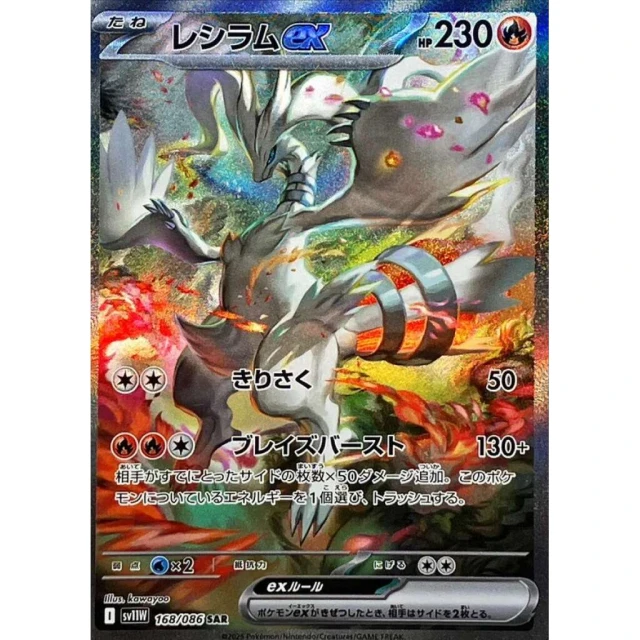
EV ≈ (5 × average RR price) + (2 × average AR price) + (1 × average SR price) + (average SAR count × average SAR price) + (UR probability × average UR price) + (MUR probability × average MUR price)

Rule-of-thumb ballpark for a mid-cycle set like SV10 or SV11W (browse the SV11W Super Electric Breaker card list or SV11B Black Bolt card list for current chase lists):

  • 5 RR × ~$5 average = ~$25
  • 2 AR × ~$8 average = ~$16
  • 1 SR × ~$25 average = ~$25
  • ~0.5 SAR × ~$80 average = ~$40
  • UR fraction (~0.15) × $120 = ~$18
  • MUR fraction (~0.05) × $300 = ~$15 (Mega sets only)

That’s roughly $125–$140 in expected singles value per box for a typical SV-era release. Japanese boxes typically retail around that range on the secondary market, meaning raw EV and box price tend to sit close to each other — which is why collectors buy for the opening experience and the chance at outlier pulls rather than as a pure value play. Sets with genuinely high-demand chase cards (flagship High Class packs, late-cycle Mega sets) can run positive EV; most regular Booster sets hover near break-even.
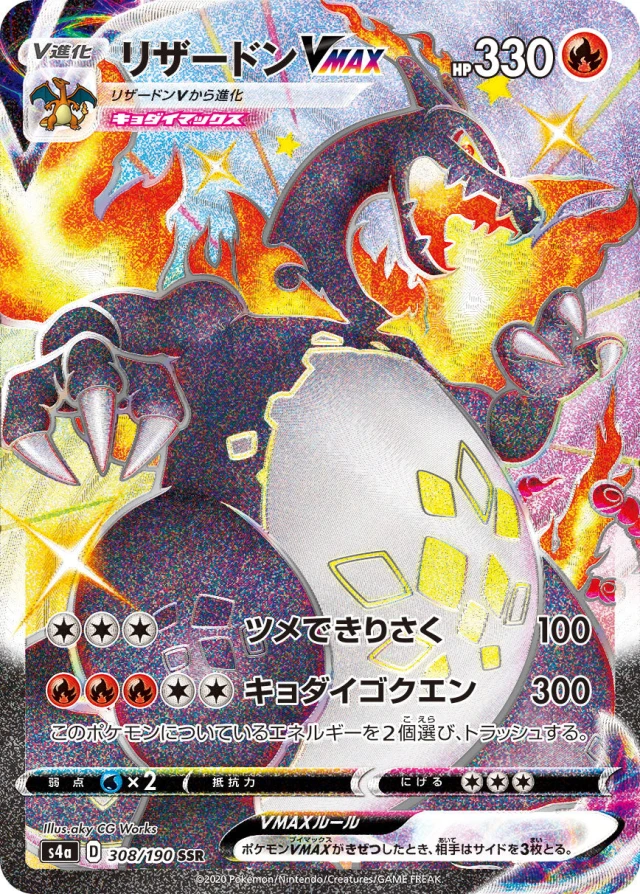
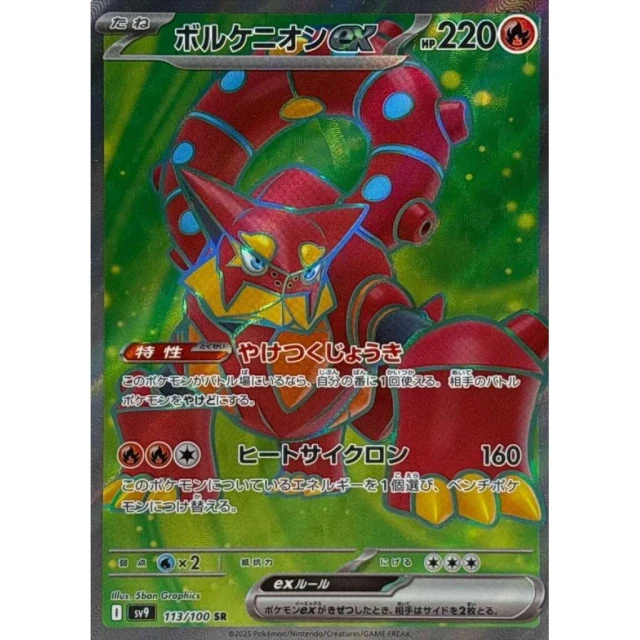
For context on the classic chase-card sets that set the benchmark for modern pricing, the S4a Shiny Star V card list still shows what a high-EV Sword & Shield-era box looked like at its peak.

Where to Buy Sealed Japanese Booster Boxes

Sealed Japanese Pokemon booster box (SV11W White Flare) — representative sealed-product photo
A sealed Japanese booster box (SV11W White Flare shown) — the product format covered by every pull-rate estimate above.

If you want to experience the pull rates yourself rather than buy singles, sealed boxes are the route:

For collectors who want specific cards instead of opening chance, singles are nearly always cheaper per-card than pulling from sealed at the SAR and above tier. Sealed makes sense when you value the opening experience, want sealed-collection upside, or are building a set by quantity over specific chase cards.

Frequently Asked Questions

How many packs are in a Japanese Pokemon booster box?

Standard Japanese Pokemon booster boxes (Scarlet & Violet series and Mega series) contain 30 packs with 5 Karten pro Pack, for a total of 150 cards per box. This differs from English booster boxes, which contain 36 packs with 10 Karten pro Pack (360 cards total). Some special Japanese products like High Class packs use different formats — for example, S12a VSTAR Universe is 10 packs × 11 cards.

How many SAR cards come in a Japanese booster box?

On average, a Japanese booster box contains 2–4 SAR (Special Art Rare) cards, but box-to-box variance is significant. Some boxes pull 0–1 SARs, while lucky boxes can pull 4–5. Across 10+ boxes the average converges to approximately 2–4 per box. These figures are estimated based on opening data and are not officially confirmed by The Pokémon Company.

What is the UR pull rate in Japanese Pokemon boxes?

UR (Ultra Rare, full-gold) cards are estimated to pull approximately once every 5–8 booster boxes in current Scarlet & Violet-era sets. MUR (Mega Ultra Rare), the newer Mega-era rarity, is rarer — estimated approximately 1 per 10–25 boxes depending on the set. All figures are estimates based on community-aggregated opening data.

Are Japanese pull rates better than English pull rates?

Not better or worse — structurally different. Japanese boxes deliver fewer total cards per box (150 vs. 360) but concentrate hits into fewer slots. Per-card, Japanese boxes have a higher hit density. Per-box, English boxes yield more total holo cards simply because there are more packs. Japanese boxes also feature unique rarities (SAR, UR, MUR) that have no direct English equivalent, which is why Japanese boxes tend to trade at a 15–40% premium over equivalent English sets.

What is a dual-hit pack in Japanese Pokemon?

A dual-hit pack (sometimes called a “god pack” by community openers) is a pack where two of the five cards are chase-tier rarity instead of the usual one. Most Japanese booster boxes contain approximately one dual-hit pack on average, though some boxes have zero and some have two. The Pokémon Company has never officially named or confirmed the mechanic — it’s a pattern identified through community opening data.