Japanese TCG Store Samurai Sword
Japanese Pokemon Card Grading Guide (PSA/BGS/CGC)

Japanese Pokemon Card Grading Guide (PSA/BGS/CGC)

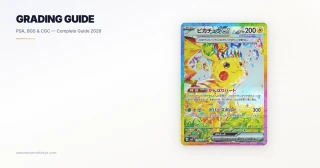
A PSA 10 Pikachu ex SAR from Super Electric Breaker recently sold for $516 on eBay. The same card ungraded trades around ¥55,000 (~$375). That single plastic case added roughly $140 in value.

Grading Japanese Pokemon cards has become one of the smartest moves a collector can make — and Japanese cards have a built-in advantage that most English-language guides completely ignore. JPN cards consistently grade higher than their English counterparts thanks to superior card stock and tighter quality control at the printing facility.

This guide covers everything you need to know about grading Japanese Pokemon cards in 2026: which service to choose (PSA, BGS, or CGC), exactly how much it costs after the February 2026 price update, how to submit your cards step by step, and which cards are actually worth the grading fee. We handle Japanese Pokemon cards daily at our warehouse, and we have seen firsthand how a PSA 10 slab transforms a card’s market value.

Key Takeaway

A PSA 10 slab adds 38-75% to a Japanese SAR’s value — Pikachu ex SAR jumps from ¥55,000 raw to ~$516 graded. Japanese cards grade PSA 10 at significantly higher rates than English prints thanks to thicker card stock and tighter QC, making every JPN box opening a potential grading opportunity.

+38-75%
PSA 10 Premium

$33
PSA Fee (2026)

$516
Top PSA 10 Sale

60-89%
JPN PSA 10 Rate

Why Grade Japanese Pokemon Cards?

Grading Japanese Pokemon cards locks in a card’s condition with a trusted third-party score, and the price premium for top grades is significant. A PSA 10 (Gem Mint) designation can add 50-200% to a card’s raw value — sometimes more for chase cards with low PSA 10 populations.

The PSA 10 Premium — Real Numbers

The gap between raw and graded prices tells the story. Here are real market examples from early 2026:

PSA 10 Pikachu ex SAR Super Electric Breaker Japanese Pokemon card graded slab
PSA 10 graded Pikachu ex SAR in slab
Card Rarity Raw Price PSA 10 Price Premium
Pikachu ex SAR (Super Electric Breaker) SAR ¥55,000 (~$375) ~$516 (¥76,000) +38%
Mega Charizard X ex SAR (Inferno X) SAR ¥65,000 (~$440) ~$720 (¥105,000) +62%
Umbreon ex SAR (Terastal Festival ex) SAR ¥47,000 (~$320) ~$420 (¥62,000) +32%
Mew ex SAR (Shiny Treasure ex) SAR ¥55,000 (~$375) ~$575 (¥85,000) +55%
Charizard ex SAR (Pokemon Card 151) SAR ¥20,000 (~$136) ~$238 (¥35,000) +75%

Prices as of March 2026. Secondary market prices via SNKRDUNK and eBay sold listings.

The pattern is clear: cards valued at $100+ raw see the strongest return on grading investment. The grading fee ($25-$33 for PSA Value tiers) is a fraction of the premium gained.

Why Japanese Cards Grade Higher Than English

Japanese Pokemon cards have a structural advantage when it comes to grading. The printing facility in Japan produces cards with:

  • Better centering — JPN cards are cut with tighter tolerances, making off-center cards far less common than in English print runs
  • Smoother card stock — The paper quality is more uniform, reducing surface imperfections that cost points on the grading scale
  • Cleaner edges — Factory-fresh JPN cards show fewer whitening issues straight out of the pack
  • Consistent foil application — Holographic patterns and texture are applied more evenly

This means a freshly pulled Japanese SAR or SR has a meaningfully higher chance of earning a PSA 10 compared to the same card printed in English. Collectors who grade Japanese cards regularly report PSA 10 hit rates of 60-80% on pack-fresh cards, compared to 40-60% for English equivalents.

For collectors buying sealed Japanese booster boxes, this is a major advantage. Every box you open is a potential source of PSA 10 candidates.

PSA vs BGS vs CGC — Which Service for Japanese Cards?

PSA is the strongest choice for Japanese Pokemon cards if resale value matters to you. Three grading services dominate the Pokemon card market, and each has strengths — but for Japanese cards specifically, the numbers favor PSA.

PSA — The Market Leader

PSA holds roughly 70% of the graded Pokemon card market. For Japanese cards, PSA is the default choice for most collectors and resellers.

Why PSA for JPN cards:

  • Highest resale liquidity — PSA slabs sell faster and for more money on eBay, Mercari, and SNKRDUNK
  • PSA Japan accepts domestic submissions — no international shipping needed if you are in Japan
  • PSA POP Report provides transparent population data for every card
  • Most recognized brand globally among Pokemon collectors

Drawback: PSA uses a single overall grade (1-10) without subgrades. If your card scores a 9 with near-perfect centering but a small surface mark, you only see “PSA 9” — not the breakdown.

BGS (Beckett Grading Services) — Subgrades for Serious Collectors

BGS assigns four subgrades — Centering, Corners, Edges, and Surface — alongside the overall grade. This transparency appeals to collectors who want to know exactly where a card lost points.

BGS graded Pokemon card showing four subgrades centering corners edges surface
BGS graded card showing subgrades label close-up

The BGS Black Label: A BGS 10 Black Label (all four subgrades at 10) is rarer than a PSA 10 and commands a significant premium. However, BGS Black Labels are extremely difficult to achieve on any card.

For JPN cards specifically:

  • BGS market share for Pokemon is smaller than PSA — resale prices are typically 10-20% lower than equivalent PSA grades
  • Turnaround times have historically been longer
  • No domestic Japan submission option — cards must ship to the US

CGC (Certified Guaranty Company) — The Growing Alternative

CGC entered the trading card market more recently and has been gaining traction with competitive pricing and faster turnaround.

For JPN cards:

  • Stricter centering standards than PSA — JPN cards’ better centering works in your favor here
  • Growing acceptance but still lags PSA in resale value by 15-25%
  • Offers subgrades (optional, for an additional fee)
  • No domestic Japan submission
Feature PSA BGS CGC
Market Share (Pokemon) ~70% ~15% ~15%
Resale Premium Highest Medium Growing
Subgrades No Yes (4) Optional
JPN Domestic Submission Yes (PSA Japan) No No
Starting Price (2026) $24.99 $14.95 $15.00
Best For Resale value, liquidity Detailed condition data Budget grading

Our recommendation: For Japanese Pokemon cards, PSA is the strongest choice if you plan to sell or trade your graded cards. The resale premium alone justifies the slightly higher cost. If you are a personal collector who values detailed condition breakdowns, BGS is worth considering.

PSA Grading Costs in 2026 (Updated February)

PSA updated its pricing on February 10, 2026, with increases of $3-$5 across most service levels. Here is the complete breakdown.

US Pricing Tiers

Service Level Cost Per Card Turnaround Max Declared Value Best For
Value Bulk $24.99 95 business days $499 Bulk submissions (20+ cards)
Value $32.99 75 business days $499 Standard single cards
Value Plus $49.99 45 business days $999 Faster turnaround
Value Max $64.99 35 business days $999 Mid-priority cards
Regular $79.99 25 business days $2,499 Higher-value cards
Express $149.00 15 business days $2,499 Time-sensitive submissions
Super Express $299.00 7 business days $4,999 Urgent, high-value cards

Value Bulk requires PSA Collectors Club membership ($99/year). All prices per card.

PSA Japan Pricing (¥ — Domestic Submissions)

If you are submitting from within Japan, PSA Japan offers yen-denominated pricing through psacard.co.jp:

Service Level Cost Per Card (¥) Turnaround Change (Feb 2026)
Value Bulk (バリュー・バルク) ¥3,980 90 business days +¥1,000
Value (バリュー) ¥4,980 +¥1,000
Value Plus (バリュー・プラス) ¥6,980 +¥1,000
Regular (レギュラー) ¥9,980 +¥1,000

PSA Japan pricing as of February 2026. Higher tiers (Express+) available — check psacard.co.jp for current rates.

Which Tier to Choose

The right tier depends on your card’s value:

  • Card worth $100-$300 raw → Value Bulk ($24.99) or Value ($32.99). The grading fee is a small percentage of the potential premium
  • Card worth $300-$1,000 raw → Value ($32.99) to Value Plus ($49.99). Worth the faster turnaround since the card represents significant value
  • Card worth $1,000+ raw → Regular ($79.99) or Express ($149). You want your high-value card back quickly with proper insurance coverage

Rule of thumb: If the grading fee is less than 10% of the card’s raw value, it is almost always worth submitting. For cards under $75 raw, the math gets tight — the grading fee plus shipping can eat into or exceed the PSA 10 premium.

How to Submit Japanese Cards for Grading — Step by Step

Submitting cards to PSA is straightforward once you know the process. Here are the five steps.

Card Saver I semi-rigid holder and penny sleeve for PSA grading submission
Card Saver I semi-rigid holder with penny sleeve for PSA submission

Step 1 — Inspect and Select Your Cards

Before spending money on grading, evaluate each card honestly:

  • Check centering — Hold the card up and compare the border width on all four sides. JPN cards are generally well-centered, but check anyway
  • Inspect corners — Use a loupe or magnifying glass. Even tiny whitening can drop a grade
  • Look for surface scratches — Tilt the card under direct light. Holo cards show scratches more easily
  • Check edges — Run your finger along each edge. Feel for nicks or rough spots

The $75 rule: Only submit cards worth $75 or more in raw condition. Below that threshold, the grading fee ($25-$33) plus return shipping ($10-$20) makes the ROI marginal at best.

Step 2 — Prepare and Package Your Cards

Proper packaging prevents damage during transit — and PSA will charge you if cards arrive damaged.

  1. Place each card in a penny sleeve (soft sleeve), inserting top-first
  2. Slide the sleeved card into a Card Saver I (semi-rigid holder). Do NOT use top-loaders — PSA prefers Card Saver I holders
  3. Write the card’s submission number on the Card Saver with a marker
  4. Stack Card Savers together and wrap with a rubber band or painter’s tape
  5. Place the stack between two pieces of cardboard for rigidity
  6. Use a box that fits snugly — excess space means cards can shift during shipping

Step 3 — Create Your Submission on PSA’s Website

PSA online submission form for Japanese Pokemon card grading
PSA online submission form screenshot
  1. Log in to your PSA account at psacard.com (or psacard.co.jp for PSA Japan)
  2. Click “Submit” and select your service level
  3. Enter each card’s details: Card Name, Set, Card Number, Year, Declared Value
  4. For Japanese cards, select “Japanese” as the language — PSA handles JPN cards routinely
  5. Review your submission, pay the grading fee, and print the packing slip

Declared value tip: Be honest with declared values. PSA uses this for insurance purposes. Underdeclaring risks denied claims if something goes wrong. Overdeclaring bumps you into a higher service tier.

Step 4 — Ship to PSA

PSA Lounge Tokyo Akihabara storefront for walk-in Pokemon card grading submissions
PSA Lounge Tokyo in Akihabara – storefront photo
  • From the US: Ship to PSA’s facility in Santa Ana, California. Use USPS Priority Mail with tracking and insurance matching your declared value
  • From Japan (via PSA Japan): Ship domestically to PSA Japan’s receiving address. Standard tracked shipping within Japan is sufficient
  • From other countries: Ship internationally to PSA US, or use a forwarding service. Factor in customs declarations and shipping insurance
  • PSA Lounge Tokyo (Akihabara): Walk-in submissions accepted — bring your cards directly and skip shipping entirely

Always use tracked shipping. Untracked packages with valuable cards are a risk not worth taking.

Step 5 — Receive and Verify Your Graded Cards

After PSA grades your cards:

  1. Check your PSA account for grade results before the cards arrive
  2. Verify each slab matches the card you submitted (cert number, card name, grade)
  3. Look up your card on the PSA POP Report to see how many copies exist at each grade
  4. Update your collection tracking with the PSA certification number

Your graded cards will arrive in PSA’s tamper-evident slabs, ready for display, sale, or long-term storage.

What the Grades Mean — PSA Scale Explained

PSA uses a 1-10 scale, but for modern Japanese Pokemon cards, the grades that matter most are 8, 9, and 10. Cards grading below 8 are typically not worth the submission fee unless they are vintage or extremely rare.

PSA grading scale 1 to 10 explained for Pokemon cards with grade descriptions
PSA grading scale visual diagram showing grades 1-10

PSA 8-9 — Near Mint to Mint

  • PSA 8 (NM-MT): Minor imperfections visible upon close inspection. Slight whitening on one or two corners, minor centering shift. A PSA 8 on a $200+ card still holds value, but the premium over raw is modest (10-20%)
  • PSA 9 (Mint): Nearly perfect with one minor flaw — perhaps slightly off-center or a single corner with minimal whitening. PSA 9 carries a solid premium (20-40% over raw) and is a realistic target for most pack-fresh JPN cards

PSA 10 (Gem Mint) — The Gold Standard

PSA 10 means the card is virtually perfect: sharp corners, flawless surface, centered within PSA’s tolerances, and clean edges. This is the grade that commands the massive premium.

For Japanese cards, PSA 10 is achievable at higher rates than English cards. The combination of better card stock, tighter centering, and cleaner printing gives JPN cards an edge. Many collectors report that 6-8 out of every 10 pack-fresh JPN SARs or SRs earn a PSA 10.

Grade 상태 Market Impact JPN Card Hit Rate (Pack-Fresh)
PSA 10 Gem Mint — virtually perfect 50-200% premium over raw 60-80%
PSA 9 Mint — one minor flaw 20-40% premium over raw 15-30%
PSA 8 NM-MT — minor imperfections 10-20% premium over raw 5-10%
PSA 7 or below Visible wear Often below raw market price Rare for pack-fresh

Which Japanese Cards Are Worth Grading?

Not every card deserves a slab. Grading fees, shipping costs, and turnaround time mean you should be selective about what you submit.

The $75 Rule — When Grading Pays Off

A simple ROI framework: only grade cards worth $75 or more in raw condition.

Here is the math. Assume you use PSA Value Bulk ($24.99) with $15 in shipping costs:

  • Total grading cost: ~$40
  • If the PSA 10 premium is 50%: your card needs to be worth at least $80 raw to break even
  • If the PSA 10 premium is 75%: break-even drops to around $55 raw

Since JPN cards hit PSA 10 at higher rates (60-80%), the expected value calculation favors grading. But you still need the raw card to be worth enough to absorb the fee.

Best Candidates by Rarity

Rarity Grade Priority Why
SAR (Special Art Rare) High — always consider grading Highest raw values, strongest PSA 10 premiums
MUR (Master Ultra Rare) High Ultra-rare, extremely high per-card value
UR (Ultra Rare) Medium-High Solid premiums, especially for popular characters
SR (Super Rare) Medium Grade if raw value exceeds $75
AR (Art Rare) Low Most ARs are under $20 raw — grading fee exceeds premium
RR (Double Rare) Low Rarely worth grading unless it is a meta staple

Which sets have the best grading candidates? Check our detailed pull rates and top card guides for each set:

Charizard ex SAR Pokemon Card 151 Japanese grading candidate PSA 10
Charizard ex SAR from Pokemon Card 151 — top grading candidate

For a broader look at the most valuable Japanese cards, see our Most Valuable Japanese Pokemon Cards 2026 guide and our investment analysis.

Cards NOT Worth Grading

Save your money on these:

  • Cards under $50 raw — The math does not work. Grading cost + shipping eats the premium
  • Cards with visible damage — Creases, bends, or heavy whitening will grade PSA 6 or below. Not worth the fee
  • Common and uncommon cards — Unless it is a vintage error card, sub-$5 cards should never be graded
  • Cards you pulled and handled without sleeves — Surface micro-scratches from bare handling almost guarantee a PSA 9 or lower

Tips for Getting PSA 10 on Japanese Cards

Pulling a valuable card is only half the battle. How you handle it from pack to slab determines whether you get a PSA 10 or settle for a 9.

Handle Fresh Pulls Correctly

The moment you pull a card from the pack:

  1. Touch only the edges — Fingerprints on the surface show under PSA’s inspection light
  2. Sleeve immediately — Have penny sleeves ready before you open packs. Insert top-first into the sleeve
  3. Do not riffle through the pack — Sliding cards against each other causes micro-scratches on holo surfaces
  4. Work on a clean, soft surface — A playmat or microfiber cloth prevents back-side scratches
  5. Store sleeved cards flat — Avoid bending by storing in a Card Saver or top-loader right away

Common Defects That Cost You a Grade

Even on Japanese cards with their superior print quality, these issues appear:

  • Print lines — Faint horizontal lines across the holo surface. Common on textured cards. Hold under angled light to check
  • Corner whitening — Even factory-fresh JPN cards occasionally show minor whitening on one corner. Check all four
  • Off-center cuts — While JPN centering is generally excellent, some cards still come slightly off. PSA allows roughly 60/40 centering for a 10
  • Surface texture irregularities — On full-art and SAR cards, look for bumps or inconsistencies in the textured surface
  • Edge nicks — Tiny chips on the card edge from pack opening. Use a loupe to inspect

Pro tip: If a card has one minor flaw, it is likely a PSA 9 — still worth grading if the raw value exceeds $100. Do not only submit cards you think are “perfect 10s.” A PSA 9 SAR still commands a meaningful premium.

The Bottom Line

Grading Japanese Pokemon cards is one of the highest-ROI moves a collector can make, especially given JPN cards’ natural advantage in achieving top grades.

Three key takeaways:

  1. PSA is the top choice for JPN cards — 70% market share, highest resale value, and PSA Japan enables domestic submissions from Japan
  2. The 2026 costs are manageable — At $24.99-$32.99 for Value tiers, the grading fee is a small fraction of the premium on cards worth $75+
  3. JPN cards grade higher — Superior card stock and centering give Japanese cards a 60-80% PSA 10 hit rate on pack-fresh cards, compared to 40-60% for English

The best way to build a collection of gradeable cards? Start with quality sealed product. Every Japanese booster box is a potential source of PSA 10 candidates — and every box from our store is serial-tracked for authenticity.

Grade-Worthy Cards Start Here
Japanese Sealed Booster Boxes
From ¥5,500 (~$37)
Ships from Tokyo · Tracked · Serial-numbered

Browse Collection →

FAQ [schema: FAQPage]

How much does it cost to get a Japanese Pokemon card graded?

PSA grading starts at $24.99 per card (Value Bulk tier, as of February 2026). PSA Japan offers yen-denominated pricing starting at ¥3,980. BGS starts at $14.95 and CGC at $15.00. Factor in return shipping ($10-$20 for US domestic, more for international) when calculating total cost.

Is it worth grading Japanese Pokemon cards?

Yes, if the card is worth $75 or more in raw condition. PSA 10 premiums on Japanese SARs and URs typically range from 50-200% over raw prices. Japanese cards also have a higher PSA 10 hit rate (60-80% pack-fresh) compared to English cards, making the expected return on grading stronger.

Can you send Japanese cards to PSA from Japan?

Yes. PSA Japan (psacard.co.jp) accepts domestic submissions from within Japan. Value Bulk pricing starts at ¥3,980 per card with a 90-business-day turnaround. You ship domestically within Japan, avoiding international shipping costs and customs. PSA Lounge Tokyo in Akihabara also accepts walk-in submissions.

What grade do most Japanese Pokemon cards get?

Pack-fresh Japanese cards in good condition typically receive PSA 9 or PSA 10. The superior card stock and centering of JPN printing gives them an advantage — collectors commonly report 60-80% PSA 10 rates on carefully handled pack-fresh SARs and SRs.

PSA vs CGC — which is better for Japanese Pokemon cards?

PSA is the stronger choice for resale value and market liquidity. PSA-graded Pokemon cards sell for 15-25% more than equivalent CGC grades on secondary markets. CGC offers lower starting prices ($15 vs $24.99) and optional subgrades, making it a reasonable budget alternative if you plan to keep the cards in your personal collection.

How long does PSA grading take in 2026?

After the February 2026 update: Value Bulk takes 95 business days, Value takes 75 days, and Express takes 15 days. PSA Japan’s Value Bulk turnaround is 90 business days. Actual times may vary based on submission volume.

What Japanese Pokemon cards are worth grading?

Focus on SARs (Special Art Rare) and URs (Ultra Rare) worth $75+ in raw condition. Top candidates include chase cards like Pikachu ex SAR, Charizard ex SAR, and popular character SARs from recent sets. Avoid grading cards under $50 raw — the grading fee and shipping costs will eat into or exceed the premium.


⚡ Shop Japanese Pokemon Booster Boxes

Authentic sealed products shipped directly from Tokyo, Japan with tracking & insurance via FedEx.

Browse All Japanese Pokemon Booster Boxes