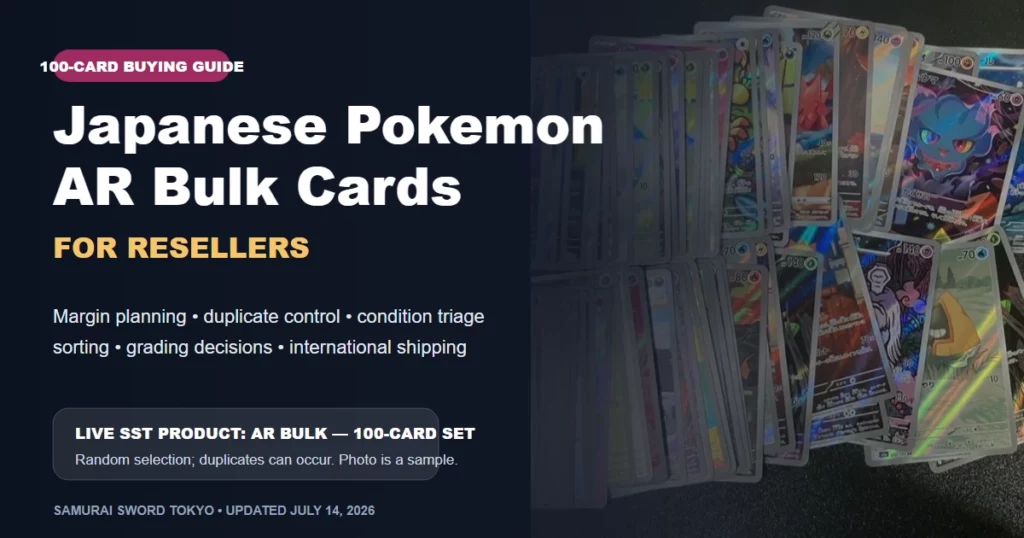
Bijgewerkt: 14 juli 2026. Live WooCommerce-momentopname gecontroleerd op 2026-07-14 16:14 JST. Prijs en voorraad zijn volatiel en moeten vóór aankoop opnieuw worden bevestigd.
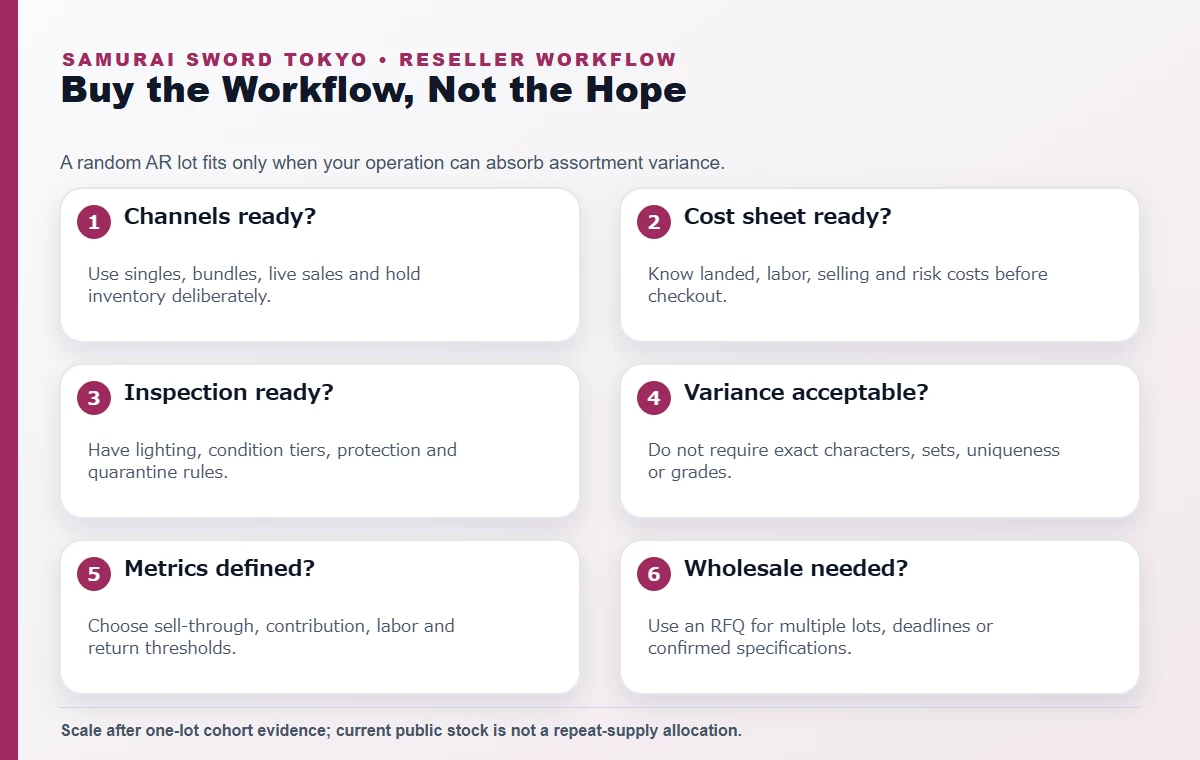
Een Japanse Pokemon AR-lot van 100 kaarten kan nuttige voorraad zijn voor een reseller, maar je moet het nooit modelleren als 100 gegarandeerd unieke, mint-conditie, direct verkoopbare kaarten. Het huidige product van Samurai Sword Tokyo is een willekeurige samenstelling. De winkel geeft aan dat ze haar best doet om dubbele kaarten te vermijden, maar waarschuwt daarbij nadrukkelijk dat dubbele kaarten kunnen voorkomen en dat de foto slechts een voorbeeld is. Dat ene detail verandert het juiste koopmodel: bereken de landed cost, inspecteer elke kaart, scheid je verkoopkanalen en meet de werkelijke doorverkoop voordat je opnieuw bestelt.
Deze gids zet die onzekerheid om in een operationeel plan. Hij behandelt de gedateerde live productmomentopname, de all-in kosteneconomie, dubbelecontroles, conditiebeoordeling van raw kaarten, gradingtriage, sorteren en aanbieden, internationale verzending, en de metrics die een winkel na de eerste lot moet beoordelen. De gids is geschreven voor overzeese kaartwinkels, online verkopers, breakers, beursverkopers en collector-resellers die Japanse voorraad uit Tokyo inkopen.
1. Live productmomentopname AR Bulk 100 kaarten
De gedateerde cijfers om te gebruiken—geen tijdloze beloften
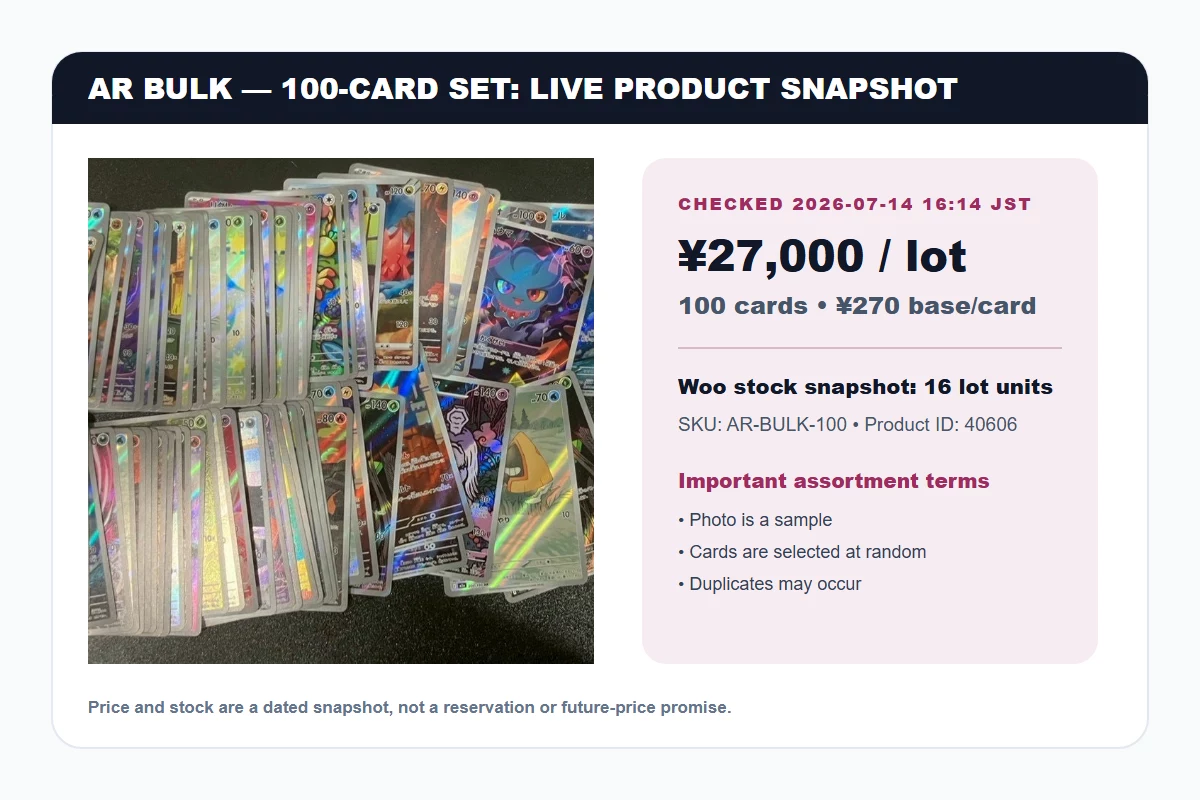
Op 2026-07-14 om 16:14 JST toonde het live WooCommerce-record voor product-ID 40606 de producttitel AR Bulk – 100-Card Set, een reguliere en actuele prijs van ¥27.000, beheerde voorraad van 16 loteenheden, en de status op voorraad. Eén vermelde eenheid vertegenwoordigt 100 kaarten, dus de eenvoudige basis op productprijs kwam neer op ¥270 per kaart. Dit is een momentopname op een specifiek tijdstip. Het reserveert geen voorraad, legt geen toekomstige prijs vast en bevat geen bestemmingsspecifieke kosten. Open de productpagina altijd opnieuw vlak voordat je bestelt.
| Veld | Gecontroleerde waarde | Hoe een reseller dit moet gebruiken |
|---|---|---|
| Product | AR Bulk – 100-Card Set | Bevestig het exacte product en type eenheid; verwar één kaart niet met één lot van 100 kaarten. |
| Product-ID / SKU | 40606 / AR-BULK-100 | Bewaar beide identificatiegegevens in inkooprecords en wholesale-aanvragen. |
| Prijsmomentopname | ¥27.000 per lot van 100 kaarten | Gebruik dit alleen als goederenkost; tel elke landed en verkoopkosten erbij op. |
| Basisrekensom | ¥270 per kaart | Startbasis vóór vracht, fees, belasting, arbeid, verpakkingsmateriaal, grading en verliezen. |
| Voorraadmomentopname | 16 loteenheden; op voorraad | Volatiele beschikbaarheid, geen gereserveerde voorraad. Controleer opnieuw bij aankoop. |
| Selectievoorwaarden | Willekeurig; dubbele kaarten kunnen voorkomen | Reken niet op 100 unieke kaarten, vaste personages of vaste sets. |
Waar de productomschrijving daadwerkelijk toe verplicht
De productomschrijving is kort maar commercieel belangrijk: de foto is een voorbeeld; kaarten worden volledig willekeurig geselecteerd; de verkoper doet zijn best om dubbele kaarten te vermijden; en dubbele kaarten kunnen toch voorkomen. Een gedisciplineerde koper behandelt alle vier deze uitspraken als aankoopvoorwaarden. De foto toont de productcategorie en het visuele karakter van de lot, maar identificeert niet de exacte kaarten die zullen aankomen. “Beste inspanning” is niet hetzelfde als een uniciteitsgarantie.
Dat betekent dat je een binnenkomende lot niet moet adverteren voordat je hem hebt ontvangen, geen personagemix aan je eigen klanten moet beloven, en geen exacte kaartnummers vooraf moet verkopen. Ontvang, tel, inspecteer en catalogiseer eerst. Als jouw bedrijfsmodel afhangt van een minimumaantal unieke kaarten, een specifieke uitbreiding, of een vaste hoeveelheid populaire Pokemon, is een willekeurige bulk-lot het verkeerde instrument, tenzij de verkoper een aparte specificatie schriftelijk bevestigt.
Gebruik de productpagina voor afrekenen en de wholesale-desk voor specificaties
De productpagina is de snelste route voor de vermelde eenheid wanneer de live prijs, voorraad en voorwaarden bij je plan passen. Gebruik voor grotere hoeveelheden, terugkerende levering, exacte identificatiegegevens, deadline-eisen of een aanvraag die afwijkt van de vermelde willekeurige samenstelling, de SST wholesale RFQ-pagina. Vermeld de productnaam, SKU, gewenst aantal lots van 100 kaarten, bestemmingsland, deadline, betalingsvoorkeur, en of vervangingen acceptabel zijn. Een aanvraag is een verzoek om bevestiging, geen voorraadreservering.
2. Wat een AR bulk-lot wel—en niet—is
AR staat voor Art Rare, geen conditiegraad
In het officiële materiaal van het Japanse Pokemon Card Game wordt AR gebruikt voor Art Rare. De aanduiding beschrijft de zeldzaamheids- en presentatiecategorie van de kaart. Het betekent niet “automatisch premium”, “mint”, “PSA 10” of “gegarandeerde winst”. Vraag naar personages, set, artwork, illustrator, taal, conditie, aanbod en huidige koperinteresse kunnen zeer verschillende doorverkoopresultaten opleveren tussen kaarten met hetzelfde zeldzaamheidslabel.
Dat onderscheid is belangrijk omdat een bulkkoper verleid kan worden om de hele zending te prijzen op basis van de sterkste AR-voorbeelden die online te zien zijn. Een veiligere methode is bottom-up: identificeer elke ontvangen kaart, registreer de conditie, groepeer dubbele kaarten, controleer de recente netto-opbrengst van je eigen kanaal, en wijs een realistische route toe. Sommige kaarten rechtvaardigen misschien individuele vermeldingen; andere passen beter bij personagebundels, set-completielots, goedkope add-ons, live-verkooptrays of langetermijnvoorraad.
De 100 kaarten zijn voorraadvolume, geen 100 gelijke eenheden
Honderd kaarten geven een reseller voldoende volume om meerdere verkooproutes op te bouwen, maar ze zijn niet economisch inwisselbaar. Twee exemplaren van dezelfde kaart kunnen verschillen door centrering, whitening, printlijnen, randslijtage, krassen, deuken of oppervlaktevervuiling. Twee even schone kaarten kunnen nog steeds verschillen in doorverkoop omdat één personage of artwork meer actieve vraag heeft in jouw markt.
| De lot geeft je | De lot garandeert niet | Vereiste reactie van de koper |
|---|---|---|
| 100 Japanse AR-kaarten | 100 verschillende kaarten | Tel unieke kaartidentiteiten en dubbeldiepte na aankomst. |
| Een willekeurige selectie | Specifieke Pokemon, sets of artiesten | Verkoop geen exacte inhoud vooraf en bouw geen vaste samenstellingsprognose. |
| Een voorbeeldproductfoto | De afgebeelde kaarten | Behandel de afbeelding alleen als bewijs van categorie. |
| Raw-kaartvoorraad | Een numerieke graad of gem rate | Inspecteer eerst; dien alleen kaarten in die je eigen economische toets doorstaan. |
| Een vermelde productprijs | Jouw landed of break-even kost | Bouw een volledig kostenoverzicht per zending en verkoopkanaal. |
Best passende verkoopkanalen
Een willekeurige AR-lot is het meest flexibel wanneer je bedrijf al meerdere kanalen gebruikt. Een webwinkel kan de sterkste kaarten individueel vermelden. Een beursverkoper kan kaarten organiseren per prijsband of personage. Een breaker kan lagerwaardige kaarten gebruiken als duidelijk vermelde add-ons. Een winkel kan artiest-, type-, generatie- of set-completiebundels samenstellen nadat de ontvangen kaarten zijn geïdentificeerd. Dubbele kaarten kunnen bijdragen aan vermeldingen met meerdere hoeveelheden wanneer er vraag is, maar diezelfde dubbele kaarten kunnen dode voorraad worden wanneer een vermelding geen verkeer krijgt.
Een verkoper met één kanaal loopt meer risico. Als jouw enige kanaal een hoge gemiddelde orderwaarde, uitgebreide betaalde advertenties of individuele fotografie voor elk goedkoop item vereist, kunnen arbeid en fees de marge opslokken. De juiste vraag is niet “Zijn AR-kaarten populair?” maar “Kan mijn bedrijf deze exacte ontvangen mix omzetten in netto cash tegen een tarief dat kapitaal, arbeid en variatie dekt?”
3. Resellereconomie: modelleer landed cost vóór marge
Begin met een all-in aankoopbasis
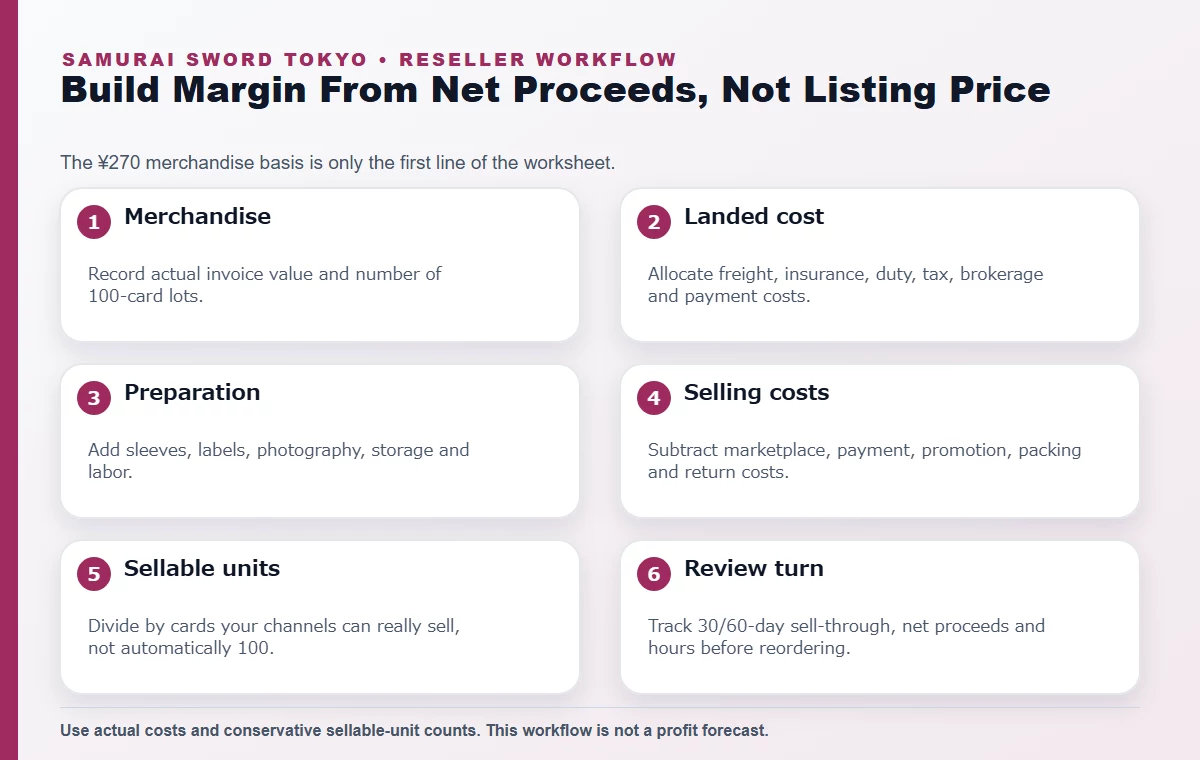
De eenvoudige basis van ¥270 is alleen nuttig als eerste regel van een werkblad. Tel internationale verzending toegewezen aan deze lot, betalings- of wisselkoerskosten, invoerrechten en belastingen waar van toepassing, brokerage, inkomende sleeves of teambags, labels, opslag, fotografie, marketplace-commissies, betalingsverwerking, verwachte retouren, gradingkosten en arbeid erbij op. Als de lot van 100 kaarten een zending deelt met andere producten, verdeel de vracht dan volgens een consistente methode zoals gewicht, verzekerde waarde of verpakt volume, en documenteer die methode.
Bepaal vervolgens hoeveel kaarten daadwerkelijk verkoopbaar zijn via je geplande kanalen. Als vijf kaarten worden vastgehouden voor conditiebeoordeling, tien in trage bundels worden geplaatst en drie beschadigd zijn buiten je standaard, onderschat delen door 100 de basis van de individueel vermelde voorraad. Er is geen universele noemer: bereken een basis op zendingsniveau, en vervolgens een basis op kanaalniveau.
| Kostenlaag | Voorbeeldinvoer | Wat te registreren |
|---|---|---|
| Goederen | Momentopname ¥27.000 | Werkelijke factuurwaarde en aantal in de lot. |
| Inkomende logistiek | Jouw toegewezen bedrag | Vracht, verzekering, brokerage en verpakkingsaandeel. |
| Invoer en betaling | Bestemmingsspecifiek | Daadwerkelijk in rekening gebrachte invoerrechten, belasting, betalingsfee en wisselkoersmarge. |
| Voorbereiding | Materiaal plus arbeid | Sleeves, labels, fotografie, gegevensinvoer en sorteertijd. |
| Verkoopkosten | Kanaalspecifiek percentage en vaste fees | Marketplace, betaling, promotie en uitgaande verpakking. |
| Risicoreserve | Jouw beleid | Retouren, verlies, conditiegeschillen, kortingen en onverkochte voorraad. |
Gebruik netto-opbrengst, niet de vermeldingsprijs
Een vermeldingsprijs is geen omzet. Omzet is geen marge. Marge is geen winst na arbeid en overhead. Schat voor elke verkooproute conservatieve netto-opbrengsten: verwachte verkoopprijs minus marketplace-commissie, betalingsfee, kortingen, kosten voor gepromote vermeldingen, uitgaande verpakking, verzendtoeslag en retourvoorziening. Gebruik recent verkoopbewijs van de markt waar je daadwerkelijk verkoopt en verwijder uitschieters die je niet kunt reproduceren.
Bouw voor een gemengde lot meerdere buckets in plaats van één heroïsch gemiddelde. Een praktisch model kan individueel vermelde premiumkaarten, standaard singles, themabundels, add-ons en voorraad om aan te houden bevatten. Ken elke bucket een conservatieve doorverkooptermijn toe. Kapitaal dat zes maanden vastzit, is economisch anders dan cash die binnen twee weken wordt teruggewonnen, zelfs als de brutomzet identiek is.
Een illustratieve gevoeligheidstabel—geen doorverkoopprognose
De onderstaande tabel gebruikt hypothetische kosten om de methode te tonen. Ze schat niet de marktwaarde van de ontvangen kaarten. Vervang elk cijfer behalve de bekende productmomentopname door je eigen offerte, feeschema en operationele gegevens. De regel “gemiddelde netto-opbrengst” betekent geld dat overblijft na variabele kanaalkosten en uitgaande transactiekosten, maar vóór vaste overhead tenzij je die expliciet meeneemt.
| Illustratief geval | All-in lotbasis | Verkoopbare eenheden | Basis per verkoopbare eenheid | Gemiddelde netto-opbrengst nodig voor nulcontributie |
|---|---|---|---|---|
| Lean inkomend | ¥32.000 | 95 | Ongeveer ¥337 | Minstens ¥337 |
| Gematigde landed costs | ¥36.000 | 90 | ¥400 | Minstens ¥400 |
| Hogere vracht- en arbeidstoewijzing | ¥42.000 | 85 | Ongeveer ¥494 | Minstens ¥494 |
| Met een apart gradingbudget | ¥50.000 | 85 raw-verkoopequivalenten | Ongeveer ¥588 | Hoger; graderesultaten blijven onzeker |
Gebruik deze tabel niet als prijsvoorspelling. Het is gevoeligheidsrekenwerk. Jouw kaarten, fees, vracht, belastingen, arbeid, graderesultaten en doorverkoop zullen verschillen.
Meet voorraadrotatie én brutomarge
Volg na de lancering het aantal dagen tot eerste verkoop, 30-dagen doorverkoop, 60-dagen doorverkoop, netto-opbrengst per ontvangen kaart, retourpercentage, kortingspercentage en arbeidsuren per 100 kaarten. Een lot die een aantrekkelijke bruto-marge oplevert maar uitgebreide fotografie, frequente herprijzing en lange houdtijd vereist, kan slechter zijn dan een lot met bescheiden marge die snel roteert met gestandaardiseerde vermeldingen.
Stel een evaluatiedatum vast voordat je koopt. Vergelijk op die datum geplande en werkelijke cijfers. Als de samenstelling diepere kortingen vereist dan verwacht, verander dan de bundelstructuur of het kanaal voordat je een volgende lot bestelt. Herbestellen omdat “AR-kaarten liquide lijken” is geen metric; herbestellen omdat je ontvangen cohort aan een gedocumenteerde contributie- en doorverkoopdrempel voldeed, is een bedrijfsbeslissing.
4. Dubbelrisico: maak van willekeur een samenstellingsbeleid
Ga ervan uit dat dubbele kaarten kunnen voorkomen en tel ze nauwkeurig
De dubbele-kaartwaarschuwing van de verkoper moet worden weerspiegeld in je ontvangstformulier. Registreer totaal aantal kaarten, unieke kaartidentiteiten, exemplaren per identiteit, en het percentage van de lot dat wordt vertegenwoordigd door de vijf diepste dubbele posities. Vertrouw niet op visueel geheugen. Vergelijkbare artwork, setherdrukken, reverse-holo-uitvoeringen en verschillen in kaartnummer kunnen informeel tellen onbetrouwbaar maken.
Er is geen beloofd dubbelpercentage, dus publiceer geen prognose. Definieer in plaats daarvan acties voor wat er ook binnenkomt. Een tweede exemplaar van een kaart met hoge vraag kan waardevolle voorraad met meerdere hoeveelheden zijn. Acht exemplaren van een trage kaart vereisen mogelijk bundels of geduldig aanhouden. Het economische probleem is concentratie, niet dubbeling op zich.
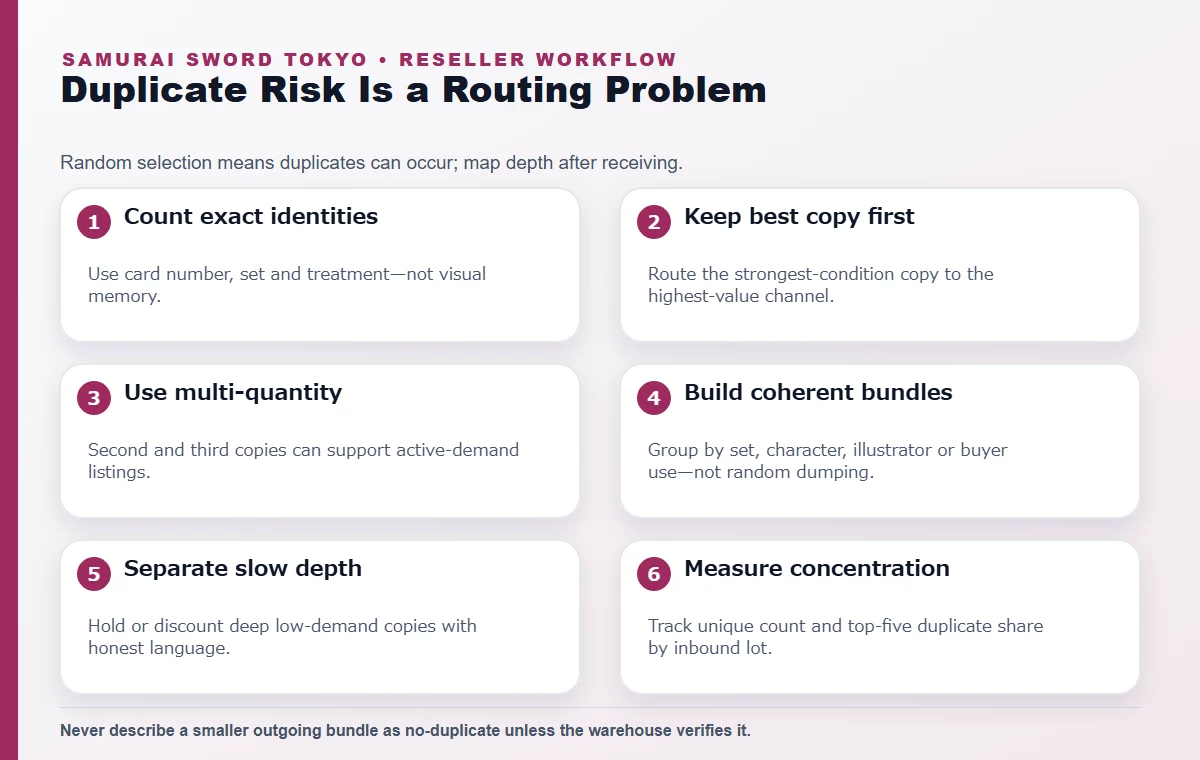
Route dubbeldiepte naar verschillende aanbiedingen
| Waargenomen dubbelpositie | Mogelijke route | Controle |
|---|---|---|
| Eerste schone exemplaar | Individuele vermelding of setmap | Bewaar het exemplaar met de sterkste conditie voor de meest waardevolle route. |
| Tweede en derde exemplaar | Vermelding met meerdere hoeveelheden, live-verkooptray of alternatief platform | Fotografeer alleen een representatieve conditie als je vermeldingsbeleid dit toestaat en verschillen worden vermeld. |
| Diepere exemplaren met actieve vraag | Herbevoorradingspool of personagebundel | Beperk voorraadblootstelling op basis van recente doorverkoop, niet op volgersaantallen. |
| Diepere exemplaren met zwakke vraag | Set-samenstellot, add-on of long-tail bundel | Verberg ongewenste dubbele kaarten niet in een misleidend “variatie”-aanbod. |
| Conditie-uitschieters | Aparte vermelding voor beschadigd/gespeeld of niet-verkoopbeoordeling | Middel een gebrek nooit weg omdat andere exemplaren schoon zijn. |
Gebruik eerlijke bundeltaal
Als je kleinere lots doorverkoopt, beschrijf dan precies wat de koper ontvangt. “Bundel van tien AR-kaarten” betekent niet automatisch tien unieke kaarten. Vermeld of uniciteit gegarandeerd is, of de foto de werkelijke lot is, of de selectie willekeurig is, en welke conditiestandaard van toepassing is. Als je een bundel zonder dubbele kaarten samenstelt uit de ontvangen voorraad, bevestig dit dan op het moment van inpakken en maak de belofte specifiek voor die uitgaande bundel—niet voor de oorspronkelijke levering van 100 kaarten.
Transparante samenstellingstaal verlaagt het risico op geschillen en helpt je producten eerlijk te vergelijken. Het voorkomt ook een veelvoorkomende operationele fout: aantrekkelijke marketingtekst maken voordat het magazijn een herhaalbare pickregel heeft vastgesteld. De vermelding, voorraadlocatie en inpaklijst moeten allemaal dezelfde definitie van “uniek”, “willekeurig”, “voorbeeld” en “werkelijk getoonde kaarten” gebruiken.
5. Conditiebeoordeling en gradingtriage
Inspecteer raw kaarten volgens een herhaalbare standaard
Conditie is een feit per kaart. Tel de lot bij aankomst voordat je veel handelt, en inspecteer vervolgens onder diffuus voorlicht en schuin oppervlaktelicht. Controleer voor- en achterkant op centrering, hoeken, randwhitening, afsplintering, krassen, printlijnen, deuken, kreukels, vlekken, kromtrekking en vreemd materiaal. Gebruik schone handen of geschikte hanteringspraktijken en plaats geïnspecteerde kaarten in verse bescherming volgens je winkelbeleid.
Leid de achterkant niet af van de voorkant. Moderne Japanse kaarten kunnen op het eerste gezicht sterk ogen terwijl een kleine chip aan de achterrand, rollerlijn, deuk of printfout de juiste vermeldings- of gradingbeslissing verandert. Fotografeer opvallende gebreken voordat de voorraad wordt gemengd. Als authenticiteit of vervalsing onzeker is, isoleer de kaart dan en escaleer hem voor beoordeling in plaats van hem te verkopen onder een zelfverzekerd conditielabel.
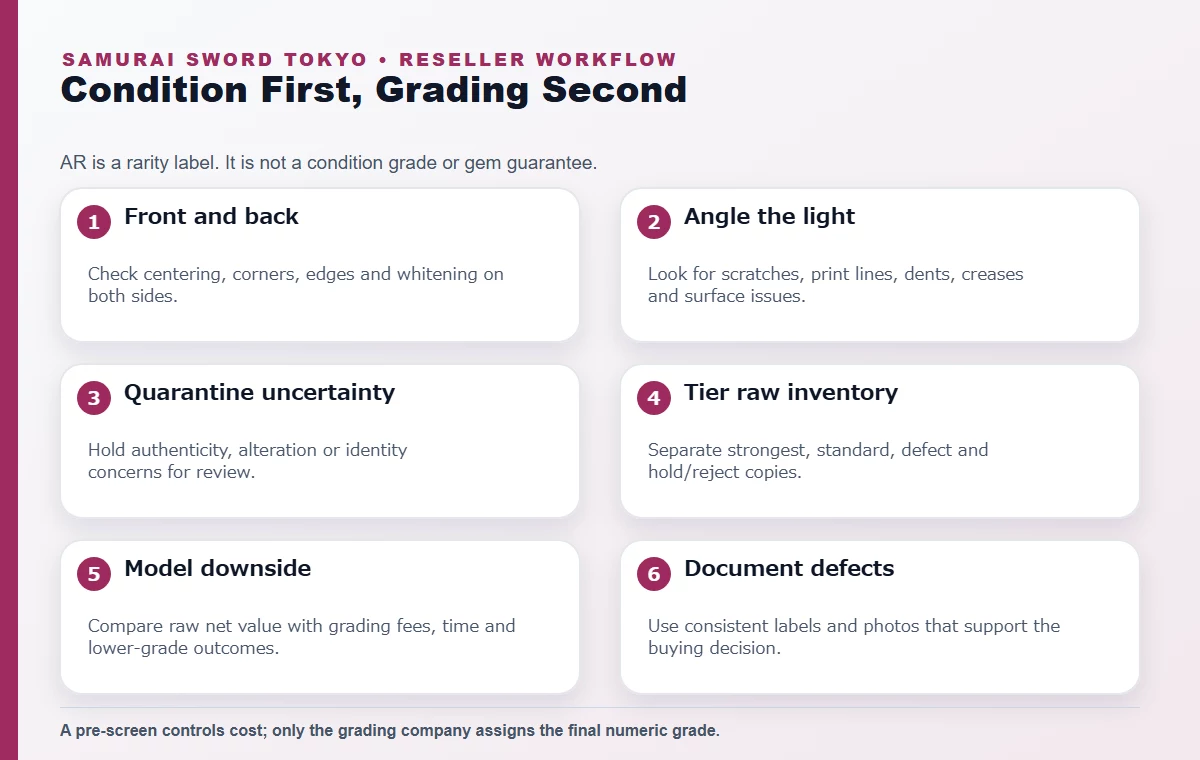
Scheid doorverkoopconditie van gradingkandidatuur
Een kaart kan perfect acceptabele raw voorraad zijn zonder een verstandige gradingkandidaat te zijn. De gepubliceerde gradingnormen van PSA beschrijven een PSA 10 als vrijwel perfect en bespreken scherpe hoeken, focus, originele glans, vlekken, printonvolkomenheden, centrering en algehele visuele aantrekkingskracht. PSA merkt ook op dat grading een subjectieve component bevat en identificeert vervalste of anderszins niet-gradeerbare kaarten. Jouw voorselectie is daarom een kostenbeheersingsstap, geen gradegarantie.
| Intaketier | Typische observatie | Aanbevolen route | Vereiste bewoording |
|---|---|---|---|
| A: sterkste raw exemplaar | Schone oppervlakken, scherpe hoeken, minimale randproblemen, acceptabele centrering | Beoordeling met hoge resolutie; overweeg grading pas na economische toets | Raw/ongegradeerd totdat een grader een resultaat toekent |
| B: standaard verkoopbaar exemplaar | Klein productie- of hanteringsprobleem binnen je beleid | Individuele raw-vermelding of samengestelde bundel | Gebruik je gedefinieerde conditielabel en werkelijke foto’s waar nodig |
| C: zichtbaar gebrek | Whitening, kras, printlijn, deuk of slijtage die de waarde beïnvloedt | Duidelijk vermelde vermelding met lagere conditie of aparte lot | Benoem en fotografeer het materiële gebrek |
| Aanhouden / afwijzen | Authenticiteitszorg, mogelijke vervalsing, ernstige schade of onzekere identiteit | Quarantaine voor deskundige beoordeling; niet vermelden als normale voorraad | Geen zelfverzekerde bewering totdat opgelost |
Gradeer alleen wanneer de verwachte netto-waarde de nadelen rechtvaardigt
Vergelijk voor elke kandidaat conservatieve gegradeerde netto-opbrengsten met de raw netto-opbrengst die je nu zou kunnen realiseren. Trek gradingfee, verzending beide kanten, verzekering, voorbereidingsmateriaal, aanpassingen van de aangegeven waarde, verkoopfees, verwachte tijd, en de kans op een lagere-dan-beoogde graad of geen graad af. Gebruik een reeks uitkomsten in plaats van elke kaart te vermenigvuldigen met een PSA 10-prijs.
De economie van indienen kan snel veranderen. Servicelevels, regels voor aangegeven waarde, doorlooptijdschattingen, wisselkoersen en marktpremies zijn externe variabelen, dus controleer de actuele pagina’s van het gradingbedrijf wanneer je klaar bent. Als jouw voordeel efficiënte handel in raw kaarten is, kan grading complexiteit toevoegen zonder het portefeuillerendement te verbeteren. De beste gradingkandidaat is niet altijd het beste bedrijfsgebruik van cash.
6. Sorteren, catalogiseren en aanbieden van een lot van 100 AR-kaarten
Bouw één betrouwbaar ontvangstformulier
Ken de inkomende lot een batch-ID toe voordat je opent. Je formulier moet het volgende bevatten: ontvangstdatum, leverancier product-ID en SKU, aankoopvaluta, factuurkosten, toegewezen vracht, bestemmingskosten, kaartnaam, setcode, kaartnummer, zeldzaamheid, illustrator waar relevant, hoeveelheid, conditietier, opslaglocatie, beoogd kanaal, vermeldingsdatum, verkoopdatum, brutoopbrengst, fees, retouren en netto-opbrengst. Een barcode is optioneel; een stabiele unieke voorraadsleutel is dat niet.
Houd de lotvoorwaarden van de leverancier vast aan het batchrecord. Zo kun je controleren of je uitgaande bundeltaal strenger, losser of gewoon anders is. Het geeft toekomstige kopers in je team ook een echte geschiedenis van dubbele kaarten en doorverkoop in plaats van anekdotisch geheugen.
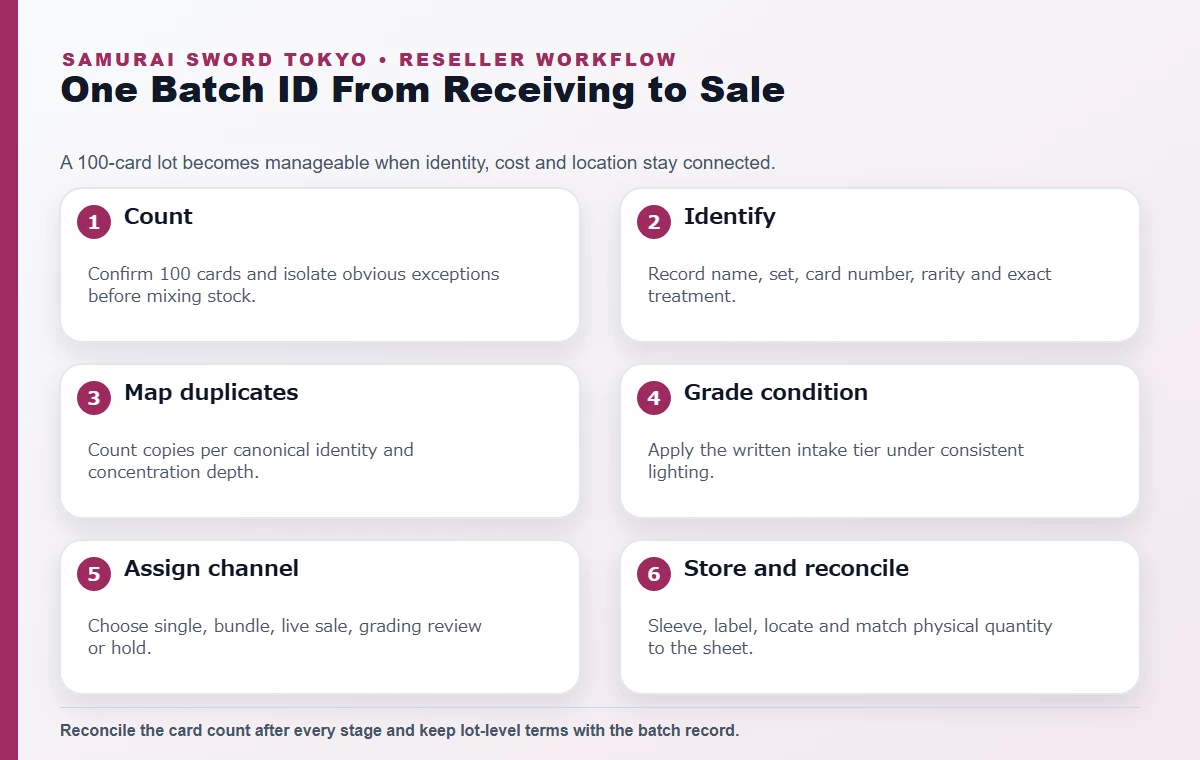
Sorteer in rondes om hanteringsfouten te verminderen
| Ronde | Actie | Resultaat | Kwaliteitscontrole |
|---|---|---|---|
| 1. Tellen en isoleren | Bevestig totale hoeveelheid; leg voor de hand liggende schade of onzekerheid apart | Ontvangen aantal en uitzonderingstray | Tweede telling voordat kaarten de voorraad ingaan |
| 2. Identificeren | Registreer naam, set, kaartnummer en zeldzaamheid | Canonieke kaartrijen | Gebruik waar mogelijk officiële kaartreferenties |
| 3. Dubbelkaart in kaart brengen | Groepeer exacte identiteiten en tel exemplaren | Uniek aantal en concentratierapport | Combineer geen verschillende kaartnummers of uitvoeringen |
| 4. Conditie | Pas de schriftelijke intaketiers toe | Route-klare voorraad | Beoordeel grensgevallen onder schuin licht |
| 5. Kanaal | Wijs single, bundel, live-verkoop, gradingbeoordeling of aanhouden toe | Vermeldingswachtrij | Gebruik conservatieve netto-opbrengstaannames |
| 6. Opslag | Sleeve, label en plaats volgens stabiele locatiecode | Pickbare voorraad | Reconcilieer hoeveelheid na vermelding |
Ontwerp vermeldingen rond koopintentie
Individuele vermeldingen werken wanneer de koper zoekt op een personage, setnummer, illustrator of specifieke artwork. Bundels werken wanneer de groepering zelf gemak creëert: een evolutielijn, één set, een personagefamilie, een kleur- of typethema, een illustratorselectie, of een startercollectie. Willekeurige bundels werken alleen wanneer de willekeur duidelijk wordt vermeld en de prijs de onzekerheid van de koper weerspiegelt.
Gebruik de werkelijke kaartafbeelding wanneer conditie of identiteit belangrijk is. Als een representatieve foto wordt gebruikt voor een vermelding met meerdere hoeveelheden, vermeld deze praktijk dan en houd de exemplaren binnen een smalle, gedocumenteerde conditieband. Vermijd met trefwoorden volgestopte titels die Japanse AR vermengen met SAR-, SR- of Engelse Illustration Rare-terminologie. Precieze identiteit vermindert retouren en beschermt de zoekrelevantie.
7. Internationale verzending, bescherming en kostenbeheersing
Modelleer inkomende verzending vóór het afrekenen
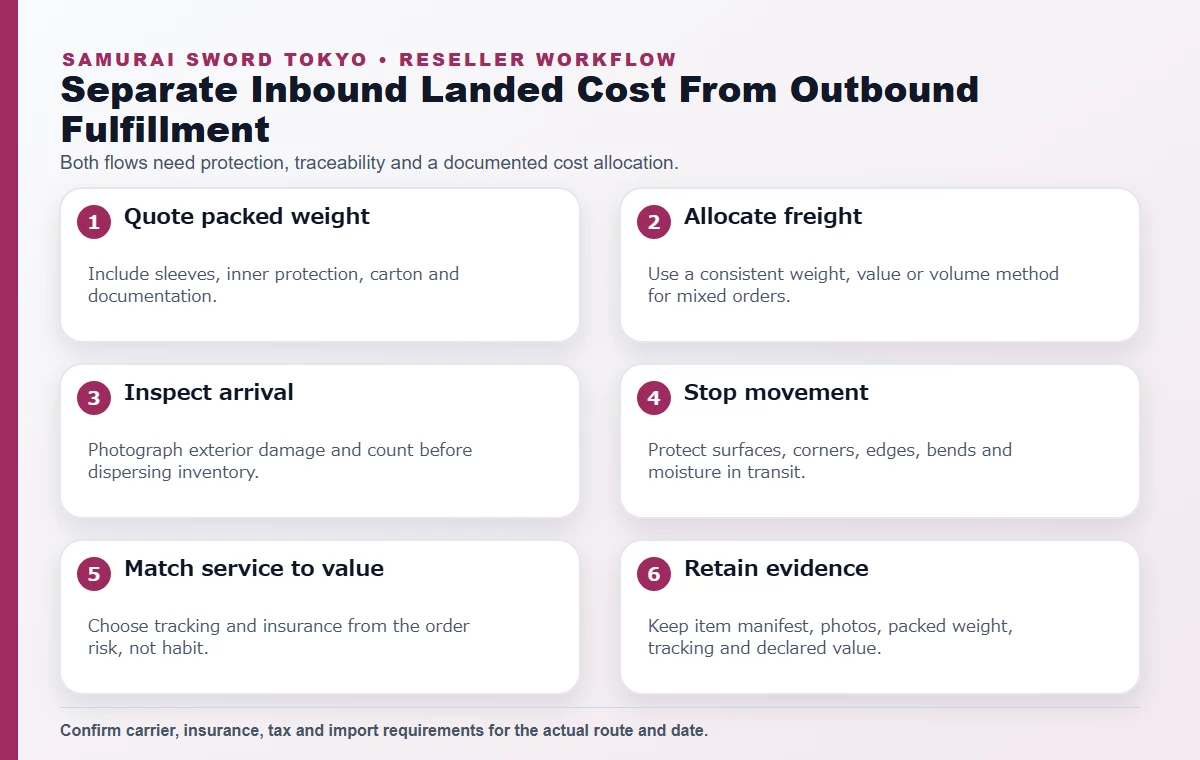
Internationale vracht kan de basis per kaart wezenlijk veranderen, vooral als één lot van 100 kaarten alleen wordt verzonden. Vergelijk een enkele lotbestelling met een geconsolideerde bestelling pas nadat je rekening hebt gehouden met kapitaalblootstelling, voorraadrotatie, pakketgewicht, verzekering en douanebehandeling. Een grotere zending kan de vracht per kaart verlagen, terwijl het kapitaal dat op het spel staat en de kosten van een trage samenstelling toenemen.
Vraag of bereken de verpakte zending, niet alleen het kale kaartgewicht. Sleeves, binnendozen, vulmateriaal, buitenkartons en documentatie voegen massa en volume toe. Invoerrechten, belastingen en brokerage op de bestemming zijn normaal gesproken kosten voor de koper, tenzij een offerte expliciet anders vermeldt. Bevestig de bestemmingsregels en offerte voordat je een landed-costschatting als definitief presenteert.
Bescherm kaarten tegen beweging, druk en vocht
Fotografeer voor inkomende ontvangst uitwendige schade voordat je opent en bewaar relevante labels totdat de telling en conditiecontrole voltooid zijn. Sleeve voor uitgaande verkopen elke kaart volgens waarde- en conditiebeleid, voorkom beweging binnen de verpakking, vermijd overmatige druk, voeg waterbestendigheid toe die past bij de route, en gebruik een stevige structuur wanneer buigrisico dit rechtvaardigt. Het beschermingsniveau moet overeenkomen met de orderwaarde en vervoersomgeving zonder onnodige portokosten te creëren.
Als je kaarten indient voor grading, volg dan de actuele verpakkings- en verzendinstructies van het gradingbedrijf in plaats van te improviseren op basis van marketplace-gewoonten. Gradinginzendingen hebben andere identificatie-, ordervermeldings-, sleeve- en verpakkingseisen dan losse klantverkopen. Verzeker en volg volgens je risicobeleid, en bewaar een gespecificeerd manifest en foto’s van vóór verzending.
Kies een uitgaand formaat op basis van orderwaarde en traceerbaarheid
| Orderpatroon | Beschermingsprioriteit | Vraag voor kostenbeheersing | Vast te leggen record |
|---|---|---|---|
| Eén lager geprijsde raw single | Bescherming van oppervlak, hoek, vocht en buiging | Kan het formaat aan je beleid voldoen zonder de bijdrage teniet te doen? | Vermeldings-ID, conditiefoto’s, verpakt gewicht |
| Meerdere raw kaarten | Voorkom interne beweging en randcontact | Wanneer wordt een stevige envelop of kleine doos veiliger? | Picklijst, eindtelling, verpakkingsfoto |
| Hoogwaardige single of gegradeerde kaart | Stevige bescherming, tracking en waarde-passende verzekering | Komt de vervoersservice overeen met het aangegeven risico? | Serie- of certnummer, foto’s, tracking, aangegeven waarde |
| Wholesale-/resellerbundel | Telintegriteit, gelaagde bescherming, kartonsterkte | Hoe wordt de vracht verdeeld over voorraadeenheden? | Batchmanifest, aantal kartons, gewicht, factuur |
8. Wie moet deze lot kopen—en wanneer herbestellen
Goede fit: bedrijven die samenstellingsvariatie kunnen opvangen
De lot past bij een reseller met een schriftelijk conditiebeleid, meerdere verkooproutes, een betrouwbaar kaartidentificatieproces en voldoende werkkapitaal om tragere exemplaren aan te houden. Het past ook bij een content- of live-verkoopoperatie die het sorteerproces kan omzetten in nuttige klantontdekking zonder de samenstelling verkeerd voor te stellen. De koper moet zich comfortabel voelen bij “nee” zeggen tegen grading wanneer de cijfers niet kloppen.
Een kaartwinkel kan de lot gebruiken om lager-tot-middenprijs Japanse voorraad te verbreden. Een beursverkoper kan visueel aantrekkelijke trays en bundels maken. Een online verkoper kan long-tail zoekdekking uitbreiden. Die voordelen zijn operationeel, niet automatisch. De lot creëert grondstof; jouw catalogus, prijsstelling, marketing en fulfillment zetten het om.
Zwakke fit: kopers die exacte kaarten of gegarandeerd rendement willen
| Koperprofiel | Fit | Reden | Betere volgende stap |
|---|---|---|---|
| Multichannel reseller met intakewerkwijze | Mogelijk sterk | Kan verschillende waarden, condities en dubbele kaarten routeren | Voer een cohortanalyse van één lot uit voordat je opschaalt |
| Winkel die exacte kaartnummers nodig heeft | Zwak | Willekeurige samenstelling bevestigt geen exacte inhoud | Koop geïdentificeerde singles of vraag een bevestigde specificatie aan |
| Koper die 100 PSA 10-kandidaten verwacht | Slecht | Zeldzaamheid is geen conditie en graden zijn niet gegarandeerd | Koop gegradeerde voorraad of inspecteer exacte raw kaarten |
| Single-platformverkoper met hoge vaste vermeldingskosten | Voorwaardelijk | Arbeid en trage kaarten kunnen de marge tenietdoen | Test eerst bundel- en live-verkooproutes |
| Verzamelaar die een map zonder dubbele kaarten wil | Voorwaardelijk tot zwak | Dubbele kaarten kunnen voorkomen en exacte inhoud is onbekend | Koop een samengestelde set of bouw vanuit geïdentificeerde singles |
Herbestel op basis van cohortbewijs, niet enthousiasme
Kies vóór de eerste aankoop drempels voor 30-dagen doorverkoop, 60-dagen doorverkoop, netto-bijdrage na variabele kosten, maximale arbeidsuren, retourpercentage en dubbelconcentratie. Zet na ontvangst van de lot het batchrecord vast en evalueer dat exacte cohort. Combineer resultaten niet met niet-gerelateerde verzegelde producten of gegradeerde kaarten.
| Metric | Waarom het belangrijk is | Herbestelvraag |
|---|---|---|
| Unieke identiteiten / 100 | Meet de breedte van de samenstelling | Paste de dubbelconcentratie bij je kanalen? |
| Verkoopbare eenheden na intake | Corrigeert de noemer | Viel de conditie-uitval binnen je reserve? |
| Netto-opbrengst per ontvangen kaart | Verbindt alle routes met de oorspronkelijke lot | Dekte de gerealiseerde opbrengst de landed- en verkoopkosten? |
| Arbeidsuren per lot | Legt verborgen operationele kosten bloot | Kan het proces worden gestandaardiseerd zonder nauwkeurigheid te verlagen? |
| Doorverkoop na 30/60 dagen | Meet de snelheid van kapitaalherstel | Zal een volgende lot gezonde diepte of overtollige voorraad creëren? |
| Retouren en conditiegeschillen | Test de kwaliteit van vermelding en inspectie | Moet je beschrijvingsbeleid worden verbeterd voordat je opschaalt? |
Als het eerste cohort aan de drempels voldoet, controleer dan opnieuw de huidige productpagina en vergelijk de nieuwe prijs, voorraad, verzending en bestemmingskosten met de eerste bestelling. Gebruik de wholesale RFQ als je meerdere lots of herhaalde levering nodig hebt, in plaats van aan te nemen dat het openbare voorraadcijfer een toewijzing is. Schaal de werkwijze pas op nadat het bewijs dit ondersteunt.
9. Veelgestelde vragen: Japanse Pokemon AR bulk-kaarten voor resellers
Zijn alle 100 AR-kaarten gegarandeerd verschillend?
Nee. Het product vermeldt dat kaarten willekeurig worden geselecteerd. Samurai Sword Tokyo doet zijn best om dubbele kaarten te vermijden, maar dubbele kaarten kunnen voorkomen. Bouw je doorverkoopplan rond een onbekende samenstelling in plaats van aan te nemen dat er 100 unieke kaartnummers of personages zijn.
Betekent AR Bulk dat elke kaart gradeerbaar is als PSA 10?
Nee. AR beschrijft de zeldzaamheid van de kaart, niet de conditie of toekomstige graad. Een reseller moet centrering, hoeken, randen, oppervlak, printlijnen, deuken, whitening en authenticiteit inspecteren voordat hij beslist of een kaart de moeite waard is om in te dienen. Een gradingbedrijf neemt de uiteindelijke gradebeslissing.
Wat was de live prijs toen deze gids werd opgesteld?
De WooCommerce-momentopname gecontroleerd op 14 juli 2026 om 16:14 JST toonde ¥27.000 voor één lot van 100 kaarten, oftewel ¥270 per kaart vóór verzending, betalingskosten, invoerrechten, belastingen, arbeid, verpakking, retouren en marketplace-fees. Prijs en voorraad kunnen veranderen, dus bevestig de productpagina voordat je bestelt.
Hoeveel AR Bulk-lots waren er op voorraad?
Dezelfde gedateerde WooCommerce-momentopname toonde 16 loteenheden op voorraad. Dat cijfer is geen reservering en kan na publicatie veranderen. De huidige productpagina en checkoutstatus zijn de juiste bron wanneer je klaar bent om te kopen.
Kan ik specifieke Pokemon, sets of kaartnummers aanvragen?
Ga er niet van uit dat kaartselectie beschikbaar is bij een willekeurig-lotproduct. Als je bedrijf exacte personages, sets, minimale uniciteit of herhaalde levering met een specificatie vereist, stuur dan een gestructureerde wholesale-aanvraag en vraag wat daadwerkelijk kan worden bevestigd voordat je betaalt.
Wat is de veiligste manier om break-even te berekenen?
Tel de lotprijs, toegewezen internationale verzending, betalingskosten, invoerkosten, inkomend verpakkingsmateriaal, gradingkosten, marketplace-fees, verwachte retouren en de waarde van je arbeid bij elkaar op. Deel het totaal door het aantal verkoopbare eenheden, niet automatisch door 100. Vergelijk die all-in basis vervolgens met conservatieve netto-opbrengsten.
Moet ik kaarten individueel of als kleinere themabundels vermelden?
Gebruik beide routes wanneer de samenstelling dit ondersteunt. Vermeld sterkere personages of schonere exemplaren individueel, groepeer samenhangende goedkope kaarten per set, type, illustrator of thema, en houd trage dubbele kaarten aan voor add-ons of toekomstige bundels. De ontvangen samenstelling moet de kanaalmix bepalen.
Hoe moet ik conditiebeschrijvingen aanpakken?
Stel een schriftelijk conditiebeleid op en pas het consistent toe. Fotografeer gebreken die de koopbeslissing kunnen beïnvloeden, noem een raw kaart niet mint enkel op basis van de voorkant, en scheid kaarten met deuken, kreukels, zware whitening, oppervlakteschade of mogelijke vervalsing van standaardvoorraad.
Zijn verzending, douanerechten en belastingen inbegrepen in de momentopname van ¥27.000?
Behandel de weergegeven productprijs als de goederenprijs, tenzij het afrekenen of een offerte anders vermeldt. Verzending, kosten van betaalmethode, invoerrechten, belastingen, brokerage en vereisten van het bestemmingsland kunnen de landed cost veranderen. Bevestig deze voor je adres voordat je de marge berekent.
Voor wie is deze lot van 100 kaarten het meest geschikt?
Het is het meest geschikt voor een reseller die raw kaarten kan inspecteren, samenstellingsvariatie kan tolereren, kaarten naar meerdere verkoopkanalen kan routeren, arbeid kan volgen en tragere voorraad kan aanhouden. Het is een zwakkere fit voor een koper die exacte kaarten, gegarandeerde uniciteit, gegarandeerde graden of onmiddellijke omzet tegen een vaste marge nodig heeft.
Dit artikel biedt operationele koopadvies, geen garantie voor samenstelling, conditie, graad, doorverkoop, marge of winst. Productprijs en voorraad zijn gecontroleerd op 2026-07-14 16:14 JST en kunnen veranderen. Marktwaarden, gradingkosten, vervoerskosten, belastingen en invoervereisten moeten worden geverifieerd wanneer je handelt.
Gekozen bij dit artikel
📩 Sale-alerts & coupons alleen voor leden
Sale-alerts, coupons en restock-berichten per e-mail, rechtstreeks uit Tokio.