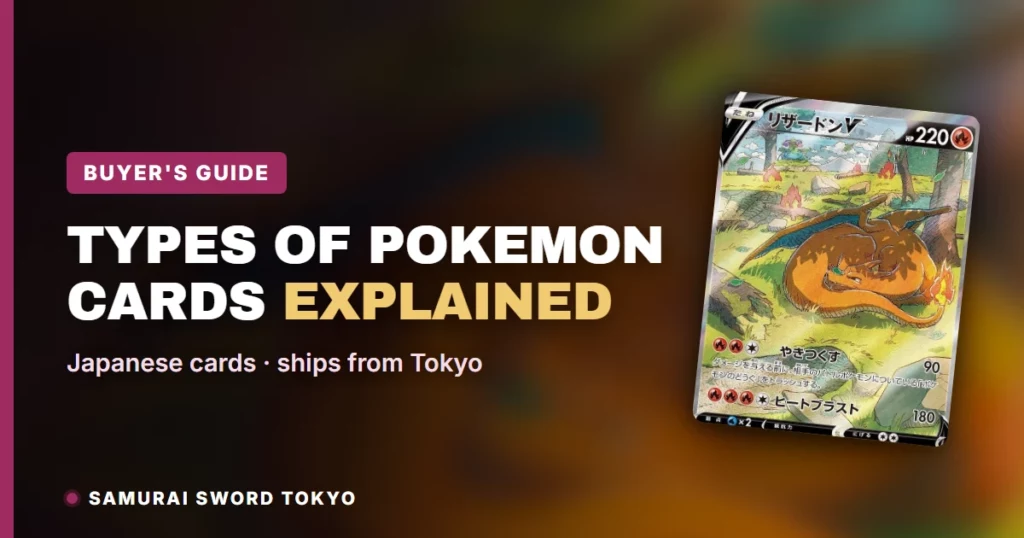
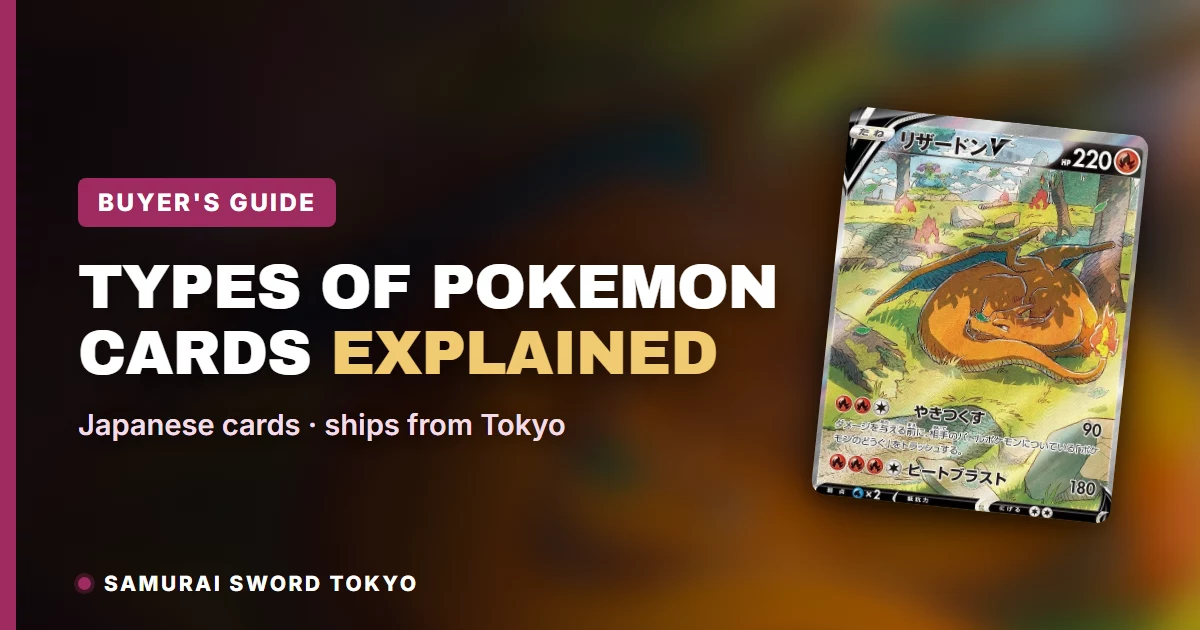
There are only three card types in the Pokemon Trading Card Game: Pokemon cards, Trainer cards and Energy cards. Everything else — ex, V, GX, VMAX, Full Art, SR, SAR — is a rarity label or a special-rule subcategory layered on top of one of those three, not a fourth type.
That distinction matters more than it sounds. A new collector looking at a binder of Japanese cards will see “Pokemon V”, “Supporter”, “Special Energy” and “SAR” printed in different corners and assume they’re all naming the same kind of thing. They aren’t. This guide sorts the three real card types, their official subtypes, and the special-rule Pokemon cards that get mistaken for types of their own — using only the definitions Bulbapedia documents for the Pokemon TCG.
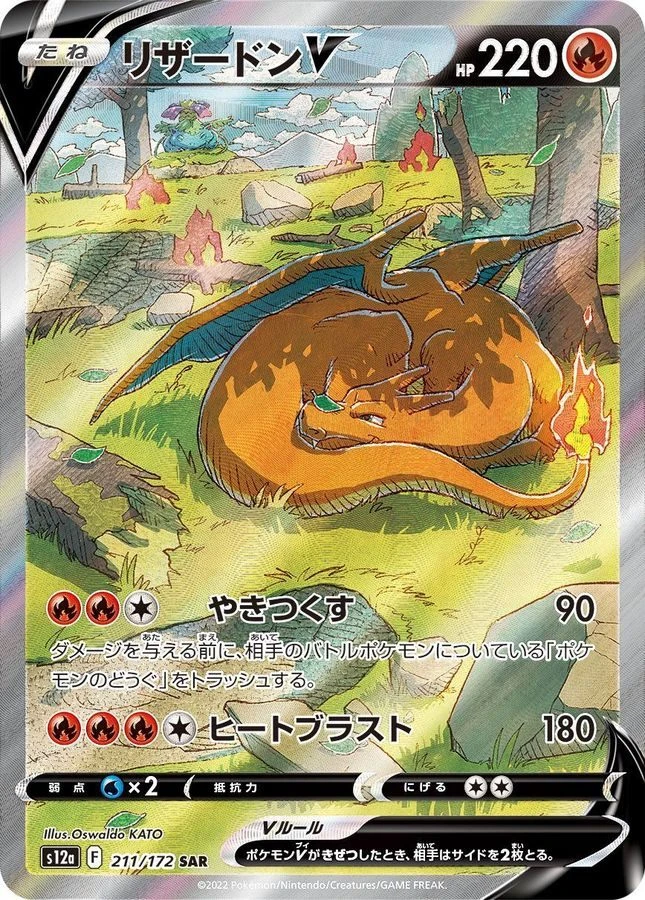
The Pokemon TCG has exactly three card types — Pokemon, Trainer and Energy. Trainer cards split into four official subtypes (Item, Pokemon Tool, Supporter, Stadium); Energy cards split into two (Basic and Special). Pokemon-ex, V, GX and VMAX are not separate types — they’re special-rule Pokemon cards. A PSA10 Charizard V 211/172 SAR is currently listed at ¥18,260 (~$115) (更新:当前售罄 — 可通过 Quick Order 申请补货) as a Pokemon-card example, and a PSA10 Sabrina’s Suggestion 109/095 SR is currently listed at ¥22,198 (~$140) as a Trainer-card example.
Yen figures below convert at ¥159/USD (September 2026). Card-type definitions are sourced from Bulbapedia’s Trainer card, Supporter card, Energy card and Full Art card pages — see the inline citations for each claim.
The Three Fundamental 卡牌类型
Per Bulbapedia, the Pokemon TCG is built on exactly three card types: Pokemon cards, which perform attacks; Trainer cards, which “provide a more supportive role, allowing a player to search through their deck, draw cards, or other special effects”; and Energy cards, which power those attacks.
| Type | Function | What happens after use |
|---|---|---|
| Pokemon card | Performs attacks, is placed on the Bench or Active spot | Stays in play until Knocked Out |
| Trainer card | Supports the player — deck search, draw, or a special effect | Varies by subtype — some are discarded after use, others stay in play |
| Energy card | Attached to a Pokemon to power its attacks | Stays attached until discarded by an effect |
“Trainer card” is often described loosely as one-per-turn, but that’s only true of one subtype (Supporter). The four official Trainer subtypes each carry their own rule on how many can be played and what happens to the card afterward — Item cards break the one-per-turn pattern entirely, and Pokemon Tool and Stadium cards aren’t discarded after use at all. That’s covered next.
Trainer Cards: Item, Pokemon Tool, Supporter and Stadium
Trainer cards split into four official subtypes, and each one plays by different rules:
| Subtype | Rule | Notes |
|---|---|---|
| 商品 | Multiple playable per turn | The original Trainer subtype |
| Pokemon Tool | One per Pokemon at a time | Functions like a held item, attached to a Pokemon |
| Supporter | Limited to one per turn | “Usually much more powerful than regular Item cards”; briefly elevated to its own card type during the Diamond & Pearl Series, before reverting to a Trainer subtype once Generation IV Trainer cards were reclassified as Item cards |
| Stadium | Limited to one per turn | Affects the whole field and remains in play indefinitely until replaced by a different Stadium card |
Item cards are the oldest Trainer subtype, and multiple Item cards can be played in a single turn. Pokemon Tool cards function like held items, with one Tool attached to each Pokemon at a time. Supporter cards moved the other direction: internationally they arrived with the Expedition Base Set, and in Japan during the “P Promotional cards” web era, and they are limited to one per turn. Stadium cards work differently again — you can still only play one per turn, but instead of being discarded after use, a Stadium stays on the field affecting both players until a different Stadium card replaces it.
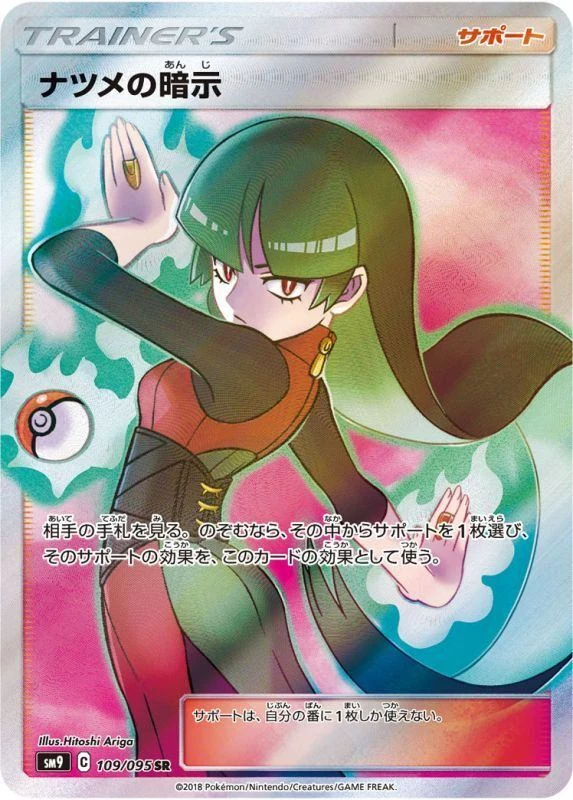
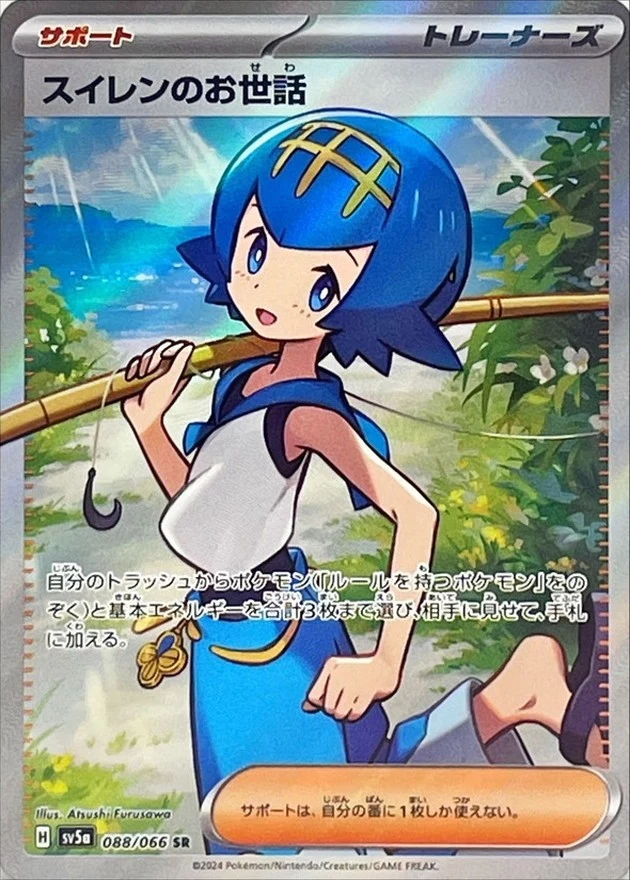
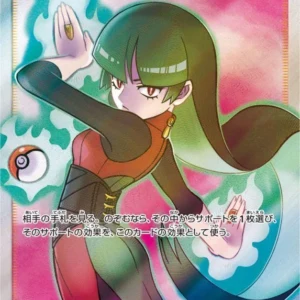
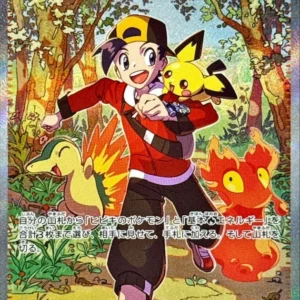
Both of the Supporter cards pictured above — and Ethan’s Adventure 089/063 SAR, currently listed at ¥25,078 (~$158) — are Trainer cards, subtype Supporter, not a distinct rarity of “Trainer type.” Their SR and SAR markings describe the print, not the card type. Our PSA10 Trainer cards guide and female Pokemon Trainer cards guide cover Supporter cards like these in more depth.
Energy Cards: Basic vs Special
Energy cards split into two subtypes with very different deck-building rules.
Basic Energy cards provide one unit of a specific energy type with no extra effect. Across the game’s history there have been nine Basic Energy types: Grass, Fire, Water, Lightning, Psychic, Fighting, Darkness, Metal and Fairy. Fairy is a historical case rather than a current one — it was introduced in the XY Series and carried through the Sun & Moon Series before being discontinued starting with the Sword & Shield Series. Basic Energy is also the single exception to the game’s deck-building limit: it’s the only card type a deck is allowed to include more than four of under a single name.
Special Energy cards trade that flexibility for extra effects — they can carry multiple energy units, multiple types, or additional abilities on the card. In exchange, a Special Energy card is capped like any other non-Basic-Energy card: a deck can include at most four of the same-named Special Energy card under the format’s regulation marks.
Our 30th Celebration Basic Energy cards guide covers one specific 30th-anniversary Energy foil set in detail — that article is about a single release, while this section is the general definition of what an Energy card is and how the Basic/Special split works across the whole game.
Where ex, V, GX and VMAX Actually Fit In
This is the most common mix-up in the hobby: Pokemon-ex, Pokemon V, Pokemon GX, Pokemon VMAX and similar mechanics are not separate card types. They are special-rule Pokemon cards — the same fundamental type covered above — that carry an extra rule layered on top, such as giving the opponent additional Prize cards when the Pokemon is Knocked Out.
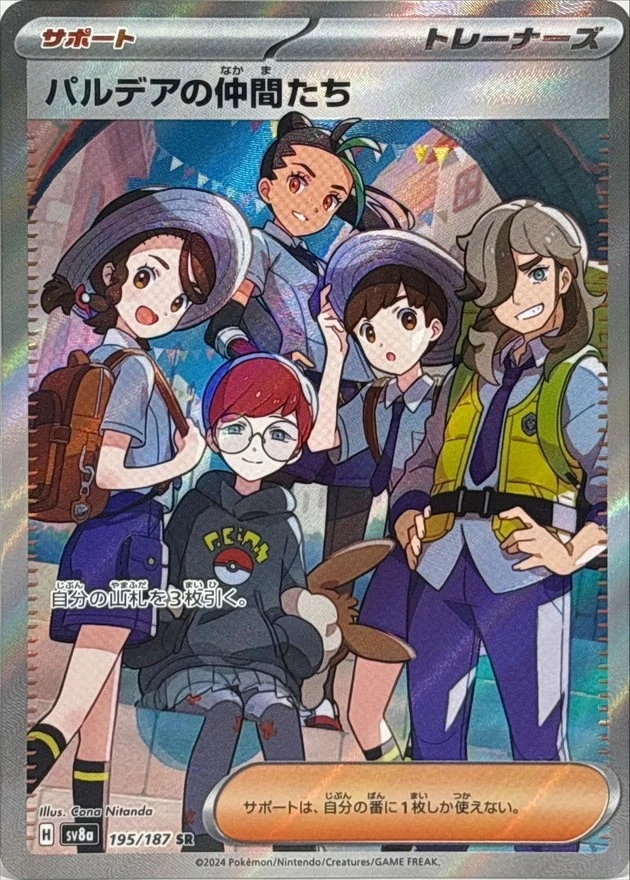
Full Art printings of these special-rule Pokemon are their own separate classification again: Bulbapedia lists Full Art cards as introduced with the Black & White Series, and they can apply across Pokemon and Trainer cards alike. So a single Japanese card can carry up to three independent labels at once — its fundamental type (Pokemon or Trainer), its special-rule subcategory (ex, V, GX, VMAX, or none), and its print style (Full Art or standard). Confusing any one of those three for the others is where most “is this a rare type of card?” questions come from.
Full Art Cards and the Japanese SR Designation
Full Art is a physical print style — artwork that runs across the entire face of the card — not a card type or a rarity tier by itself. It was introduced with the Black & White Series and has since been applied to both Pokemon cards and Trainer cards.
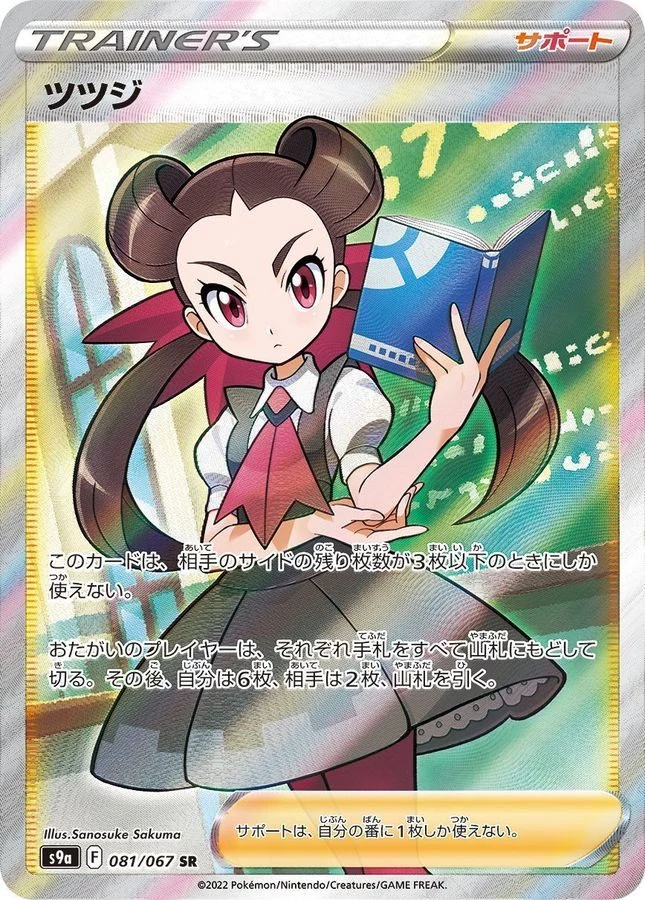
In Japan specifically, Full Art Trainer cards of the Supporter subtype commonly carry the SR (Secret Rare) designation. That said, “SR” is not an exclusive Trainer signal — the same two-letter designation has also been used on alternate-art Pokemon cards in Japanese sets, so seeing “SR” on a card tells you it’s a Secret Rare print, not automatically that it’s a Full Art Trainer Supporter. You still need to check whether the card itself is a Pokemon or a Trainer card. Our Full Art Pokemon cards guide and Japanese Pokemon card rarities guide go further into how these print-style and rarity labels stack together set by set.
Which Type of Card Are You Actually Buying From Japan?
Once the three types and their subtypes are sorted, it’s easier to see what you’re actually adding to a collection. Here’s a spread of currently listed PSA10 examples across the categories covered above:
| 卡牌 | Type / subtype | Listed price |
|---|---|---|
| Charizard V 211/172, SAR | Pokemon card (V special rule) | ¥18,260 (~$115) (更新:当前售罄 — 可通过 Quick Order 申请补货) |
| Sabrina’s Suggestion 109/095, SR | Trainer card, Supporter | ¥22,198 (~$140) |
| Ethan’s Adventure 089/063, SAR | Trainer card, Supporter | ¥25,078 (~$158) |
| Lana’s Aid SV5a 088/066, SR | Trainer card, Supporter | ¥12,078 (~$76) |
| Friends of Paldea SV8a 195/187, SR | Trainer card, Supporter (from a Pokemon-ex era set) | ¥7,986 (~$50) |
All five are PSA10-graded Japanese cards, and four of the five are Trainer cards — a reminder that “Supporter” and “Trainer” cover a lot of ground beyond the Pokemon cards that usually get the attention. Browse the full PSA10 graded card collection to see more of each type side by side, or use 快速下单 to build a mixed order of Pokemon and Trainer cards in one pass.
常见问题
What are the three types of Pokemon cards?
Pokemon cards, Trainer cards and Energy cards. Pokemon cards perform attacks, Trainer cards provide supportive effects such as deck search or drawing, and Energy cards power attacks by being attached to a Pokemon.
What’s the difference between an Item card and a Supporter card?
Both are Trainer card subtypes. Item cards are the original Trainer subtype and multiple can be played in a single turn. Supporter cards are limited to one per turn and are described by Bulbapedia as usually much more powerful than a regular Item card — they were briefly elevated to their own card type during the Diamond & Pearl Series, before reverting to a Trainer subtype once Generation IV Trainer cards were reclassified as Item cards.
Is Pokemon V or Pokemon ex a separate card type?
No. Pokemon-ex, Pokemon V, Pokemon GX and Pokemon VMAX are special-rule Pokemon cards — the same fundamental “Pokemon card” type — that carry an extra rule such as giving the opponent additional Prize cards when Knocked Out. They are not a fourth card type.
What is a Stadium card?
A Stadium is a Trainer card subtype that affects the whole field rather than being discarded after one use. Only one Stadium card can be played per turn, and once played, it remains in play indefinitely until a different Stadium card replaces it.
How many Basic Energy types have there been?
Nine historically: Grass, Fire, Water, Lightning, Psychic, Fighting, Darkness, Metal and Fairy. Fairy was introduced in the XY Series, carried through the Sun & Moon Series, and was discontinued starting with the Sword & Shield Series.
Can you run more than four of the same card in a Pokemon deck?
Only with Basic Energy cards. Every other card type, including Special Energy, is capped at four of the same-named card under the format’s regulation marks.
按配送国家/地区提供免运费与运费折扣
- 每个配送国家/地区都有各自的门槛金额和优惠券代码。
- 每笔已付款的活动订单都会为您的账户解锁下一档。
- 请登录,或在结账时选择“Create account: Yes”,即可使用活动代码。
优惠券代码、最低订单金额与运费优惠均取决于您的配送国家/地区 — 请打开活动页面查看适用于您的条款。 最低金额仅按商品小计计算:运费、税费及其他折扣均不计入。 活动于日本时间 September 10, 2026 23:59(September 10, 2026 14:59 UTC)结束,届时优惠码将停止生效。 优惠券不适用于预购商品。请加入有货商品后再使用优惠券。 进口关税、税费及清关费用不含在价格内,将于派送时收取;我们以完税方式发货的目的地除外。
为本文精选

📩 会员专属折扣与优惠券
促销提醒、优惠券、补货通知,邮件直达,来自东京。