Japanese TCG Store Samurai Sword
English
Orders 購物車
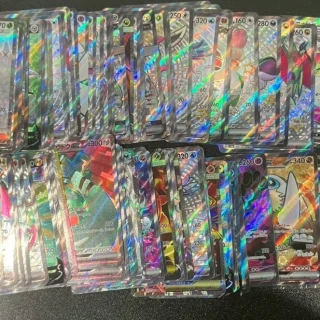
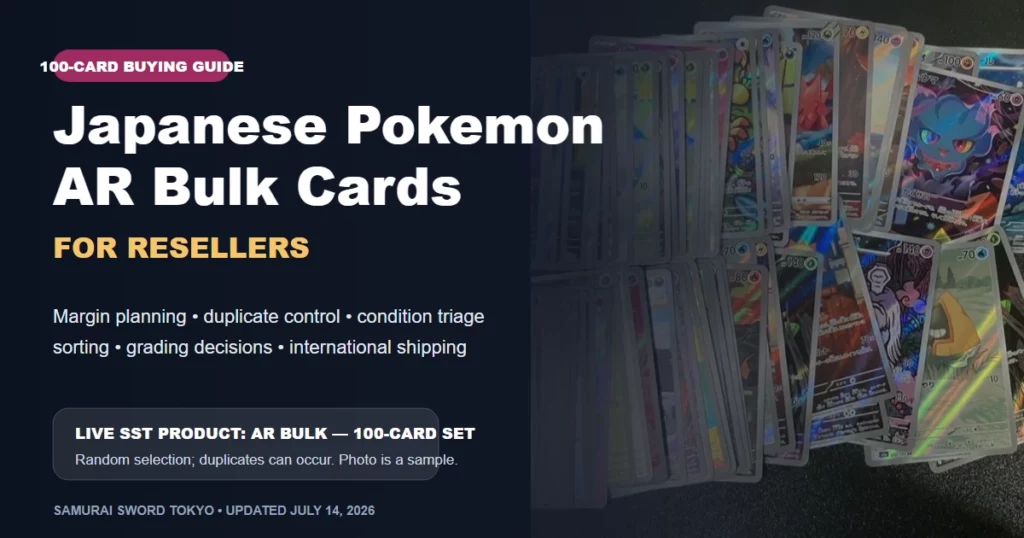
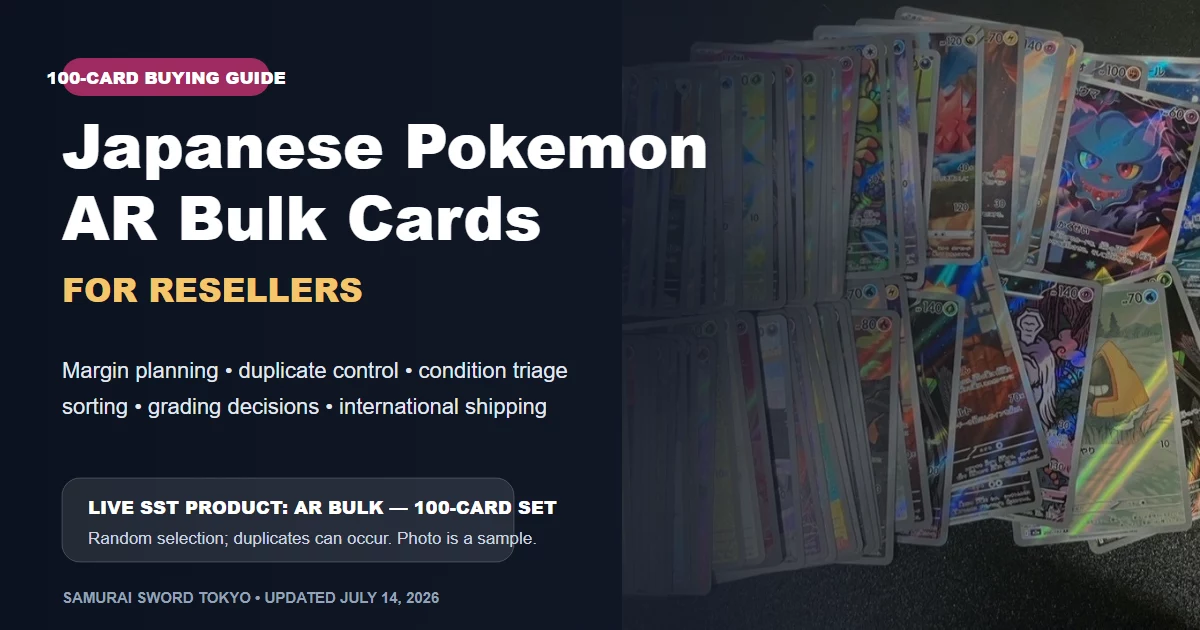
Japanese Pokemon AR Bulk 100-card reseller buying guide hero using the SST product sample photo

Japanese Pokemon AR Bulk Cards for Resellers: 100-Card Lot Buying Guide

Japanese Pokemon AR Bulk 100-card reseller buying guide hero using the SST product sample photo
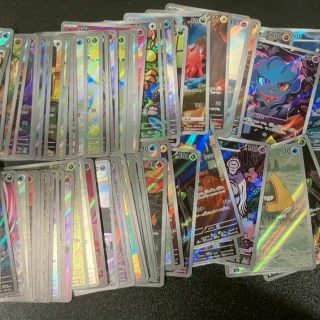
Reseller guide for the SST AR Bulk 100-card lot. The product photo is a sample; assortment and duplicates vary.

Updated: July 14, 2026. Live WooCommerce snapshot checked 2026-07-14 16:14 JST. Price and stock are volatile and must be reconfirmed before purchase.

A 100-card Japanese Pokemon AR lot can be useful inventory for a reseller, but it should never be modeled as 100 guaranteed unique, mint, instantly sellable cards. The current Samurai Sword Tokyo product is a random assortment. The store says it will do its best to avoid duplicates, while expressly warning that duplicates may occur and that the photo is only a sample. That single detail changes the right buying model: calculate landed cost, inspect every card, separate sales channels, and measure actual sell-through before reordering.

This guide turns that uncertainty into an operating plan. It explains the dated live product snapshot, all-in unit economics, duplicate controls, raw-card condition intake, grading triage, sorting and listing, international shipping, and the metrics a store should review after the first lot. It is written for overseas card shops, online sellers, breakers, convention vendors, and collector-resellers buying Japanese inventory from Tokyo.

AR Bulk — 100-Card SetProduct ID 40606 • SKU AR-BULK-100 • random selection • duplicates may occur

Check current price and stock

Key decision: At the checked merchandise price of ¥27,000, the starting basis is ¥270 per card. That is not break-even. Add freight, payment costs, duties or taxes, supplies, labor, marketplace fees, grading, and returns, then divide by the number of cards that are genuinely sellable through your channels.

1. Live AR Bulk 100-card product snapshot

The dated numbers to use—not timeless promises

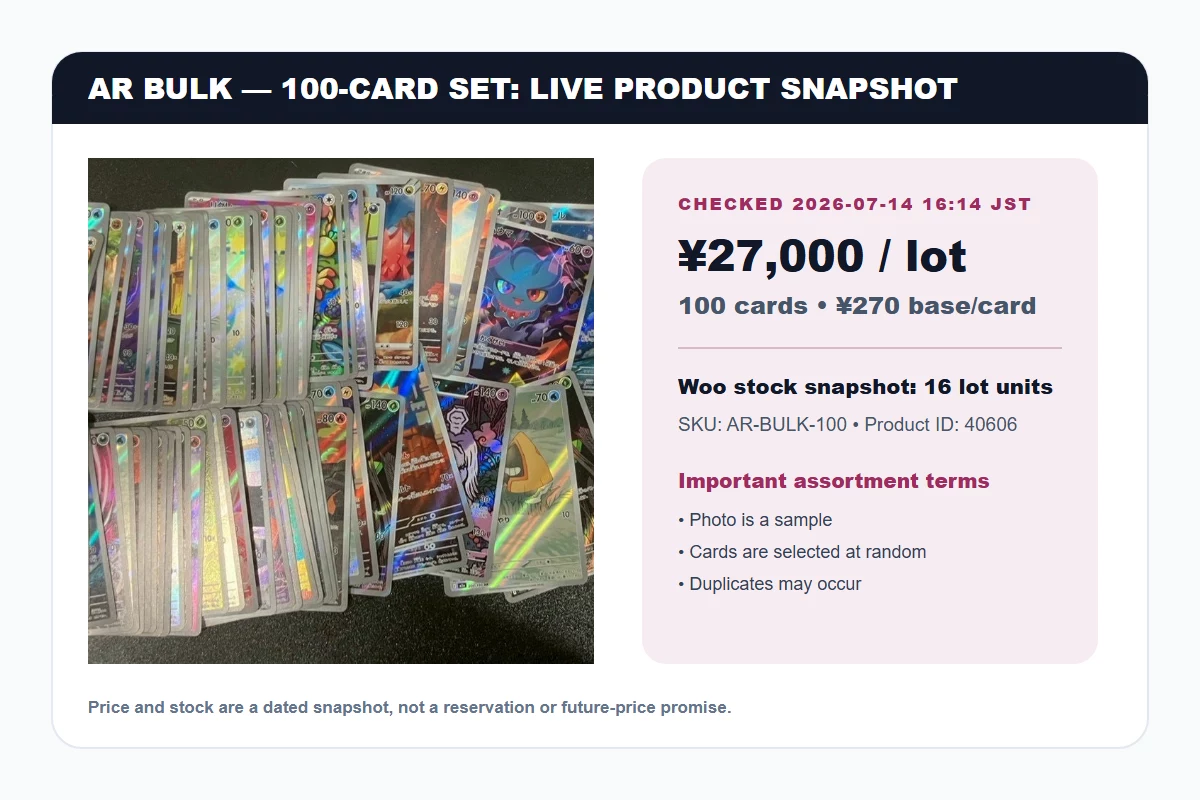
At 2026-07-14 16:14 JST, the live WooCommerce record for product ID 40606 showed the product title AR Bulk – 100-Card Set, a regular and current price of ¥27,000, managed stock of 16 lot units, and an in-stock status. One listed unit represents 100 cards, so the simple merchandise-price basis was ¥270 per card. This is a point-in-time record. It does not reserve inventory, lock a future price, or include destination-specific costs. Always reopen the product page immediately before ordering.

Field Checked value How a reseller should use it
Product AR Bulk – 100-Card Set Confirm the exact product and unit type; do not confuse one card with one 100-card lot.
Product ID / SKU 40606 / AR-BULK-100 Keep both identifiers in purchase records and wholesale inquiries.
Price snapshot ¥27,000 per 100-card lot Use as merchandise cost only; add every landed and selling expense.
Base arithmetic ¥270 per card Starting basis before freight, fees, tax, labor, supplies, grading, and losses.
Stock snapshot 16 lot units; in stock Volatile availability, not reserved supply. Check again at purchase.
Selection terms Random; duplicates may occur Do not budget on 100 unique cards, fixed characters, or fixed sets.
AR Bulk 100-card set live product snapshot with dated price, stock, and random-selection terms
Live product snapshot from WooCommerce, checked 2026-07-14 16:14 JST. The embedded card photo is the SST sample image, not a guaranteed assortment.

What the product description actually commits to

The product description is short but commercially important: the photo is a sample; cards are selected completely at random; the seller will do its best to avoid duplicates; and duplicates may still occur. A disciplined buyer treats all four statements as purchase terms. The photograph demonstrates the product category and visual character of the lot, but it does not identify the exact cards that will arrive. “Best effort” is not the same as a uniqueness guarantee.

That means you should not advertise an incoming lot before receiving it, promise a character mix to your own customers, or pre-sell exact card numbers. Receive, count, inspect, and catalog first. If your business model depends on a minimum number of unique cards, a particular expansion, or a fixed quantity of popular Pokemon, a random bulk lot is the wrong instrument unless the seller confirms a separate specification in writing.

Use the product page for checkout and the wholesale desk for specifications

The product page is the fastest route for the listed unit when the live price, stock, and terms fit your plan. For larger quantities, recurring supply, exact identifiers, deadline requirements, or a request that differs from the listed random assortment, use the SST wholesale RFQ page. Include the product name, SKU, desired number of 100-card lots, destination country, deadline, payment preference, and whether substitutes are acceptable. An inquiry is a request for confirmation, not inventory reservation.

2. What an AR bulk lot is—and is not

AR refers to Art Rare, not a condition grade

On the Japanese Pokemon Card Game’s official materials, AR is used for Art Rare. The designation describes the rarity and presentation category of the card. It does not mean “automatic premium,” “mint,” “PSA 10,” or “guaranteed profit.” Character demand, set, artwork, illustrator, language, condition, supply, and current buyer interest can produce very different resale outcomes among cards that share the same rarity label.

That distinction matters because a bulk buyer can be tempted to price the entire shipment from the strongest AR examples seen online. A safer method is bottom-up: identify every received card, record condition, group duplicates, check your own channel’s recent net proceeds, and assign a realistic route. Some cards may justify individual listings; others may be better in character bundles, set-completion lots, low-cost add-ons, live-sale trays, or longer-term inventory.

The 100-card count is inventory volume, not 100 equal units

One hundred cards give a reseller enough volume to build multiple merchandising routes, but they are not economically interchangeable. Two copies of the same card can differ because of centering, whitening, print lines, edge wear, scratches, dents, or surface contamination. Two equally clean cards can still differ in sell-through because one character or artwork has more active demand in your market.

The lot gives you The lot does not guarantee Required buyer response
100 Japanese AR cards 100 different cards Count unique card identities and duplicate depth after arrival.
A random selection Specific Pokemon, sets, or artists Do not pre-sell exact content or build a fixed assortment forecast.
A sample product photo The pictured cards Treat the image as category evidence only.
Raw-card inventory A numeric grade or gem rate Inspect first; submit only cards that pass your own economic screen.
A listed merchandise price Your landed or break-even cost Build a full cost sheet by shipment and sales channel.

Best-fit sales channels

A random AR lot is most flexible when your business already uses several channels. A web store can list the strongest cards individually. A convention seller can organize cards by price band or character. A breaker can use lower-value cards as clearly disclosed add-ons. A store can build artist, type, generation, or set-completion bundles after identifying the received cards. Duplicates can support multi-quantity listings when demand exists, but the same duplicates can become dead stock when a listing has no traffic.

A single-channel seller faces more risk. If your only channel requires high average order value, extensive paid advertising, or individual photography for every low-price item, labor and fees can absorb the spread. The correct question is not “Are AR cards popular?” It is “Can my operation convert this exact received mix into net cash at a rate that covers capital, labor, and variance?”

3. Reseller economics: model landed cost before margin

Start with an all-in acquisition basis

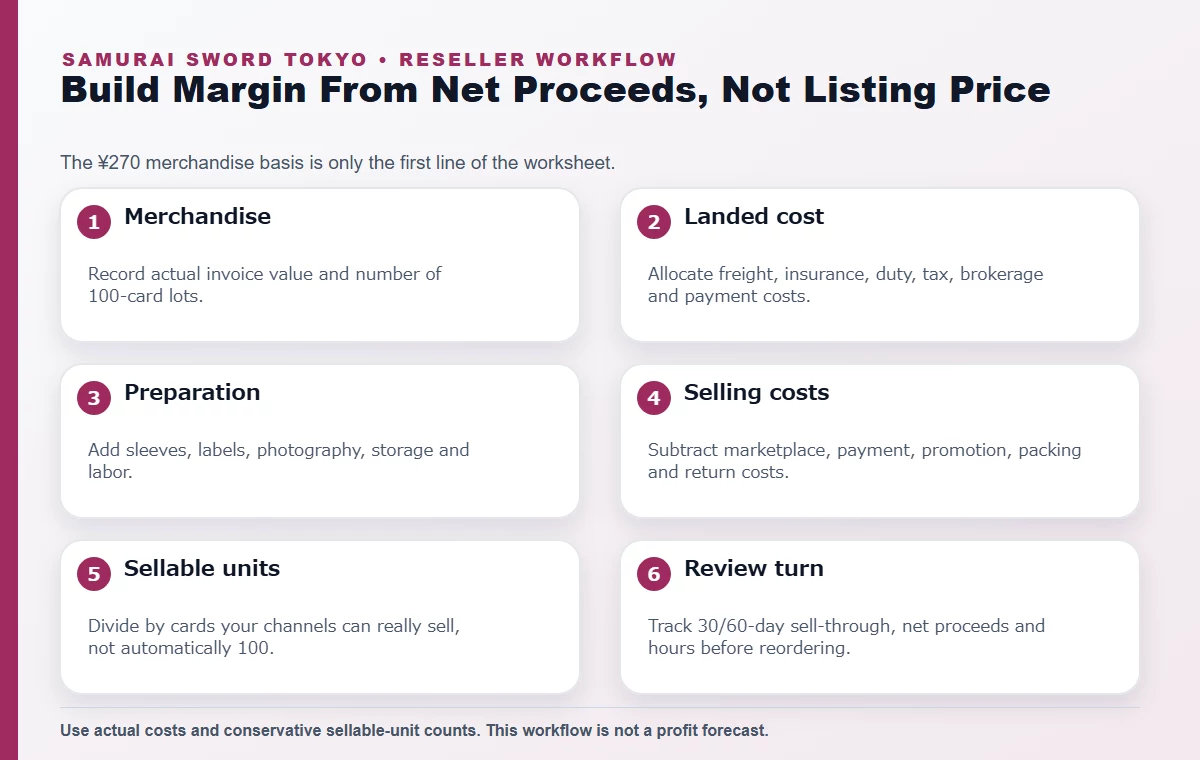
The ¥270 simple basis is useful only as the first line of a worksheet. Add international shipping allocated to this lot, payment or foreign-exchange costs, import duties and taxes where applicable, brokerage, inbound sleeves or team bags, labels, storage, photography, marketplace commissions, payment processing, expected returns, grading fees, and labor. If the 100-card lot shares a shipment with other products, allocate freight by a consistent method such as weight, insured value, or packed volume, and document that method.

Then decide how many cards are actually sellable through your planned channels. If five cards are held for condition review, ten are placed into slow bundles, and three are damaged beyond your standard, dividing by 100 understates the basis of the individually listed inventory. There is no universal denominator: calculate a shipment-level basis, then a channel-level basis.

Cost layer Example input What to record
Merchandise ¥27,000 snapshot Actual invoice value and lot count.
Inbound logistics Your allocated amount Freight, insurance, brokerage, and packing share.
Import and payment Destination-specific Duty, tax, payment fee, and FX spread actually charged.
Preparation Supplies plus labor Sleeves, labels, photography, data entry, and sorting time.
Selling costs Channel-specific percentage and fixed fees Marketplace, payment, promotion, and outbound packaging.
Risk reserve Your policy Returns, loss, condition disputes, discounts, and unsold stock.
Reseller margin model for a Japanese Pokemon AR 100-card bulk lot
The merchandise price is one line of the model. Use actual landed and channel costs before deciding whether a lot fits your business.

Use net proceeds, not listing price

A listing price is not revenue. Revenue is not margin. Margin is not profit after labor and overhead. For each sales route, estimate conservative net proceeds: expected selling price minus marketplace commission, payment fee, discounts, promoted-listing costs, outbound packaging, shipping subsidy, and return allowance. Use recent sold evidence from the market where you actually sell, and remove outliers you cannot reproduce.

For a mixed lot, build several buckets rather than one heroic average. A practical model might include individually listed premium cards, standard singles, themed bundles, add-ons, and hold inventory. Assign each bucket a conservative sell-through horizon. Capital tied up for six months is economically different from cash recovered in two weeks, even when gross revenue is identical.

An illustrative sensitivity table—not a resale forecast

The table below uses hypothetical costs to show the method. It does not estimate the market value of the received cards. Replace every figure except the known merchandise snapshot with your own quote, fee schedule, and operating data. The “average net proceeds” line means money retained after variable channel fees and outbound transaction costs, but before fixed overhead unless you explicitly include it.

Illustrative case All-in lot basis Sellable units Basis per sellable unit Average net proceeds needed for zero contribution
Lean inbound ¥32,000 95 About ¥337 At least ¥337
Moderate landed costs ¥36,000 90 ¥400 At least ¥400
Higher freight and labor allocation ¥42,000 85 About ¥494 At least ¥494
With a separate grading budget ¥50,000 85 raw-sale equivalents About ¥588 Higher; graded outcomes remain uncertain

Do not use this table as a price prediction. It is sensitivity arithmetic. Your cards, fees, freight, taxes, labor, grade outcomes, and sell-through will differ.

Measure inventory turn as well as gross margin

After launch, track days to first sale, 30-day sell-through, 60-day sell-through, net proceeds per received card, return rate, discount rate, and hours of labor per 100 cards. A lot that produces an attractive gross spread but requires extensive photography, frequent repricing, and long holding time may be worse than a modest-spread lot that turns quickly with standardized listings.

Set a review date before you buy. At that date, compare planned and actual figures. If the assortment requires deeper discounts than expected, change the bundle structure or channel before ordering another lot. Reordering because “AR cards look liquid” is not a metric; reordering because your received cohort met a documented contribution and sell-through threshold is a business decision.

4. Duplicate risk: turn randomness into an assortment policy

Assume duplicates can occur and count them precisely

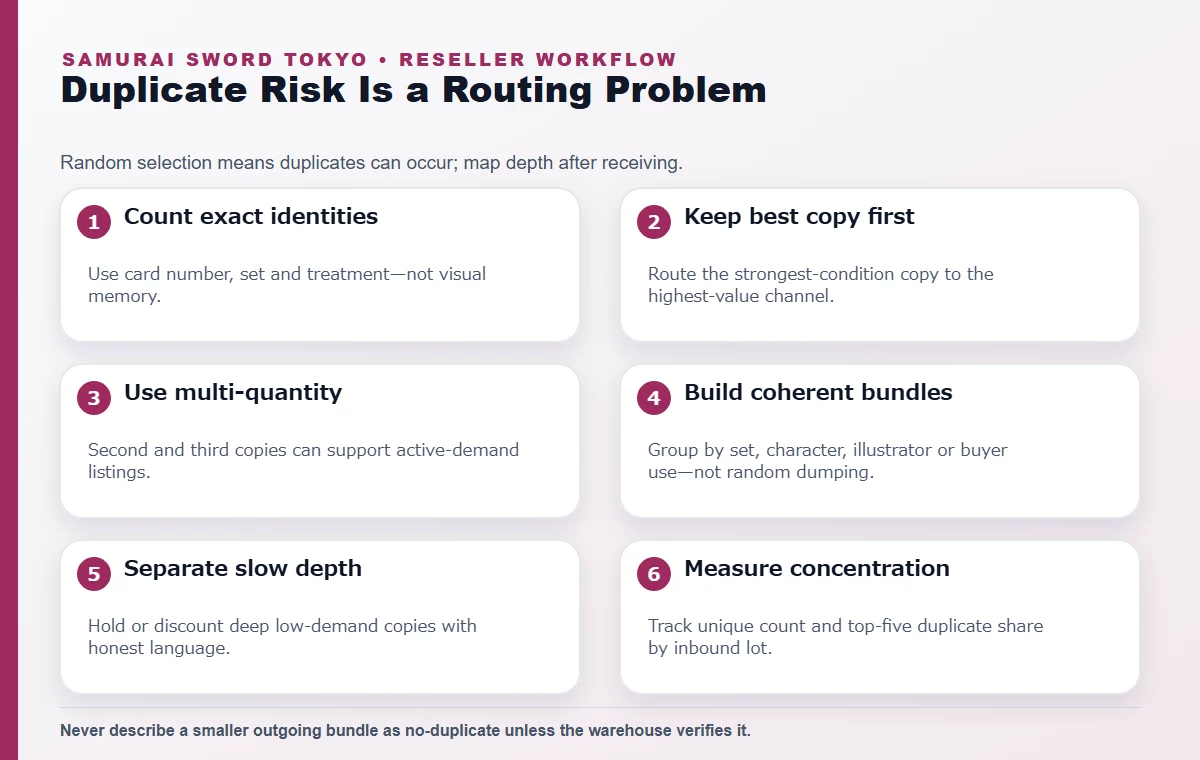
The seller’s duplicate warning should be reflected in your receiving sheet. Record total cards, unique card identities, copies per identity, and the percentage of the lot represented by the five deepest duplicate positions. Do not use visual memory. Similar artwork, set reprints, reverse-holo treatments, and card-number differences can make informal counting unreliable.

There is no promised duplicate rate, so avoid publishing a forecast. Instead, define actions for whatever arrives. A second copy of a high-demand card may be valuable multi-quantity inventory. Eight copies of a slow card may require bundles or patient holding. The economic problem is concentration, not duplication by itself.

Duplicate-risk playbook for random Japanese Pokemon AR bulk cards
A random lot needs a receiving-time duplicate map. Route cards by actual depth and demand rather than assuming every repeat is a loss.

Route duplicate depth into different offers

Observed duplicate position Possible route Control
First clean copy Individual listing or set binder Keep the strongest-condition copy for the highest-value route.
Second and third copies Multi-quantity listing, live-sale tray, or alternate platform Photograph representative condition only if your listing policy allows it and differences are disclosed.
Deeper copies with active demand Store restock pool or character bundle Cap inventory exposure using recent sell-through, not follower counts.
Deeper copies with weak demand Set-building lot, add-on, or long-tail bundle Do not hide unwanted duplicates inside a misleading “variety” offer.
狀態 outliers Separate damaged/played listing or non-sale review Never average a defect away because other copies are clean.

Use truthful bundle language

If you resell smaller lots, describe exactly what the buyer receives. “Ten-card AR bundle” does not automatically mean ten unique cards. State whether uniqueness is guaranteed, whether the photo is the actual lot, whether selection is random, and what condition standard applies. If you create a no-duplicate bundle from the received inventory, confirm it at packing time and make the promise specific to that outgoing bundle—not to the original 100-card supply.

Transparent assortment language lowers dispute risk and helps you compare products honestly. It also prevents a common operational mistake: creating attractive marketing copy before the warehouse has defined a repeatable pick rule. The listing, inventory location, and packing checklist should all use the same definition of “unique,” “random,” “sample,” and “actual cards shown.”

5. 狀態 intake and grading triage

Inspect raw cards under a repeatable standard

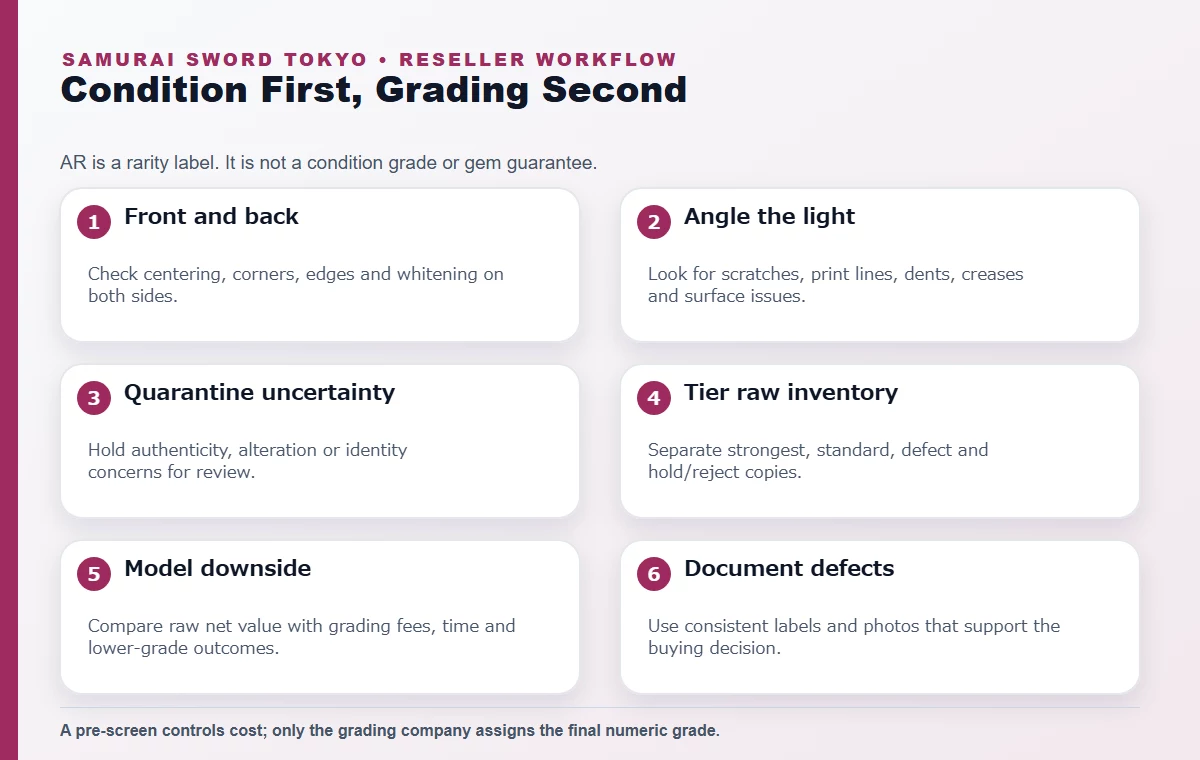
狀態 is a card-by-card fact. On arrival, count the lot before extensive handling, then inspect under diffuse front lighting and angled surface lighting. Check front and back centering, corners, edge whitening, chipping, scratches, print lines, dents, creases, stains, warping, and foreign material. Use clean hands or appropriate handling practices and place inspected cards into fresh protection according to your store policy.

Do not infer the back from the front. Modern Japanese cards can look strong at a glance while a small back-edge chip, roller line, indentation, or print defect changes the appropriate listing or grading decision. Photograph notable defects before inventory is mixed. If authenticity or alteration is uncertain, isolate the card and escalate it for review rather than selling it under a confident condition label.

狀態 and grading triage workflow for Japanese Pokemon AR cards
狀態 triage is a routing process, not a promise of grade. The final numeric grade belongs to the grading company.

Separate resale condition from grading candidacy

A card can be perfectly acceptable raw inventory without being a sensible grading candidate. PSA’s published grading standards describe a PSA 10 as virtually perfect and discuss sharp corners, focus, original gloss, staining, print imperfections, centering, and overall eye appeal. PSA also notes that grading contains a subjective component and identifies altered or otherwise ungradable cards. Your pre-screen is therefore a cost-control step, not a grade guarantee.

Intake tier Typical observation Recommended route Required wording
A: strongest raw copy Clean surfaces, sharp corners, minimal edge issues, acceptable centering High-resolution review; consider grading only after economic screen Raw/ungraded until a grader assigns a result
B: standard sellable copy Minor manufacturing or handling issue within your policy Individual raw listing or curated bundle Use your defined condition label and actual photos where needed
C: visible defect Whitening, scratch, print line, dent, or wear affecting value Clearly disclosed lower-condition listing or separate lot Name and photograph the material defect
Hold / reject Authenticity concern, possible alteration, severe damage, or uncertain identity Quarantine for expert review; do not list as normal stock No confident claim until resolved

Grade only when expected net value justifies the downside

For each candidate, compare conservative graded net proceeds with the raw net proceeds you could realize now. Subtract grading fee, shipping both ways, insurance, preparation supplies, declared-value adjustments, selling fees, expected time, and the probability of a lower-than-target grade or no grade. Use a range of outcomes instead of multiplying every card by a PSA 10 price.

Submission economics can change quickly. Service levels, declared-value rules, turnaround estimates, exchange rates, and market premiums are external variables, so confirm the grading company’s current pages when you are ready. If your advantage is efficient raw-card merchandising, grading may add complexity without improving portfolio return. The best grading candidate is not always the best business use of cash.

6. Sorting, cataloging, and listing a 100-card AR lot

Build one source-of-truth receiving sheet

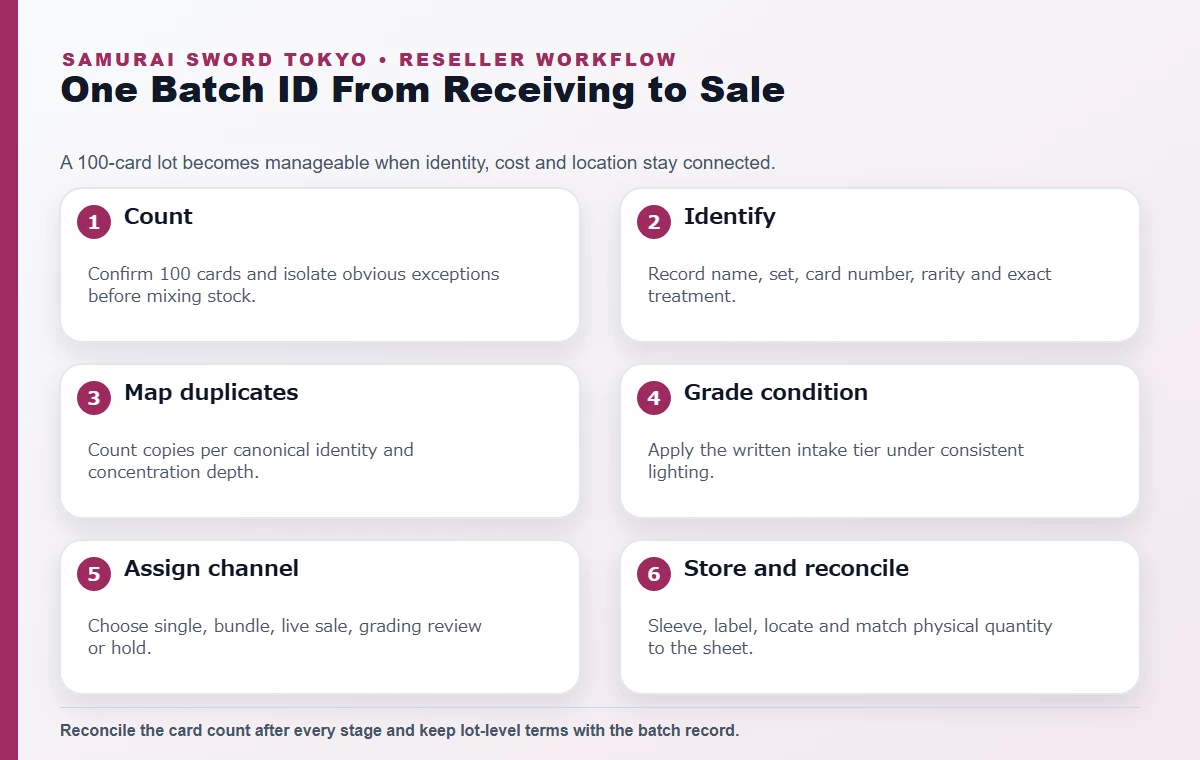
Assign the inbound lot a batch ID before opening. Your sheet should include received date, supplier product ID and SKU, purchase currency, invoice cost, allocated freight, destination charges, card name, set code, card number, rarity, illustrator when relevant, quantity, condition tier, storage location, intended channel, list date, sale date, gross proceeds, fees, returns, and net proceeds. A barcode is optional; a stable unique inventory key is not.

Keep the supplier’s lot-level terms attached to the batch record. That lets you audit whether your outgoing bundle language is stricter, looser, or simply different. It also gives future buyers on your team a real duplicate and sell-through history instead of anecdotal memory.

Sorting, cataloging, and listing workflow for a 100-card AR lot
A stable batch ID connects purchase cost, card identity, condition, storage, listing, sale, and reorder decisions.

Sort in passes to reduce handling errors

Pass Action Output Quality control
1. Count and isolate Confirm total quantity; set aside obvious damage or uncertainty Received count and exception tray Second count before cards enter inventory
2. Identify Record name, set, card number, and rarity Canonical card rows Use official card references where possible
3. Duplicate map Group exact identities and count copies Unique count and concentration report Do not combine different card numbers or treatments
4. 狀態 Apply the written intake tiers Route-ready inventory Review borderline cards under angled light
5. Channel Assign single, bundle, live sale, grading review, or hold Listing queue Use conservative net-proceeds assumptions
6. Storage Sleeve, label, and place by stable location code Pickable inventory Reconcile quantity after listing

Design listings around buyer intent

Individual listings work when the buyer searches a character, set number, illustrator, or specific artwork. Bundles work when the grouping itself creates convenience: an evolution line, one set, a character family, a color or type theme, an illustrator selection, or a starter collection. Random bundles work only when randomness is clearly stated and the price reflects the buyer’s uncertainty.

Use the actual card image when condition or identity matters. If a representative photo is used for a multi-quantity listing, disclose that practice and keep the copies within a narrow, documented condition band. Avoid keyword-stuffed titles that blur Japanese AR with SAR, SR, or English Illustration Rare terminology. Precise identity reduces returns and protects search relevance.

7. International shipping, protection, and cost control

Model inbound shipping before checkout

International freight can materially change the per-card basis, especially if one 100-card lot ships alone. Compare a single-lot order with a consolidated order only after considering cash exposure, inventory turn, package weight, insurance, and customs treatment. A larger shipment can lower freight per card while increasing capital at risk and the cost of a slow assortment.

Request or calculate the packed shipment, not only the bare card weight. Sleeves, inner boxes, cushioning, outer cartons, and documentation add mass and volume. Destination import duties, taxes, and brokerage are normally buyer-side considerations unless a quote explicitly states otherwise. Confirm the destination rules and quote before presenting any landed-cost estimate as final.

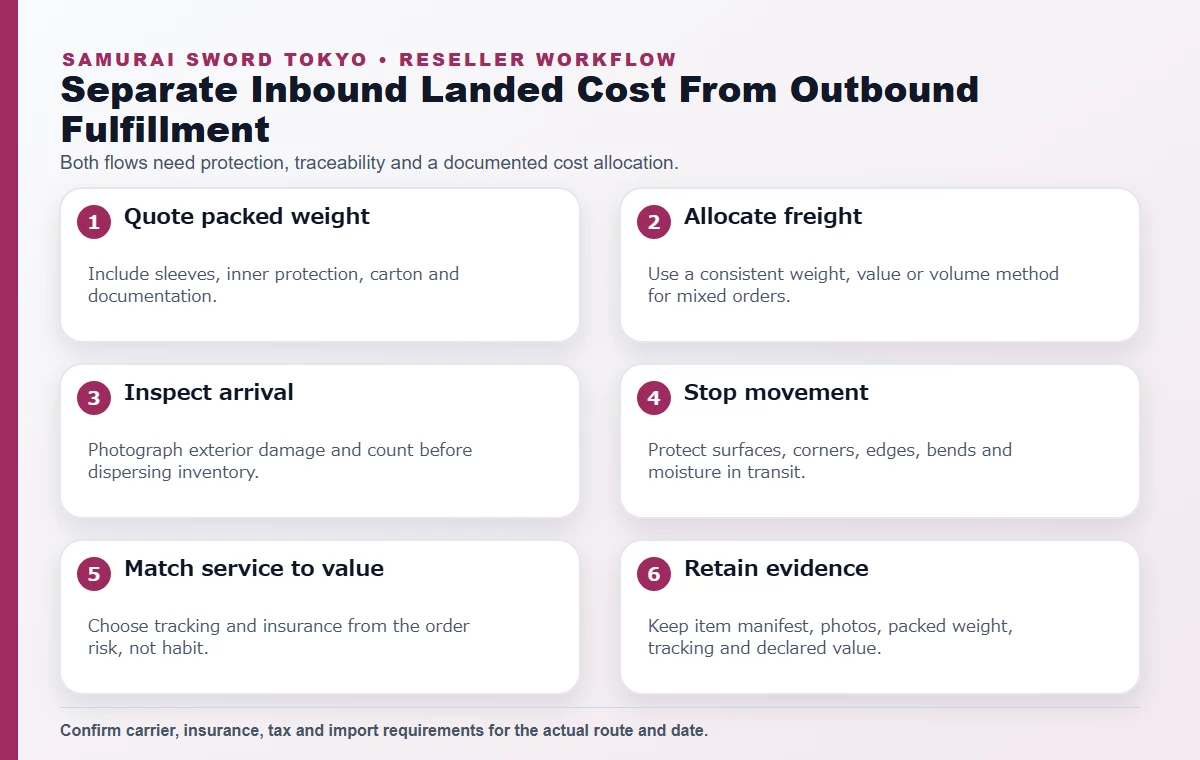
Shipping protection and cost-control matrix for Japanese Pokemon AR cards
Separate inbound landed-cost planning from outbound customer fulfillment. Both need protection, tracking rules, and a documented cost allocation.

Protect cards from movement, pressure, and moisture

For inbound receiving, photograph exterior damage before opening and preserve relevant labels until the count and condition check are complete. For outbound sales, sleeve each card according to value and condition policy, prevent movement inside the package, avoid excessive pressure, add water resistance appropriate to the route, and use a rigid structure when bending risk warrants it. The protection level should match the order value and carrier environment without creating unnecessary postage.

If you submit cards for grading, follow the grading company’s current packaging and shipping instructions rather than improvising from marketplace habits. Grading submissions have different identification, order-document, sleeve, and package requirements from customer singles. Insure and track according to your risk policy, and retain an itemized manifest and pre-shipment images.

Choose an outbound format by order value and traceability

Order pattern Protection priority Cost-control question Record to retain
One lower-price raw single Surface, corner, moisture, and bend protection Can the format meet your policy without erasing contribution? Listing ID, condition photos, packed weight
Several raw cards Prevent internal movement and edge contact When does a rigid mailer or small box become safer? Pick list, final count, package image
High-value single or graded card Rigid protection, tracking, and value-appropriate insurance Does the carrier service match the declared risk? Serial or cert number, photos, tracking, declared value
Wholesale/reseller bundle Count integrity, layered protection, carton strength How is freight allocated across inventory units? Batch manifest, carton count, weight, invoice

8. Who should buy this lot—and when to reorder

Strong fit: operations that can absorb assortment variance

The lot fits a reseller with a written condition policy, multiple sales routes, a reliable card-identification process, and enough working capital to hold slower copies. It also fits a content or live-selling operation that can turn the sorting process into useful customer discovery without misrepresenting the assortment. The buyer should be comfortable saying “no” to grading when the numbers do not work.

A card shop can use the lot to broaden lower-to-mid-price Japanese inventory. A convention vendor can create visually compelling trays and bundles. An online seller can expand long-tail search coverage. Those advantages are operational, not automatic. The lot creates raw material; your catalog, pricing, merchandising, and fulfillment convert it.

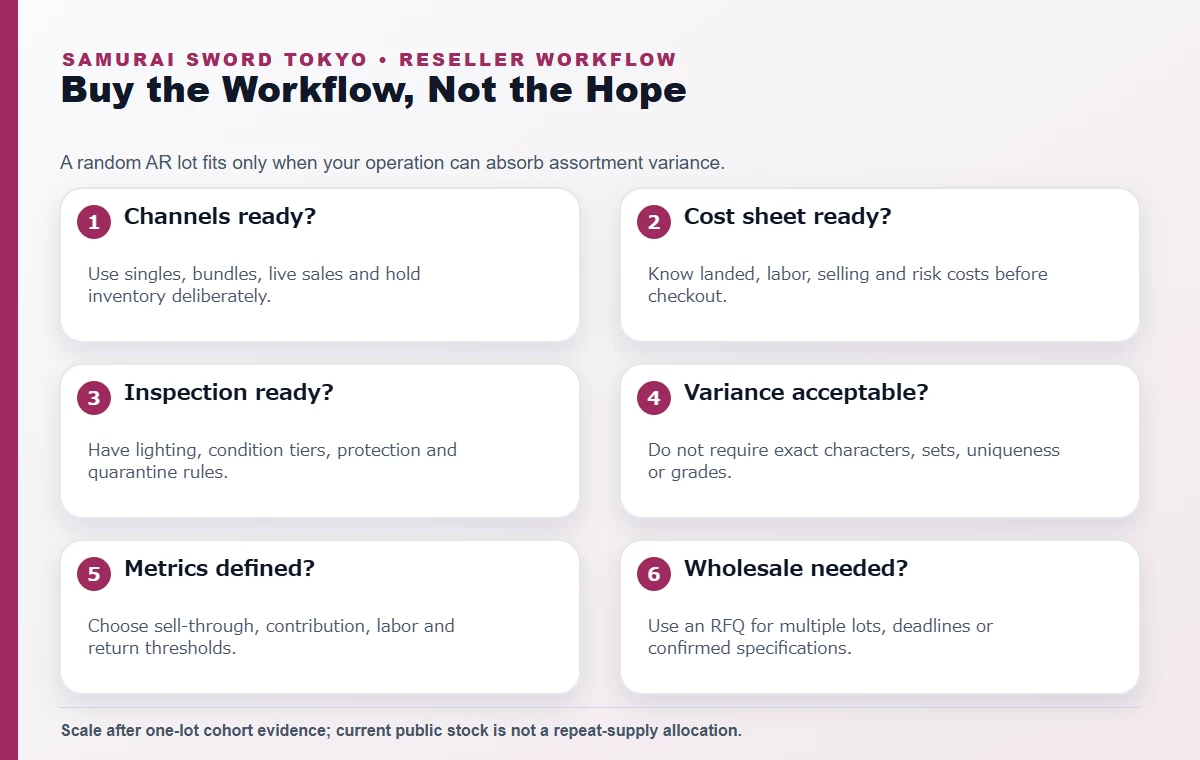
Buying decision checklist for resellers considering a Japanese Pokemon AR 100-card lot
Buy only when your channels, cost sheet, inspection capacity, and assortment-risk limits are already defined.

Weak fit: exact-card or guaranteed-return buyers

Buyer profile Fit Reason Better next step
Multi-channel reseller with intake workflow Potentially strong Can route different values, conditions, and duplicates Run one-lot cohort analysis before scaling
Store needing exact card numbers Weak Random assortment does not confirm exact content Buy identified singles or request a confirmed specification
Buyer expecting 100 PSA 10 candidates Poor Rarity is not condition and grades are not guaranteed Buy graded inventory or inspect exact raw cards
Single-platform seller with high fixed listing cost 狀態al Labor and slow cards may erase spread Test bundle and live-sale routes first
Collector wanting a no-duplicate binder 狀態al to weak Duplicates may occur and exact content is unknown Buy a curated set or build from identified singles

Reorder from cohort evidence, not enthusiasm

Before the first purchase, choose thresholds for 30-day sell-through, 60-day sell-through, net contribution after variable costs, maximum labor hours, return rate, and duplicate concentration. After receiving the lot, lock the batch record and evaluate that exact cohort. Do not combine results with unrelated sealed products or graded cards.

Metric Why it matters Reorder question
Unique identities / 100 Measures assortment breadth Did duplicate concentration fit your channels?
Sellable units after intake Corrects the denominator Was condition fallout inside your reserve?
Net proceeds per received card Connects all routes to the original lot Did realized proceeds cover landed and selling costs?
Labor hours per lot Exposes hidden operating cost Can the process be standardized without lowering accuracy?
30/60-day sell-through Measures capital recovery speed Will another lot create healthy depth or excess stock?
Returns and condition disputes Tests listing and inspection quality Does your description policy need repair before scaling?

If the first cohort meets the thresholds, check the current product page again and compare the new price, stock, shipping, and destination costs with the first order. If you need multiple lots or repeat supply, use the wholesale RFQ rather than assuming the public stock figure is an allocation. Scale the workflow only after the evidence supports it.

Ready to evaluate the current lot?Reconfirm price, stock, assortment terms, shipping, and your all-in cost before checkout.

Open AR Bulk — 100-Card Set

9. FAQ: Japanese Pokemon AR bulk cards for resellers

Are all 100 AR cards guaranteed to be different?

No. The product states that cards are selected at random. Samurai Sword Tokyo will do its best to avoid duplicates, but duplicates may occur. Build your resale plan around an unknown assortment rather than assuming 100 unique card numbers or characters.

Does AR Bulk mean every card is gradeable as a PSA 10?

No. AR describes the card rarity, not the condition or future grade. A reseller should inspect centering, corners, edges, surface, print lines, dents, whitening, and authenticity before deciding whether any card is worth submitting. A grading company makes the final grade decision.

What was the live price when this guide was prepared?

The WooCommerce snapshot checked on July 14, 2026 at 16:14 JST showed ¥27,000 for one 100-card lot, or ¥270 per card before shipping, payment costs, duties, taxes, labor, packaging, returns, and marketplace fees. Price and stock can change, so confirm the product page before ordering.

How many AR Bulk lots were in stock?

The same dated WooCommerce snapshot showed 16 lot units in stock. That figure is not a reservation and may change after publication. The current product page and checkout state are the correct source when you are ready to buy.

Can I request specific Pokemon, sets, or card numbers?

Do not assume card selection is available on a random-lot product. If your business requires exact characters, sets, minimum uniqueness, or repeated supply with a specification, send a structured wholesale inquiry and ask what can actually be confirmed before paying.

What is the safest way to calculate break-even?

Add the lot price, allocated international shipping, payment costs, import charges, inbound supplies, grading expenses, marketplace fees, expected returns, and the value of your labor. Divide the total by the number of sellable units, not automatically by 100. Then compare that all-in basis with conservative net proceeds.

Should I list cards individually or as smaller themed bundles?

Use both routes when the assortment supports them. List stronger characters or cleaner copies individually, group coherent low-price cards by set, type, illustrator, or theme, and retain slow duplicates for add-ons or future bundles. The received assortment should decide the channel mix.

How should I handle condition descriptions?

Create a written condition policy and apply it consistently. Photograph defects that can affect the buying decision, avoid calling a raw card mint based only on the front, and separate cards with dents, creases, heavy whitening, surface damage, or possible alteration from standard inventory.

Are shipping, customs duties, and taxes included in the ¥27,000 snapshot?

Treat the displayed product price as the merchandise price unless checkout or a quote states otherwise. Shipping, payment method costs, import duties, taxes, brokerage, and destination-country requirements can change the landed cost. Confirm them for your address before calculating margin.

Who is this 100-card lot best suited to?

It is best suited to a reseller who can inspect raw cards, tolerate assortment variance, route cards into multiple sales channels, track labor, and hold slower inventory. It is a weaker fit for a buyer who needs exact cards, guaranteed uniqueness, guaranteed grades, or immediate turnover at a fixed margin.

This article provides operational buying guidance, not a guarantee of assortment, condition, grade, sell-through, margin, or profit. Product price and stock were checked at 2026-07-14 16:14 JST and may change. Marketplace values, grading fees, carrier charges, taxes, and import requirements must be verified when you act.


Get coupons & new TCG alerts

Subscribe for new Japanese TCG arrivals, restocks, and occasional coupon emails from Samurai Sword Tokyo.

Storm Emeralda pre-order is open

Reserve M6 Storm Emeralda from Tokyo

Storm Emeralda booster boxes are now available for pre-order. Reserve the Japanese M6 Rayquaza set now, or browse live stock while allocation is available.

  • M6 pre-order now open
  • FedEx international shipping
  • Support for larger orders