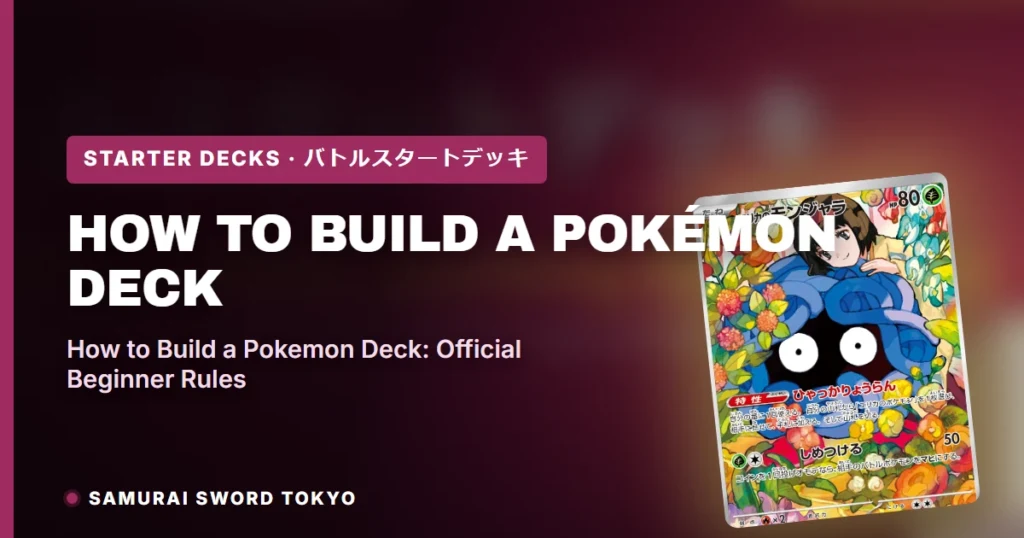
If you want to know how to build a Pokemon deck, the official Japanese rules fit on a few lines: a deck is 60 cards, you may use at most 4 cards with the same name, and the game is won by taking 6 Prize cards. This guide walks through those rules in plain English from the official pokemon-card.com pages, using the cards of the MEGA スタートデッキ100 バトルコレクション (MEGA Start Deck 100 Battle Collection, released on Friday, December 19, 2025) as worked examples, and shows how the Japanese starter products work as ready-made templates.
Every rule below is quoted or rendered from the official Japanese beginner pages, with the Japanese wording given so you can check it. We sell Japanese sealed product and graded singles from Tokyo, so the starter products we currently list are in the last section; official manufacturer prices are labelled as such, and every store price is linked. USD figures convert at ¥154/USD and are approximate.
- The three numbers: 60 cards per deck, no more than 4 cards with the same name (basic Energy excepted), and 6 Prize cards to win.
- The official beginner split: about 15 Pokémon, 30 Trainers and 15 Energy. The official page treats it as a starting point, not a rule.
- A ready-made deck is the easiest template. The MEGA Start Deck 100 Battle Collection is one 60-card deck, and the official page says you need two or more decks to play a match.
The Official Rules in One Table
The official ポケモンカードゲーム beginner page (/howtoplay/) states the deck-building rules in a handful of sentences. The table gives the Japanese wording and an English rendering of each.
| Rule | Official Japanese wording | English rendering |
|---|---|---|
| Deck size | 60枚のカードを組み合わせた「デッキ」を、ひとり1個使います。 | Each player uses one deck made of 60 cards. |
| Same-name limit | 同じ名前のカードは4枚まで。 | Up to 4 cards with the same name. |
| Basic Energy | 基本エネルギーカードはデッキに何枚でも入れることができます。 | Basic Energy cards can go in the deck in any number. |
| Basic Pokémon | たねポケモンは、デッキに1枚以上入れないといけないよ。 | You must put at least 1 Basic Pokémon in the deck. |
| Evolution | 進化ポケモンを使うためには、進化前のたねポケモンが必要だよ。 | To use an Evolution Pokémon you need the Pokémon it evolves from. |
| Prize cards | 先にサイドを6枚とれば勝ち! | Take 6 Prize cards first and you win. |
| Opening hand | 山札を上から7枚引いて、手に持ちます。 | Draw 7 cards from the top of your deck into your hand. |
| Bench | ベンチは5匹まで置けます。 | You can place up to 5 Pokémon on the Bench. |
The same page lists three ways to win: take all 6 Prize cards, leave the opponent with no Pokémon in play, or have the opponent unable to draw a card at the start of their turn. The third is a reminder that the deck is also the supply of cards you draw from during the match.
The page also shows the Pokémon types: grass, fire, water, lightning, psychic, fighting, darkness, metal, dragon and colorless, and notes that there is no colorless basic Energy (無色タイプの基本エネルギーはありません). If you are new to the match itself, our how to play Pokémon cards guide walks through a turn.
Start With Basic Pokémon
The rule table says at least 1 Basic Pokémon (たねポケモン) is required, and that an Evolution Pokémon needs the Pokémon it evolves from. The official beginner page gives no Basic-count target in our sources; the 15-Pokémon split in a later section is the only number it gives.
Two high-numbered cards of the MEGA Start Deck 100 Battle Collection (743/742 and 749/742, in the product’s numbering above the 742 base cards) show the difference between a Basic Pokémon and an Evolution Pokémon.
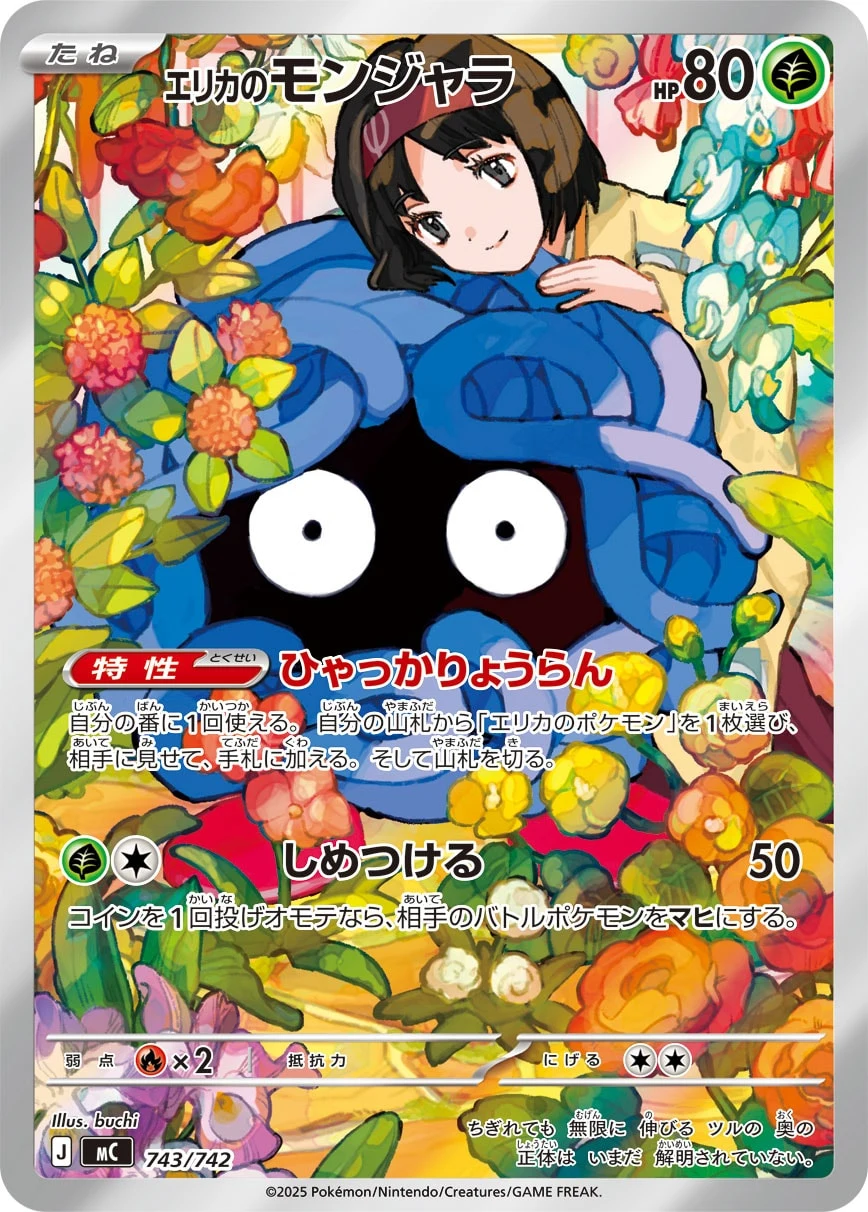
エリカのモンジャラ is a たね (Basic) Pokémon with HP 80. Its ability ひゃっかりょうらん lets you search your deck for an Erika’s Pokémon (rendering), and its attack しめつける does 50 with a coin flip for Paralysis (rendering). Because it is a Basic, it needs no pre-evolution. It was illustrated by buchi.
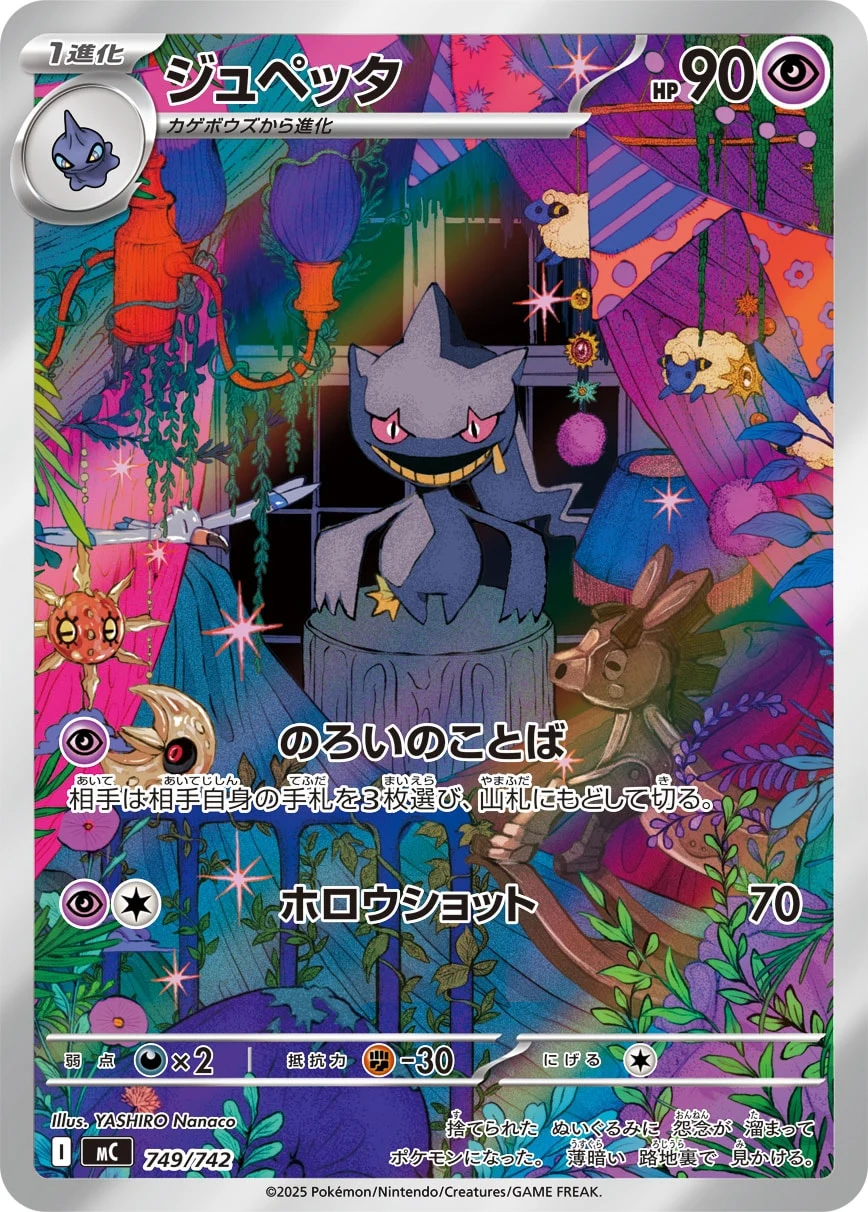
ジュペッタ is a 1進化 (Stage 1) Pokémon with HP 90. Its ability のろいのことば makes the opponent return 3 cards from their hand (rendering), its attack ホロウショット does 70, and its Resistance is −30. Under the evolution rule in the table, using it requires the Basic Pokémon it evolves from, so a deck with ジュペッタ also needs that Basic.
The practical order: count your Basics first, then check that every Evolution card in the list has its pre-evolution in the list too.
The 4-Copy Rule and the Energy Exception
The 4-copy rule counts by name. The official page adds a note that ピカチュウ and ピカチュウex count as different names, so a deck can hold 4 of one and 4 of the other. This is the official wording for the rule, and it is the only example the page gives; we do not generalise it to every card family.
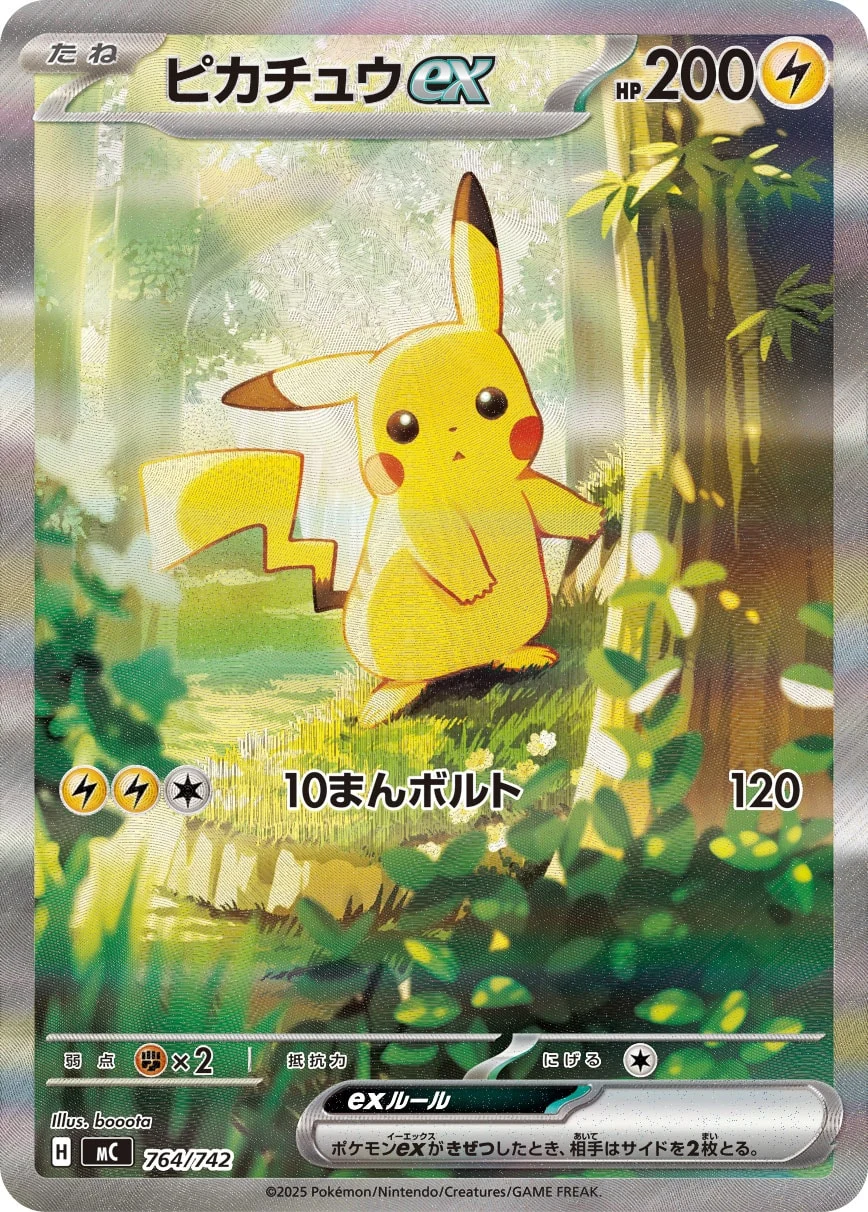
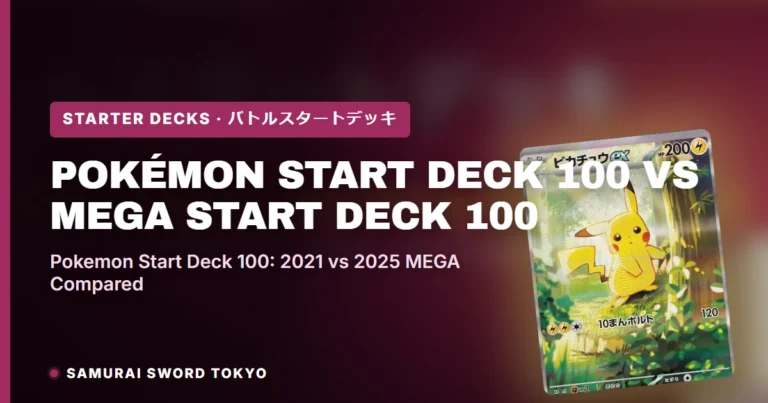
ピカチュウex 764/742 is a たね (Basic) Pokémon with HP 200. Its attack 10まんボルト (literal rendering: “100,000 volts”) does 120. The regular print of the same card in the same product is numbered 227/742 and was illustrated by takuyoa, and the secret-numbered 764/742 was illustrated by booota. Both have the same name, so under the rule they share the same limit of 4 copies, even though they are different prints. That is our reading of the rule’s wording, not an official example.
The exception is basic Energy: the official wording says the deck can hold any number. Basic Energy is the one card type without a per-name limit.
| Card type | Limit by name | Official source wording |
|---|---|---|
| Pokémon (Basic, Stage 1, Stage 2) | 4 | 同じ名前のカードは4枚まで。 |
| Trainers | 4 | 同じ名前のカードは4枚まで。 (the same sentence) |
| Basic Energy | No limit | 基本エネルギーカードはデッキに何枚でも入れることができます。 |
| Special Energy | Not stated on the official beginner page | Not stated |
The last row is a gap, not a ruling: the beginner page does not discuss special Energy, so we leave it as not stated. The official advanced rule guide (上級プレイヤー用ルールガイド, version 3.4, 74 pages) is the full reference; we do not quote it here.
The 15 / 30 / 15 Beginner Split
The official 「デッキのつくりかた」 (how to build a deck) section gives a beginner ratio. In its own words: 「まずは15枚エネルギーを入れてみよう。」 (“Start by putting in 15 Energy cards”) and 「バトルを有利にできるトレーナーズを、30枚を目安に入れよう!」 (“Put in around 30 Trainers cards that can give you an advantage in battle”). The figure’s alt text shows the whole split as ポケモン15・トレーナーズ30・エネルギー15, which adds to the 60 cards.
The official starter decks do not all follow it exactly. The two 2025 スターターセットMEGA decks list their exact split:
| Deck | Pokémon | Trainers | Energy | Total |
|---|---|---|---|---|
| Official beginner guide | 15 | 30 | 15 | 60 |
| スターターセットMEGA メガゲンガーex | 18 | 27 | 15 | 60 |
| スターターセットMEGA メガディアンシーex | 16 | 29 | 15 | 60 |
Both starter decks hold 15 Energy, as the guide suggests, and they vary in how they split the other 45 cards between Pokémon and Trainers. Both also contain the same three 4-copy Trainer slots: ハイパーボール ×4, アイリスの闘志 ×4 and リーリエの決心 ×4, which shows what maximum use of the same-name limit looks like in an official deck. The split for the 2026 MEGA スターターセットex decks and for our listed Starter Set ex products is not stated in our sources, so we do not give one.
What the split is for
Energy pays for attacks, Trainers draw cards and fetch Pokémon, and Pokémon are what you attack with. The official page presents the three numbers as a place to start; nothing in it says a deck must use them. Treat 15 / 30 / 15 as a first recipe and adjust one number at a time after you have played a few matches.
Using Starter Decks as Templates
A ready-made deck is already legal, and each Japanese starter product gives a complete 60-card list to study. The official /about/ page splits the choice into two: booster packs for people who want cards first (a few random cards each), and ready-made decks for people who want to try a battle quickly (a 60-card deck). Everything in this section is the second kind.
| Produit | What you get | Official price | Template notes from the official page |
|---|---|---|---|
| MEGA スタートデッキ100 バトルコレクション | 1 deck of 60 cards from 100 types (random), always 2 or more Pokémon ex | ¥891 | Needs a second deck to play a match; damage counter sheet only |
| MEGA スターターセットex (3 decks) | 1 fixed 60-card deck, coin, playmat, guide | ¥1,800 each | Needs a second deck; some reprints included |
| スターターセットex (2023) | 1 fixed 60-card deck, coin, playmat, promo pack (1 random of 4) | ¥1,800 each | The promo card can be swapped into the 60 cards: the first customization step |
| exスタートデッキ (2023) | 1 fixed 60-card deck, damage counters | ¥550 | All cards are normal (non-holo) |

The official 2026 MEGA スターターセットex page calls out the key cards of each deck (for example the Eevee ex deck is built around イーブイex and パーモット), and the Starter Set ex page describes the promo pack as the first step of customizing. Beyond that, the official site’s deck recipe hub (いろんなデッキを見る) lists more decks, including ones aimed at beginners.

Our Start Deck 100 Battle Collection guide and Starter Set ex comparison cover those lines in more detail.
Which Cards Are Allowed: Regulation Marks
The deck rules above say how many cards; the regulation says which cards. The official wording is that regulation is the rule deciding which cards can go in your deck, and it comes in three kinds: Standard, Extra and Hall of Fame (殿堂).
| Regulation | What is allowed (official wording, rendered) | Source / date |
|---|---|---|
| Standard | Cards with H, I or J in the regulation mark at the bottom left | In effect from Friday, January 23, 2026 (page updated January 22, 2026) |
| Extra | Cards from the BW series through the latest | Page updated February 19, 2026 |
| Hall of Fame (殿堂) | Cards from DP through MEGA; the Hall of Fame points of the 60 cards must total 4 or less | Page updated January 26, 2024 |
The change to H, I and J was announced on Friday, November 7, 2025. Until Thursday, December 18, 2025 the Standard marks were G, H and I; from Friday, December 19, 2025 to Thursday, January 22, 2026 they were G, H, I and J, with the J mark debuting in the MEGA スタートデッキ100 バトルコレクション; from Friday, January 23, 2026 cards with G are no longer Standard. No official notice of a further change (such as the H mark leaving) had been found on pokemon-card.com as of October 29, 2026, so the next rotation is not announced.
The official City League 2027 Season 1 notice lists the format as a 60-card deck with 6 Prize cards under Standard regulation. For a deck you build to play at a shop or event, check the regulation mark on each card before you finish. The official card database pages show the regulation mark only as the set logo image, so we do not claim which mark any specific card here carries.
A Seven-Step Build Checklist
Putting the rules together gives a checklist you can follow with any Japanese cards. Each step comes from the rules in the sections above.
- Pick a starting point. Use a starter deck as your base, or choose one Pokémon you like and build around it. The ready-made decks in the template table are already legal.
- Count to 60. The deck must be exactly the size the rules say: 60 cards.
- Add Basic Pokémon first. You need at least 1, and every Evolution card needs the Pokémon it evolves from.
- Add Energy. Start with 15, as the official beginner page suggests, matched to the types of your attackers.
- Add Trainers. The official guide points to around 30 cards that give you an advantage; you may use up to 4 of each name.
- Check the 4-copy limit by name. ピカチュウ and ピカチュウex count as different names; basic Energy has no limit.
- Check the regulation. Under Standard from January 23, 2026 the mark must be H, I or J. Play your deck once with a friend and change one thing at a time.
If you are buying a single-deck starter product, the official pages say you need two or more decks to play a match, so plan for a second deck or a second player’s deck.
A Note on the バトルスタートデッキ Filing
On October 29, 2026 fan sites reported a Japanese trademark filing for 「バトルスタートデッキ」 (working English translation: Battle Start Deck; no official English name exists), which some of those sites read as a possible beginner-deck product; nothing is announced. Our Battle Start Deck guide explains what is confirmed and what is not, and the ex★ 2027 round-up covers the other three reported names.
Where to Buy Starter Decks and Cards
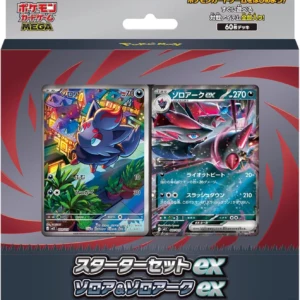
The MEGA Start Deck 100 Battle Collection is currently listed at ¥1,097 (~$7), and the same product is also listed as a White Box version at ¥38,570 (~$250); our regular vs White Box guide explains the difference. For fixed decks, the Starter Set ex Zorua & Zoroark ex is currently listed at ¥1,584 (~$10) and the Starter Set ex Sprigatito & Meowscarada ex is currently listed at ¥1,796 (~$12). Starter Set ex Eevee ex has no listed price on October 29, 2026, so sourcing requests for it go through Commande rapide.
Two of the cards pictured above are also listed as graded singles: the PSA10 Erika’s Tangela AR Style [MC 743/742] is currently listed at ¥16,566 (~$108) and the PSA10 Banette AR Style [MC 749/742] is currently listed at ¥13,850 (~$90) (the “AR Style” label is from our listing names; the official database prints no rarity). These are collector items, not cards for a first deck; a beginner deck is better served by the starter products above.
The card list hub shows the cards inside released sets with official images. If you want the English-language side, see our Battle Academy vs Starter Set ex comparison, and our best Japanese sets for beginners guide for choosing sets.
Foire aux questions
How many cards are in a Pokémon deck?
60. The official beginner page says each player uses one deck made of 60 cards (60枚のカードを組み合わせた「デッキ」を、ひとり1個使います。).
How many copies of the same card can I use?
Up to 4 cards with the same name. Basic Energy cards are the exception and can go in any number. The official page notes that ピカチュウ and ピカチュウex count as different names.
How many Energy and Trainer cards should a beginner deck have?
The official beginner page suggests starting with 15 Energy and around 30 Trainers, and shows the split as 15 Pokémon, 30 Trainers and 15 Energy. It is a starting point, not a rule.
Which cards can I use in a Standard deck?
From Friday, January 23, 2026, Standard allows cards whose bottom-left regulation mark is H, I or J. No further rotation had been announced on pokemon-card.com as of October 29, 2026.
Is one starter deck enough to play a match?
No. The official MEGA スタートデッキ100 バトルコレクション and MEGA スターターセットex pages both say 対戦には2つ以上のデッキが必要です。 (you need two or more decks to play a match).
Which Japanese starter products does Samurai Sword Tokyo currently list?
We currently list the MEGA Start Deck 100 Battle Collection, the Starter Set ex Zorua & Zoroark ex and the Starter Set ex Sprigatito & Meowscarada ex. The product pages show the current prices.
Des bonbons ou un sort : ouvrez trois coffres, économisez jusqu'à 4%
VOIR COMMENT ÇA MARCHERéservé aux membres · Chaque commande payée ouvre le coffre suivant · Se termine le 31 oct., 23:59 JST · Les droits d'importation, taxes et frais de douane ne sont pas inclus dans le prix et sont perçus à la livraison, sauf pour les destinations que nous expédions en droits acquittés.
Sélectionné pour cet article
📩 Get member-only sale alerts & coupons
Sale alerts, coupons and restock notices by email — straight from Tokyo.