If you have just opened a Japanese Pokémon booster pack, the first thing that stops you is often not the attack text but the symbols. A leaf, a flame, an eye, a fist: each one is a card type. The Japanese card search writes nine type names in kanji and two, フェアリー and ドラゴン, in katakana. This guide puts all of them in one table you can use straight away.
The official Japanese card database sorts Pokémon cards into 11 types: 草 Grass, 炎 Fire, 水 Water, 雷 Lightning, 超 Psychic, 闘 Fighting, 悪 Darkness, 鋼 Metal, フェアリー Fairy, ドラゴン Dragon and 無色 Colorless. The official beginner guide pictures ten of them, all but Fairy, and the card search shows フェアリー only outside its default Standard-regulation view. Weakness and Resistance are not fixed for each type. They are printed on each individual card, and the official rules tell you to read them from the card in front of you.
We checked the rules against the official Japanese site pokemon-card.com and the official English Advanced Player’s Rulebook Ver. 3.4 on November 18, 2026. This is a rules explainer only: no deck advice and no ranking of types.
- 11 card types are listed in the official Japanese card search across all regulations: 草, 炎, 水, 雷, 超, 闘, 悪, 鋼, フェアリー, ドラゴン and 無色. Its default Standard view shows ten, without フェアリー.
- The official rule guide lists Basic Energy for 9 of them. There is no basic Dragon Energy and no basic Colorless Energy.
- Weakness (弱点) and Resistance (抵抗力) are printed on each card. Apply the modifier printed on the defending Active Pokémon. In our 2,179-card sample, 2,092 cards showed ×2 Weakness and one showed +20.
- The examples in this guide come from Japanese MEGA sets such as the メガブレイブ (M1L Mega Brave) booster box and the M4 Ninja Spinner booster box.
The Pokémon TCG Type Chart: All 11 Types
This is the table to keep open while you sort cards. The Japanese names are exactly as the official card search writes them. The readings are the furigana printed over each type symbol in Japanese card text on the checked example cards; Fairy and Dragon are written in katakana, so they need no reading. Eight colours were checked on basic Energy cards. The Fairy, Dragon and Colorless colours describe Pokémon card icons. English names follow the English rulebook; ‘Dragon’ follows the Japanese search’s internal key dragon.
| # | Japanese name | Reading | English name | Symbol | Colour | Basic Energy? |
|---|---|---|---|---|---|---|
| 1 | 草 | くさ (kusa) | Grass | Leaf | Green | Yes |
| 2 | 炎 | ほのお (honoo) | Fire | Flame | Red | Yes |
| 3 | 水 | みず (mizu) | Water | Water drop | Blue | Yes |
| 4 | 雷 | かみなり (kaminari) | Lightning | Lightning bolt | Yellow | Yes |
| 5 | 超 | ちょう (chou) | Psychic | Eye | Purple | Yes |
| 6 | 闘 | とう (tou) | Fighting | Fist | Orange | Yes |
| 7 | 悪 | あく (aku) | Darkness | Dark crescent on a dark disc | Dark teal with black | Yes |
| 8 | 鋼 | はがね (hagane) | Metal | Angular silver mark | Silver / grey | Yes |
| 9 | フェアリー | (katakana) | Fairy | Winged mark | Pink | Yes |
| 10 | ドラゴン | (katakana) | Dragon | Dragon mark | Gold / ochre | No |
| 11 | 無色 | むしょく (mushoku) | Colorless | Black star on a white circle | White / light grey | No |
Three notes on the names:
- The card search and the Pokédex do not always write a name the same way. Steel appears as 鋼 in the card search, while the official Pokédex writes はがね; both read hagane.
- Dragon is ドラゴン. The card search writes Dragon in katakana.
- Darkness has two English spellings in official text. The English rulebook uses Darkness in its Basic Energy list and Dark in its all-Energy list. Both refer to 悪.
Why the Count Is 11 (and Why Basic Energy Has 9)
The card-search and Energy lists answer different questions.
| Official list | Count | What is on it |
|---|---|---|
| Card search filter “タイプ” (Pokémon type), all regulations | 11 | 草, 炎, 水, 雷, 超, 闘, 悪, 鋼, フェアリー, ドラゴン, 無色 |
| The same filter in the default Standard (スタンダード) view | 10 | The same list without フェアリー |
| Basic Energy (rule guide, section I-C) | 9 | Grass, Fire, Water, Lightning, Psychic, Fighting, Darkness, Metal, Fairy |
| Every type of Energy (rule guide, D-08) | 10 | The 9 basic types plus Colorless |
| Beginner guide, picture of Pokémon types | 10 | 草, 炎, 水, 雷, 超, 闘, 悪, 鋼, ドラゴン, 無色 (no フェアリー) |
| Beginner guide, picture of basic Energy cards | 8 | Grass, Fire, Water, Lightning, Psychic, Fighting, Darkness, Metal (no Fairy) |
With all regulations selected, the card search applies the same 11 labels to its Weakness (弱点), Resistance (抵抗力) and attack-Energy filters; the Standard view omits フェアリー from all four. The attack-Energy filter adds one more option, なし (“none”), for attacks that need no Energy; that is not a type.
The official English rulebook says “Basic Energy can be one of 9 types”, ending its list with Fairy. The Japanese beginner page adds that 無色タイプの基本エネルギーはありません, meaning there is no Colorless basic Energy. Dragon is in neither Energy list.
How Weakness and Resistance Work
The official beginner guide’s example uses a Ralts card with a Darkness Weakness and a Fighting Resistance: damage from a Darkness Pokémon is doubled, and damage from a Fighting Pokémon is reduced by 30. The same page adds that if no mark is printed, the Pokémon has no Weakness or no Resistance.
Whose type counts
The beginner guide’s FAQ answers a question that confuses many new players. The comparison is between the attacking Pokémon’s type and the defending Pokémon’s printed Weakness or Resistance. The Energy used to pay for the attack, or attached to the attacker, does not matter. A Grass Pokémon powered by Fire Energy still attacks as a Grass Pokémon.
Only the Active Pokémon
Weakness and Resistance change damage only for the Active Pokémon (バトルポケモン). Damage to Benched Pokémon is not changed.
The order of the damage calculation
| Step | What happens |
|---|---|
| 1 | Read the attack’s damage number and text |
| 2 | Apply effects on the attacking Pokémon |
| 3 | Weakness: if the printed Weakness type matches the attacker’s type, apply the printed Weakness modifier. Both rule guides say to apply the modifier written on the card, not a fixed number. |
| 4 | Resistance: if the printed Resistance type matches the attacker’s type, subtract the printed number; if the result is 0 or less, the calculation ends |
| 5 | Apply effects on the Pokémon taking the damage |
Why There Is No Fixed Weakness Chart
The official TCG sources reviewed here give no fixed Weakness chart: neither the official rules hub, the beginner guide nor the advanced rule guide contains a table saying “type A is weak to type B”. Each card carries its own Weakness and Resistance.
To show what that looks like in practice, here is what the official card database showed on November 18, 2026 for 2,179 Pokémon card entries under 21 Japanese set codes. The sample covers the MEGA series sets M1L to M6, M2a and the M6a 30th CELEBRATION set, plus SV4a, SV8a, S4a, S8b, S12a, a few smaller products and 11 MEGA promo cards. It is a sample, not the whole database.
| Card type | Cards in sample | Printed Weakness in sample | Printed Resistance in sample |
|---|---|---|---|
| Grass | 267 | Fire ×2 261 · Lightning ×2 6 | none 261 · Fighting −30 6 |
| Fire | 176 | Water ×2 173 · Lightning ×2 3 | none 172 · Fighting −30 4 |
| Water | 263 | Lightning ×2 188 · Metal ×2 74 · none 1 | none 260 · Fighting −30 3 |
| Lightning | 232 | Fighting ×2 223 · Lightning ×2 9 | none 222 · Fighting −30 9 · Metal −20 1 |
| Psychic | 339 | Darkness ×2 248 · Metal ×2 87 · Lightning ×2 3 · Psychic +20 1 | Fighting −30 249 · none 88 · Fighting −20 1 · Colorless −20 1 |
| Fighting | 207 | Grass ×2 113 · Psychic ×2 94 | none 207 |
| Darkness | 248 | Grass ×2 153 · Fighting ×2 76 · Lightning ×2 18 · none 1 | none 228 · Fighting −30 18 · Psychic −30 2 |
| Metal | 133 | Fire ×2 128 · Lightning ×2 5 | Grass −30 127 · Fighting −30 5 · Psychic −20 1 |
| Colorless | 226 | Fighting ×2 161 · Lightning ×2 64 · Psychic ×2 1 | none 161 · Fighting −30 64 · Psychic −30 1 |
| Dragon | 85 | none 84 · Dragon ×2 1 | none 85 |
| Fairy | 1 | Metal ×2 1 | Darkness −20 1 |
The displayed rows total 2,177 single-type cards. The full 2,179-card sample also includes one Lightning/Metal card and one Darkness/Psychic card. The patterns that matter for reading cards:
- The same type, different Weakness. Of 263 Water cards in the sample, 188 showed Lightning Weakness, 74 Metal and one none.
- In the sample, the multiplier is almost always ×2. 2,092 of the 2,179 cards print ×2, 86 print no Weakness, and one card prints +20: a Yuxie reprint in M6a whose Weakness is Psychic +20.
- In the sample, Resistance is usually absent. 1,685 cards print none, 489 print −30 and 5 print −20.
- No Fighting card in the sample prints a Resistance. In the sample, Psychic and Metal cards are where Resistance is common.
How to Read the Bottom of a Japanese Card
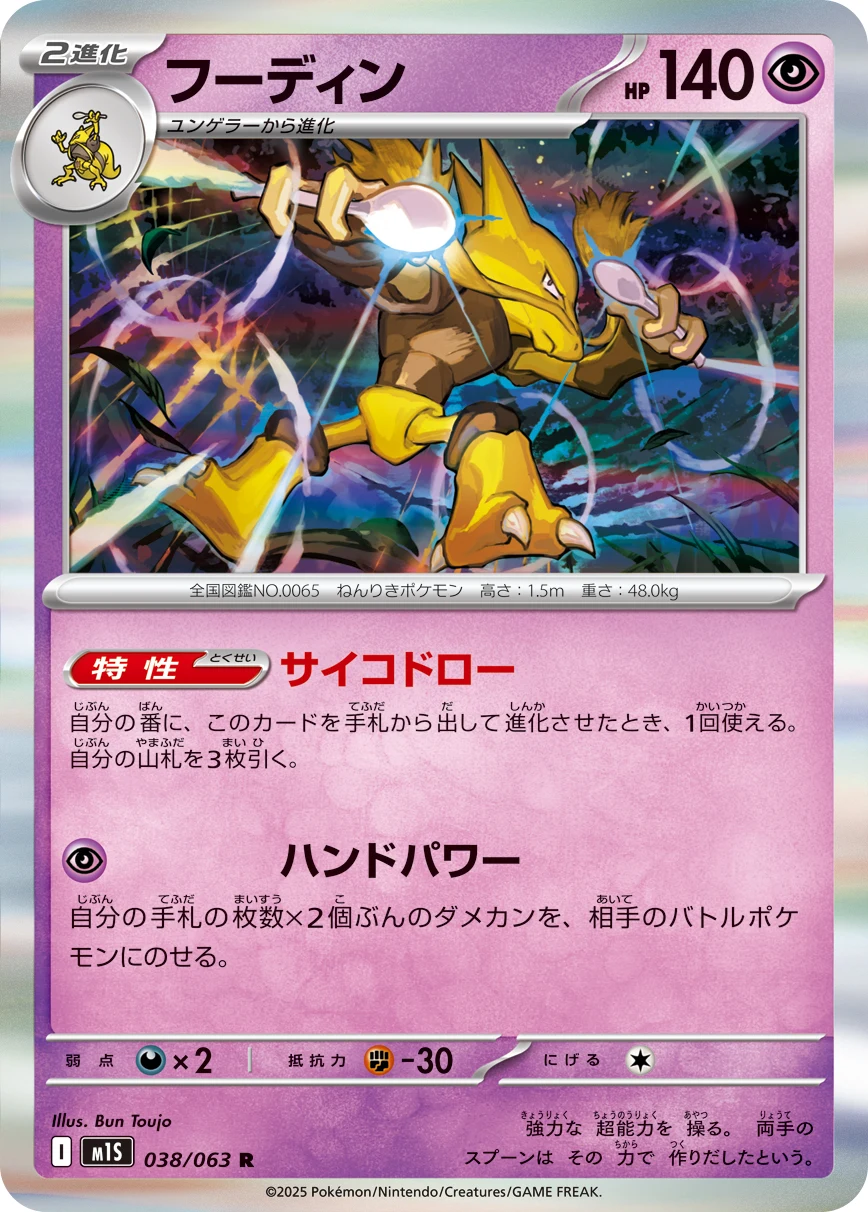
The official beginner guide explains card layout with this Alakazam from メガシンフォニア (M1S Mega Symphonia). The type mark sits at the top right, next to the HP: the guide says the type can be read from the mark at the top right of the card. Alakazam’s bottom bar reads as follows.
弱点 [Darkness symbol] ×2 | 抵抗力 [Fighting symbol] −30 | にげる [one Colorless symbol]
| Japanese label | English term | What follows it on the card | Meaning |
|---|---|---|---|
| 弱点 | Weakness | A type symbol and ×2 on this Alakazam | Damage from that type’s attackers is changed by the printed modifier |
| 抵抗力 | Resistance | A type symbol and a minus number (−30 here) | Damage from that type’s attackers is reduced by the number |
| にげる | Retreat (Retreat Cost) | Colorless symbols | Energy you discard to move this Pokémon from the Active Spot to the Bench |
- Alakazam shows one Colorless symbol for its Retreat Cost. The English rulebook places the Retreat Cost at the bottom right corner of the card.
- In the 2,179-card sample, 90 cards print no Retreat symbol, 1,001 print one, 753 print two, 260 print three and 75 print four.
- Attack costs sit to the left of the attack name. The symbols there are the Energy types the attack needs. A Colorless symbol in a cost can be paid by any type.
The beginner guide numbers 16 parts of the card, including the regulation mark, expansion mark, rarity mark and collection number. If you are matching a Japanese card to a set list, those are the parts to read; our Japanese card list hub collects the set lists.
Example Cards by Type
Each image is the official card image from the Japanese card database.
Grass
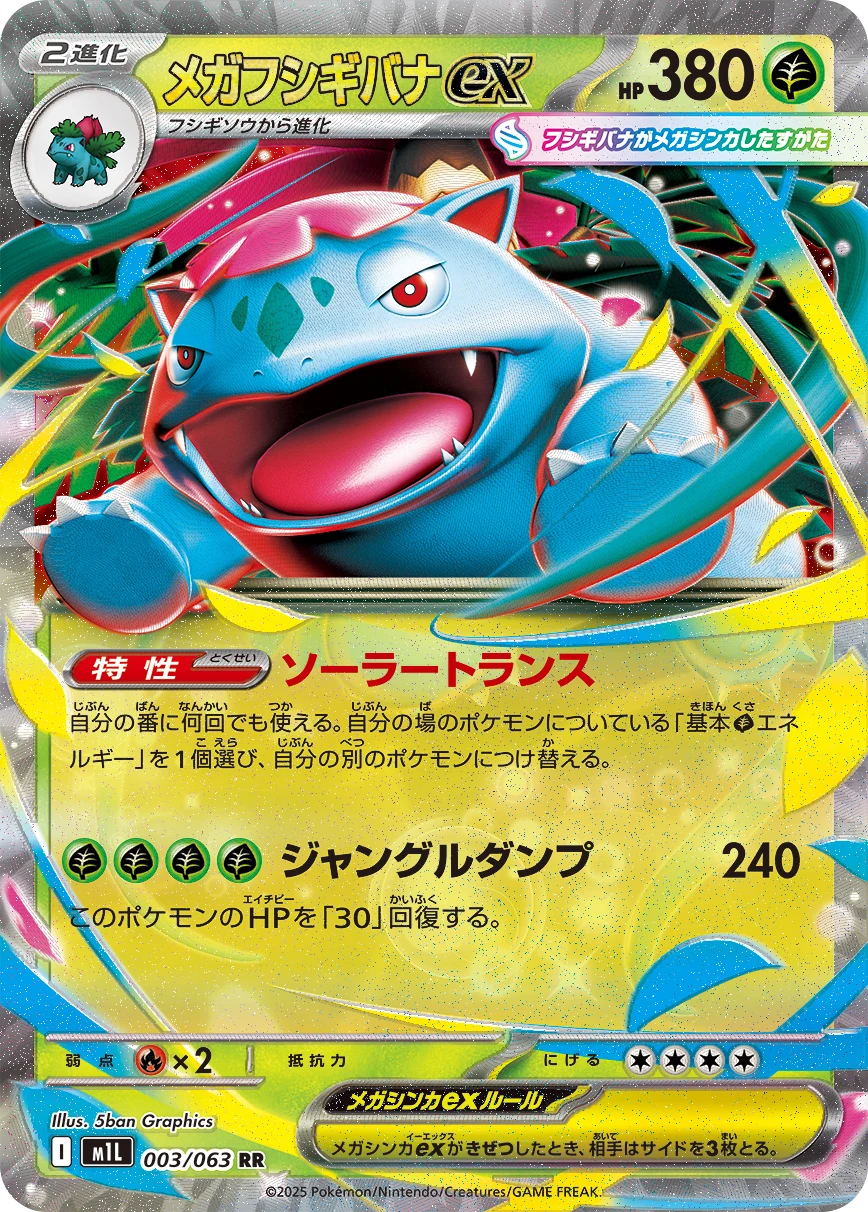
Mega Venusaur ex from M1L Mega Brave: Weakness Fire ×2, no Resistance, Retreat 4. On the checked example, the card text shows くさ above the Grass symbol.
Fire
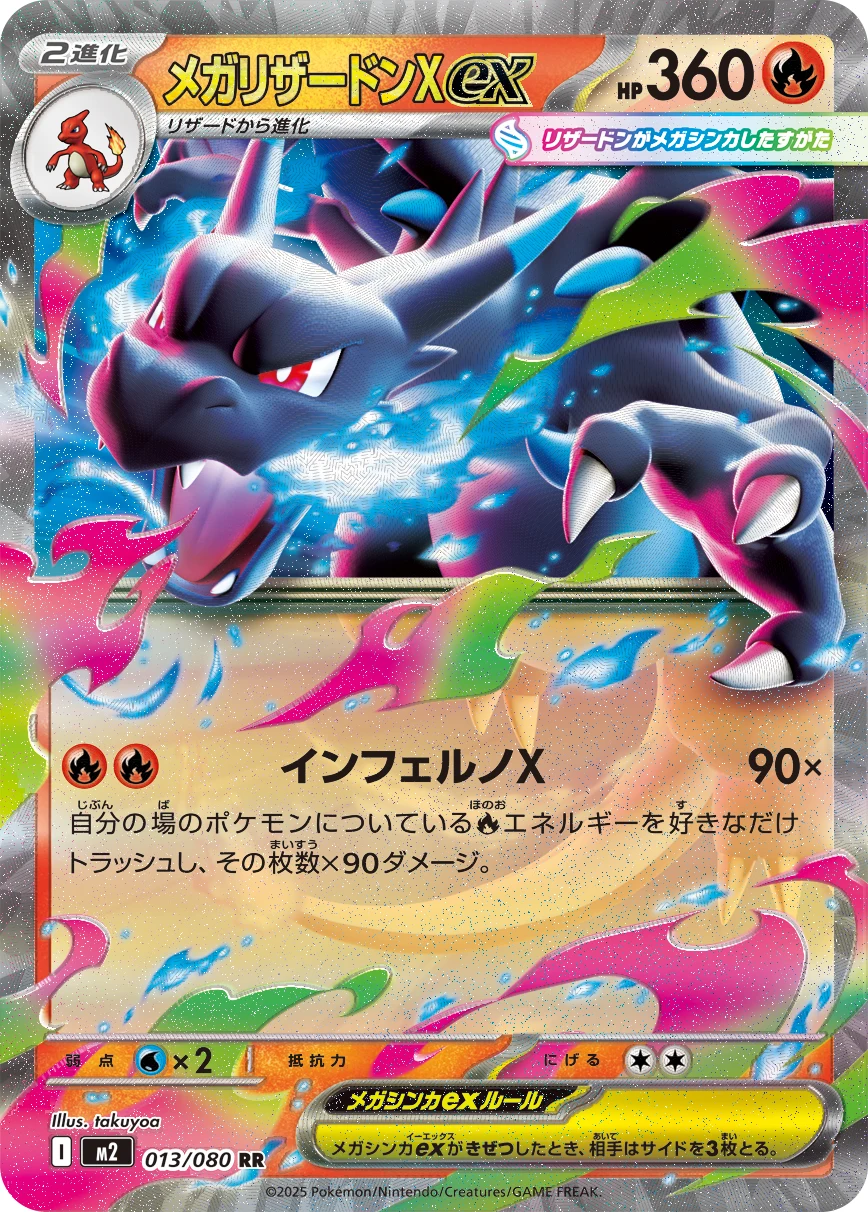
Mega Charizard X ex from M2 Inferno X: Weakness Water ×2, no Resistance, Retreat 2. On the checked example, the card text shows ほのお above the Fire symbol.
Water
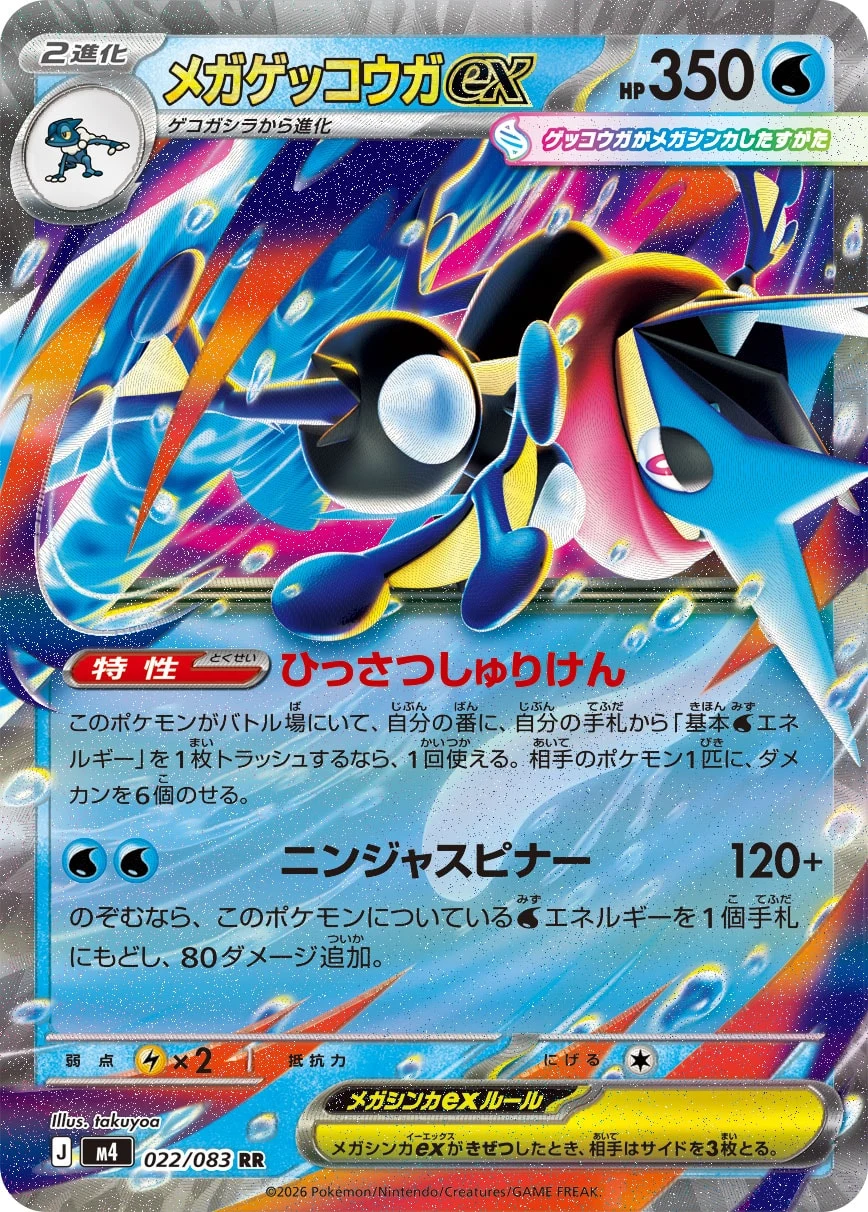
Mega Greninja ex from M4 Ninja Spinner: Weakness Lightning ×2, no Resistance, Retreat 1. On the checked example, the card text shows みず above the Water symbol.
Lightning
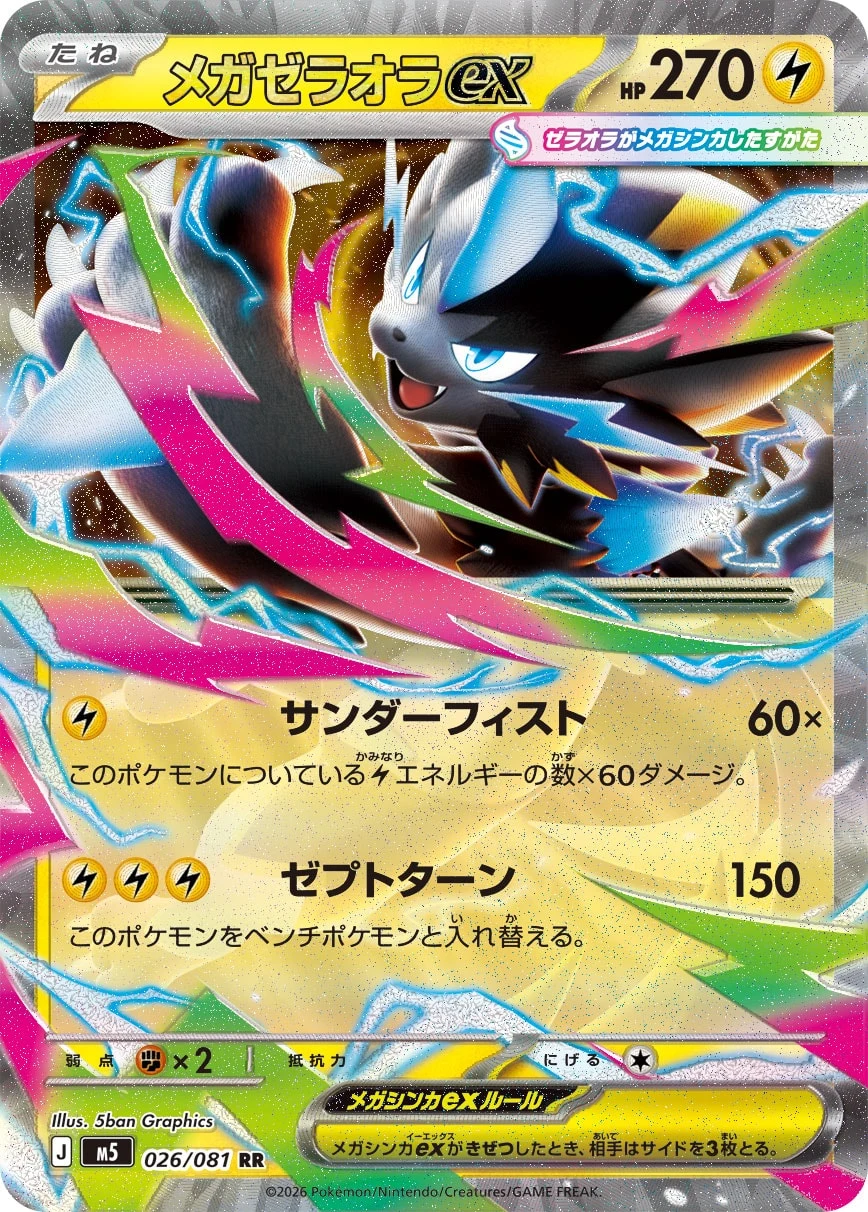
Mega Zeraora ex from M5 Abyss Eye: Weakness Fighting ×2, no Resistance, Retreat 1. On the checked example, the card text shows かみなり above the Lightning symbol.
Psychic
Alakazam from M1S, shown in the section above, is the Psychic example: Weakness Darkness ×2, Resistance Fighting −30, Retreat 1. Mega Gardevoir ex, M1S 042/063, shows ちょう above the Psychic symbol.
Fighting
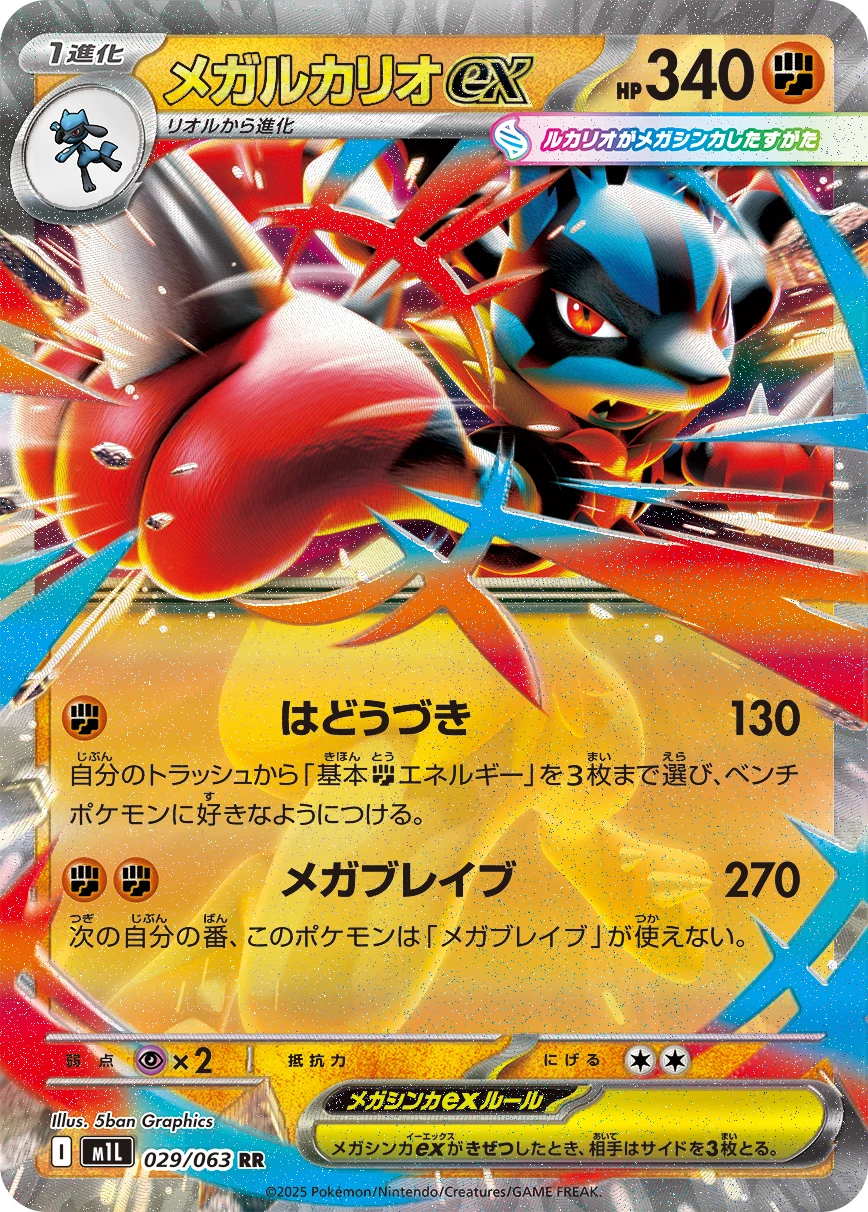
Mega Lucario ex from M1L Mega Brave: Weakness Psychic ×2, no Resistance, Retreat 2. On the checked example, the card text shows とう above the Fighting symbol.
Darkness
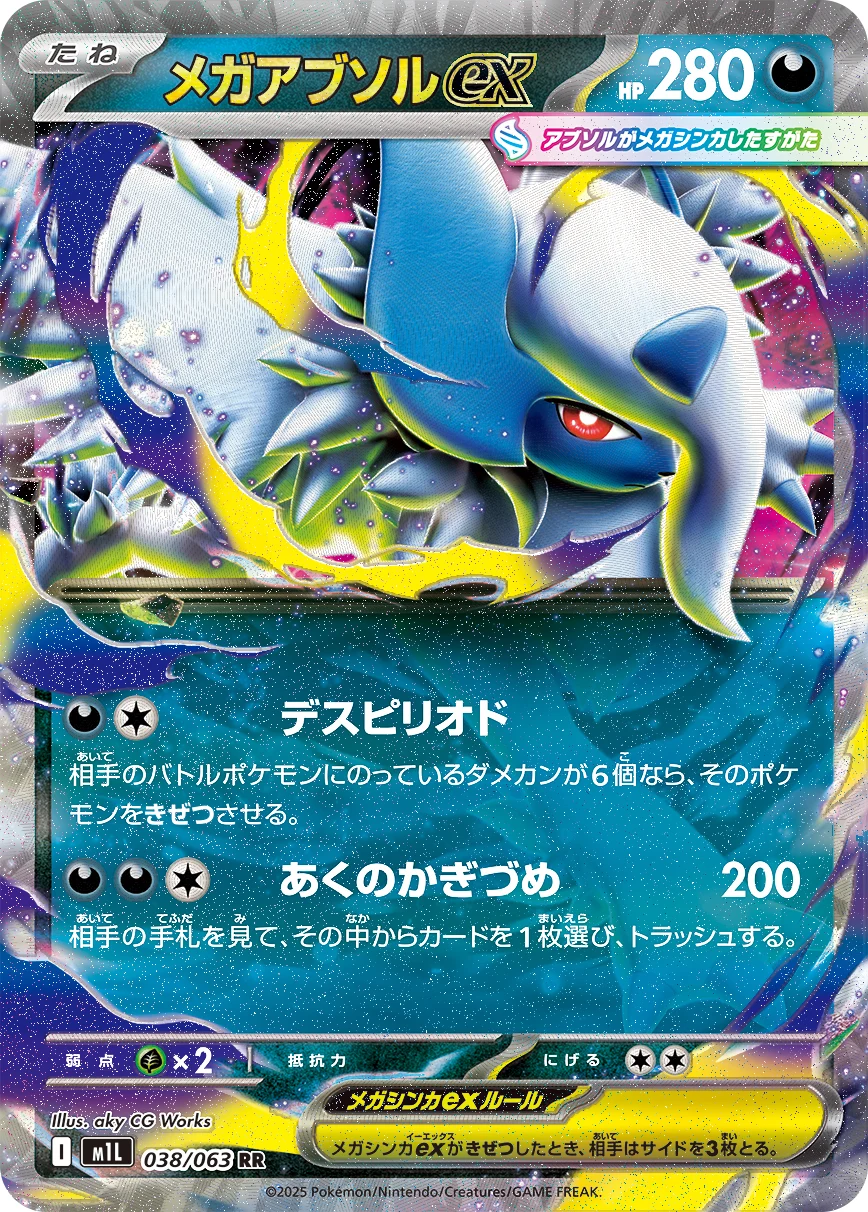
Mega Absol ex from M1L Mega Brave: Weakness Grass ×2, no Resistance, Retreat 2. On a checked Crawdaunt card from the same set, the card text shows あく above the Darkness symbol. For more on this type, see our Dark-type Pokémon cards guide.
Metal
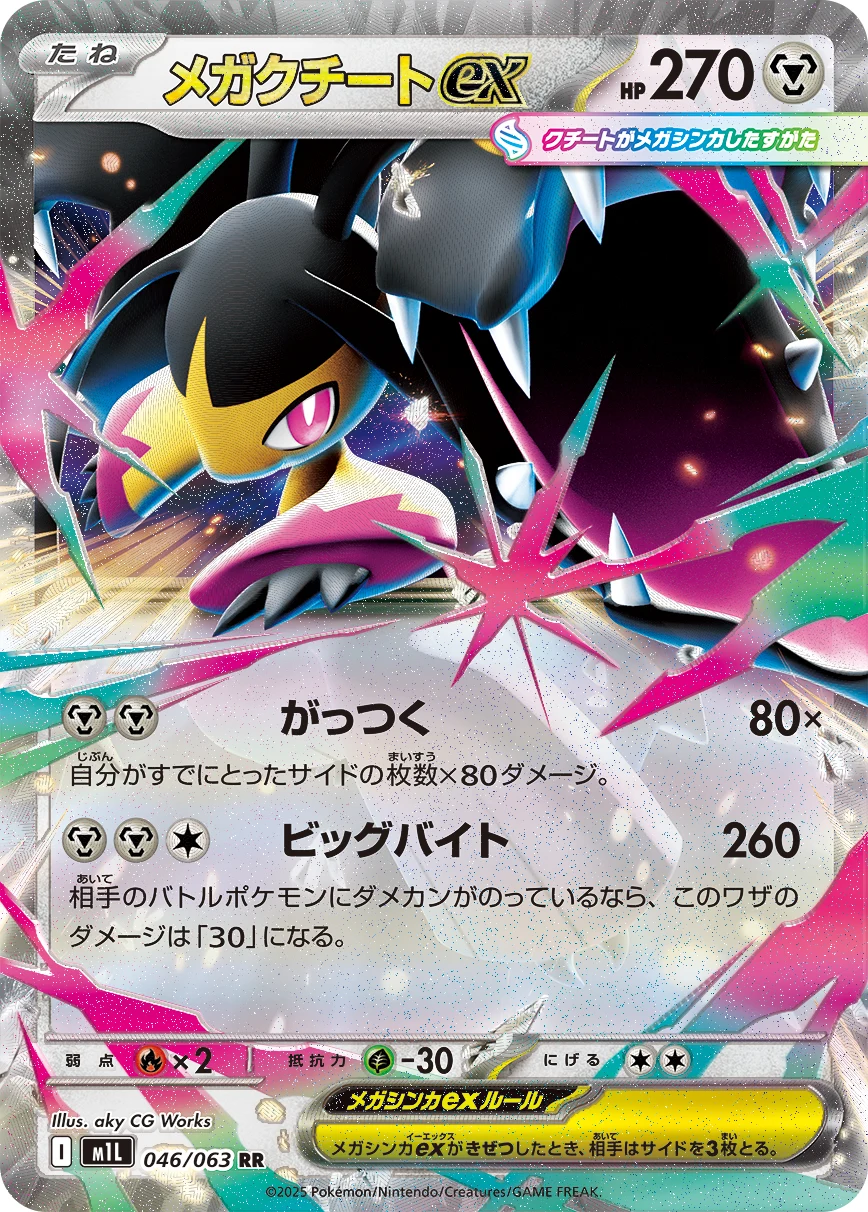
Mega Mawile ex from M1L Mega Brave has Fire ×2 Weakness and Grass −30 Resistance, Retreat 2. Of the 133 sampled Metal cards, 128 showed Fire Weakness and 127 showed Grass −30 Resistance. On a checked Metagross card from M4, the card text shows はがね above the Metal symbol.
Fairy
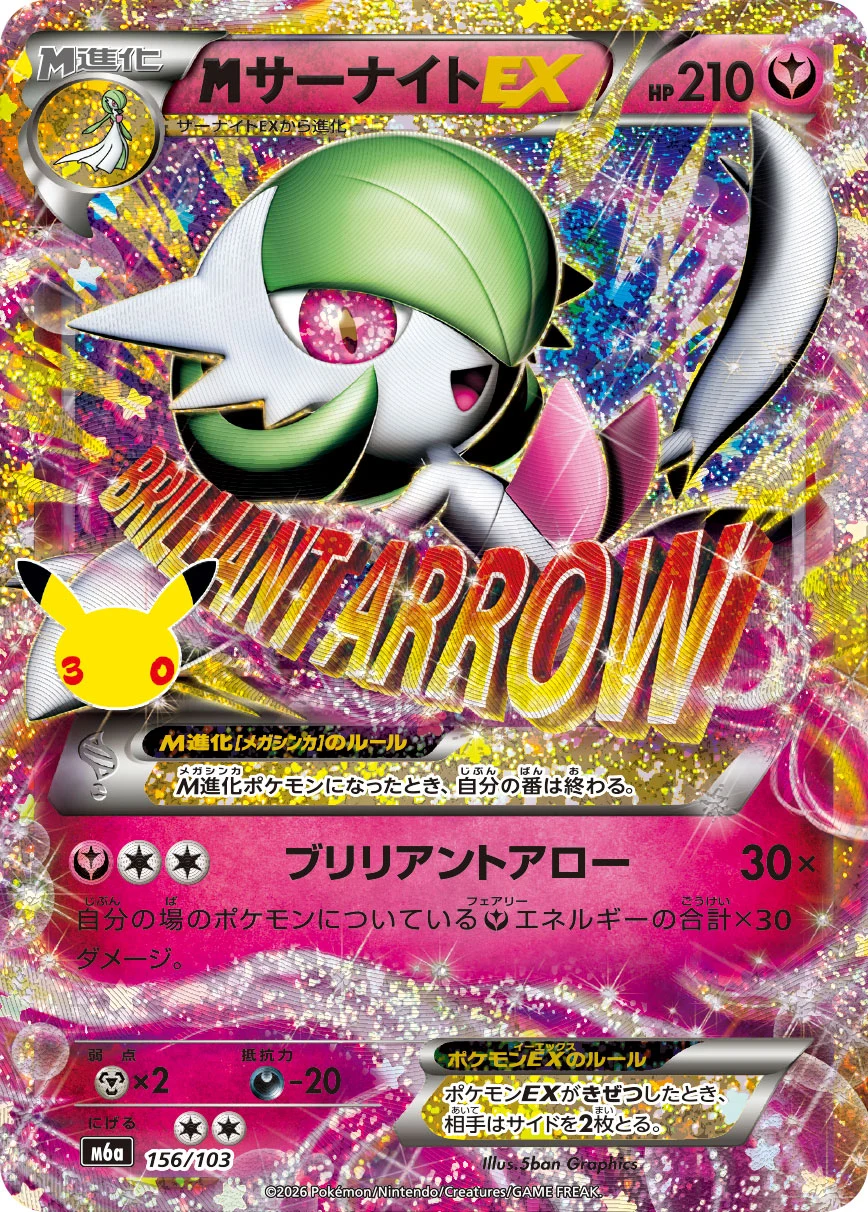
The one Fairy card in the sample is this M Gardevoir-EX from M6a 30th CELEBRATION, a classic-style card with the pink Fairy symbol: Weakness Metal ×2, Resistance Darkness −20, Retreat 2. Our Fairy-type Pokémon cards guide covers the type in more depth.
Dragon and Colorless: the Special Cases
Dragon
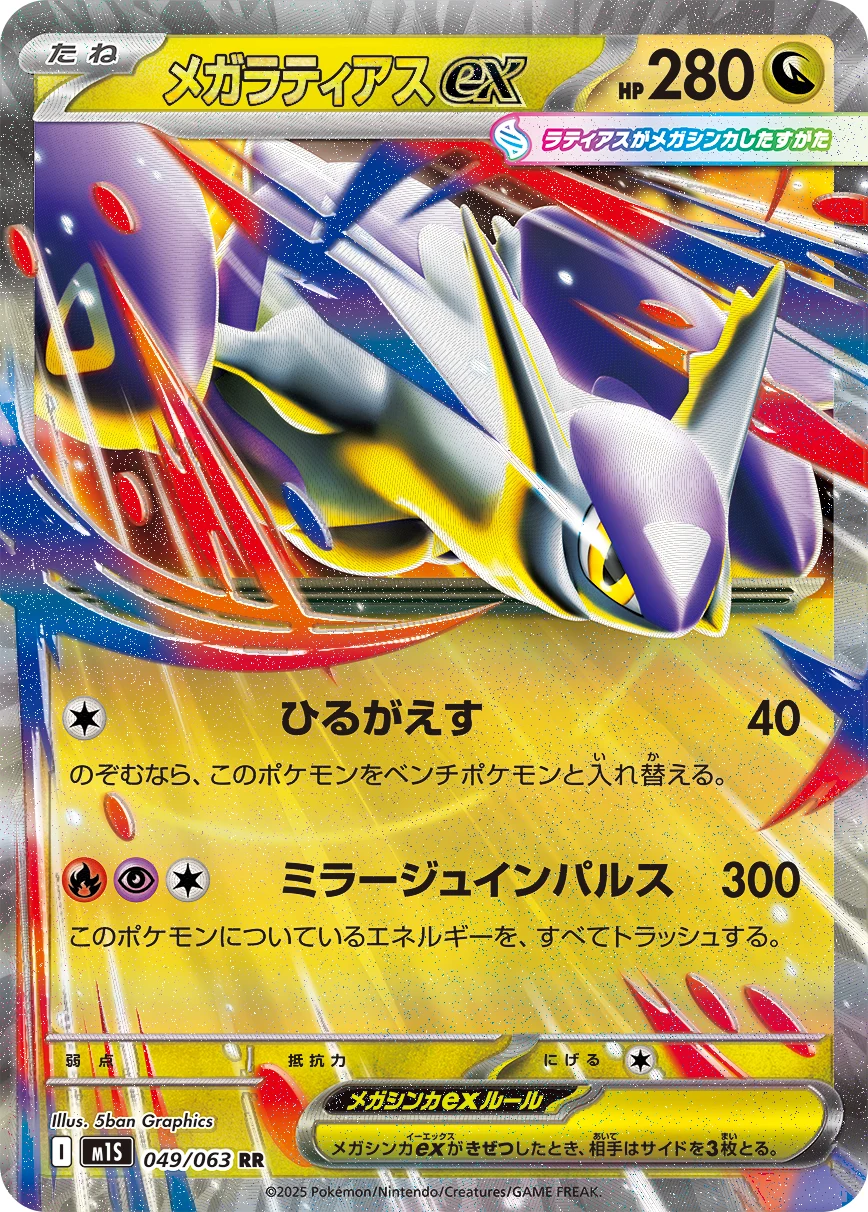
Dragon is a full Pokémon type in the official card search, but it differs from the nine Energy types in two ways:
- No basic Dragon Energy. Mega Latias ex’s second attack, Mirage Impulse (rendering of ミラージュインパルス), costs one Fire, one Psychic and one Colorless Energy.
- Usually no Weakness in the sample. 84 of the 85 Dragon cards in the sample print no Weakness, and none prints a Resistance. The exception is a Rayquaza-EX reprint in M6a, weak to Dragon ×2. Mega Latias ex prints no Weakness and no Resistance, with Retreat 1.
Our Dragon-type Pokémon cards guide looks at the type in more detail.
Colorless
Colorless does two different jobs:
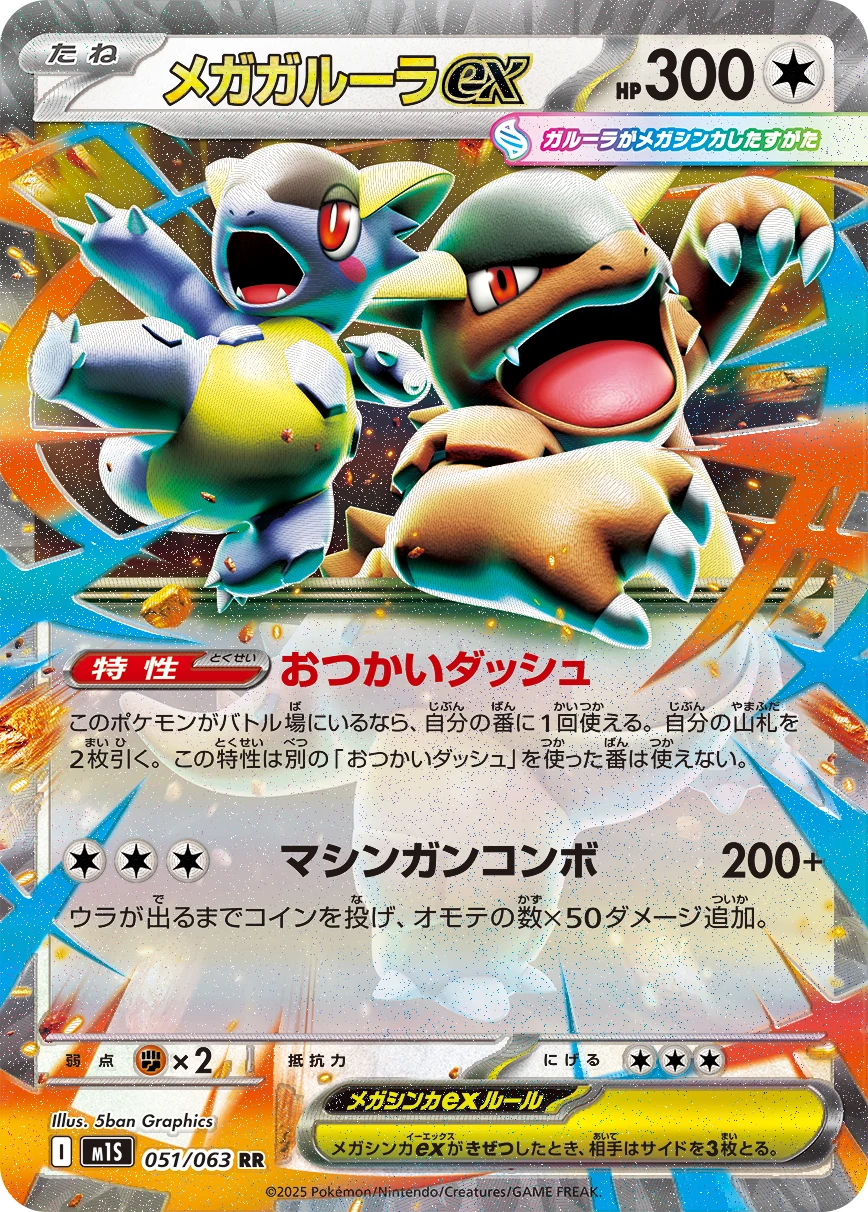
- As a Pokémon type. Mega Kangaskhan ex is a Colorless Pokémon: Weakness Fighting ×2, no Resistance, Retreat 3. Of 226 Colorless cards in the sample, 161 showed Fighting Weakness, 64 Lightning and one Psychic.
- As a cost symbol. In an attack cost, the Colorless star can be paid with any type of Energy.
The Prism Energy image on the official beginner page shows むしょく over the Colorless star.
Jenis kartu vs Video-Game Types
A Pokémon’s card type can differ from its Pokédex type. The Pokédex lists Clefable as Fairy and Mawile as Steel/Fairy. The two cards shown here are Psychic and Metal respectively.
| Pokémon | Type in the official Pokédex | Kartu | Card type |
|---|---|---|---|
| Clefable (ピクシー) | Fairy (フェアリー) | Mega Clefable ex (メガピクシーex), M3 030 RR | Psychic (超) |
| Mawile (クチート) | Steel and Fairy (はがね・フェアリー) | Mega Mawile ex (メガクチートex), M1L 046/063 RR | Metal (鋼) |
No official page cited here maps every video-game type to a card type. The rule for collectors is simple: the card type is the symbol at the top right of the card, whatever the Pokémon’s type is in the games.
A Pokémon can also have two card types. In the sample, a Metagross from M6a is both Lightning and Metal, and the official rule guide quotes the Scovillain ex Ability “Double Type” (rendering of ダブルタイプ), which makes that Pokémon Grass and Fire while it is in play. Single-type posts such as our Water-type Pokémon cards guide and Fire-type Pokémon cards guide look at one type each.
Checklist: Reading Type on a Japanese Card
- Top right, next to HP: the type symbol. Match it to the chart above.
- 弱点 (Weakness): a type symbol plus the modifier to apply. No symbol means no Weakness.
- 抵抗力 (Resistance): a type symbol plus a minus number. In our sample, 1,685 cards showed no Resistance, 489 showed −30 and five showed −20.
- にげる (Retreat): count the Colorless stars; that is the card’s printed Retreat Cost.
- Left of each attack name: the Energy symbols the attack needs. A star can be paid with any type.
- Never assume Weakness from type alone. Water cards, Fighting cards, Darkness cards and Colorless cards each print more than one Weakness type in our sample.
Where to Buy Japanese Pokémon Cards from Japan
These Japanese boxes are listed in our shop:
- M1L Mega Brave Booster Box (Mega Venusaur ex, Mega Lucario ex, Mega Absol ex, Mega Mawile ex) — currently listed at Sealed ¥8,242 / No Shrink ¥7,792
- M1S Mega Symphonia Booster Box (Alakazam, Mega Latias ex, Mega Kangaskhan ex) — currently listed at No Shrink ¥6,598
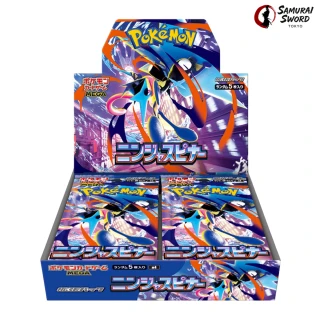
- M4 Ninja Spinner Booster Box (Mega Greninja ex) — currently listed at Sealed ¥9,066 / No Shrink ¥8,573
- M5 Abyss Eye Booster Box (Mega Zeraora ex) — currently listed at No Shrink ¥7,105
- M7 ハドウシーカー (Hadou Seeker) Booster Box — currently listed at Sealed ¥10,500 / No Shrink ¥9,500. ‘Aura Seeker’ is a fan translation.
- M2 Inferno X Booster Box (Mega Charizard X ex) and M2a Mega Dream ex Booster Box
- M6a 30th CELEBRATION Booster Box (M Gardevoir-EX)
Set lists help you check type, number and rarity before you buy single cards: see the M1L Mega Brave card list, the M1S Mega Symphonia card list and the full card list hub. Sourcing requests for a specific card or product go through Pesan Cepat.
Pertanyaan yang Sering Diajukan
How many types are there in the Pokémon TCG?
The official Japanese card search lists 11 types across all regulations: Grass, Fire, Water, Lightning, Psychic, Fighting, Darkness, Metal, Fairy, Dragon and Colorless. Its default Standard view shows ten, without Fairy. The official rule guide lists Basic Energy for 9 of them; there is no basic Dragon or Colorless Energy. The official beginner guide pictures ten Pokémon types, without Fairy.
What are the Japanese names of the Pokémon card types?
草 (kusa) Grass, 炎 (honoo) Fire, 水 (mizu) Water, 雷 (kaminari) Lightning, 超 (chou) Psychic, 闘 (tou) Fighting, 悪 (aku) Darkness, 鋼 (hagane) Metal, フェアリー Fairy, ドラゴン Dragon and 無色 (mushoku) Colorless.
Is there a fixed weakness chart in the Pokémon TCG?
No. Weakness and Resistance are printed on each card, and cards of the same type can differ. Of 263 Water cards in our sample, 188 showed Lightning Weakness, 74 Metal and one none.
How much extra damage does Weakness do?
The rules apply the modifier printed on the card. In our 2,179-card sample, 2,092 cards showed ×2 Weakness and one showed +20. Weakness only affects the Active Pokémon.
What does Resistance −30 mean?
Damage from an attacker of the printed type is reduced by 30. In our sample, 1,685 cards showed no Resistance, 489 showed −30 and five showed −20. Resistance only affects the Active Pokémon.
What do 弱点, 抵抗力 and にげる mean on a Japanese card?
弱点 is Weakness, 抵抗力 is Resistance and にげる is Retreat. The number of Colorless stars after にげる is the Energy you discard to retreat.
Dipilih untuk artikel ini
📩 Diskon & kupon khusus member
Notifikasi sale, kupon, dan restock via email, langsung dari Tokyo.