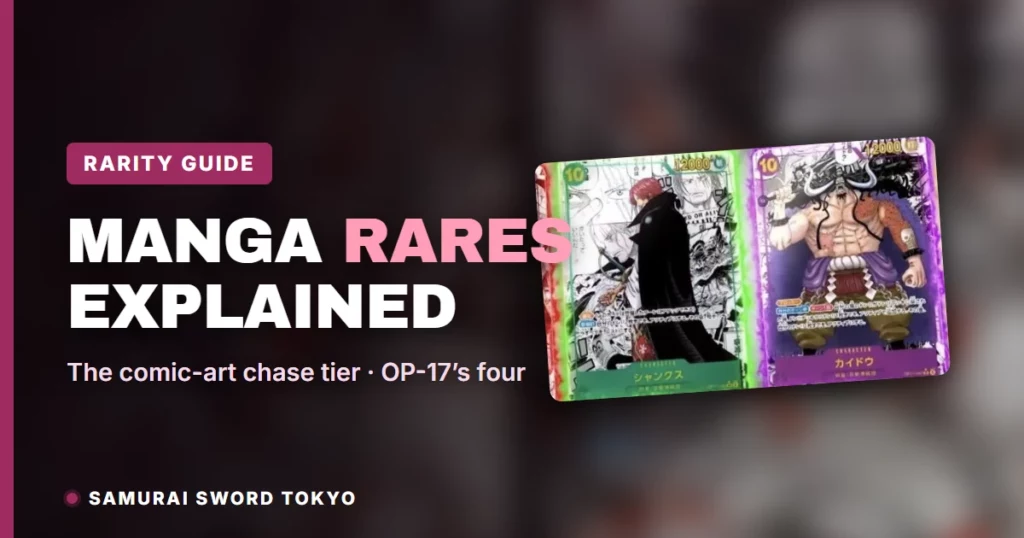

Open enough Japanese One Piece boxes and you learn the hierarchy fast: Commons fill the binder, Super Rares carry the box, Secret Rares get the group chat excited — and then there’s a tier above all of that. A card printed in stark black-and-white, framed like a page torn straight out of the manga, that most people who buy a box will simply never see. Nowhere does that hierarchy get more attention than on a Monkey D. Luffy card, since Luffy sits somewhere on nearly every rarity rung this guide covers, from promo prints to the comic-art chase tier itself.
Collectors call these manga rares, and they have become the defining chase tier of the modern One Piece Card Game. When a new Japanese set is announced, the first question serious collectors ask isn’t “who are the Leaders?” — it’s “who got the manga treatment?” OP-17 released in Japan on Saturday, August 22, 2026, confirming the four manga treatments Bandai’s official reveal program had already shown pre-release — and now that boxes are open, the asking prices on all four confirm they were exactly the kind of characters this tier exists for.
This guide explains what a manga rare actually is, where it sits against SEC, SP, and parallel treatments, showcases the four confirmed OP-17 manga cards with early post-release asking prices, and lays out how to think about chasing one — sealed boxes versus singles — without pretending the odds are something they aren’t. We ship Japanese One Piece sealed product out of Tokyo every week, so the market observations here come from the side of the hobby we trade in daily.
“Manga rare” is the community’s name for the comic-panel-art treatment that appears as the scarcest chase tier in recent Japanese One Piece sets. OP-17 released Saturday, August 22, 2026, with four confirmed manga treatments: Newgate OP17-005, Shanks OP17-022, Kaido OP17-062, and Charlotte Linlin OP17-112. Bandai publishes no official pull rates, but early post-release asking prices already show why the tier headlines set values — Shanks is asking ¥184,000, Newgate ¥120,000, Kaido ¥85,000, and Linlin ¥80,000 (snkrdunk, Aug 24, 2026) — and historically, sets carrying beloved chase cards are the ones whose sealed boxes age best.
Added a Monkey D. Luffy card value section comparing manga-style, Leader, and promo tiers against current shop and SNKRDUNK pricing.
What “Manga Rare” Actually Means
“Manga rare” is not an official Bandai rarity name. You won’t find it printed on the card or listed on a product page. It’s the name the collector community settled on for a specific kind of alternate-art treatment: the card’s artwork is rendered in black-and-white, comic-panel style, lifted directly from the visual language of the One Piece manga — screentone shading, ink linework, sometimes panel framing, as if the card were a page of the source material rather than an illustration of it.
The name stuck because it describes exactly what you’re looking at. Where a Special Art or parallel card gives a character a new painted illustration, a manga-style treatment strips the color away and hands you the character the way readers first met them. For a franchise where the manga is the canon, that carries a weight no painted alternate art quite matches.
Three things define the tier in practice:
- The art style. Black-and-white comic-panel rendering in the manga aesthetic, instantly distinguishable from every other card in the set.
- The frequency. These are ultra-low-frequency alternate treatments — the slot most box openers never hit. Bandai publishes no official pull rates, so nobody can quote you true odds, but community box-opening experience across recent Japanese sets consistently places manga treatments at the very bottom of the frequency ladder, below SEC and SP hits.
- The characters. The treatment is reserved for the franchise’s most iconic figures. It is not handed to filler characters — it goes to Emperors, legends, and story-defining names.
Put those three together — canon-defining art, extreme scarcity, top-tier characters — and you get the card type that headlines set values in recent Japanese One Piece releases.
Manga Rare vs SEC, SP, and Parallels
The modern Japanese One Piece rarity ladder confuses newcomers because several different things all read as “the rare one.” OP-17’s official reveal program is a perfect live example, because Bandai has already shown cards at each tier. Here’s how the ladder works, from bottom to top of the chase hierarchy:
| Tier | What it is | Confirmed OP-17 example |
|---|---|---|
| SR (Super Rare) | The standard high-rarity slot; multiple per box is normal | Usopp OP17-080, Luffy OP17-093, Newgate OP17-005 |
| Leader / Super Leader Parallel | Alternate-art version of a Leader card; the “Super” parallels are a scarcer, showpiece version | Super Leader Parallel Luffy OP17-079 |
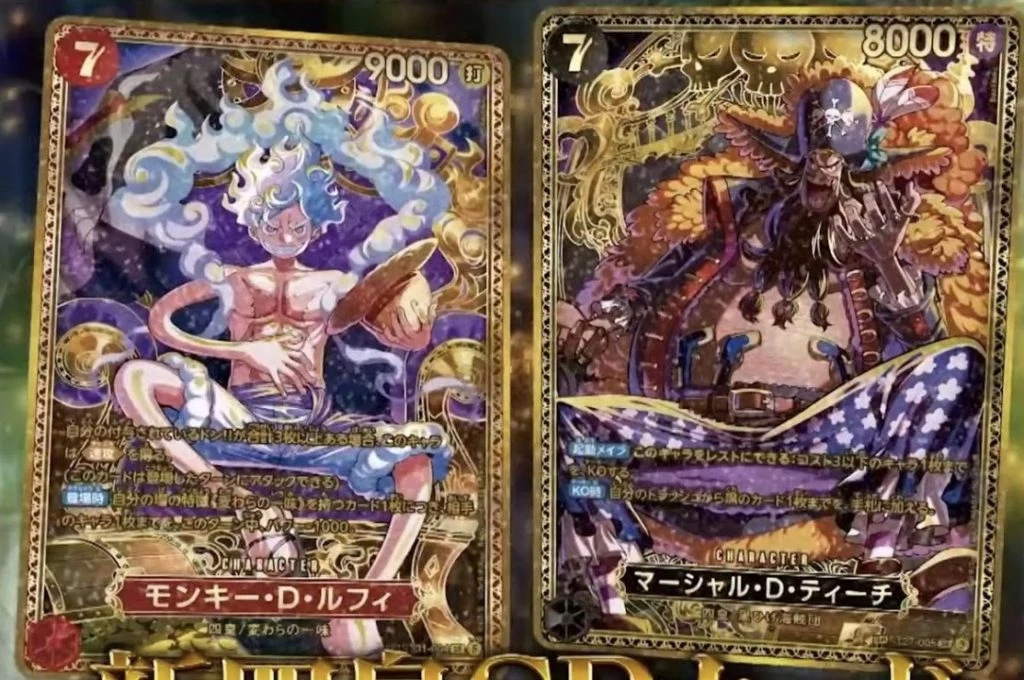
| SP treatments | Special alternate-art slots, often themed as a group within the set | New Emperor SP (Luffy, Teach, Shanks, Buggy) and Haki-style SP pairs (Garp/Roger, Yamato/Rayleigh, Zoro/Oden) |
| SEC (Secret Rare) | Numbered beyond the main set list; the official top printed rarity | Loki OP17-119 — the first confirmed OP-17 SEC |
| Manga treatment | Comic-panel black-and-white alternate art; community-named top chase tier | Newgate OP17-005, Shanks OP17-022, Kaido OP17-062, Linlin OP17-112 |
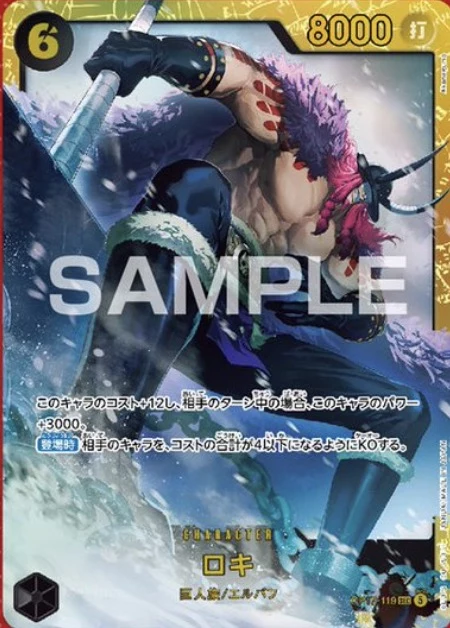
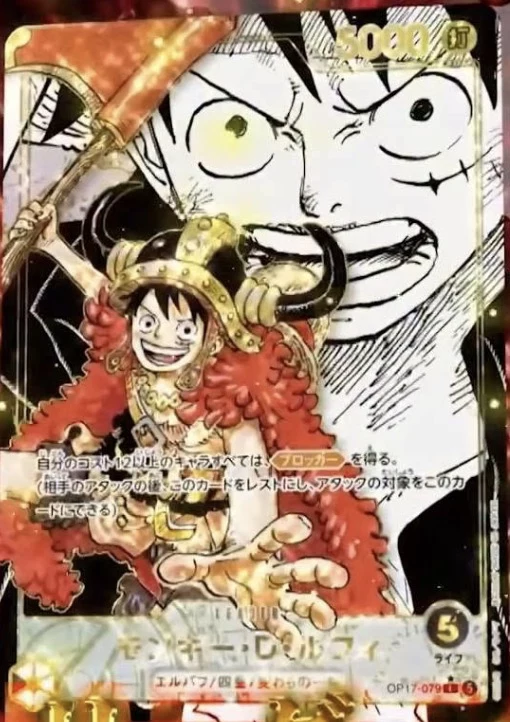
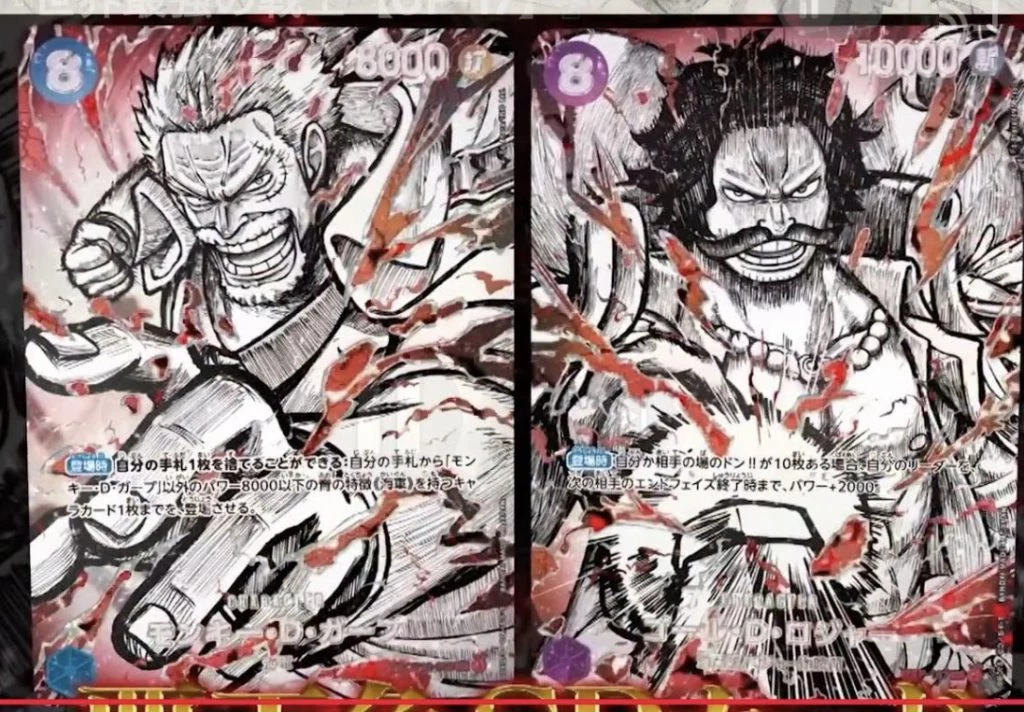
The key distinction: SEC is a rarity; the manga treatment is an art style applied at the scarcest frequency. A Secret Rare like Loki OP17-119 occupies a defined slot at the end of the set list. A manga treatment is an alternate version of a card that also exists in a normal printing — Newgate OP17-005, for instance, was revealed both as a standard SR (12000 power, cost 10) and as a manga treatment of the same card number. Same card in a deck; wildly different card in a collection.
SP treatments sit in between. OP-17’s New Emperor and Haki-style SP groups are genuine chase cards — themed alternate-art runs featuring pairs and groups of legends — but community experience across recent sets puts them above SR frequency-wise while still well short of the manga tier’s scarcity. Again: none of this is official. Bandai does not publish pull rates, so every frequency comparison here is pattern observation from Japanese box openings, not printed odds.
For the full OP-17 chase hierarchy card by card, see our OP-17 chase cards guide.
The Four Confirmed OP-17 Manga Treatments
OP-17 — Japanese set name 「世界最強の戦士」 (“The World’s Strongest Warrior”) — released in Japan on Saturday, August 22, 2026, confirming the full manga lineup Bandai’s official reveal program had shown pre-release: four cards, four Emperors-and-legends-tier characters. This is the group shot from the official program:

| 카드 | Number | Why this character | Asking Price (snkrdunk, Aug 24) |
|---|---|---|---|
| Edward Newgate (Whitebeard) | OP17-005 | The “World’s Strongest Man” in a set literally named for the world’s strongest warrior — the thematic centerpiece | ¥120,000 |
| Shanks | OP17-022 | Emperor, franchise icon, and one of OP-17’s revealed Leaders (OP17-020); perennial top-of-market demand | ¥184,000 |
| Kaido | OP17-062 | The “Strongest Creature,” also anchoring the set as a Leader (OP17-058) | ¥85,000 |
| Charlotte Linlin (Big Mom) | OP17-112 | Emperor, completing a manga lineup drawn entirely from the top of the power scale | ¥80,000 |
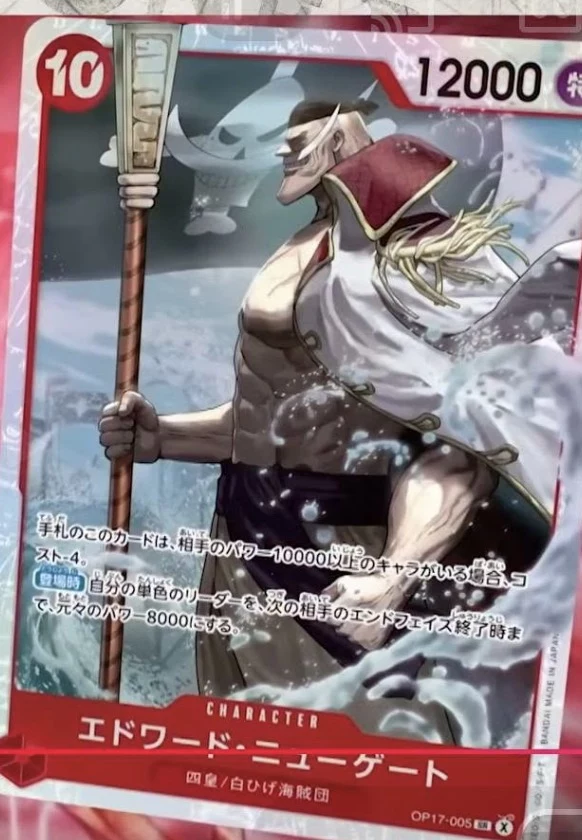
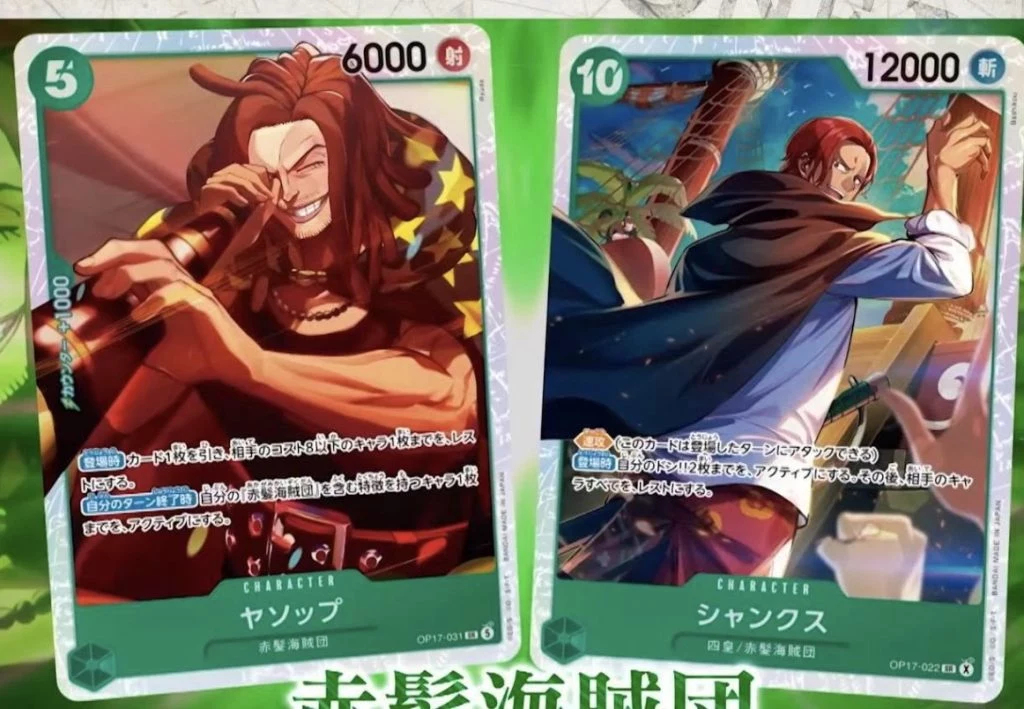
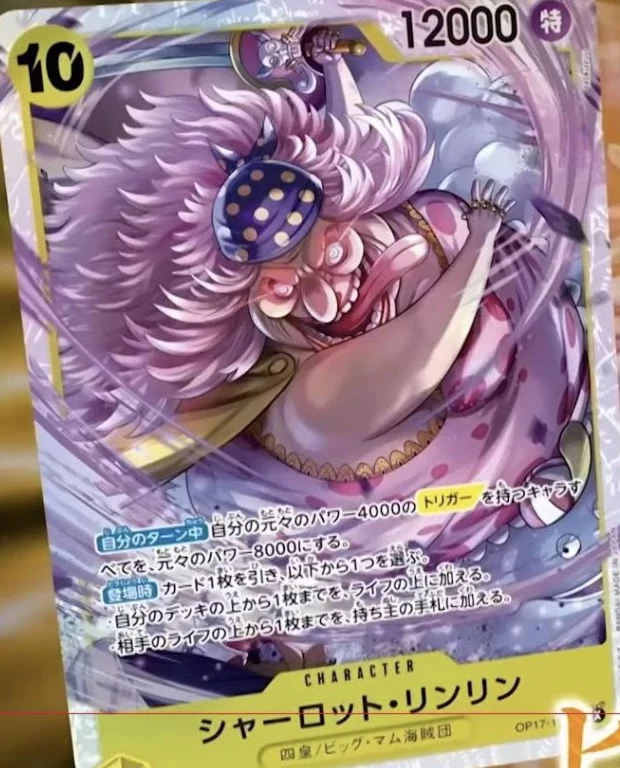
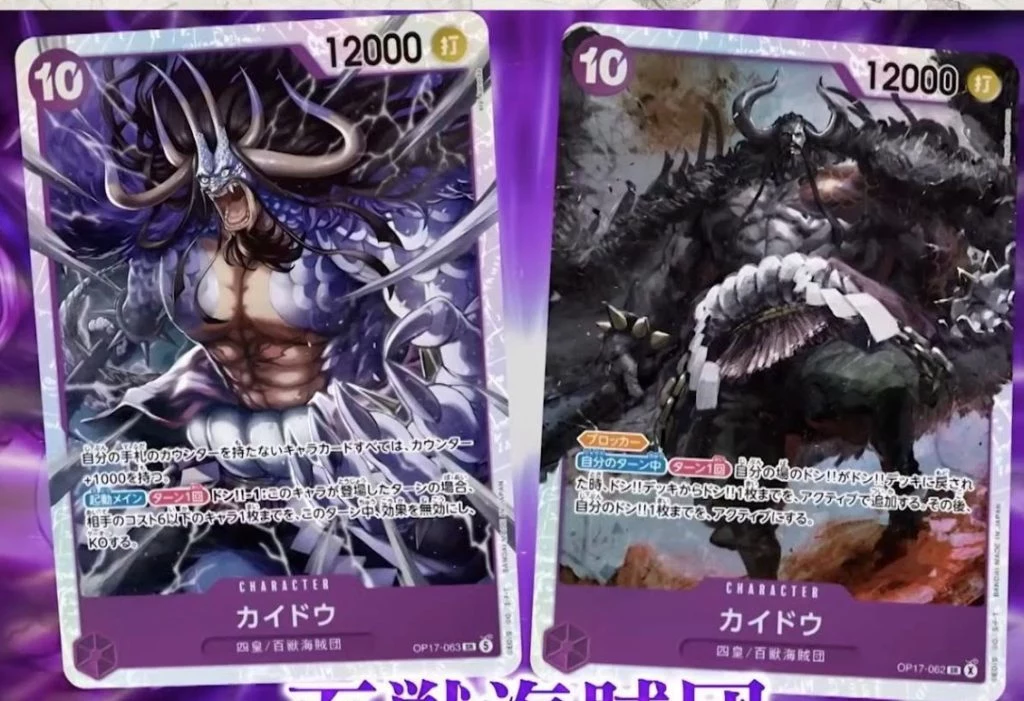
With the set two days into release, secondary marketplaces give us the first real read on both price and rarity. On snkrdunk (asking prices, Aug 24, 2026), Shanks OP17-022 leads the four at ¥184,000, followed by Newgate OP17-005 at ¥120,000 (a used copy is also asking ¥198,000), Kaido OP17-062 at ¥85,000, and Charlotte Linlin OP17-112 at ¥80,000. These are asking prices, not confirmed sales, and the market is only days old — treat them as a snapshot, not a settled valuation. Pull-rate estimates are circulating too, though sources disagree with each other: community trackers put the manga tier at roughly 1 in 65–100 boxes, depending on which site’s box-opening data you trust. Bandai has never published an official rate and this range stays unofficial — but it’s consistent with the bottom-of-the-ladder frequency this guide describes above.
One more thing the early market has clarified: OP-17 also introduced a treatment that sits above the manga tier. The 海賊団スーパーパラレル (“Pirate-Crew Super Parallel”) is a new 4th-anniversary treatment reserved for just two cards, Luffy EB04-061 and Rocks D. Xebec OP17-118, and it’s a different animal from the manga rares — a separate treatment tier from the black-and-white comic-panel manga rares. Early asking prices far exceed even the manga tier: Luffy’s copy is asking into seven figures (¥1,300,000) and Rocks D. Xebec sits at ¥540,000 (snkrdunk, Aug 24, 2026). Worth knowing about, but don’t confuse it with the manga rares this guide covers — it’s a separate, even scarcer chase slot above them.
Notice the pattern in who was chosen for the manga tier. This isn’t a random sampling of the set — it’s Whitebeard, Shanks, Kaido, and Big Mom. Every one of them is an Emperor or Emperor-equivalent, every one of them anchors major arcs, and two of them (Shanks and Kaido, plus Linlin at OP17-099) also headline the set’s revealed Leader lineup. Bandai reserved the tier for the exact characters whose manga panels fans already have burned into memory. That selection logic is the whole point of the treatment — and it’s exactly why these four were the cards everyone was watching when Japanese boxes cracked open on release weekend, and why they’re already commanding the asking prices above.
Bandai’s official complete card list was not yet published as of this update (Aug 24, 2026), though the confirmed hit lineup — SEC, TR, leaders, and the Pirate-Crew Super Parallel slot above — is well established via secondary card-list trackers at this point. Our OP-17 release date, card list, and pre-order guide tracks every confirmed reveal as it lands, and OP-17 boxes (update: currently sold out — restock requests via Quick Order) are not listed at the time of this update — sourcing requests go through 빠른 주문.
Monkey D. Luffy Card Value: Manga Rare vs Leader vs Promo
Because Luffy appears across nearly every rarity tier Bandai prints, a “Monkey D. Luffy card” is not one price point — it’s a range that runs from four figures to seven figures depending entirely on the treatment. The table below lines up a promo, a Leader card, the OP-17 Leader Parallel already covered above, and a comic-parallel Luffy card so the tier itself — not the character — is doing the explaining.
| Tier | 카드 | 가격 |
|---|---|---|
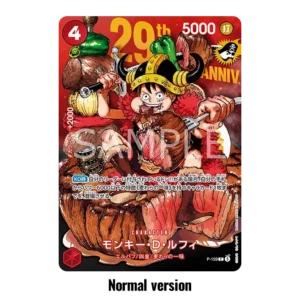
| Promo (P) | Monkey D Luffy PROMO P-159 (No holo), Shonen Jump 2026 29th Anniversary | Currently listed at ¥1,200 (~$8) |
| Leader (L) | PSA10 Monkey.D.Luffy L [OP05-060] (PSA Exclusive Collaboration Promo Card) | Currently listed at ¥115,104 (~$747) |
| Leader Parallel (manga-style alt art) | Monkey.D.Luffy L-SP (Manga Alt Art), Super Leader Parallel [OP17-079] | Lowest asking price on SNKRDUNK as of September 15, 2026 (any condition): ¥100,000 |
| Comic Parallel (SEC-SP) | PSA10 Monkey.D.Luffy SEC-SP (Comic Parallel) [OP09-119] | Currently listed at ¥427,248 (~$2,774) |
That Leader Parallel row is the same Super Leader Parallel Luffy OP17-079 named in the rarity-tiers table above — SNKRDUNK’s own listing name calls it “Manga Alt Art” even though it’s a Leader Parallel rather than one of the four confirmed OP-17 manga treatments, which is worth knowing if you’re searching marketplaces by name rather than card number. And Luffy’s reach goes a tier higher still: the 4th-anniversary Pirate-Crew Super Parallel print of Luffy EB04-061, noted above, sits above even the comic-parallel row in this table. Whichever tier you’re chasing, condition and centering matter just as much on a Luffy card as they do on Newgate, Shanks, Kaido, or Linlin — the grading notes further down apply here too.
Why Manga Rares Lead Set Values
In recent Japanese One Piece sets, manga-style treatments have consistently sat at or near the top of the singles market for their set. Three forces stack to put them there:
- Scarcity. These are the lowest-frequency treatments in the product. Bandai never publishes odds, but the community’s box-opening experience is unambiguous: this is not a “one per box” or even a reliably “one per case” conversation. Most people who open a box of a set will never personally pull its manga cards. Supply per set is tiny relative to the number of collectors who want one.
- Art. The manga aesthetic is unique within each set. Painted alternate arts compete with each other; the black-and-white comic treatment competes with nothing. It photographs distinctively, displays distinctively, and is instantly recognizable across a room — the qualities that make a card a grail rather than just an expensive pull.
- Character. Because the treatment is reserved for franchise-defining names, the demand base isn’t just One Piece TCG players — it’s the much larger population of One Piece fans. A manga-treatment Shanks or Whitebeard sells to people who have never sleeved a deck.
What this does to sealed boxes
Here’s the part that matters if you buy sealed product: sets whose chase tier stays desirable are the sets whose boxes age well. Our own store’s Japanese One Piece box ladder makes the pattern concrete:
| Set | SST price (Aug 2026) | Status |
|---|---|---|
| OP-01 Romance Dawn | ¥43,050 | Recent store price (out of stock) |
| OP-05 | ¥67,200 | Recent store price (out of stock) |
| OP-11 | ¥36,575 | Recent store price (out of stock) |
| OP-16 The Time of Battle | ¥9,600 | Currently listed |
Every one of those boxes left the factory at a comparable MSRP — OP-17’s official math is 24 packs × ¥240 = ¥5,760 per box. Yet the older, chase-led sets now sit at three to five times the price of the newest release. OP-05 at ¥67,200 versus OP-16 at ¥9,600 is not a statement about gameplay; it’s a statement about what happens when a set’s top cards stay wanted after the print run ends. That is a historical observation about how chase-led Japanese sets have behaved, not a promise about any future set — but it’s the observation that explains why collectors pay attention to a set’s manga lineup before deciding how much sealed product to hold.
Scarcity cuts both ways. A tiny number of copies means thin markets, and thin markets move on few transactions — in both directions. Manga rares lead set values because of durable demand, not because every one of them goes up forever. Buy the card or the box because you want it; treat any appreciation as a bonus.
Collecting and Grading Manga Rares
If you do land one — pulled or purchased — a few practical realities of the tier are worth knowing.
상태 sensitivity is extreme. At the top of a set’s value ladder, the gap between a flawless copy and a lightly played one is proportionally enormous. Modern Japanese alternate-art cards use textured and treated surfaces that show handling — edge whitening, surface scuffs, corner touches — far more readily than a standard holo. A card that headlines its set deserves to go straight from pack to sleeve to semi-rigid holder, ideally without a bare-fingered second pass around the table.
Grading changes the market you sell into. For chase-tier cards, graded copies and raw copies are effectively different products with different buyers. A high-grade slab removes condition doubt for remote buyers, which matters most precisely on the cards where every scratch is expensive. If your copy comes out of the pack clean, grading is the natural path; if it has a visible flaw, the calculus is much less automatic, because the flaw is priced in either way.
Centering is the silent killer. Print centering is decided at the factory, not by your handling. When you’re buying a manga-treatment single, look at centering first — it’s the defect you can actually screen for from photos, and it’s a major driver of whether a card can achieve top grades.
Japanese printings are the originals. Japanese sets release first — OP-17’s English version follows after an unusually short gap for a mainline set, with pre-release August 21 and full release August 28, 2026, at USD 4.99 MSRP per pack — but the Japanese printing remains the first-edition-style original that Japanese-market collectors chase. If you’re grading for the long term, that provenance is part of the appeal of buying Japanese.
How to Chase One: Sealed Boxes vs Singles
There are exactly two routes to a manga rare, and being honest about the math of each is the difference between a good experience and an expensive lesson.
Route 1: Open sealed product
The truth first: a sealed box is not a reliable path to a manga rare, and anyone who tells you otherwise is selling something. Bandai publishes no pull rates, and community experience across recent Japanese sets puts manga treatments at case-level-or-beyond frequency — for OP-17 specifically, early community estimates cluster around 1 in 65–100 boxes, though sources conflict and none of it is official. Buy sealed product because you want the opening experience, the SR/SEC/SP hits along the way, and the sealed-box position itself — with the manga slot as a lottery ticket riding on top, never as the plan.
Where sealed does make structural sense:
- You want exposure to the whole hit ladder, not one card — a box delivers SRs reliably and a shot at everything above.
- You believe in the set’s long-term profile. The OP-01/OP-05/OP-11 ladder above is what a strong set’s sealed boxes have historically done; a chase lineup this iconic is one of the ingredients.
- Cases beat boxes for distribution. Higher-rarity slots spread across a 12-box case more evenly than any single box — still no guarantees, but better coverage of the ladder. Our OP-17 pull rates and best cards guide breaks down the box-versus-case decision in detail.
OP-17 itself (update: currently sold out — restock requests via Quick Order) is not listed at the time of this update if you want to open your own — sourcing requests go through 빠른 주문.
Route 2: Buy the single
If the manga card is the only thing you want, buying the single after release is almost always the cheaper route than opening your way to it — that’s simply what ultra-low-frequency odds do to expected cost. The trade-off is timing: chase-tier singles launch expensive on thin early supply, and early prices on a handful of transactions are noisy. Patient buyers typically watch the first weeks of openings before committing.
The balanced plan
- Decide which you actually want: the card, or the experience plus the sealed position. Fund those separately.
- If sealed: order Japanese early — allocation on hyped Japanese sets tightens fast, and the pre-order market is anchored by shop allocations rather than deep supply. The OP-17 pre-order guide covers current availability.
- If singles: set a target price before release-day adrenaline sets it for you.
- Either way, know the alternative lottery formats too — our One Piece god pack guide explains the other famous long-shot in Japanese One Piece products.
And if you’re new to importing: buying Japanese product from Japan is more straightforward than most collectors expect — our guide to buying One Piece cards from Japan walks through the whole process.
Where to Buy Japanese One Piece Boxes
We’re a Tokyo exporter shipping Japanese sealed One Piece product worldwide with tracked delivery, including Luffy singles across every tier this guide covers. OP-17 released in Japan on Saturday, August 22, 2026:
Want the sealed box instead? OP-17 The World’s Strongest Warriors Booster Box (Japanese) (update: currently sold out — restock requests via Quick Order) is not listed at the time of this update — sourcing requests go through 빠른 주문. Prefer the prior mainline set at a lower entry point? OP-16 The Time of Battle is currently listed at ¥9,600 (~$62).
For singles, other sets, or building a mixed order, our Quick Order page is the fastest route. And for everything confirmed about OP-17’s reveals, dates, and allocation notes, keep the OP-17 pre-order guide bookmarked.
자주 묻는 질문
What is a manga rare in the One Piece Card Game?
“Manga rare” is the collector community’s name for an ultra-scarce alternate-art treatment in which the card is rendered in black-and-white, comic-panel style drawn from the One Piece manga’s aesthetic. It is not an official Bandai rarity name — it describes an art treatment applied at the lowest frequency in recent Japanese sets, reserved for the franchise’s most iconic characters.
How much is a Monkey D. Luffy card worth?
It depends entirely on the tier. The raw promo P-159 is currently listed at ¥1,200, the PSA10 Leader OP05-060 at ¥115,104, and the PSA10 comic parallel OP09-119 at ¥427,248 — the rarity tier and treatment drive the price far more than the character.
Which manga rares are confirmed for OP-17?
Four, per Bandai’s official reveal program: Edward Newgate (Whitebeard) OP17-005, Shanks OP17-022, Kaido OP17-062, and Charlotte Linlin OP17-112. OP-17 released August 22, 2026, and Bandai’s complete official card list was not yet published as of this update (Aug 24, 2026), though the confirmed hit lineup is well established via secondary trackers.
What are the pull rates for manga rares?
Nobody can tell you honestly, because Bandai publishes no official pull rates for One Piece boosters. Community box-opening experience across recent Japanese sets places manga treatments at the very bottom of the frequency ladder — scarcer than SEC and SP hits, at case-level or beyond. For OP-17 specifically, early community estimates cluster around 1 in 65 to 1 in 100 boxes, but sources conflict and every figure you see quoted anywhere — including this range — is an estimate, not printed odds.
How is a manga rare different from a Secret Rare (SEC)?
SEC is an official rarity — a card numbered beyond the main set list, like Loki OP17-119 in OP-17. A manga treatment is an alternate-art version of a card that also exists in a normal printing, done in the black-and-white comic style. In recent sets the manga treatments have been scarcer than the SEC and have typically led the set’s singles market.
Is buying a sealed box a good way to get a manga rare?
Not if the manga card is the only thing you want — at ultra-low frequencies, buying the single is almost always cheaper than opening your way to it. Sealed boxes make sense when you want the opening experience, the full hit ladder, and the sealed position itself, with the manga slot as upside rather than the plan.
When does OP-17 release?
The Japanese version released Saturday, August 22, 2026 (¥240 per 6-card pack, 131+4 card types, 24 packs per box). The English version follows after an unusually short gap for a mainline set: pre-release began August 21, with full release August 28, 2026, at USD 4.99 MSRP per pack.
¥500 할인, 저희가 드립니다
- ¥30,000 이상 주문 1건에 ¥500 할인
- 해당 주문에 포인트 +1% 추가 적립
- 계정당 쿠폰 1장
로그인 또는 회원가입 후 받기 · 계정당 1회 사용 · 주문당 쿠폰 1장 · 예약 판매 상품 제외 · 2026년 9월 24일 23:59 (JST) 종료 · 수입 관세, 세금 및 통관 수수료는 가격에 포함되어 있지 않으며 배송 시 부과됩니다. 관세를 선납하여 발송하는 지역은 예외입니다.
이 글에 맞춰 고른 상품
📩 Get member-only sale alerts & coupons
Sale alerts, coupons and restock notices by email — straight from Tokyo.