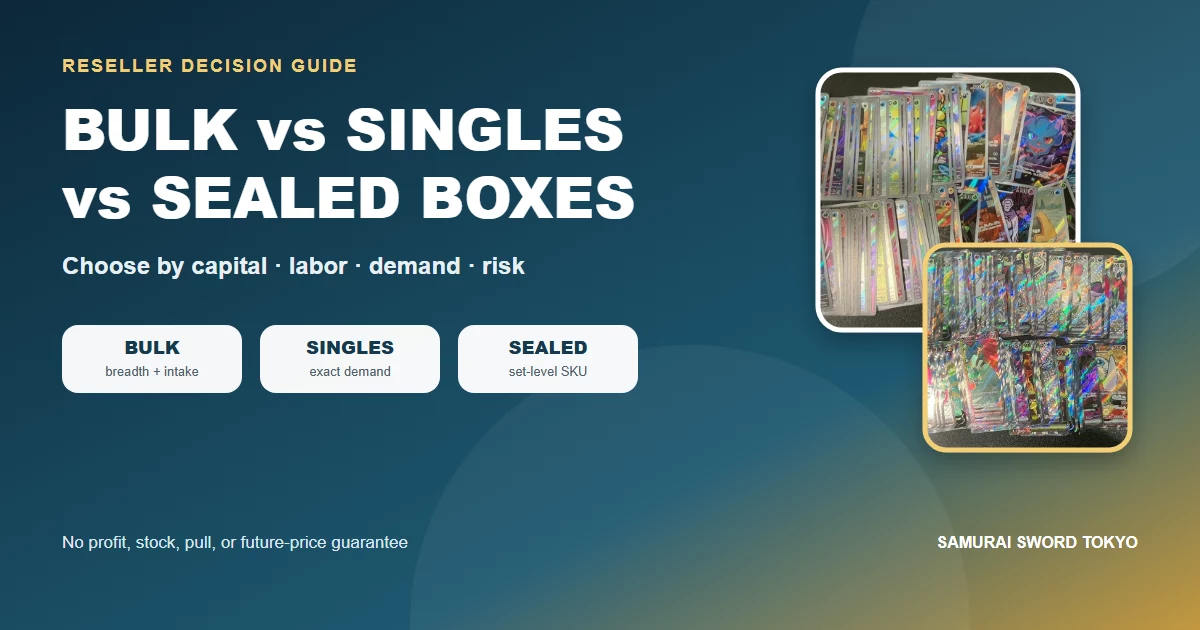
Routecontrole: 14 juli 2026 (JST). Beoogde publicatietijd: 16 maart 2026 om 7:50 uur JST. De beschikbaarheid van producten en categorieën is uitsluitend live en kan veranderen; deze gids reserveert geen voorraad en garandeert geen toekomstige levering.
Voor de meeste doorverkopers bestaat er geen universeel “beste” voorraadformaat. Bulkkaarten kunnen assortimentsdiepte creëren, ten koste van willekeurige identiteit, mogelijke duplicaten, conditie-intake en zware catalogisering. Exacte losse kaarten geven de duidelijkste productidentiteit en klantmatch, maar elke inkoopbeslissing wordt kaart voor kaart genomen. Verzegelde boosterboxen verminderen het aantal advertenties en houden de openingservaring intact, maar concentreren kapitaal op setniveau en stellen de doorverkoper bloot aan herdruk-, doosconditie- en vraagcyclusrisico’s.
De beste route is degene die jouw bedrijf kan verwerken, verkopen en op basis van bewijs herbestellen. Een liveverkoper met snel visueel sorteren kan bulk efficiënt gebruiken. Een zoekgedreven winkel geeft misschien de voorkeur aan exacte losse kaarten. Een winkel met verzamelaars die ongeopend Japans product willen, kan de voorkeur geven aan verzegelde dozen. Veel duurzame bedrijven gebruiken alle drie, elk met een eigen taak en risicobudget.
Inhoud: Beslisroute · Bulkkaarten · Losse kaarten · Verzegeld · Kapitaal · Arbeid · Risico · Portfolio · Testplan · FAQ
Beslisroute: winkelen op basis van doorverkoperintentie
De eerste klik moet aansluiten bij het voorraadprobleem
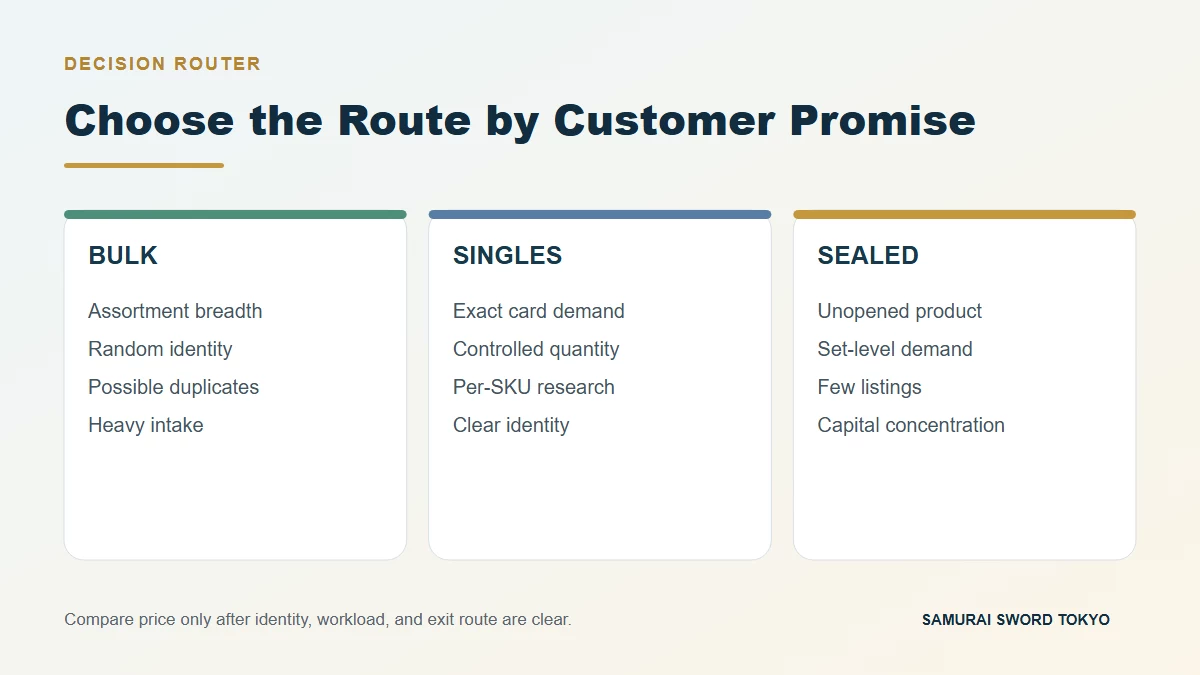
Begin niet met het formaat dat op zichzelf het goedkoopst lijkt. Begin met de klantbelofte die je moet nakomen. Als een koper om één exacte Japanse kaart vraagt, is een willekeurig lot het verkeerde startpunt. Als een conventieverkoper honderden visueel interessante kaarten nodig heeft voor roterende displays, kan het één voor één kopen van losse kaarten te veel inkooptijd kosten. Als een verzamelaar een ongeopende doos wil, kunnen noch bulk noch losse kaarten de verzegelde staat vervangen.
| Behoefte doorverkoper | Beste eerste route | Waarom | Primair SST-pad |
|---|---|---|---|
| Breed assortiment aan art-kaarten of rarity-lanes | Bulkkaarten | Eén lot creëert veel SKU’s op kaartniveau, met acceptatie van willekeur en duplicaten | AR Bulk — 100-kaartenset of SR Bulk — 100-kaartenset |
| Exacte klantverzoeken | Losse kaarten | Identiteit, versie en conditie kunnen per kaart worden geselecteerd | Japanse Pokemon losse kaarten |
| Ongeopend product / vraag op setniveau | Verzegeld | Eén SKU behoudt de verzegelde openingservaring | Japanse Pokemon verzegelde boosterboxen |
| Gemengde winkel of terugkerende inkoop | Groothandel | Routemix, budget, timing en vereisten kunnen samen worden aangegeven | Groothandelaanvraag |
Wat kopers in de eerste 10 minuten moeten controleren
| Controle | Bulkkaarten | Losse kaarten | Verzegeld |
|---|---|---|---|
| Exacte identiteit | Onbekend tot intake | Bekend vóór aankoop | Set/product bekend; interne pulls onbekend |
| Conditiewerk | Per kaart | Per kaart, maar vooraf geselecteerd | Doos-/zegelinspectie in plaats van elke kaart |
| Duplicaatrisico | Expliciet mogelijk bij willekeurige lots | Gecontroleerd via bestelhoeveelheid | Dubbele dozen zijn bewuste hoeveelheid |
| Aantal advertenties | Mogelijk zeer hoog | Hoog maar gecontroleerd | Laag ten opzichte van eenheden kaartvoorraad |
| Vraagniveau | Kaart-/personage-/rarity-mix | Exacte kaart | Set, doos, chase-verhaal, verzegelde verzamelaar |
| Herdrukgevoeligheid | Kaart- en aanbodspecifiek | Kaartspecifiek | Vaak geconcentreerd op product-/setniveau |
| Beste bewijs | Intakesteekproef en doorverkoop | Verkoopdata voor exacte kaart/versie | Vraag naar set, herdrukinformatie, live categorie/offerte |
Deze verschillen verklaren waarom één brutomargedoel niet voldoende is. Elk formaat gebruikt kapitaal en arbeid anders. Een formaat kan een hoog percentage opslag laten zien, maar toch een slechtere cashflow opleveren omdat het te lang duurt om te catalogiseren of te verkopen.
Live routes zijn bewijs, geen voorraadbeloftes
De huidige WooCommerce-structuur van Samurai Sword Tokyo gebruikt het /collections-pad als categoriebasis. De huidige categorie voor Pokemon-losse kaarten is Pokemon Losse Kaart, en de verzegelde categorie is Pokemon Verzegelde Boosterbox. Deze routes zijn op 14 juli 2026 geverifieerd tegen de live taxonomie. Categorietoewijzingsaantallen zijn niet hetzelfde als momenteel verkoopbare voorraad, en noch een link, noch dit artikel reserveert voorraad.
Bulkroute: koop breedte, creëer daarna orde
Wat de huidige AR- en SR-lots werkelijk beloven
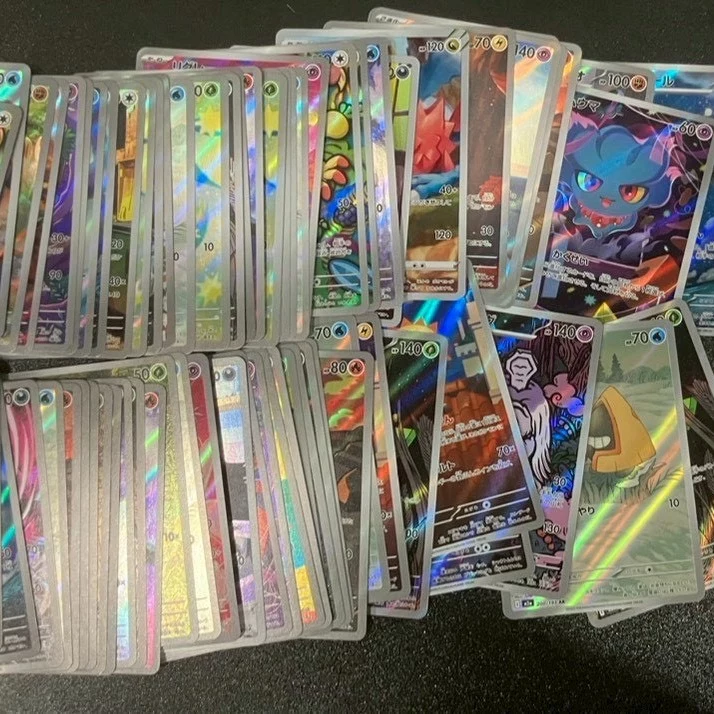
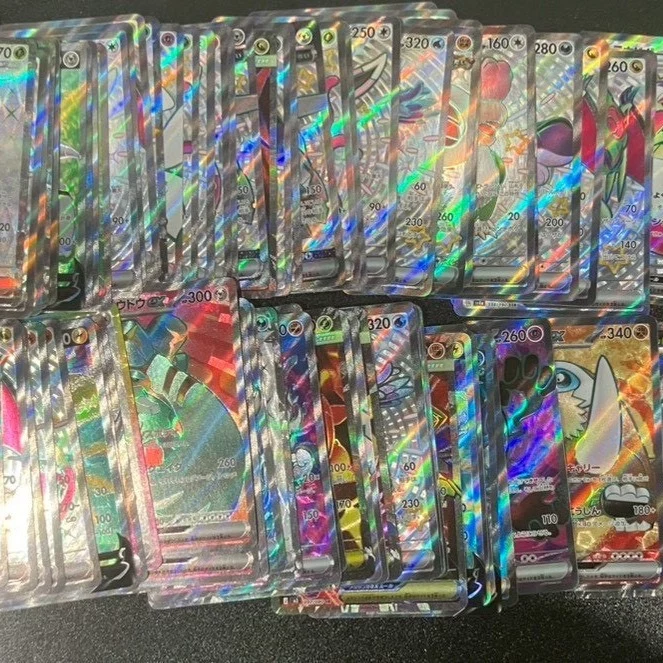
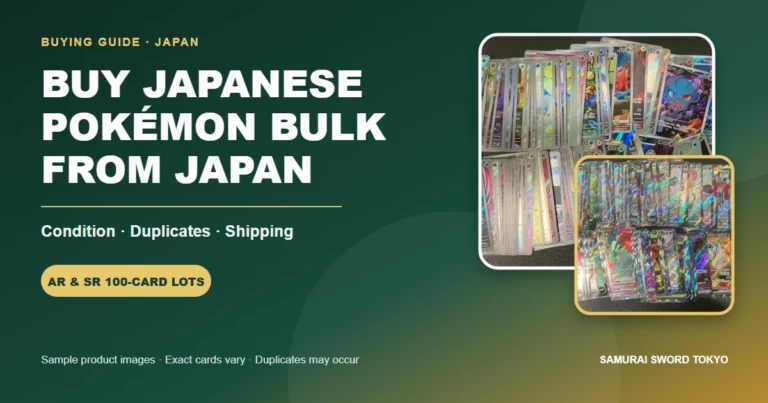
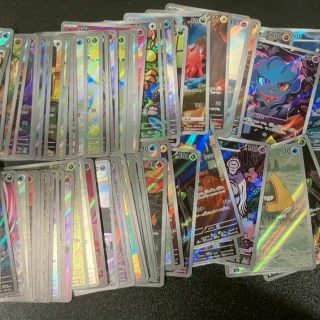
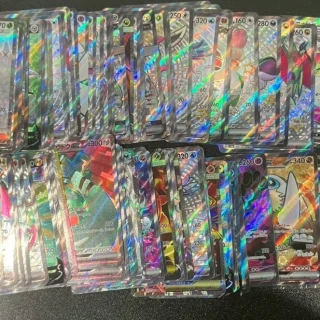
De huidige pagina’s AR Bulk en SR Bulk zijn beide producten met 100 kaarten. Hun schriftelijke bekendmakingen bepalen de koperverwachting: de foto is een voorbeeld, kaarten worden willekeurig geselecteerd, Samurai Sword Tokyo probeert duplicaten te vermijden, maar duplicaten kunnen nog steeds voorkomen. “100-kaartenset” beschrijft dus een hoeveelheid, geen 100 gegarandeerd unieke kaartnummers.
Deze route is het sterkst wanneer de doorverkoper een ongeordend assortiment kan omzetten in bruikbare voorraad. Dat vereist identiteitscontroles, conditie-inspectie, stabiele SKU’s, telling van duplicaten, opslag, afbeeldingen, prijsonderzoek en een kanaal voor traag verkopende kaarten. De inkoop is slechts het begin; operationele verwerking creëert het feitelijke product dat een klant uiteindelijk ziet.
Wanneer bulk wint
Bulk kan beter presteren dan andere routes wanneer inkooptijd de bottleneck is en het bedrijf al een snel intakesysteem heeft. Conventieverkopers, liveverkopers, binderspecialisten, verkopers van personagebundels en winkels met veel bestellingen van meerdere kaarten kunnen de breedte waarderen. Een herhaald exemplaar is niet automatisch een mislukking als dezelfde SKU consistent verkoopt of kan rouleren tussen evenementen.
Bulk kan ook content en ontdekking ondersteunen: een breed visueel assortiment geeft een doorverkoper meer onderwerpen voor social posts, livestreams, themadienbladen of “shop op Pokemon”-routes. Maar dat voordeel bestaat alleen als elke exacte kaart eerlijk wordt weergegeven. Gebruik de voorbeeldfoto van het lot nooit opnieuw alsof het de specifieke voorraad van de klant is, en beloof nooit personages die in dat voorbeeld te zien zijn.
Wanneer bulk verliest
Bulk past slecht wanneer de doorverkoper exacte kaarten nodig heeft, weinig catalogiseercapaciteit heeft, de ruwe conditie niet kan inspecteren of geen plan heeft voor herhaalde traag verkopende exemplaren. Het faalt ook wanneer de winstgevendheid afhangt van elke kaart die Near Mint, gradeerbaar of meer waard is dan het gemiddelde van het lot. De huidige productbeschrijvingen geven dergelijke garanties niet.
| Bulksterkte | Operationele vereiste | Faalmodus | Beheersmaatregel |
|---|---|---|---|
| Snelle assortimentsdiepte | Herhaalbare identiteits- en conditie-intake | Kaarten blijven ongelijst in dozen | Stel een deadline voor intake-uren |
| Veel visuele SKU’s | Efficiënte fotografie en advertentiesjabloon | Arbeid overschrijdt brutomarge | Meet minuten per verkoopbare SKU |
| Mogelijke hoeveelheid per SKU | Afzetkanaal en opslag voor duplicaten | Kapitaal concentreert zich in zwakke herhalingen | Volg exemplaren per SKU en leeftijd |
| Willekeurige ontdekking | Conservatieve waardeprognose | Voorbeeldafbeelding vertekent verwachte waarde | Prognose per bucket, niet per afgebeelde kaart |
| Inkoop in één lot | Nauwkeurige toewijzing van landed cost | Vracht en rechten verdwijnen uit het model | Wijs werkelijke kosten consistent toe |
Losse-kaartenroute: koop exacte vraag en beheers identiteit
Waarom exacte losse kaarten de schoonste klantmatch zijn
De Japanse Pokemon-losse-kaartcategorie is de juiste route wanneer een klant zoekt op Pokemon, Trainer, set, kaartnummer, rarity, taal of exacte artwork. De doorverkoper kent de productidentiteit vóór aankoop en kan de hoeveelheid weloverwogen bepalen. Dit elimineert het risico van willekeurig assortiment en maakt merchandising op basis van zoekwoorden, collecties en verlanglijstjes nauwkeuriger.
Exacte selectie is vooral nuttig voor het aanvullen van bewezen verkopers. Als historische bestellingen constante vraag naar een specifieke kaart tonen, kan het kopen van die kaart efficiënter zijn dan het aanschaffen van een willekeurig lot in de hoop dat hij erin zit. De doorverkoper kan ook versies onderscheiden die er vergelijkbaar uitzien maar verschillen in setcode, kaartnummer, stempel, rarity, mirror-afwerking of herdruk.
Losse kaarten zijn gecontroleerd, niet moeiteloos
Elke losse kaart vereist nog steeds conditiezekerheid, prijsonderzoek, een voorraadregistratie, opslag en afhandeling. Één voor één inkopen kan tijd kosten, en populaire kaarten kunnen een hoge inkoopprijs hebben omdat andere kopers dezelfde vraag zien. De exacte identiteit vermindert het assortimentsrisico; het garandeert niet dat de doorverkoopprijs standhoudt of dat de kaart binnen de gewenste periode verkoopt.
Gebruik de officiële kaartzoekpagina van het Japanse Pokemon Card Game om de kaartidentiteit en de actuele officiële taxonomie te controleren, waar van toepassing. Controleer vervolgens de exacte productpagina en het conditiebewijs. Voeg twee drukken niet samen omdat de artwork gelijkend lijkt.
Wanneer losse kaarten winnen of verliezen
| Situatie | Voordeel losse kaarten | Nadeel losse kaarten | Beslisregel |
|---|---|---|---|
| Verlanglijst van klant | Exacte levering | Inkoop kan competitief zijn | Koop alleen de exacte gevraagde versie |
| Bewezen bestseller | Gecontroleerde herbestelling | Prijs kan stijgen bij zichtbare vraag | Hanteer een maximale landed cost |
| SEO-/zoekwinkel | Duidelijke landingspagina’s per kaartnaam | Veel individuele advertenties | Prioriteer zoekopdrachten met verkoopbewijs |
| Ruwe kaart met hoge waarde | Focus op exacte inspectie | Eén conditiefout heeft impact | Vereis gedetailleerde conditiebeoordeling |
| Nieuwe doorverkoper | Eenvoudige identiteitslogica | Verleiding om hype achterna te jagen | Begin met lage aantallen en gemeten omloopsnelheid |
Losse kaarten verliezen wanneer inkoop- en advertentie-overhead gefragmenteerd raakt, wanneer de doorverkoper aantrekkelijke kaarten koopt zonder klantbewijs, of wanneer huidige vraagprijzen worden verward met de waarde van afgeronde verkopen. Een kleinere exacte voorraad is niet automatisch liquide. Elke SKU heeft nog steeds een exitplan nodig.
Verzegelde route: verkoop het product, niet de verwachte pulls
De verzegelde propositie is vraag op setniveau
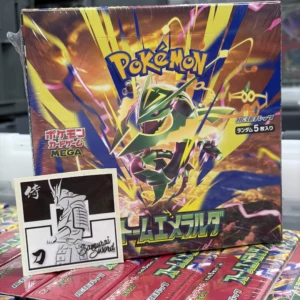
De huidige route voor ongeopende Japanse Pokemon-dozen is de categorie verzegelde boosterboxen, met ook een bredere route Japanse boosterboxen beschikbaar. Deze gids vermijdt bewust het publiceren van individuele prijzen voor verzegelde producten. Doosprijs, voorraad, shrink-/geen-shrinkstatus, allocatie en herdrukverwachtingen kunnen veranderen; controleer de live categorie, exacte productpagina en actuele groothandelsofferte op het moment van beslissen.
Een verzegelde doorverkoper verkoopt een gedefinieerd ongeopend product en het bijbehorende verhaal op setniveau: release-tijdperk, chase-lineup, openingservaring, verzamelwaarde, taal en doosconditie. De interne kaartuitkomst blijft onzeker, dus adverteer een doos niet alsof deze een specifieke chase of gegarandeerde winst bevat. Schattingen van pull-rates, indien gebruikt, hebben hun eigen bron en voorbehoud nodig; ze vervangen geen these voor verzegelde voorraad.
Waarom verzegeld de operatie kan vereenvoudigen
Eén doos is één primaire SKU. De doorverkoper fotografeert en inspecteert de buitenkant, bevestigt het exacte product en de zegelstatus, legt de conditie vast en slaat een kleiner aantal eenheden op dan een equivalent assortiment kaart voor kaart. Listing, picking en tellen kunnen sneller gaan dan bij een willekeurig lot van 100 kaarten. Die operationele eenvoud is een van de redenen waarom verzegeld groothandel en herhaalinkoop door winkels kan ondersteunen.
Een laag aantal advertenties betekent echter geen laag risico. Een doos kan meer kapitaal per eenheid absorberen, en de vraag kan meebewegen met nieuwe releases, officiële herdrukken, allocatiewijzigingen, sentiment onder verzamelaars of de relatieve waarde van chase-kaarten. Deuken, scheuren, verkleuring, kneuzing of zorgen over het zegel van de doos kunnen het kopersvertrouwen verminderen. Opslagvolume en internationaal verzendgewicht spelen ook een rol.
Wanneer verzegeld wint of verliest
| Verzegelde factor | Waarom het kan winnen | Waarom het kan verliezen | Benodigd bewijs |
|---|---|---|---|
| Weinig SKU’s | Snellere listing en afhandeling | Kapitaal concentreert per set | Doorverkoop op setniveau |
| Ongeopende ervaring | Spreekt verzamelaars/openers aan | Koperverwachtingen kunnen speculatief zijn | Nauwkeurige product- en zegelomschrijving |
| Herkenbaar product | Eenvoudigere merchandising | Nieuwe releases strijden om aandacht | Monitoring van releases/herdrukken |
| Doosaantal | Werkt voor winkels en breakers | Verzend-/opslagkosten stijgen | Checkout-/groothandelsofferte |
| Optie voor lang aanhouden | Product kan verzegeld blijven | Kapitaal is niet beschikbaar tijdens het aanhouden | Maximale aanhoudperiode en exitregel |
Verzegeld is een slechte keuze wanneer het bedrijf snelle cashflow op kaartniveau nodig heeft, dozen niet veilig kan opslaan, of uitsluitend koopt omdat online discussie een toekomstige prijs voorspelt. Het is ook verkeerd voor een klant die één exacte losse kaart wil. Gebruik de officiële nieuwspagina van het Pokemon Card Game om productaankondigingen en herdrukgerelateerde informatie te volgen, en controleer daarna de specifieke SST-route.
Kapitaal en landed cost: vergelijk dezelfde economische eenheid
Productkosten zijn slechts de eerste laag
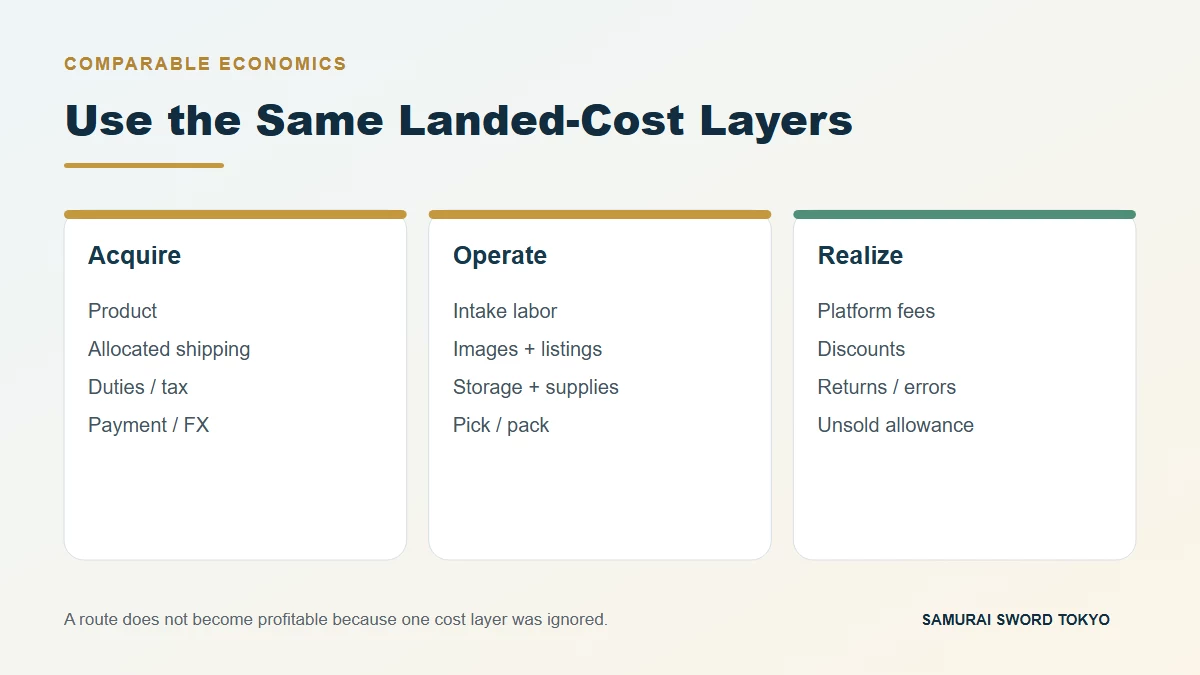
Voor elke route omvat de landed cost inkoop, toegewezen verzending, bestemmingsrechten of -belastingen waar van toepassing, betalings- en valutakosten, benodigdheden, intake-arbeid, advertentie-arbeid, marktplaatskosten, pick-/packarbeid, klantenservice- en retourvoorziening, kortingen, en voorraad die onverkocht blijft na de doelperiode. Verschillende routes verdelen deze kosten anders, maar geen enkele laat ze verdwijnen.
Bulk spreidt de inkoop vaak over veel kaarten terwijl de arbeid per lot toeneemt. Losse kaarten concentreren onderzoek en inkoop op het niveau van de exacte SKU. Verzegeld kan de advertentie-arbeid verminderen terwijl kapitaal en opslag per eenheid toenemen. Vergelijk de netto-opbrengst per arbeidsuur en per kapitaaldag, niet alleen het brutopercentage opslag.
Cashconversie is belangrijker dan de mooiste marge
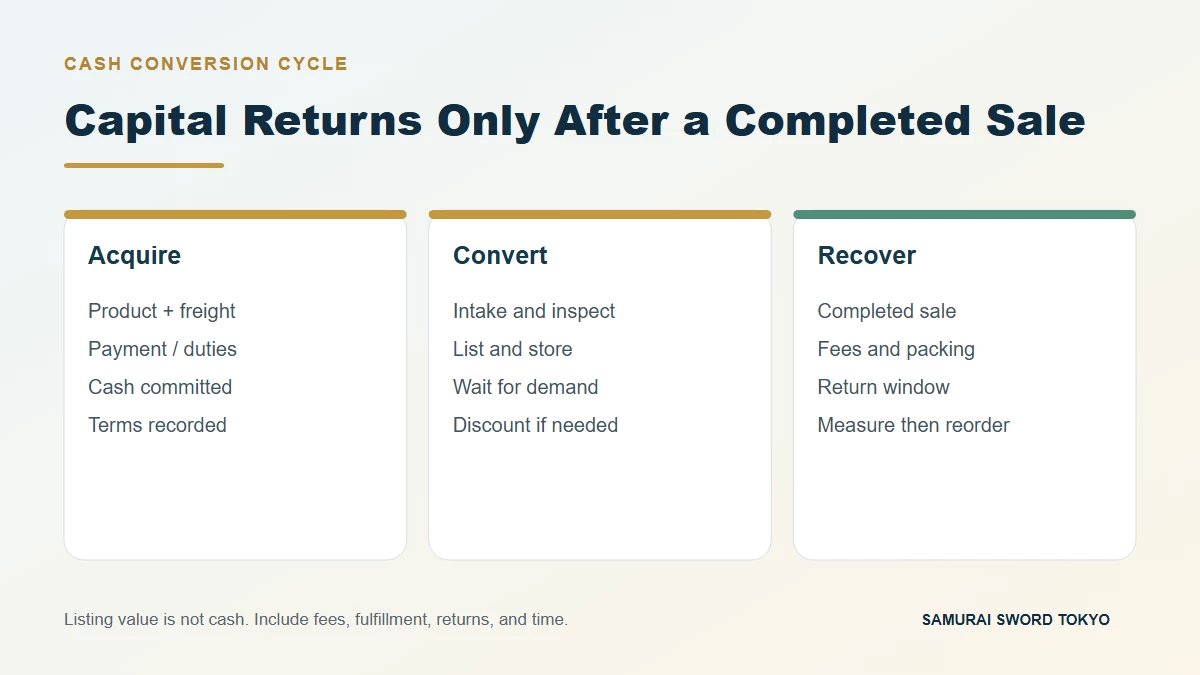
Een bulkkaart die weinig kost maar zes maanden nodig heeft om te listen, is operationeel niet goedkoop. Een losse kaart met hoge vraag en een bescheiden marge kan kapitaal snel laten circuleren. Een verzegelde doos met een aantrekkelijke theoretische winst levert mogelijk geen bruikbare cash op zolang hij in opslag ligt. Bepaal de maximale tijd voor elke fase: inkoop, intake, listing, verkoop en herbestelling.
| Metriek | Bulkkaarten | Losse kaarten | Verzegeld |
|---|---|---|---|
| Primaire kosteneenheid | Lot, daarna per ontvangen/verkoopbare kaart | Exacte kaart | Exacte doos/product |
| Verborgen kostenrisico | Intake en ongeliste kaarten | Fragmentatie van onderzoek en conditie | Opslag, vracht, kapitaalconcentratie |
| Omzeteenheid | Kaart, bundel of hoeveelheidslisting | Exacte kaart | Doos/product |
| Beste snelheidsmetriek | % gecatalogiseerd en verkocht binnen 30/60/90 dagen | Dagen per SKU-verkoop en herbestelling | Verkochte eenheden per set en aanhoudperiode |
| Kapitaalwaarschuwing | Veel kleine, traag verkopende kaarten | Te veel betalen voor evidente vraag | Te veel aanhouden in één release |
Verdeel gedeelde verzendkosten eerlijk
Het huidige SST-verzendbeleid berekent de verzendkosten bij het afrekenen en stelt dat aparte bestellingen apart worden verzonden in plaats van later te worden gecombineerd. Als een doorverkoper bulk-, losse-kaarten- en verzegelde producten in één pakket wil, moet het winkelmandje vóór het afrekenen worden gepland. Verdeel de werkelijke vracht over de producten met een consistente methode zoals gewicht, volume of waarde; laat één route er niet beter uitzien door de vracht ervan elders toe te wijzen.
Arbeid en doorvoer: de route die jouw team aankan
Bulk creëert de grootste intakewachtrij
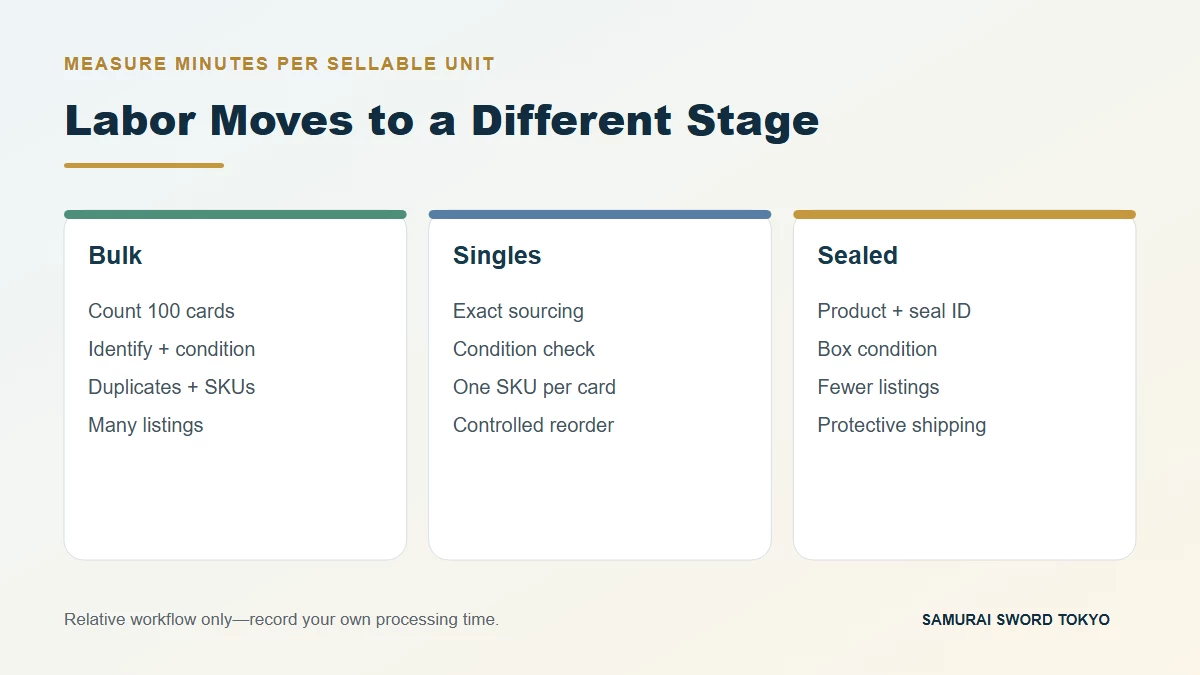
Een willekeurig lot van 100 kaarten moet worden geteld, geïdentificeerd, geïnspecteerd, gesorteerd, toegewezen aan SKU’s, gefotografeerd of gekoppeld aan een accuraat beeldsysteem, geprijsd, opgeslagen en doorgeleid naar advertenties of bundels. Dubbele exemplaren vereisen hoeveelheidscontrole. Conditie-uitzonderingen vereisen individuele foto’s en conservatieve omschrijvingen. Het lot kan vandaag fysiek zijn ontvangen maar dagenlang commercieel onbeschikbaar zijn als de intakecapaciteit zwak is.
Exacte losse kaarten vereisen nog steeds veel van dezelfde stappen, maar identiteit en beoogde hoeveelheid zijn bekend bij aankoop. Verzegelde dozen verleggen de aandacht van inspectie kaart voor kaart naar product, zegel, uiterlijke conditie, variant en verzendbescherming. Elke route heeft een standaardwerkwijze nodig die kort genoeg is om te volgen en gedetailleerd genoeg om SKU-vermenging te voorkomen.
Meet bottlenecks per fase
| Fase | Bulk-bottleneck | Losse-kaarten-bottleneck | Verzegeld-bottleneck |
|---|---|---|---|
| Inkoop | Onbekende mix en lotvoorwaarden | Vinden van exacte kaart/versie | Vinden van juiste set/zegel/hoeveelheid |
| Intake | Wachtrij voor identiteit en conditie van 100 kaarten | Conditie per kaart | Verificatie van doos/zegel/buitenkant |
| Listing | Veel SKU’s en duplicaten | Veel exacte advertenties | Weinig advertenties, meer productdetail |
| Opslag | Kaartorganisatie | Beveiliging van hoogwaardige kaarten | Ruimte en kneusbescherming |
| Afhandeling | Picken van exacte kaart/conditie | Nauwkeurigheid exacte kaart | Beschermende doosverpakking en vracht |
| Herbestelling | Mix herhaalt zich mogelijk niet | Exacte SKU kan gericht worden besteld | Aanbod en herdruk van de set kunnen veranderen |
Kies formaten die passen bij bestaande arbeid, niet bij ingebeelde arbeid
Een soloverkoper met twee uur per week moet geen pipeline kopen die twintig uur intake vereist. Een winkel met barcode-, fotografie- en personeelssystemen kan hetzelfde lot efficiënt verwerken. Registreer minuten per ontvangen eenheid, minuten per geliste SKU, correctiepercentage en bestellingen per arbeidsuur. Gebruik deze feiten bij de volgende inkoopbeslissing.
Als jouw team één route niet kan verwerken zonder achterstand te creëren, verminder dan de hoeveelheid of verander van formaat. Ongeliste voorraad heeft inkoopkosten maar geen doorzoekbaar verkoopoppervlak. De goedkoopste operationele verbetering is vaak een kleinere bestelling die klanten sneller bereikt.
Risico en koperverwachtingen: beheers wat elk formaat kan breken
Bulkrisico is onzekerheid over de mix
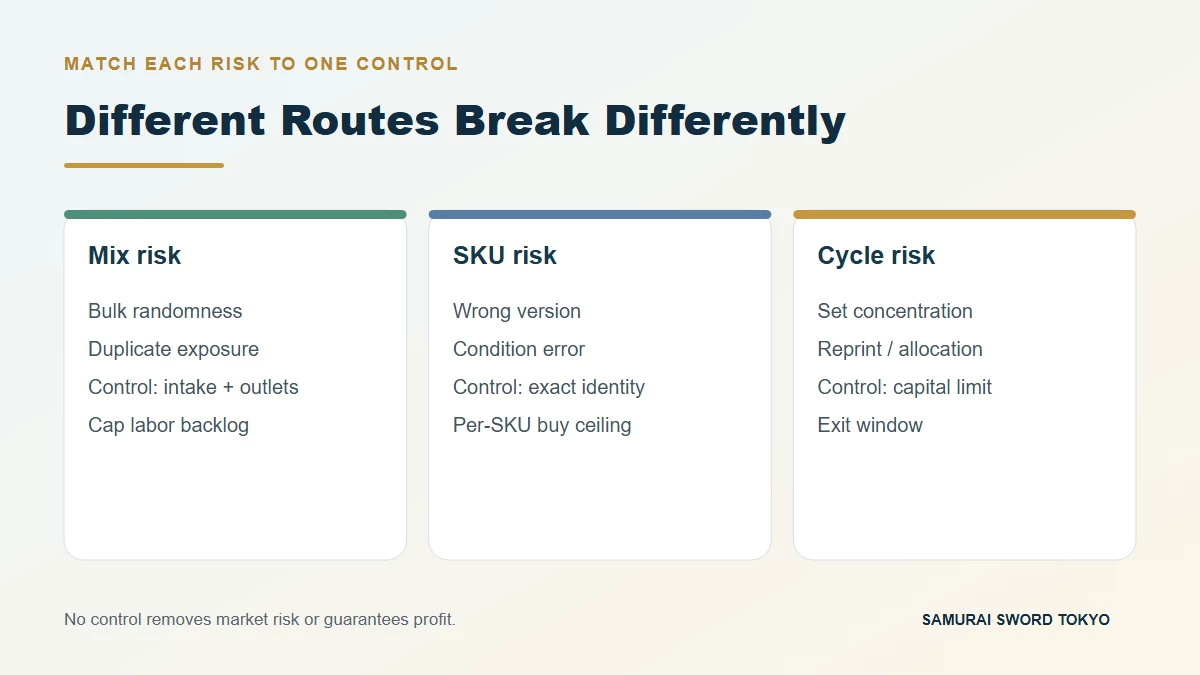
Bulkrisico begint met wat niet bekend is: exacte kaartidentiteiten, concentratie van duplicaten en de conditieverdeling van een willekeurig assortiment. De beheersmaatregelen zijn bekendmaking, conservatieve prognoses, intakesteekproeven, afzetkanalen voor duplicaten en een maximaal arbeidsbudget. De huidige tekst over voorbeeldfoto’s en duplicaten moet zichtbaar blijven voor de koper.
Losse-kaarten-risico is fouten in de exacte SKU
Losse-kaarten-risico omvat een verkeerde set, verkeerd kaartnummer, verkeerde taal, verkeerde variatie, onjuiste conditie, of inkoop tegen een prijs die niet wordt ondersteund door afgeronde vraag. De beheersmaatregelen zijn identiteitsverificatie, exacte afbeeldingen, conservatieve conditiebeoordeling en aankoopplafonds per SKU.
Verzegeld risico is concentratie op product en cyclus
Verzegeld risico omvat een verkeerde variant, geschillen over zegel of doosconditie, wijzigingen in herdruk of allocatie, concurrentie in de releasecyclus, opslagschade en kapitaal dat vastzit in één set. Beheersmaatregelen omvatten exacte productbenaming, registratie van uiterlijke conditie, monitoring van officieel nieuws, actualisering van categorie/groothandel, hoeveelheidslimieten en een vastgestelde exitdatum.
| Risico | Bulkbeheersing | Losse-kaarten-beheersing | Verzegeld-beheersing |
|---|---|---|---|
| Identiteit | Intake van elke kaart | Verifieer exacte kaart vóór aankoop | Verifieer exacte doos/set/variant |
| Conditie | Beoordeel elke ontvangen kaart consistent | Gebruik bewijs van de exacte kaart | Leg doos- en zegelconditie vast |
| Beschikbaarheid | Beloof nooit toekomstige lotvoorraad | Bevestig live SKU | Bevestig categorie/product/offerte |
| Vraag | Gebruik doorverkoop per bucket | Gebruik verkoopbewijs van de exacte kaart | Gebruik vraag op setniveau en releasecontext |
| Concentratie | Limieten en afzetkanalen voor duplicaten | Hoeveelheidsplafond per SKU | Kapitaalplafond per set |
| Klantclaim | Bekendmaking willekeur/voorbeeld | Exacte versie en conditie | Geen gegarandeerde pulls of retouren |
Geen enkele beheersmaatregel neemt marktrisico weg. Het maakt de beslissing controleerbaar en vermindert fouten die de doorverkoper kan voorkomen.
Bouw een gemengd voorraadportfolio
Geef elke route één taak
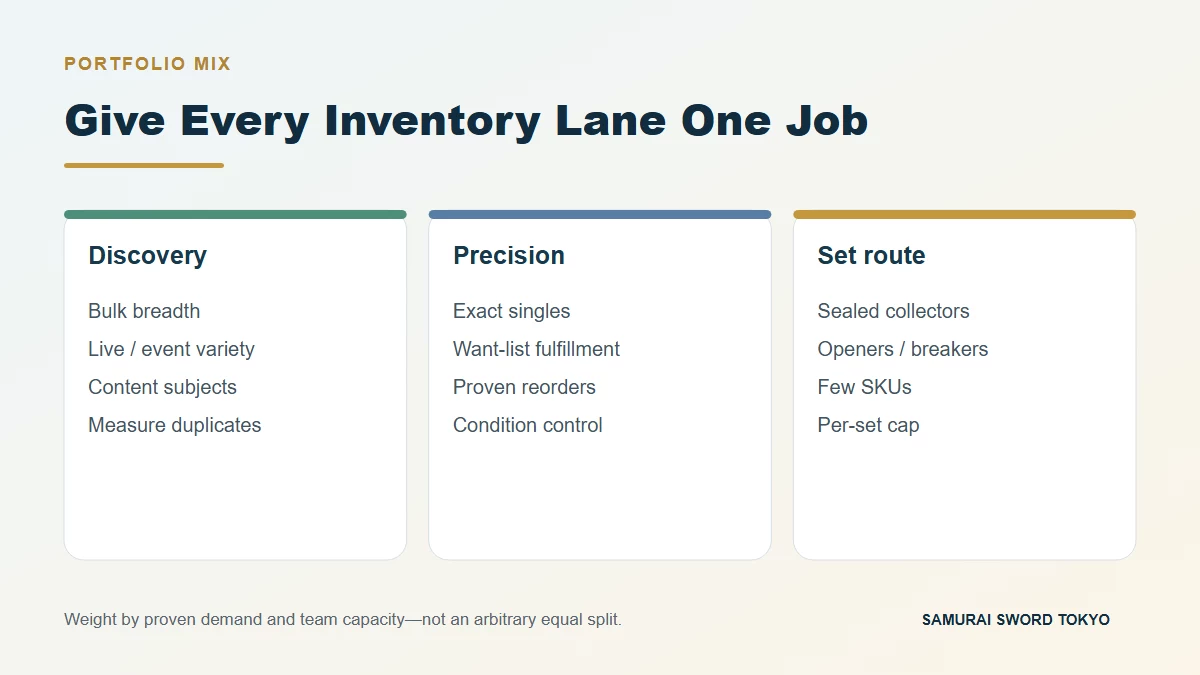
Bulk kan ontdekking en breedte bieden. Losse kaarten kunnen exacte zoekvraag vervullen en bewezen kaarten aanvullen. Verzegeld kan verzamelaars, openers, winkels en breakers bedienen die het ongeopende product willen. Een gemengd portfolio wordt nuttig zodra die rollen expliciet zijn; anders worden het drie ongerelateerde stapels die concurreren om cash en arbeid.
Maak aparte dashboards. Volg voor bulk het percentage gecatalogiseerd, unieke SKU’s, concentratie van duplicaten en doorverkoop per rarity of personage. Volg voor losse kaarten de omloopsnelheid per exacte SKU, het succes van aanvulling en conditiegerelateerde retouren. Volg voor verzegeld eenheden per set, aantal dagen aangehouden, opslag, release-/herdrukgebeurtenissen en momenten van prijs-/offerte-actualisering.
Budgetteer op basis van capaciteit en bewijs
Gebruik geen willekeurige gelijke verdeling. Een winkel met sterke vraag naar dozen en beperkt personeel voor het scannen van kaarten kan meer toewijzen aan verzegeld. Een marketplace-verkoper met veel volume en volwassen operaties in losse kaarten kan meer toewijzen aan exacte losse kaarten. Een liveverkoper met snel sorteren en een publiek dat van variatie houdt, kan een gecontroleerd aandeel toewijzen aan bulk.
| Type bedrijf | Kernlane | Ondersteunende lane | Limiet |
|---|---|---|---|
| Zoekgedreven online winkel voor losse kaarten | Exacte losse kaarten | Selectieve bulk voor ontdekking | Beperk achterstand in ongeliste intake |
| Conventie-/liveverkoper | Bulk of gemengde losse kaarten | Verzegelde hoogtepunten | Beperk concentratie van duplicaten |
| Op verzamelaars gerichte verzegelde winkel | Verzegeld | Chase losse kaarten | Beperk kapitaal per set |
| Nieuwe doorverkoper | Kleine test met exacte losse kaarten | Eén gecontroleerde bulk-/verzegeld-test | Geen route opschalen zonder bewijs |
| Kaartenwinkel / breaker | Verzegeld + exacte losse kaarten | Bulk voor nevenvoorraad | Gebruik actuele groothandelsofferte en arbeidsplan |
Gebruik groothandel voor gemengde inkoop, niet voor vage verzoeken
De groothandelaanvraag is de juiste plek om bestemming, routemix, budget, hoeveelheid, conditievereisten, tolerantie voor duplicaten, timing en vervangingsregels aan te geven. Het garandeert geen enkel product, allocatie, prijs of aangepast assortiment. Wacht op actuele schriftelijke bevestiging voordat je voorraad aan klanten belooft.
Testen en herbestellen: een 30/60/90-dagenkader
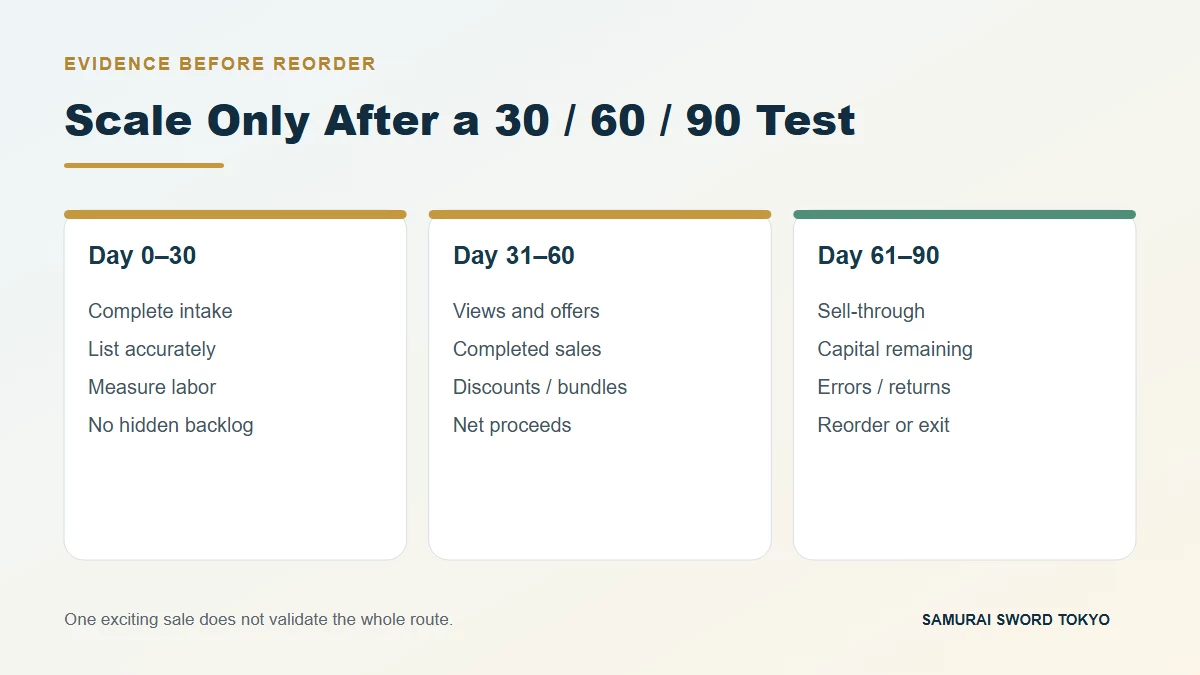
Dag 0 tot 30: bewijs het intakesysteem
Stel voor elke gekozen route een vast testbudget en een maximale arbeidstoewijzing in. Registreer de live URL, bestelvoorwaarden, verzendkosten bij checkout en de reden waarom elk item is gekozen. Tel en inspecteer bij aankomst voordat je het mengt met bestaande voorraad. Het doel van de eerste 30 dagen is niet maximale omzet; het is complete, nauwkeurige, doorzoekbare voorraad zonder verborgen achterstand.
Bereken voor bulk unieke SKU’s, concentratie van duplicaten, conditieverdeling en minuten per kaart. Controleer voor losse kaarten het foutpercentage in identiteit/conditie en de tijd per listing. Leg voor verzegeld de doos-/zegelconditie, opslagruimte, voltooiing van listings en de actuele release-/herdrukinformatie vast die bij de beslissing is gebruikt.
Dag 31 tot 60: meet echte klantvraag
Volg weergaven, aanvragen, biedingen, afgeronde verkopen, kortingen, bundels, gemiddeld aantal kaarten of dozen per bestelling en netto-opbrengst. Scheid de bruto listingwaarde van het daadwerkelijk ontvangen geld. Identificeer voorraad die verkoopt zonder promotie, voorraad die korting nodig heeft en voorraad die geen gekwalificeerde interesse ontvangt.
Dag 61 tot 90: beslis of je herbestelt, aanpast of stopt
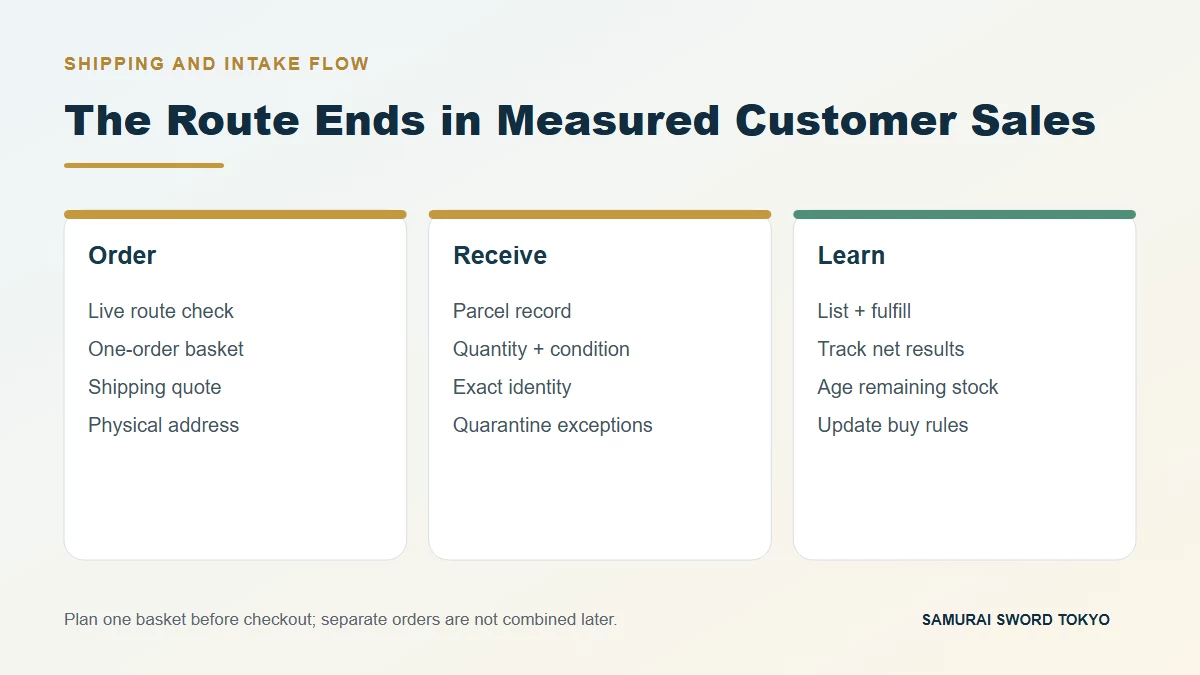
Vergelijk na 90 dagen elke route op netto marge na arbeid, verkocht percentage, nog vastzittend kapitaal, fout-/retourpercentage en kwaliteit van de resterende voorraad. Herbestel alleen als de route voldoet aan de drempels die vóór de test zijn vastgelegd. Pas aan wanneer één oplossing duidelijk is, zoals snellere beeldvorming of een lagere hoeveelheid per SKU. Stop wanneer de klantfit of de economie niet werkt onder conservatieve aannames.
| Poort | Herbestellen | Aanpassen | Stoppen/uitstappen |
|---|---|---|---|
| Intake | Op schema voltooid | Achterstand heeft één oplosbare oorzaak | Voorraad kan niet economisch worden gecatalogiseerd |
| Vraag | Doel voor doorverkoop behaald | Interesse bestaat maar prijs/kanaal moet veranderen | Weinig gekwalificeerde vraag |
| Marge | Positief na volledige kosten en arbeid | Dicht bij doel met meetbare oplossing | Afhankelijk van weggelaten kosten of optimistische listings |
| Risico | Fouten/retouren binnen limiet | Eén beheersmaatregel moet worden verbeterd | Identiteit, conditie of claims falen herhaaldelijk |
| Kapitaal | Resterende voorraad past binnen aanhoudlimiet | Verminder volgende hoeveelheid | Kapitaalblokkade verhindert betere voorraad |
Het kader beschermt tegen enthousiasmebias. Eén sterke pull, één viral gegane kaart of één snelle doosverkoop valideert niet de hele route. Herhaalde, nauwkeurig gemeten transacties doen dat wel.
Veelgestelde vragen
Zijn bulk Pokemon-kaarten beter voor doorverkopers dan losse kaarten?
Alleen wanneer de doorverkoper willekeur, mogelijke duplicaten, conditie-intake en een hoog advertentievolume efficiënt kan verwerken. Losse kaarten zijn meestal beter voor exacte klantvraag. Vergelijk netto-opbrengst per arbeidsuur en kapitaaldag in plaats van aan te nemen dat de route met de laagste gemiddelde inkoopprijs wint.
Zijn verzegelde boosterboxen veiliger dan bulkkaarten?
Niet universeel. Verzegeld elimineert het werk van assortiment kaart voor kaart, maar concentreert risico op set- en productniveau. Herdrukken, allocatie, doosconditie, opslag en vraagcycli spelen een rol. Bulk en verzegeld falen op verschillende manieren; geen van beide garandeert winst.
Welke route vereist de minste advertentie-arbeid?
Verzegeld vereist meestal de minste advertenties omdat één doos één primaire SKU is. Exacte losse kaarten vereisen veel gecontroleerde advertenties. Willekeurige bulk creëert doorgaans de grootste intakewachtrij omdat elke kaart moet worden geïdentificeerd, geïnspecteerd, gesorteerd en doorgeleid.
Kan een bulklot van 100 kaarten worden beschouwd als 100 unieke kaarten?
Nee. De live AR- en SR-beschrijvingen stellen dat de selectie willekeurig is en dat duplicaten kunnen voorkomen ondanks een beste inspanning om ze te vermijden. Hoeveelheid is geen garantie voor uniciteit, en de voorbeeldafbeelding is geen exacte inhoudsopgave.
Ontvangen bulkkopers de exacte kaarten van de voorbeeldfoto?
Nee. De foto wordt omschreven als een voorbeeld. Voorspel geen waarde op basis van afgebeelde kaarten, beloof die identiteiten niet verderop in de keten, en gebruik het bronvoorbeeld niet opnieuw alsof het jouw exacte doorverkoopvoorraad vertegenwoordigt.
Moet een nieuwe doorverkoper beginnen met verzegelde dozen?
Alleen na het definiëren van klantvraag, opslag, beheersmaatregelen voor doosconditie, monitoring van herdrukken, vrachteconomie en een exitvenster. Een kleine test over meerdere routes leert vaak meer dan het hele startbudget in één verzegelde release steken.
Wat is de beste route voor exacte klantverzoeken?
Gebruik de route Japanse Pokemon losse kaarten. Bevestig kaartnummer, set, rarity, taal, versie en conditie. Bulk is willekeurig, en verzegeld garandeert geen specifieke pull.
Hoe moet een doorverkoper de winst tussen de drie routes vergelijken?
Gebruik de werkelijke netto-opbrengst na inkoop, verzending, rechten of belastingen, betalingskosten, arbeid, benodigdheden, platformkosten, kortingen, retouren en onverkochte voorraad. Pas dezelfde tijdshorizon en arbeidstarief toe op alle routes. Deze gids garandeert geen winst.
Kan voorraad of toekomstige beschikbaarheid uit deze gids worden aangenomen?
Nee. Routes zijn geverifieerd op 14 juli 2026, maar producten, categorie-inhoud, voorraad, offertes en verzendvoorwaarden kunnen veranderen. Controleer de live pagina opnieuw en verkrijg actuele schriftelijke bevestiging voordat je toezeggingen aan klanten doet.
Wanneer moet een doorverkoper de groothandelsroute gebruiken?
Gebruik groothandel voor terugkerende levering, gemengde formaten, winkel- of breaker-hoeveelheden, of vereisten die een schriftelijk antwoord behoeven. Vermeld bestemming, budget, hoeveelheden, routemix, tolerantie voor duplicaten, conditieregels, timing en vervangingen.
Kernboodschap
Bulk, losse kaarten en verzegelde dozen lossen verschillende problemen voor doorverkopers op. Bulk koopt breedte en creëert verwerkingswerk. Losse kaarten kopen exacte identiteit en vereisen inkoopdiscipline op kaartniveau. Verzegeld koopt een gedefinieerd ongeopend product en concentreert kapitaal op setniveau. De juiste route is niet degene met de meest opwindende brutomarge; het is degene die klanten nauwkeurig bereikt, cash omzet binnen de doelperiode, en herhaald kan worden zonder de arbeids- of risicolimieten van het team te doorbreken.
Begin bij de live SST-route die aansluit bij de klantbelofte: AR Bulk, SR Bulk, Japanse Pokemon losse kaarten, of verzegelde boosterboxen. Gebruik groothandel voor een actueel gesprek over gemengde bestellingen of terugkerende levering. Controleer beschikbaarheid en voorwaarden op het moment van beslissen, en schaal pas op na gemeten resultaten over 30/60/90 dagen.
Gekozen bij dit artikel
📩 Sale-alerts & coupons alleen voor leden
Sale-alerts, coupons en restock-berichten per e-mail, rechtstreeks uit Tokio.