Every One Piece Card Game deck runs on exactly one Leader card, and that single card decides two things before a match even starts: which colors you’re allowed to play, and how much damage your opponent needs to deal before you lose. Miss that and nothing else about the game clicks into place.
Leader cards also show up in more places than most players expect — starter decks, Ultimate Decks with three to choose from, booster pulls, and reprint lines like Premium Card Collection -Leader Collection-. Some carry a second, parallel version that trades well above the standard printing. This guide walks through how a Leader card works, how to read one, and which parallel Leader prints are worth knowing about, using only what’s confirmed in the official rule manual and card list.
We ship Japanese One Piece Card Game sealed product out of Tokyo with tracked delivery, and one graded Leader parallel currently sits in our own stock — the card this guide keeps coming back to as a working example.
A Leader card sets your deck’s color identity and starting Life total — there are six colors (Red, Green, Blue, Purple, Black, Yellow), and a Leader can run one or two of them. Our own stock includes a graded example of one of the more recognizable parallel Leader prints: PSA 10 Luffy & Ace [ST30-001], currently listed at ¥96,387. For new sealed product, our OP-17 The World’s Strongest Warriors booster box is currently listed at ¥28,000, pre-ordering ahead of its release.
Rules content is drawn directly from the official One Piece Card Game rule manual. Card data comes from the official card list and the LimitlessTCG card database. Our own price is a listed price, not a market average, and reflects live catalog stock rather than a projection.
What Is a Leader Card?
The official rule manual sums up the Leader card’s role in one line: “Create your own crew centered around a Leader card… Keep attacking to reduce the opposing Leader card’s Life to 0 and deliver a finishing blow to achieve victory!” Every deck has one, and it does double duty — it’s both the card that determines your win condition (reduce the opponent’s Leader Life to zero) and the card that determines what you’re even allowed to put in your deck.
Physically, a Leader card is printed on a red-backed card stock, distinct from the rest of the deck (per Wikipedia’s overview of the game). At the start of a match, cards equal to the Leader’s Life value are placed face-down from the top of the deck to form the Life area — so a Leader with 5000 Power and 4 Life starts the game with four life cards, not four hit points in the abstract sense.
How to Read a Leader Card
A Leader card carries more printed information than a standard Character card. Per the official rule manual, the elements printed on every Leader are: Attribute, Color, Card Category, Card Name, Life, Card Number, Rarity, Block Symbol, Power, Effects, and Type.
- Life — how many cards get placed as your starting Life total.
- Power — the Leader’s own attack value.
- Color — one or two colors, which directly restricts what else can go in the deck (more on that below).
- Rarity — Leader cards are marked “L” on the official card list, regardless of whether a parallel version exists.
Leader Power also interacts with DON!! cards the same way Character cards do — each DON!! attached adds 1000 Power for the turn. Our DON!! cards guide covers how that resource works in more depth.
Deck-Building Rules Around Your Leader
Your Leader isn’t just a card in the deck — it’s the filter for the other 50. The official rule manual lays out the core constraint: a deck consists of one Leader card plus a 50-card main deck of Character, Event, and Stage cards, and the main deck can only include cards whose color matches a color in the Leader’s own color identity. A single-color Red Leader can only run Red cards; a two-color Leader like Red-Green can run cards from either of those two colors, but nothing outside them.
The other hard limit: up to four copies of the same card number per deck, same as most modern trading card games. Both rules apply regardless of rarity — a Leader parallel and its standard-printing counterpart still occupy the same “one Leader” slot, since they’re the same card number.
If you’re picking up a Leader card to actually build around, the color identity is the first thing to check — it decides your entire card pool before you’ve picked a single Character card.
The Six Leader Colors
The official card list’s color filter confirms six colors run through the game: Red, Green, Blue, Purple, Black, and Yellow. A Leader can be printed in a single color or in two colors combined, and both formats are common across the card pool. ST30-001 Luffy & Ace, for example, is a two-color Red-Green Leader, while ST13-001 Sabo runs Red-Yellow — different pairings that lead to different playable card pools even though both are two-color Leaders.
There’s no rule requiring a two-color Leader over a single-color one; the split is purely about which characters and archetypes a given product is built around.
Notable Leader Card Parallels
Some Leader cards also have a parallel version. Here are the confirmed examples from our research:
| Code | 卡牌 | Origin | Color / Stats | Confirmed Parallel |
|---|---|---|---|---|
| ST30-001 | Luffy & Ace | Starter Deck EX -Luffy & Ace- (ST-30) | Red-Green, 6000 Power | L-Parallel — our PSA 10 anchor |
| OP02-001 | Edward.Newgate | OP02 Paramount War | Red, 6000 Power, Life 6 | Alternate Art parallel, plus ST-15 and Premium Bandai promo reprints |
| OP09-062 | Nico Robin | OP09 booster | L (color/power unconfirmed) | L Parallel version confirmed in market listings |
| ST13-001 | Sabo | Ultimate Deck -Three Brothers’ Bond- (ST-13) | Red-Yellow, 5000 Power, Life 4 | Deck parallel, Prize Card, and Leader Collection reprint |
| ST13-002 | Portgas.D.Ace | ST-13 | Blue-Yellow, 5000 Power, Life 4 | Deck parallel, Prize Card, and Leader Collection reprint |
| ST13-003 | Monkey.D.Luffy | ST-13 | Black-Yellow, 5000 Power, Life 4 | Deck parallel, Prize Card, Misc. Promos, and Leader Collection reprint |
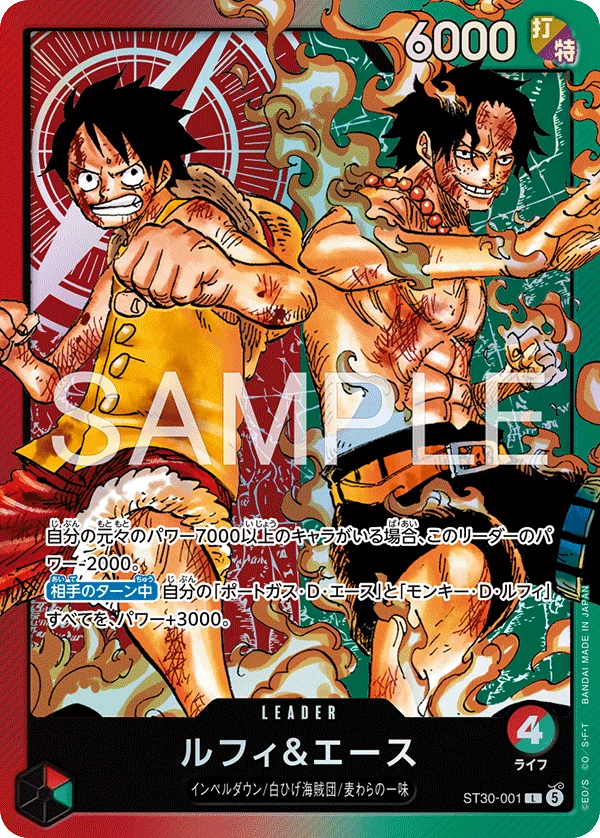
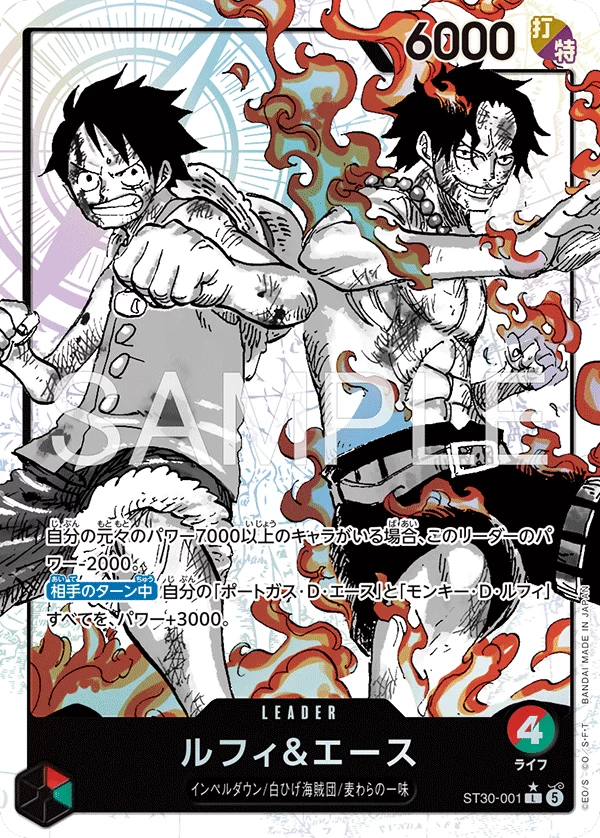
ST30-001 Luffy & Ace comes from Starter Deck EX -Luffy & Ace-, which also includes a three-card bonus pack; the Leader has a confirmed L-Parallel printing. Our own graded copy — PSA 10, currently listed at ¥96,387 — is that L-Parallel print.
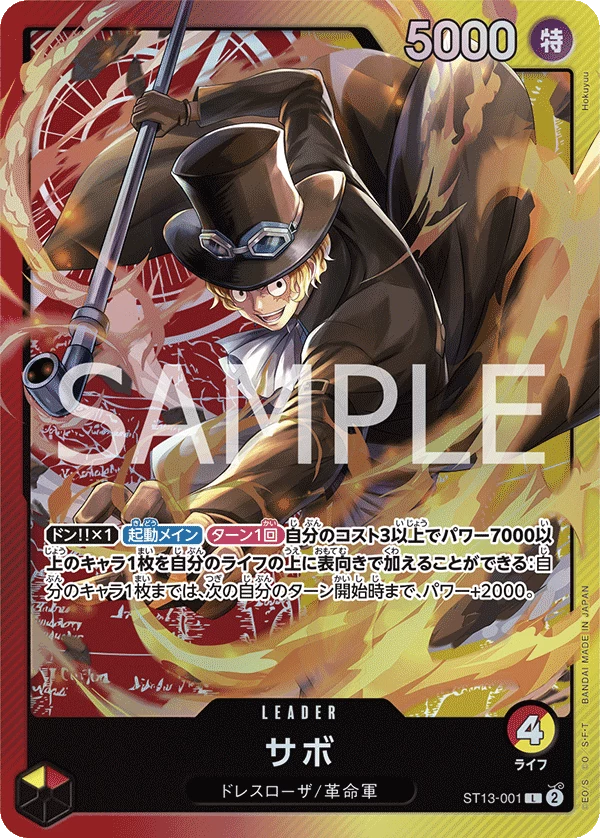
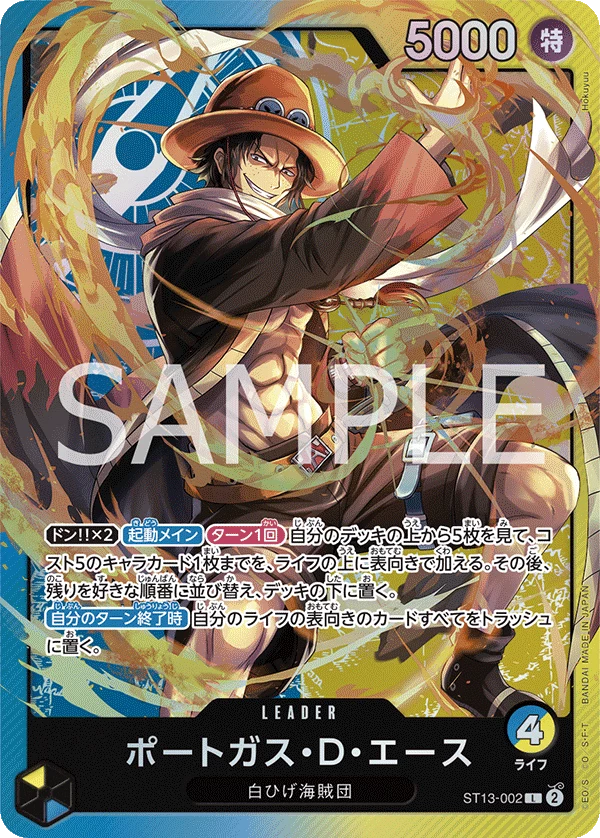
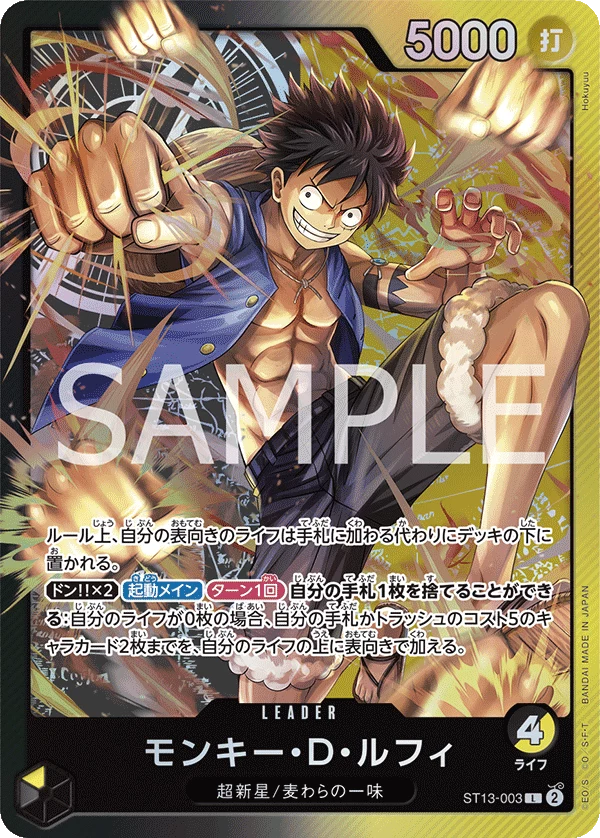
The ST-13 Ultimate Deck -Three Brothers’ Bond- is the deepest single product for Leader parallels in our research: all three Leaders (Sabo, Ace, and Luffy) carry a deck-included parallel, and each has also turned up as a tournament Prize Card and in the Premium Card Collection -Leader Collection- reprint line. That’s three separate reprint paths for the same three Leader cards, which is why ST-13 shows up repeatedly across secondary-market listings.
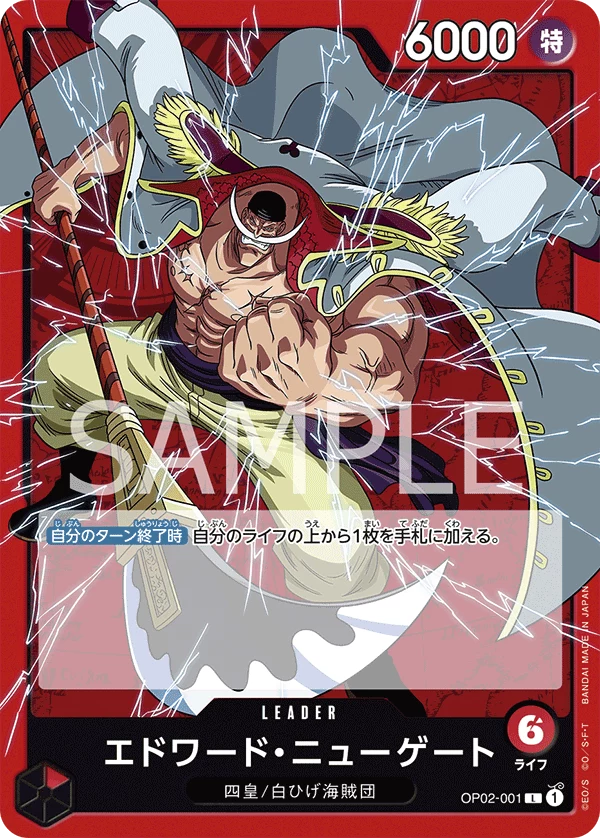
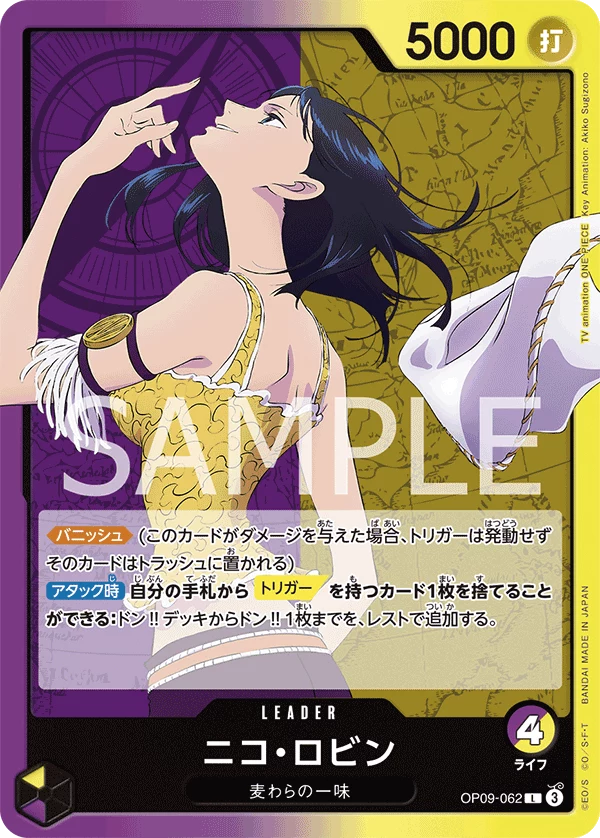
OP02-001 Edward.Newgate, pulled from OP02 Paramount War, is the booster-sourced example — its Alternate Art parallel has also been reprinted through ST-15 and through Premium Bandai promo channels, giving it more circulating variants than most other Leaders in this list. OP09-062 Nico Robin is confirmed to carry an L Parallel version on the secondary market, though we don’t have confirmed color and Power figures for it from the sources reviewed here.
Leader cards aren’t the only category with a comic-panel style variant — Character and SP cards have their own comic-art parallel line, which our comic parallel cards guide covers separately. For a broader view of where high-value cards sit across the whole card pool, see our most valuable One Piece cards guide.
Not every Leader has a confirmed parallel. Early printings like ST01-001 (the Leader of the original Straw Hat Crew starter deck) and OP01-001 Roronoa Zoro (OP-01’s Leader) are common reference points for new players, but our research didn’t turn up a confirmed parallel version for either, so we’re not claiming one exists.
What “L-P” Actually Means
On the official card list, every Leader card — parallel or not — is rarity-coded simply as “L” (for example: ST30-001 | L | LEADER). There is no separate official rarity name for the parallel version. Terms like “L-P” or “L Parallel” are retail and secondary-market shorthand, including on our own product listings, used to distinguish a Leader’s alternate-art or foil printing from its standard version. If you see “L-P” on a listing, it’s a distribution label, not a Bandai rarity designation — the card itself is still officially just an “L.”
How to Get Leader Cards
Based on what’s confirmed across the products in this guide, Leader cards reach players through five channels:
- Starter decks — the most direct route. Each starter deck’s -001 card is typically its Leader, guaranteed in every copy. Our starter decks guide covers the full ST-01 through ST-36 lineup.
- Booster packs — some Leaders are pulled cards rather than guaranteed inclusions, like OP02-001, OP09-062, and OP13-003.
- Ultimate Decks — a step up from a standard starter deck. ST-10 (subtitled “The Three Captains”) and ST-13 (subtitled “The Three Brothers’ Bond”) each ship with three separate Leader cards in one product rather than one.
- Premium Card Collection -Leader Collection- — a reprint line that has carried ST-13’s three Leaders in confirmed listings.
- Tournament Prize Cards — a distribution path confirmed for the ST-13 Leaders specifically, separate from retail product entirely.
For sealed product sourcing more generally, our One Piece booster box buying guide walks through how box purchases work end to end.
Where to Buy Leader Cards and OP-17 Product
We ship Japanese One Piece Card Game sealed product and singles worldwide from Tokyo with tracked delivery. Our current Leader-card stock is the graded ST30-001 L-Parallel described above; for new sealed product, our featured item right now is the upcoming OP-17 set.
For the graded ST30-001 Leader parallel discussed throughout this guide, see the listing directly: PSA 10 Luffy & Ace [ST30-001], ¥96,387 — one graded copy, and once it sells, it’s gone.
Looking for a specific Leader card that isn’t part of our current listed stock? Request a quote via our Quick Order page.
常见问题
What is a Leader card in the One Piece Card Game?
It’s the single card every deck is built around. Per the official rule manual, the Leader sets your deck’s win condition (reduce the opponent’s Leader Life to 0) and, through its color, restricts which other cards you’re allowed to include in your 50-card main deck.
How many colors can a Leader card have?
The official card list confirms six colors: Red, Green, Blue, Purple, Black, and Yellow. A Leader can be printed in a single color or in two colors combined — both formats exist across the card pool.
What does “L-P” or “Leader Parallel” mean?
It’s retail and secondary-market shorthand, not an official Bandai rarity name. On the official card list, every Leader is rarity-coded simply as “L,” whether it’s the standard printing or a parallel version.
Can I put any color of card in my deck?
No. Per the official rule manual, your 50-card main deck can only include Character, Event, and Stage cards that match a color in your Leader’s own color identity, plus up to four copies of the same card number.
Where can I find a Leader card besides a starter deck?
Booster packs (as a pulled card), Ultimate Decks like ST-10 and ST-13 (which ship with three Leaders each), the Premium Card Collection -Leader Collection- reprint line, and tournament Prize Cards are all confirmed distribution paths.
为本文精选
📩 会员专属折扣与优惠券
促销提醒、优惠券、补货通知,邮件直达,来自东京。