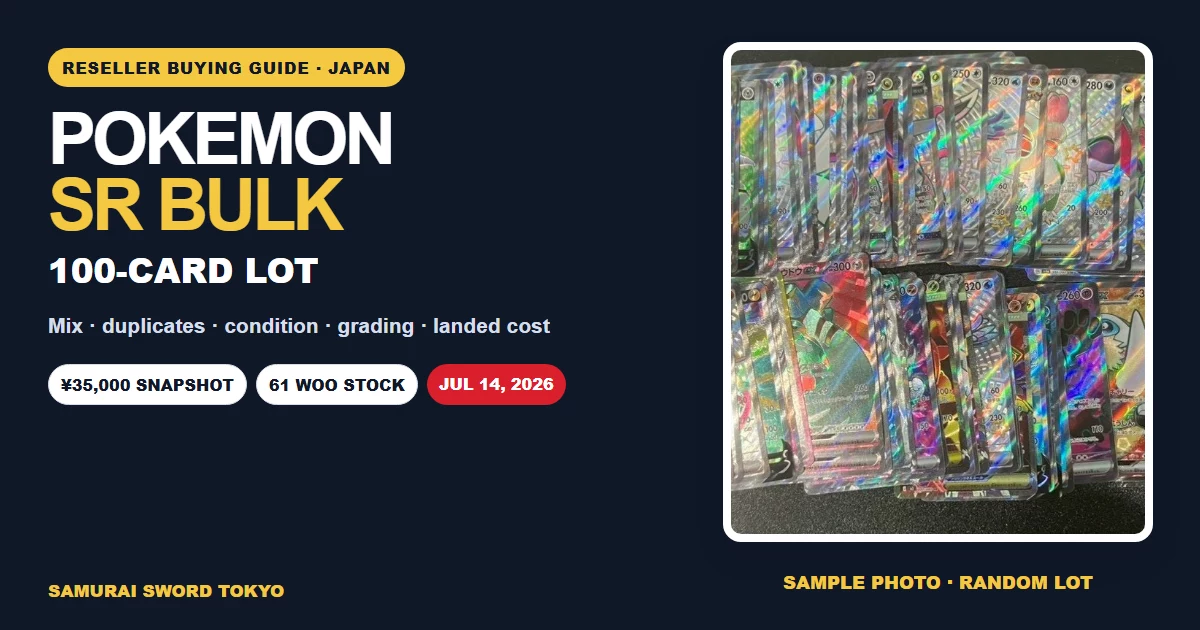
Satu lot bulk SR Pokemon Jepang bisa menjadi persediaan reseller yang berguna jika Anda ingin banyak listing bertiket rendah, bundel bertema, atau variasi live-sale tanpa membuka puluhan box tersegel. Ini bukan jalan pintas menuju kartu chase yang dijamin, grade yang dijamin, atau keuntungan yang dijamin. Keunggulan komersialnya berasal dari proses: menghitung secara akurat, mengidentifikasi setiap kartu, mengendalikan duplikat, menilai kondisi secara konsisten, dan mengetahui landed cost Anda sebelum mencantumkan apa pun.
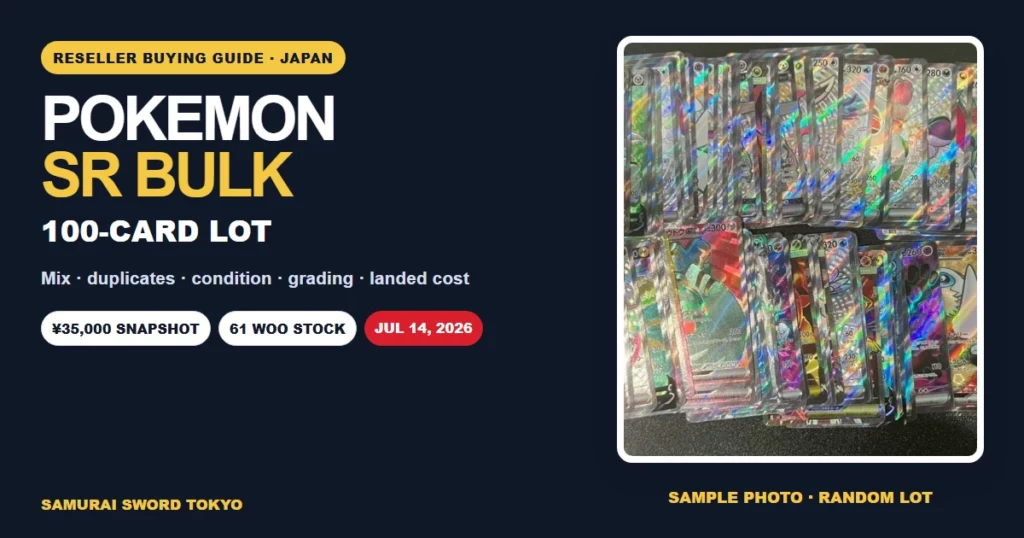
Samurai Sword Tokyo saat ini mencantumkan SR Bulk – 100-Card Set. Pada snapshot WooCommerce langsung yang diambil 14 Juli 2026, pukul 16:17 JST, kolom harga produk menunjukkan ¥35.000, kolom stok Woo menunjukkan 61 lot, dan status stok adalah tersedia. Itu setara dengan patokan harga beli sederhana sebesar ¥350 per kartu sebelum pengiriman, bea masuk, pajak, biaya pembayaran, perlengkapan, tenaga kerja, kartu yang ditolak, dan biaya penjualan. Harga dan stok bersifat fluktuatif; periksa kembali halaman produk langsung segera sebelum memesan.
Periksa dulu lot 100 kartu yang aktif
Buka halaman produk saat ini untuk memastikan harga dan ketersediaan. Nilai 14 Juli dalam panduan ini adalah audit bertanggal, bukan penawaran tetap atau reservasi stok.
Tanggal bukti: 14 Juli 2026, pukul 16:17 JST. Harga, stok, ketentuan grading, aturan kurir, dan biaya impor dapat berubah. Periksa kembali sumber utama sebelum bertindak.
Apakah Lot SR 100 Kartu Cocok untuk Model Resale Anda?
Pertanyaan pertama yang tepat bukanlah “Apakah kartu SR berharga?” Melainkan “Bisakah toko saya mengubah campuran acak 100 kartu menjadi penawaran yang jelas dan dideskripsikan secara akurat dengan biaya operasional yang terkendali?” Reseller dengan katalogisasi cepat, lalu lintas Pokemon yang sudah ada, dan beberapa saluran penjualan dapat merutekan kartu berbeda ke pembeli berbeda. Penjual yang bergantung pada satu hit premium mungkin tidak memiliki cara yang andal untuk menutup tenaga kerja dan biaya internasional ketika campurannya biasa saja.
Snapshot produk langsung: harga, stok, dan ketentuan lot
| Kolom | Snapshot 14 Juli 2026 | Cara reseller menggunakannya |
|---|---|---|
| Produk | SR Bulk – 100-Card Set (ID 40607) | Pastikan Anda mengevaluasi lot SR, bukan lot AR yang harganya lebih rendah. |
| SKU | SR-BULK-100 | Simpan SKU pemasok dalam catatan pembelian dan intake Anda. |
| Harga | ¥35.000 per lot 100 kartu | Gunakan hanya sebagai komponen pembelian; ini bukan landed cost. |
| Stok Woo | 61 lot; status tersedia | Ketersediaan adalah snapshot, bukan reservasi atau janji di masa depan. |
| Patokan unit sederhana | ¥350 per kartu | Sebelum ongkos kirim, biaya impor, tenaga kerja, perlengkapan, kartu ditolak, dan biaya penjualan. |
| Pernyataan seleksi | Acak; foto sampel; duplikat dapat terjadi | Jangan menjual di muka daftar isi yang pasti atau campuran bebas duplikat. |
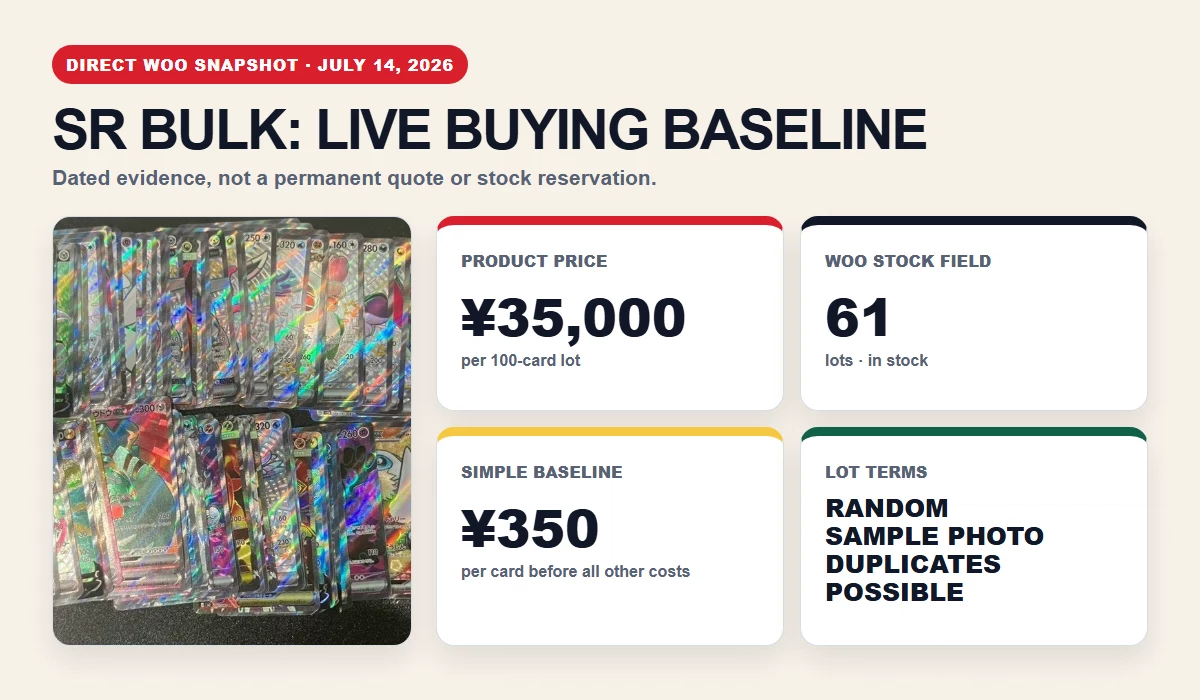
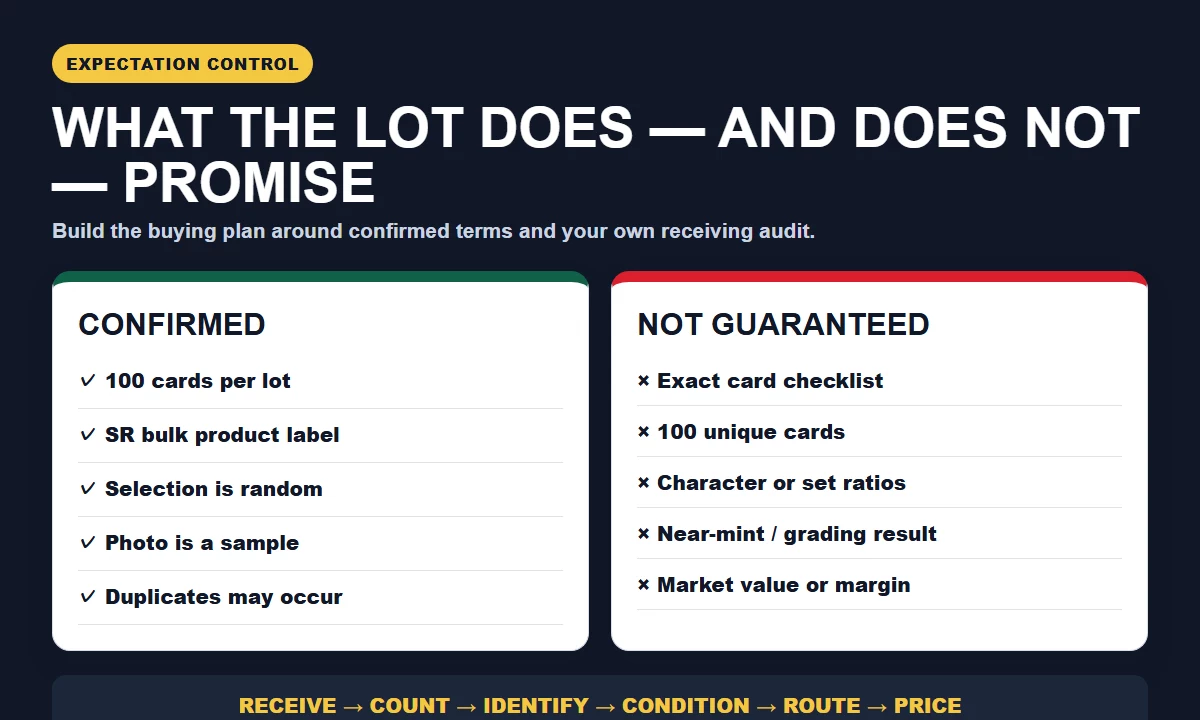
Deskripsi listing menyatakan bahwa foto tersebut adalah sampel, kartu dipilih sepenuhnya secara acak, dan penjual akan berusaha menghindari duplikat sambil mengakui bahwa duplikat tetap dapat terjadi. Ketiga fakta ini mendefinisikan risiko komersial lebih jelas daripada kata “bulk”. Artinya, hasil yang Anda harapkan harus berupa rentang hasil persediaan yang dapat dikelola, bukan satu komposisi yang diasumsikan.
Profil reseller yang cocok dan tidak cocok
| Profil pembeli | Kesesuaian | Alasan |
|---|---|---|
| Toko kartu dengan lemari kartu satuan mentah atau katalog web yang dapat dicari | Sangat cocok | Banyak SKU bertiket rendah yang berbeda dapat menciptakan kedalaman dan penjelajahan berulang. |
| Penjual live atau breaker yang dapat menyajikan variasi acak secara jujur | Berpotensi cocok | Duplikat dapat dirutekan ke berbagai sesi jika kondisi dan identitas terkendali. |
| Vendor konvensi yang membangun binder kartu Jepang yang terjangkau | Berpotensi cocok | Variasi visual bisa berguna ketika penawaran tidak dibangun di sekitar chase yang pasti. |
| Reseller khusus grading | Kurang cocok tanpa bukti inspeksi | Judul bulk mentah dan foto sampel tidak menjamin kartu siap-grading. |
| Penjual pre-order yang menjanjikan daftar isi tetap | Tidak cocok | Produk ini acak dan duplikat dapat terjadi. |
| Pembeli yang membutuhkan satu trainer, Pokemon, atau set tertentu | Tidak cocok | Kartu satuan yang pasti mengurangi risiko campuran dan tenaga kerja katalogisasi. |
Tes go/no-go tiga pertanyaan
- Bisakah Anda menjual setidaknya tiga jalur persediaan—misalnya kartu mentah satuan, bundel bertema, dan lot toko/display—tanpa mengubah kebenaran produk?
- Bisakah Anda menghitung, mengidentifikasi, memotret, dan menilai kondisi 100 kartu cukup cepat sehingga tenaga kerja tidak menghapus keuntungan harga?
- Bisakah Anda menanggung hasil konservatif yang berisi karakter berulang, nomor kartu berulang, atau kartu yang seharusnya tidak digrading?
Jika salah satu jawabannya tidak, kurangi jumlahnya, perbaiki alur kerja terlebih dahulu, atau beli persediaan yang pasti. Sebuah lot bisa saja diberi harga yang wajar namun tetap menjadi input yang salah untuk model bisnis tertentu.
Arti “SR Bulk”—dan Apa yang Tidak Dijaminnya
SR adalah filter kelangkaan yang nyata dalam basis data resmi Japanese Pokemon Card Game, tetapi “SR bulk” pada produk reseller juga merupakan label lot yang berorientasi pemasok. Keduanya adalah konsep yang berkaitan, bukan izin untuk mengasumsikan bahwa setiap kemungkinan kelangkaan premium, rasio karakter, atau era terwakili. Pencarian kartu resmi saat ini memisahkan SR dari kategori seperti AR, SAR, UR, SSR, HR, CHR, dan CSR. Karena itu, pembeli harus memverifikasi nomor cetak setiap kartu dan entri basis data resmi, alih-alih memperlakukan setiap kartu bertekstur atau full-art sebagai dapat dipertukarkan.
SR dibandingkan dengan label kelangkaan Jepang yang berdekatan
| Label | Arti operasional untuk intake | Jangan diasumsikan |
|---|---|---|
| SR | Catat nomor kartu yang tercetak dan pastikan entri kelangkaan resmi. | Bahwa setiap SR memiliki permintaan, harga, perlakuan seni, atau potensi grading yang sama. |
| AR | Pisahkan dari SR jika pemasok atau pelanggan Anda menggunakan filter kelangkaan yang ketat. | Bahwa lot AR dan SR dapat dipertukarkan karena keduanya bisa berfokus pada ilustrasi. |
| SAR | Katalogkan hanya ketika kartu yang tepat dikonfirmasi sebagai SAR. | Bahwa kartu yang secara visual rumit dalam lot berlabel SR dijamin sebagai SAR. |
| UR / HR / SSR | Gunakan entri kartu resmi dan konteks era. | Bahwa label premium yang berdekatan termasuk dalam lot SR acak. |
| Promo atau perlakuan khusus | Catat nomor promo, stempel, dan konteks distribusi. | Bahwa kelangkaan dapat disimpulkan hanya dari pola foil. |
Aturan foto sampel
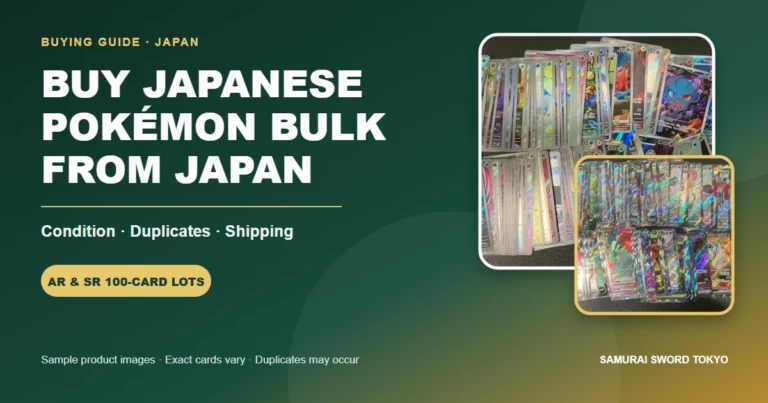
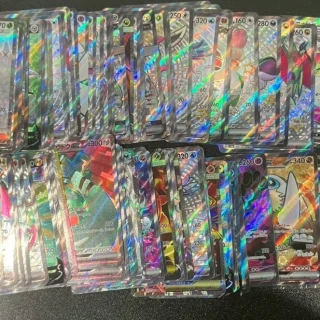
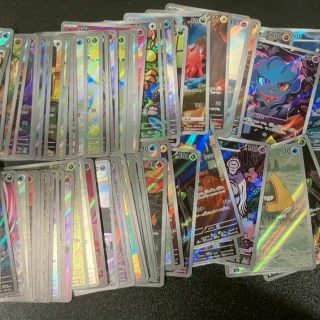
Foto sumber menunjukkan sekelompok besar kartu Pokemon Jepang mengkilap yang ditata bersama. Foto ini berguna untuk mengenali produk secara umum dan untuk merancang panduan ini. Foto ini tidak membuktikan karakter, set, nomor kartu, jumlah duplikat, kualitas permukaan, atau nilai jual kembali yang pasti dari lot berikutnya. Jangan memotong satu kartu menarik dari sampel dan menyiratkan bahwa kartu itu akan disertakan. Jangan mengiklankan “kartu yang ditampilkan” kecuali pemasok secara eksplisit mengubah ketentuan menjadi lot yang difoto secara pasti.
Aturan campuran acak
Seleksi acak berarti campuran dapat bervariasi antar Pokemon, Trainer, era set, popularitas karya seni, dan likuiditas pasar. Campuran juga dapat bervariasi antara dua lot yang dibeli pada waktu yang sama. Acak tidak berarti seragam secara statistik, dan tidak ada model probabilitas yang dipublikasikan untuk nomor kartu individual dalam produk ini. Bangun perkiraan di sekitar kategori—kartu unik, kelompok duplikat, jalur kondisi, dan rute penjualan—bukan hit yang disebutkan namanya.
Aturan duplikat
Upaya terbaik penjual untuk mengurangi duplikat memang membantu, tetapi listing secara eksplisit mengizinkan duplikat. Rencanakan untuk itu. “Duplikat” seharusnya biasanya berarti nomor kartu dan perlakuan yang sama, bukan sekadar nama Pokemon yang sama. Dua kartu Charizard dari set berbeda atau dengan nomor kartu berbeda adalah item katalog yang berbeda. Sebaliknya, karya seni dan nomor yang sama yang diulang lima kali adalah satu SKU dengan kuantitas lima, bahkan jika variasi cetak kecil membuat salinannya terlihat sedikit berbeda.
Cara Mengaudit Campuran, Duplikat, dan Jumlah saat Kedatangan
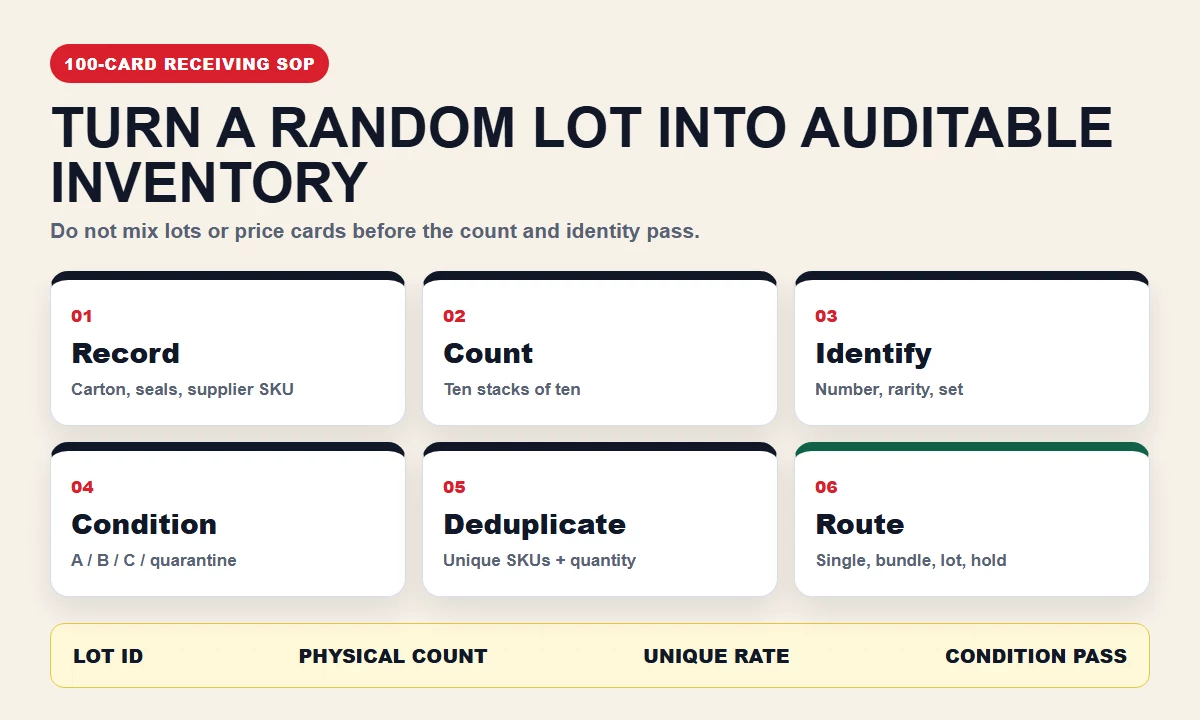
Meja penerimaan adalah tempat pembelian bulk menjadi persediaan yang andal. Rekam video atau foto paket tersegel sebelum membuka, simpan label pemasok, dan hitung sebelum menyortir. Ini melindungi kedua belah pihak jika jumlah fisik berbeda dari pesanan dan memberi tim Anda rantai penyimpanan yang bertanggal waktu. Jangan mulai mencantumkan kartu yang menarik sementara sisanya masih belum dihitung.
Langkah 1: rekonsiliasi jumlah fisik
Gunakan playmat atau baki penyortiran yang bersih dan hitung dalam kelompok sepuluh. Satu unit 100 kartu harus terurai menjadi sepuluh tumpukan sepuluh sebelum sleeve, katalogisasi, atau keputusan grading. Catat kekurangan, kelebihan, dan kerusakan transit yang jelas secara terpisah. Jika beberapa lot tiba bersamaan, jaga agar setiap unit pemasok terisolasi hingga jumlah dan ID intake-nya lengkap; jika tidak, pelaporan duplikat dan kondisi pada tingkat lot menjadi tidak mungkin.
Langkah 2: buat lembar audit tingkat lot
| Kolom | Contoh format | Mengapa ini penting |
|---|---|---|
| ID lot internal | SR-20260714-A | Menghubungkan setiap kartu ke satu pembelian dan pengiriman. |
| Produk/SKU pemasok | 40607 / SR-BULK-100 | Mencegah kebingungan dengan bulk AR atau pembelian kartu yang pasti. |
| Jumlah fisik | 100 diterima | Menetapkan penyebut untuk setiap rasio berikutnya. |
| Nomor kartu unik | Diukur setelah katalogisasi | Menunjukkan kedalaman campuran tanpa menyiratkan nilai. |
| Unit duplikat | Jumlah total dikurangi jumlah unik | Mengukur pekerjaan perutean. |
| Jumlah jalur kondisi | A / B / C / karantina | Mencegah kartu rusak masuk ke listing yang bersih. |
| Pengecualian | Ketidakcocokan, dugaan perubahan, kelembapan, bau | Membuat antrean tinjauan dan jejak bukti. |
Langkah 3: identifikasi campuran sebelum penetapan harga
Urutkan terlebih dahulu berdasarkan nomor kartu cetak dan kelangkaan, kemudian berdasarkan karakter atau tema. Menetapkan harga terlalu cepat menciptakan anchoring: tim menghabiskan waktu untuk kartu yang paling dikenali dan mengabaikan persediaan yang berulang atau likuiditasnya rendah. Putaran identitas yang lengkap juga mengungkap kartu yang tampak mirip tetapi berasal dari set berbeda, dan membuat tingkat duplikat dapat diukur.
| Metrik | Perhitungan | Keputusan yang didukung |
|---|---|---|
| Tingkat kartu unik | Nomor kartu unik / 100 | Seberapa besar keluasan katalog yang diciptakan lot. |
| Tingkat duplikat | (100 – nomor kartu unik) / 100 | Seberapa banyak persediaan yang memerlukan perutean kuantitas atau bundel. |
| Konsentrasi SKU teratas | Kuantitas kartu identik terbesar / 100 | Apakah satu item berulang mendominasi lot. |
| Pembagian Pokemon/Trainer | Hitung berdasarkan jenis kartu setelah verifikasi | Merchandising dan perutean audiens. |
| Sebaran era/set | Hitung berdasarkan kode set atau keluarga rilis | Tag pencarian, bagian binder, dan kesesuaian pelanggan. |
| Tingkat kelulusan kondisi | Kartu mentah yang dapat dijual / 100 | Penyebut kartu yang diterima untuk landed cost. |
Langkah 4: kelompokkan duplikat berdasarkan tindakan
| Salinan identik | Tindakan default | Kontrol |
|---|---|---|
| 1 | Cantumkan sebagai SKU tunggal | Foto jalur kondisi yang sebenarnya atau gunakan kata-kata foto-representatif yang tepat. |
| 2-3 | SKU tunggal dengan kuantitas, atau dibagi antar saluran | Jaga agar salinan berkondisi terburuk tidak masuk ke listing berkondisi terbaik. |
| 4-9 | Uji bundel bertema, playset hanya jika sesuai, atau rotasi live-sale | Jangan pernah menyebut kelompok acak sebagai set lengkap. |
| 10+ | Lot grosir/toko atau stok pengisian ulang terjadwal | Pantau penjualan sebelum membeli lebih banyak dengan profil yang sama. |
Duplikat bisa berguna secara komersial jika dihitung dan dirutekan secara akurat. Risikonya muncul ketika rencana pembelian mengasumsikan 100 listing unik. Modelkan setidaknya satu skenario duplikat konservatif sebelum memesan; misalnya, tanyakan apakah operasi Anda tetap berjalan jika hanya 70 hingga 80 nomor kartu yang unik. Rentang itu adalah uji stres, bukan perkiraan untuk produk ini.
Pengendalian Kondisi Tanpa Menjanjikan Berlebihan
Kartu modern mentah bisa terlihat bersih dalam foto kelompok sambil menunjukkan pemutihan, goresan, penyok, garis cetak, atau bekas tekanan di bawah cahaya langsung. “Pack fresh” bukan grade kondisi yang terukur, dan foto pemasok bulk tidak dapat menetapkan kondisi kartu yang Anda terima. Reseller harus membuat standar internal yang dapat diulang, mengungkapkannya, dan memfoto pengecualian.
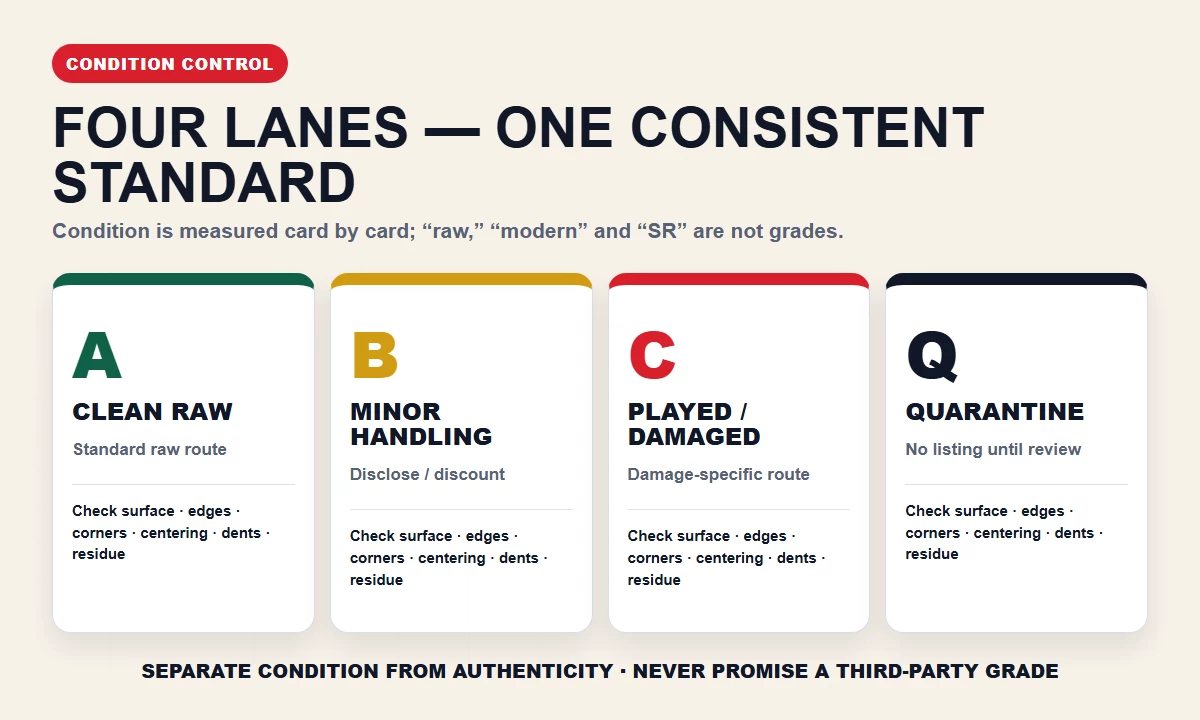
Gunakan empat jalur kondisi
| Jalur | Definisi internal | Rute umum |
|---|---|---|
| A — mentah bersih | Tidak ada lipatan, penyok, atau pemutihan besar yang langsung terlihat; permukaan lolos pemeriksaan cahaya bersudut. | Listing mentah standar dengan gambar aktual atau representatif sebagaimana diungkapkan. |
| B — penanganan ringan | Masalah tepi atau permukaan kecil yang harus diungkapkan tetapi tetap layak jual. | Kartu satuan diskon atau bundel yang dilabeli dengan jelas. |
| C — dimainkan/rusak | Lipatan, penyok, goresan berat, mengelupas, kelembapan, atau keausan tepi besar. | Listing dengan kerusakan diungkapkan, bundel non-premium, atau keputusan tidak dijual. |
| Q — karantina | Kekhawatiran identitas, keaslian, perubahan, bau, atau kontaminasi. | Tidak dicantumkan sampai ditinjau dan didokumentasikan. |
Periksa permukaan foil di bawah cahaya terkendali
Gunakan cahaya atas yang menyebar ditambah lampu samping yang dapat digerakkan. Putar kartu daripada menggosok permukaannya. Periksa bagian depan dan belakang untuk garis cetak, bekas roller, goresan, penyok, tepi terkelupas, kompresi sudut, noda, residu, dan tekukan. Sleeve dapat menyembunyikan pemutihan tepi dan menciptakan pantulan, jadi periksa di luar sleeve dengan tangan yang bersih dan kering atau alat penanganan yang sesuai. Jangan pernah membersihkan, menekan, atau mewarnai ulang kartu untuk memperbaiki penampilan; perubahan dapat menghancurkan kepercayaan dan dapat membuat kartu tidak memenuhi syarat untuk grade numerik.
Pisahkan kondisi dari keaslian
Kartu asli bisa rusak, dan kartu yang terlihat bersih secara visual masih bisa memerlukan tinjauan identitas atau keaslian. Jangan gunakan “asli” sebagai sinonim untuk “near mint”. Demikian pula, jangan mendeskripsikan kartu mentah sebagai “kualitas PSA 10”. Standar yang dipublikasikan PSA mendeskripsikan angka 10 sebagai hampir sempurna dan mencakup pertimbangan centering, sudut, fokus, kilap, dan noda, sambil juga mengakui adanya penilaian dan daya tarik visual. Penyaringan intake Anda bukanlah hasil akhir dari perusahaan grading.
Tulis listing yang bertahan dari retur
- Nyatakan apakah gambar menunjukkan kartu yang persis atau bersifat representatif.
- Gunakan nomor kartu tercetak, set atau tanda regulasi, kelangkaan, dan bahasa dalam judul atau spesifikasi item.
- Ungkapkan cacat material dengan foto close-up daripada mengandalkan kata grade yang luas.
- Jaga agar catatan jalur kondisi tetap melekat pada ID persediaan setelah kartu berpindah antar saluran.
- Jangan menggabungkan salinan jalur A dan B di bawah satu kondisi tanpa menjelaskan rentangnya.
Deskripsi konservatif yang konsisten sering kali lebih penting daripada memberikan kondisi paling optimis. Retur, pengembalian dana sebagian, dan waktu layanan pelanggan adalah bagian dari ekonomi bahkan ketika kartu itu sendiri murah.
Keaslian dan Akurasi Katalog dalam Skala Besar
Reseller memerlukan dua kontrol: memverifikasi bahwa identitas kartu dicatat dengan benar, dan mengeskalasi apa pun yang tampak tidak konsisten dengan kartu asli yang diterbitkan pabrik. Kontrol pertama adalah pekerjaan katalog rutin. Kontrol kedua adalah penyaringan risiko, bukan jaminan. Gambar, nomor kartu yang cocok, atau hasil basis data saja tidak dapat membuktikan keaslian.
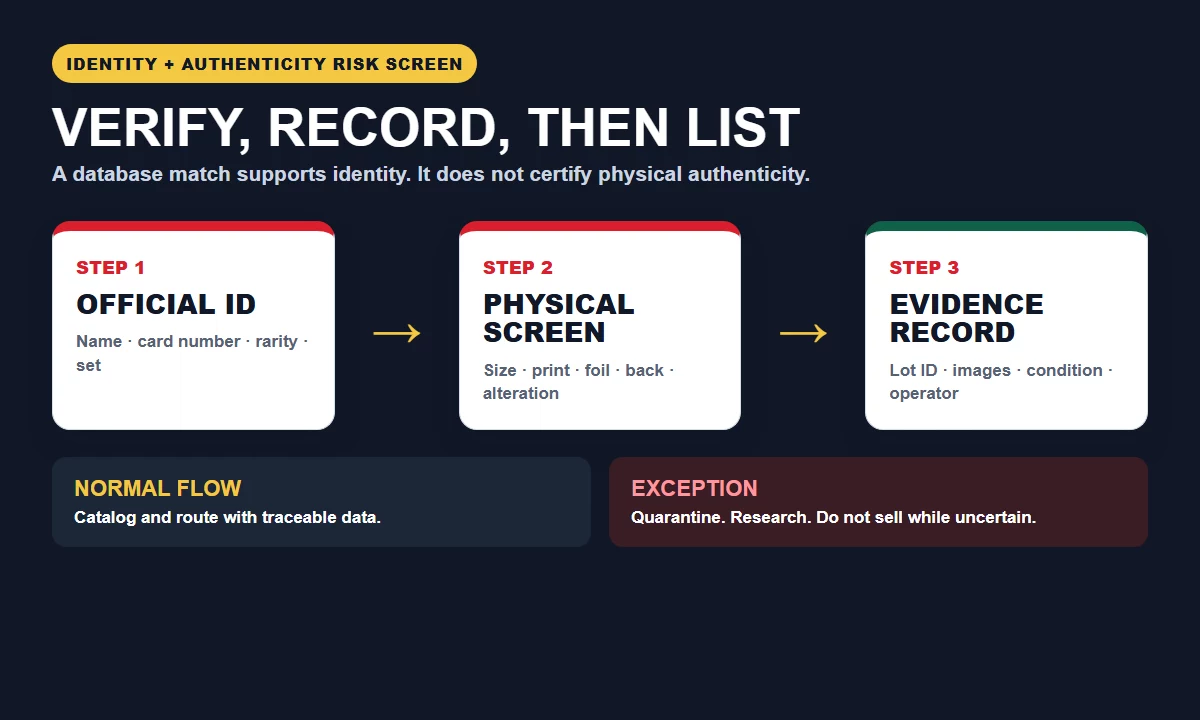
Mulai dengan basis data kartu Jepang resmi
Gunakan pencarian kartu resmi Pokemon Card Game untuk memeriksa silang nama, nomor cetak, kelangkaan, dan konteks set. Pencarian resmi menampilkan filter kelangkaan termasuk SR dan kategori yang berdekatan, menjadikannya otoritas yang lebih baik untuk klasifikasi daripada judul marketplace. SST juga menyediakan hub daftar kartu Pokemon Jepang sebagai alat bantu navigasi, tetapi data kartu resmi harus menyelesaikan konflik identitas.
Jalankan penyaringan konsistensi fisik
| Pemeriksaan | Kontrol normal | Eskalasi ketika |
|---|---|---|
| Identitas tercetak | Nama, nomor, kelangkaan, dan konteks set sesuai dengan referensi resmi. | Nomor, kelangkaan, atau seni tidak cocok dengan referensi. |
| Dimensi dan potongan | Kartu sejajar dengan kartu perbandingan asli yang diketahui. | Ukuran, radius sudut, atau potongan terlihat tidak konsisten. |
| Tipografi dan simbol | Ketebalan teks, simbol energi, dan teks aturan terlihat konsisten. | Font, spasi, atau simbol terdistorsi atau salah eja. |
| Permukaan dan foil | Pola dan hasil akhir berperilaku konsisten di bawah cahaya yang berubah. | Cetakan pelangi statis, tekstur tidak biasa, atau pemisahan lapisan muncul. |
| Belakang dan warna | Desain belakang dan keseimbangan warna konsisten dengan era. | Registrasi, warna, atau geometri tepi secara material tidak normal. |
| Bukti perubahan | Tidak ada pewarnaan ulang, pemotongan, residu penekanan, atau lapisan asing. | Tepi, kilap, atau permukaan menunjukkan kemungkinan intervensi. |
Karantina dulu, teliti kemudian
Jangan menempatkan kartu yang meragukan ke dalam listing aktif sambil menelitinya. Berikan ID karantina, foto kedua sisi dan kekhawatiran spesifik, catat sumber perbandingan, dan dapatkan tinjauan dari yang berpengalaman. Jika bukti tetap tidak memadai, jangan menjualnya sebagai asli. Aturan yang sama berlaku untuk kartu dengan kemungkinan pembersihan atau perubahan: ketidakpastian tidak boleh disampaikan kepada pelanggan melalui bahasa yang meyakinkan.
Simpan catatan katalog yang dapat dilacak
Minimal, simpan ID lot internal, SKU pemasok, nomor kartu, kelangkaan, set, nama karakter atau Trainer, bahasa, jalur kondisi, kuantitas, dan jalur gambar. Tambahkan tanggal dan operator untuk setiap koreksi. Catatan ini memungkinkan Anda menjawab pertanyaan pelanggan, melacak kesalahan berulang, dan menghitung penjualan sebenarnya per lot, bukan per kumpulan persediaan campuran.
Perutean Reseller: Kartu Satuan, Bundel, Live Sale, dan Lot Toko
Lot acak menjadi lebih mudah dimonetisasi ketika setiap kartu memiliki lebih dari satu tujuan yang jujur. Tujuannya bukan memaksa setiap kartu ke harga tertinggi yang diiklankan. Tujuannya adalah mencocokkan kedalaman persediaan, kondisi, permintaan, dan tenaga kerja dengan saluran yang paling mungkin menjualnya secara akurat.
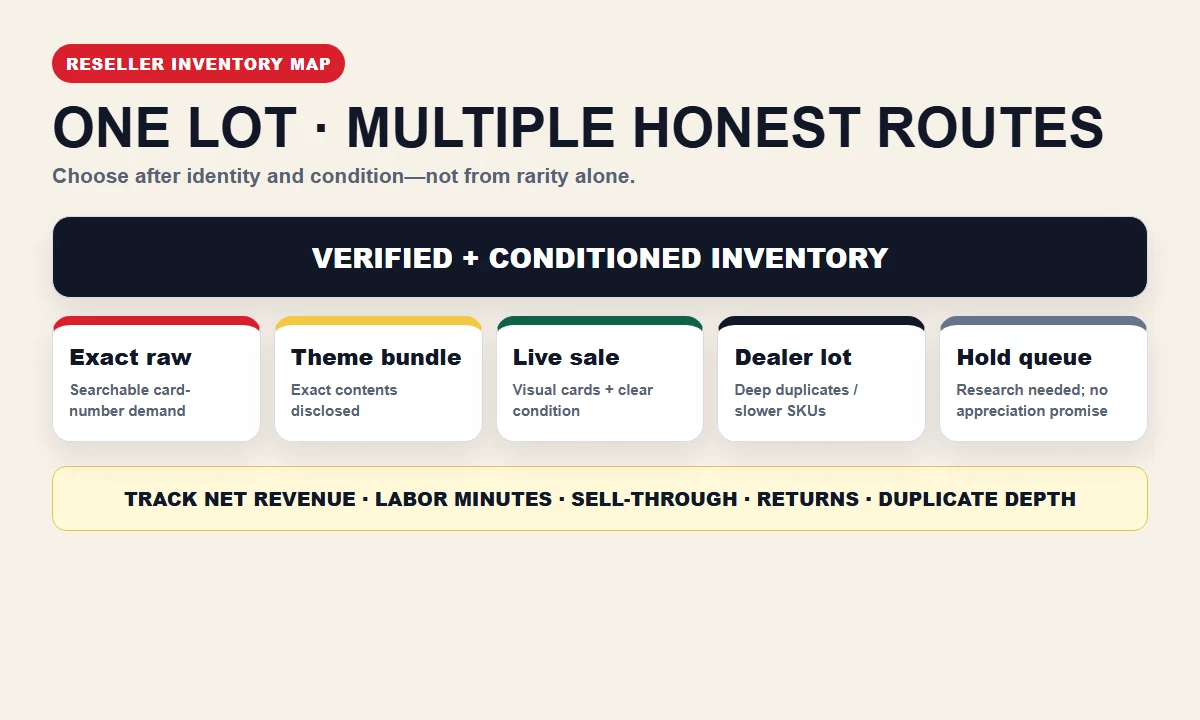
Pilih rute setelah katalogisasi
| Rute | Kandidat terbaik | Biaya atau risiko utama |
|---|---|---|
| Kartu satuan mentah yang pasti | Nomor kartu terverifikasi, foto bersih, permintaan yang dapat dicari. | Fotografi, spesifikasi item, tenaga kerja pick-and-pack. |
| Bundel karakter atau Trainer | Beberapa kartu berbeda dengan tema yang jelas. | Bundel harus mengungkapkan isi yang pasti; tema tidak membenarkan kerusakan tersembunyi. |
| Mini-lot set atau era | Kartu terverifikasi dari keluarga produk yang sama. | Jangan menyebutnya lengkap kecuali setiap kartu yang diperlukan disertakan. |
| Rotasi live-sale | Kartu yang menarik secara visual dengan pengungkapan kondisi yang jelas. | Waktu presentasi dan biaya platform dapat melebihi biaya kartu. |
| Lot dealer/toko | Duplikat dalam atau persediaan yang bergerak lebih lambat. | Realisasi unit yang lebih rendah dapat ditukar dengan perputaran yang lebih cepat. |
| Antrean tahan/riset | Kartu yang baru dirilis, sulit diidentifikasi, atau tidak pasti. | Modal tetap terikat; menahan bukan strategi apresiasi yang dijamin. |
Bangun satu SKU, lalu kelola kuantitas
Nomor kartu identik dalam jalur kondisi yang sama biasanya harus berbagi satu SKU katalog dengan kuantitas. Ini mencegah listing duplikat bersaing satu sama lain dan membuat pengisian ulang terlihat. Jika salinan berbeda secara material dalam kondisi, pisahkan. Salinan bersih dan salinan penyok adalah penawaran yang berbeda meskipun nomor kartu tercetaknya cocok.
Gunakan bundel bertema dengan hati-hati
Bundel dapat mengurangi tenaga kerja listing dan memberikan tujuan yang berguna bagi karakter berulang. Bundel harus menunjukkan atau menyebutkan setiap kartu yang disertakan, menyatakan apakah duplikat ada, dan menghindari istilah seperti “nilai misteri” yang menyiratkan batas bawah finansial yang tidak diungkapkan. Bundel bertema paling kuat ketika pembeli memahami tema, kuantitas yang pasti, bahasa, rentang kondisi, dan apakah fotonya persis.
Biarkan penjualan menentukan ukuran pemesanan ulang
Lacak unit terjual tiga puluh hari, hari hingga penjualan pertama, rata-rata pendapatan bersih setelah biaya marketplace, tingkat retur, dan kedalaman duplikat yang tersisa per lot intake. Pesan ulang karena rute yang dapat diulang terjual habis, bukan karena beberapa kartu menarik membuat foto pertama terlihat kuat. Stok SST saat ini dapat mendukung pengisian ulang hari ini, tetapi harga dan ketersediaan di masa depan tidak dijamin.
| Metrik | Apa yang diungkapkannya | Tanda peringatan |
|---|---|---|
| Pendapatan bersih per kartu yang diterima | Pendapatan setelah biaya penjualan dan pengembalian dana. | Menggunakan harga listing kotor sebagai keuntungan. |
| Menit tenaga kerja per kartu terjual | Biaya operasional katalogisasi dan pemenuhan. | Listing bertiket rendah menghabiskan waktu kartu premium. |
| Penjualan 30 hari | Seberapa cepat rute yang dipilih menghabiskan stok. | Memesan ulang sementara kedalaman duplikat terus meningkat. |
| Tingkat retur/masalah | Kualitas deskripsi identitas dan kondisi. | Klaim “tidak sesuai deskripsi” yang berulang. |
| Konsentrasi persediaan | Paparan terhadap satu nomor kartu atau karakter. | Satu SKU lambat mendominasi unit yang tersisa. |
Butuh pesanan yang lebih besar atau berulang?
Periksa dulu persediaan quick-order saat ini, lalu gunakan halaman pertanyaan SST untuk pertanyaan spesifik bisnis. Respons khusus tidak dijanjikan, dan stok langsung tetap menjadi sinyal ketersediaan yang mengendalikan.
Strategi Grading: Pilih Kandidat, Jangan Berasumsi Hasil
Kata SR tidak membuat grading menguntungkan, dan kartu yang terlihat bersih dalam foto kelompok tidak otomatis menjadi kandidat grading. Grading menambah tinjauan autentikasi, opini kondisi, biaya layanan, pengiriman, paparan asuransi, dan waktu tunggu. Kartu mentah harus terlebih dahulu lolos penyaringan identitas, permintaan, dan kondisi berdasarkan kelebihannya sendiri.
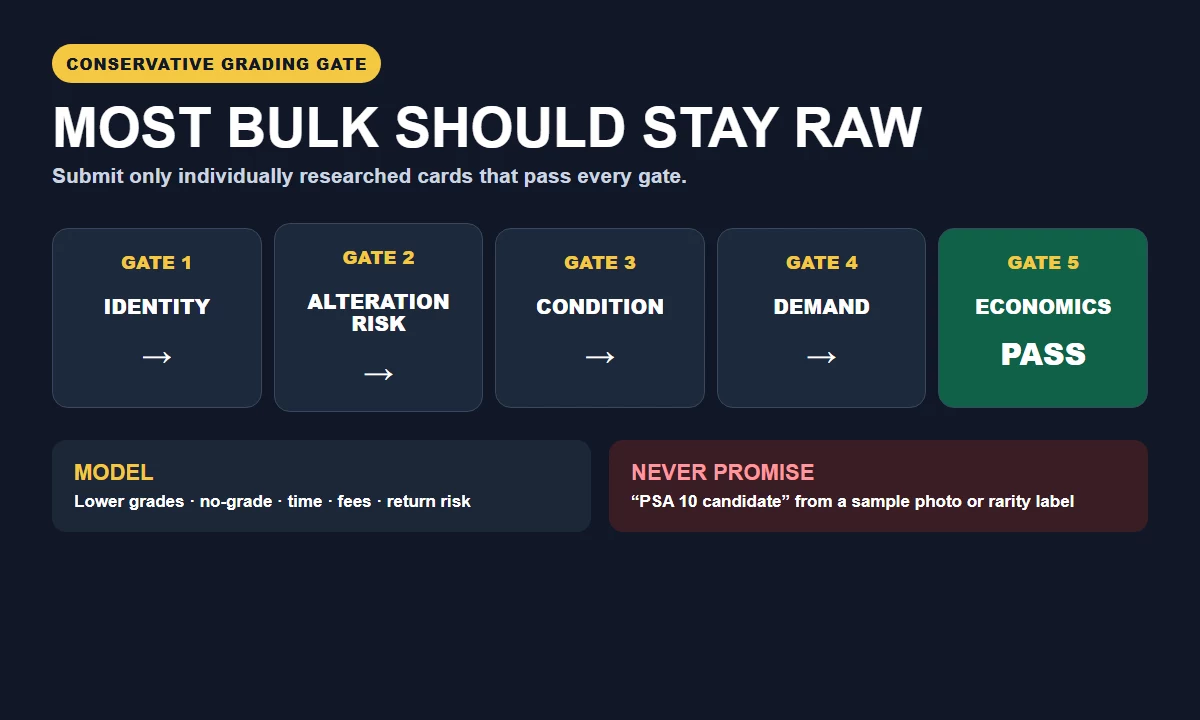
Gunakan penyaringan grading lima gerbang
| Gerbang | Pertanyaan | Tindakan jika gagal |
|---|---|---|
| Identitas | Apakah nomor kartu, kelangkaan, dan varian yang tepat telah dikonfirmasi? | Katalogkan atau karantina; jangan dikirim. |
| Keaslian/perubahan | Apakah ada kekhawatiran tentang pemotongan, pewarnaan ulang, pembersihan, atau restorasi? | Eskalasi; jangan berasumsi grade numerik. |
| Kondisi | Apakah bagian depan, belakang, tepi, sudut, permukaan, dan centering memenuhi ambang batas Anda? | Jual mentah dengan kondisi yang akurat atau tolak. |
| Permintaan | Apakah ada bukti permintaan pembeli untuk kartu yang tepat ini pada grade target? | Utamakan persediaan mentah; jangan grading hanya karena kelangkaan. |
| Ekonomi | Apakah hasil konservatif menutupi semua biaya grading dan penjualan? | Jangan dikirim jika keputusan memerlukan grade teratas agar berhasil. |
Modelkan distribusi grade, bukan jumlah PSA 10
Standar yang dipublikasikan PSA menyebut PSA 10 hampir sempurna dan mendeskripsikan ekspektasi ketat untuk sudut, fokus, kilap, noda, dan centering, dengan toleransi untuk cacat cetak kecil hanya ketika daya tarik visual tidak terganggu. Halaman yang sama menjelaskan bahwa daya tarik visual memperkenalkan penilaian. Karena itu, model reseller harus mencakup grade numerik yang lebih rendah, hasil tanpa grade, dan kartu yang dikembalikan sebagai meragukan atau diubah jika relevan. Jangan memasarkan persediaan mentah sebagai “kandidat 10” hanya karena modern dan mengkilap.
Hitung setiap biaya grading
- Tingkat layanan dan biaya keanggotaan pada saat pengiriman.
- Pengiriman keluar dan pengembalian, asuransi, dan paparan bea cukai jika berlaku.
- Card saver, sleeve, label, dan tenaga kerja persiapan.
- Modal yang terikat selama perkiraan waktu pemrosesan, yang dapat berubah.
- Kemungkinan biaya tambahan, hasil tanpa grade, dan grade yang lebih rendah dari yang dimodelkan.
- Biaya marketplace, risiko retur, dan pemenuhan setelah slab kembali.
PSA menyatakan bahwa perkiraan waktu pemrosesan dan ketentuan layanan dapat berubah. Periksa halaman layanan resmi saat ini alih-alih menyalin biaya atau waktu dari artikel yang lebih lama. Panduan ini sengaja tidak menyisipkan biaya grading ke dalam ekonomi lot karena nilai yang benar bergantung pada akun, tingkat layanan, tujuan, dan tanggal pengiriman Anda.
Jaga agar kartu yang dikirim tetap terhubung ke lot asli
Berikan ID pengiriman yang menghubungkan setiap kartu kembali ke ID intake bulk SR. Catat gambar mentah, logika nilai yang dinyatakan, tingkat layanan, tanggal keluar, grade yang diterima, dan semua biaya. Tanpa keterlacakan lot, satu kartu yang berhasil dapat membuat seluruh pembelian tampak lebih menguntungkan daripada sebenarnya, sementara pengiriman yang tidak berhasil menghilang ke dalam biaya umum.
Landed Cost, Titik Impas, dan Sensitivitas Margin
Patokan pembelian 14 Juli sederhana: ¥35.000 dibagi 100 sama dengan ¥350 per kartu. Perhitungan bisnisnya tidak sederhana karena hanya kartu yang diterima dan dapat dijual yang seharusnya berada dalam penyebut, sementara setiap biaya akuisisi dan pemrosesan termasuk dalam pembilang. Harga beli per kartu yang rendah bisa menjadi landed cost yang tinggi ketika pengiriman, tenaga kerja, kartu yang ditolak, dan penjualan yang lambat diabaikan.
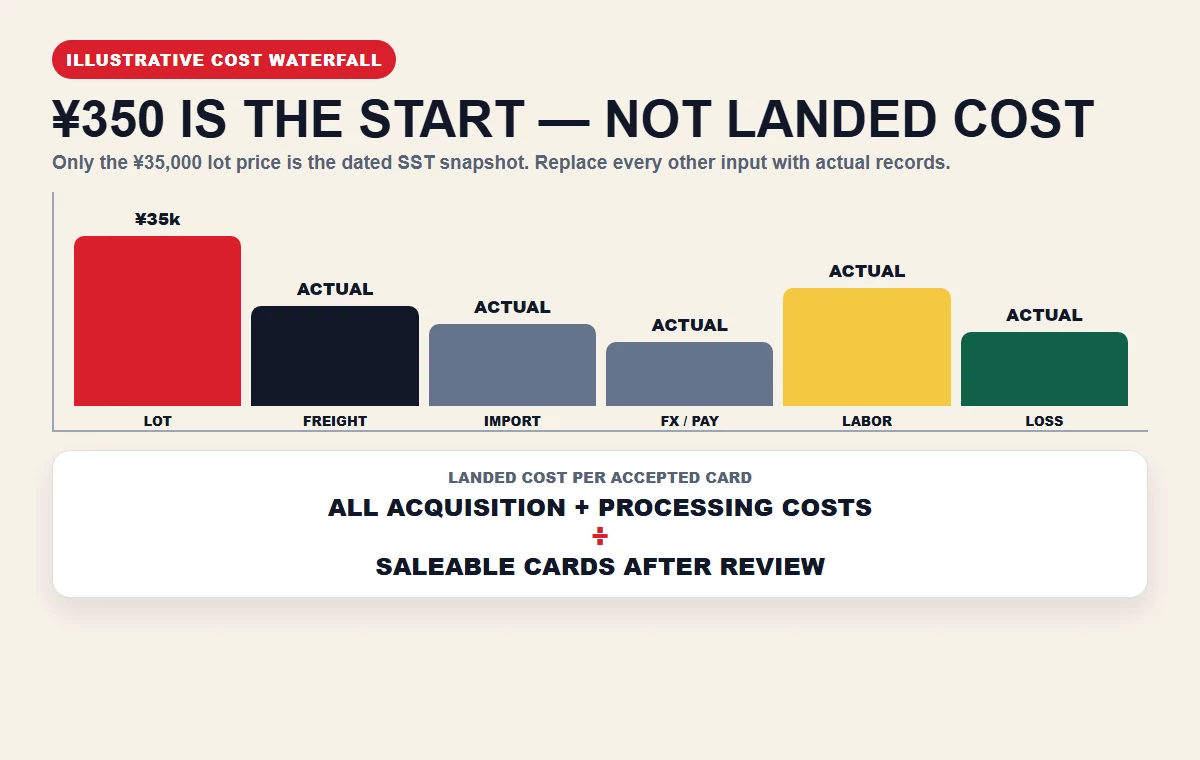
Gunakan rumus landed cost per kartu yang diterima
“Diterima” berarti kartu yang bisnis Anda bersedia jual dalam salah satu jalur kondisi yang diungkapkan. Kartu karantina, kerusakan parah, dan pengecualian identitas yang belum terselesaikan tidak boleh diam-diam tetap berada dalam penyebut. Kartu-kartu ini tetap berada dalam pembilang biaya karena bisnis membayar untuk memperoleh dan memprosesnya.
| Input | Gunakan bukti aktual dari | Kesalahan umum |
|---|---|---|
| Pembelian lot | Faktur pemasok/pesanan Woo | Menggunakan harga artikel lama setelah harga langsung berubah. |
| Alokasi pengiriman | Faktur kurir yang dialokasikan di seluruh pesanan gabungan | Menetapkan pengiriman nol karena produk lain berbagi karton. |
| Bea masuk, pajak, dan kepabeanan | Faktur impor dan aturan lokal | Mengasumsikan setiap tujuan memiliki perlakuan yang sama. |
| Pembayaran dan FX | Pernyataan prosesor atau bank | Menggunakan kurs tukar utama tanpa spread konversi. |
| Perlengkapan | Sleeve, kantong, label, penyimpanan, dan pengemasan | Memperlakukan barang habis pakai sebagai gratis. |
| Tenaga kerja | Waktu penerimaan, katalogisasi, pengambilan gambar, dan pemenuhan yang diukur | Menilai tenaga kerja pemilik sebagai nol. |
| Tunjangan kerugian | Kerusakan historis, retur, dan penghapusan yang tidak terjual | Memodelkan setiap kartu dalam kondisi terbaik yang terlihat. |
Skenario sensitivitas ilustratif
Tabel berikut bukan perkiraan, penawaran, atau janji keuntungan. Tabel ini mempertahankan pembelian lot pada ¥35.000 yang diaudit dan mengubah input operasional hipotetis sehingga pembeli dapat melihat mengapa penyebut kartu yang diterima itu penting. Ganti setiap asumsi dengan catatan Anda sendiri.
| Skenario | Lot | Biaya landed/pemrosesan lainnya | Kartu yang diterima | Landed cost ilustratif per kartu yang diterima |
|---|---|---|---|---|
| Contoh operasi ramping | ¥35.000 | ¥10.000 | 98 | Sekitar ¥459 |
| Uji stres dasar | ¥35.000 | ¥15.000 | 95 | Sekitar ¥526 |
| Contoh friksi tinggi | ¥35.000 | ¥25.000 | 90 | Sekitar ¥667 |
Hitung titik impas dari pendapatan bersih
Harga listing kotor bukanlah pendapatan bersih. Jika marketplace mengenakan biaya persentase ditambah biaya pembayaran atau listing yang dipromosikan, harga kotor yang diperlukan harus menutupi pemotongan tersebut. Tambahkan lagi tenaga kerja pengemasan dan pemenuhan hanya jika belum termasuk dalam model landed. Untuk lot campuran, gunakan model portofolio: beberapa kartu mungkin terjual secara individual, beberapa dalam bundel, dan beberapa mungkin tetap tidak terjual. Jangan menetapkan harga jual yang diharapkan sama untuk setiap SR.
| Baris | Rumus atau input | Penggunaan |
|---|---|---|
| Biaya persediaan yang diterima | Kartu yang diterima × landed cost per kartu yang diterima | Total biaya yang dialokasikan untuk persediaan yang dapat dijual. |
| Penjualan bersih yang diharapkan | Kotor yang terkumpul dikurangi biaya marketplace, pengembalian dana, dan diskon | Dapat dibandingkan dengan biaya persediaan yang diterima. |
| Cadangan yang tidak terjual | Biaya persediaan yang tidak diharapkan terjual dalam jendela perencanaan | Mencegah asumsi penjualan 100% yang optimis. |
| Kontribusi operasional | Penjualan bersih yang diharapkan dikurangi biaya persediaan dikurangi tenaga kerja pemenuhan | Kontribusi bisnis sebelum overhead dan pajak. |
| Margin keamanan | Skenario penurunan konservatif versus titik impas | Menunjukkan apakah satu campuran buruk menghapus rencana. |
Perlakukan mata uang dan harga sebagai variabel bertanggal
Harga SST dinyatakan dalam JPY. Biaya kartu Anda dalam USD, EUR, GBP, atau mata uang lain bergantung pada kurs penyelesaian aktual dan biaya pada tanggal pemesanan. Harga lot ¥35.000 saat ini juga dapat berubah. Simpan kutipan checkout dan catatan pembayaran, lalu kunci lot intake ke jumlah JPY dan mata uang lokal yang sebenarnya. Jangan pernah menggabungkan kartu dari pembelian dengan harga berbeda di bawah satu biaya yang diasumsikan tanpa metode rata-rata tertimbang yang terdokumentasi.
Pengiriman Internasional, Penyimpanan, dan Daftar Periksa Pembelian Akhir
Pembeli internasional harus memutuskan bagaimana kartu akan dilindungi, dideklarasikan, dikeluarkan dari bea cukai, dan diterima sebelum melakukan pesanan besar. Trading card itu kompak, tetapi tekanan permukaan, kelembapan, dan gerakan dapat menciptakan masalah kondisi yang mahal untuk didokumentasikan setelah beberapa lot tercampur bersama.
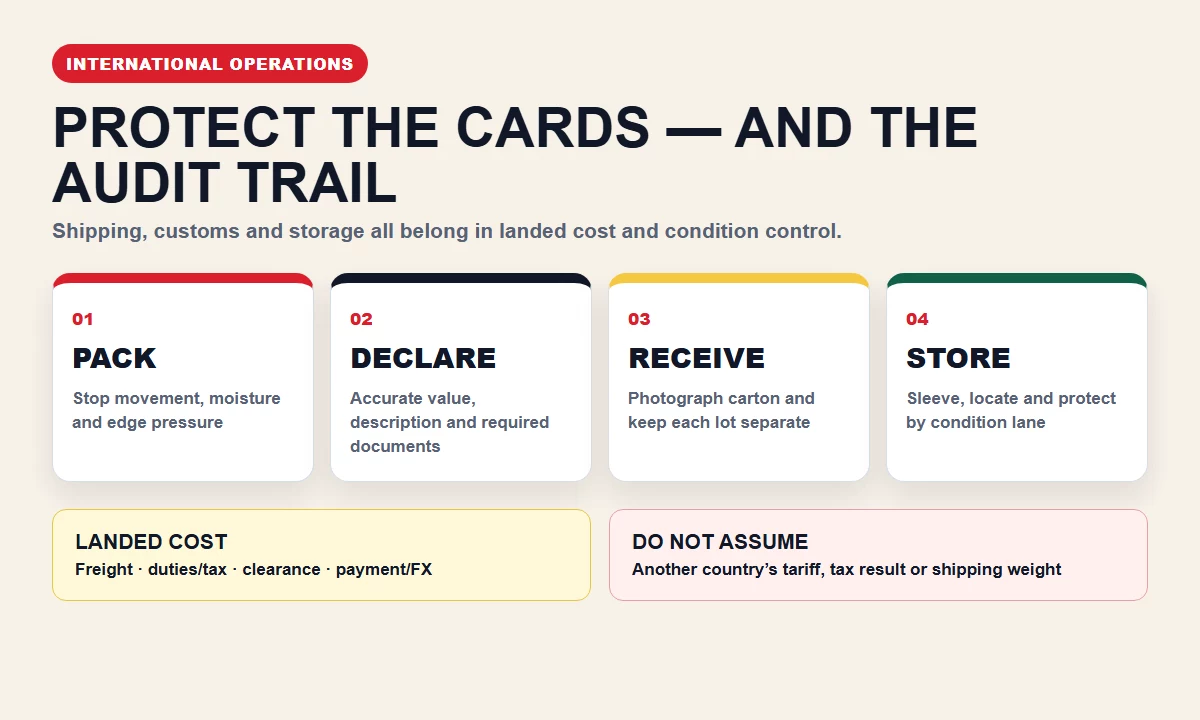
Rencanakan pengemasan seputar kondisi kartu dan keterlacakan lot
- Minta agar tumpukan bagian dalam tidak dapat bergeser bebas atau menyentuh tepi karton yang keras.
- Jaga agar setiap unit 100 kartu dapat diidentifikasi ketika memesan lebih dari satu lot.
- Gunakan perlindungan bagian dalam yang tahan kelembapan yang sesuai dengan rute dan iklim.
- Hindari kompresi berlebihan yang dapat menciptakan penyok atau tekukan.
- Foto karton luar, segel, label, dan kemasan bagian dalam sebelum menyortir.
Jangan menyimpulkan berat paket yang sebenarnya dari kolom katalog. Pesanan gabungan, bahan pelindung, dan aturan dimensional kurir dapat mengubah pengiriman yang dikenakan biaya. Gunakan kutipan checkout atau bisnis untuk pengiriman yang sebenarnya dan alokasikan biayanya secara konsisten antar produk.
Tambahkan bea masuk, pajak, dan kepabeanan ke landed cost
Panduan internasional FedEx saat ini menjelaskan bahwa bea masuk dan pajak adalah biaya impor yang dikenakan pemerintah dan dapat bergantung pada nilai yang dideklarasikan, asal, klasifikasi HS, perjanjian, deskripsi, dan penggunaan produk. Tanggung jawab dapat ditugaskan kepada pengirim, penerima, atau pihak ketiga tergantung pada pengiriman, dan biaya terkait kepabeanan mungkin berlaku. Aturan berubah berdasarkan tujuan; pastikan kewajiban importir Anda sendiri dan jangan menyalin hasil pajak pembeli lain.
Simpan lot sebagai persediaan, bukan sebagai satu tumpukan lepas
Setelah intake, sleeve kartu sesuai dengan kebijakan penanganan Anda dan jaga jalur kondisi terpisah secara fisik. Gunakan pembatas untuk set atau nomor kartu dan kode lokasi dalam catatan persediaan. Simpan jauh dari kelembapan, sinar matahari langsung, debu, dan tekanan. Kartu yang lolos intake masih bisa rusak karena penanganan live-sale berulang atau karena kotak penyimpanan yang terlalu penuh.
Daftar periksa akhir sebelum pembelian
| Pemeriksaan | Kondisi lulus | Jika belum siap |
|---|---|---|
| Produk langsung | Harga dan stok saat ini diperiksa kembali di halaman produk. | Jeda; nilai artikel hanyalah snapshot bertanggal. |
| Ketidakpastian lot | Seleksi acak, foto sampel, dan risiko duplikat diterima. | Beli kartu satuan yang pasti sebagai gantinya. |
| Kapasitas intake | Tim dapat menghitung, mengidentifikasi, menyaring kondisi, dan mengkatalogkan 100 kartu dengan cepat. | Kurangi jumlah atau jadwalkan tenaga kerja. |
| Rute penjualan | Setidaknya dua rute jujur ada untuk kartu biasa dan duplikat. | Rancang perutean sebelum pembelian. |
| Model biaya | Pengiriman, impor, FX, perlengkapan, tenaga kerja, biaya, dan penolakan disertakan. | Jangan gunakan ¥350 sebagai biaya akhir. |
| Kebijakan grading | Hanya kartu yang disaring secara individual masuk ke antrean grading. | Jaga agar lot tetap mentah. |
| Keterlacakan | ID lot, SKU, faktur, gambar, dan kode lokasi sudah siap. | Buat template intake terlebih dahulu. |
SR versus bulk AR: pilih berdasarkan permintaan pelanggan, bukan hierarki
Sebagai konteks, AR Bulk – 100-Card Set terkait dari SST menunjukkan snapshot Woo langsung sebesar ¥27.000 dan 16 unit tersedia selama audit 14 Juli yang sama. Lot SR menunjukkan ¥35.000 dan 61. Ini tidak membuktikan lot mana yang memiliki nilai jual kembali atau margin yang lebih baik. Ini hanya menetapkan dua opsi pemasok saat ini dengan label dan biaya pembelian yang berbeda. Bandingkan apa yang benar-benar dicari pelanggan Anda, seberapa akurat tim Anda dapat mengkatalogkan setiap kelangkaan, dan apakah patokan akuisisi yang lebih rendah atau lebih tinggi sesuai dengan saluran Anda.
| Produk | ID Produk | Harga snapshot | Stok Woo | Patokan pembelian sederhana |
|---|---|---|---|---|
| SR Bulk – 100-Card Set | 40607 | ¥35.000 | 61 | ¥350/kartu sebelum biaya lainnya |
| AR Bulk – 100-Card Set | 40606 | ¥27.000 | 16 | ¥270/kartu sebelum biaya lainnya |
Siap mengevaluasi lot langsung?
Pastikan halaman produk saat ini, lalu pesan hanya jumlah yang dapat diserap oleh sistem intake dan penjualan Anda. Untuk pertanyaan sourcing yang lebih besar, gunakan rute pertanyaan SST sebelum checkout.
Pertanyaan yang Sering Diajukan
Berapa banyak kartu dalam produk bulk SR Pokemon Jepang SST?
Produk ini dicantumkan sebagai set 100 kartu. Hitung kartu fisik sebelum menyortir dan jaga agar setiap unit terpisah jika beberapa lot tiba bersamaan. Foto sampel bukan daftar isi yang pasti.
Berapa harga SR Bulk 100 kartu pada 14 Juli 2026?
Audit WooCommerce langsung yang hanya-baca pada 14 Juli 2026, pukul 16:17 JST menunjukkan ¥35.000 untuk ID produk 40607. Itu adalah kolom harga produk bertanggal, bukan penawaran permanen. Periksa kembali halaman langsung sebelum memesan.
Apakah lot bulk SR tersedia?
Audit yang sama menunjukkan kuantitas stok Woo sebesar 61 lot dan status tersedia. Persediaan dapat dibeli, ditahan, direkonsiliasi, atau diberi harga ulang setelah snapshot, jadi halaman produk langsung mengendalikan ketersediaan saat ini.
Apakah lot bulk SR 100 kartu berisi 100 kartu yang berbeda?
Tidak dijamin. Listing menyatakan bahwa seleksi bersifat acak dan penjual akan berusaha menghindari duplikat, tetapi duplikat dapat terjadi. Bangun rencana Anda di sekitar tingkat kartu unik yang dapat diukur setelah diterima.
Apakah kartu yang persis dalam foto sampel dijamin?
Tidak. Listing mendeskripsikan foto tersebut sebagai sampel. Gunakan untuk mengidentifikasi kategori produk, bukan untuk mengiklankan karakter, nomor kartu, set, kondisi, atau nilai yang pasti dalam pesanan berikutnya.
Apakah semua kartu dijamin near mint atau kandidat PSA 10?
Tidak ada jaminan seperti itu yang dinyatakan. Periksa setiap kartu untuk permukaan, tepi, sudut, centering, penyok, goresan, dan kekhawatiran perubahan. Penyaringan kondisi mentah tidak dapat menjamin grade pihak ketiga.
Bisakah saya menggrading kartu dari lot bulk SR?
Anda dapat meneliti dan menyaring kartu secara individual, tetapi kirimkan hanya ketika identitas, risiko keaslian, kondisi, permintaan, dan ekonomi konservatif semuanya lulus. Sertakan hasil grade lebih rendah dan tanpa grade dalam model.
Apakah ¥350 adalah biaya sebenarnya per kartu?
Itu hanya ¥35.000 dibagi 100. Landed cost sebenarnya juga harus mencakup pengiriman yang dialokasikan, biaya impor, biaya pembayaran dan FX, perlengkapan, tenaga kerja, penolakan, retur, dan biaya penjualan, dibagi dengan kartu yang dapat dijual yang diterima.
Bagaimana reseller harus menangani duplikat?
Katalogkan kartu identik di bawah satu SKU dengan kuantitas, pisahkan perbedaan kondisi material, dan rutekan salinan yang lebih dalam ke bundel bertema yang transparan, rotasi live-sale, atau lot dealer. Jangan pernah menyebut kelompok acak sebagai set lengkap.
Bagaimana cara memastikan kartu Jepang benar-benar SR?
Gunakan nomor kartu yang tercetak dan pencarian kartu resmi Japanese Pokemon Card Game untuk memastikan kelangkaan dan konteks set. Jangan mengandalkan penampilan foil atau judul marketplace saja.
Haruskah saya membeli bulk SR atau bulk AR?
Pilih berdasarkan permintaan pelanggan, keterampilan intake, biaya pembelian, dan rute penjualan. Snapshot 14 Juli menunjukkan harga dan stok yang berbeda untuk kedua produk, tetapi tidak membuktikan bahwa satu memiliki keuntungan atau nilai yang lebih baik.
Bisakah pembeli internasional dikenakan bea masuk atau pajak?
Berpotensi. Perlakuan impor bergantung pada aturan tujuan, nilai yang dideklarasikan, klasifikasi, asal, dan ketentuan pengiriman. Pastikan persyaratan bea cukai dan kurir saat ini untuk bisnis Anda dan sertakan semua biaya dalam landed cost.
Sumber yang diperiksa 14 Juli 2026: ID produk SST 40607 dan ID produk AR terkait 40606 melalui audit WooCommerce langsung yang hanya-baca; halaman produk SST langsung; pencarian kartu resmi Pokemon Card Game; standar grading PSA; dan panduan bea masuk, pajak, dan pengiriman internasional FedEx. Nilai saat ini adalah snapshot bertanggal. Contoh operasional adalah kerangka editorial SST, bukan janji nilai atau pendapatan.
Dipilih untuk artikel ini
📩 Get member-only sale alerts & coupons
Sale alerts, coupons and restock notices by email — straight from Tokyo.