All ten promo cards, the app-coupon distribution route, 98 eligible Japanese stores, stock-voucher rules, the separate United States program, and the checks an overseas collector should complete.
Answer first: Per ROUND1’s published campaign terms, Japan’s ONE PIECE × ROUND1 collaboration began on July 18 and runs through October 17, 2026. The Japanese promo is a one-card pack with ten possible Straw Hat Crew designs. The current route requires a winning purchase-right coupon in the ROUND1 app, an eligible activity, and a qualifying collaboration-menu item. Designs are random; local card shortages are handled through the announced exchange-voucher process.
The most useful way to understand this promotion is to separate four facts that are often mixed together. First, the overall collaboration includes food, drinks, activities, original goods, amusement prizes, photo features, and game-related rewards. Second, the Japanese trading-card benefit has its own narrower conditions. Third, the pack contains only one random card, even though the lineup has ten designs. Fourth, the North American card program is not the same distribution route as Japan.
Use ROUND1’s campaign page and revised distribution notice to check participation, coupon eligibility and redemption. The card table below separates exact print identities from historical marketplace asking prices. Listing prices do not establish official distribution odds or guarantee a future resale price.
The SST Promotion Pack price and listing state, ROUND1 lottery-coupon rules and voucher notice were checked on October 15, 2026. SNKRDUNK asks remain historical observations from October 8, 2026; other campaign background retains its July 18, 2026 check date. See also the Promotion Pack explained, the important update on ROUND1 promo card orders and the One Piece card list.
ONE PIECE × ROUND1 2026: official Japan quick facts
| Question | Official Japan answer | Practical meaning |
|---|---|---|
| What is distributed? | One ONE PIECE Card Game ROUND1 promotional card from ten designs. | A sealed pack contains one card, not all ten cards. |
| Can the design be chosen? | No. Distribution is random and design selection is not available. | A duplicate or unwanted character is not an exchange reason. |
| What is required? | An eligible ROUND1 activity, a winning app coupon, and one qualifying collaboration-menu item. | Walking to an amusement counter and asking only for the card is not the published Japan route. |
| What is the daily limit? | The current FAQ permits up to five qualifying purchases per day for coupon winners. | The winner’s coupon allocation and valid period still apply; cards may be supplied through vouchers. |
| Where is the route available? | At 98 published eligible Japanese stores. | The broader 100-venue Japan collaboration number describes a wider campaign scope. |
| What if stock is unavailable? | A limited exchange-voucher process may apply under the official conditions. | Keep the same-day receipt and follow the issuing store’s instructions. |
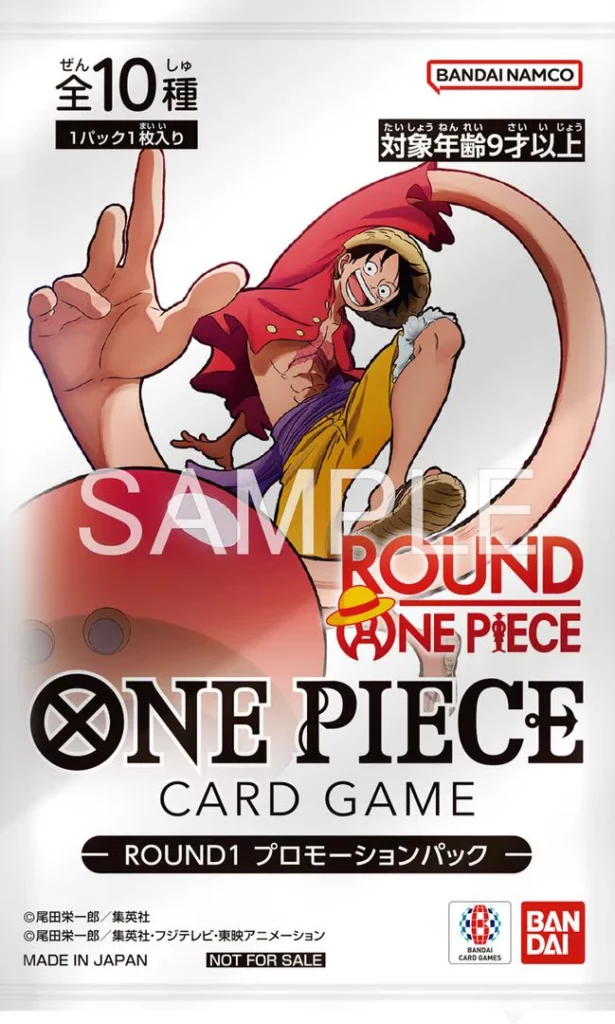
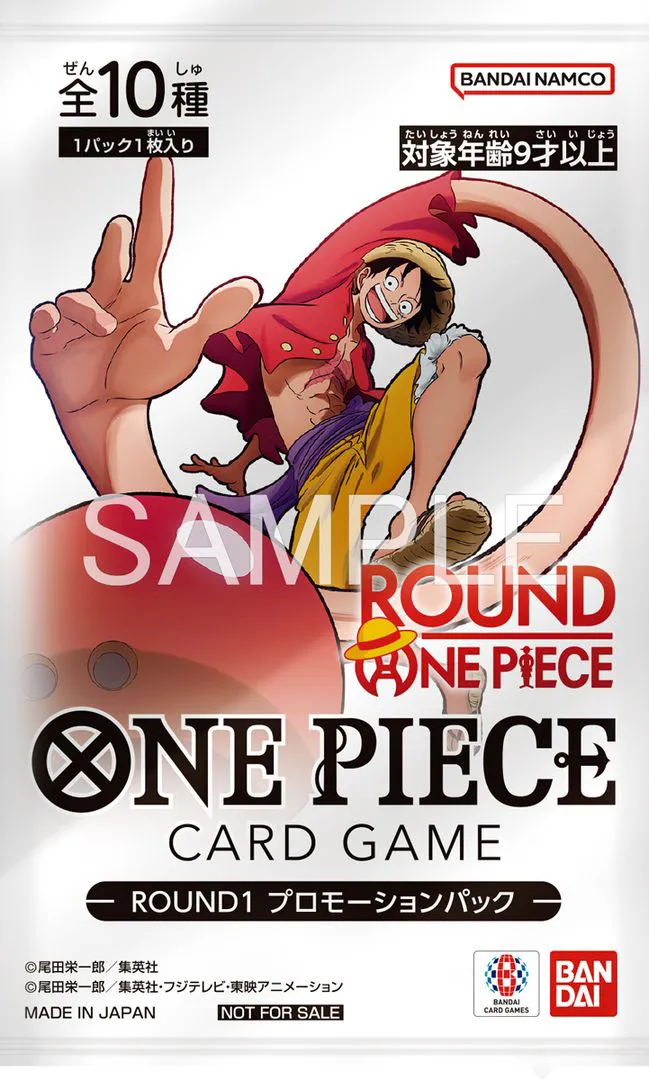
The Japanese pack wrapper states that there are ten types, one card per pack, a target age of nine and older, and Japanese manufacture. Its “NOT FOR SALE” marking identifies promotional distribution rather than a normal retail booster. Check ROUND1’s current campaign terms, including its restrictions on obtaining novelties for resale, when reviewing the official participation route.
The official campaign announcement also describes a larger simultaneous collaboration across Japan and North America. That overall scale is useful context, but it is not a substitute for the detailed card conditions. A headline venue count cannot tell a visitor which menu is available, whether a specific store has stock, which coupon is valid, or what the United States terms require.
How the Japanese ROUND1 promo-card route works
Short answer: first confirm that your ROUND1 app holds a winning coupon for the relevant period. Then follow the eligible-store, activity and collaboration-menu conditions. App registration alone does not provide a purchase right. Present the winning coupon in the app and follow the store’s card or exchange-voucher instructions.
Launch-day rules and lottery coupon timing
The original plan to distribute daily coupons to all app members was replaced before launch. ROUND1’s revised notice describes lottery winners receiving five coupons for their eligible period. Its campaign FAQ describes 13 lottery rounds. As checked on October 15, 2026, purchase rights remain winner-only and the page carries a card-shortage voucher notice. Read the coupon screen for the applicable dates and remaining allocation.
Check the current campaign page and the relevant store’s official notices before travelling. The winning customer must attend in person; ROUND1 says it may request identification. When cards are unavailable, keep the voucher and the same-day receipt and follow the issuing store’s redemption instructions.
Why the official route is not a card-only counter transaction
The Japanese notice connects the card to a qualifying collaboration-menu item and an eligible ROUND1 activity. This matters because short social summaries sometimes describe the promotion as though a customer simply pays for a card pack. That description omits the app, venue, activity, and menu conditions. It can also mislead an overseas collector into believing that the Japanese promotional wrapper was a normal product distributed through card shops.
Use precise language when describing origin. “Obtained through the Japanese ROUND1 collaboration-menu benefit” matches the published route. “Purchased as a normal retail booster from ROUND1” does not. If a later seller offers the sealed pack, the seller should still explain whether the item is the Japanese campaign pack, one opened card, or another regional item.
All ten ONE PIECE × ROUND1 promo cards
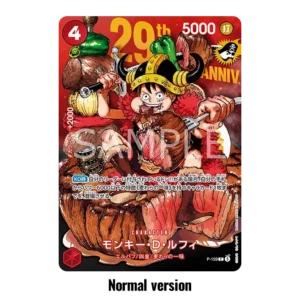
The official ROUND1 lineup shows ten Straw Hat Crew members in event artwork. The printed card numbers identify each promo, including Sanji OP15-047. The final column records the lowest SNKRDUNK asking price observed on October 8, 2026 for the matching ROUND1 listing; these are historical asks, not completed sale prices.
| # | Character | Printed card number | Base set code | Identity note | Lowest SNKRDUNK ask (Oct 8, 2026, raw) |
|---|---|---|---|---|---|
| 1 | Monkey D. Luffy | OP16-095 |
OP-16 | Official ROUND1 event-art printing; one of ten possible random designs. | ¥4,300 (single listing, weak) |
| 2 | Roronoa Zoro | PRB02-006 |
PRB-02 | Official ROUND1 event-art printing; one of ten possible random designs. | ¥2,400 (single listing, weak) |
| 3 | Nami | ST29-008 |
ST-29 | Official ROUND1 event-art printing; one of ten possible random designs. | ¥2,400 |
| 4 | Usopp | OP11-003 |
OP-11 | Official ROUND1 event-art printing; one of ten possible random designs. | ¥1,000 |
| 5 | Sanji | OP15-047 |
OP-15 | Official ROUND1 event-art printing; one of ten possible random designs. | ¥1,000 |
| 6 | Tony Tony Chopper | OP09-068 |
OP-09 | Official ROUND1 event-art printing; one of ten possible random designs. | ¥1,111 |
| 7 | Nico Robin | EB03-054 |
EB-03 | Official ROUND1 event-art printing; one of ten possible random designs. | ¥1,700 (single listing, weak) |
| 8 | Franky | ST21-011 |
ST-21 | Official ROUND1 event-art printing; one of ten possible random designs. | ¥1,000 |
| 9 | Brook | OP11-056 |
OP-11 | Official ROUND1 event-art printing; one of ten possible random designs. | ¥1,000 |
| 10 | Jinbe | ST29-005 |
ST-29 | Official ROUND1 event-art printing; one of ten possible random designs. | ¥1,000 |
These are ROUND1 event-art printings that use existing card identities rather than ten newly invented promotional card numbers. That distinction helps with verification. A listing should show the character, the printed card number, the Japanese text, and the ROUND1 event artwork together. A title that names only the character is not enough because the ONE PIECE Card Game contains many cards for the same member of the Straw Hat Crew.
The official lineup is also a reminder that “ten-card set” and “ten cards” are different descriptions. A true complete lineup must contain each of the ten named characters once. A group of ten random cards can contain duplicates. A sealed pack is a one-card unknown. An opened single is one identified card. Those formats should be stated clearly without suggesting that one has a guaranteed relationship to another.
How to verify a named single
Start with the printed card number. Then compare the visible character, event artwork, Japanese language, color, cost, power, and other card-face details with the official campaign image and Bandai database entry. Ask for a front image that is large enough to read the number and a separate back image that shows condition. If the seller uses a stock image, request the actual copy before relying on a condition description.
Do not infer that the ten cards share one base set. The lineup deliberately draws from OP, ST, PRB, and EB products. That is why the exact code matters. For example, Sanji’s event-art card uses OP15-047, Zoro uses PRB02-006, and Nico Robin uses EB03-054. The mixed source codes are part of the official lineup, not evidence that cards were combined from unrelated unofficial sets.
What the Promotion Pack is—and what it does not guarantee
The official Japanese wrapper is a sealed one-card promotional pack. It identifies ten possible types and one card inside. It is not a ten-card bundle, a booster with a published rarity ladder, a character-selectable pack, or a promise of a complete set. The “NOT FOR SALE” marking refers to the campaign distribution format printed on the wrapper. The official acquisition path is the Japanese ROUND1 collaboration benefit described above.
For an overseas collector, format is the first verification question. A seller may offer the sealed one-card pack, one opened named card, several opened cards, or a complete ten-character lineup. Each format needs different evidence. A sealed pack needs clear front and back wrapper images, intact seals, and confirmation that it is the Japanese campaign version. A named single needs readable front and back images. A complete lineup needs one image showing all ten identities plus closer condition images.
Officially established
- Ten possible card designs.
- One card in each promotional pack.
- Random distribution through the Japan route.
- No design selection or duplicate exchange.
- Campaign distribution is subject to stock.
Not established by the reviewed sources
- Equal odds for all ten designs.
- A guaranteed number of unique cards from multiple packs.
- A published total print run.
- A published per-store allocation or restock quantity.
- A guarantee that current SST inventory or the current sale price will remain available.
Condition deserves extra attention because the official route takes place during an entertainment visit. A card may be carried before it is sleeved. Ask about edge wear, corner whitening, surface marks, bends, moisture, and how the item was stored. If the wrapper is the collectible object, confirm that it has not been cut, resealed, heavily folded, or punctured. A “new” label should not replace photographs.
Language should also be explicit. The product image used here is the Japanese pack, and the card list above refers to the Japanese event-art lineup shown in ROUND1’s official asset. Shared character art across regions does not automatically make two releases identical. Check printed language, wrapper, distribution program, and official regional terms separately.
Eligible Japan stores, local stock, and exchange vouchers
The official numbers describe two scopes. ROUND1’s wider company announcement describes the overall collaboration at 100 venues in Japan and 59 in North America. The detailed Japanese menu and promo-card notice lists 98 eligible Japanese stores for the card route. This is not a numerical conflict: some venues participate in the broader collaboration without offering the qualifying menu path.
Two Japanese venues identified in the published materials—Machida Jorna and Chofu Ekimae—are amusement-only exceptions and do not provide the collaboration menu. Other campaign features can have their own limited store lists. A visitor should therefore verify the exact feature, not merely confirm that “ONE PIECE × ROUND1” appears somewhere on a location page.
How to check local availability
ROUND1 directs customers to the campaign information and the relevant store’s official X account for stock-related notices. The notice asks customers not to telephone stores for individual current or incoming quantities. Even official social updates can lag behind the counter, so use a three-part check: campaign page, store account, and the in-store counter. None of those checks creates a reservation.
Store-level variation is expected. An eligible location can differ in facilities, menu availability, operating hours, novelty stock, and timing. The number of participating stores should never be converted into an estimate of pack quantity. ROUND1 has not published a total print run or a uniform allocation for every eligible store.
What the out-of-stock voucher does
The official Japan notice describes an exchange voucher for certain temporary card-stock shortages. The voucher is limited and tied to the issuing store. The customer must keep the receipt from the date the voucher was issued. After novelty stock arrives, the store announces eligible voucher numbers through its official X account. Redemption is valid for 30 days from that announcement under the published process.
The process is not an online backorder. ROUND1 does not promise individual contact or home delivery. Redemption must be handled at the same store that issued the voucher, and the card design remains random. A voucher does not reserve a character. The receipt is important because it connects the transaction and voucher to the store process; ROUND1 also warns that receipts are not reissued.
Group visits require care. One receipt may cover the group’s transaction, so the group should decide who will keep the original receipt and how any vouchers will be redeemed together. Photographing a receipt may help personal recordkeeping, but it does not replace whatever original documentation the store requires. Read the voucher itself and the store announcement before making a return trip.
Other ONE PIECE × ROUND1 goods, prizes, and experiences
The promo card is only one part of the collaboration. ROUND1’s official announcement also presents original collaboration food and drinks, mini stickers, activity-specific experiences, original goods, amusement prizes, photo features, and rewards connected with ONE PIECE Bounty Rush. These features explain why the overall campaign venue count and the card-menu store count are not interchangeable.
Original merchandise and amusement prizes follow their own availability rules. A store may carry one feature without carrying every other feature, and an amusement prize is not distributed through the same coupon-and-menu condition as the promo card. Similarly, a photo spot or game-related reward can use a smaller location list. Always read the specific panel or terms for the feature you want.
This separation is useful when reviewing a social post. A photograph of a Chopper prize, a T-shirt, a postcard reward, or a photo spot does not prove that the person received a card pack at that venue. Ask which feature is shown and which official rule applies. The collaboration branding is shared, but fulfillment paths are not automatically shared.
Food and novelty rules also matter. The campaign prohibits conduct associated with improper stockpiling, resale-driven bulk behavior, and food waste. A visitor should use the collaboration as intended, respect per-person limits, and follow staff instructions. The card is a benefit connected to the qualifying experience, not permission to bypass venue rules.
Japan vs. United States ROUND1 card programs
They are separate programs. Japan uses the ROUND1 app, an eligible activity, and a qualifying collaboration-menu item. The United States Phase 1 terms used advance registration, a selected designated location, identification, and a Round1 Game Card deposit process during a specified store window. The shared collaboration does not make the operational rules interchangeable.
| Point | Japan card route | United States Phase 1 |
|---|---|---|
| Initial access | Winning ROUND1 app coupon allocated through the Japanese campaign lottery. | Advance registration from July 1 to July 5, 2026, with the first 9,000 valid registrations under the terms. |
| Location | One of 98 eligible Japanese collaboration-menu stores. | The designated location connected with the successful registration. |
| In-store window | Japanese campaign period from July 18 through October 17, subject to local stock. | Phase 1 store window from July 18 through July 24 under the published terms. |
| Required transaction | Eligible activity plus one qualifying menu item with one coupon. | USD 20 deposit to the customer’s R1 Game Card for each requested OP Card, up to the stated limit, subject to availability. |
| Identity check | The winning customer attends with the live app coupon; identification may be requested. | Registration confirmation and matching identification at the designated location. |
| Selection | No character design selection. | No inspection, request, or exchange for a specific card under the Phase 1 terms. |
| Guarantee | Coupon validity does not guarantee local stock. | Registration is not a reservation, preorder, or guarantee of availability. |
The United States terms describe a right to request card purchases under the program, not the Japanese collaboration-menu bonus. They also state that the participant must complete the process in a single visit, use the designated location, and present the required identity and confirmation. A deposit amount should not be confused with the later transfer price of a card outside the program.
Do not assume that the exact wrapper, printed language, card pool, or regional packaging is identical unless the relevant official source says so. The safest description is narrow: these are separate ROUND1 card programs running within the broader collaboration. Verify the region printed or shown on the actual item.
Remote participation is not supported by either set of terms described here. The Japanese route is an in-person venue benefit. The United States Phase 1 requires the registered participant at the designated store with identification. A third party offering an item later is not acting as the official remote distribution channel merely because the item originated from one of these programs.
Overseas collector verification checklist
An overseas collector usually encounters the promotion after the official venue step. That changes the task from “How do I use the coupon?” to “What exactly is this item, and can the seller prove it?” The checks below focus on identity, format, condition, fulfillment, and shipping. They are designed to prevent a Japanese pack, an opened single, a duplicate group, and a different regional item from being described as though they were the same product.
Questions to send before accepting an overseas offer
- Is this the Japanese ROUND1 campaign version shown in the official product image?
- Is the item a sealed one-card pack or an opened card?
- If opened, what is the exact printed card number?
- If described as complete, can one current photograph show all ten different characters?
- Are the photographs of the actual item that will be shipped?
- Is the item already in hand, or is fulfillment dependent on a later store visit or voucher?
- What happens if the stated item cannot be supplied?
- How will the card or wrapper be protected during international shipping?
A seller’s acquisition story is supporting context, not a replacement for item evidence. A receipt or ROUND1 voucher may help explain origin, but it does not prove the condition of a specific card unless the item is also shown. Avoid requesting personal information that is unnecessary; the goal is to establish the item, not expose another customer’s private data.
For authenticity, compare multiple stable details rather than one logo. Check the card number, Japanese text, layout, artwork, color, cost, power, copyright line, and card back. For the pack, compare the official front design, Bandai Namco and Bandai marks, age label, ten-type statement, one-card statement, “MADE IN JAPAN,” and “NOT FOR SALE” marking. If photographs are too small to inspect those details, ask for clearer images.
For a sealed wrapper, remember that authenticity and contents are separate questions. A genuine sealed pack can still contain any one of the ten random designs, and the official sources do not publish equal per-design odds. Do not accept a claim that a wrapper is more likely to contain one character unless that claim is supported by an official source for this exact promotion.
Buy the Japanese ROUND1 Promotion Pack from SST
ONE PIECE × ROUND1 Promotion Pack Japanese 2026
At the time of this update (October 15, 2026), the SST product is listed at ¥3,119 (~$20). The product is one sealed Japanese campaign pack containing one random card from ten possible designs.
Use the live product page for the current offer. It shows the latest availability, quantity limits, item condition, and shipping information before checkout.
Buy the ROUND1 Promotion Pack →
Stock can change after this article is updated. Opening a sealed pack does not guarantee a specific character.
How the SST checkout contract applies
SST has no minimum order amount or quantity, so the ROUND1 pack may be ordered by itself, subject to its product-specific purchase limits. Coupons and discounts remain subject to each offer’s eligibility, exclusions, usage limits and expiry conditions.
Before paying, review the live product page for current inventory, purchase limits, shipping timing, and the random one-card contents. Article text can become stale after a stock change; the product page and cart are the purchasing source of truth.
ONE PIECE × ROUND1 Japan FAQ
What is the ONE PIECE × ROUND1 Promotion Pack?
It is a Japanese campaign pack made for the 2026 ONE PIECE × ROUND1 collaboration. The official wrapper states that one pack contains one card and that there are ten possible designs. It is a promotional distribution item, not a normal retail booster pack.
When does the ROUND1 collaboration run in Japan?
ROUND1’s published campaign terms list July 18 through October 17, 2026. The campaign began at 10:00 a.m. on July 18. Card distribution follows the current lottery-coupon, store, activity, menu and voucher conditions.
How is one promo card obtained through the official Japan route?
Check that you hold a winning ROUND1 app coupon for the eligible period. Use an eligible activity and qualifying collaboration-menu item at the relevant Japanese store, then follow the coupon and redemption instructions. App registration alone does not provide a purchase right.
How many app coupons can one person use in a day?
The current FAQ permits up to five qualifying purchases per day for coupon winners. The winner’s coupon allocation and eligible period still apply; this is not a promise of five new coupons every day. Check the live app screen before visiting.
Can the character design be selected?
No. ROUND1 states that the card is random, the design cannot be selected, and an unwanted or duplicate design cannot be exchanged merely because of the result.
Which ten characters are in the ROUND1 card lineup?
The official lineup shows Monkey D. Luffy, Roronoa Zoro, Nami, Usopp, Sanji, Tony Tony Chopper, Nico Robin, Franky, Brook, and Jinbe. The printed card numbers are listed in the card table in this guide.
Does random distribution mean all ten designs have equal odds?
No official source reviewed for this guide publishes uniform per-design probabilities. Random means the recipient cannot select the design. It should not be converted into a same-rate claim or a mathematical completion guarantee.
Why do official materials mention both 100 Japanese venues and 98 eligible stores?
The wider collaboration announcement covers 100 venues in Japan, while the published collaboration-menu and promo-card route covers 98 eligible Japanese stores. The numbers describe different scopes and should not be treated as a contradiction.
What happens if a Japanese store is temporarily out of promo cards?
The official notice describes a limited exchange-voucher process. Keep the same-day receipt and voucher, follow the issuing store’s official X announcement, and return to that same store within the published redemption period. A voucher is not home delivery and does not allow a character selection.
Can a customer call a store to confirm card inventory?
ROUND1 asks customers not to request individual inventory checks by telephone. Use the official campaign page, the relevant store’s official X account, and the in-store counter, understanding that online notices may not reflect the counter instantly.
Can the promo card or collaboration menu be reserved?
A winning coupon provides the purchase right described on its screen. Confirm the current store and redemption conditions before visiting. If cards are unavailable, follow the announced voucher process; do not assume a card will be handed over immediately.
Are the Japan and United States ROUND1 card programs the same?
No. Japan uses lottery-allocated app coupons with activity and collaboration-menu conditions. The United States Phase 1 terms used advance registration, a designated location, identification and a Round1 Game Card deposit. Follow the terms for the named region and period.
Can I buy the Japanese ROUND1 Promotion Pack from SST now?
Yes. At the time of this update (October 15, 2026), SST lists the sealed Japanese one-card pack at ¥3,119 (~$20). Each pack holds one random card from ten possible designs. Check the live product page because inventory and purchase limits can change.
What does one SST ROUND1 Promotion Pack contain?
One unopened Japanese campaign pack contains one random card from ten possible Straw Hat Crew designs. Buying one pack does not guarantee Luffy or any other specific character.
Can the SST ROUND1 pack be ordered by itself?
Yes. SST has no minimum order amount or quantity, so the pack may be ordered by itself subject to its product-specific purchase limits. Check the current product page before ordering. Coupons and discounts remain subject to each offer’s eligibility, exclusions, usage limits and expiry conditions.
- ROUND1 official ONE PIECE collaboration page
- ROUND1 official revised lottery and distribution notice
- ROUND1 company collaboration announcement
- Bandai official ONE PIECE Card Game card database
- ROUND1 USA official Phase 1 terms
ROUND1’s lottery-coupon and voucher information and the SST price and listing state were checked October 15, 2026 JST. Other campaign background retains its July 18, 2026 check date. SNKRDUNK asking prices were observed October 8, 2026 JST. Check the current official campaign page, coupon screen and SST product page before making a visit or purchase.
Picked for this article
📩 Get member-only sale alerts & coupons
Sale alerts, coupons and restock notices by email — straight from Tokyo.

![OP-03 Pull Rates, Best Cards & Box Value [2026 Guide]](https://samuraiswordtokyo.com/wp-content/uploads/blog-refresh/472/featured_1200x630_91fa6c25-cdcc-479f-b179-a898cdd21879.webp)