Two cards from the same set, same character, can sit in completely different price brackets. Character popularity, competitive playability, and physical condition all play into that, but this guide focuses on four structural factors that sit underneath those market forces and are verifiable from the card and set itself: which official rarity tier a card was printed at, which channel it was distributed through, whether it carries a parallel treatment on top of its base rarity, and how large the card pool it was pulled from actually is.
This guide walks through each of those four structural mechanisms using the One Piece Card Game’s own rarity system and our own catalogue as worked examples. It does not quote market prices or predict where any card is headed — that’s not something a rarity code can tell you, and rarity is only one input among several that ultimately set a card’s price. What it can tell you is why two SR cards from the same set are not interchangeable, and why a tournament-distributed card behaves differently from a retail pull before you even look at a price tag.
The One Piece Card Game’s official rarity ladder runs L, C, UC, R, SR, SEC, with parallel and „Comic Parallel“ art treatments layered on top of those base tiers. Distribution channel matters as much as rarity letter — a Flagship Battle souvenir card such as the PSA10 Dracule Mihawk SR [OP01-070] is capped by tournament attendance, not booster print runs. Set size also shapes the maths: our OP-16 „The Time of Battle“ booster box draws from 127 official card types across 6 Karten pro Pack.
This article covers structural drivers only — rarity tier, distribution channel, parallel treatment and set size. It does not cite market prices for any of these mechanisms; the only prices below are our own current listing prices, shown as purchase links, converted at ¥159/USD (September 2026).
The Official One Piece Card Rarity Ladder
The One Piece Card Game uses the rarity codes below. Leader (L) identifies a card’s deck role, so it should not be placed into a most-to-least-common sequence with the pull-rarity codes.
| Code | Tier | What it marks |
|---|---|---|
| L | Leader | The Leader card that anchors a deck — a distinct card role, not a pull-rarity step. |
| C | Common | The base tier that fills out a deck’s core. |
| UC | Uncommon | One step above Common. |
| R | Rare | A step above Uncommon. |
| SR | Super Rare | A chase-tier card, often the character-focused pulls a set is built around. |
| SEK | Secret Rare | The top of the base ladder. |
On top of these base letters, the game layers parallel and alt-art treatments — alternate foil or artwork versions of a card that already carries one of the codes above — plus a distinct „Comic Parallel“ manga-panel treatment covered in its own section below. Our dedicated One Piece card rarity explainer walks through the full L/C/UC/R/SR/SEC ladder and the parallel tiers built on top of it in more depth than we cover here.
The practical point for anyone trying to understand value: the letter code tells you where a card sits on this ladder, and that’s a fixed, verifiable fact about the print. It’s the starting point for everything else in this article, not the end of the story.
Retail Pulls vs Tournament-Only Distribution
Rarity code describes where a card sits on the print ladder. It says nothing about how that card reached the market — and distribution channel is a separate structural factor entirely.
Most SR and SEC cards come from booster packs, meaning their supply scales with however many packs and boxes a set prints. Some cards, however, are never sold in a booster pack at all. The One Piece Card Game runs official Flagship Battle tournaments, and certain SR cards are distributed exclusively as souvenirs tied to tournament results — not as retail pulls.
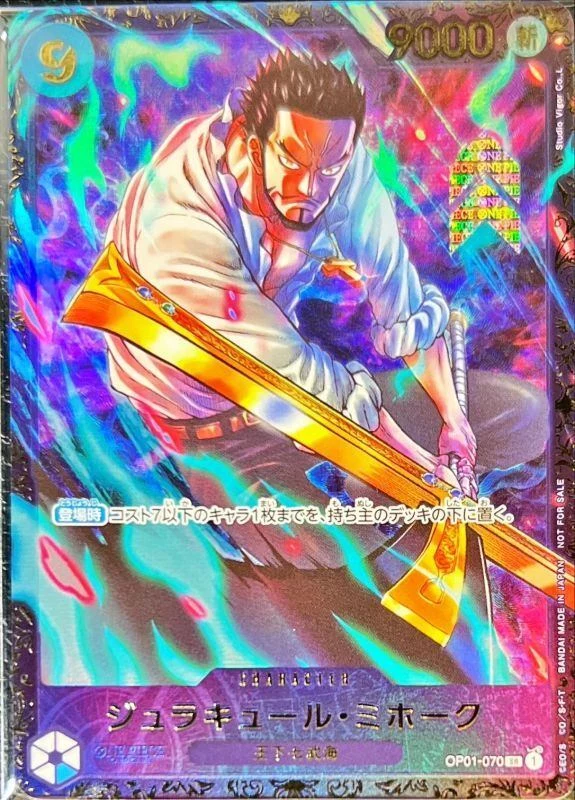
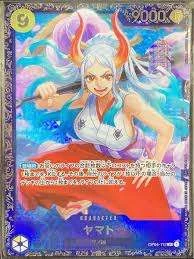
Our own graded catalogue carries two clear examples of this. The PSA10 Dracule Mihawk SR [OP01-070] is a „Flagship Battle Victory Souvenir“ — a card given specifically to tournament winners. The PSA10 Yamato SR [OP04-112] (update: currently sold out — restock requests via Quick Order) is a „Flagship Battle Top 8 Souvenirs“ print, awarded to players who finished in the top eight of an event.
The structural point here is supply mechanics, not price: a booster-pulled SR’s supply is bounded by how many boxes get opened. A Flagship Battle souvenir’s supply is bounded by tournament-side factors instead — how many events have been run, each event’s own distribution rules, and how many players attended and placed at each one — a completely different, and generally much smaller, ceiling than a booster print run. That distinction exists independently of whatever tier the card carries on the rarity ladder.
Comic Parallel (SP): A Second Layer on Base Rarity
A third structural factor sits on top of both rarity tier and distribution channel: whether a card also received a Comic Parallel treatment — a manga-panel-style alternate art version layered onto a specific card that already has a base rarity.
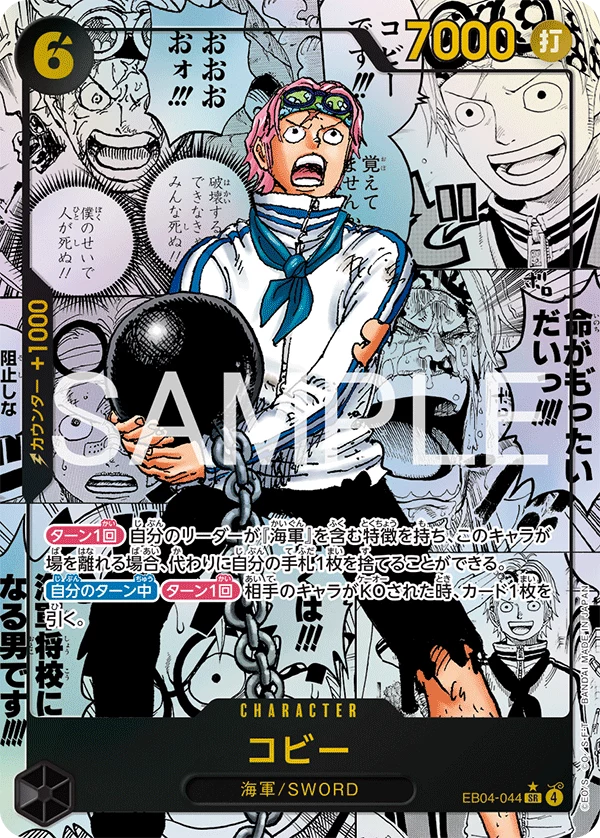
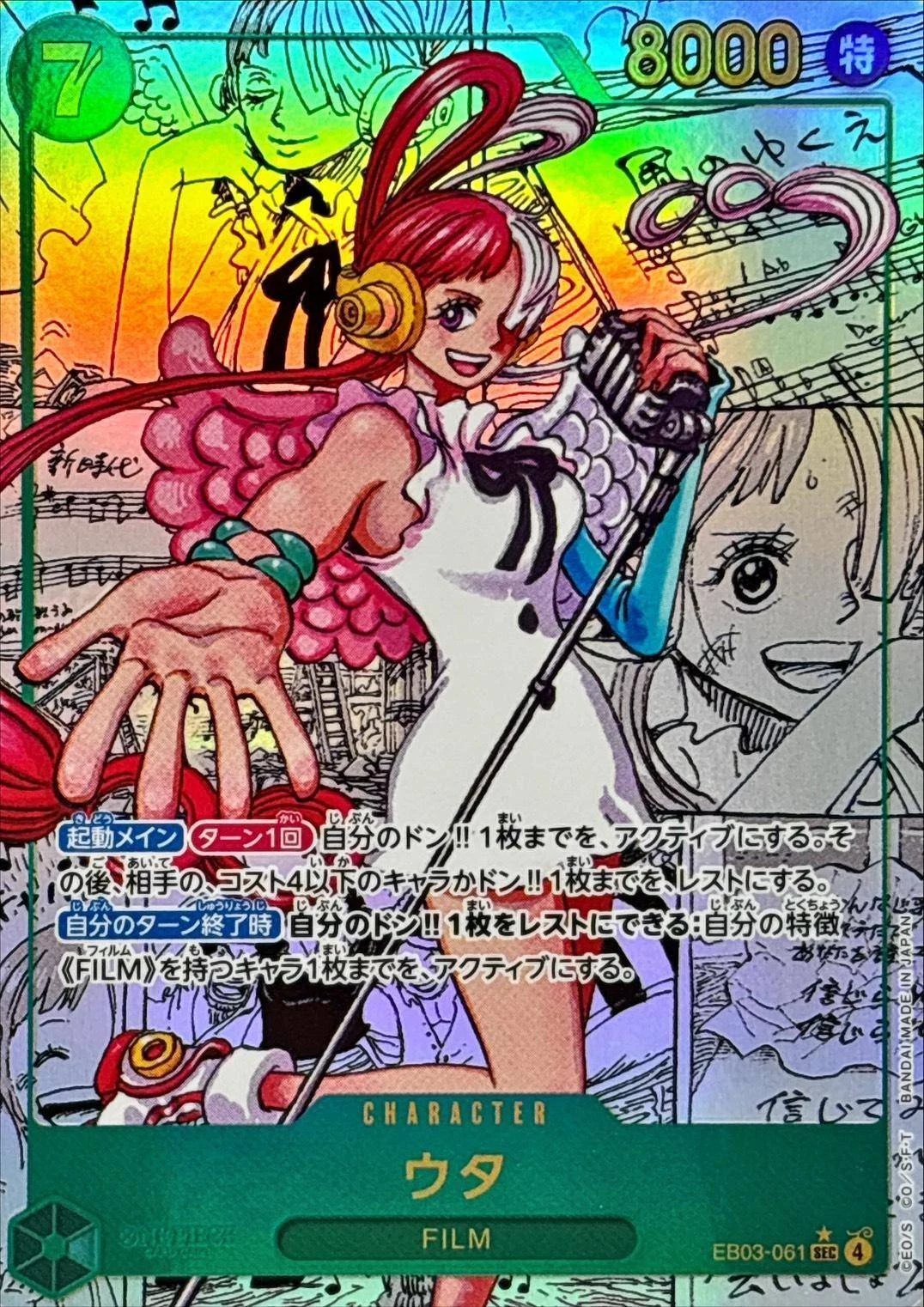
Our catalogue includes the PSA10 Koby SR-SP [EB04-044] (update: currently sold out — restock requests via Quick Order), a Comic Parallel print from the Extra Booster „EGGHEAD CRISIS,“ and the PSA10 Uta SEC-SP [EB03-061], a Comic Parallel print from the Extra Booster „ONE PIECE Heroines edition.“ The SR-SP and SEC-SP forms here are our catalogue labels for these products; they should not be read as suffixes printed in the official card-list rarity field.
The structural takeaway: two cards can share an identical base rarity code and still not be the same print. An SR and an SR-SP of the same character are different products — one carries an additional, distinct art treatment the other does not.
Set Size and the Maths of Pulling a Specific Card
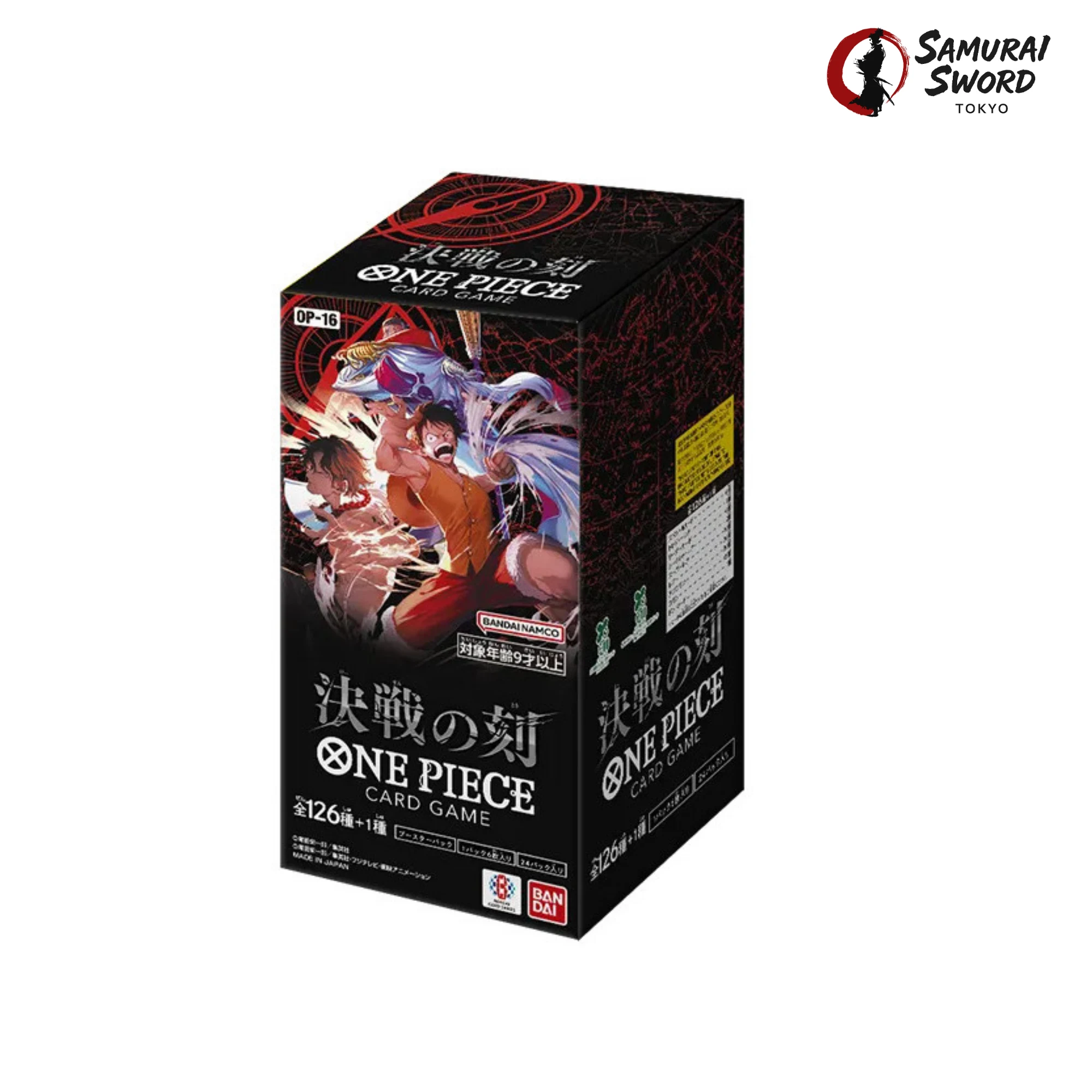
A fourth structural factor to record is set size: how many total card types exist in a given set. That count gives useful context, but it does not by itself establish the odds of pulling a specific card.
Our anchor set, OP-16 „The Time of Battle,“ officially contains 126+1 card types (127 in total), according to the game’s own official product page, with 6 Karten pro Pack. The official specification also separates rarity categories, so total card types and pack size alone are not enough to calculate the chance of pulling a particular card.
This is a structural description only. Without verified collation and rarity-slot allocation, it does not establish absolute supply or the probability of pulling a specific card.
Extra Booster vs Mainline Booster Pack
Not every One Piece booster product draws from the same size of card pool. Extra Boosters (EB-01 through EB-04 to date) are a distinct product line from mainline numbered Booster Packs (OP-01, OP-02, and so on) — designed to reinforce archetypes from previously released sets and spotlight characters who aren’t central to a mainline set’s main cast, rather than introduce a fresh mainline story arc.
Structurally, that positioning tends to come with a smaller card-type pool than a mainline Booster Pack. One comparison reported in aggregated summaries of the game’s own product positioning puts EB-01 at roughly 62 card types, against OP-06’s 126 — a pool less than half the size. We haven’t independently re-verified that exact count against an official source, so treat it as a directional illustration of the Extra Booster format rather than a fixed number.
The verified distinction here is product focus and card-pool size. Neither point supplies a specific-card probability without verified rarity and collation data.
What This Means When You’re Buying
Put the four mechanisms together and you get a simple checklist for evaluating any One Piece card before you buy: what’s the rarity code, was it a retail pull or a tournament-distribution card, does it carry a Comic Parallel or other parallel treatment, and how large is the set or booster line it came from.
Applied to our own current listings:
- Our OP-16 „The Time of Battle“ Japanese booster box is currently listed at ¥12,360 (~$78) — a mainline Booster Pack drawing from the full 127-type pool covered above.
- The PSA10 Dracule Mihawk SR [OP01-070] Flagship Battle Victory Souvenir is currently listed at ¥129,118 (~$812) — a tournament-distribution card, not a booster pull.
- The PSA10 Yamato SR [OP04-112] (update: currently sold out — restock requests via Quick Order) Flagship Battle Top 8 Souvenir is currently listed at ¥28,336 (~$178) — the same tournament-distribution channel at a different placement tier.
- The PSA10 Koby SR-SP [EB04-044] (update: currently sold out — restock requests via Quick Order) Comic Parallel is currently listed at ¥180,620 (~$1,136) — an Extra Booster card with the additional parallel treatment layered on.
- The PSA10 Uta SEC-SP [EB03-061] Comic Parallel is currently listed at ¥184,800 (~$1,162) — the top base tier plus the same parallel treatment.
None of these five listings are presented here as evidence for why one is worth more than another — they’re simply worked examples of the four mechanisms above, with a purchase link if you want to look closer at any of them. For a deeper look at how the market has actually priced specific cards, see our most valuable One Piece cards ranking and our One Piece card prices guide — both cover measured pricing directly, which this article deliberately does not. If you’re specifically after scarcity-driven cards, our rarest One Piece cards guide is the companion piece to this one.
For a mixed order across sealed boxes and graded singles, our One Piece booster box collection and PSA 10 graded card collection cover both sides of what’s discussed above, and Schnellbestellung lets you build a combined order in one pass.
Häufig gestellte Fragen
What are the official One Piece Card Game rarity tiers?
The official codes include L (Leader), C (Common), UC (Uncommon), R (Rare), SR (Super Rare), and SEC (Secret Rare). L identifies a card role rather than a pull-rarity step. Parallel and alt-art treatments, including the distinct „Comic Parallel“ manga-style version, are layered on top of a card’s base code.
What is a Comic Parallel (SP) card in One Piece?
A Comic Parallel is a manga-panel-style alternate art treatment applied to a specific card that already carries a base rarity code. Our catalogue labels the Koby and Uta examples SR-SP and SEC-SP; those are catalogue labels, not suffixes in the official card-list rarity field.
Why are Flagship Battle souvenir cards different from booster pulls?
A booster-pulled card’s supply is bounded by how many packs and boxes of that set get opened. A Flagship Battle souvenir card, such as a Victory Souvenir or Top 8 Souvenir print, is distributed through tournament results instead — bounded by how many events are run, each event’s distribution rules, and how many players attended and placed — a different, generally smaller supply mechanism that has nothing to do with booster print runs.
Does a bigger set change my odds of pulling a specific card?
Set size alone does not establish the odds of pulling a specific card. OP-16 „The Time of Battle“ officially carries 127 card types across 6 Karten pro Pack, but a probability calculation would also require verified rarity and collation data.
What’s the difference between an Extra Booster and a mainline Booster Pack?
Mainline Booster Packs (OP-01, OP-02, and so on) carry the game’s main storyline sets. Extra Boosters (EB-01 through EB-04) are a separate product line built to reinforce previously released archetypes and spotlight characters outside a mainline set’s main cast, and they typically draw from a smaller card-type pool than a mainline Booster Pack.
Where can I buy Japanese One Piece cards and boxes?
We ship Japanese sealed One Piece booster boxes and graded singles worldwide out of Tokyo with tracked delivery. Browse our One Piece booster box collection and PSA 10 graded card collection, or use Schnellbestellung to combine sealed product and singles in one order.
Passend zu diesem Artikel


📩 Get member-only sale alerts & coupons
Sale alerts, coupons and restock notices by email — straight from Tokyo.