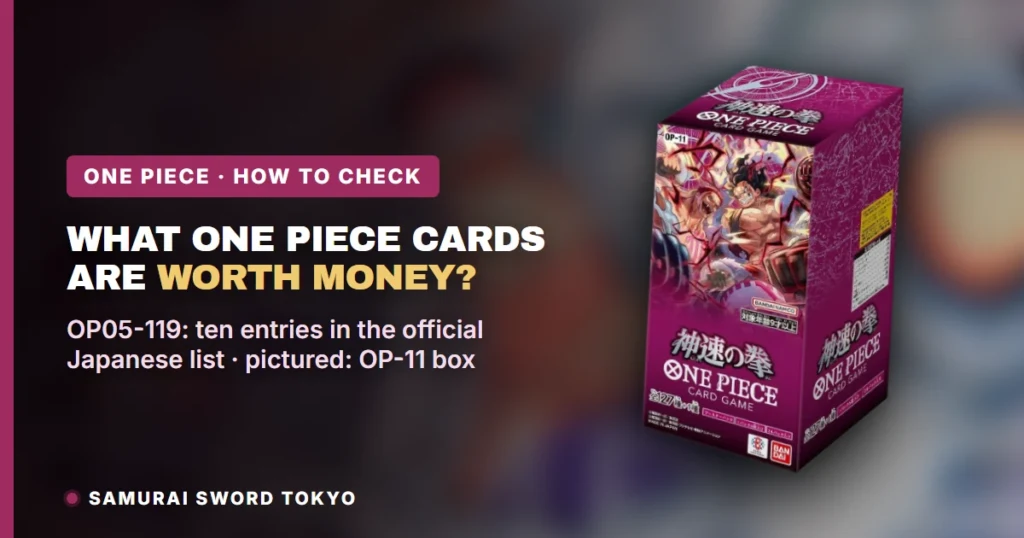
Identify the exact printing before comparing prices. The official Japanese list has ten entries for OP05-119 Monkey.D.Luffy, and our six PSA 10 examples of that card have different asking prices despite sharing a card number. You can’t tell which printing you hold from the character alone.
This guide is a check you can run on your own Japanese card in a few minutes. It shows where the card number and rarity are printed, what the marks next to them mean, how to look the card up in the official card list on onepiece-cardgame.com, and how to tell the exact printing you hold. The price examples come only from our online store’s own listings, last checked on November 19, 2026. They are list prices (asking prices), not completed sales.
- The official Japanese card list shows 10 entries for OP05-119 Monkey.D.Luffy under the same card number: three from OP-05, three from PRB-01, one from an anniversary set and three SP cards from OP-09 and OP-11.
- The six PSA 10 listings of those printings in the table below run from a base OP-05 copy currently listed at ¥6,001 (back order) to an OP-11 SP card currently listed at ¥1,878,000 (back order).
- Read three things on the card: the card number, the rarity box, and any extra mark (a ★ or an “SP” box). Compare the artwork and check the listed product if you know the card’s source.
Shop counts, the median and the price bands are from our listings at 19:18 JST on November 18, 2026. Individual list prices were last checked on November 19, 2026; the listings change daily, and the product page shows the current figure. US dollar figures use ¥154 = US$1. Many PSA 10 examples here are back-order listings (sourced to order).
The Short Answer: Which One Piece Cards Are Worth Money
Use the number, marks, artwork and source product to match the printing. Then compare like with like. What to read on your card:
- The printing. On the official images we checked, a ★ above the rarity box appears on some parallels and on the OP-09 SP card, and an “SP” box before the number appears on SP cards. Some reprints carry neither mark, so the exact printing can remain uncertain when the source is unknown.
- The rarity box. The official list’s rarity filter has nine values.
- The distribution route. Promotion cards and cards from limited products have their own series in the official list, with the route named for each entry.
- Language and condition. Compare the same language, printing and grade.
If you want the background, our One Piece rarity guide explains the L, C, UC, R, SR and SEC ladder, and what drives One Piece card prices covers supply and distribution. This page is the practical check.
Step 1: Read the Bottom Line of Your Card
Turn the card face up and look at the lower right of the name panel. On the Japanese OP05-119 base image, three things sit together there:
- The card number, such as OP05-119. One number can be shared by printings from several products: OP05-119 appears on entries from OP-05, PRB-01, OP-09, OP-11 and an anniversary set. Some promos use a P number, such as P-110. Others retain a set number, such as ST01-002.
- The rarity box: a small boxed code such as C, UC, R, SR, SEC, L or P.
- A circled number with a small fruit mark. This is not a rarity. The official site calls it the block icon: “the number printed at the bottom right of the card.” It is ① for the first four sets and ② for sets five to eight, updated each year, and from April 1, 2026 it marks the card pool for Standard events.
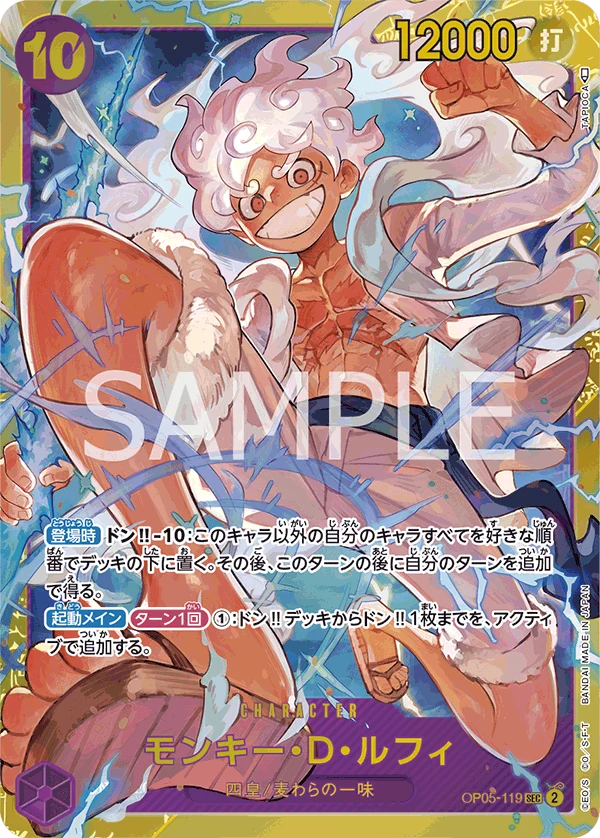
Now look for an extra mark. On the official OP05-119 images we checked, two marks appear next to the number on some printings:
| What you see next to the number | Where it appears on the checked images | Example on the official images |
|---|---|---|
| Number + rarity box only | The base printing, and reprints that look the same | OP05-119 SEC (OP-05 base) |
| A small ★ above the rarity box | Some parallels, and the OP-09 SP card | OP05-119 ★SEC (OP-05 and PRB-01 parallels) |
| An “SP” box before the number | SP cards (the official list labels these SPカード) | SP OP05-119 SEC (OP-09 and OP-11) |
| A P number and a P rarity box | A promotion card | P-110 P |
One caution: some reprints look identical to the base card at the bottom line. The official list shows a PRB-01 printing of OP05-119 and an anniversary-set printing whose bottom lines match the base card. Compare the artwork, SP box and listed source product. If the marks match and the source of the physical card is unknown, the exact printing can remain uncertain.
Step 2: Look the Card Up in the Official Card List
The official Japanese card list is at onepiece-cardgame.com/cardlist. Type the card number into the free-word search box. Each result shows the card number, the rarity and the card type, the card image, and a field called 入手情報 (where obtained), which names the product the printing came from.
The official rarity filter offers nine values: L, C, UC, R, SR, SEC, P, SPカード and TR. These are the labels in that filter:
| Official label | What it stands for (our reading) |
|---|---|
| C | Common |
| UC | Uncommon |
| R | Rare |
| SR | Super Rare |
| SEC | Secret Rare |
| L | Leader |
| P | Promotion card |
| SPカード | SP card |
| TR | Listed as TR |
Two details of the official list matter:
- Parallels share the card number. In the list, a parallel is a separate entry with the same number and the same rarity as the base card. Several entries can name the same product, so compare their artwork.
- “Manga” is not a rarity. The list has a separate filter for illustration type with four choices: 原作 (original manga artwork), アニメ (anime), オリジナル (original) and その他 (other). The official OP-17 世界最強の戦士 (The World’s Strongest Warriors) product page describes the Super Leader Parallel (スーパーリーダーパラレル) as a Leader parallel using artwork from the original ONE PIECE manga. Collector names such as “comic parallel” or “manga rare” describe that artwork, not an official rarity.
How the official OP-17 product page defines the special versions, in short: a parallel card is a card with a special design that differs from the regular card (full art, shiny finishes or textured finishes), and an SP card is a character card with a special design, separate from parallels. Our One Piece SP cards guide goes into SP cards in more depth.
Ten Entries for OP05-119 in the Official Japanese List
Here is why the card number alone does not answer the money question. A free-word search for OP05-119 on the official Japanese list returns ten entries, all named モンキー・D・ルフィ (Monkey.D.Luffy):
| Entries in the official list | Rarity shown | Where obtained (official field) |
|---|---|---|
| 3 (base + 2 parallels) | SEC | OP-05 新時代の主役 (Awakening of the New Era) |
| 3 | SEC | PRB-01 ONE PIECE CARD THE BEST |
| 1 | SEC | English 2nd ANNIVERSARY SET |
| 1 | SP card | OP-09 新たなる皇帝 (Emperors in the New World) |
| 2 | SP card | OP-11 神速の拳 (A Fist of Divine Speed) |
That is 3 + 3 + 1 + 1 + 2 = 10 entries for one card number in the official Japanese list. Now compare our shop’s PSA 10 listings for six of them. All six are the same card number and the same grade:
| Printing (PSA 10) | Mark on the card | Our list price |
|---|---|---|
| OP-05 base printing | None | Currently listed at ¥6,001 (~$39) as a back order |
| English 2nd Anniversary Set, Japanese version | None seen on the official image | Currently listed at ¥27,665 (~$180) as a back order |
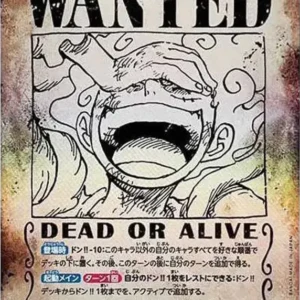
| OP-09 SP card, Wanted-poster design | SP box and ★ | Currently listed at ¥72,665 (~$472) |
| OP-11 SP card, silver-toned (shop listing: Silver Background) | SP box | Currently listed at ¥924,429 as a back order |
| OP-05 parallel with manga-panel artwork | ★ | Currently listed at ¥1,100,000 as a back order |
| OP-11 SP card, gold-toned (shop listing: Gold Background) | SP box | Currently listed at ¥1,878,000 as a back order |
Both the base copy and the gold-toned copy show Monkey.D.Luffy, OP05-119 and a printed SEC box, and both shop listings are PSA 10. The official list classifies the OP-05 base entry as SEC and the gold-toned OP-11 entry as an SP card. Their list prices differ. So the habit to build when you price a One Piece card is simple: identify the printing before you look at any price.
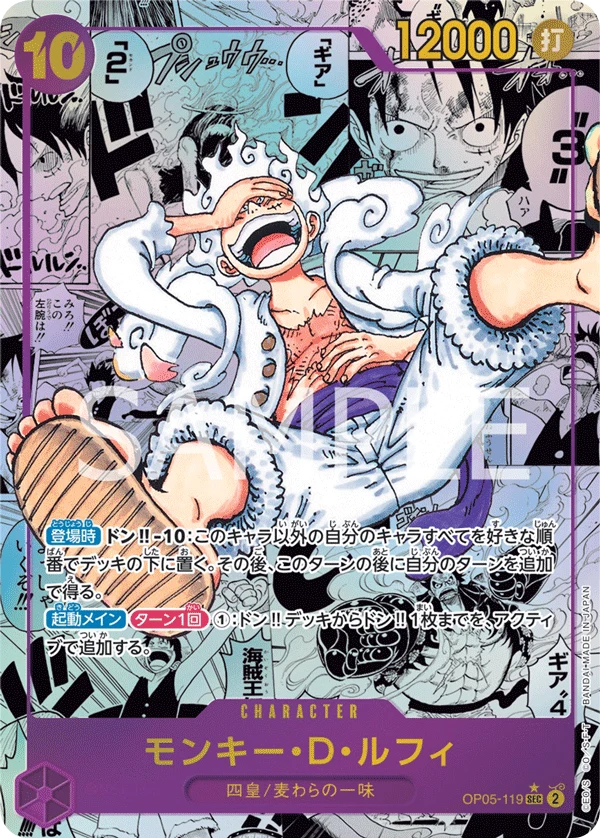
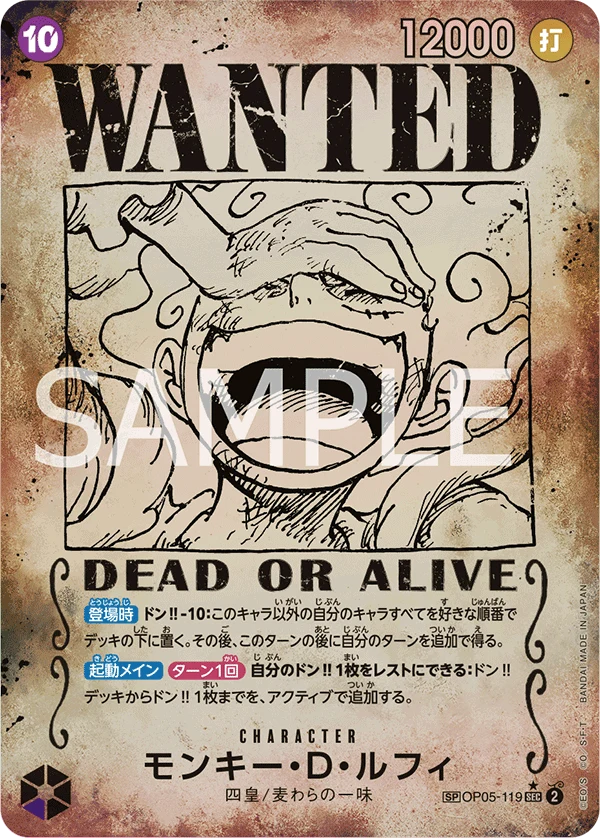
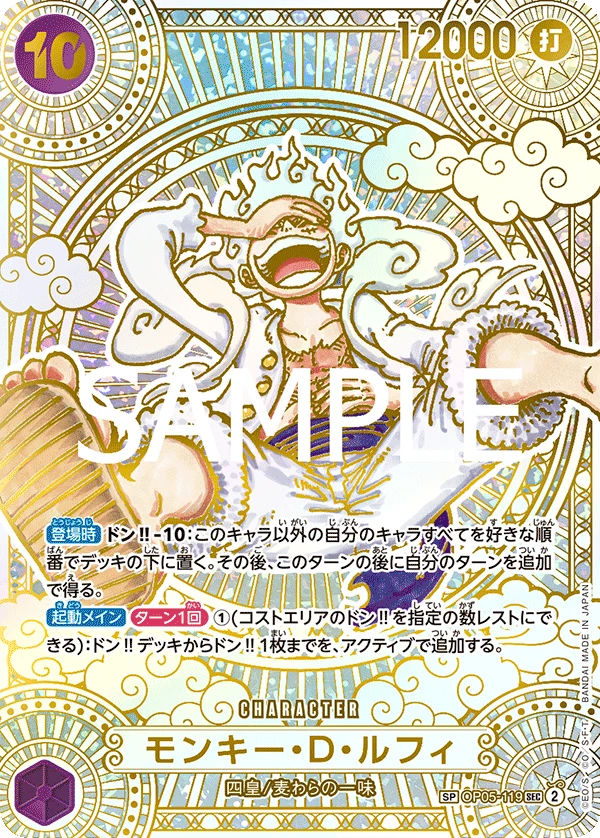
Three of the shop’s listings for the same card number show how far apart the printings sit:
- OP05-119 SEC — English 2nd Anniversary Set, Japanese version: PSA 10 currently listed at ¥27,665 (back order)
- SP OP05-119 — OP-09, Wanted-poster design: PSA 10 currently listed at ¥72,665
- OP05-119 ★SEC parallel — OP-05, manga-panel artwork: PSA 10 currently listed at ¥1,100,000 (back order)
Note the naming gap. Our listings call the manga-panel version a “Comic Parallel” and the OP-09 and OP-11 versions “SPC”; the official list calls the first an SEC entry and the others SP cards. When you search marketplaces you will meet the collector names, so translate them back to the official printing and its where-obtained product. The OP-05 card list and the OP-11 card list on our site group these sets’ cards in one place.
Promo and Event Cards: The P Numbers
If your card’s number starts with P- (for example P-110) and the rarity box reads P, it is a promotion card. Promos are given out in very different ways, and the official list records the route.
The official list keeps two series for these cards:
- プロモーションカード (Promotion cards): 479 entries on November 18, 2026. The where-obtained field names the route, for example a promotion pack, a 交流会 meet-up event, a Seven-Eleven tie-up campaign, a Championship set or a Weekly Shonen Jump mail-in offer.
- 限定商品収録カード (cards in limited products): 203 entries, including cards from premium card collections, anniversary sets and playmat sets.
Not every card in the promotion list carries a P rarity. Of the 479 promotion-list entries, 171 have rarity P and 308 have another rarity.
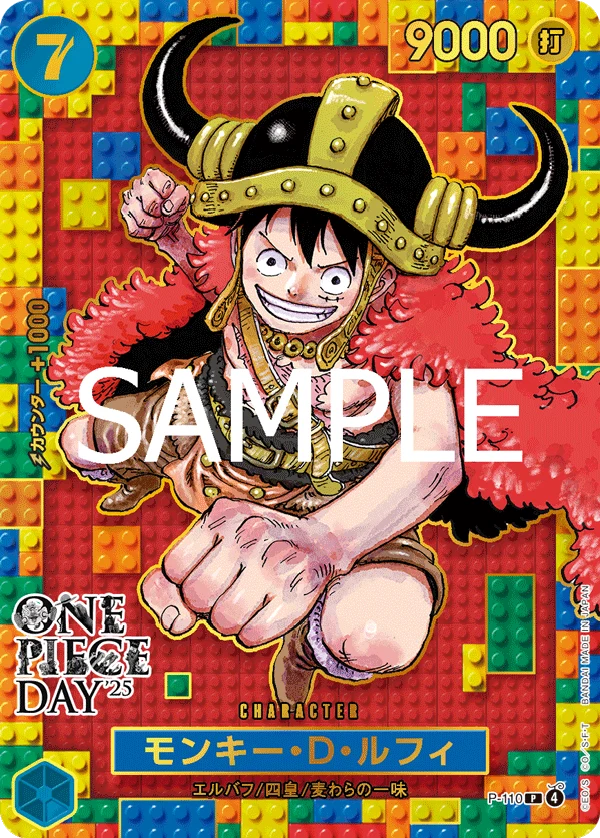
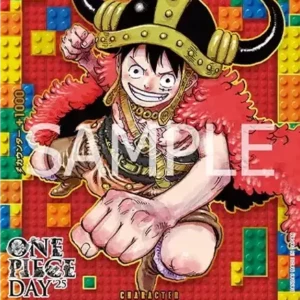
P-110 is a useful example. The official list gives its where-obtained product as プレミアムカードコレクション-ONE PIECE DAY’25- (Premium Card Collection ONE PIECE DAY ’25). A PSA 10 P-110 is currently listed at ¥26,200 in our shop, and the sealed collection it comes from has its own product page.
The promotion list records the distribution route. For a price comparison, match the exact card and product. Another of our examples is a PSA 10 Usopp from the Premium Card Collection 25th Anniversary Edition [ST01-002], currently listed at ¥5,503. Our One Piece promo cards guide walks through the promo routes.
Japanese or English: Check the Language First
The official site lists five language versions of ONE PIECE CARD GAME cards: Japanese, English, French, Simplified Chinese and Korean. Compare the same language, printing and grade.
The quickest checks on the card itself:
- The text. The card name, type line and effect are in Japanese on a Japanese printing and in English on an English printing.
- The bottom line stays the same. The card number, rarity box and block icon are printed in the same place on the Japanese and English OP05-119 base images, so the number alone does not tell you the language.
- The copyright line on the right edge differs. On the official images of OP05-119, the Japanese card prints “©EO/S ©O/S·F·T” and the English card prints “©EO/S ©E.O./S., T.A.”
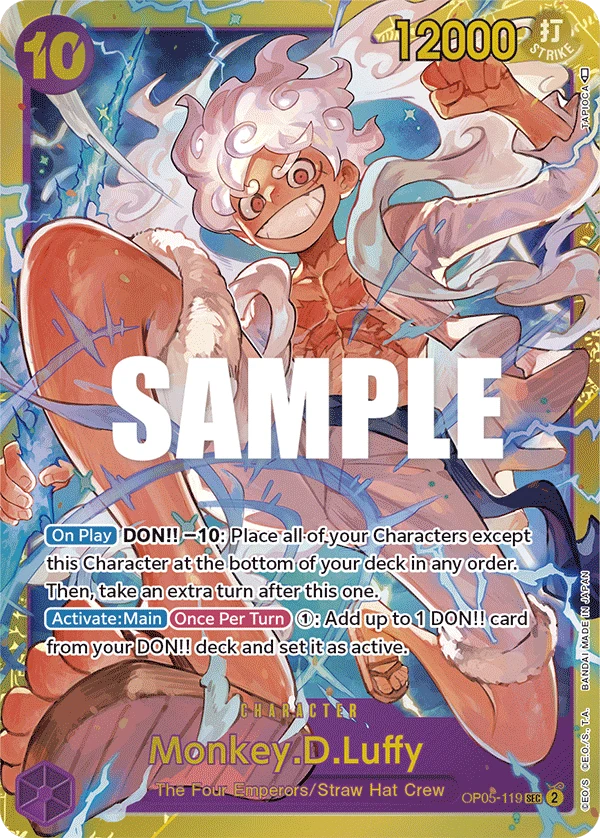
Watch the product names too. The official Japanese list includes printings from English-named products, such as the English 2nd ANNIVERSARY SET, and our listing for that printing says “Japanese Ver.” Our catalogue uses [EN] for English and [CN] or [CHN] for Chinese examples. Our comparison of Japanese and English One Piece booster packs covers the product side.
Condition and Grading
Once you know the printing, condition decides where your copy sits. Check it under a bright light:
- Corners and edges: look for whitening, soft corners and chips.
- Surface: tilt the card to find scratches, print lines and dents, especially on foil and textured printings.
- Centering: compare the border widths left to right and top to bottom.
Grading companies examine a card, assign a numeric grade and seal it in a holder. In our listings at 19:18 JST on November 18, 2026 we counted 330 PSA 10 Japanese One Piece listings that name a card number and carry a price (306 of them back-order listings). The listings change daily:
| List price band (PSA 10, Japanese; Nov 18, 2026, 19:18 JST) | Listings | Share |
|---|---|---|
| Under ¥5,000 | 0 | 0% |
| ¥5,000–¥9,999 | 31 | 9.4% |
| ¥10,000–¥29,999 | 145 | 43.9% |
| ¥30,000–¥99,999 | 74 | 22.4% |
| ¥100,000–¥299,999 | 52 | 15.8% |
| ¥300,000 and up | 28 | 8.5% |
At that time the median was ¥27,563 (~$179), and 176 listings (53.3%) sat under ¥30,000. These are counts of listings, not of distinct cards. The base OP05-119 and the gold-toned OP-11 example above both have PSA 10 listings in our shop.
These are PSA 10 asking prices. They do not establish the value of an ungraded copy or the return from grading it.
Checklist: What to Match on Your Card
Use this with the card in your hand and the official list open.
| What you see | What to match |
|---|---|
| Rarity box | Record the printed rarity and the list classification separately. The gold-toned OP-11 card shows SEC and is listed as an SP card. |
| Extra mark | A ★ above the rarity, or an SP box before the number; no mark still needs the official list, because some reprints look like the base |
| Number | A P number with a P box marks a promotion card; any number can have several entries |
| Artwork | The entry image, for example manga-panel, Wanted-poster, gold-toned or silver-toned on OP05-119 |
| Where obtained (official list) | The product named in the 入手情報 field |
| Language | The text and copyright line; compare the same language |
| Condition | Corners, edges, surface and centering |
Use the number, marks, artwork and source product to match the printing.
Common Mistakes
- Trusting a collector label. “Manga rare”, “comic parallel” or “SPC” are names used by shops and collectors. Map them to the official entry before you compare prices.
- Mixing graded and raw. A PSA 10 asking price applies to a PSA 10 copy of the same printing.
- Reading one asking price as the value. An asking price is what a seller hopes for. Compare several listings and, where you can, completed sales.
For a sense of where the expensive printings cluster, our guide to valuable One Piece cards collects dated asking prices by print.
Where to Buy Japanese One Piece Cards
We sell Japanese One Piece sealed product and PSA 10 graded singles from Tokyo. Starting points from this guide:
- Premium Card Collection ONE PIECE DAY ’25 — the official list names it as the source of P-110; the product page shows the current price.
- OP-05 Awakening of the New Era Japanese booster box — OP-05 is the source of the base OP05-119 and two parallels.
- OP-11 A Fist of Divine Speed Japanese booster box — OP-11 is the source of two OP05-119 SP cards.
- OP-18 神の支配 (The Dominance of God) Japanese booster box — currently listed at ¥12,999.
- OP-17 The World’s Strongest Warriors Japanese booster box — OP-17 is the set the official site uses to explain parallel and SP cards.
- EB-05 Heroines Edition vol.2 Japanese booster box — currently listed at ¥13,200.
Browse all Japanese One Piece boxes and products, see the set lists on our card list hub and the OP-18 card list, or send a sourcing request for a specific printing through Quick Order. The product page shows the current terms.
Frequently Asked Questions
What One Piece cards are worth money?
Identify the exact printing before comparing prices. The official Japanese list has ten entries for OP05-119, and our six PSA 10 examples have different asking prices despite sharing a card number. Use the number, marks, artwork and source product to match the printing.
Where is the rarity printed on a Japanese One Piece card?
At the lower right of the name panel, in a small box next to the card number, for example OP05-119 SEC. On the official images we checked, a star above the box appears on some parallels and on the OP-09 SP card, and an SP box before the number appears on SP cards. The circled number after it is the block icon, not a rarity.
How do I know which version of a One Piece card I have?
Search the card number on the official card list at onepiece-cardgame.com. Each printing is a separate entry with its own image and a where-obtained field naming its product. Compare your card’s artwork, marks and source product with the entries. OP05-119, for example, has ten entries in the official Japanese list. If the marks match and the source of the physical card is unknown, the exact printing can remain uncertain.
Are One Piece promo cards worth money?
Read the number and rarity separately. Check the relevant promotion-card or limited-product entry for the source. P-110 appears in the limited-product list. For a price comparison, match the exact card and product.
How do I tell a Japanese One Piece card from an English one?
Read the text: the card name, type line and effect are in Japanese on a Japanese printing. The card number, rarity box and block icon sit in the same place on the Japanese and English OP05-119 base images, and the copyright line on the right edge differs. The official site lists five language versions. Compare the same language, printing and grade.
Does a PSA 10 grade make a One Piece card valuable?
The printing comes first; the grade then places the copy within that printing. The base OP05-119 and the gold-toned OP-11 example in this guide both have PSA 10 listings in our shop, and the table in the grading section shows how PSA 10 list prices spread. These are asking prices; they do not establish the value of an ungraded copy.
Picked for this article
📩 Get member-only sale alerts & coupons
Sale alerts, coupons and restock notices by email — straight from Tokyo.