![Team Rocket Japanese Pokemon Cards: From 1997 Old-Backs to SV10 [2026]](https://samuraiswordtokyo.com/wp-content/uploads/2026/08/featured2-team-rocket-japanese-pokemon-cards-1-1024x538.webp)
Team Rocket has been stealing Pokemon — and selling Pokemon cards — for 29 years.
The villains debuted on Japanese cardboard in 1997, in an old-back expansion pack that predates the modern card back entirely. In 2026 they are back on top of the hobby again, headlining SV10 Glory of Team Rocket, a Japanese set built around six villain Special Art Rares and some of the most talked-about pull rates of the Scarlet & Violet era. In between sit anniversary promos, deck-set oddities, and graded singles that range from pocket money to five figures in yen — times ten.
This guide walks the whole 29-year arc from the Japanese side of the market, where we operate. We’re a Tokyo exporter of Japanese sealed product and PSA-graded singles, so every price in this article is either a live price from our own store shelf or a recent listing from our own inventory — not a scraped estimate. One quick note for English-side searchers: the “Team Rocket tin” you may have seen is an English-language product; this article covers the Japanese cards, which is what we stock and ship.
Japanese Team Rocket cards span three tiers: the modern SV10 Glory of Team Rocket booster box (¥22,048, in stock), PSA10 graded singles from ¥5,379 to ¥117,418 currently on our shelf, and the 1997 old-back “Team Rocket” expansion at the vintage summit — our PSA10 old-back Dragonite recently listed at ¥657,140 and sold. All ship worldwide from Tokyo.
All prices are live prices from our Tokyo store as of August 2026, converted at ¥163/USD. Graded singles are one-of-one inventory — each slab listed exists as a single copy and can sell at any time.
The Modern Era: SV10 Glory of Team Rocket
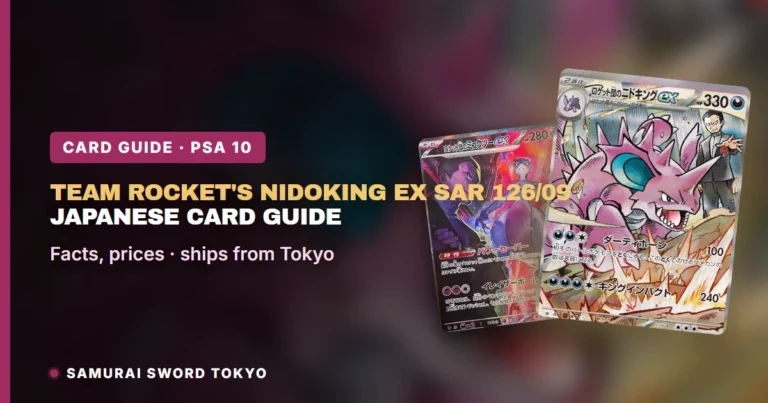
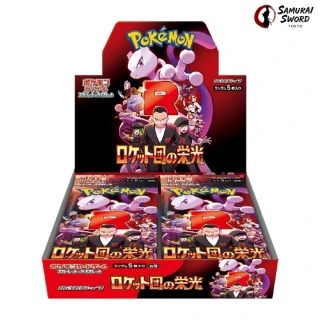
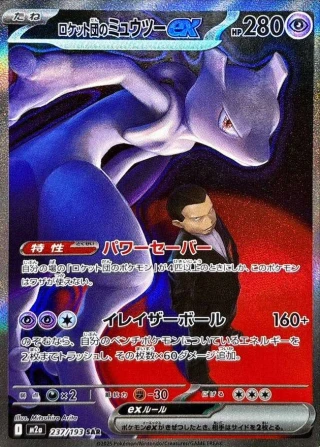
If you came to Team Rocket cards through the 2025–26 hype cycle, this is the set that did it. SV10 Glory of Team Rocket is the Japanese expansion that brought the villains back as the headline act rather than a side theme, and in our Glory of Team Rocket pull rates guide — compiled from data across 1,000+ pack openings — we called it one of the strongest SAR lineups in the Scarlet & Violet era. That wasn’t hype for its own sake: the set’s Special Art Rare slot is stacked with six villain-themed SARs, covering Mewtwo, Moltres, Nidoking, Crobat, Giovanni, and Ariana.
What makes the lineup unusual is coherence. Most modern sets scatter their chase cards across unrelated Pokemon; SV10 built an entire rogues’ gallery. Giovanni and Ariana bring the human villains onto Special Art Rare canvases, while the Pokemon SARs — Mewtwo, Moltres, Nidoking, Crobat — are drawn as the team’s enforcers rather than as neutral creatures. Collectors responded to that storytelling, and the market showed it immediately.

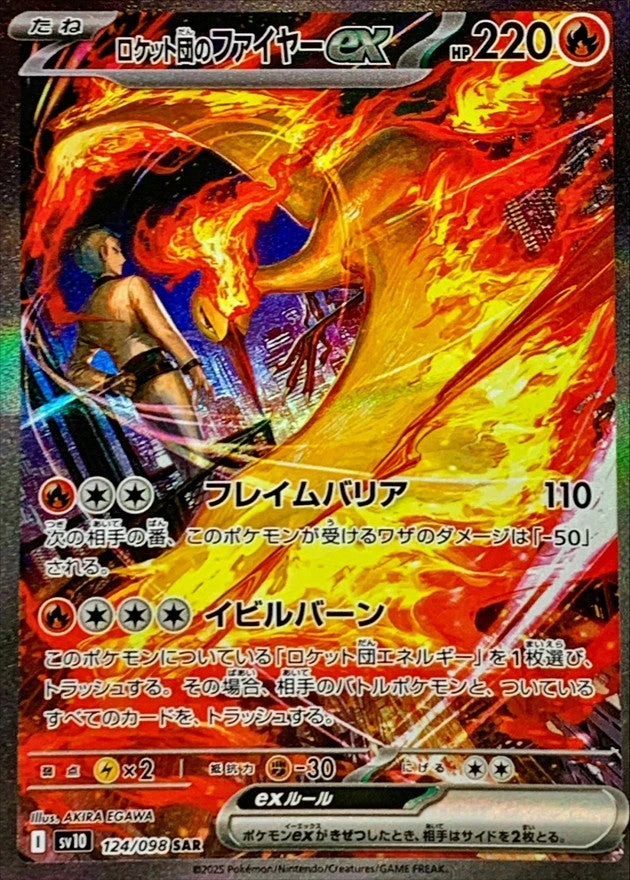
The box price tells the story of the whole release in three acts. At its peak, the Japanese booster box traded around ¥38,000 (~$233) — a number driven by allocation shortages and the sheer pull of that SAR lineup. It then cooled sharply as reprint supply arrived; at one point our own guide measured boxes around ¥17,000. Today it has settled between those extremes: our current store price is ¥22,048 (~$135), in stock at our SV10 Glory of Team Rocket booster box page. For a set this recent, that journey — spike, correction, stabilization — is about as healthy as a chase set gets, and it means buyers today are no longer paying the panic premium of the launch window.
If the rarity codes here are unfamiliar — SAR, AR, UR and how they rank — our Japanese Pokemon card rarities explained guide covers the full ladder. The short version for this set: AR cards are alternate-art rares that appear regularly, SAR cards are the full-canvas special art rares that carry the set’s value, and the UR is the gold-treatment secret rare at the very end of the print sheet. All of the villain chase cards discussed in this article live in the SAR and UR slots.
One more reason this set matters to buyers outside Japan: it is a Japanese-first release. The Japanese printing is the one the character artists’ work debuts in, the one Japanese grading submissions come from, and the one that established the market prices everyone else references. For collectors who intend to grade, that matters — Japanese print runs are widely regarded by collectors as the cleaner product out of the pack, which is a real consideration when a PSA 10 is the goal.
A box at ¥22,048 is the lottery ticket; the graded singles below are the guaranteed outcomes. Which route makes sense depends on whether you want the opening experience or the specific card — the next section prices the second option.
PSA10 Team Rocket Singles In Stock Right Now
Everything in this table is a PSA10 slab physically on our shelf in Tokyo as of this writing. These are one-of-one listings — when a slab sells, it’s gone until we source another — so treat this as a snapshot of a working inventory rather than a permanent catalogue.
| # | Card | Number | Grade | Store price |
|---|---|---|---|---|
| 1 | Team Rocket’s Koffing SAR | SV10 125/098 | PSA 10 | ¥117,418 (~$720) |
| 2 | Team Rocket’s Ariana SAR | 237/193 | PSA 10 | ¥36,915 (~$226) |
| 3 | Team Rocket’s Mewtwo ex (promo) | P 043/M-P (update: currently sold out — restock requests via Quick Order) | PSA 10 | ¥32,823 (~$201) |
| 4 | Team Rocket’s Mewtwo UR | SV10 130/098 | PSA 10 | ¥27,007 (~$166) |
| 5 | Rocket’s Thunder (25th Anniversary promo) | 008/025 (update: currently sold out — restock requests via Quick Order) | PSA 10 | ¥13,335 (~$82) |
| 6 | Team Rocket’s Orbeetle AR | SV10 104/098 | PSA 10 | ¥5,379 (~$33) |
The spread here is instructive. At the bottom, the Orbeetle AR at ¥5,379 (~$33) is a genuine entry-level slab: a PSA10 art rare from the hottest villain set of the era for roughly the price of three booster packs’ worth of impulse spending. In the middle, the two Mewtwo — the SV10 UR at ¥27,007 and the M-P promo at ¥32,823 — give you the franchise’s most famous villain-adjacent Pokemon in two different frames, and the Ariana SAR at ¥36,915 puts one of the set’s human villains on the shelf in top grade.

And at the top sits the surprise: Team Rocket’s Koffing SAR at ¥117,418 (~$720) — the most expensive graded Team Rocket card on our shelf, ahead of every Mewtwo we stock. A Koffing. We’ll unpack why in the next section, because the answer says a lot about how modern Japanese chase cards actually work.
Why PSA 10 specifically? Top-grade slabs consistently command a multiple over raw copies of the same card, and the gap widens as the card gets scarcer — a dynamic we break down with real examples in our PSA10 Mega Pokemon cards guide. For a villain set where the art is the entire point, condition certainty is worth paying for.
Each graded single above is a single physical slab. Prices are live at time of writing but availability changes without notice — if a card matters to you, check the current listing on our PSA10 collection before planning around it.
Why a Koffing Outprices Mewtwo
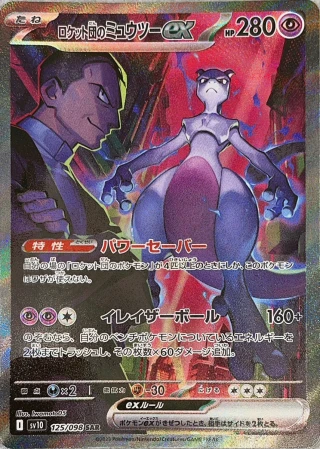
On paper it looks backwards. Mewtwo is one of the most famous Pokemon ever printed; Koffing is a first-route poison ball. Yet on our shelf, the PSA10 Koffing SAR at ¥117,418 sits more than four times higher than the PSA10 Mewtwo UR at ¥27,007. This isn’t a quirk of our pricing — it reflects how the Japanese market has treated the card — and the logic behind it is worth understanding before you buy anything from a character-driven set.
The first factor is which demand a card taps. Mewtwo cards are plentiful across three decades of printings, so demand for “a great Mewtwo card” spreads across dozens of options in every era and price band. Koffing, by contrast, almost never gets a premium art slot. When a set finally gives a supporting character its one showcase card, that card becomes the single destination for everyone who wants it — there is no substitute printing to absorb the demand.
The second factor is what the art is actually of. Koffing isn’t just a Pokemon in Team Rocket’s world — it’s the team’s mascot-tier sidekick, inseparable from the anime’s villain duo since 1997. A Team Rocket-themed Koffing SAR is less a “Koffing card” than a Team Rocket character piece, and character-story SARs are precisely what the SV10 collector base formed around. Nostalgia demand attaches to the scene, not to the Pokedex entry.
The third factor is rarity structure. Both cards come from the same boxes, but within the secret-rare slots, the market has room to rank them — and when collectors converge on one SAR as the set’s identity card, its price separates from the rest of the sheet. That convergence is qualitative and can shift, which is exactly why we’d rather show you our live shelf prices than quote a theory.
The practical lesson: in villain and character sets, don’t price cards by the Pokemon’s fame. Price them by how rarely that character gets premium treatment. It’s the same dynamic that makes trainer-character cards outperform legendary Pokemon in set after set — and it’s why the humble Koffing is, for now, the king of our Team Rocket shelf.
The Vintage Summit: 1997’s Old-Back “Team Rocket” Expansion
Everything above is the modern chapter. The original chapter was printed in 1997, when Japan released the expansion pack known simply as “Team Rocket” (Rocket Gang, PMCG4) — the set that put the villains on cards for the first time and introduced the “Dark” Pokemon concept that would define villain-themed cards for years.
These are old-back cards, or kyu-ura in Japanese collecting slang: printed before Japan adopted the standardized card back in use since the early 2000s, they carry the original Japanese back design that instantly identifies a card as pre-modern. Old-back sets sit at the top of the Japanese vintage hierarchy for the same reasons early English sets do — age, attrition, and the fact that almost nothing from 1997 survived three decades of playgrounds in grade-worthy condition.
We won’t quote a market table for this set, because vintage old-back singles trade thinly and third-party price estimates are notoriously unreliable. What we can tell you is what has passed through our own inventory: our PSA10 old-back Dragonite from the 1997 Team Rocket expansion (No. 149) recently listed at ¥657,140 (~$4,030) — and it is currently sold. That single data point tells you most of what you need to know about the ceiling: a top-graded card from this set trades at roughly thirty modern booster boxes’ worth of yen, and buyers are there when one surfaces.
For collectors, the practical realities of old-back hunting are these:
- Population is the story. High-grade old-backs are scarce in absolute terms, so availability — not list price — is usually the binding constraint. Copies appear when they appear.
- Authentication matters more than anywhere else. A graded slab from PSA removes the two big vintage risks — condition disputes and authenticity — which is why nearly all serious old-back trade happens in slabs.
- Japan is the source market. These cards were never printed anywhere else, and the deepest supply still surfaces domestically — which is precisely the pipeline a Tokyo exporter exists to serve.
Because old-back inventory is irregular, the efficient move is to tell us what you’re hunting rather than waiting for a listing to appear. Our Quick Order page exists for exactly this — more in the buying section below.
Promo Corner: 25th Anniversary Rockets and the Satoshi VS Team Rocket Deck
Between 1997 and SV10, the most collectible Team Rocket cards came not from expansions but from promos and special products — a corner of the market that rewards knowing exactly what exists.
The 25th Anniversary promos (2021) are the accessible end. Japan’s 25th Anniversary celebration produced a promo series that included Team Rocket nostalgia cards, and two of them matter here. Rocket’s Thunder (008/025) is the one currently on our shelf — a PSA10 copy at ¥13,335 (~$82), which makes it one of the cheapest ways to own a graded piece of the anniversary series. Its sibling, Here Comes Team Rocket! (S8a-P 006/025), revives one of the franchise’s most beloved villain artworks; a PSA10 copy recently listed on our store at ¥11,376 (~$70) and sold to an overseas buyer, which is typical of how quickly these anniversary Rockets move when they surface.
At the other end of the spectrum sits a genuine oddity: the “Satoshi VS Team Rocket” 30-card deck set, a Japanese deck product that pitted the anime’s hero against the villain duo. Deck-exclusive cards like these were never available in boosters, print runs were modest, and high-grade survivors are rare — a combination that puts top slabs from this product firmly in grail territory. From our own inventory: a PSA10 Mimikyu GX from the set recently listed at ¥182,310 (~$1,120) and is currently sold.
The pattern across the promo corner is consistent with everything else in this guide: Japanese Team Rocket material that was distributed narrowly — promo packs, deck sets, anniversary products — separates in price from booster-set cards and stays separated. If a Team Rocket card was hard to get on day one, it is much harder to get now.
It’s also the corner of the market where doing your homework pays off most. Booster-set chase cards have visible, liquid markets; promo and deck-set cards trade in ones and twos, which means a patient buyer with a clear target list has a real edge over someone browsing whatever happens to be listed. Knowing that Rocket’s Thunder and Here Comes Team Rocket! are siblings from the same anniversary series, or that the Satoshi VS Team Rocket deck exists at all, is exactly the kind of knowledge that separates a deliberate collection from an expensive accumulation.
The Here Comes Team Rocket!, Mimikyu GX, and old-back Dragonite figures above are recent one-of-one listings from our store that have already sold. They’re shared as reference points from our own sales history, not as available inventory or as market-wide price guides.
How to Buy Team Rocket Cards from Japan
We ship Japanese sealed product and graded singles worldwide from Tokyo with tracked delivery. For Team Rocket collectors, there are three practical routes, and they map onto the three tiers this guide has covered.
Route one: the sealed box. If you want the SV10 experience — the pack-opening, the shot at the six villain SARs — the booster box is the direct path, and at ¥22,048 it’s well off its ¥38,000 peak.
Route two: graded singles. If you want a specific card in certainty-grade condition — the Koffing SAR, a Mewtwo, the anniversary promos — browse our PSA10 collection. Everything there is a slab we physically hold in Tokyo, priced in yen off the Japanese market we buy from daily. Remember the one-of-one rule: what you see is the copy we have.
Route three: the want list. For anything not currently listed — vintage old-backs, deck-set exclusives, a particular SV10 SAR in PSA10 — use our Quick Order page. Tell us the cards you’re hunting and we source from the Japanese domestic market, which is where old-back and promo material surfaces first. This is by far the most effective route for the vintage tier, where waiting for a public listing can mean waiting a very long time.
Two practical notes for international buyers. First, all our pricing is in yen; at the current ¥163/USD rate, the yen prices in this article convert favorably for dollar-based collectors compared to recent years. Second, every order ships tracked from Tokyo — sealed boxes and slabs alike — so the same logistics apply whether you’re importing one Orbeetle or an old-back grail.
If you’re deciding between the three routes, a simple framework: buy sealed when the opening experience is part of the value for you, buy graded singles when a specific card is the goal and condition certainty matters, and use the want list when the card you’re after simply isn’t in public circulation. Plenty of our Team Rocket customers end up doing all three — a box for the fun of it, a slab or two for the collection, and a standing want list for the vintage piece they’re patient about.
Frequently Asked Questions
What is Glory of Team Rocket (SV10)?
SV10 Glory of Team Rocket is the Japanese expansion that brought Team Rocket back as a headline theme, with six villain Special Art Rares — Mewtwo, Moltres, Nidoking, Crobat, Giovanni, and Ariana. Our store currently has the Japanese booster box in stock at ¥22,048 (~$135), down from its ¥38,000 peak.
What is the most valuable Team Rocket card?
From our own inventory: the top graded Team Rocket card currently in stock is a PSA10 Team Rocket’s Koffing SAR at ¥117,418 (~$720), and the highest-priced Team Rocket card we’ve recently listed was a PSA10 old-back Dragonite from the 1997 Japanese Team Rocket expansion at ¥657,140 (~$4,030), which has sold. Vintage old-back prices vary widely by card and grade, so we only quote our own listings.
What does “old-back” mean for Japanese Pokemon cards?
Old-back (kyu-ura) refers to Japanese cards printed before Japan adopted the standardized modern card back in the early 2000s. The 1997 Team Rocket expansion is an old-back set, which places it in the oldest and scarcest tier of Japanese vintage.
Why is the Koffing SAR worth more than the Mewtwo cards?
Character-art scarcity. Mewtwo demand spreads across decades of printings, while Koffing — Team Rocket’s signature sidekick — almost never receives a premium art card. The SV10 SAR is the single destination for that demand, so collectors have converged on it as one of the set’s identity cards.
Is there an English version of the Team Rocket products?
Yes — English-language Team Rocket products exist, including the “Team Rocket tin” many collectors search for. This guide covers the Japanese cards, which release first, are printed separately, and are what we stock and export from Tokyo.
What is the Satoshi VS Team Rocket deck set?
A Japanese 30-card deck product themed around the anime’s hero-versus-villain matchup, with deck-exclusive cards never available in boosters. High-grade cards from it are rare; a PSA10 Mimikyu GX from the set recently listed on our store at ¥182,310 (~$1,120) and has sold.
Do you ship Team Rocket cards internationally?
Yes. We ship sealed boxes and PSA-graded singles worldwide from Tokyo with tracked delivery. For cards not currently listed — especially vintage old-backs and promos — submit a want list through our Quick Order page and we source from the Japanese domestic market.
500 Points Free on Sign-Up
CREATE FREE ACCOUNT1 pt = ¥1 at checkout · Points expire 30 days after they are earned · Import duties, taxes and customs charges are not included in the price and are collected on delivery, except for destinations we ship duty-paid.
Picked for this article
📩 Get member-only sale alerts & coupons
Sale alerts, coupons and restock notices by email — straight from Tokyo.