Tomokazu Komiya is the Pokemon TCG illustrator whose deliberately deformed, primitivism-style cards look unlike almost anything else printed under the Pokemon Company banner. In 2023, the Van Gogh Museum in Amsterdam put its own paintings next to Pokemon art for a licensed collaboration — and Komiya was one of the illustrators chosen to reinterpret Van Gogh masterworks, work that sits squarely inside the same deformed, loosely colored style Bulbapedia credits to his wider Pokemon Trading Card Game catalog.
Komiya’s cards are deliberately “deformed and loosely colored,” in Bulbapedia’s own description of the style — stretched faces, oversized eyes, and color choices that clash on purpose. This guide covers who Komiya is, what that style actually looks like across a TCG career that spans vending-era Japan to the newest English sets, and everything we’ve verified about Tomokazu Komiya Pokemon cards, including where things stand on our end: we don’t currently hold a graded Komiya PSA 10, and this guide doubles as the way to ask us to source one.
We do not currently hold a graded Tomokazu Komiya PSA 10. Komiya is a Japanese illustrator born in 1973 whose Pokemon TCG work is credited by Bulbapedia to the Primitivism art movement — intentionally “deformed and loosely colored” Pokemon portraits with exaggerated facial proportions. Komiya’s TCG debut dates back to Japan’s early vending-card series, and in 2023 the illustrator contributed to the official Pokemon × Van Gogh Museum collaboration. If you want a Komiya card, flag it on our Quick Order page and we’ll source it.
- We don’t hold a graded Tomokazu Komiya card at the time of this update; sourcing requests go through Quick Order.
- The most recent Komiya print in our verified list is the Karrablast AR from Black Bolt (SV11B 094/086); see the full Black Bolt card list.
- Browse our current PSA 10 card list or the wider PSA 10 collection for graded cards from other illustrators that are currently listed.
Card and set details verified against Bulbapedia and Limitless TCG; store state current as of September 23, 2026.
Who Is Tomokazu Komiya?
Tomokazu Komiya (小宮智和) is a Japanese illustrator born in 1973. Per Bulbapedia, Komiya’s first Pokemon Trading Card Game artwork appeared in Japan’s Expansion Sheet 1, part of the early vending-machine card series, well before the illustrator’s English-language debut arrived on Neo Genesis.
That gives Komiya a TCG career running from Japan’s early vending-card era through to current-era sets. The Limitless TCG artist database listed 249 cards under Komiya’s name as of August 2026, covering only main-line TCG sets — no Pokemon Trading Card Game Pocket sets appear in that result. Bulbapedia’s own tally counts 271 TCG cards plus a separate 36 Pokemon TCG Pocket cards; because the two databases scope things differently, we’re citing both figures separately rather than adding them into one number.
What makes Komiya’s catalog stand out isn’t the size — it’s the consistency of a deliberately deformed, loosely colored style that sits far from the more polished character art most collectors associate with the franchise.
The Primitivism Style: Deformed, Loose, and Deliberate
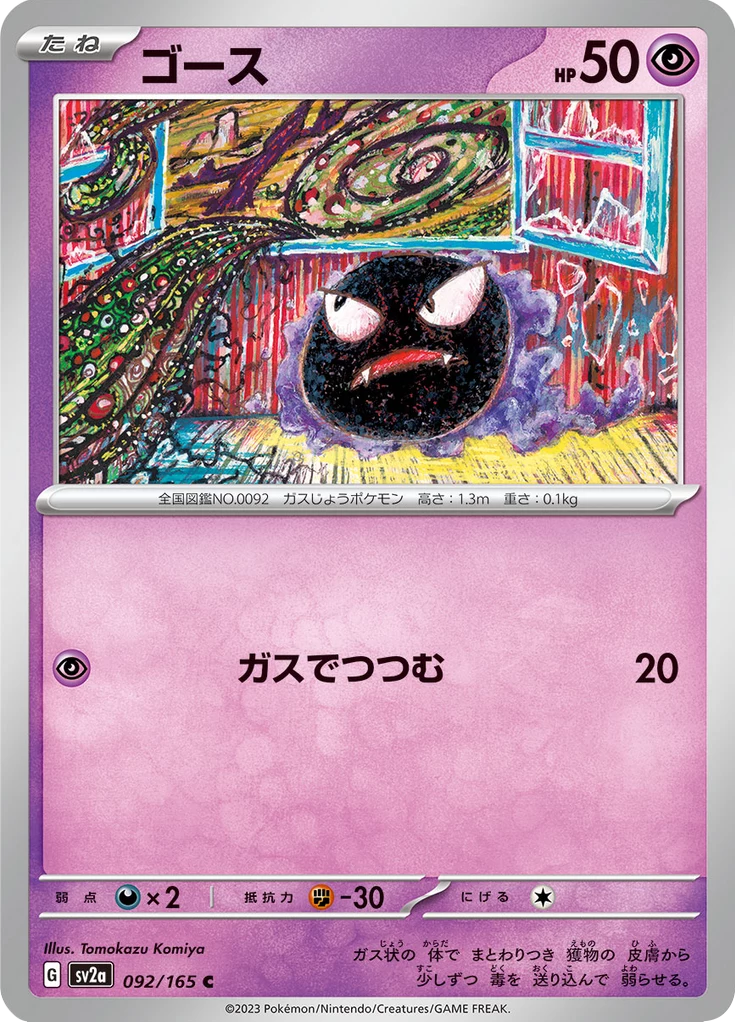
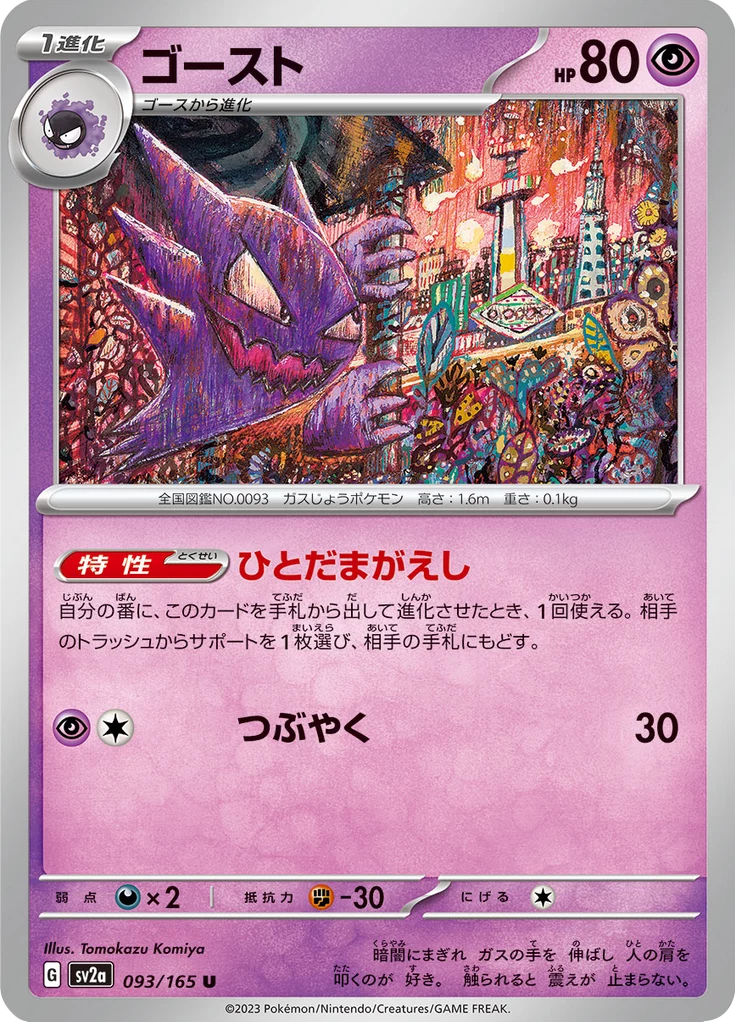
Bulbapedia files Komiya’s work under Primitivism, describing the movement as one that “takes inspiration from themes or stylistic elements of prehistory, tribal cultures, or children’s art.” Some fans use the shorthand “folk-art” or “naive style” for the look, and that description is consistent with Bulbapedia’s framing — but Primitivism is the term Bulbapedia itself uses, and it’s the one worth citing.
In practice, Bulbapedia describes the work as exaggerating the features of Pokemon — particularly facial and bodily proportions, focusing on the eyes or length of the face — paired with “deformed and loosely colored images” and “vibrant colors or unusual tones to create a stark contrast.” The Gastly-Haunter-Gengar line from Pokemon Card 151 above (Japanese prints shown) is a compact example: three creatures from the same evolution family, each stretched and re-colored in ways that prioritize mood over anatomical accuracy.
That same trio also illustrates a distinction worth making for anyone shopping the Pokemon 151 (MEW) set specifically: Komiya’s Pokemon 151 cards are this Gastly/Haunter/Gengar line at numbers 92 through 94. They are not the same cards as the set’s widely traded alternate-art rares of Psyduck, Charmander, Snorlax, Squirtle, and Pikachu, which carry different illustrator credits entirely. See the full Pokemon 151 (SV2a) card list for every print in the set.
From Vending Cards to Black Bolt: A Career Span
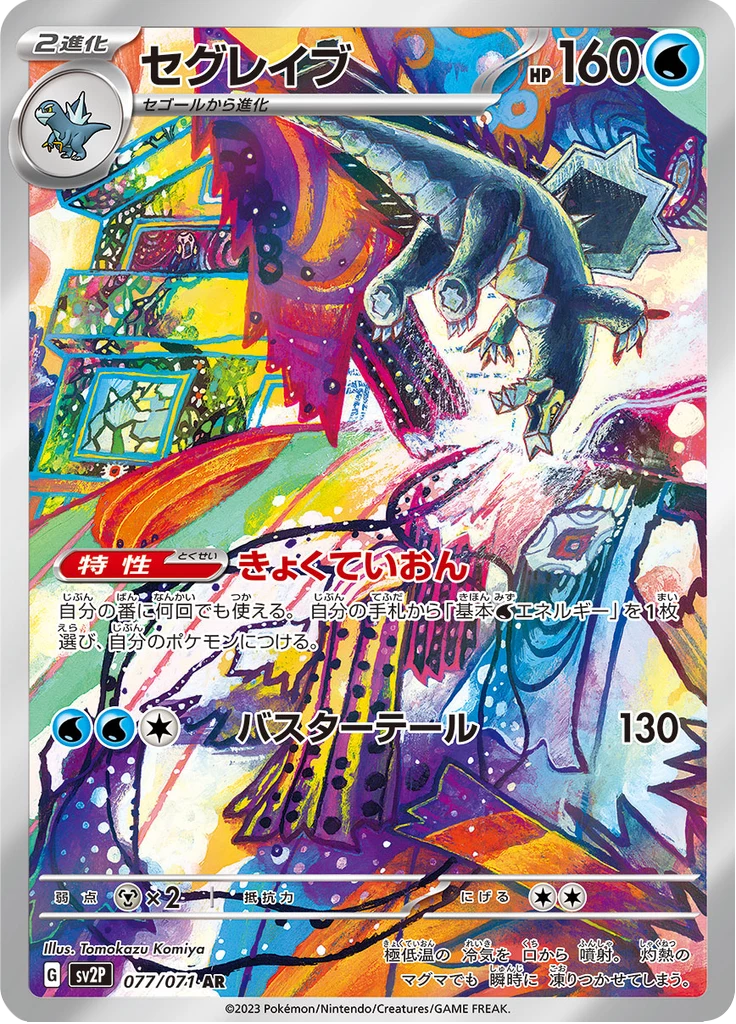
The Limitless database’s 249 results for Komiya span roughly three decades of Pokemon TCG history, and the illustrator’s more recent work shows the same Primitivism approach applied to newer card formats. Paldea Evolved’s Baxcalibur Illustration Rare and its companion Illustration Rares for Frigibax and Arctibax — the full three-stage line, numbers 208 through 210 — put Komiya’s exaggerated proportions on a full-art canvas rather than the smaller frame of a standard-rarity card. The JP print pictured above is from Snow Hazard; see the full Snow Hazard (SV2P) card list for every print in the set.
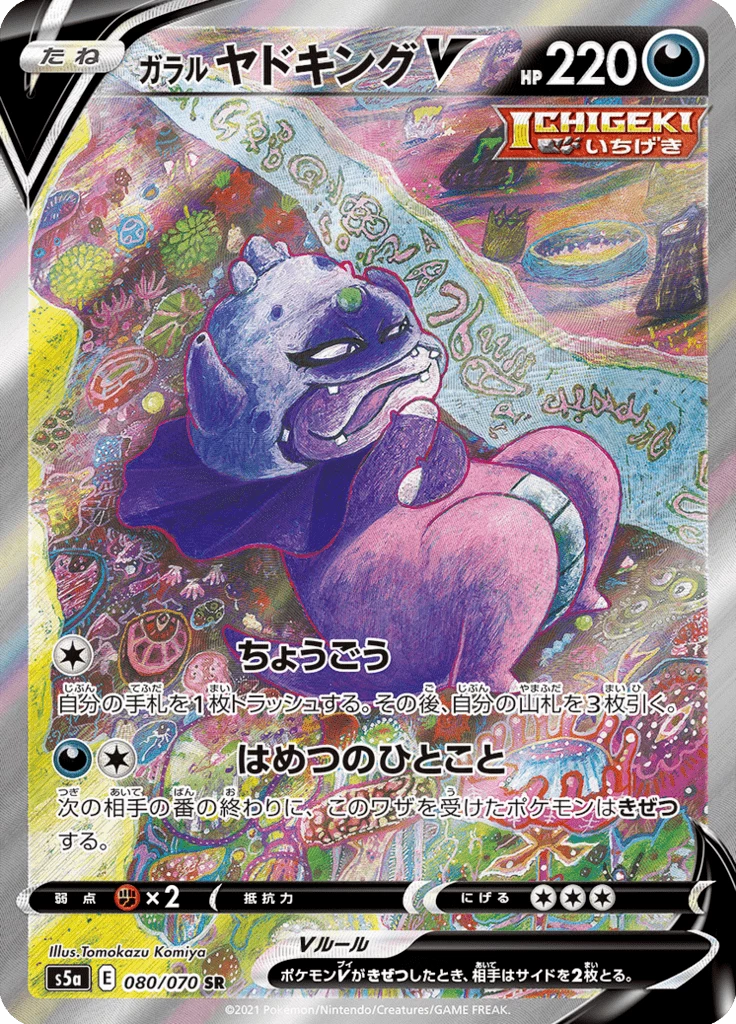
Chilling Reign’s Galarian Slowking V, an Ultra Rare, sits at a higher rarity tier and shows the style holding up on a Pokemon V card, where full-body illustration space leaves more room for the deliberately loose coloring Bulbapedia describes. The JP print pictured above is from Matchless Fighters; see the full Matchless Fighters (S5a) card list for every print in the set.
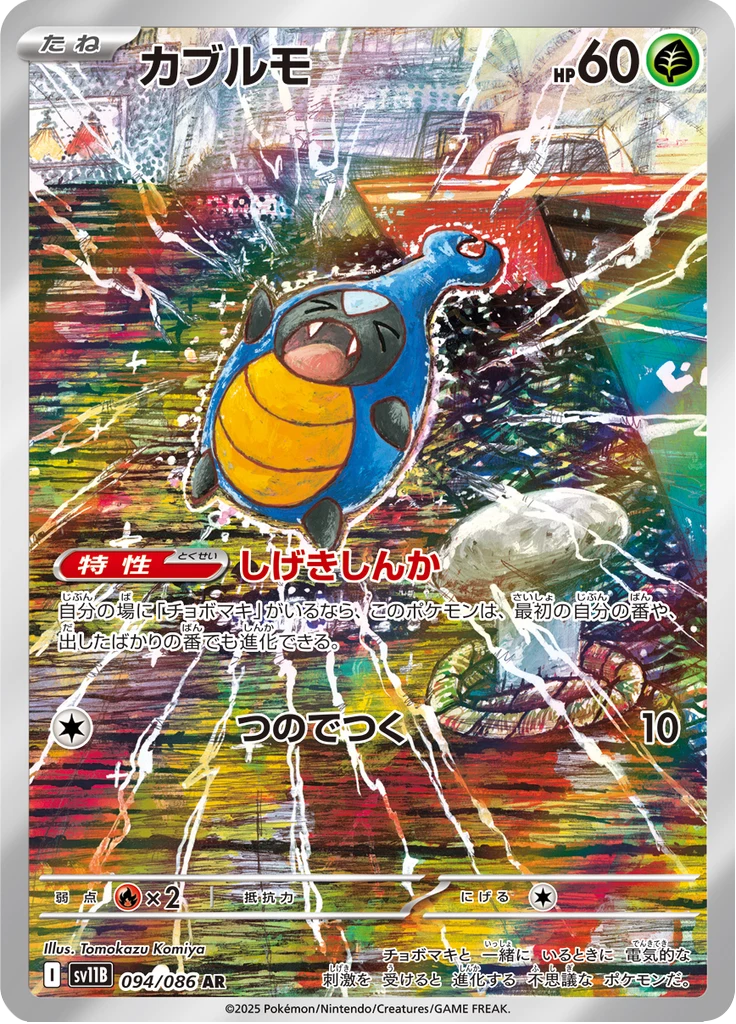
Komiya’s most recent English-set work in the verified list comes from Black Bolt (JP print pictured; the set released under the same title in English), where a Karrablast Illustration Rare shows the style in a current-era print run rather than only vending-era archives. Between the vending-series debut and Black Bolt, Komiya’s card list also runs through Rebel Clash’s Spiritomb, Vivid Voltage’s Shedinja and Ninjask, Silver Tempest’s Jynx, and dozens of other Rare, Uncommon, and Common prints — a career built more on steady output across sets than a handful of chase cards. Raw Black Bolt singles — the set that Karrablast AR comes from — are listed in our Black Bolt (SV11B) singles collection.
USD figures convert at ¥154/USD, approximate.
Beyond the Cards: Pokemon Tales and the Van Gogh Museum
Komiya’s Pokemon work extends beyond the trading card game itself. Per Bulbapedia, the illustrator contributed artwork to multiple volumes of the Pokemon Tales picture-book series, published by Shogakukan between 1997 and 2002 — putting Komiya’s Primitivism style in front of readers well before most of the illustrator’s TCG catalog existed.
More recently, Komiya was one of the illustrators selected for the 2023 Pokemon × Van Gogh Museum collaboration, contributing illustrations of Sunflora and Smeargle reinterpreted through specific Van Gogh masterworks. That collaboration is separate from the well-known “Pikachu with Grey Felt Hat” promo card from the same Van Gogh Museum partnership, which carries a different illustrator credit — worth flagging clearly, since the two are easy to conflate.
Komiya’s art has also appeared on official Pokemon Center merchandise, including postcards, stickers, and card sleeves, along with sticker designs for the Pokemon HOME app. Taken together, the picture-book work, the museum collaboration, and the merchandise line point to a Primitivism style that Pokemon has repeatedly reached for outside the trading card game as well as inside it.
Komiya Cards and How to Source One
We don’t currently hold a graded Tomokazu Komiya card. The table below lists the illustrator’s notable printings referenced in this guide — all sold out at the time of this update; sourcing requests go through Quick Order:
| Card | Set | Type | Status |
|---|---|---|---|
| Gastly | Pokemon 151 (92) | Common | Sold out at the time of this update — request via Quick Order |
| Haunter | Pokemon 151 (93) | Uncommon | Sold out at the time of this update |
| Gengar | Pokemon 151 (94) | Rare | Sold out at the time of this update |
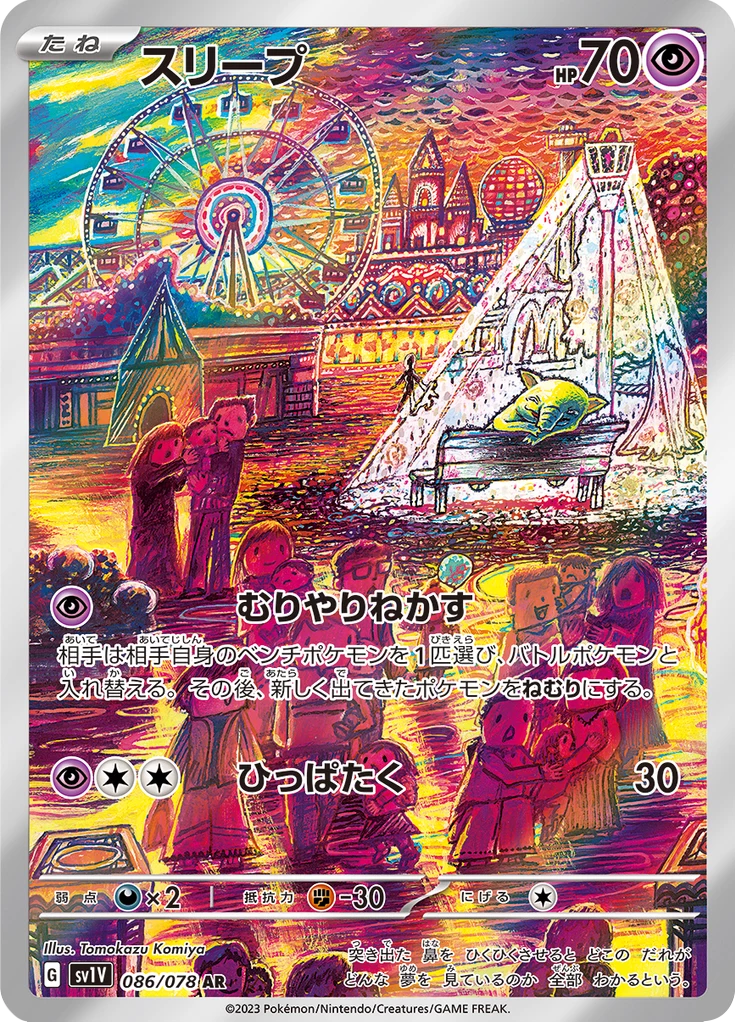
| Drowzee, AR | Scarlet & Violet (210) | Illustration Rare | Sold out at the time of this update |
| Baxcalibur, AR | Paldea Evolved (210) | Illustration Rare | Sold out at the time of this update |
| Galarian Slowking V | Chilling Reign (179) | Ultra Rare | Sold out at the time of this update |
| Karrablast, AR | Black Bolt (94) | Illustration Rare | Sold out at the time of this update |
Komiya did not illustrate the Pokemon 151 Psyduck, Charmander, Snorlax, Squirtle or Pikachu ARs; his Pokemon 151 cards are the Gastly, Haunter and Gengar line (92–94). We don’t currently hold graded examples of those either.
The JP print pictured above (Drowzee, SV1V 086/078 AR) is from Violet ex; see the full Violet ex (SV1V) card list for every print in the set.
Because we don’t hold a copy to ship immediately, a Komiya request works differently from a listing that’s currently in our catalog: we track down and confirm a graded copy before it’s added to a listing. That process starts with a request on our Quick Order page, where you can flag any of the cards above and we’ll confirm availability and next steps.
If you’re interested in artists working in unconventional techniques rather than standard illustration, our Yuka Morii guide covers another Pokemon TCG illustrator built around a distinctive, non-traditional method. For a wider look at how the game’s most recognized artist compares, our Mitsuhiro Arita guide is a useful counterpoint.
Requesting a Komiya Card from Japan
We source and ship Japanese Pokemon cards and sealed product from Tokyo. For an illustrator like Komiya, where we don’t hold graded stock on hand, the process runs through a direct request rather than an existing listing:
- Flag which Komiya card you’re after — the Pokemon 151 Gastly/Haunter/Gengar line, the Paldea Evolved Baxcalibur, the Chilling Reign Galarian Slowking V, the Black Bolt Karrablast, or any other verified print — on our Quick Order page.
- Browse our current PSA 10 card list for graded cards from other illustrators that are currently listed, or the full PSA 10 collection.
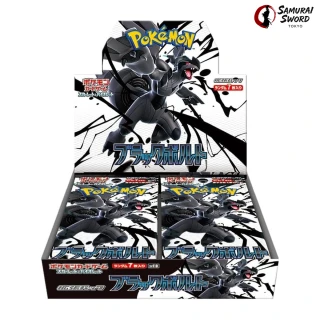
- For Black Bolt sealed product, see the Black Bolt card list or the Black Bolt booster box listing above.
- If you’re comparing artists working in similarly unconventional styles, our Amelicart guide covers another sourcing-only illustrator profile built the same way — catalog, notable cards, and current listing status.
For more illustrator profiles, see our guides to Yuka Morii, Mitsuhiro Arita, sowsow, and 5ban Graphics.
Frequently Asked Questions
Who is Tomokazu Komiya?
Tomokazu Komiya is a Japanese illustrator born in 1973. Bulbapedia credits Komiya’s Pokemon Trading Card Game work to the Primitivism art movement, and the illustrator’s TCG debut dates back to Japan’s early Expansion Sheet 1 vending-card series, with an English-language debut on Neo Genesis.
What is Tomokazu Komiya’s art style called?
Bulbapedia describes Komiya’s Pokemon TCG work as Primitivism, an art movement drawing on prehistoric, tribal, or children’s-art themes. In practice this means “deformed and loosely colored images” with exaggerated facial and bodily proportions and vibrant, contrasting color choices, per Bulbapedia.
When did Tomokazu Komiya start illustrating Pokemon cards?
Komiya’s first Pokemon TCG artwork appeared in Japan’s Expansion Sheet 1, part of the early vending-machine card series. The English-language debut came later, on the Neo Genesis expansion.
Do you currently have any Tomokazu Komiya PSA 10 cards?
Not currently. We don’t hold a graded Komiya card in inventory. Flag the card you want on our Quick Order page and we’ll confirm sourcing and availability.
What is the Pokemon × Van Gogh Museum collaboration?
In 2023, Pokemon partnered with the Van Gogh Museum on a licensed collaboration. Komiya contributed illustrations of Sunflora and Smeargle reinterpreted through specific Van Gogh masterworks. This is separate from the “Pikachu with Grey Felt Hat” promo card from the same partnership, which carries a different illustrator credit.
Which Pokemon 151 cards did Komiya illustrate?
Komiya illustrated the Gastly, Haunter, and Gengar line in the Pokemon 151 (MEW) set, at card numbers 92 through 94. These are different cards from the set’s widely traded Psyduck, Charmander, Snorlax, Squirtle, and Pikachu alternate-art rares, which have different illustrator credits.
Picked for this article


📩 Get member-only sale alerts & coupons
Sale alerts, coupons and restock notices by email — straight from Tokyo.