
A card with a printing mistake sounds like the last thing a collector would want. In the Japanese secondary market, it isn’t that simple — sometimes it’s the corrected version, not the error, that turns out harder to find.
This is not a long list of famous misprints. Most of what circulates online about Japanese error cards — a smudged corner here, a “rare stamp” there — traces back to nothing more than forum folklore with no primary source behind it. We deal in Japanese sealed product and graded singles out of Tokyo every week, and the one Japanese printing error we can document against a primary source is a single card: Sylveon EX 026/032 from the CP3 Pokekyun Collection Concept Pack. This guide uses that documented case to explain how error cards are actually classified, why “error” does not automatically mean “valuable,” and what to check before anyone pays a premium for one.
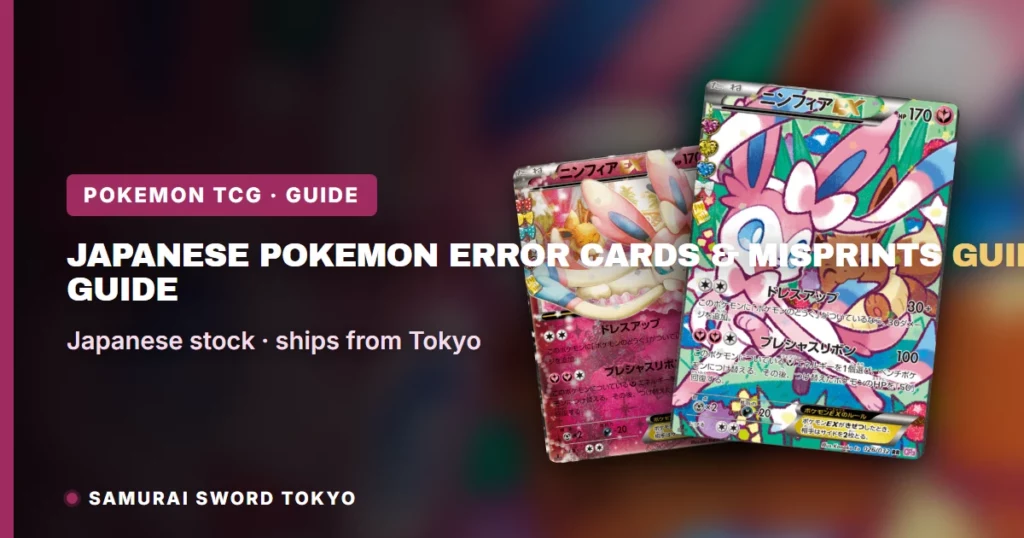
The CP3 Sylveon EX 026/032 (Kanako Eo illustration) has a documented printing error — a white dot where a second Energy symbol should sit. A corrected print run exists too, and it is the corrected version that is harder to find, not the error. Treat any other “famous Japanese error card” claim you see online as unverified until it points to a primary source.
Prices below are our own current PSA10 listings, checked August 13, 2026, converted at ¥163/USD where noted. Stock moves throughout the day — treat every figure as “currently listed,” not a guaranteed count.
What Actually Counts as an “Error Card”?
The general classification collectors use for error cards splits into a handful of buckets, and most “famous misprint” claims online fail to specify which one they actually mean:
- Printing or manufacturing errors — ink that failed to lay down, holofoil that shifted out of position, or color that ran off-register during the press run.
- Design errors — a mistake baked into the artwork or layout itself, such as an illustration element placed incorrectly or an Energy symbol missing from where it should print.
- Text errors — typos, formatting slips, or incorrect numbers printed on the card.
- Registration errors — misalignment in printed values like Energy cost or HP, where the layers of the print job don’t line up.
There is also a distinction worth flagging before going further: some design errors get caught and fixed within the same print run, producing what’s generally referred to as a “corrected” version alongside the original error copies. That is exactly the pattern behind the CP3 case below.
One general tendency worth knowing: on Japanese holofoil cards with an Evolution box in the corner, the holo pattern was designed in a way that overlaps the bottom of that box on a broad range of printings. That’s a widely shared design quirk of the era rather than a defect specific to any one card, and it’s a different thing from the documented printing error covered below.
The Documented Case: CP3 Sylveon EX 026/032
Pokekyun Collection — CP3 — is a Japanese Concept Pack from the XY BREAK era: four cards per pack, every card holo, released in January 2016. The set gives two Pokemon, Flareon and Sylveon, two separate EX slots each, illustrated by different artists. Only one of those four cards carries a documented printing error — the 026/032 Sylveon EX, illustrated by Kanako Eo. The other Sylveon EX slot, 025/032 (illustrated by sui), has no reported issue.


The error itself: on early Japanese copies of the 026/032 full-art print, there is a white dot printed where a second Energy symbol should have appeared. A corrected print run followed, believed to come from a second printing that also included the promotional Pikachu and Psyduck cards bearing the Pokekyun Collection logo. That corrected version was distributed only through single or double-pack blisters sold at Pokemon Center Japan during the set’s release window — a narrower distribution channel than the general Concept Pack release.
We currently don’t have the 026/032 Error version in our own stock — it’s currently out of stock, last listed at ¥456,610. If you’re chasing this specific printing, our full Pokekyun Collection CP3 value guide covers all 32 cards in the set with current pricing, including the artist-pair structure that explains why this small Concept Pack spans such a wide price range.
Error vs Corrected: Which One Is Actually Rarer?
The intuitive assumption is that the error copy is the rare one — it’s the “mistake,” so surely fewer of them exist. The CP3 case shows the opposite. The error print came from the set’s general release, distributed through the standard Concept Pack channel. The corrected print, by contrast, only reached collectors through Pokemon Center Japan blister packs during the release window — a narrower, more limited distribution than the general error copies ever had. That makes the corrected 026/032 the harder card to track down, not the error.
This isn’t unique to Japan as a pattern, even if the documentation for Japanese sets is thinner. A comparable dynamic shows up in vintage English-language and Portuguese-language Pokemon printings, where a corrected unlimited Blaine’s Charizard from Gym Challenge is considered rarer and more sought-after than the original error version — the reverse of what most people assume walking in. We’re citing that as a parallel pattern from a different market, not as a Japanese example; the CP3 case above is the one we can stand behind for Japanese sets specifically.
Buy based on documented distribution, not on the word “error” in a listing title. On CP3 specifically, the corrected print’s smaller distribution window is what drives its scarcity — not the mistake itself.
The honest summary for Japanese sets as a whole: documented examples of Japanese printing errors are rarer than the ones cataloged for vintage English printings, simply because far fewer Japanese misprints have been traced back to a verifiable source. That scarcity of documentation is a separate thing from the scarcity of the cards themselves, and the two get conflated constantly in online discussion.
Misprint vs Errata: Don’t Confuse the Two
A separate category shows up constantly in the same conversations as printing errors, and it’s worth separating out: errata. Cards like PlusPower, Energy Retrieval, Brock’s Ninetales, Lt. Surge’s Electrode, and Slowking all have documented errata — official corrections to their printed rules text or effect wording. That’s a rules-and-rulings issue, decided after release, not a physical printing mistake caught on the press. An errata’d card usually still looks and prints exactly as intended; what changed is how it’s ruled to function in play.
Printing errors and misprints, by contrast, are physical: a symbol that didn’t print, foil that shifted, ink that failed. If a listing describes a card as an “error” but is really describing a rules correction, it’s describing errata — a different collecting category with a different reason to matter.
Buying Japanese Error Cards: What to Check
With only one documented Japanese case to work from, the practical buying advice is narrower than a typical guide, but it holds regardless of which set a claimed error comes from:
- Confirm the card number and illustrator, not just the Pokemon name. On CP3, the error sits specifically on 026/032 (Kanako Eo). The 025/032 slot (sui) is a different card entirely, even though both are called “Sylveon EX.”
- Ask for the source behind the claim. If a seller describes a card as a documented error, that claim should trace back to something verifiable — not just a description copied from another listing.
- Don’t assume authenticity from the presence of a printing quirk. A genuine printing variant and a counterfeit card are two completely different things, and one doesn’t rule out the other. Our guide to spotting fake Japanese Pokemon cards covers authentication separately from printing-variant identification.
- Check for a 1st Edition stamp separately from the error question. CP3 also carries 1st Edition (1ED) stamped copies as its own, unrelated collecting angle — see our Japanese 1st Edition cards guide for how that stamp works across Concept Packs.
Where to Buy CP3 and Other Japanese Concept Pack Singles
The 026/032 Error version itself isn’t something we always have in stock, but the wider CP3 lineup moves through our Tokyo listings regularly, including the artist-pair Flareon EX cards and the set’s more accessible commons and uncommons.
| Card | CP3 # | Current price |
|---|---|---|
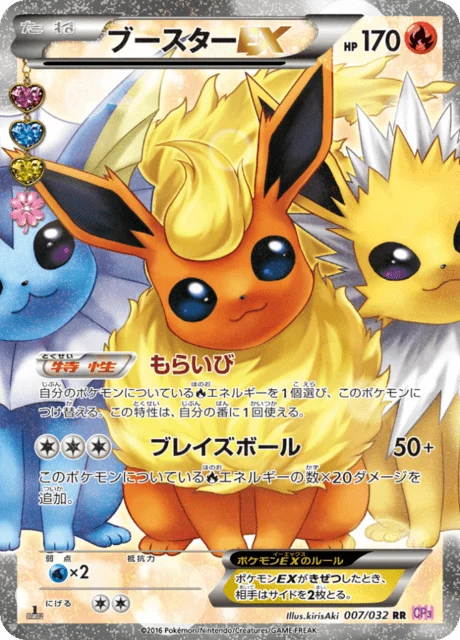
| Flareon EX RR (kirisAki) | 007/032 | currently listed at ¥804,388 (update: currently sold out — restock requests via Quick Order) |
| Flareon EX RR (Nishida) | 006/032 | currently listed at ¥154,397 |
| Jirachi U | 015/032 | currently listed at ¥36,874 (update: currently sold out — restock requests via Quick Order) |
| Charmeleon C | 004/032 | currently listed at ¥32,164 (update: currently sold out — restock requests via Quick Order) |
| Charmander C | 003/032 | currently listed at ¥31,258 (update: currently sold out — restock requests via Quick Order) |
| Altaria U | 029/032 | currently listed at ¥31,106 (update: currently sold out — restock requests via Quick Order) |
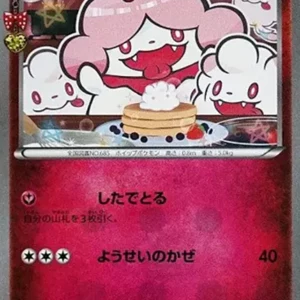
| Slurpuff U | 024/032 | currently listed at ¥25,750 |
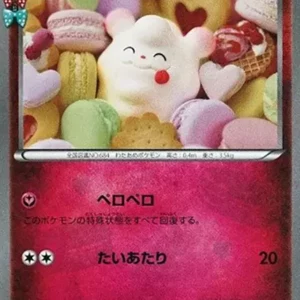
| Swirlix C | 023/032 | currently listed at ¥15,450 |
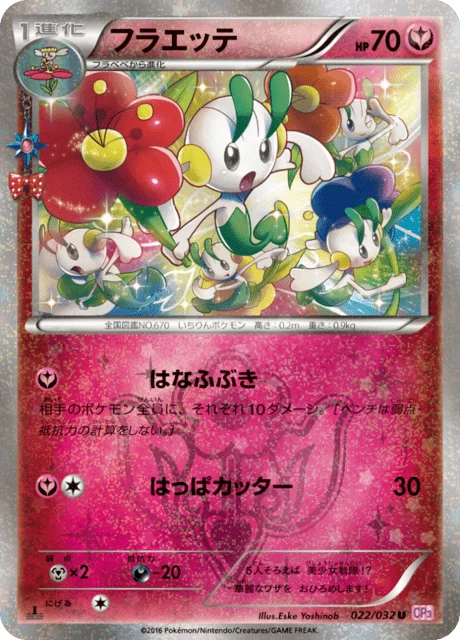
| Floette U | 022/032 | currently listed at ¥15,429 (update: currently sold out — restock requests via Quick Order) |
View Product → (update: currently sold out — restock requests via Quick Order)
For the 026/032 Error version specifically, or any other single not currently listed, our Quick Order page is the fastest way to request it directly. For the wider Japan-exclusive card landscape beyond CP3, see our companion Japan-exclusive Pokemon cards guide.
Frequently Asked Questions
What is the CP3 Sylveon EX error card?
It’s Sylveon EX 026/032 from the Pokekyun Collection (CP3) Concept Pack, illustrated by Kanako Eo. Early Japanese copies have a documented printing error — a white dot where a second Energy symbol should have printed. The other Sylveon EX in the set, 025/032 (sui illustration), has no reported issue.
Is the error version or the corrected version of Sylveon EX more valuable?
The corrected version is the harder one to find. It came from a later print run distributed only through Pokemon Center Japan blister packs during the set’s release, a narrower channel than the general error copies. The intuitive assumption — that the “mistake” copy is the rare one — is backwards here.
How can I tell if my Sylveon EX 026/032 is the error or the corrected print?
Check next to the Precious Ribbon attack’s Energy cost, where the second Energy symbol should appear on the full-art print. A white dot in that position is the documented error; a properly printed Energy symbol is the corrected version.
Are all Japanese printing errors valuable?
No. Value depends on documented distribution, not on the word “error” itself. Most claimed Japanese error cards circulating online have no primary source behind them, and even where a genuine error exists, the corrected version can end up scarcer than the error, as with the CP3 Sylveon EX case above.
500 Points Free on Sign-Up
CREATE FREE ACCOUNT1 pt = ¥1 at checkout · Points expire 30 days after they are earned · Import duties, taxes and customs charges are not included in the price and are collected on delivery, except for destinations we ship duty-paid.
Picked for this article
📩 Get member-only sale alerts & coupons
Sale alerts, coupons and restock notices by email — straight from Tokyo.