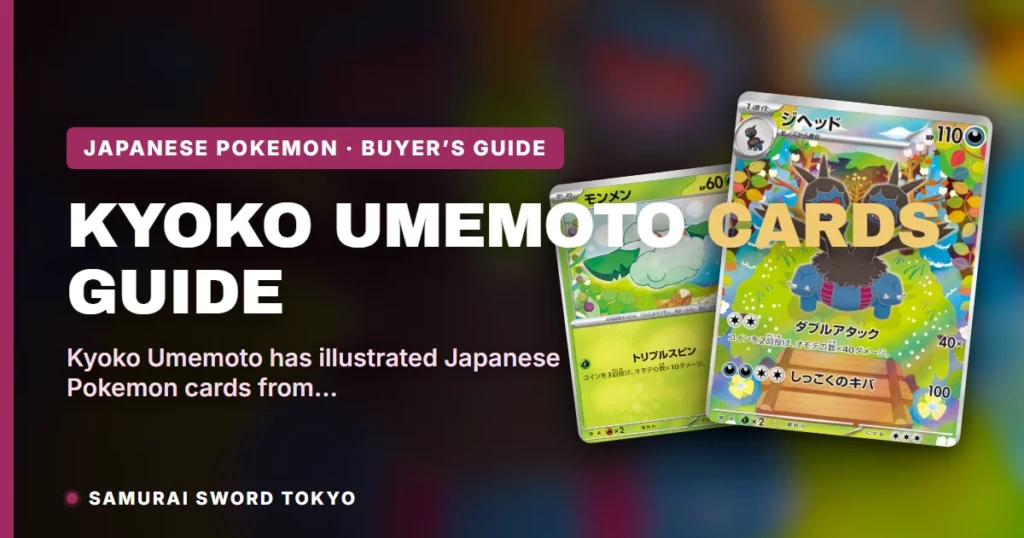
Kyoko Umemoto’s Pokemon TCG credit stretches back to the Japanese VS series in 2001, and it hasn’t stopped — Serebii’s Cardex still lists Umemoto’s work through the White Flare, Black Bolt, and Destined Rivals period. That’s a credited run that predates most of the set codes collectors use today.
Serebii’s Cardex tallies 179 cards under Umemoto’s credit, counting reprints, and the Limitless TCG database independently returns 177 hits on a Japanese-language artist search for the same name. This guide walks through what’s actually documented about that run — the 2001 origin point, the current Scarlet & Violet-era prints, and the rarity range in between — using only what Limitless and Serebii show on the record. We ship Japanese sealed product out of Tokyo every week, so where a card’s set is available to us as sealed booster boxes, we’ve linked it below.
No verifiable biographical details are publicly documented for Kyoko Umemoto beyond this TCG credit history, so this guide covers documented card and career work only — no invented backstory, no assumed pronouns.
Kyoko Umemoto has been credited on Japanese Pokemon TCG prints since the 2001 VS series — 179 cards per Serebii’s Cardex (counting reprints), with 177 separate hits on Limitless TCG’s Japanese-language artist search. The most recent confirmed print in this guide is Zweilous AR (SV11W 143/086) from White Flare, released 2025-06-06. We don’t carry single Umemoto-credited cards in stock, but the sealed White Flare Booster Box is currently listed at ¥20,800〜, and singles requests run through Quick Order.
Card and set details below are drawn from Limitless TCG’s individual card pages and Serebii’s artist Cardex, cited throughout. Sealed booster box prices reflect our own catalog as of August 2026, converted at ¥163/USD.
Who Is Kyoko Umemoto?
Kyoko Umemoto is a credited illustrator for the Japanese Pokemon Trading Card Game, per Serebii’s Cardex, with a documented run that begins in the VS series (2001) and continues into current Scarlet & Violet-era sets. Limitless TCG’s artist search independently returns 177 hits under the “Kyoko Umemoto” credit on Japanese-language cards, and Serebii’s own tally — which counts reprints across the card’s full print history — puts the number at 179.
Those two figures measure overlapping but not identical things: Serebii’s 179 counts every printing a given illustration has appeared in, including reprints, while Limitless’s 177 reflects distinct Japanese-language card pages returned by an artist-name search. They describe the same body of work from two different angles rather than two different totals to be added together.
No publicly documented biographical information exists for Kyoko Umemoto beyond this credit history — no verifiable birth year, studio affiliation, or outside commission work turned up in either source. This guide sticks to what’s on the record: the cards themselves, and where they sit in the TCG’s print history.
That’s a deliberately narrower approach than some illustrator profiles can take. Where a source documents a birth year, a picture-book bibliography, or an outside art-world collaboration, that belongs in the record. Where it doesn’t, the honest version of the profile is the card catalog on its own — which, at 179 credited prints across 24 years, is substantial enough to stand alone.
For readers comparing artists across our illustrator series, Umemoto’s catalog sits alongside Naoyo Kimura and Mitsuhiro Arita — both with dedicated guides covering their own most notable printings.
A Credited Run That Starts in 2001
Serebii’s Cardex lists Umemoto’s earliest credited appearance in the Japanese VS series, which released in 2001 — placing the start of this credit near the beginning of the Japanese TCG’s modern print history. From there, Serebii’s own record carries the credit forward continuously into the White Flare, Black Bolt, and Destined Rivals period, which is the most recent set era reflected in that same Cardex entry.
Serebii’s Cardex describes Umemoto as “one of the longest-serving artists” working in the Japanese Pokemon TCG — that characterization comes directly from Serebii’s own entry, not an editorial claim made independently here. Given the 2001-to-current span the same source documents, it’s a description the record supports.
Neither Serebii nor Limitless names which specific VS-series cards belong to Umemoto’s earliest credits beyond the set-level statement above, so this guide doesn’t attempt to list individual 2001-era card numbers — the point that matters for collectors is the length of the run itself, not any single card from it.
What a 2001-to-current credit does tell you, in practical terms, is that Umemoto’s work isn’t tied to one specific card generation or set family. A collector who only knows the White Flare-era prints below and one who only knows a much older VS-series card would both be looking at the same illustrator credit, decades apart. That continuity is unusual enough among Japanese TCG artist credits that it’s worth stating plainly rather than assuming.
The Modern Catalog: White Flare and Beyond
Limitless TCG’s Japanese-language database confirms Umemoto’s credit on a run of current-era prints, each verified on its own individual card page rather than a substring match on the artist search results.
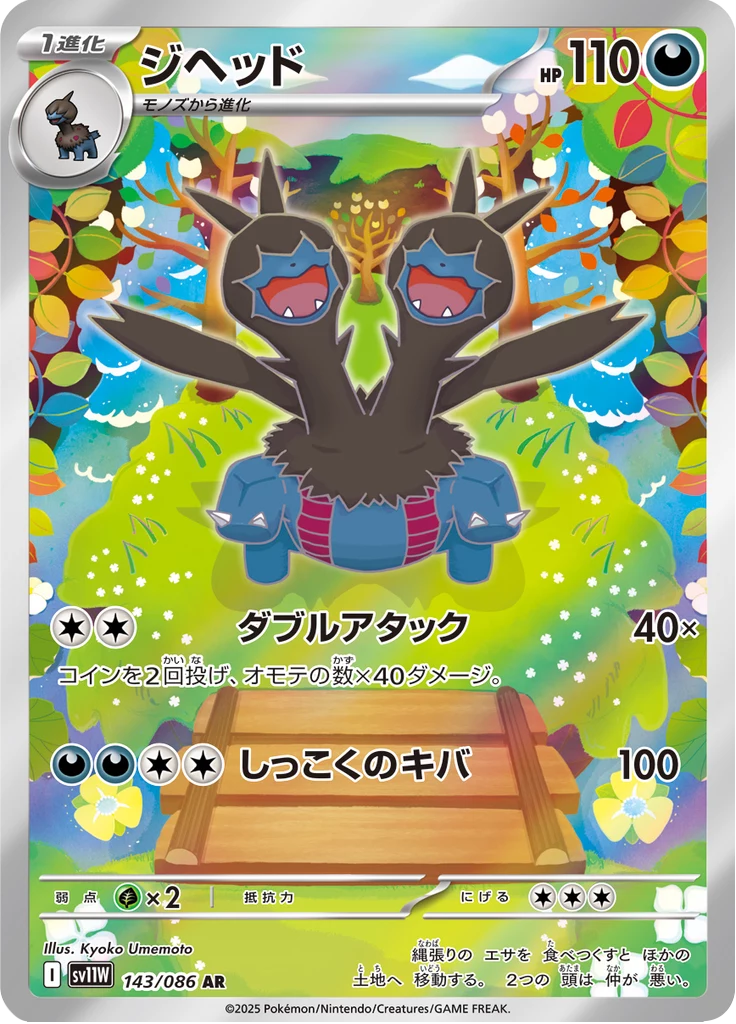
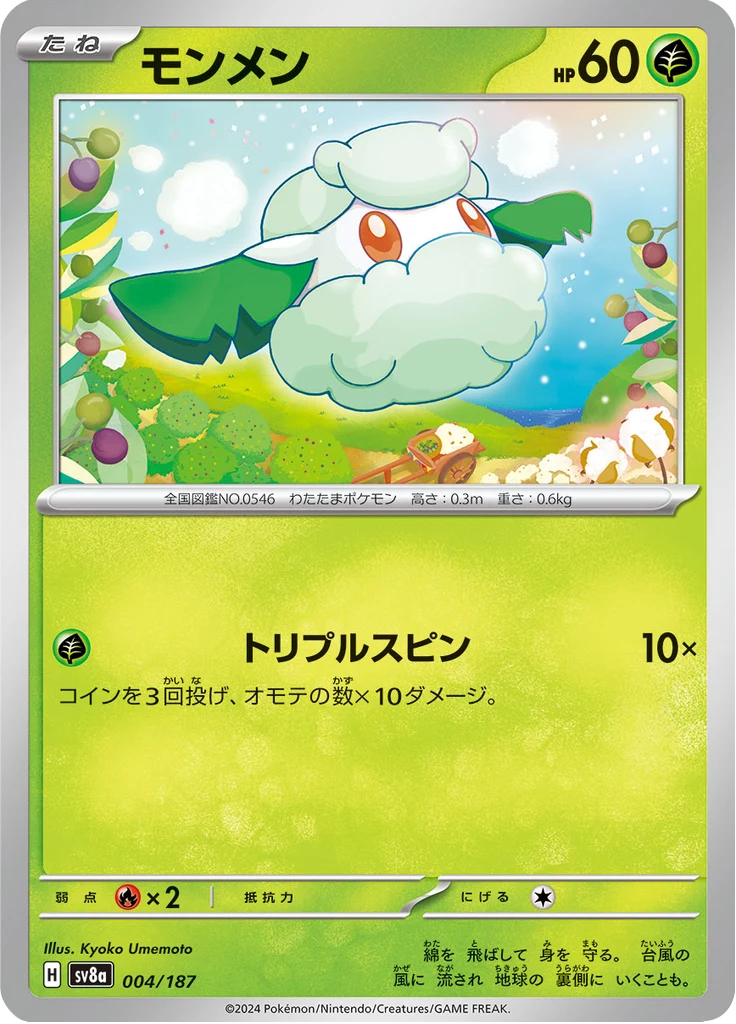
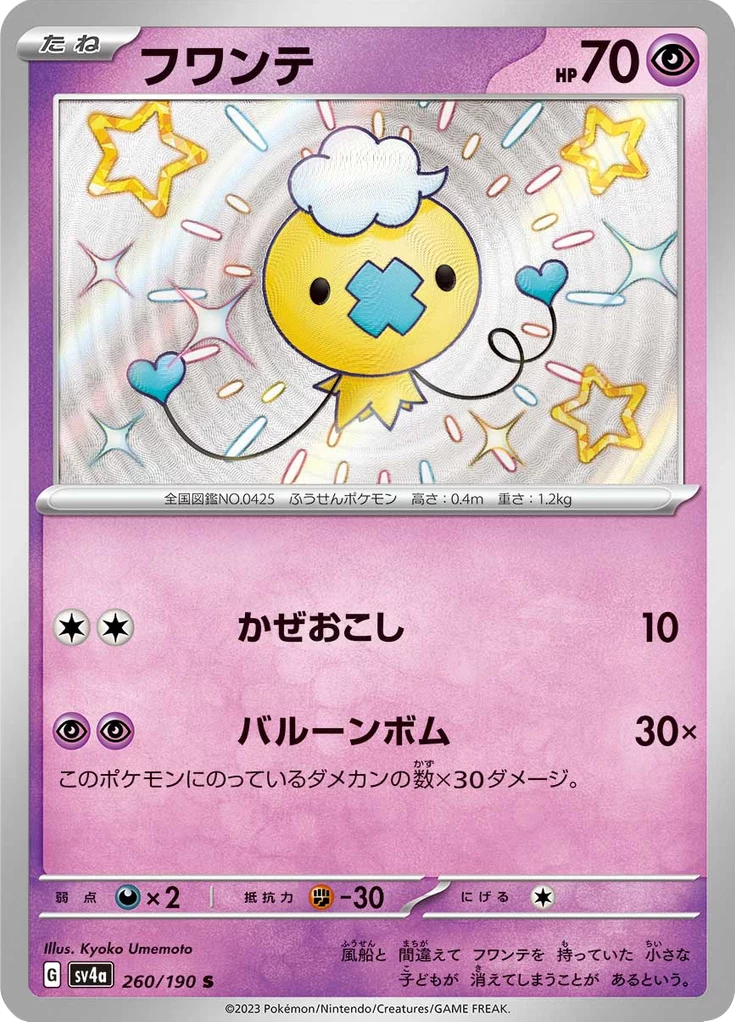
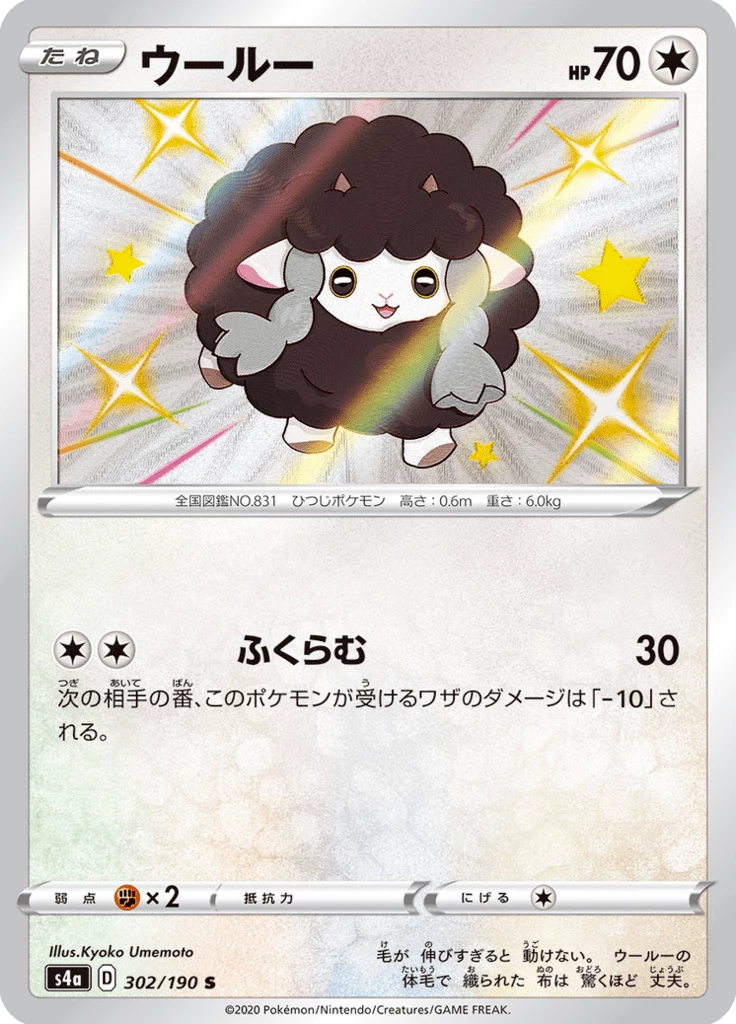
The Zweilous AR from White Flare (SV11W 143/086, released 2025-06-06) is the most recent confirmed print in this catalog and anchors the current-era end of Umemoto’s run. Cottonee from Terastal Festival ex (SV8a 4/187, released 2024-12-06) carries no printed rarity code — it sits in the set’s standard high-class-pack slot rather than a named rarity tier. Both Drifloon (SV4a 260/190, Shiny Treasure ex, 2023-12-01) and Wooloo (S4a 302/190, Shiny Star V, 2020-11-20) are Shiny Rare prints — the color-swapped treatment the Japanese TCG uses across multiple sets, confirmed on each card’s individual Limitless page.
Every card in this section and the table below was checked on its own Limitless TCG card page in addition to appearing in the artist search results, so the credit isn’t resting on a search-index match alone.
| Card | Set (JP code) | Number | Rarity | Year |
|---|---|---|---|---|
| Zweilous | White Flare (SV11W) | 143/086 | AR | 2025 |
| Cottonee | Terastal Festival ex (SV8a) | 4/187 | — | 2024 |
| Drifloon | Shiny Treasure ex (SV4a) | 260/190 | Shiny Rare | 2023 |
| Wooloo | Shiny Star V (S4a) | 302/190 | Shiny Rare | 2020 |
| Gossifleur | Shiny Star V (S4a) | 209/190 | Shiny Rare | 2020 |
| Beheeyem | Miracle Twin (SM11) | 37/094 | U | 2019 |
If you’re following the current Scarlet & Violet-era side of this catalog specifically, our White Flare set guide and Terastal Festival ex set guide cover the sets that produced the Zweilous and Cottonee prints above.
From Common to AR: The Rarity Range in Umemoto’s Catalog
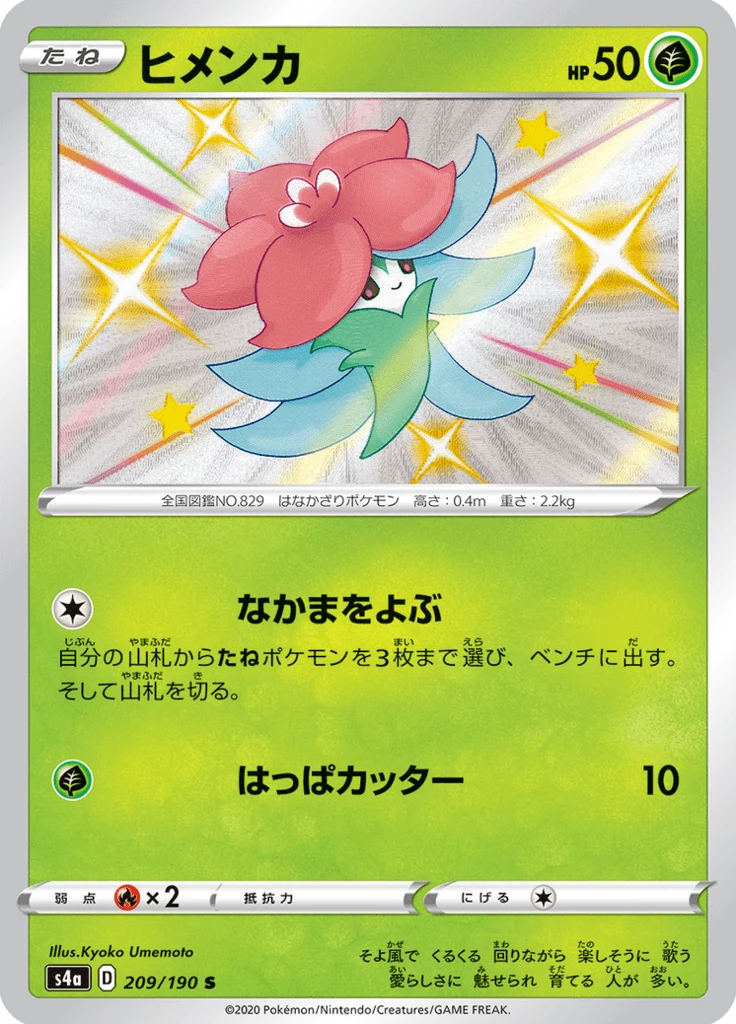
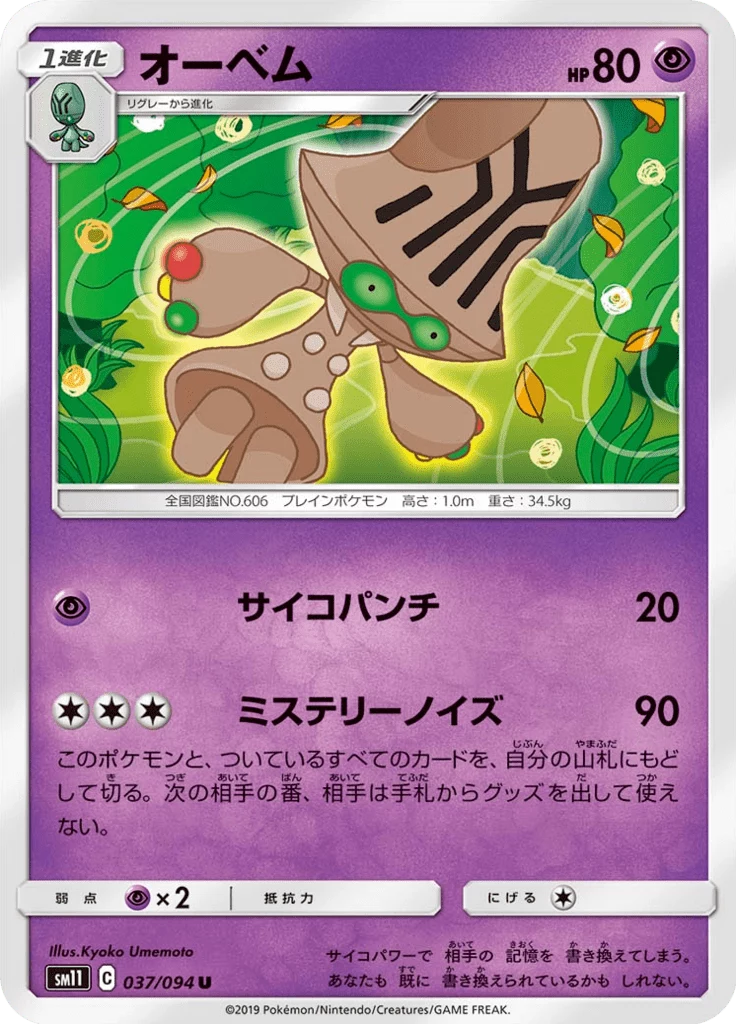
Gossifleur (S4a 209/190, Shiny Star V, 2020-11-20) is the second Shiny Rare confirmed in this catalog from the same 2020 set as Wooloo above — both color-swapped prints released in the same Shiny Star V print run. Beheeyem (SM11 37/094, Miracle Twin, released 2019-05-31) sits at the opposite end of the rarity scale: a plain Uncommon print from the Sun & Moon era, and the oldest specifically-dated card confirmed in this guide.
Reading the six confirmed cards together, Umemoto’s documented catalog spans from an Uncommon common-slot print through Shiny Rare and AR treatments — not concentrated in any single rarity tier. For readers interested in the Shiny Rare finish specifically, our shiny and super-rare cards guide covers that finish across multiple sets and artists.
That spread is worth flagging for a specific reason: an illustrator credit on its own doesn’t predict rarity tier. Two Shiny Star V prints from the same 2020 set, on the same artist credit, land at the same rarity band — but the 2019 Miracle Twin Uncommon and the 2025 White Flare AR sit five years and two rarity tiers apart under that same name. If you’re building a collection around a specific illustrator rather than a specific set, the card number and set code on the physical card are still what determine which print — and which price range — you’re actually looking at.
Sourcing Umemoto-Credited Cards Through Sealed Product
We checked Umemoto’s Japanese-language card credits against our current catalog directly, and the result is a sourcing case rather than a stock case: we don’t hold graded or raw Umemoto-credited singles in inventory as of this guide. What we do carry is sealed booster boxes for the sets that produced the cards above, which is the most direct route to opening one yourself.

For the other sets in this guide, sealed boxes are listed here:
- Terastal Festival ex Booster Box — currently listed at ¥19,760〜 (Cottonee)
- Shiny Treasure ex Booster Box — currently listed at ¥17,680〜 (Drifloon)
- Shiny Star V Booster Box — currently listed at ¥23,415 (Wooloo, Gossifleur)
- Miracle Twin Booster Box — currently listed at ¥199,500 (Beheeyem)
If a specific Umemoto-credited card from the table above is what brought you here rather than a full sealed box, the Quick Order page is the fastest way to flag a singles request. For a broader look at how graded versus raw copies compare once a specific card does turn up, our PSA 10 vs raw Japanese Pokemon cards guide walks through that decision.
Where to Buy Kyoko Umemoto Cards from Japan
We ship Japanese sealed product worldwide out of Tokyo with tracked delivery. For Umemoto’s catalog specifically, the White Flare box is the most current route, since it contains the newest confirmed print in this guide.
Browse the full card list for other current-era Japanese stock, or use our Quick Order page to request a specific Umemoto-credited single and build a mixed order of boxes and singles in one checkout.
Frequently Asked Questions
Who is Kyoko Umemoto?
Kyoko Umemoto is a credited illustrator for the Japanese Pokemon Trading Card Game whose documented run begins with the 2001 VS series and continues into the White Flare, Black Bolt, and Destined Rivals period, per Serebii’s Cardex. Serebii counts 179 cards under Umemoto’s credit including reprints; Limitless TCG separately returns 177 hits on a Japanese-language artist search.
How long has Kyoko Umemoto been illustrating Pokemon cards?
At least since 2001, when Umemoto’s earliest credited work appears in the Japanese VS series, per Serebii’s Cardex. That same source carries the credit forward continuously to the White Flare, Black Bolt, and Destined Rivals era — the most recent sets reflected in the entry — and describes Umemoto as “one of the longest-serving artists” in the Japanese TCG.
What cards has Kyoko Umemoto illustrated recently?
Confirmed recent prints include Zweilous AR (White Flare, SV11W 143/086, 2025), Cottonee (Terastal Festival ex, SV8a 4/187, 2024), and Drifloon Shiny Rare (Shiny Treasure ex, SV4a 260/190, 2023), each verified on its own Limitless TCG card page.
Is there a Shiny Rare Kyoko Umemoto card?
Yes. Drifloon (SV4a 260/190, Shiny Treasure ex), Wooloo (S4a 302/190, Shiny Star V), and Gossifleur (S4a 209/190, Shiny Star V) are all confirmed Shiny Rare prints under Umemoto’s credit.
Where can I buy Kyoko Umemoto Pokemon cards from Japan?
We don’t currently hold Umemoto-credited singles in stock, but we ship sealed booster boxes for the sets that produced them — including the White Flare box, currently listed at ¥20,800〜. Use our Quick Order page to request a specific single, or browse the full card list for other current-era Japanese stock.
Picked for this article


📩 Get member-only sale alerts & coupons
Sale alerts, coupons and restock notices by email — straight from Tokyo.