Every One Piece card carries a one-, two- or three-letter tag in the corner of its official listing: L, C, UC, R, SR, SEC. Together they make up the One Piece Card Game rarity ladder. There’s a seventh abbreviation too — TR — though it has only been confirmed on a single card so far, so don’t expect to see it often.
Bandai’s own card list doesn’t publish a glossary explaining what the letters mean. You learn the ladder by cross-referencing enough card entries, which is what this guide does for you: the six confirmed rarity tiers, the TR caveat, how the numbering on the card tells you where a card sits, and where community terms like “parallel” and “manga rare” fit once you’re past the printed rarities.
Bandai’s official cardlist uses six confirmed rarity abbreviations — L (Leader), C (Common), UC (Uncommon), R (Rare), SR (Super Rare), SEC (Secret Rare) — plus TR (Treasure Rare), which has been spotted on exactly one card so far. Secret Rares are always numbered at the tail end of a set’s base range, after every other card type. Sealed OP-17 The World’s Strongest Warriors boxes (update: currently sold out — restock requests via Quick Order) are currently listed at ¥12,505 (~$81) (update: currently sold out — restock requests via Quick Order) if you want to see the ladder for yourself.
- The OP-17 The World’s Strongest Warriors booster box (update: currently sold out — restock requests via Quick Order) is currently listed at ¥12,505 (~$81) (update: currently sold out — restock requests via Quick Order), and the ONE PIECE DAY ’25 Premium Card Collection at ¥27,284 (~$177).
- Set card lists are linked from our One Piece card list page.
- Sourcing requests for a specific card go through Quick Order.
Prices below are the September 29, 2026 listings; USD figures convert at ¥154/USD, approximate. Check the linked product page for the current figure rather than treating anything here as fixed.
The Official One Piece Card Game Rarity Ladder: L, C, UC, R, SR, SEC
These six abbreviations appear as tags on individual card entries in Bandai’s official card list (asia-en.onepiece-cardgame.com/cardlist/). There is no plain-English legend on that page — you read them off the cards themselves — but all six are confirmed as the abbreviations Bandai actually uses.
| Tag | Full name | What it is |
|---|---|---|
| L | Leader | The deck’s leader card — every deck has exactly one, and it is never a Character/Event/Stage rarity. |
| C | Common | The most numerous tier in any set — roughly a third of a typical set’s base cards. |
| UC | Uncommon | Second most numerous tier, sitting between Common and Rare. |
| R | Rare | Mid-tier pull, still a base-set card rather than a chase slot. |
| SR | Super Rare | Standard high-rarity slot. |
| SEC | Secret Rare | Official top printed rarity, numbered beyond the rest of the set’s card-type run (see below). |
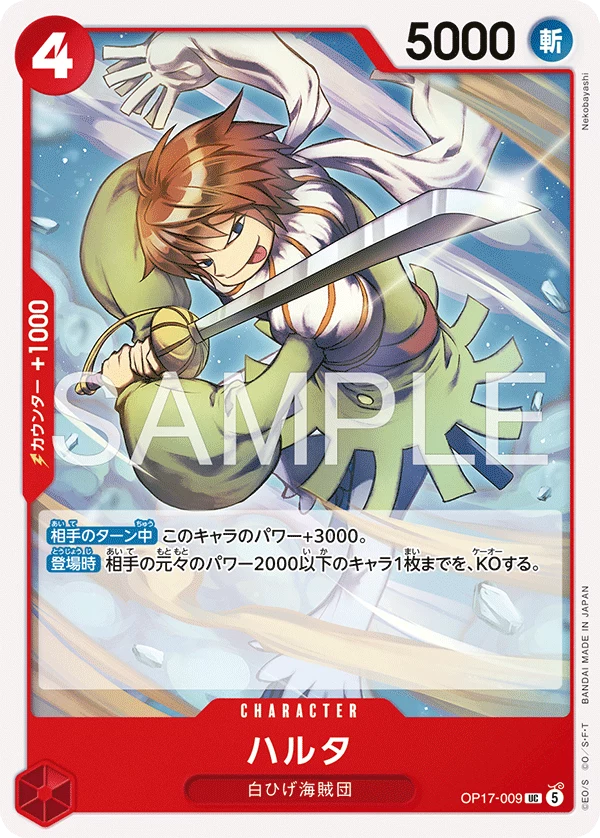
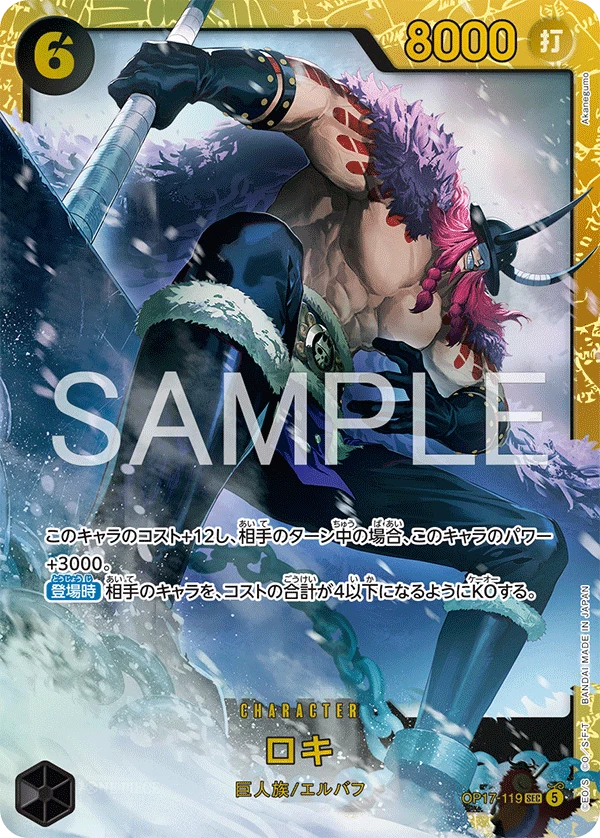
Bandai’s full official OP-17 card list confirms two Secret Rares in the set’s base numbering: Rocks D. Xebec (OP17-118) and Loki (OP17-119) — the last two cards in the set, exactly where the numbering rule further down predicts. Note the tag alone doesn’t tell you the print treatment — a Super Rare can also carry an alternate-art parallel version at the same rarity code, which is a separate thing from the six tiers above (more on that further down).
TR (Treasure Rare): One Confirmed Card, Not a Standard Tier
TR is a real abbreviation — it appears on Bandai’s official card list — but it is confirmed on exactly one card so far: Lucky.Roux, OP17-033 — and Bandai’s own OP-17 product page backs this up, listing “Treasure Rare: 1 type” in the set’s official rarity breakdown. That same card number also exists as a regular Rare (R) printing, which makes it a useful side-by-side example of how a parallel print can carry a different rarity code from its base version.
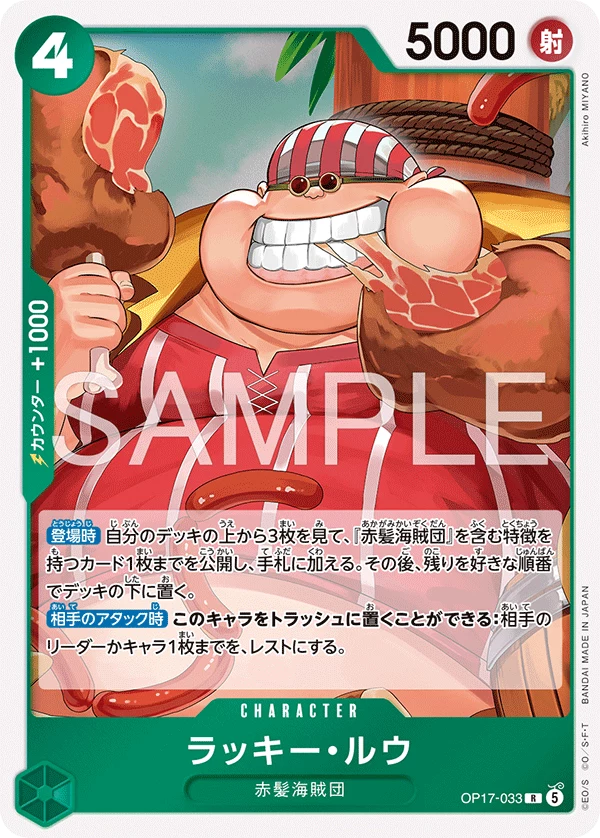
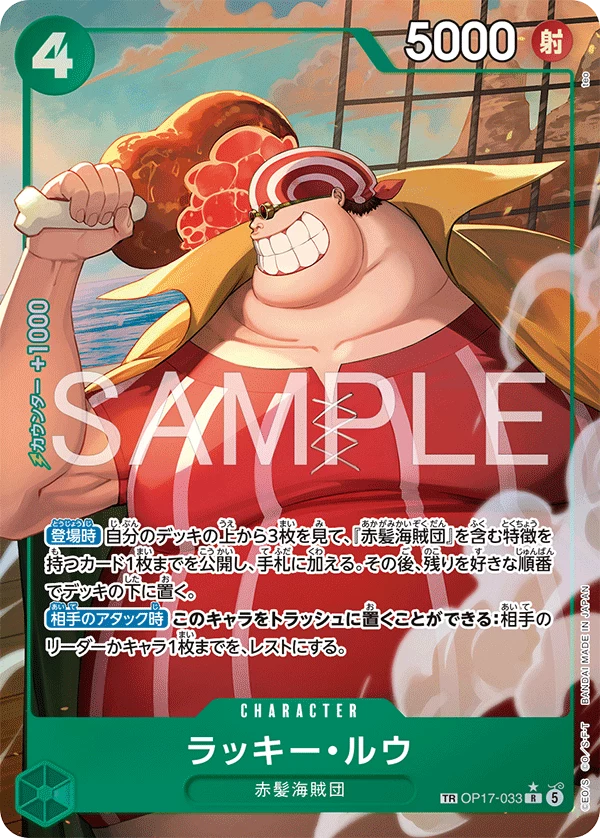
Do not assume TR is a recurring rarity you’ll find across every set, or even every box of OP-17. The only sighting confirmed so far is the Lucky.Roux parallel above. Treat it as an officially-used abbreviation, not yet a documented standard tier.
How Card Numbering Tells You Where a Card Sits
Every base card is numbered SET-### — for example OP16-045. That number is a genuine clue to rarity, because Secret Rares are consistently placed at the very end of a set’s base numbering, after every Leader, Character, Event and Stage card, rather than scattered through the print run by type.
A few confirmed examples from Bandai’s own numbering:
- OP-16 (The Time of Battle) runs OP16-001 through OP16-119. The set’s two Secret Rares, Portgas.D.Ace and Marshall.D.Teach, are numbered OP16-118 and OP16-119 — literally the last two cards in the set.
- OP-01 (Romance Dawn) runs to OP01-121. Its two Secret Rares, Shanks and Yamato, sit at OP01-120 and OP01-121.
- OP-13 (Carrying on His Will) runs to OP13-120, and its three Secret Rares — Luffy, Ace and Sabo — occupy OP13-118 through OP13-120.
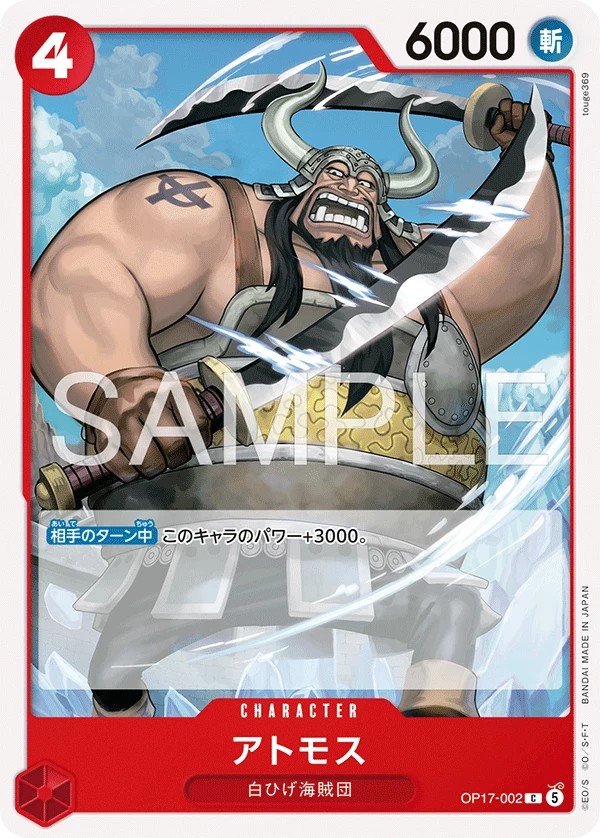
- OP-17 (The World’s Strongest Warriors) runs OP17-001 through OP17-119 per the official card list. Its two base-numbered Secret Rares, Rocks D. Xebec and Loki, sit at OP17-118 and OP17-119 — the last two slots, again.
Parallel printings (like the TR parallel above) work differently: they keep the same base number as their regular counterpart and are tracked as a separate print of that number, rather than getting a new number of their own. So a card number alone tells you which base slot a card fills; whether it’s a plain printing or a parallel is a separate question, answered by the rarity tag and print treatment, not the number.
What the Ladder Looks Like in a Real Set
To put the six tiers into proportion, here’s the confirmed rarity breakdown for OP-16 (The Time of Battle, 119 base cards) — a representative recent-size set:
| Rarity | Cards in OP-16 |
|---|---|
| Leader (L) | 6 |
| Common (C) | 45 |
| Uncommon (UC) | 30 |
| Rare (R) | 26 |
| Super Rare (SR) | 10 |
| Secret Rare (SEC) | 2 |
Commons and Uncommons make up nearly two-thirds of the set between them; Secret Rares are a rounding error by comparison — just 2 of 119 cards. That ratio (45 Common / 30 Uncommon / 26 Rare / 10 Super Rare / 2 Secret Rare, plus 6 Leaders) has repeated closely across most numbered OP sets, though set size has grown in places — OP-14 and OP-15 both run to roughly 150 base cards rather than 119. OP-17’s official list lands back on the classic shape: 119 base cards at 45 Common / 30 Uncommon / 26 Rare / 10 Super Rare / 6 Leader / 2 Secret Rare, with the product page also listing three Secret Rares in total because a comic-parallel version of an earlier Luffy SEC (EB04-061) is obtainable in OP-17 packs. For the full card-by-card list of any specific set, use our One Piece card list page, or see our OP-16 card list or the wider card list hub.
Where Parallels and “Manga Rare” Fit
Everything above is the printed rarity system. Above and alongside it sits a separate layer of alternate-art parallel prints — the same card number, usually with the same rarity code, redrawn in a different treatment. The TR parallel described earlier is the exception: it carries a different rarity code from its base Rare print. Community members refer to some of these parallel treatments by nicknames that never appear on the card or on Bandai’s site: “Manga Rare” (community-named, not an official Bandai rarity) describes a black-and-white, comic-panel alternate-art treatment, and the Japanese-market term for a related treatment is コミパラ (komipara), rendered in English as “comic parallel.”
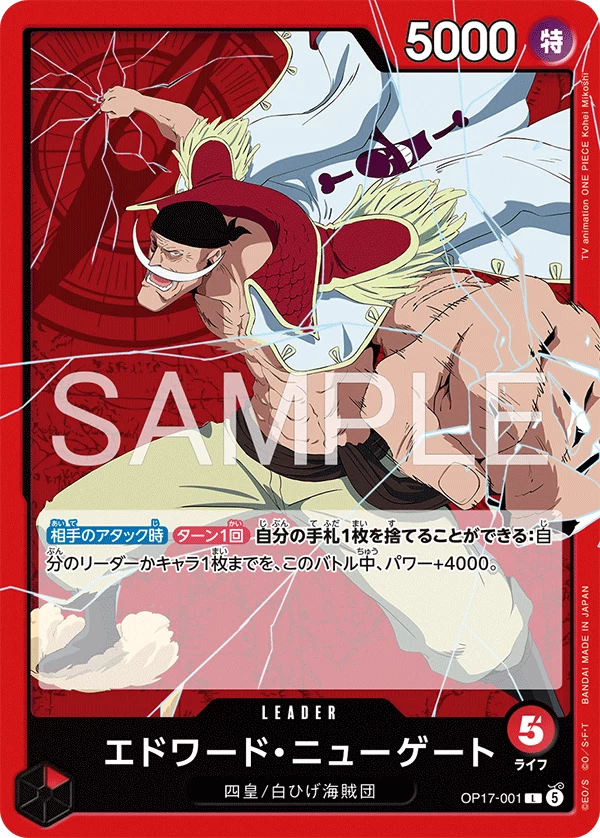
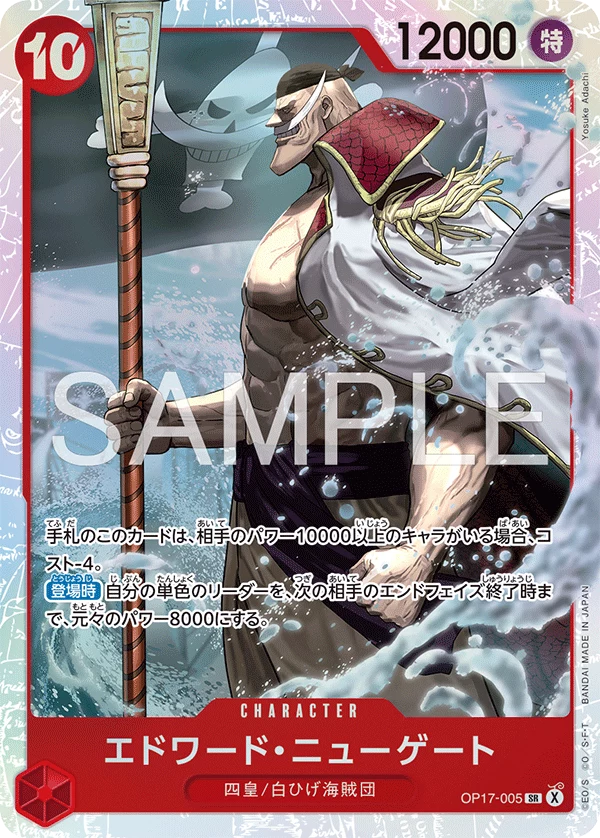
Edward Newgate’s OP17-005 — printed as an SR on the base rarity ladder — is confirmed as one of OP-17’s four manga-treatment cards, alongside Shanks (OP17-022), Kaido (OP17-062) and Charlotte Linlin (OP17-112).
Above the manga tier, OP-17 also introduced an even scarcer treatment reserved for exactly two cards. Both of these sit outside the scope of a beginner ladder — if you want the full mechanics of what separates SEC, manga treatments, and that scarcest tier from each other, our rarity-structure deep dive covers it, and our manga rare guide is dedicated entirely to that one tier. This article’s job is the printed ladder above it — L through SEC, plus the TR caveat.
Where to Buy One Piece Cards by Rarity
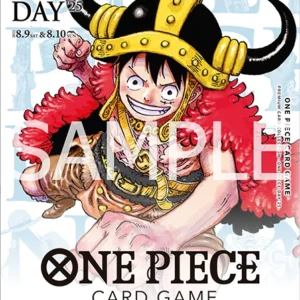
Sealed boxes are the standard route to cards across the rarity ladder for a given set. We currently list the OP-17 The World’s Strongest Warriors Japanese Booster Box (update: currently sold out — restock requests via Quick Order), currently listed at ¥12,505 (~$81) (update: currently sold out — restock requests via Quick Order), and the ONE PIECE CARD GAME Premium Card Collection – ONE PIECE DAY ’25, currently listed at ¥27,284 (~$177), both shipping from Tokyo.
Graded singles are a different route entirely: see our PSA 10 collection. If you’re hunting a specific card by number and rarity, sourcing requests go through our Quick Order page.
For the full run of sealed boxes across every numbered set, browse our One Piece card box collection, or jump to a specific set’s card-by-card breakdown via the One Piece card list page, the OP-17 card list, OP-01 card list, or the full card list hub.
Frequently Asked Questions
What are the official One Piece card rarity abbreviations?
Six are confirmed on Bandai’s official card list: L (Leader), C (Common), UC (Uncommon), R (Rare), SR (Super Rare) and SEC (Secret Rare). A seventh, TR (Treasure Rare), is also an official abbreviation but has only been confirmed on one card so far.
What is TR (Treasure Rare) and how common is it?
TR is an official Bandai rarity abbreviation, but it has only been confirmed once so far, on Lucky.Roux OP17-033, which also exists as a regular Rare printing. Don’t treat it as a standard tier present in every set.
Is “Manga Rare” an official rarity?
No. “Manga Rare” is a term the collector community uses for a black-and-white, comic-panel alternate-art treatment — it isn’t printed on the card or listed on Bandai’s card list. The Japanese-market term for a related treatment is コミパラ (komipara), rendered in English as “comic parallel.”
How can I tell if a card is a Secret Rare just from its number?
Secret Rares are consistently numbered at the very end of a set’s base range — for example OP16-118/119, OP01-120/121, or OP13-118 to 120 — after every other Leader, Character, Event and Stage card in that set. That placement is a reliable clue, though the rarity tag on the listing is the definitive source.
How many Secret Rares are typically in a set?
Usually two, based on the confirmed breakdowns for sets like OP-16 (2 of 119 base cards), OP-01 (2 of 121) and most numbered OP sets. A few sets run three — OP-13 and OP-15 both have three Secret Rares.
Picked for this article
📩 Get member-only sale alerts & coupons
Sale alerts, coupons and restock notices by email — straight from Tokyo.