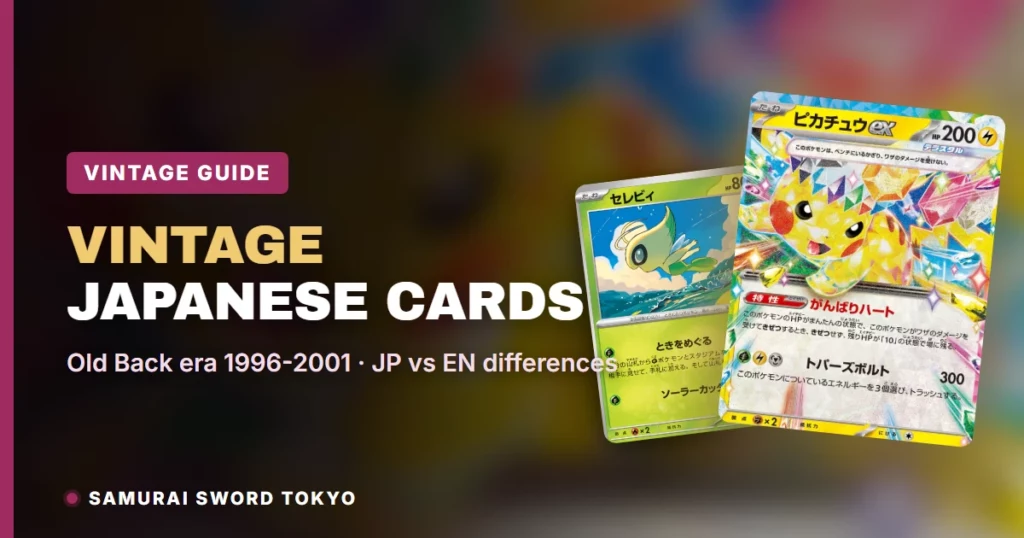
“Vintage” gets used loosely in this hobby. Ask five collectors what counts as vintage Japanese Pokemon cards — or as old Japanese Pokemon cards more generally — and you’ll get five different date ranges. There is, however, a specific and sourced window the hobby actually means when it says Old Back — and it’s narrower than most people assume.
This guide draws the line precisely: what counts as Old Back, why 1st Edition stamping works completely differently on Japanese cards than on English ones, which sets fall inside the window, and what condition and authenticity actually look like when you’re trying to buy or grade a card from this era.
Genuine Old Back vintage — the actual 1996–2001 window — is Japan’s Expansion Pack (October 1996) through the sets released just before Pokémon VS on July 19, 2001. Japanese cards did not carry a 1st Edition stamp at launch; that concept only began in 2001. Sealed Old Back booster packs are on our vintage Japanese Pokemon booster pack collection, including the Neo Genesis Old Back pack; sourcing requests for a specific vintage card go through Quick Order.
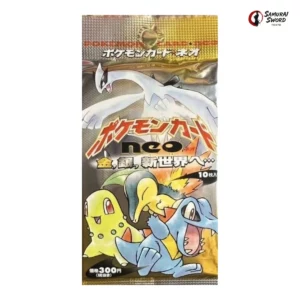
- The Neo Genesis Japanese Pokemon Booster Pack [neo1] (Old Back, 2000) is currently listed at ¥190,000 (~$1,234).
- Our sealed vintage packs are collected on the vintage Japanese Pokemon booster pack collection page.
- Sourcing requests for a specific vintage card go through Quick Order. USD figures convert at ¥154/USD, approximate.
- The October 7, 2026 update covers our store listings and prices only; the other facts in this article were last checked on September 29, 2026.
What Counts as Vintage: The Old Back Era
The Japanese Pokemon TCG launched in October 1996 with the Expansion Pack, a 102-card set. From there through the middle of 2001, every Japanese card used the same card back design — a dark blue print with a distinct Poké Ball graphic and Japanese copyright text running along the border. That back design is what the hobby calls “Old Back,” and it’s the cleanest, most objective marker for genuine vintage Japanese product.
The Old Back window ended on July 19, 2001, with the release of Pokémon VS — the set that introduced the new, more colourful back design that remains in use, and dropped the Japanese copyright text. Everything printed from Expansion Pack (October 1996) up to that VS release counts as Old Back vintage. Pokémon VS itself is the transition point: it’s the release that switched the back, so treat it as the boundary rather than squarely “old back.”
Our own site’s existing Old Back Japanese cards guide uses this same definition. Worth flagging directly: our separate vintage Japanese booster box guide covers Sun & Moon-era boxes from 2018–19 under the word “vintage” too — that’s a looser, “older/discontinued” use of the term, not this Old Back definition. If you see “vintage” elsewhere on our site referring to a 2018 box, that’s the other meaning. This article is specifically about the 1996–2001 Old Back window.
Japanese vs English Vintage: 1st Edition and the Shadowless Myth
English-language collectors bring two specific concepts into this hobby — 1st Edition stamps and “shadowless” — and both map onto Japanese cards very differently than most people expect.
1st Edition timing is backwards from what English collectors assume. On English cards, Wizards of the Coast started stamping “1st Edition” with Base Set in 1999 and continued through Neo Destiny, roughly a 1999–2003 window. The original 1996 Japanese Base Set-era cards had no 1st Edition stamp at all — the concept simply didn’t exist yet in Japan. Japanese 1st Edition stamping didn’t begin until 2001, with Pokémon VS and Pokémon Web, and it continued through Expansion Pack 20th Anniversary in 2016. So the earliest, most “vintage” Japanese cards (1996–2000) predate 1st Edition entirely — they’re not missing a stamp because they’re unlimited print runs, they’re missing it because the stamping system hadn’t launched yet.
The mark itself looks different too. The English stamp reads “1st Edition” in the lower-left of the artwork box. The Japanese mark is a large “1” over the word “EDITION” between two lines, positioned lower-right on Pokémon and Trainer cards.
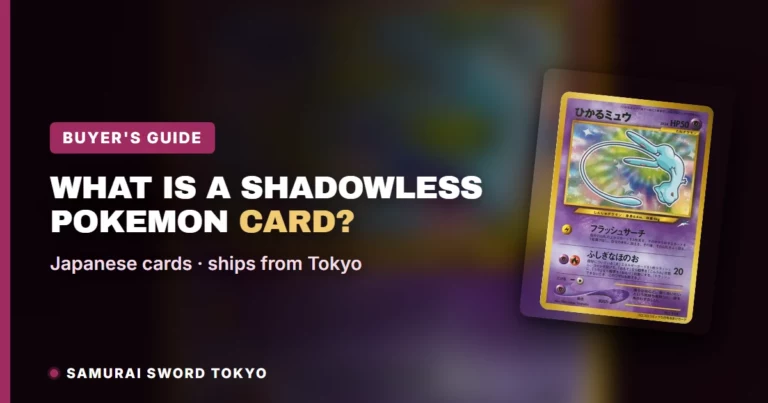
“Shadowless” is an English-print-only phenomenon — it refers to a specific print-run gap in the drop-shadow around the artwork box on early English Base Set cards, and it’s unrelated to 1st Edition stamping mechanics. It does not carry over to Japanese vintage cards the same way. The earliest Japanese cards (1996–2000) simply predate the Japanese 1st Edition concept entirely; they aren’t “shadowless Japanese cards” in the sense English collectors use the term. If a listing calls an early Japanese card “shadowless,” treat that as imported English terminology rather than a documented Japanese print variant.
Key Vintage Series, 1996–2001
Ten Japanese sets fall inside the Old Back window, across two eras:
| Era | Set | Release |
|---|---|---|
| Original / Expansion (1996–99) | Expansion Pack | October 1996 (102 cards) |
| Pokémon Jungle | March 1997 | |
| Mystery of the Fossils | June 1997 | |
| Rocket Gang | November 1997 | |
| Leaders’ Stadium | October 1998 | |
| Challenge from the Darkness | June 1999 | |
| Neo (2000–01) | Gold, Silver, to a New World… | February 2000 |
| Crossing the Ruins… | July 2000 | |
| Awakening Legends | November 2000 | |
| Darkness, and to Light… | April 2001 |
Pokémon VS (July 19, 2001, 141 cards) sits right after this list as the transition release — the last old-back-adjacent set before the back design changed. Pokémon Card web (October 2001) and everything from Base Expansion Pack (December 2001, the start of the e-Card era) onward use the modern back and are outside the Old Back window entirely.

Spotting an Old Back Card
The back design is the single most reliable identifier, and it changed exactly once in this window:
- Old Back (1996 – July 19, 2001): dark blue design, distinct Poké Ball graphic, Japanese copyright text along the border.
- Modern Japanese back (from Pokémon VS, July 19, 2001, onward): reads “Pokémon,” drops the copyright text, more colourful design overall.
One nuance worth knowing even after the 2001 redesign: the modern Japanese back still isn’t identical to the North American/European “International Back.” Collectors and hobby sources describe the Poké Ball’s “button”/opening as illustrated differently between the two. So Japanese and English backs are not the same, vintage or otherwise — the July 2001 change brought Japan closer to the international look, not fully in line with it.
Condition, Grading, and Authenticity Realities
The back design gives buyers a hard, verifiable print-date boundary — before or after July 19, 2001 — which is why collectors treat it as a fast first check on a vintage listing.
Authenticity matters more than condition scoring for cards this old. Our own Old Back Japanese cards guide discusses authenticity concerns specific to old-back Japanese Charizards, including 1996 Base-era Expansion Pack and 2001 Neo Destiny-era Shining prints — read that guide before buying a raw copy. For general fake-spotting guidance and Charizard-specific context, see our guide to spotting fake Japanese Pokemon cards and our ranked Charizard guide.
One concrete example of genuine Old Back product is a sealed Neo Genesis pack from the Neo era in the table above: the Neo Genesis Japanese Pokemon Booster Pack [neo1] (Gold, Silver, to a New World…, 2000, Old Back).
Where to Source Vintage Japanese Pokemon Cards
Be careful with “1ED” listings from this era in particular. A “1ED” tag also appears on modern Concept Pack and XY-era reprints from 2014–2016 that use the 1st-Edition-marking convention, over a decade after the true Old Back window closed. A “1ED” tag on its own does not mean a card is from 1996–2001; always check the back design and set, not just the stamp.
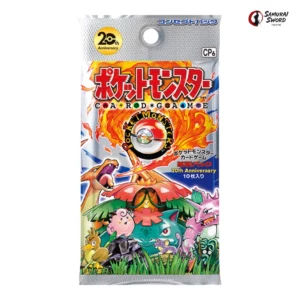
For actual sealed vintage product, start with our vintage Japanese Pokemon booster pack collection. The Neo Genesis Japanese Pokemon Booster Pack [neo1] (Gold, Silver, to a New World…, 2000, Old Back) is currently listed at ¥190,000 (~$1,234). The 20th Anniversary Japanese Pokemon Booster Pack [CP6] (XY BREAK Concept Pack, 2016) is currently listed at ¥120,000 (~$779); it is a 2016 anniversary pack, not an Old Back product, and we flag that explicitly so it isn’t mistaken for one.
For everything else — graded Old Back singles, specific set requests, or condition questions on a card you’re considering — sourcing requests go through our Quick Order page, and our Japanese booster box collection covers the modern sealed boxes we list. For a pack-by-pack buying guide to this era, see our Japanese vintage Pokemon booster packs guide. For rarity terminology on anything post-2001, see our Japanese card rarities explained guide, and for the back-design story specifically, see our companion Japanese Pokemon card back guide.
Frequently Asked Questions
What counts as a “vintage” Japanese Pokemon card?
Specifically, cards using the “Old Back” design: Japan’s Expansion Pack (October 1996) through the sets released just before Pokémon VS on July 19, 2001, when the back design changed. That’s ten sets across the Original/Expansion and Neo eras.
Do Japanese vintage cards have a 1st Edition stamp?
Not the earliest ones. Japanese cards had no 1st Edition concept in 1996–2000. Japanese 1st Edition stamping only began in 2001, with Pokémon VS and Pokémon Web, and continued through 2016. This is the reverse of English cards, which started 1st Edition stamping with Base Set in 1999.
Is “shadowless” a thing on Japanese vintage cards?
No — “shadowless” refers to a specific print-run gap in the drop-shadow around the artwork box on early English Base Set cards. It’s an English-only print phenomenon and doesn’t carry over to Japanese cards the same way. Early Japanese cards simply predate the Japanese 1st Edition concept entirely.
How can I tell if a Japanese card is genuinely Old Back?
Check the card back. Old Back (1996 – July 19, 2001) is a dark blue design with a distinct Poké Ball graphic and Japanese copyright text along the border. The modern Japanese back, used from Pokémon VS onward, reads “Pokémon,” drops the copyright text, and is more colourful. A “1ED” tag alone is not proof of vintage — several modern 2014–2016 reprints also carry 1st-Edition-style markings.
Do you list vintage Japanese Pokemon cards?
Yes, sealed vintage packs are on our vintage Japanese Pokemon booster pack collection, including the Neo Genesis Old Back pack. For a specific vintage card, submit a sourcing request through our Quick Order page.
Picked for this article
📩 Get member-only sale alerts & coupons
Sale alerts, coupons and restock notices by email — straight from Tokyo.