Machamp was an early chase card for collectors from the game’s original print run — and thanks to a detail about how it was originally distributed, the story around its debut printing is also commonly told wrong. The version people repeat isn’t quite the version that actually happened.
From that 1996 launch card through a modern 151-set reprint, a Fighting-type EX from the Bandit Ring era, an LV.X with a damage-boosting Poke-Body, and a TAG TEAM GX co-starring Marshadow, Machamp has had a long run across the Japanese Pokemon TCG. This guide walks through the key Japanese printings, corrects the record on that Base Set origin story, and points to the one graded copy we currently carry in our own inventory.
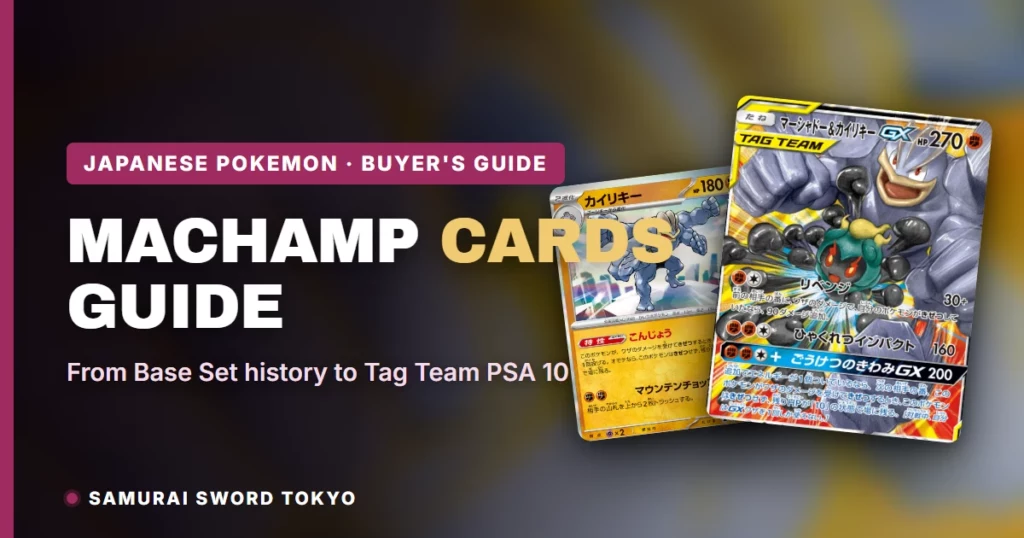
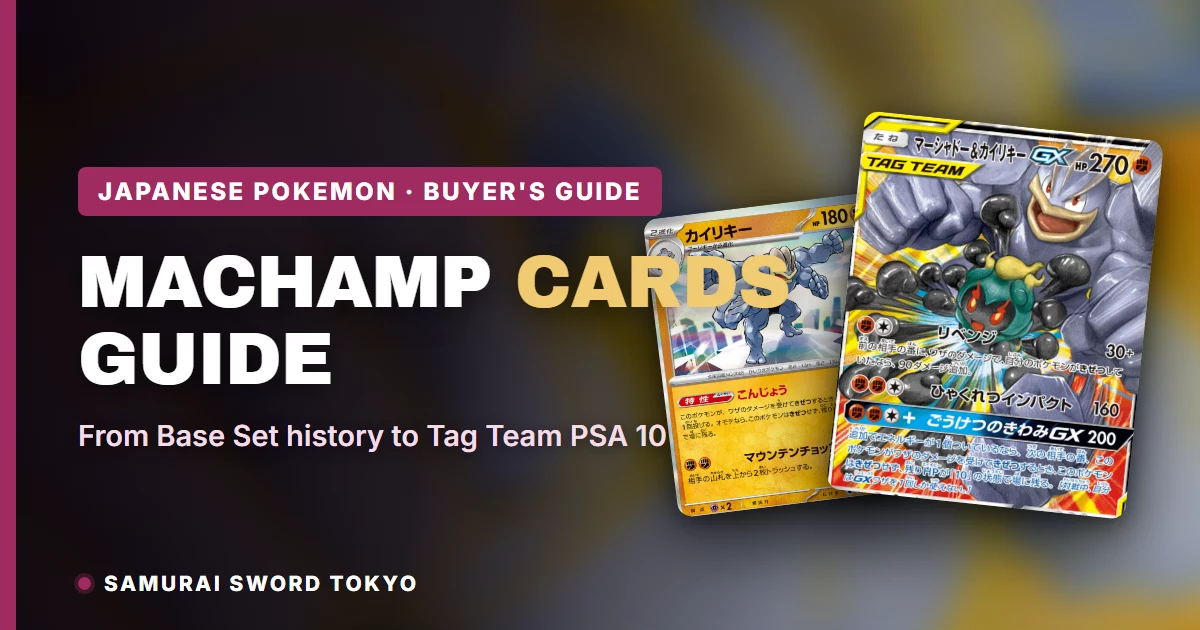
Machamp’s Japanese print history runs from the game’s 1996 launch set through the 2023 151 series, the Bandit Ring EX era, an LV.X with a damage-boosting Poke-Body, and the TAG TEAM Marshadow & Machamp-GX. We currently carry one graded copy of the latter — a PSA 10 Marshadow & Machamp-GX (SM12a 067/173), currently listed at ¥11,329 (update: currently sold out — restock requests via Quick Order) — as one-of-one stock. When it sells, it’s gone.
The 1996 Original and the 1st Edition Myth
Machamp’s reputation as a card worth chasing goes back to the very first Pokemon Trading Card Game release in 1996 — the set English-speaking collectors call Base Set, corresponding to the set that launched the game in Japan under the name Expansion Pack (拡張パック). In that original line-up, Machamp was one of the Rare Holo cards: a Fighting-type, 100 HP, illustrated by Ken Sugimori, the artist behind the franchise’s core visual identity.
There’s a story about this exact card that gets repeated constantly, and it’s usually told slightly wrong. In the English-language Base Set specifically, collectors often say a “1st Edition Machamp” was included in every booster pack. According to the documented print history, that isn’t what happened. The 1st Edition Machamp — first appearing unstamped in the initial shadowless print run, then carrying the actual “1st Edition” stamp in a second print run — was packaged into the English Base Set’s 2-Player Starter Set, a two-deck box built for head-to-head play. Every deck in that starter box got a copy. The card wasn’t something you pulled at random from booster packs; it was guaranteed by opening the right product.
There’s a second layer to the story too, also specific to the English-language release. Base Set’s Unlimited Edition, as a standalone officially branded product, was never released the way people generally assume. A non-holo Machamp without any 1st Edition stamp appeared instead in Trainer Deck A, a separate preconstructed deck entirely.
Where a Pokemon card was originally packaged — booster pack, starter deck, promo box — has shaped how collectible it became since the very first set, long before secret rares and special art rares existed as categories. That same distribution logic runs through several of the modern Japanese Machamp prints below, which came out of themed box products rather than standard boosters.
Machamp’s design also explains a lot about why it kept getting reprinted across every era that followed. A four-armed Fighting-type built to hit hard is an easy concept for a card designer to keep returning to, whether the mechanic of the moment is a Poke-Body, an EX, an LV.X, or a TAG TEAM GX. The sections below trace that thread from the original Rare Holo through the card’s most recent Japanese printings.
Machamp in the 151 Set (SV2a 068/165)
![Machamp [SV2a 068/165] R (Pokemon Card 151)](https://samuraiswordtokyo.com/wp-content/uploads/2026/08/SV2a_68_JP-1.webp)
Machamp appears in Pokemon Card 151 — the 2023 Scarlet & Violet-era set built entirely around the original 151 Kanto Pokemon, reprinting classic species with new artwork rather than reissuing old print runs. Here it’s numbered 068/165, printed at Rare rarity, and illustrated by Ryuta Fuse.
The 151 set is where a lot of collectors encounter Machamp for the first time, usually while chasing the same set’s more famous chase cards — Ditto’s Master Ball mirror variants among them. If you’re building out a 151 collection, our Ditto Japanese Pokemon cards guide covers that side of the set, and our Snorlax cards guide walks through another Kanto classic that runs alongside it.
Compared with the older prints covered further down this guide, the 151 Machamp sits at a single Rare rarity tier inside a modern, widely distributed booster set — a different distribution shape than a card tied to a starter deck, a themed box, or a TAG TEAM release. For collectors who want a clean, on-set copy of Machamp to pair with a broader Kanto-era collection, that structural difference is worth knowing before you start comparing prints.
Machamp-EX in Bandit Ring (XY7)
Machamp’s EX era printing comes from Bandit Ring, the Japanese release corresponding to the English Ancient Origins set (Limitless set code XY7). It’s a 180 HP Fighting-type EX, with two versions in circulation from the same set: a standard Rare Holo ex print at 037/081, illustrated by Eske Yoshinob, and a Rare Ultra full art version at 088/081, illustrated by Ryo Ueda.
![Machamp EX [XY7 037/081] (Bandit Ring)](https://samuraiswordtokyo.com/wp-content/uploads/2026/08/XY7_37_JP-1.webp)
![Machamp EX [XY7 088/081] UR (Bandit Ring)](https://samuraiswordtokyo.com/wp-content/uploads/2026/08/XY7_88_JP-1.webp)
Both prints carry the same two attacks. “Steaming Mad” (スチーミングマッド) deals more damage the more damage counters are already sitting on the opponent’s Pokemon, and “Crazy Hammer” (クレイジーハンマー) hits harder if the defending Pokemon is affected by a Special Condition. Mechanically it’s a card built to punish a board that’s already taken a beating — fitting, for a Pokemon whose whole design is built around brute force.
The 037/081 print uses the standard EX card frame; the 088/081 full art carries the same stats and attacks in an alternate frame, illustrated by a different artist than the base print.
Bandit Ring sits in the middle of Machamp’s Japanese print timeline — released years after the original 1996 Expansion Pack, and years before the 151 reprint above. The EX-era design language is a useful reference point if you’re trying to date a Machamp card by sight: the “-EX” suffix, the 180 HP stat line, and the two-attack layout described above are all consistent markers of this specific generation of the mechanic, distinct from both the older Rare Holo era and the GX cards covered further down.
Machamp LV.X in Intense Fight in the Destroyed Sky
The LV.X era produced one of Machamp’s more distinctive Japanese prints: Machamp LV.X, from the set Japanese collectors know as 破裂の閃光 (052/092), corresponding to the English Stormfront release. It’s a 150 HP Fighting-type card illustrated by Ryo Ueda — the same illustrator behind the Bandit Ring full art above.
What sets this LV.X apart is its Poke-Body, “No Guard” (ノーガード): as long as Machamp is in play, all of Machamp’s attacks deal 60 more damage, and any damage the opponent deals to Machamp is also increased by 60. It’s an aggressive, double-edged ability — it turns Machamp into a harder hitter and a bigger target at the same time. Its attack, “Stubborn” (意地っ張り), adds to that same all-in playstyle.
We don’t currently have a verified image source for this print, so we’re covering it here for identification purposes rather than pairing it with a photo. If you’re trying to confirm a copy against the print run described above, the Poke-Body text and the 052/092 numbering on a 破裂の閃光-era card are the details to check.
LV.X cards as a mechanic only existed for a relatively short window in the game’s history, upgrading a Pokemon already in play with a levelled-up version rather than requiring a separate evolution step. That short design window is part of why LV.X prints tend to stand out from the rest of a collection at a glance — and it’s part of why “No Guard” reads as such an aggressive effect even by Machamp’s usual standards.
Marshadow & Machamp-GX and Our PSA 10
![Marshadow & Machamp GX [SM12a 067/173] RR (Tag All Stars)](https://samuraiswordtokyo.com/wp-content/uploads/2026/08/SM12a_67_JP-1.webp)
Machamp’s TAG TEAM appearance pairs it with Marshadow on a single 270 HP Fighting-type card, illustrated by Mitsuhiro Arita. The card first appeared in Japan in the set Double Blaze (SM10, 042/095 RR), then was reprinted with the same effect and artwork in Tag All Stars (SM12a), where it’s numbered 067/173 at RR rarity. Tag All Stars released in Japan on October 4, 2019, as part of the Sun & Moon-era’s run of recap and reprint sets.
The card has three attacks to work with. “Revenge” (リベンジ) deals 90 more damage if one of your own Pokemon was knocked out by an attack during the opponent’s previous turn. “Hundred-strike Impact” (ひゃくれつインパクト) hits for a flat 160 damage. And the GX move, “Heroic Pinnacle GX” (ごうけつのきわみGX), deals 200 damage plus an additional effect, usable once per game like any GX attack.
This is the exact print we currently hold in graded condition. Our copy is a PSA 10 Marshadow & Machamp-GX, SM12a 067/173, currently listed at ¥11,329. It’s one-of-one stock — we hold a single graded copy, not a running allocation, so when it sells, it’s gone.
A PSA 10 grade means the card has been reviewed and certified by Professional Sports Authenticator against their gem mint standard, covering centering, corners, edges, and surface. Reprint sets like Tag All Stars exist to bring earlier cards such as this Marshadow & Machamp-GX back into circulation, which is part of why a Double Blaze-era design can still show up as a fresh graded pull years after its original release.
View Product → (update: currently sold out — restock requests via Quick Order)
Where to Buy Machamp Cards from Japan
We ship Japanese sealed product and graded singles worldwide out of Tokyo with tracked delivery. If you want the exact copy covered above, it’s a single graded card — not a batch — so availability changes the moment it sells.
View Product → (update: currently sold out — restock requests via Quick Order)
For the rest of our graded PSA 10 Japanese cards, browse the full PSA 10 card list. For raw singles, sealed boxes, and everything else we carry, the full card list is the place to search. And if you’re putting together a mixed order across multiple cards or sets, our Quick Order page is the fastest way to build it in one pass.
For other Kanto classics from the 151 set, see our guides to Ditto and Snorlax. If you collect across generations rather than by Pokemon, our Metagross Japanese Pokemon cards guide covers a different Fighting-adjacent chase line from the ex and Mega eras.
Frequently Asked Questions
Was a 1st Edition Machamp really included in every Base Set pack?
Not in the way it’s usually described. The 1st Edition Machamp was packaged into the 2-Player Starter Set — a two-deck box for head-to-head play — rather than distributed randomly through standard booster packs. Every deck in that starter box included a copy, first unstamped in the shadowless print run, then with the 1st Edition stamp in a later print run.
What’s the difference between the two Machamp-EX Bandit Ring prints?
Both the 037/081 standard Rare Holo ex and the 088/081 Rare Ultra full art carry the same stats and attacks — “Steaming Mad” and “Crazy Hammer.” The difference is presentation: 037/081 uses the standard EX card frame, while 088/081 is a full art alternate illustrated by a different artist.
What does Machamp LV.X’s Poke-Body do?
Machamp LV.X’s Poke-Body, “No Guard,” adds 60 damage to all of Machamp’s attacks while it’s in play, but also adds 60 to any damage the opponent deals to Machamp in return. It’s a double-edged effect that raises both the card’s offense and its exposure.
Where can I buy a graded PSA 10 Machamp card from Japan?
We currently carry one graded copy: a PSA 10 Marshadow & Machamp-GX (SM12a 067/173), currently listed at ¥11,329 (update: currently sold out — restock requests via Quick Order). It’s one-of-one stock, and our full graded selection is browsable on the PSA 10 card list.
Get ¥2,000 in points with a free account
Create free account1 pt = ¥1 · Use on up to 20% of your order total · Welcome points expire 30 days after sign-up · Import duties, taxes and customs charges are not included in the price and are collected on delivery, except for destinations we ship duty-paid.
Picked for this article

📩 Get member-only sale alerts & coupons
Sale alerts, coupons and restock notices by email — straight from Tokyo.