
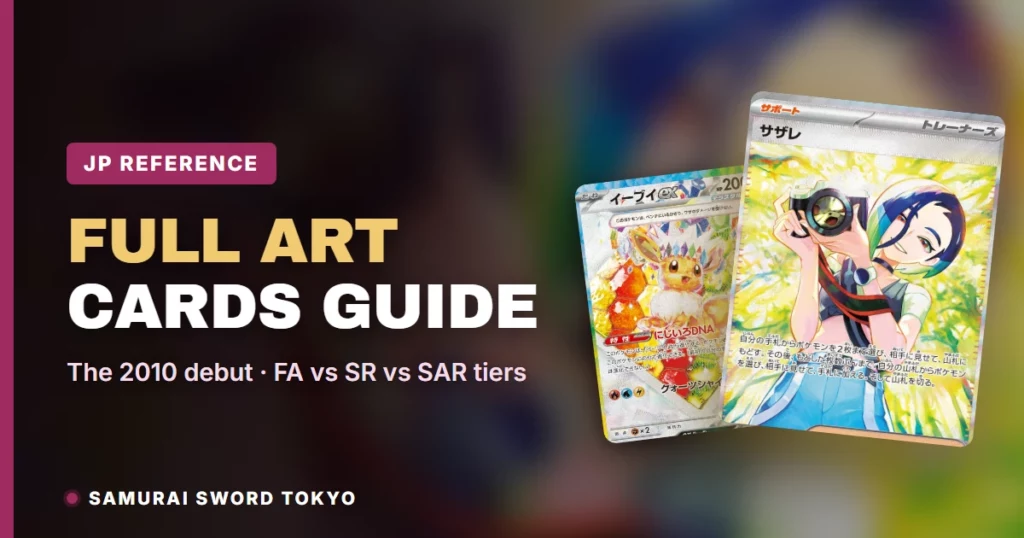
Pokemon full arts are cards where the illustration and holofoil extend across the entire card face, rather than being boxed into a smaller illustration window. It’s one of the more recognisable design choices in the modern TCG, and the story of Pokemon full arts started with two Japanese sets in December 2010.
If you’re buying Japanese product and keep seeing SAR, AR, SR, CHR and UR stamped on cards that all look like “full art” to you, this guide untangles it: what Full Art actually means, when it first appeared, and how one visual category splintered into half a dozen Japanese rarity labels over sixteen years. We ship graded and sealed Japanese product out of Tokyo, so the examples below are cards we’ve actually had cross our desk.
Store prices and availability were checked on October 15, 2026. The SNKRDUNK asking prices below remain the October 8, 2026 snapshot; rarity terminology and numbering guidance were rechecked on October 15, 2026, while other background facts retain their August 27, 2026 check date. Browse set pages in the Japanese Pokemon card list; for the best-known picks see best full art Pokemon cards, and for Trainer cards see the full art Trainer cards guide.
Full Art cards debuted in Japan on December 17, 2010 with the Black Collection and White Collection sets — about four months ahead of the English Black & White release on April 25, 2011. “Full Art” is a visual category (art covering the entire card face), not a rarity itself; Japanese sets sort Full Art cards into labels like SAR, AR, SR, CHR, CSR and UR depending on era and which Pokemon is depicted.
Store prices below were checked on October 15, 2026. USD figures convert at ¥154/USD, approximate.
What Is a Full Art Pokemon Card?
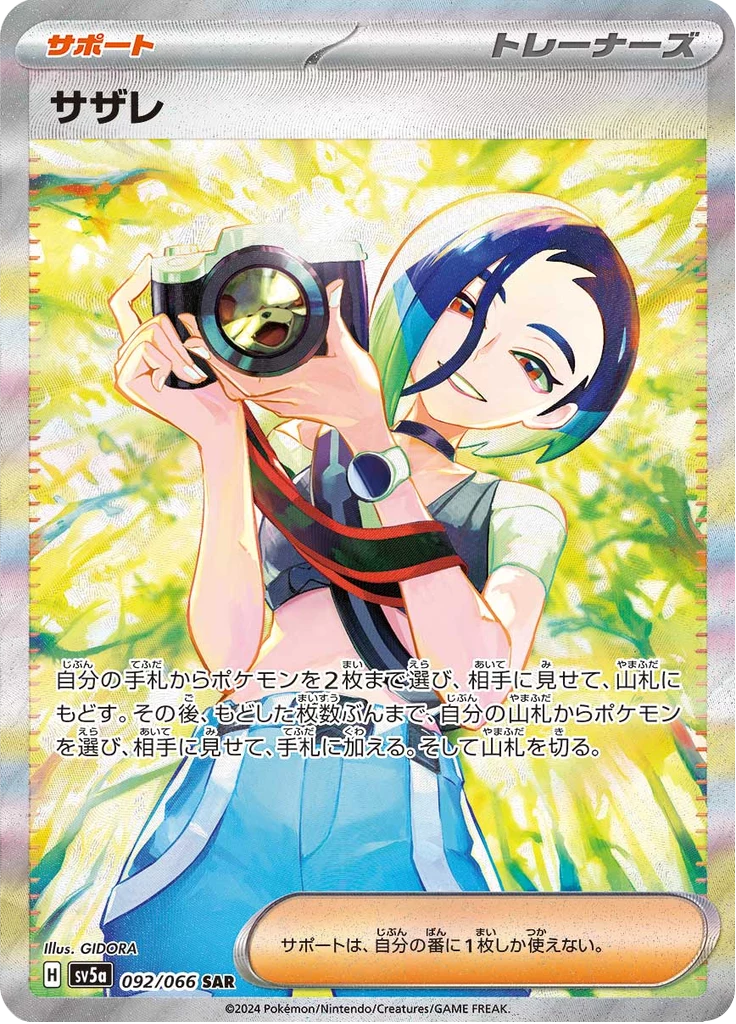
A Full Art card is an artwork variant where the illustration extends across the entire card face — artwork and holofoil covering the whole card, rather than being boxed into the usual illustration window with a border and text panel around it. That’s the core definition, and it hasn’t changed since the category was introduced.
What has changed is which Pokemon get the treatment and what Japan calls the resulting card. A Full Art print of a Basic Pokemon looks different from a Full Art print of a Pokemon ex, and Japanese sets give those two things different rarity labels even though both are, visually, Full Art cards. We’ll get to that hierarchy in a moment — first, where the category came from.
The First Full Art Cards: Black Collection & White Collection
Full Art cards were introduced in the Black & White expansion, first originating from the Black Collection and White Collection sets in Japan, released December 17, 2010. The English-language Black & White set followed on April 25, 2011 — roughly four months later.
Do not confuse the “Black & White” naming here with the 2025–26 Black Bolt / White Flare expansion that introduced the unrelated “Black White Rare” (BWR) label — the two are fifteen years apart and share nothing except a similar name.
How to Spot a Full Art Card in a Japanese Set
Two tells work together on Japanese product:
- The artwork extends beyond a small illustration window. Look for the full-card composition and foil treatment; a border can still surround a Full Art card.
- The card number and rarity label identify the print. Many Japanese AR, SAR and SR cards are numbered above the main set’s stated total, but that is not a universal test for Full Art. English sets can also use above-total numbering: the official English Rayquaza VMAX entry shows 218/203. Check the exact set and print alongside the artwork.
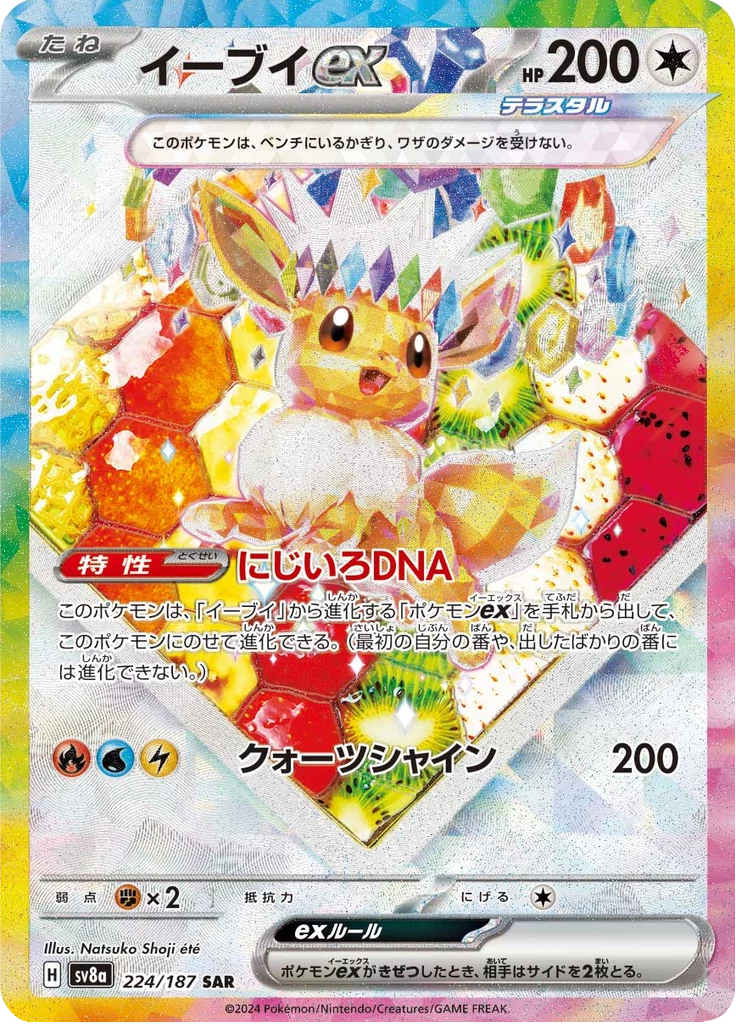
You can see it directly in the Terastal Fest ex set: the Eevee ex Special Art Rare is numbered 224/187 — card 224 in a set whose base count is 187. A Sylveon ex from the same set is 212/187. Both numbers exceed the set total, and both are Full Art.
Full Art Isn’t a Rarity — It’s a Category
This is the point that trips up most buyers moving from English to Japanese product: “Full Art” is not itself a rarity tier. It’s the umbrella visual category — art covering the whole face. The rarity label printed on the card (SR, SAR, AR, CHR, CSR, UR, and others depending on era) is a separate classification Japan assigns depending on which Pokemon or Trainer is shown and which set era the card comes from.
Full Art describes the visual treatment; rarity labels such as SAR, AR, SR, CSR and UR identify categories that vary by set and era. Check the exact card layout as well as its rarity label. Not every Full Art card carries the same label, and the labels themselves have changed meaning across eras — our Japanese rarity symbols guide covers the full letter-by-letter breakdown era by era; this article stays focused on the Full Art category itself.
Japanese SR stands for Super Rare, as shown in the official Alter Genesis SR feature. It is a rarity label used for Full Art prints, distinct from a card being numbered beyond the main set. As the game’s rarity system expanded, additional Full Art sub-labels split off: Special Illustration Rares (SIR) emerged as the English-side term for a more elaborate art treatment, corresponding to the Japanese SAR label — see our SA / Special Art guide for that specific tier in depth.
How Full Art Evolved: EX to GX to V to ex
Which Pokemon receive Full Art treatment has shifted with every generation of Japanese sets:
- Starting with Next Destinies, Full Art cards predominantly featured Pokemon-EX.
- Later eras moved the treatment onto Pokemon-GX, then Pokemon V, and now Pokemon ex in the current Scarlet & Violet-descended sets.
- All Pokemon VMAX cards are classified as Full Art cards by default — that’s a blanket rule for the VMAX mechanic specifically, not a claim that every EX, GX, V or ex card automatically gets Full Art treatment. Those Pokemon “predominantly” received Full Art from specific sets onward; it isn’t a guarantee attached to every single card of that type.
For the set-by-set rarity terminology within each of those eras, see our era hubs: Black & White Era, XY Era, Sun & Moon Era, Sword & Shield Era, and Scarlet & Violet Era.
Full Art vs SAR: What’s the Difference?
Since SAR is the label buyers run into most often on current Japanese product, it’s worth being precise: every SAR card is a Full Art card, but “SAR” describes something narrower than “Full Art.”
| JP label | What it is | Relationship to Full Art |
|---|---|---|
| SR (Super Rare) | A Japanese rarity label used for Full Art Pokemon and Trainer prints; terminology varies by era | Full Art card |
| AR (Art Rare) | Full art of a regular Basic, Stage 1 or Stage 2 Pokemon, typically depicted in its environment | Full Art card |
| SAR (Special Art Rare) | Full art given to Pokemon ex and Supporter cards specifically, with an added layer of glitter foil; English-side term is Special Illustration Rare (SIR) | Full Art card |
| UR (Ultra Rare) | Gold foil prints of Pokemon, Item, Stadium or Energy cards; the current English-side equivalent name is Hyper Rare | Full Art card |
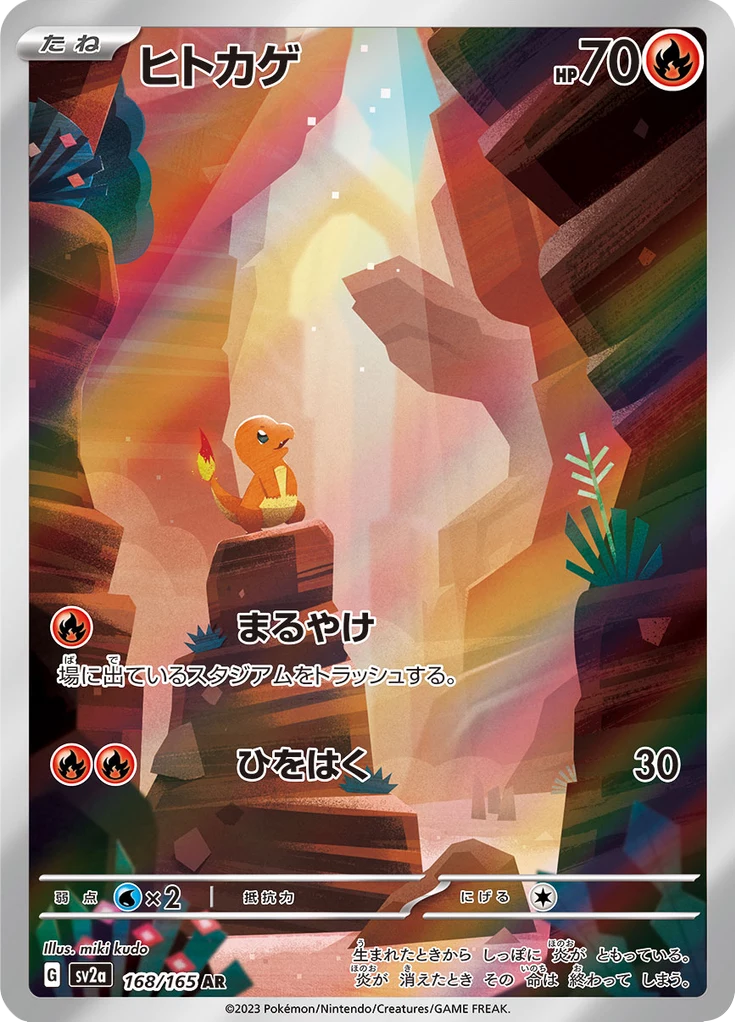
The distinction matters conceptually more than it does for price: a card labelled AR and a card labelled SAR from the same set are both Full Art, and SAR is reserved for the higher-profile ex/Supporter subjects while AR covers regular Basic Pokemon. That doesn’t translate into a fixed price gap, though — the Charmander AR and Eevee ex SAR examples below had lowest SNKRDUNK asks of ¥13,800 and ¥14,800 as PSA 10 on October 8, 2026, so treat SAR and AR as different subject-tier labels, not a price ladder.
Pokemon Full Arts in Practice: SAR and AR Examples
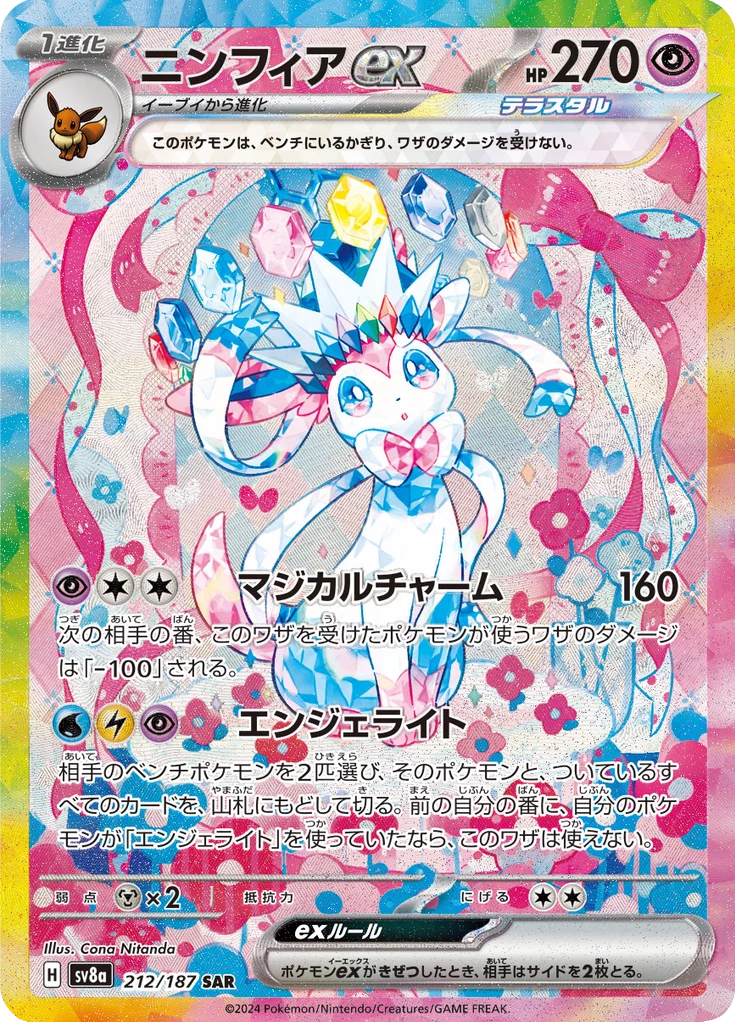
Three graded Japanese Full Art cards, spanning both label tiers, with their lowest SNKRDUNK asks on October 8, 2026:
| Card | Label | Set | Lowest SNKRDUNK ask (Oct 8, 2026) | Our listing |
|---|---|---|---|---|
| Eevee ex 224/187 | SAR | Terastal Fest ex (SV8a) | Raw ¥3,700 / PSA 10 ¥14,800 | Sold out |
| Sylveon ex 212/187 | SAR | Terastal Fest ex (SV8a) | Raw ¥11,000 / PSA 10 ¥32,800 | Sold out |
| Charmander 168/165 | AR | Pokemon Card 151 (SV2a) | Raw ¥2,700 / PSA 10 ¥13,800 | Sold out |
The three pictured card designs correspond to the PSA 10 examples discussed above, and all three show the same Secret-card numbering tell — card number printed above the set total. Asks are the lowest asking prices on SNKRDUNK on October 8, 2026 (raw and PSA 10 listings of the same set and number), not sale prices. The Eevee ex, Charmander and Sylveon ex slabs are sold out at the time of this update — restock requests go through Quick Order.
When you see a title like “PSA10 Eevee ex SAR [SV8a 224/187],” that’s: grade (PSA10), Pokemon (Eevee ex), rarity label (SAR), set code (SV8a), and card number over set total (224/187) — the same information this guide just walked through, condensed into one line.
Where to Buy Japanese Full Art Pokemon Cards
We ship graded singles and sealed Japanese booster product from Tokyo. For sealed product from the same sets as the examples above, our Quick Order page is the starting point. For a specific single or another sourcing request, use Quick Order. The SV8a Terastal Festival ex Sealed option is listed at ¥22,057 (~$143). The No Shrink option and the separate Damaged Box listing are sold out.
If rarity terminology across eras is still confusing, start with our Japanese rarity symbols guide for the full letter-by-letter reference, or how to read a Japanese card for the basics of set codes and numbering.
Frequently Asked Questions
What was the first Full Art Pokemon card?
Full Art cards were introduced in Japan on December 17, 2010, in the Black Collection and White Collection sets — part of the Black & White expansion. The English-language Black & White release followed on April 25, 2011, roughly four months later.
Is Full Art a rarity, like SAR or UR?
No. Full Art is a visual category — artwork and holofoil covering the entire card face. SR, SAR, AR, CSR and UR are Japanese rarity labels that vary by set and era; check the exact card layout as well as its label. Every SAR card is a Full Art card, but “Full Art” itself isn’t one of the letter labels.
How do I tell a Full Art card is a Secret card in a Japanese set?
Compare the card number with the printed main-set total: 224/187 and 212/187 are examples numbered beyond that total. This identifies their position in the set, rather than defining all Full Art cards. English sets can also use above-total numbering. Check the artwork, rarity label and exact set together.
What’s the difference between Full Art and SAR?
SAR (Special Art Rare) is one specific Japanese rarity label given to Full Art cards of Pokemon ex and Supporter cards, with an added layer of glitter foil; the English-side equivalent term is Special Illustration Rare (SIR). AR (Art Rare) is a separate label for Full Art cards of regular Basic, Stage 1 or Stage 2 Pokemon. Both AR and SAR cards are Full Art — the label just tells you which subject and treatment tier.
Are all VMAX cards Full Art?
Yes — all Pokemon VMAX cards are classified as Full Art cards by default. Other card types like EX, GX, V and ex predominantly received Full Art treatment starting with specific sets, but it isn’t a guarantee applied to every single card of those types.
Picked for this article
📩 Get member-only sale alerts & coupons
Sale alerts, coupons and restock notices by email — straight from Tokyo.
![How to Buy Japanese Pokemon Cards Wholesale from Japan [2026 Guide]](https://samuraiswordtokyo.com/wp-content/uploads/2026/08/featured-how-to-buy-japanese-pokemon-cards-wholesale-1-768x403.webp)