SEC used to be the ceiling. Then Bandai started printing cards that don’t fit on the official rarity chart at all — black-and-white comic-panel art, printed as alternate-art parallels that keep the same base card number as their standard printing, and priced like it.
This guide isn’t a price ranking — for that, see our Most Valuable One Piece Cards table, which measures 17 raw-card asking prices on a single day. This article explains the structure underneath those numbers: which rarities Bandai actually prints on the card, which tiers are community-invented on top of that, and why the same card number can be worth six times more depending on which set it came from. If you’re new to rarity symbols altogether, our full rarity ladder for beginners covers the basics from Common upward.
Bandai’s own card list confirms seven printed rarity codes: L, C, UC, R, SR, SEC and TR. “Manga Rare” (community term for comic-panel parallel art) sits above SEC in observed scarcity but is never printed on the card or named by Bandai. Print run matters as much as rarity tier — the same card number can trade at up to 6x more in a reprint set than in its original. We stock the OP-17 booster box (currently listed at ¥17,000, ~$116) (update: currently sold out — restock requests via Quick Order) and the Premium Card Collection – ONE PIECE DAY ’25 (currently listed at ¥31,620, ~$215) sealed — we do not currently carry graded OP chase singles.
OP-17 has now released in both regions (Japan on August 22, English on August 28, 2026), and Bandai’s full official JP card list for the set is published. It confirms three SEC slots obtainable in OP-17 — Rocks D. Xebec (OP17-118), Loki (OP17-119), and a comic-parallel version of Luffy (EB04-061) — plus a single Treasure Rare (Lucky.Roux, OP17-033). Market asking prices in this article have been re-checked as of September 1, 2026 where noted.
Prices in this article are asking prices from cited sources. Figures dated September 1, 2026 are converted at ¥147/USD; earlier dated measurements keep the ¥159/USD rate that applied when they were taken (August 2026). Our own sealed-product prices are current listed prices, checked 2026-09-01, and can change or sell out.
Official Rarity Tiers: What Bandai Actually Prints
Bandai’s live official card list uses seven rarity abbreviations across its card entries: L (Leader), C (Common), UC (Uncommon), R (Rare), SR (Super Rare), SEC (Secret Rare) and TR (Treasure Rare). SEC is the top rarity Bandai prints on a card — it’s numbered beyond the main set list, which is how you can spot one at a glance.
TR is real but rare in a different sense: in the research behind this article, it turned up exactly once — on Lucky.Roux, OP17-033. That’s the only confirmed sighting we found — and Bandai’s own OP-17 product page now states it outright, listing exactly one Treasure Rare in the set’s official rarity breakdown of 131+4 card types. Treat TR as a genuine Bandai abbreviation, not as a rarity you should expect to find in every set.
One thing worth flagging: Bandai’s site doesn’t publish a plain-English glossary explaining any of these codes. They’re read directly off individual card entries on the official card list, not off a legend or key. So “official” here means “confirmed as printed on Bandai’s own site,” not “explained by Bandai in writing.”
| Tier | What it is | Official Bandai rarity? |
|---|---|---|
| SR — Super Rare | Standard high-rarity slot; multiple per box is normal | Yes |
| Leader / Super Leader Parallel | Alternate-art Leader card; “Super” version is a scarcer showpiece | Not a separate official rarity code |
| SP treatments | Special alternate-art slots, often grouped by theme within a set | Not a separate official rarity code |
| SEC — Secret Rare | Numbered beyond the main set list; top printed rarity | Yes |
| TR — Treasure Rare | Confirmed once in this research, on Lucky.Roux OP17-033 | Yes, but not seen as a recurring set-wide rarity |
| Manga treatment (“Manga Rare”) | Black-and-white comic-panel alternate art; community-named top chase tier | No — collector-community term |
Beyond SEC: The Community’s “Manga Rare” Tier
“Manga Rare” is not an official Bandai rarity name. You won’t find it printed on the card or listed on a product page — it’s the term the collector community settled on for a specific alternate-art treatment, and the Japanese-market equivalent is コミパラ (komipara), rendered in English as “comic parallel.”
Three things define the treatment, per our companion deep dive:
- Art style. Black-and-white comic-panel artwork lifted from actual manga panels — screentone shading, ink linework, sometimes even panel framing carried over from the source page.
- Scarcity, by observation only. Community box-opening experience places manga treatments below SEC and SP hits in pull frequency — but Bandai publishes no official pull rates for any tier, so this is observation, not a stated fact. If you see a specific ratio quoted anywhere (including the unofficial “1 in 65–100 boxes” estimate that circulates for OP-17), treat it as a disputed community estimate, not a Bandai number.
- Casting. The treatment is reserved for franchise-defining characters — Emperors, series leads, established legends — not filler characters.
Where does that leave the ladder? Community observation places the manga treatment above SEC in practical scarcity, even though SEC remains the top rarity Bandai officially prints. That’s a nuance worth sitting with: the “rarest” card in a set, by what actually trades hands for the most money, is often not the one carrying the officially-highest rarity code. For the full walk-through of this tier specifically, see our Manga Rare Cards Explained guide.
OP-17’s Confirmed Manga Treatments and First SEC
OP-17, The World’s Strongest Warriors, gives a concrete, current example of what this tier looks like in practice. Four manga treatments were confirmed through Bandai’s official reveal program for the set: Edward Newgate (Whitebeard), Shanks, Kaido and Charlotte Linlin. With the full official card list now published, the set’s SEC lineup is confirmed: Rocks D. Xebec (OP17-118) and Loki (OP17-119) close out the base numbering, and a comic-parallel version of Luffy (EB04-061) is listed on the official card list as obtainable in OP-17 — the third SEC slot.
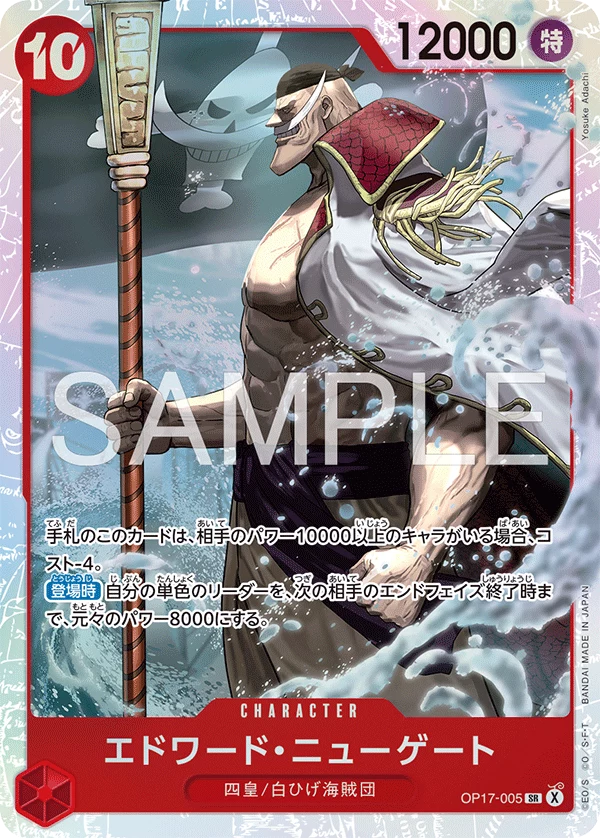
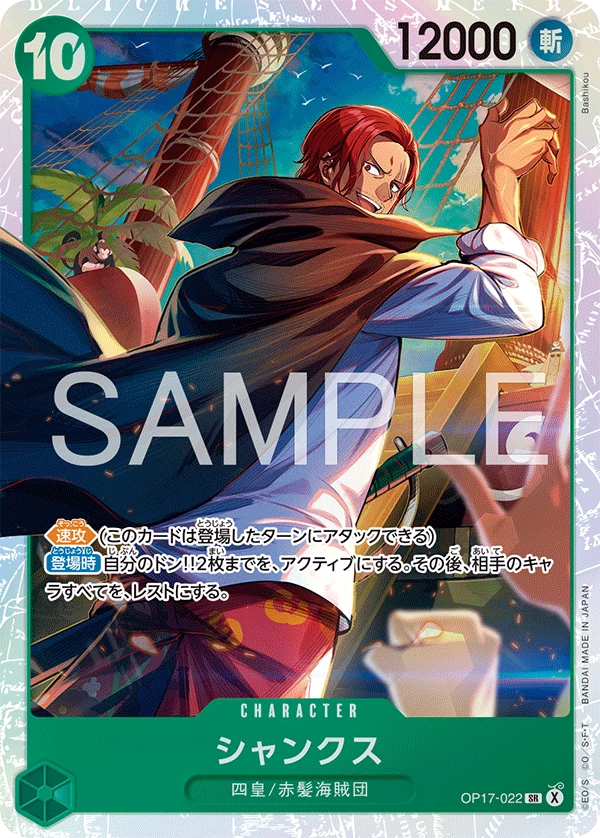
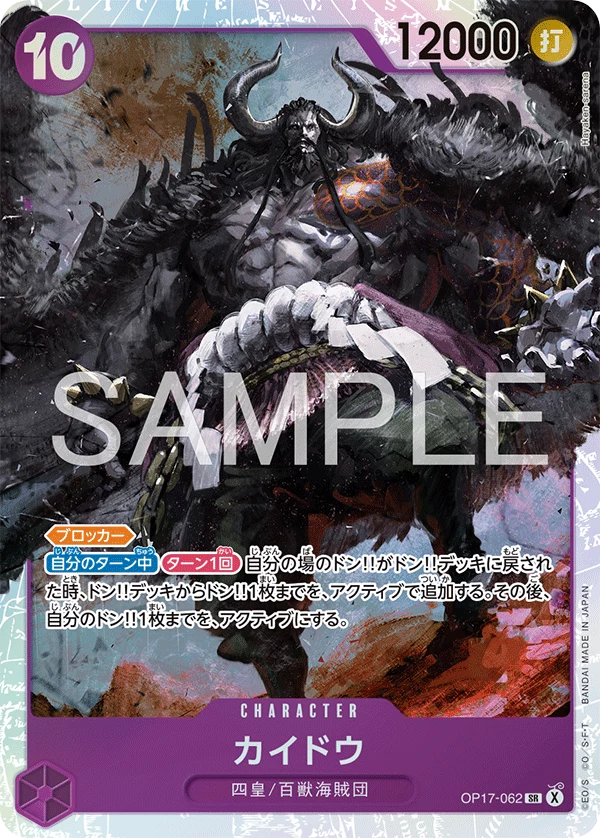
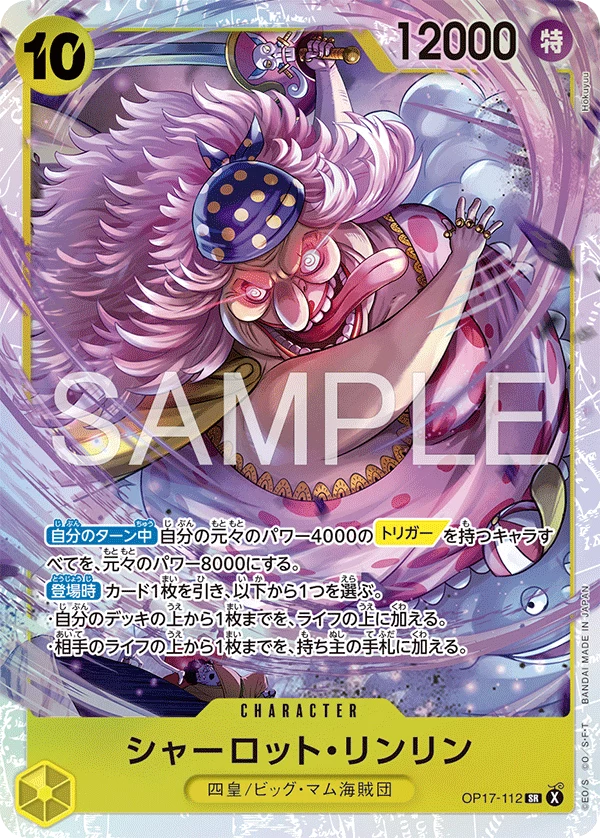
These four images show the base printing of each card number — the manga-treatment parallel is a separate alternate-art printing of the same card number, confirmed to exist for these four characters specifically in OP-17’s reveal program. Each is a franchise-defining character, consistent with the casting pattern described above.
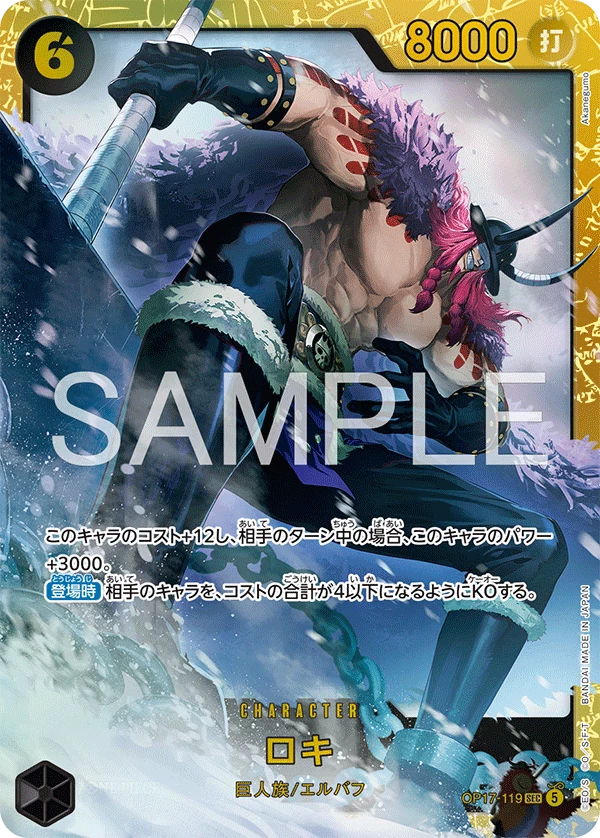
We’ve covered OP-17’s chase cards in full detail separately — see our OP-17 Chase Cards Guide and the full OP-17 card list for the complete rarity breakdown of the set.
Pirate-Crew Super Parallel: A Scarcer Tier Above the Manga Cards
OP-17 also introduced a treatment sitting above even the manga tier: the 海賊団スーパーパラレル (“Pirate-Crew Super Parallel”), a new 4th-anniversary treatment reserved for exactly two cards — Luffy (EB04-061) and Rocks D. Xebec (OP17-118). This is a separate, even scarcer chase slot than the manga rares, not a variant of them — and, per the research behind our OP-17 coverage, is specific to this set. Don’t assume every future set will get one.
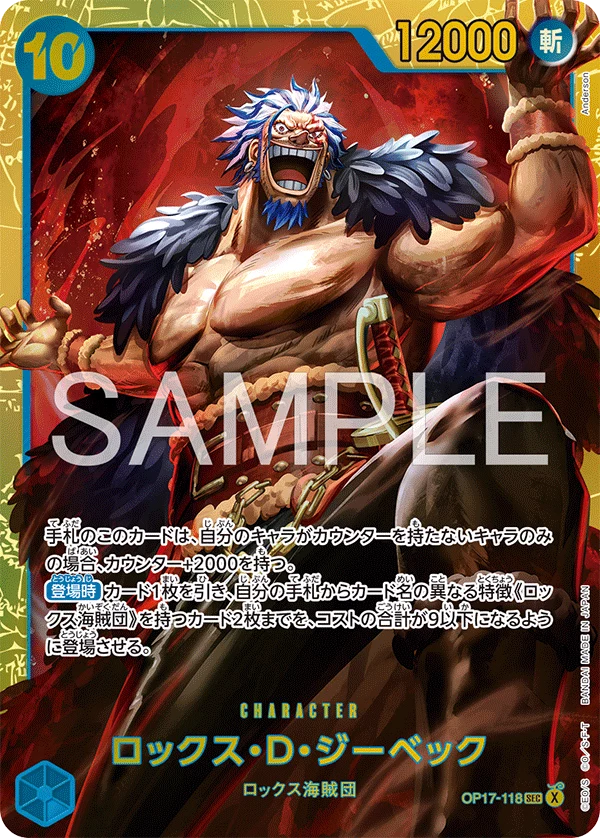
Asking prices measured on SNKRDUNK as of September 1, 2026 (not sales — lowest current asking prices, specific to that date): Luffy EB04-061 at ¥1,300,000 (~$8,844), and Rocks D. Xebec OP17-118 at ¥511,111 (~$3,477). Those numbers move; they’re here to illustrate the tier, not to serve as a live price.
Print Run Matters as Much as the Rarity Printed on the Card
Rarity tier alone doesn’t fix a card’s value — which set it was printed in matters just as much. The clearest example: the same card number can carry wildly different asking prices depending on whether it’s the original printing or a later “THE BEST” reprint.
| Card | Set / printing | Asking price (measured Aug 5, 2026) |
|---|---|---|
| Shanks, SEC-SP Comic Parallel OP01-120 | OP-01 Romance Dawn (original print) | ¥138,000 (~$868) |
| Shanks, SEC-SP Comic Parallel OP01-120 | PRB-01 THE BEST (reprint) | ¥860,000 (~$5,409) |
| Luffy, OP13-118 | OP-13 Carrying on His Will — regular comic parallel | ¥350,000 (~$2,201) |
| Luffy, OP13-118 | OP-13 Carrying on His Will — Red Comic Parallel | ¥1,570,000 (~$9,874, single listing) |
Both rows in the Shanks example are the same card number, same character, same base art concept — but the THE BEST reprint asked for roughly six times more than the original Romance Dawn print on the same measurement day. That’s a print-run effect, not a rarity-tier effect: both are the same officially-stated rarity.
The Red Comic Parallel (レッドコミパラ), introduced in OP-13, sits in its own tier above the regular comic parallel of the same card number — the Luffy OP13-118 comparison above shows a roughly 4.5x gap between the two versions of the identical card. Again: same card number, same base character art, different parallel treatment, very different asking price.
The practical takeaway is the same one that underpins our Most Valuable One Piece Cards price table: every one of the top 17 raw cards measured there was a comic parallel of some kind — but which set, and which parallel variant of that set, changed the price by multiples.
Grading and Condition at the Top End
Condition sensitivity gets extreme at the top of this ladder. Centering is described as “the silent killer” of a card’s grade — it’s decided at the print stage, not by how carefully a card is handled afterward, so a mint-looking card can still miss a top grade on centering alone.
In the same August 5, 2026 measurement referenced above, grading carried a premium of roughly 2.5x–5x the raw asking price for a top grade across the comic parallels tracked. That’s specific to that measurement, not a universal multiplier — grading premiums move with the card and the market.
One more wrinkle worth knowing: grading company isn’t interchangeable at this level. An ARS 10 (a Japanese grading service) ask has been observed exceeding a PSA 10 ask on the identical card. If you’re comparing graded listings, check which company graded the card before comparing price.
Where to Buy: Sealed Product and Sourcing Chase Singles
We currently list sealed OP-17 product, not individual chase singles. Our WooCommerce catalogue was checked in full on 2026-08-27 for OP-coded PSA10 graded singles — none are currently listed. If you’re after a specific manga-treatment, SEC, or Pirate-Crew Super Parallel single, the fastest route is to send us a want-list through Quick Order rather than searching listed singles that don’t exist in our catalogue yet.
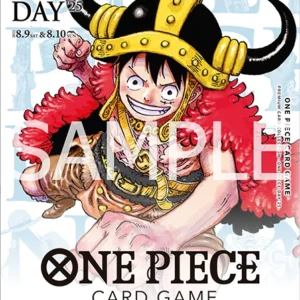
For a curated single-card box outside a full booster box, the Premium Card Collection – ONE PIECE DAY ’25 is currently listed at ¥31,620 (~$215). Browse the full range of sealed boxes in our One Piece Card Box collection, and check the card list hub for set-by-set breakdowns. For want-list requests on graded or ungraded chase singles, use Quick Order — tell us the card number and treatment you’re after and we’ll source it.
Frequently Asked Questions
Is “Manga Rare” an official One Piece card rarity?
No. It’s a term the collector community uses for a black-and-white comic-panel alternate-art treatment. It doesn’t appear printed on the card or on Bandai’s official card list — the confirmed official rarity codes are L, C, UC, R, SR, SEC and TR.
What is the rarest official rarity Bandai prints on a One Piece card?
SEC (Secret Rare) is the top rarity Bandai prints and numbers beyond the main set list. TR (Treasure Rare) is also a confirmed official abbreviation, but in this research it was only found once, on Lucky.Roux OP17-033 — it isn’t a rarity you should expect in every set.
Does a card’s rarity tier alone tell you what it’s worth?
No. Print run and set of origin matter just as much. The same card number reprinted in a later set (like PRB-01 “THE BEST”) has asked for up to roughly six times more than its original printing on the same measurement day, despite carrying the identical printed rarity.
What is the Pirate-Crew Super Parallel?
A new treatment introduced with OP-17, reserved for exactly two cards: Luffy (EB04-061) and Rocks D. Xebec (OP17-118). It’s described as a separate, even scarcer chase slot above the manga treatment tier, and is specific to OP-17 — it shouldn’t be assumed to apply to other sets.
Does grading change the price of top-tier One Piece cards?
Yes, substantially. One measurement observed grading premiums of roughly 2.5x to 5x the raw asking price for a top grade across tracked comic parallels. Centering is especially unforgiving at this level, since it’s fixed at print and can’t be improved by careful handling.
Picked for this article
📩 Get member-only sale alerts & coupons
Sale alerts, coupons and restock notices by email — straight from Tokyo.