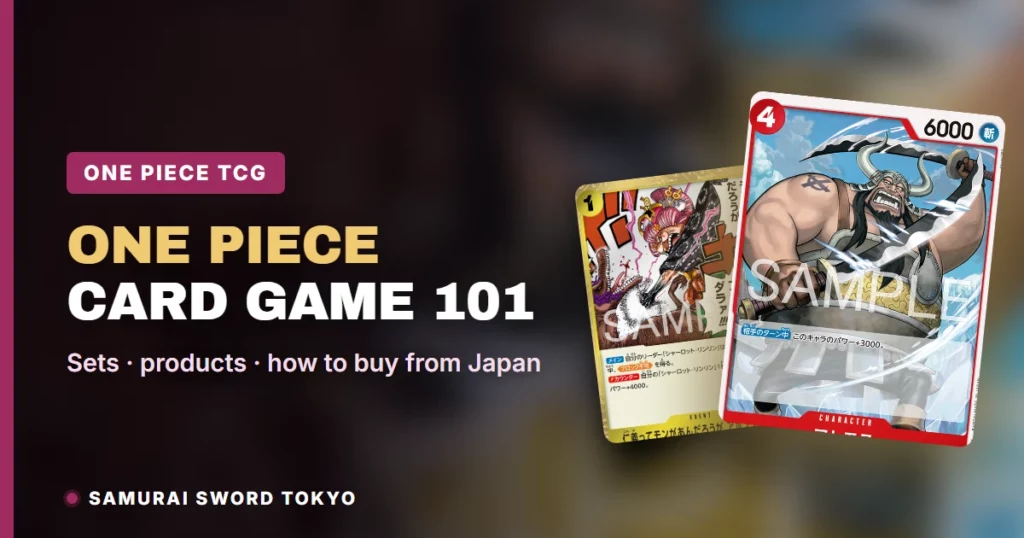
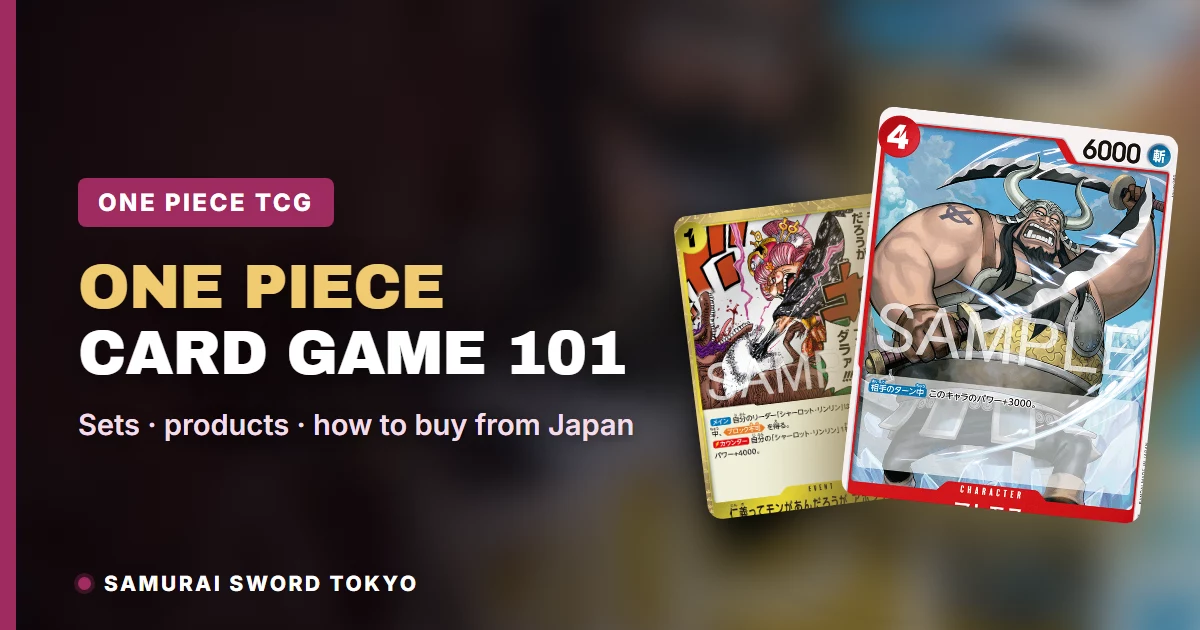
The One Piece Trading Card Game has run for four years across seventeen main sets, and it started as a niche import out of Japan. If you have seen the name “One Piece Card Game” on a booster box, a Discord server, or a friend’s binder, the short version is that it is Bandai’s trading card game built around Eiichiro Oda’s One Piece manga.
The One Piece Card Game is published by Bandai. It launched in Japan with OP-01, Romance Dawn, and in English about four and a half months later. Bandai’s numbering runs main boosters OP-01 through OP-17, The World’s Strongest Warriors, alongside Extra Booster (EB), Premium Booster (PRB) and Starter Deck (ST) side series. We ship the sealed Japanese boxes out of Tokyo with tracked delivery.
- Set reference: OP-17 card list.
- Sealed Japanese One Piece booster boxes are listed on our store as of this update.
USD figures convert at ¥154/USD, approximate.
What Is the One Piece Trading Card Game?
The One Piece Card Game is a physical trading card game published by Bandai, built around Eiichiro Oda’s One Piece manga and anime. Players build decks led by a single Leader card and battle using Character, Event and Stage cards, spending DON!! cards as the game’s resource system.
Bandai launched the game in Japan on 22 July 2022 with the first main set, OP-01 “Romance Dawn.” An English-language version followed on 2 December 2022, and the two release calendars have run on separate schedules ever since — Japanese sets consistently arrive first, which is the whole reason a market for importing sealed Japanese product exists.
The set list also takes in several side series and dozens of promotional cards. The seventeenth main set is OP-17, “The World’s Strongest Warriors” (世界最強の戦士), which released in Japan on 22 August 2026, with its English edition following on 28 August 2026.
Product Types: Booster Boxes, Starter Decks, Extra Boosters & Promos
Bandai’s own product listings group everything into three categories: Boosters, Decks, and Other (accessories and promo items). In practice, that breaks down into product lines you’ll see repeated across the set list:
- Booster boxes — the main numbered series, OP-01 through OP-17. Each box contains sealed packs.
- Starter decks (ST) — pre-built, ready-to-play decks aimed at new players. Bandai’s ST-31 through ST-36 wave released on 11 July 2026. See our starter decks guide for that pre-built route.
- Extra Boosters (EB) — a side series numbered separately from the main OP line (EB-01 through EB-04 as of August 27, 2026), typically built around a theme or anniversary rather than continuing the main story arc.
- Premium Boosters (PRB) — curated “best of” releases (PRB-01, PRB-02) that reprint chase cards from across multiple earlier sets in one box, aimed at collectors who don’t want to chase individual older sets.
- Promo cards — cards distributed through events, tournaments, magazines or retail campaigns rather than sold in booster boxes. These sit outside the numbered set structure entirely.
How One Piece Card Sets Are Numbered
Once you know the prefix system, the whole catalog reads clearly:
| Prefix | Series | Example |
|---|---|---|
| OP-XX | Main numbered booster | OP-17, The World’s Strongest Warriors |
| EB-XX | Extra Booster (side series) | EB-01 through EB-04 |
| PRB-XX | Premium Booster (curated reprint box) | PRB-01, PRB-02 |
| ST-XX | Starter Deck | ST-31 through ST-36 (11 July 2026) |
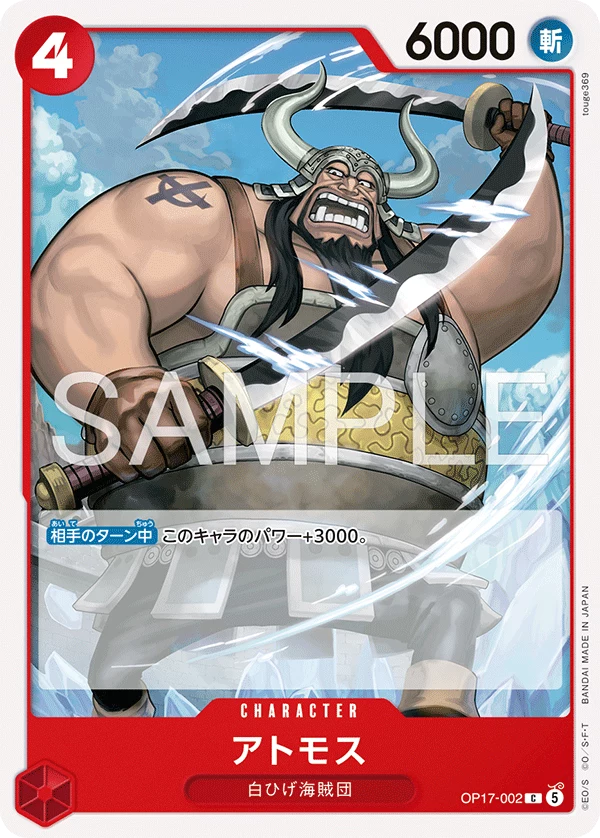
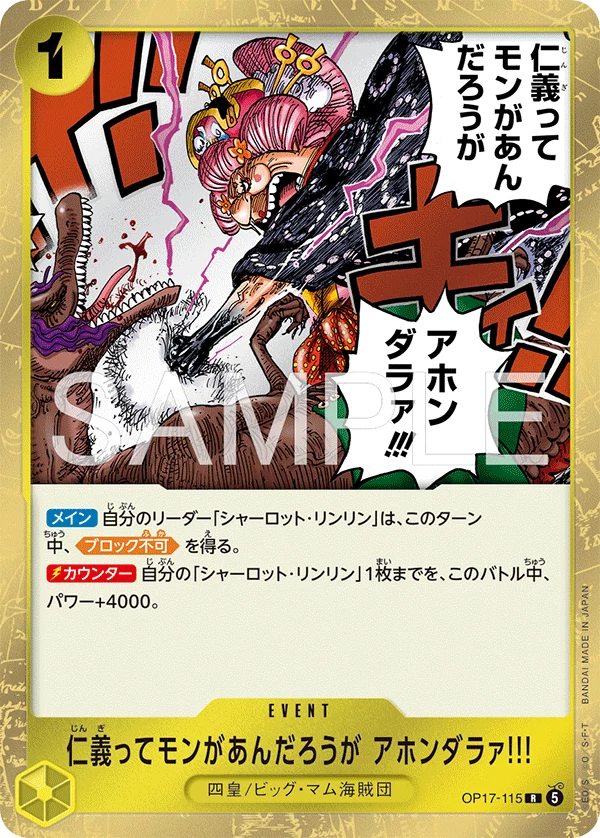
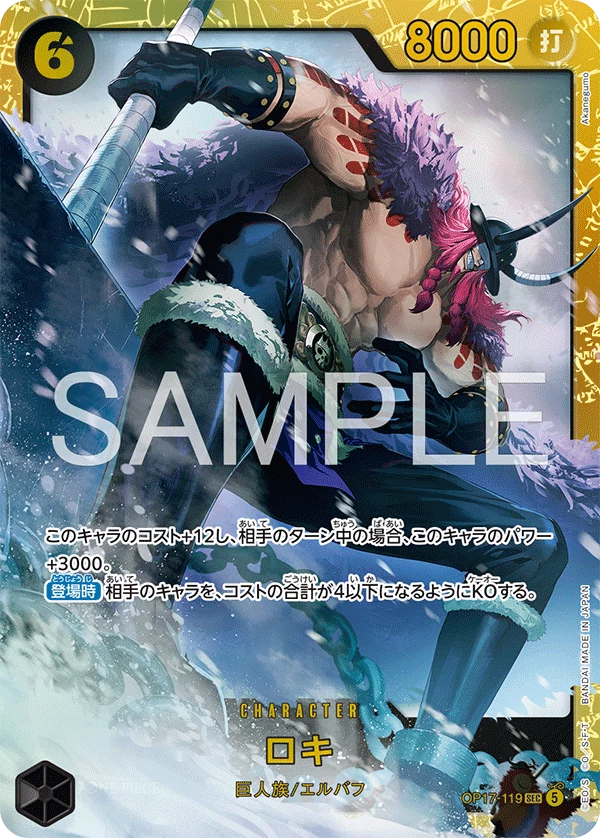
Within a set, individual cards are numbered too — for example OP17-001 through the end of the main list, with Secret Rare (SEC) as Bandai’s top printed rarity.
For the full run of main sets in release order, see our One Piece card sets in order guide, and for a rarity-by-rarity breakdown of what L, C, UC, R, SR and SEC actually mean, see One Piece card rarity explained.
How to Buy One Piece Cards from Japan
We ship sealed Japanese One Piece Card Game product worldwide out of Tokyo, with tracked delivery on every order.
The OP-16 The Time of Battle Japanese booster box is currently listed at ¥10,437 (~$68).
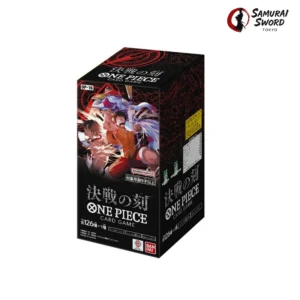
The OP-17 The World’s Strongest Warriors Japanese booster box sold out at the time of this update — sourcing requests go through Quick Order. Other sets are in our One Piece card box collection, and our One Piece booster box guide goes deeper on what’s inside each box if you’re comparing sets before buying.
A Starter Path: Where to Begin
If you’re new to the game, the simplest path is to learn the rules first. Our how to play the One Piece Card Game guide covers Leaders, DON!!, Life, and the basic turn structure in beginner terms — read that first if the rules are new to you.
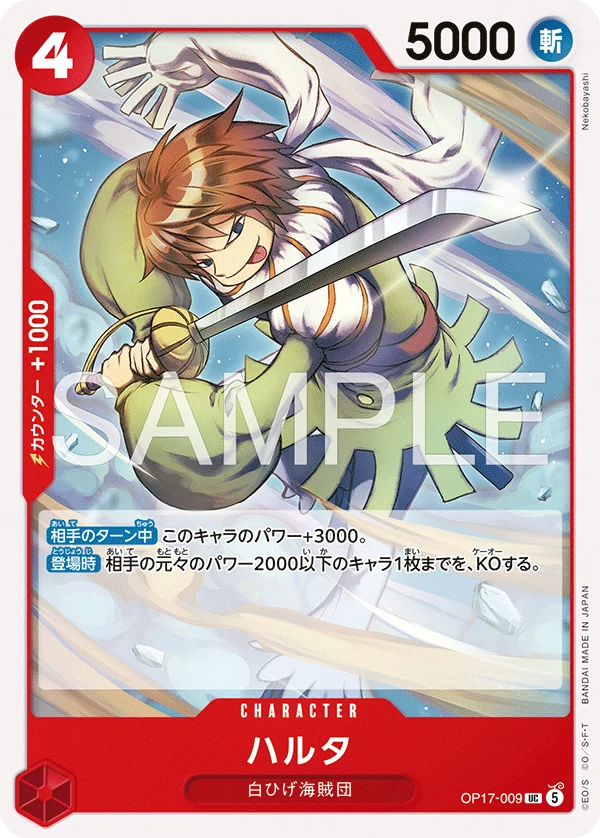
From there, a booster box is the way to open packs of the set you want to play; the OP-17 main list includes Characters such as Haruta (OP17-009).
Once you know which characters and colours you gravitate toward, our rarest One Piece cards guide and the full OP-17 card list are useful next stops for chasing specific pulls rather than buying blind.
Frequently Asked Questions
Who makes the One Piece Card Game?
Bandai publishes the One Piece Card Game, based on Eiichiro Oda’s One Piece manga and anime.
What’s the difference between a booster box, a starter deck, and an Extra Booster?
A booster box is the main numbered series (OP-XX) made up of randomised packs. A starter deck (ST-XX) is a fixed, pre-built deck aimed at new players. An Extra Booster (EB-XX) is a separate side series, often themed or built around reprints and exclusive alternate art rather than continuing the main story arc.
How are One Piece card sets numbered?
Main boosters use the OP-XX prefix (currently OP-01 through OP-17). Side series use their own prefixes: EB (Extra Booster), PRB (Premium Booster), and ST (Starter Deck). Within a set, Secret Rare cards are numbered beyond the main card list rather than within it.
How do I buy One Piece cards from Japan?
We ship sealed Japanese One Piece Card Game booster boxes worldwide from Tokyo with tracked delivery. Sealed Japanese One Piece booster boxes are in our One Piece card box collection.
Picked for this article
📩 Get member-only sale alerts & coupons
Sale alerts, coupons and restock notices by email — straight from Tokyo.