Use the PSA Population Report to find the exact Japanese card printing before comparing its grade counts. The Pokémon name alone is rarely enough. Year, set, number, language and variety can separate entries that look similar in a seller’s title.
A population figure describes PSA’s records. It does not tell you the manufacturer’s print run, how many copies survive worldwide or the chance that your raw card will earn PSA 10. This guide explains the lookup, the distinctions to preserve and a simple calculation you can use without turning it into a grading prediction.
Match the printing first, grade second. Save the exact entry and observation date. Keep ordinary grades, half grades, qualifiers and Authentic designations distinct. A calculated PSA 10 share describes the records you counted; it is not a guarantee about the next card submitted.
Official public explanations checked September 20, 2026. Our access check at the report’s current entry points led to Collectors sign-in; the instructions below follow PSA’s published guidance, not a walkthrough of a signed-in session. No live card population is quoted.
Start a Specific Japanese-Card Search
Start at the official PSA Population Report. Complete the normal sign-in flow if requested. PSA’s public report introduction offers category-and-year browsing, including TCG Cards, as well as searches for particular sets or subjects.
The published search help recommends detailed terms, including the card number. It names Show Population for an item’s counts and View Set for the wider set. Follow the options available in your session; their screen positions may change.
- Write down the language, release year, set and printed number from your card or listing.
- Search using the name plus year and number. Add the set when results remain ambiguous.
- Inspect the complete result description before opening its population. A similar thumbnail is not enough.
- If the result is missing, broaden one term at a time, then compare the set’s entries. A failed search is not evidence of a zero population.
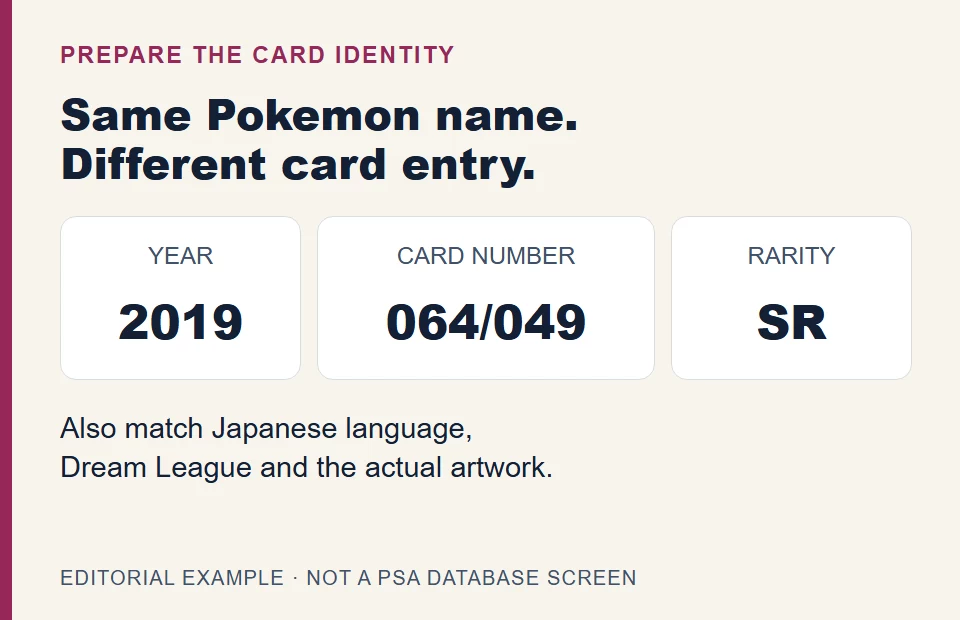
Keep the query concise enough to adjust. A marketplace title may include a grade, sales language or seller-specific nickname that is not part of the card’s identification. Remove those extras when they obscure the year and number.
Match the Year, Set, Number and Variety
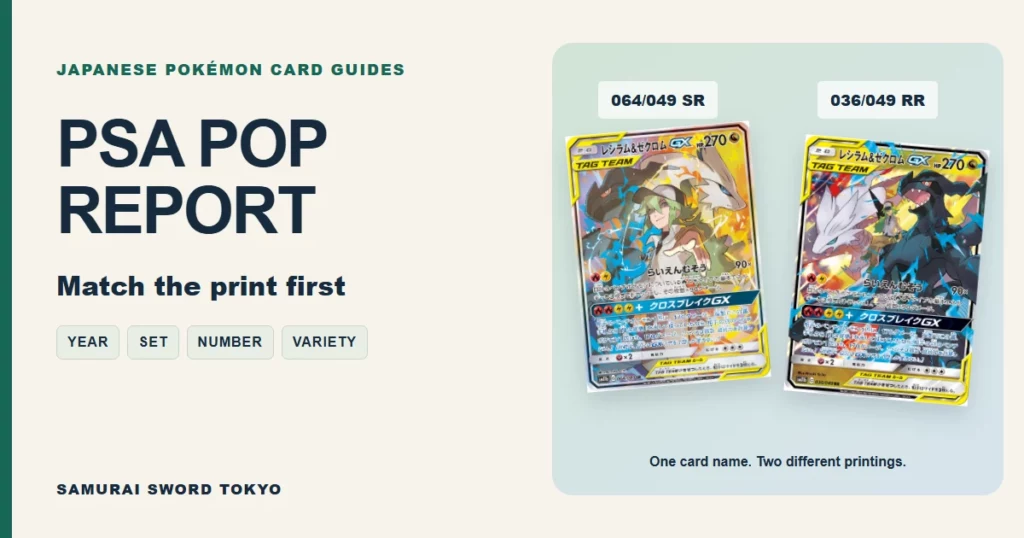
Reshiram & Zekrom-GX illustrates the problem. The official Japanese entries identify 064/049 SR and 036/049 RR in SM11b Dream League. Both feature N and credit Naoki Saito, but they have different illustrations and numbers.
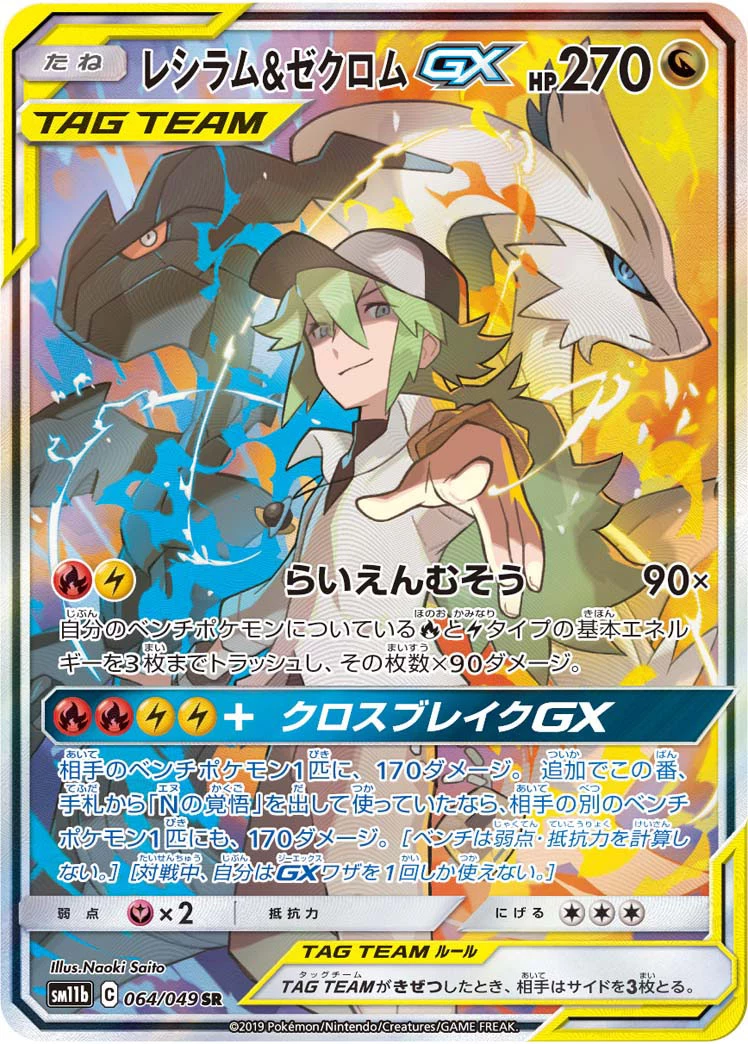
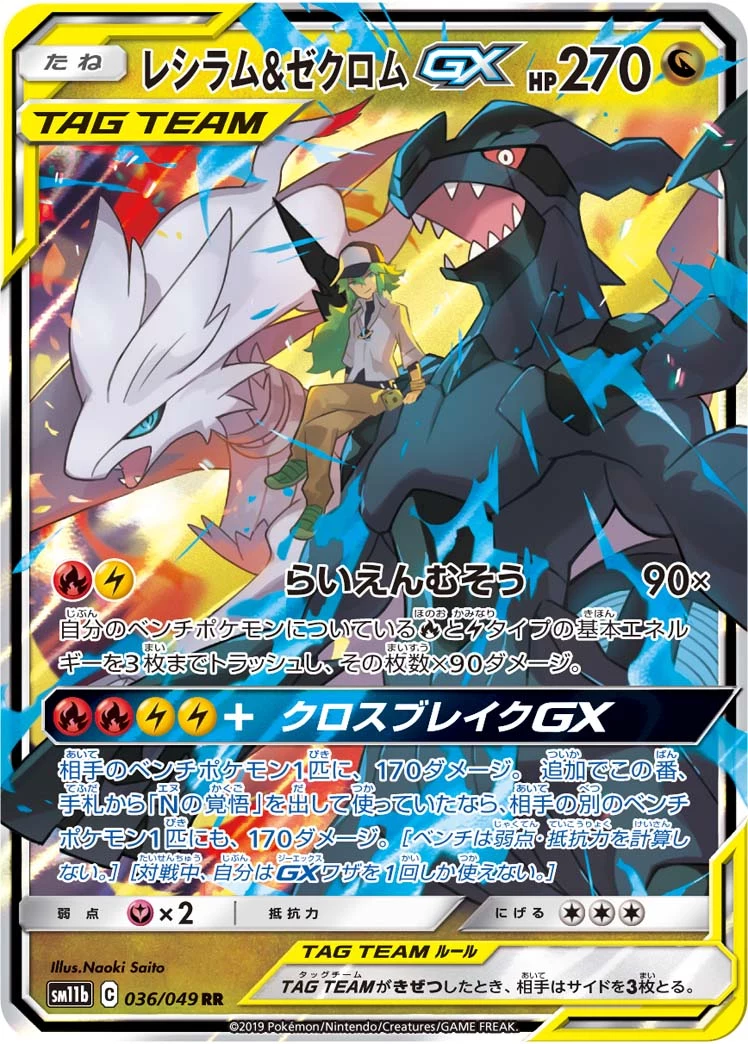
For the first card, 2019 Reshiram Zekrom 064 is a reasonable starting query based on the card’s identity. It is a search suggestion, not a claim that PSA uses that exact title. Retain the full 064/049 number in your notes and compare the returned description with the card.
| Match this detail | Why it matters |
|---|---|
| Language and release year | Japanese and English releases may use different set names, numbers or dates. |
| Set and complete card number | A repeated Pokémon name does not identify one print. |
| Artwork and variety wording | Check any edition, stamp or finish description instead of assuming it is interchangeable. |
| Grade and qualifiers | A PSA 9 count is a different observation from a PSA 10 count. |
Do not merge entries simply because their names resemble each other. Our Reshiram & Zekrom-GX comparison explains the two illustrations in detail. Neither image above is evidence of a particular slab or population figure.
Read the Grade Lines Before Adding Numbers
PSA’s population notes distinguish three mutually exclusive lines:
| Line | What PSA’s notes include |
|---|---|
| Grade | Whole-number grades 1–10 and Authentic designations |
| + | Half-point grades 1.5–8.5 |
| Q | Qualified grades, with a noted condition exception |
An Authentic entry is not a numerical PSA 10. A half-point line is not a second copy of the whole-number line. Read the headings and the total’s scope before summing anything; record which categories your denominator includes.
Keep a short observation record: the entry URL, full description, chosen grade, counts, included categories and date. Save a screenshot for your own comparison when accessible. Without those details, two collectors can quote different totals while referring to different rows or definitions.
What Population Counts Can and Cannot Tell You
PSA’s original explanation of the report describes records entering after grading and certification. Consequently, a count is not the number of parcels submitted, cards waiting in a queue or every copy manufactured. It also does not count raw cards or another grading company’s holders as PSA records.
PSA’s discussion of population context warns that a low figure can reflect limited submissions or newly recognized varieties. A card may have a small graded population because few owners chose to submit it. Low pop alone therefore does not establish a low print run or a reason to pay a premium.
Labels can also become more specific over time. In its 2006 T206 labeling announcement, PSA explained that older records could remain without a newly recognized back designation until relabeling. That is a documented historical example, not a claim that a particular Pokémon entry has the same issue.
Use that lesson when encountering separate labels: investigate their meaning before adding or comparing them. A total in a grading database is not, by itself, a verified census of distinct cards still surviving in collectors’ hands. Nor is it the number currently offered for sale.
Calculate a PSA 10 Share: An Illustrative Example
The following numbers are fictional teaching values. They are not a live PSA population for any card.
| Defined example | Records |
|---|---|
| Numerically graded, unqualified records in the selected sample | 200 |
| PSA 10 records within that same sample | 80 |
| PSA 10 share: 80 ÷ 200 | 40% |
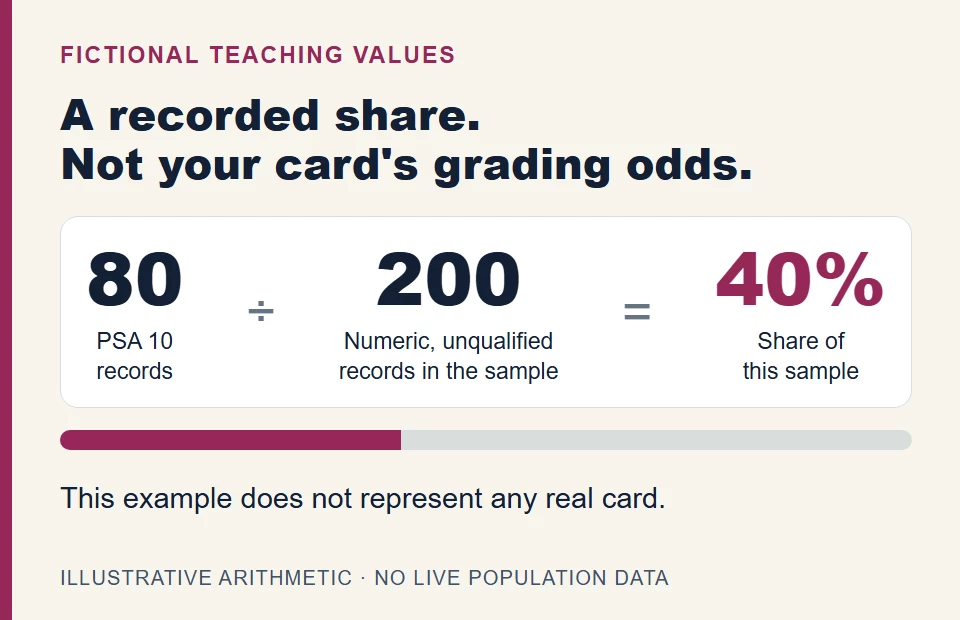
This calculation answers one question: what share of the defined sample received that grade? It does not mean your card has a 40% chance of grading PSA 10. Submitted cards are selected by their owners, not randomly sampled from all surviving copies, and your card has its own condition.
PSA’s grading standards consider the individual card’s attributes, including centering, corners and surface. Population arithmetic cannot inspect those features. Changing the denominator to include Authentic or qualified entries would also change what the percentage describes, so state the scope every time.
Use the Result When Comparing a Purchase
A useful buying note identifies the card first, then the observation: printing, language, grade, report entry and date. Compare prices separately using equivalent condition and selling terms. Population is not a sold-price database and does not establish a guaranteed future price.
For a particular slab, use PSA Cert Verification with its certification number and compare the returned details with the offered item. PSA cautions that a valid number alone cannot authenticate a physical listing; request clear photographs of the actual slab as well.
For the illustrated example, check our separate SR 064/049 (update: currently sold out — restock requests via Quick Order) and RR 036/049 (update: currently sold out — restock requests via Quick Order) product pages for current offers and availability. Browse the PSA 10 collection or use Quick Order for an exact-print sourcing request. A low population claim should never replace checking the item you are buying.
Frequently Asked Questions
How do I search for a Japanese Pokémon card in the PSA Population Report?
Start with the official report and use specific identity details such as the name, year and card number. Check the full result against the language, set, artwork and variety. Sign in if the current entry point requests it.
Does no search result mean the PSA population is zero?
No. The query may not match the entry’s wording, or access or loading may be incomplete. Check the set and card identity before making a population claim.
Is PSA population the same as the number of cards printed?
No. It describes PSA’s recorded population, not a manufacturer’s print run, raw copies, other companies’ graded cards or all surviving copies worldwide.
Why can similar card descriptions appear under different labels?
Language, edition, finish or other recognized varieties can distinguish entries. PSA has also changed how some varieties are labeled over time. Check the exact descriptions before combining counts.
Does a 40% PSA 10 share mean my raw card has a 40% chance?
No. In this guide, 80 out of 200 is a fictional arithmetic example. A share among selected grading records is not the probability for another card, whose actual condition must be assessed.
Can I use a population count to verify a specific slab?
Use PSA Cert Verification for the individual certification record and compare it with actual item photographs. The population report answers an aggregate-count question, and a matching certification number alone does not prove a physical listing is genuine.
Get ¥2,000 in points with a free account
Create free account1 pt = ¥1 · Use on up to 20% of your order total · Welcome points expire 30 days after sign-up · Import duties, taxes and customs charges are not included in the price and are collected on delivery, except for destinations we ship duty-paid.
Picked for this article

📩 Get member-only sale alerts & coupons
Sale alerts, coupons and restock notices by email — straight from Tokyo.