Every Japanese Pokemon card printed before Pokémon VS shares one thing in common: flip it over, and the back looks nothing like the cards Japan has printed for the last twenty-plus years. Collectors call these Old Back Pokemon cards — the earliest tier of Japanese vintage Pokemon cards — and the term covers the entire opening act of the Japanese Pokemon TCG, from the game’s debut through the last releases before the back design changed for good.
“Old Back” refers to Japanese cards printed from the TCG’s launch until the switch to the current back design, introduced with the Pokémon VS release.
- Set reference: Japanese Pokemon card list.
- Graded vintage Japanese Pokemon singles are listed on our store as of this update.
USD figures convert at ¥154/USD, approximate.
What Makes Old Back Pokemon Cards Different
The Japanese Pokemon Trading Card Game launched in October 1996, originally published by Media Factory. “Old Back” (旧裏, kyū-ura) is the collector term for the card-back design used from that launch until the release of Pokémon VS.
The distinguishing features of the Old Back design are specific and checkable on the card itself: the text reads “ポケットモンスターカードゲーム” (Pocket Monsters Card Game), a copyright notice runs along the bottom of the card, and the red upper portion of the Poké Ball artwork appears as a separate illustration rather than blending into the rest of the ball. If a Japanese card in your hand shows all three of those, it’s an Old Back print.
Old Back status is about the card back, not the set or the year alone. The safest way to confirm a card is Old Back is to check the back design directly against the description above, rather than assuming from the set name.
The Back-Design Switch: Pokémon VS
The back design changed on July 19, 2001, with the release of Pokémon VS. From that point forward, Japanese card backs matched the design used internationally: the text simply reads “Pokémon,” the copyright notice is removed, the overall design uses more color, and the Poké Ball’s button is positioned differently than on the Old Back print. The following Pokémon Web release (October 2001) and the “Base Expansion Pack” — the Japanese release that corresponds to the English-language Expedition Base Set (December 2001) — both carried this same new back rather than introducing it. That design has continued essentially unchanged from Pokémon VS through every Japanese set released since, including Scarlet & Violet-era product.
In other words, every Japanese Pokemon card printed for the last two-plus decades shares one back design, and everything before Pokémon VS shares a different one. That single dividing line is what “Old Back” refers to.
Old Back vs. 1st Edition: Where They Actually Overlap
Because Old Back and the Japanese 1st Edition (1ED) stamp are both artifacts of the same window, it’s easy to assume they mix and match freely. They don’t — and the actual relationship is simpler than two unrelated timelines:
- The back-design switch and the 1st Edition stamp system both began with the same release: Pokémon VS — the first Japanese expansion to carry the new back design and, at the same time, the first to include 1st Edition prints.
- Because of that, the two systems don’t overlap chronologically. Every Old Back card, by definition, predates Pokémon VS — so it predates the 1st Edition stamp system too.
An Old Back card never carries a 1ED stamp. The 1st Edition system ran for roughly fifteen years after Pokémon VS, across every set with the new back design — but by the time 1ED stamps existed, Old Back had already ended. For the full story on how the 1ED stamp works, how long it ran, and how it compares to the English WOTC version, see our Japanese 1st Edition cards guide.
Old Back PSA 10 Cards: Celebi, Machamp and Wartortle
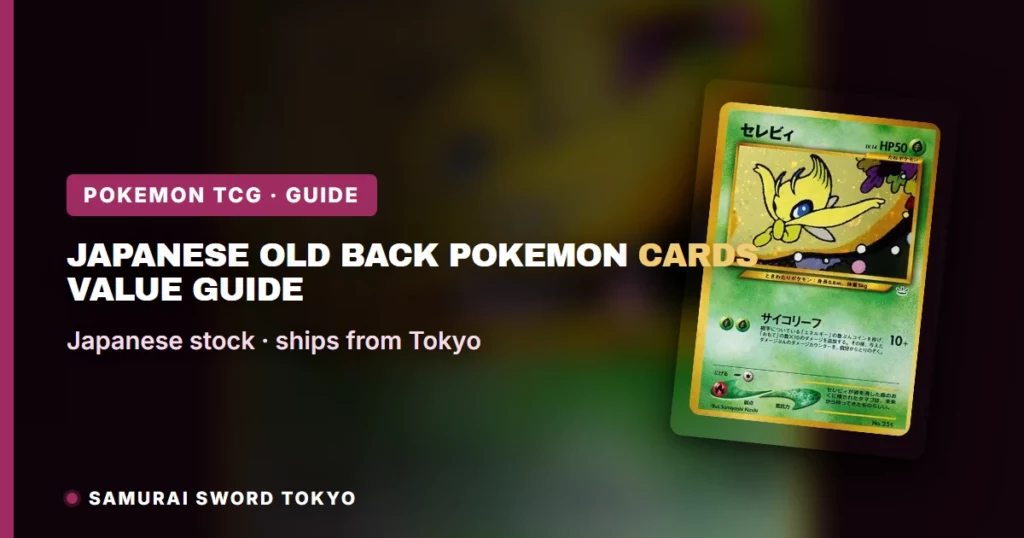
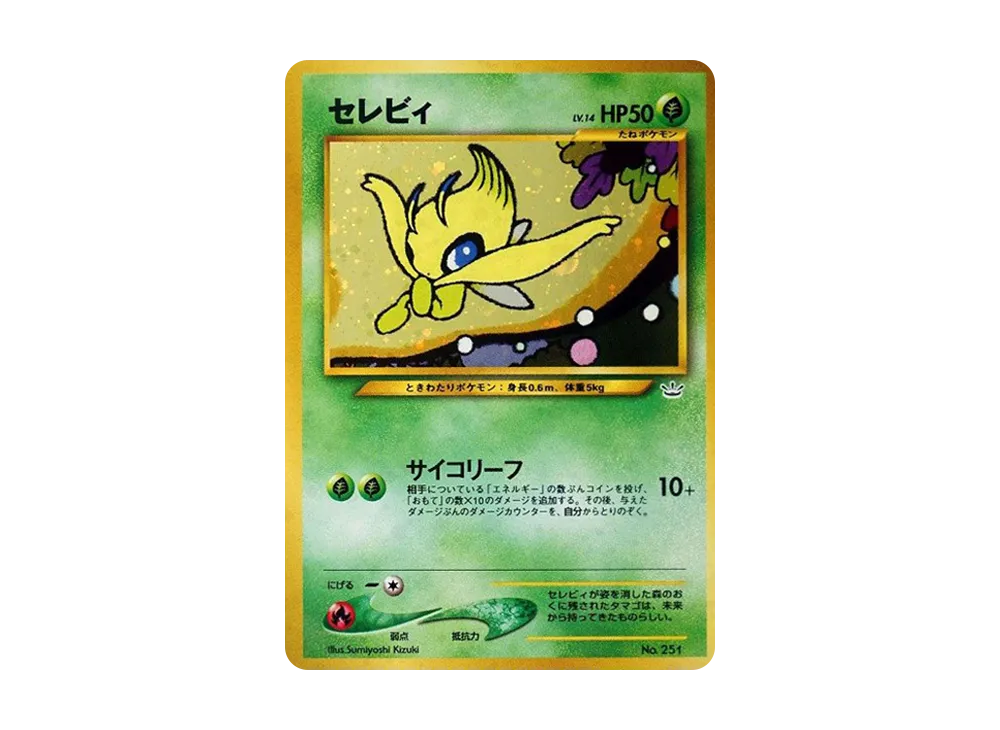
Celebi: Old Back, catalogued as PRMF-3 No.251, from Premium File 3, is graded PSA 10 and currently listed at ¥468,000 (~$3,039) (update: currently sold out — restock requests via Quick Order).
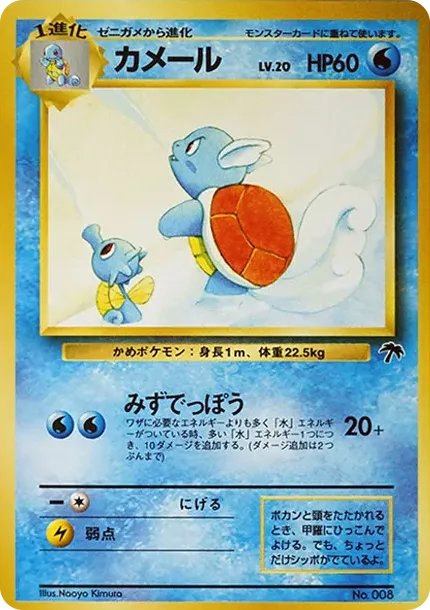
Giovanni’s Machamp and Wartortle are two more Old Back prints graded PSA 10. Giovanni’s Machamp is a Team Rocket-era Old Back print; see our Team Rocket Japanese Pokemon cards guide and PSA 10 Team Rocket cards guide for more. Wartortle is covered further in our Squirtle & Blastoise cards guide.

| Card | Catalog number |
|---|---|
| Celebi: Old Back (update: currently sold out — restock requests via Quick Order) | PRMF-3 No.251 |
| Giovanni’s Machamp R: Old Back | PMCG-G2 No.068 |
| Wartortle: Old Back | PMCG-P No.008 |
On September 23, 2026, the lowest asking prices on SNKRDUNK were ¥240,000 for the Celebi print in PSA 10, ¥3,500 raw and ¥110,000 in PSA 10 for Giovanni’s Machamp, and ¥130,000 for the Wartortle print (PMCG-P No.008) in PSA 10.

30 Years of Old Back Collecting
The Japanese Pokemon TCG reaches its 30th anniversary in October 2026, counting from the TCG’s launch. Old Back cards represent nearly the first five years of that run — the entire window before the back design and the wider card ecosystem shifted to the format the game has used ever since.
For context on where a card like the Premium File 3 Celebi sits against the rest of the current Japanese market, our most valuable Japanese Pokemon cards guide covers a broader range of chase cards across eras, old and new. For Celebi’s other Japanese printings, see our best mythical Pokemon cards guide.
Grading Old Back Cards
Getting a card from this era to a PSA 10 grade is itself worth understanding — a quarter-century-old card surviving in gem-mint condition is a different proposition than grading something printed last year. PSA 10 designates Gem Mint condition per PSA’s published grading standards. Our Japanese Pokemon card grading guide covers how PSA grades vintage Japanese product and what separates a 9 from a 10 at this age.
Where to Buy Old Back Cards from Japan
We ship graded Japanese singles from Tokyo:
- Celebi: Old Back, PSA 10 (Neo Premium File 3, PRMF-3 No.251) (update: currently sold out — restock requests via Quick Order)
- Giovanni’s Machamp R: Old Back, PSA 10 (PMCG-G2 No.068) — currently listed at ¥101,650 (~$660)
- Wartortle: Old Back, PSA 10 (PMCG-P No.008) sold out at the time of this update — sourcing requests go through Quick Order
- Browse the wider graded lineup on our PSA 10 collection
Frequently Asked Questions
What does “Old Back” mean for Japanese Pokemon cards?
It refers to Japanese cards printed from the TCG’s launch until the Pokémon VS release, distinguished by a specific card-back design: “Pocket Monsters Card Game” text, a copyright notice along the bottom, and a red upper Poké Ball section shown as a separate illustration.
When did the Old Back design change?
It changed with the release of Pokémon VS. The new back — “Pokémon” text, no copyright notice, more color, a repositioned Poké Ball button — has continued through every Japanese set released since, including the Pokémon Web and Base Expansion Pack releases that followed it.
Is Old Back the same as Japanese 1st Edition?
No, but they’re closely linked: both began with the same release, Pokémon VS, which introduced the new card back and the first 1st Edition stamps at the same time. Because Old Back cards by definition predate Pokémon VS, they predate the 1st Edition stamp system too — an Old Back card never carries a 1ED stamp.
What is the Celebi: Old Back card from Premium File 3?
A standalone promo, catalogued as PRMF-3 No.251, distributed through Neo Premium File 3. It marks Celebi’s first appearance in the Pokemon TCG, printed as a holo in that release.
Which sets do the Giovanni’s Machamp and Wartortle Old Back prints come from?
Giovanni’s Machamp R comes from the Gym Expansion “Challenge from the Darkness,” a Team Rocket-era Old Back release. Wartortle is an Old Back promotion card from the Southern Island movie release commemoration.
Picked for this article

📩 Get member-only sale alerts & coupons
Sale alerts, coupons and restock notices by email — straight from Tokyo.