Full card list: Storm Emeralda (M6) card list → every card by number with rarity, individual card pages and in-stock PSA 10 prices.
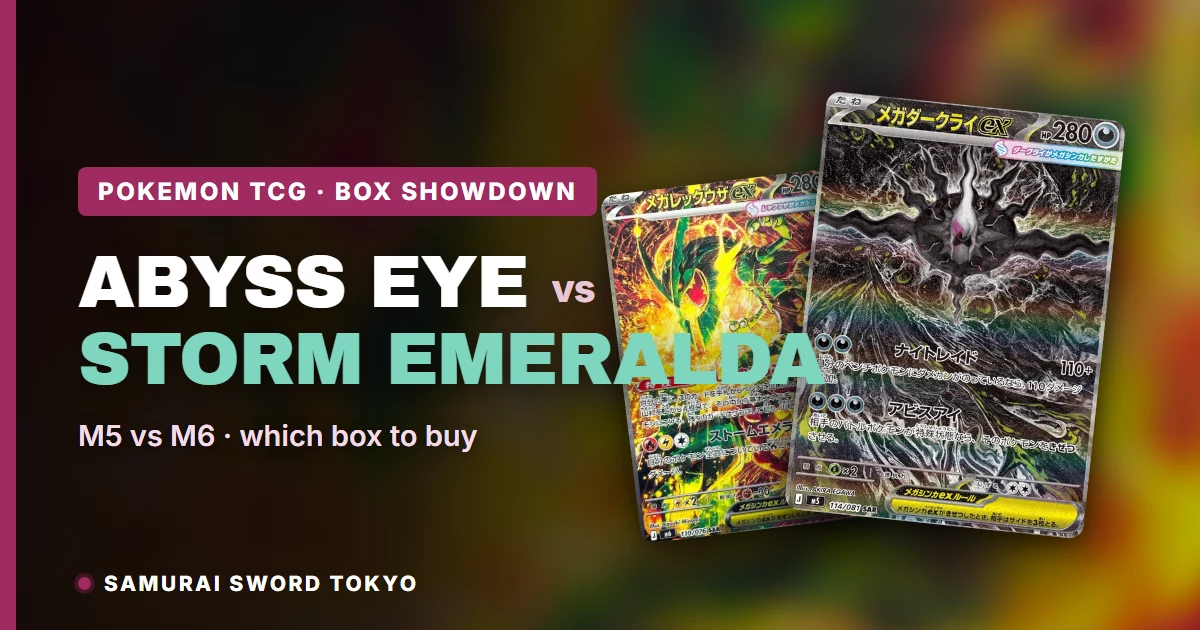
Two Mega-series boxes, both currently on the shelf, and a price gap of more than double between them. One question keeps coming up: is the pricier box actually worth it, or is the cheaper set the smarter buy?
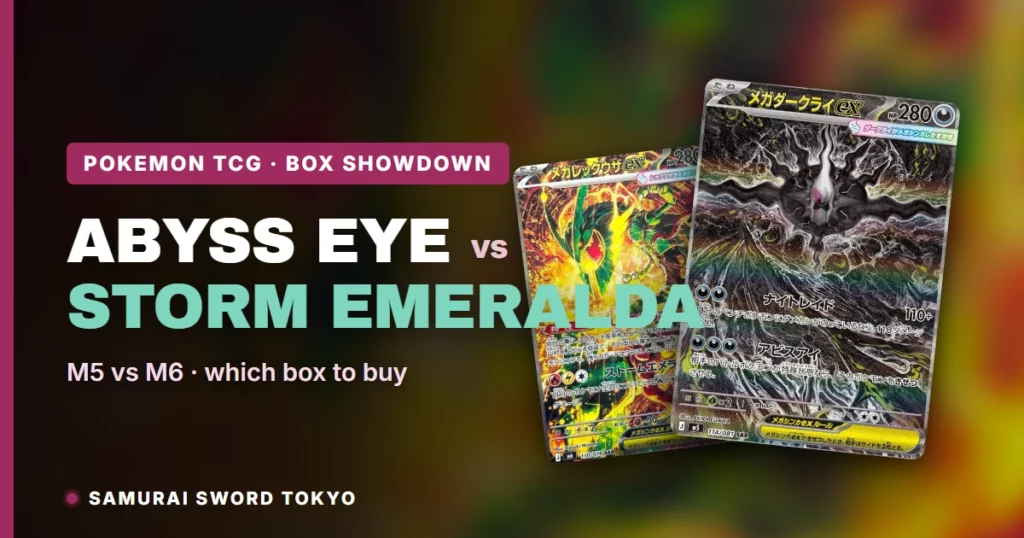
M5 Abyss Eye and M6 Storm Emeralda are the two most recent MEGA-era Japanese sets, released about ten weeks apart in 2026. Abyss Eye introduced Mega Darkrai ex; Storm Emeralda answered with Mega Rayquaza ex as its headline pull. Both are live in the Japanese market right now — nothing here is a pre-order. This guide lines the two boxes up side by side: what’s in each set, how the two headline chase cards compare, what the price gap actually buys, and which one fits your budget and goals. Every price below comes from the Japanese market we source and ship out of Tokyo.
Both sets are currently listed direct from Tokyo: M5 Abyss Eye from ¥7,600, or M6 Storm Emeralda from ¥16,800 — roughly a 2.2x gap that this guide breaks down card by card below.
M5 vs M6 at a Glance
Both sets belong to the same MEGA-series era and share a similar structure — a large base set topped with a tier of secret rares built around one headline Mega ex. Here’s how the basics line up:
| M5 Abyss Eye | M6 Storm Emeralda | |
|---|---|---|
| Japan release date | May 22, 2026 | July 31, 2026 |
| Total cards | 118 | 113 (76-card base + 37 secret rare) |
| Headline Mega ex | Mega Darkrai ex (Darkness) | Mega Rayquaza ex |
| Top chase print | Mega Darkrai ex, Special Art Rare & Mega Ultra Rare | Mega Rayquaza ex, Special Art Rare & Mega Ultra Rare |
| SST box price | currently listed from ¥7,600 | currently listed from ¥16,800 |
M5 has been in the market for about three months and its pricing has had time to settle; M6 released more recently and is still finding its level. For the full rundown of each set individually, see our M5 Abyss Eye guide and our M6 Storm Emeralda card list. For sealed product from other current and vintage Japanese sets, browse our full card list hub.
The Chase Card Showdown: Mega Darkrai ex vs Mega Rayquaza ex
Each set builds its entire secret-rare tier around one Pokemon printed twice — once as a Special Art Rare, once as the set’s top Mega Ultra Rare. Here’s what each one actually does on the field:
| Card | Number | Rarity | Set | Highlights |
|---|---|---|---|---|
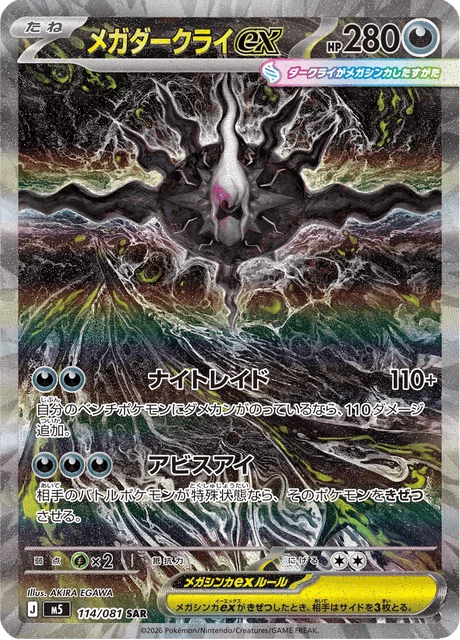
| Mega Darkrai ex | 114/118 | SAR | M5 Abyss Eye | 280 HP, Darkness · “Night Raid” for 110+ damage · “Abyss Eye” can instantly knock out the opponent’s Active Pokemon under a special condition (secondary prices not documented in this guide) |
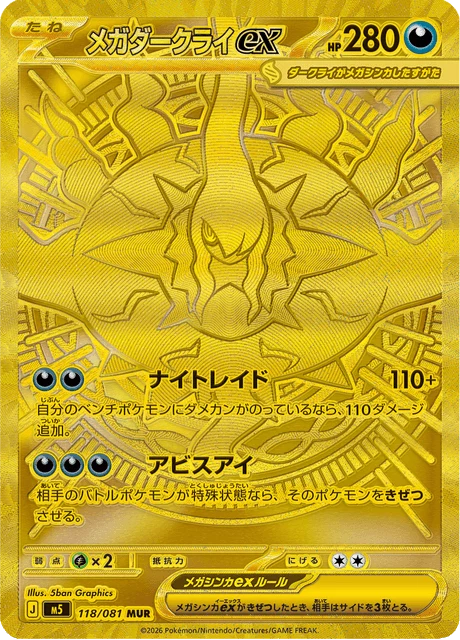
| Mega Darkrai ex | 118/118 | MUR | M5 Abyss Eye | Same 280 HP stat line as the SAR print, in the set’s top Mega Ultra Rare treatment |
| Mega Rayquaza ex | 110/076 | SAR | M6 Storm Emeralda | ¥138,000 (~$850), day-one Japanese secondary-market price |
| Mega Rayquaza ex | 113/076 | MUR | M6 Storm Emeralda | ¥298,000 (~$1,830), day-one price — the gold top card of the set |
Mega Darkrai ex’s calling card is its kit — a 110+ damage attack backed by a special-condition instant knockout, the kind of card built for the table as much as the binder. Mega Rayquaza ex’s calling card is the number: at ¥298,000 on release day, the MUR carried the highest price documented between these two sets in this guide, and the SAR at ¥138,000 wasn’t far behind. Those two figures are day-one Japanese secondary-market prices from our own release coverage; secondary prices move fast in the first weeks after any set drops, so treat them as a snapshot rather than a floor.
M5’s chase: Mega Darkrai ex
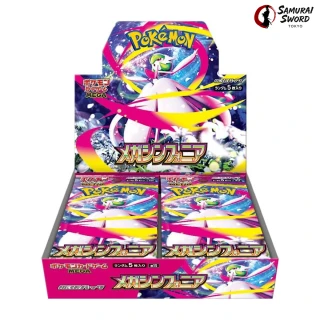
M6’s chase: Mega Rayquaza ex
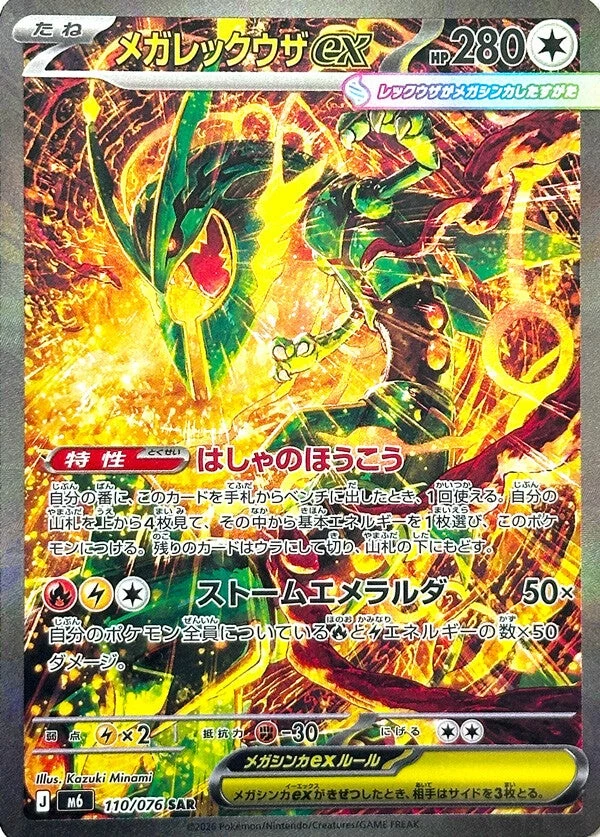
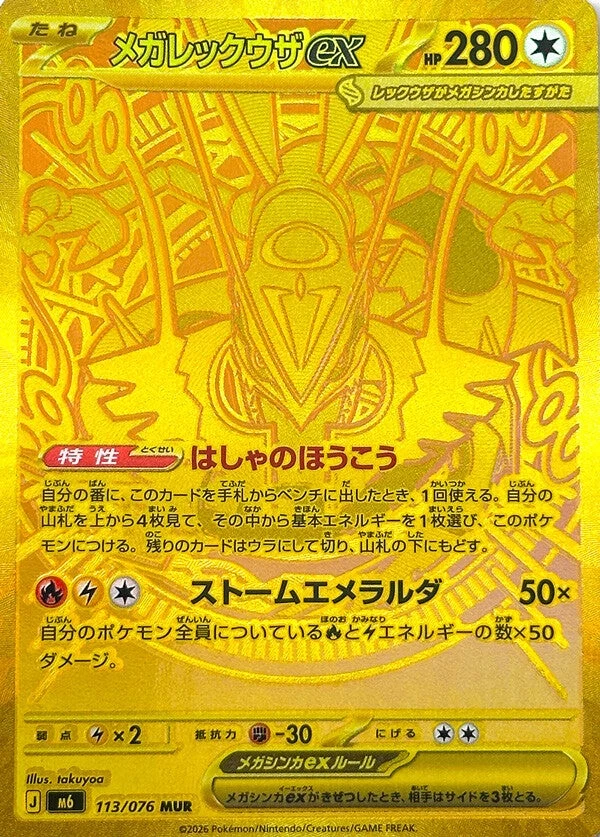
For the complete pull-order breakdown of each set, see our M5 Abyss Eye pull rates guide and our M6 Storm Emeralda pull rates guide.
Pull Rates: What the Community Data Says
Neither set has official pull rates published by The Pokemon Company — nobody does, for Japanese sets. What exists is community-reported, aggregated opening data across the recent MEGA-series releases, M5 Abyss Eye included, and it points to a consistent pattern across both boxes:
| Rarity tier | Estimated rate per box | What that means |
|---|---|---|
| SAR Special Art Rare | ~1 per 2–3 boxes | Roughly a coin flip per box, either set |
| MUR Mega Ultra Rare | ~1 per 50–100 boxes | Case-level odds, not box-level, either set |
This is the same MEGA-series estimate published in our M6 release coverage, and it was built in part from Abyss Eye opening data — so the same rough odds apply whether you’re chasing Mega Darkrai ex or Mega Rayquaza ex. The practical read: a single box of either set gives you a realistic shot at the SAR print, and no realistic shot at all at the MUR. If the MUR is the actual goal, buying single boxes is the wrong tool for the job regardless of which set you pick.
Community-reported, unofficial figures aggregated from opening data on comparable MEGA-series product. Real boxes vary, and neither Pokemon set publishes exact odds.
The Price Gap: What ¥7,600 vs ¥16,800 Actually Buys You
At current SST listings, M6 Storm Emeralda (from ¥16,800, about $103 at ¥163/USD) runs roughly 2.2x the price of M5 Abyss Eye (from ¥7,600, about $47). That’s not a small gap, and it’s worth understanding what drives it before deciding which one to open.
Three factors explain most of it. First, timing: M6 released about ten weeks after M5, and newer Japanese sealed product typically carries a launch premium that eases as reprint supply catches up — our M6 release coverage already shows box asks softening in the first week after launch. Second, headline value: Mega Rayquaza ex’s day-one MUR price of ¥298,000 sits well above anything documented for Mega Darkrai ex in this guide, and box pricing tends to track the ceiling value of what’s inside. Third, momentum: Storm Emeralda is the more recent, more actively traded release right now, and that shows up in the ask price independent of the underlying odds, which — as the pull-rate section above shows — are essentially identical between the two sets.
Put simply: the extra spend on M6 buys you a shot at a higher-ceiling chase card and a fresher release, not better odds. For how these two boxes stack up against the rest of the current and recent MEGA-series lineup on price, see our Japanese Pokemon MEGA booster box price index.
Which Box Should You Buy?
Both boxes are defensible buys. Which one makes sense depends on what you’re actually after:
- You want Mega Darkrai ex specifically. M5 Abyss Eye is the set built around it — its SAR and MUR prints both live here. At from ¥7,600, it’s also the lower-cost entry into the current MEGA lineup.
- You want the single highest-ceiling card in the current MEGA lineup. M6 Storm Emeralda is home to the ¥298,000 Mega Rayquaza ex MUR, day-one price. The odds are still roughly 1-in-50-to-100 per box either way — you’re buying a shot at a bigger number, not better odds.
- You’re budget-conscious or testing the format for the first time. M5 Abyss Eye at from ¥7,600 is roughly half the entry cost of M6, with three months of market history already behind it.
- You want the newest release and don’t mind price movement. M6 Storm Emeralda is the more recent set and the one still actively repricing week to week — the tradeoff for buying fresh is that the price you pay today may not be the price a month from now, in either direction.
- You can’t decide. Because the two headline Mega ex are different Pokemon in different card-power lanes (a tanky special-condition attacker versus one of the franchise’s most recognizable Legendaries), a reasonable split is one box of each rather than doubling up on either.
Where to Buy M5 and M6
We stock both boxes sealed, sourced directly from the Japanese market, and ship worldwide from Tokyo with tracked delivery.
For singles from either set, other current Japanese releases, or vintage MEGA-era boxes, browse our card list hub or build a mixed order through our Quick Order page.
Frequently Asked Questions
What’s the price difference between M5 Abyss Eye and M6 Storm Emeralda boxes?
At current SST listings, M5 Abyss Eye starts from ¥7,600 and M6 Storm Emeralda starts from ¥16,800 — roughly a 2.2x gap, driven mainly by M6’s more recent release and higher-ceiling chase card.
Which set has the higher-value chase card?
M6 Storm Emeralda. Its Mega Rayquaza ex Mega Ultra Rare carried a day-one Japanese secondary-market price of ¥298,000 (about $1,830), the highest documented figure between the two sets in this guide.
How many cards are in M5 Abyss Eye vs M6 Storm Emeralda?
M5 Abyss Eye totals 118 cards. M6 Storm Emeralda totals 113 cards across a 76-card base set plus 37 secret rares (12 Art Rare, 18 Super Rare, 6 Special Art Rare, 1 Mega Ultra Rare).
Are the pull rates different between M5 and M6?
Community-reported estimates put both sets at roughly the same odds: about 1 Special Art Rare per 2–3 boxes and about 1 Mega Ultra Rare per 50–100 boxes. These are unofficial, aggregated figures — neither set has published official rates.
Should I buy M5 Abyss Eye or M6 Storm Emeralda?
It depends on your goal. M5 is the lower-cost entry and the only source of Mega Darkrai ex. M6 carries the higher-ceiling chase card and is the more recently released, more actively traded set. The odds of hitting either set’s top card are similar, so the choice comes down to which Mega ex and which price tier you want.
Pull rates are community-reported estimates aggregated from opening data on recent MEGA-series sets and are not officially confirmed. M6 Storm Emeralda secondary-market prices are day-one snapshots (July 31, 2026, JST) at ¥163/USD; see our M6 release coverage for the latest week-one repricing direction. SST box prices reflect current listings as of this guide’s publish date.
500 Points Free on Sign-Up
CREATE FREE ACCOUNT1 pt = ¥1 at checkout · Points expire 30 days after they are earned · Import duties, taxes and customs charges are not included in the price and are collected on delivery, except for destinations we ship duty-paid.
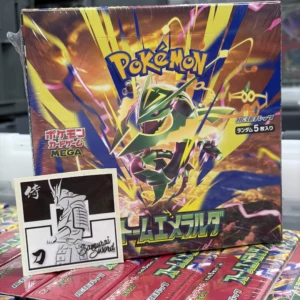
Picked for this article
📩 Get member-only sale alerts & coupons
Sale alerts, coupons and restock notices by email — straight from Tokyo.