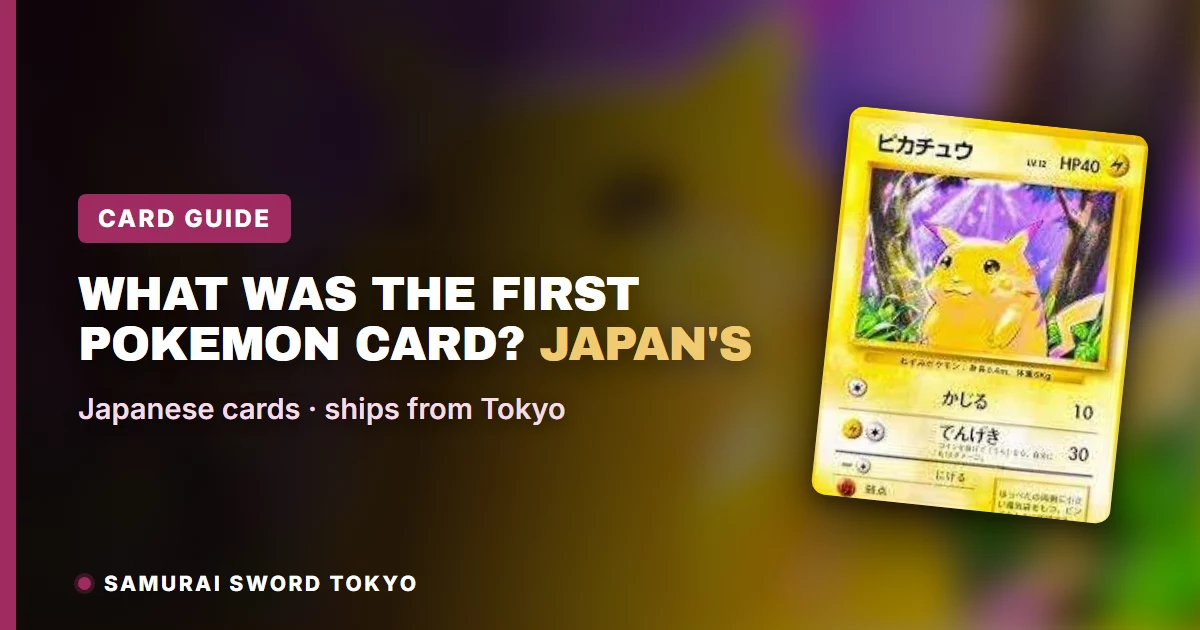
The first Japanese Pokemon card came from a single set: the Expansion Pack (拡張パック), published by Media Factory on 20 October 1996. It shipped as ¥300-plus-tax, 10-card packs, and the full set ran to 102 cards built around the original 151 Generation I Pokemon. That is the oldest Pokemon card — the actual Trading Card Game, not a lookalike collectible from the same year.
The confusion around “the oldest Pokemon card” almost always comes from one design detail: every Japanese card from 1996 through mid-2001 shares the same card back. That means a 1998 Gym card and a 2001 Neo card can look exactly as “old” as the true 1996 first print at a glance — and they routinely get mislabelled online because of it. This guide sorts out what actually dates to 1996, what only shares the look of that era, and what a genuine 1996 example is currently listed for.
The Pokemon Trading Card Game launched in Japan on 20 October 1996 with the 102-card Expansion Pack (PMCG1) from Media Factory, sold in ¥300 (+tax) packs of 10 cards. A separate Bandai Carddass line predates it by a month but has no attacks, HP, or game rules — it is not the Trading Card Game. A PSA 10 Pikachu [PMCG1-2], graded from that exact 1996 print, is currently listed at ¥915,208 (~$5,756). Everything else people call “Old Back,” including three further Old Back PSA 10 examples covered below, comes from later Gym and Neo sets that only share the card-back design — not the 1996 print date.
Yen figures below convert at ¥159/USD (September 2026). Prices are a September 2026 store snapshot — check the linked listing for the current number before ordering.
What Was the First Japanese Pokemon Card?
Ask “what was the first Pokemon card” and the precise answer is a physical product: the Expansion Pack (拡張パック), internally catalogued as PMCG1 by card databases. Media Factory published it in Japan on 20 October 1996, sold in ¥300-plus-tax packs of 10 cards, for a total set size of 102 cards drawn from the original 151 Generation I Pokemon.
That release date and pack structure line up with Bulbapedia’s Pokemon Trading Card Game entry, which records the TCG as originally published in Japan in October 1996 by Media Factory, alongside multiple Japanese-language collector sources that corroborate the exact 20 October date and ¥300 price. Treat those two specifics as well-corroborated secondary-sourced facts rather than an official Nintendo press statement.
There was no English-language version of the game yet in 1996. For that entire stretch, the Expansion Pack and its immediate Japanese follow-ups were the whole Pokemon Trading Card Game.
Carddass vs the Trading Card Game: Which Came First?
One line predates the Expansion Pack by a month, and it is the other main source of confusion around this topic: Bandai’s Carddass Pocket Monsters cards, released in September 1996. Carddass is a separate, non-TCG collectible line — the cards carry Pokemon artwork but none of the attacks, HP, or game rules that define a Pokemon Trading Card Game card.
“First Pokemon collectible card” (Carddass, September 1996) and “first Pokemon Trading Card Game card” (Expansion Pack, 20 October 1996) are two different claims about two different products. This guide, and most of what people mean when they search “oldest Pokemon card,” is about the second one.
| Line | Publisher | Release | Trading Card Game rules? |
|---|---|---|---|
| Carddass Pocket Monsters | Bandai | September 1996 | No — collectible only, no attacks or HP |
| Expansion Pack (拡張パック / PMCG1) | Media Factory | 20 October 1996 | Yes — the first Pokemon TCG set |
First Print vs Resale: The “No-Mark” Distinction
Even within the Expansion Pack itself, Japanese collectors separate two print runs of the same 102-card set. The true first print is informally called マークなし (“no-mark”), because it lacks a small rarity star that a later 再販 (resale, or reprint) run of the same cards added afterward. Both runs are the same 1996 cards from the same set — the difference is a printing detail, not a separate release. There is no verified, exact print-quantity figure for either run, so any specific count you see for the “no-mark” first print should be treated with caution.
The PSA 10 Pikachu shown above is graded from the marked 再販 (resale) print of the Expansion Pack, not the unmarked original run. It is still the same 1996 set and the same first-ever Pokemon Trading Card Game card — just from the later of the two 1996-era print passes. If you are trying to identify a raw card at home, check for that small star before assuming which of the two you are holding.
This first-print/resale split inside the 1996 set is also a different idea from “1st Edition,” a separate stamp system used on other Pokemon sets and explained in our Japanese 1st Edition Pokemon cards guide. A 1st Edition mark and the Expansion Pack’s マークなし/再販 print distinction are not interchangeable concepts, even though both describe “which print run is this.”
The “Old Back” Era: 1996–2001
Every card from the 1996 Expansion Pack through the Gym-series and Neo-series releases that followed shares one card-back design: the Japanese text ポケットモンスター カードゲーム (“Pocket Monsters Card Game”), a copyright line along the bottom, and a two-tone Poké Ball graphic. That shared back design is what “Old Back” describes — a multi-year design era running from 1996 to July 2001, not a single set. In July 2001, the “Pokemon VS” era switched to the modern card-back design still used today.
Our Japanese Old Back Pokemon cards value guide covers that whole design era across every set it spans. This article is narrower on purpose: it is specifically about which one card, from which one set, is the actual first Pokemon card ever printed. For a closer side-by-side on the back design itself, see our Old Back vs New Back explainer. And if you want the full 30-year timeline rather than just the origin story, our history of Japanese Pokemon cards, 1996–2026, is the broader companion piece — this guide zooms in on day one.
| Set / series | Year | Card-back design |
|---|---|---|
| Expansion Pack (PMCG1) | 1996 | Old Back — the first set |
| Gym Expansion 1 & 2 | 1998 | Old Back |
| Neo series (Neo 1–4, Neo Promotional) | 1999–2001 | Old Back |
| Pokemon VS era onward | From July 2001 | New Back (modern design begins) |
Set the two card backs side by side and the difference is immediate: the two-tone Poké Ball and older copyright line on any 1996–2001 card, versus the current design on anything printed since. A raw card with the two-tone-ball back is genuinely from this era — though, as the next section covers, that alone does not make it the first set.
Which Old Back Cards Are NOT From the First Set
This is the single most common mix-up in the “oldest Pokemon card” conversation: any card with the two-tone-ball Old Back design gets called “the first Pokemon card” or “from 1996,” even when it is a Gym-series or Neo-series print from years later. Three PSA 10 Old Back examples make the point directly — all genuinely Old Back, and none of them from the 1996 first set.
| Card | Set | Year | Listed price |
|---|---|---|---|
| Sabrina’s Gengar Lv.39 R [PMCG-G2 No.094] | Gym Expansion 2, “Challenge from the Darkness” | 1998 | ¥1,528,100 (~$9,611) |
| Shining Mew [neo-P No.151] | Neo Promotional | c. 2000–2001 | ¥10,442,999 (~$65,679) |
| Cal Steelix [neo4 No.208] | Neo 4, “Darkness, and to Light…” | 2001 | ¥4,720,000 (~$29,686) |
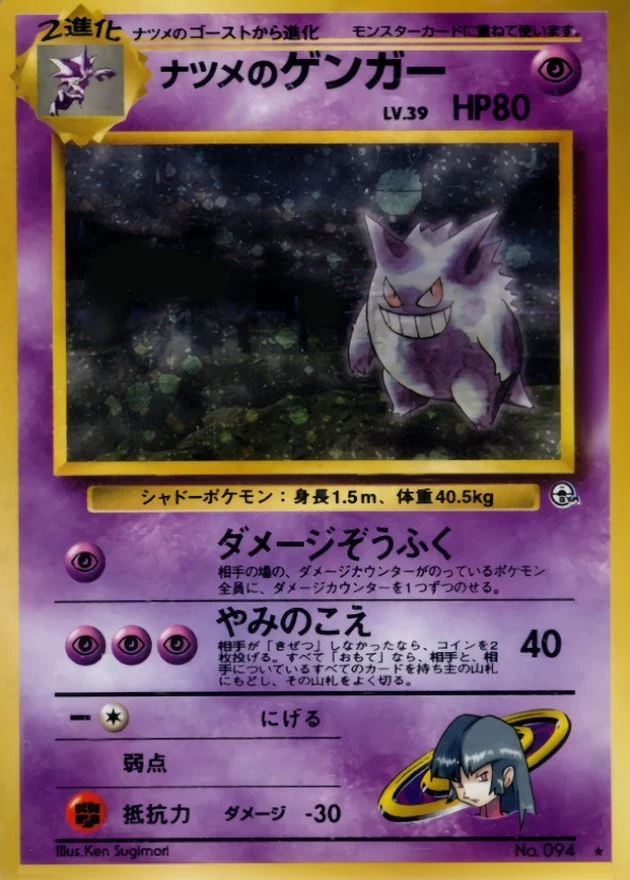
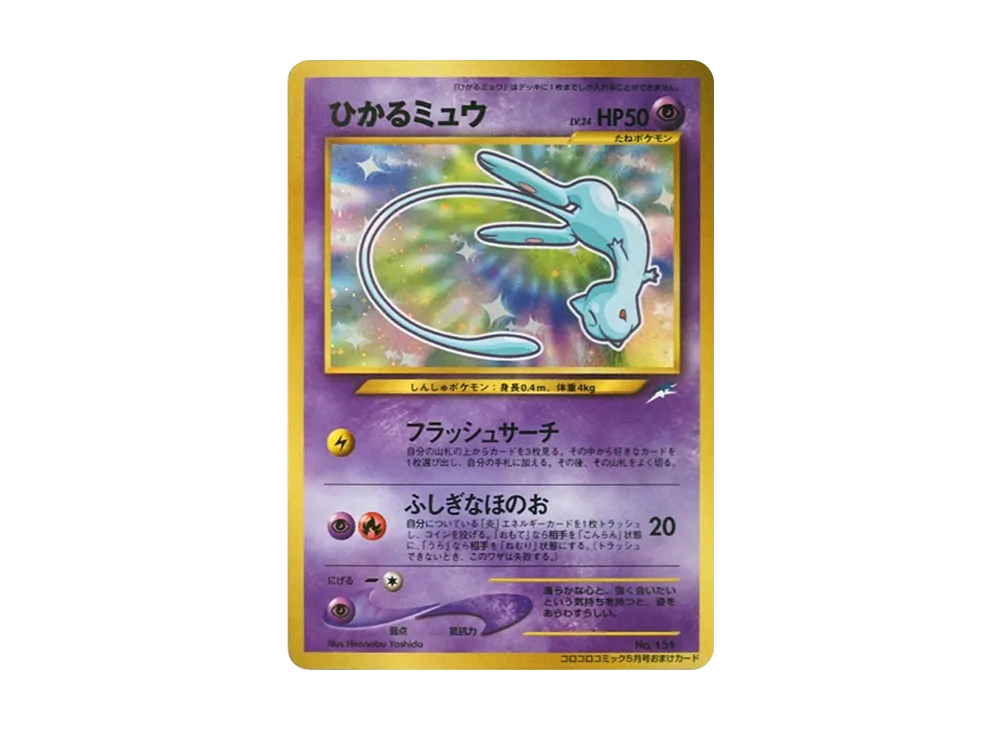
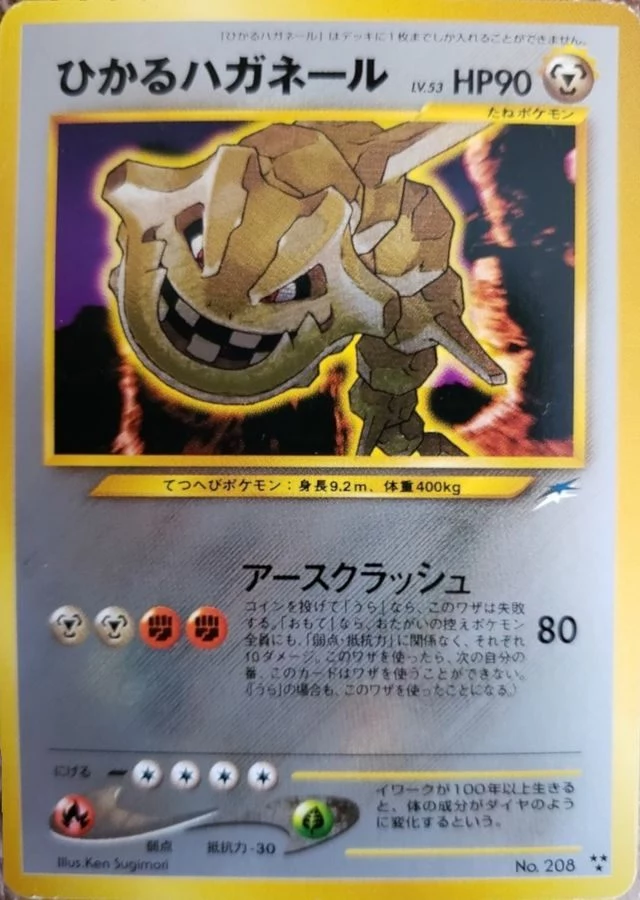
All three share the Old Back card-back design with the 1996 Expansion Pack — and nothing else about the date. Sabrina’s Gengar is a 1998 Gym-series print, Cal Steelix a 2001 Neo 4 print, and Shining Mew a Neo-series promotional print from around 2000–2001. None of them predate the Expansion Pack, and none should be described as “from 1996” or “the first set.” For a closer look at a specific Neo-era Old Back promo single, see our Celebi Old Back promo card guide. For the wider span from these Old Backs through the current era, see Team Rocket Japanese Pokemon cards.
Where to Buy Japanese Old Back Cards from Tokyo
Whether you are after the actual 1996 first set or a later Old Back print from the Gym or Neo years, here is what is currently listed:
- PSA 10 Pikachu [PMCG1-2], Expansion Pack (1996), the true first-set example — currently listed at ¥915,208 (~$5,756).
- PSA 10 Sabrina’s Gengar Lv.39 R [PMCG-G2 No.094], Gym Expansion 2 (1998) — currently listed at ¥1,528,100 (~$9,611).
- PSA 10 Cal Steelix [neo4 No.208], Neo 4 (2001) — currently listed at ¥4,720,000 (~$29,686).
- PSA 10 Shining Mew [neo-P No.151], Neo Promotional (c. 2000–2001) — currently listed at ¥10,442,999 (~$65,679).
All four ship from Tokyo with tracked delivery. Browse the wider PSA 10 graded card collection for further Old Back and modern Japanese singles, or use Quick Order to build a mixed order. If you already own a raw Old Back card and want to know what grading could do for it, our Japanese Pokemon card grading guide covers PSA, BGS, and CGC side by side.
Frequently Asked Questions
What was the first Pokemon card?
The first Japanese Pokemon Trading Card Game card came from the Expansion Pack (拡張パック, PMCG1), published by Media Factory on 20 October 1996. It was sold in ¥300 (+tax) packs of 10 cards, with 102 cards total in the set.
Is Carddass older than the Pokemon Trading Card Game?
Bandai’s Carddass Pocket Monsters line released in September 1996, one month before the Expansion Pack. It is a separate, non-TCG collectible line with no attacks, HP, or game rules, so it predates the Trading Card Game itself without being the Trading Card Game.
What does “Old Back” mean on a Japanese Pokemon card?
“Old Back” describes the card-back design used from the 1996 Expansion Pack through the Gym and Neo series, until the “Pokemon VS” era switched to the modern design in July 2001. It is a multi-year design era, not one set.
Is a Gym or Neo series “Old Back” card from 1996?
No. Gym Expansion cards released in 1998 and Neo series cards released between 1999 and 2001. They share the same Old Back card-back design as the 1996 Expansion Pack, but only the Expansion Pack itself dates to 1996.
What is the difference between a “no-mark” and “resale” print of the Expansion Pack?
Japanese collectors call the true first print run マークなし (“no-mark”), because it lacks a small rarity star that a later 再販 (resale) print run of the same 102-card set added. Both are the same 1996 cards from the same set; the difference is a printing detail between the two runs.
Is “1st Edition” the same as “the first set”?
No. “1st Edition” is a separate stamp system used on other Pokemon sets, unrelated to the Expansion Pack’s マークなし/再販 print distinction. A card can be part of the oldest set without carrying a 1st Edition mark, and 1st Edition cards exist on sets released well after 1996.
¥500 off, on us
- ¥500 off one order of ¥30,000 or more
- +1% extra points on that order
- One coupon per account
Sign in or create an account to claim · One use per account · One coupon per order · Not valid on pre-order items · Ends Sep 24, 2026, 23:59 JST · Import duties, taxes and customs charges are not included in the price and are collected on delivery, except for destinations we ship duty-paid.
Picked for this article
📩 Get member-only sale alerts & coupons
Sale alerts, coupons and restock notices by email — straight from Tokyo.