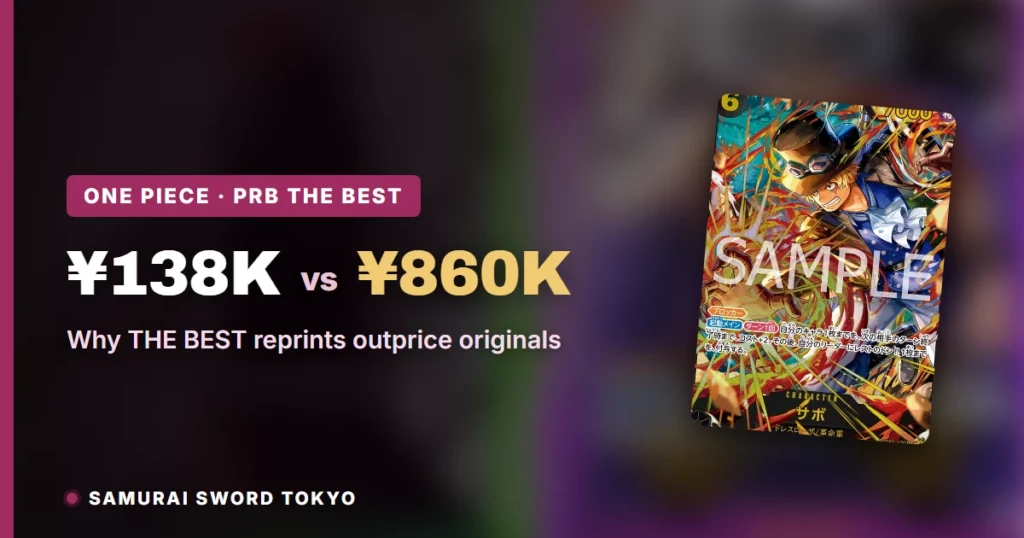
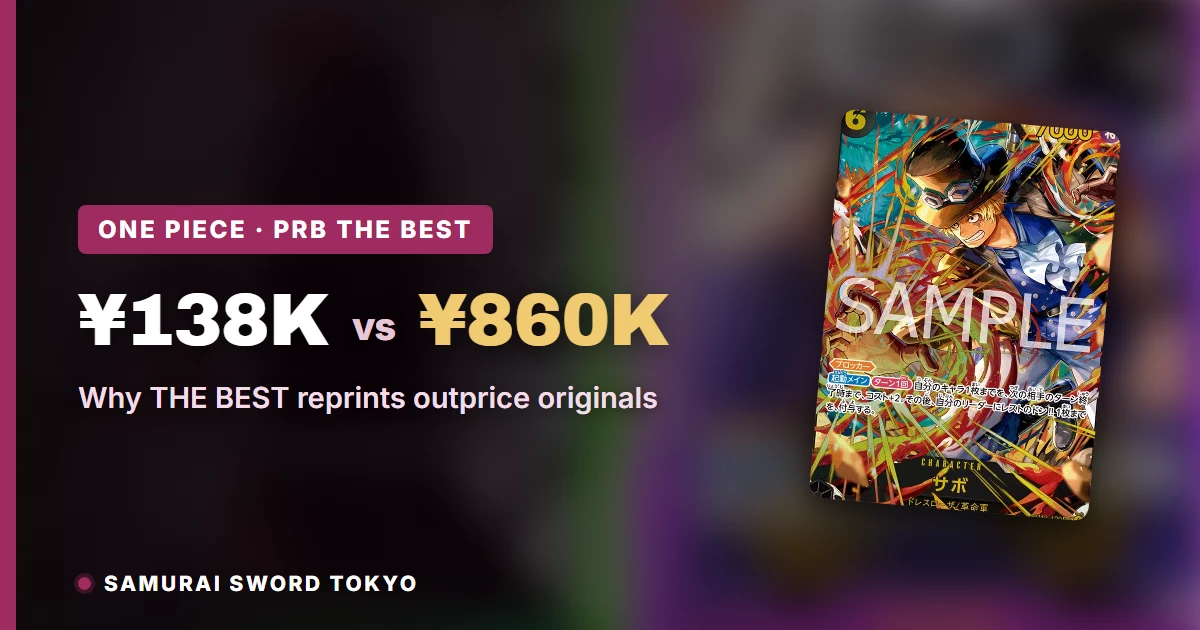
We measured asking prices for One Piece card singles on SNKRDUNK, Japan’s largest TCG marketplace, and found a reprint sitting inside the most-valuable ranking. Two of the top five asks in that list are not cards pulled from their original booster sets at all — they are cards pulled from a later reprint product called ONE PIECE CARD THE BEST, carrying the exact same card number as the original, and asking four to six times more.
The Shanks SEC-SP Comic Parallel numbered OP01-120 exists in two prints. Pulled from Romance Dawn, the set that launched the game, it was asking ¥138,000 (~$850). Pulled from ONE PIECE CARD THE BEST — same character, same card number, same manga panel — it was asking ¥860,000 (~$5,280). One card lower in the same ranking, Portgas.D.Ace SR-SP Comic Parallel OP02-013 shows the identical pattern: ¥140,000 (~$860) as a 頂上決戦 (Paramount War, OP-02) print, ¥650,000 (~$3,990) as a THE BEST print.
In the SNKRDUNK measurement, THE BEST reprint prints of comic parallel chase cards asked substantially more than their original-set counterparts on the same card number, for Shanks OP01-120 and Ace OP02-013. A third THE BEST print, Nami R-SP OP01-016, asked less, with PSA 10 asks at a multiple of the raw ask. Set of origin, not just the card number, is what separates these prices — and it is checkable before you buy.
- Set reference: ONE PIECE CARD THE BEST (PRB-01) card list.
- Sealed Japanese One Piece booster boxes are listed on our store as of this update.
All marketplace prices in this article are asking prices on SNKRDUNK, Japan’s marketplace, as of August 5, 2026, converted at ¥163/USD. Asking prices are what sellers were listing at — not confirmed sale prices. The store box figures (PRB-01, PRB-02, OP-16) convert at ¥154/USD, approximate. Where a card had a small number of listings, we say so; single-listing figures are labeled as such.
How These Prices Were Measured
Every marketplace figure in this article comes from a single, dated pass over SNKRDUNK — Japan’s largest TCG marketplace. What you’re reading is what sellers were asking for these specific cards, not a blended or averaged estimate.
For the Shanks and Ace comparisons, “print” and “set of origin” mean the same thing: the specific product a card was physically pulled from, identified by the set stamp on the card itself, not just the card number.
What Is ONE PIECE CARD THE BEST (PRB-01 & PRB-02)?
ONE PIECE CARD THE BEST is a premium booster reprint line — a product built to reissue some of the game’s most sought-after chase cards in a new print run, rather than to introduce new characters or new game content. PRB-01 was the first volume; PRB-02 followed as a second volume in the same premium booster format.
The measurement confirms the effect this reprinting has on asking prices: cards that already existed as chase-tier comic parallels in their original sets — Shanks OP01-120, Ace OP02-013, Nami OP01-016 — were reprinted inside THE BEST carrying the same card number, and those reprints were listed as distinct market entries from the originals. If you’re comparing two listings of “the same card,” the set stamp on the card face can be the entire difference in the asking price.
Nami’s THE BEST Print: A Broader Base of Listings
The Shanks and Ace numbers are dramatic, but each is drawn from a comparison between two specific listings. Nami R-SP Comic Parallel, card number OP01-016, gives us a THE BEST print with more listing depth to lean on: ¥98,000 (~$600) across four or more separate listings on the day we measured.
That broader base matters for how much weight you put on the number. A single listing tells you what one seller believes; four-plus independent listings converging in the same range tells you something closer to where the market has actually settled. At that ask, the Nami THE BEST print sits well below the Shanks and Ace THE BEST prints — a reminder that “reprinted in THE BEST” is not on its own a guarantee of six-figure pricing. Character, original rarity tier, and demand still set the floor; the reprint print just adds its own premium on top of whatever that floor already was.
PSA 10 asks on this Nami THE BEST print were ¥230,000–¥250,000 (~$1,410–$1,530) — roughly 2.3–2.6x over the raw ask. It’s the one card here with graded pricing on the THE BEST print itself, not just the original.
Why Print-of-Origin Identification Matters
If you take one habit away from this article, make it this: before you buy or sell a One Piece comic parallel that carries a card number you recognize from a famous chase-card list, confirm which product it was actually pulled from. The card number alone does not tell you that. On the Shanks and Ace comparisons, the gap between prints was large enough to turn a fair purchase into an overpay, or a fair sale into a real loss, over a detail that’s easy to skip past.
- Check the set stamp on the card, not just the number. OP01-120 and OP02-013 both appear on cards from two different products; the small set code on the card face tells you which one you’re looking at.
- Ask sellers directly if a listing doesn’t specify. A listing that only shows the card number, not the set it came from, is missing the single most important variable in its own price.
- Treat single-listing asks as a ceiling, not a benchmark. Figures drawn from one observed listing are a data point, not a certified valuation.
Confirm the set of origin every time — card numbers carry over between original booster sets and premium reprint products like PRB-01, and on Shanks OP01-120 and Ace OP02-013 the gap between prints runs into the hundreds of thousands of yen.
Why THE BEST Reprinted Comic Parallels, Not Standard Art
It’s not a coincidence that the cards THE BEST chose to reprint — Shanks, Ace, Nami — were already comic parallels (コミパラ) in their original prints. The comic parallel treatment reproduces an actual panel from Eiichiro Oda’s manga, screentone and speed lines included, rather than standalone character art. It occupies the rarest pull slots across almost every One Piece set, and it’s also the treatment that consistently produces the highest asks in the wider market — every one of the 17 cards in our most-valuable ranking is a comic parallel of some kind.

A premium booster reprint product built around this treatment is, in effect, a curated highlight reel of the game’s most recognizable chase cards, printed again for buyers who missed the originals or want a specific alternate print to chase. That’s a different value proposition than a random secondary print run of an arbitrary card — it’s a deliberate selection of the cards the manga-parallel category had already proven itself on.
The same manga-panel category is what OP-17 builds around, too — the set carries four officially revealed comic-style treatments in the style that produced every card on our most-valuable list. Our OP-17 chase cards guide profiles each of the four, and it’s worth reading alongside this article if you’re trying to understand which treatments tend to hold value over time — and which ones later become reprint candidates.
Does Grading Add the Same Premium to THE BEST Prints?
The measurement also captured graded prices on the original Romance Dawn print of Shanks OP01-120: a PSA 10 ask of ¥700,000 against the raw ask, roughly a 5x premium. We did not capture a graded THE BEST Shanks listing, so we can’t confirm the same multiple applies to the reprint — different print runs can carry different grading pass rates and population sizes, which affect the premium independently of the raw price.
Nami is the one card here with graded data on the THE BEST print itself. If that ratio holds elsewhere, a graded THE BEST Shanks or Ace would sit above the raw asks — but until we measure an actual listing, that’s an inference, not a measured fact.
The Collecting Angle: Why Buyers Chase a Reprint at All
For collectors building out a specific character — every Shanks parallel, every Ace parallel — owning both prints of the same card number is its own collecting goal, and that dual-print structure is what creates a market for both sides of the comparison.
That’s also why identification matters so much here. A seller who can correctly identify a THE BEST print, instead of listing it as a generic “OP01-120,” is the one who captures the premium this article measured rather than leaving it on the table.

How to Source PRB-01 and PRB-02 from Japan
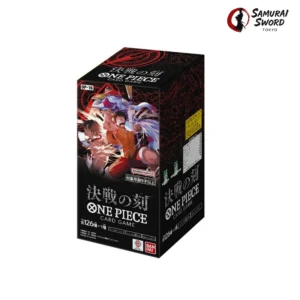
The PRB-01 ONE PIECE CARD THE BEST booster box, Box option currently listed at ¥21,957 (~$143) (update: currently sold out — restock requests via Quick Order) and the PRB-02 vol.2 box, Box option currently listed at ¥11,083 (~$72) (update: currently sold out — restock requests via Quick Order) carry the reprints. Sourcing requests for specific singles go through Quick Order.
For sealed Japanese One Piece product, the OP-16 box is listed at ¥10,437 (~$68).

Two more routes, depending on what you’re after:
- Buying for a shop — we supply card stores internationally with Japanese sealed product; our Japanese TCG wholesale guide covers how sourcing at case volume works.
- First import from Japan — if you haven’t ordered Japanese cards internationally before, our guide to buying One Piece cards from Japan walks through payment, shipping, and customs end to end.
For the wider context on where these reprint cards land against everything else in the One Piece secondary market, our manga rare cards guide covers the comic parallel treatment across every set, and the full One Piece collection lists the sealed Japanese product on our store.
Frequently Asked Questions
What is ONE PIECE CARD THE BEST (PRB-01 and PRB-02)?
ONE PIECE CARD THE BEST is a premium booster reprint line that reissues some of the game’s most sought-after chase cards, including comic parallels, in a new print run under a new set stamp. PRB-01 was the first volume and PRB-02 the second.
Why is the THE BEST print of Shanks OP01-120 worth so much more than the original?
In the SNKRDUNK measurement, the same card number pulled from the THE BEST reprint of Shanks SEC-SP Comic Parallel [OP01-120] was asking several times the original Romance Dawn print.
How can I tell if a card is from THE BEST or from its original set?
Check the set stamp printed on the card face, not just the card number — the same number (like OP01-120 or OP02-013) can appear on cards from two different products. If a listing doesn’t specify the set of origin, ask the seller directly before buying or valuing the card.
Is Ace OP02-013 from THE BEST the same card as the Paramount War print?
Same card number and artwork, different set of origin. In the measurement, the THE BEST reprint asked several times the original 頂上決戦 (Paramount War, OP-02) print.
Does grading add the same premium to THE BEST reprint cards as it does to originals?
Graded pricing was captured on one THE BEST print directly — Nami R-SP [OP01-016], where PSA 10 asks sat above the raw ask. A graded THE BEST Shanks or Ace listing was not measured, so the same multiple is not confirmed for those cards; the graded data on them is for their original-set prints.
What’s the safest way to buy specific THE BEST singles from Japan?
Confirm the set of origin before you buy — not just the card number — since the price gap between an original print and a THE BEST print can run into the hundreds of thousands of yen on the same card. Our guide to buying One Piece cards from Japan covers the full import process.
Picked for this article

📩 Get member-only sale alerts & coupons
Sale alerts, coupons and restock notices by email — straight from Tokyo.