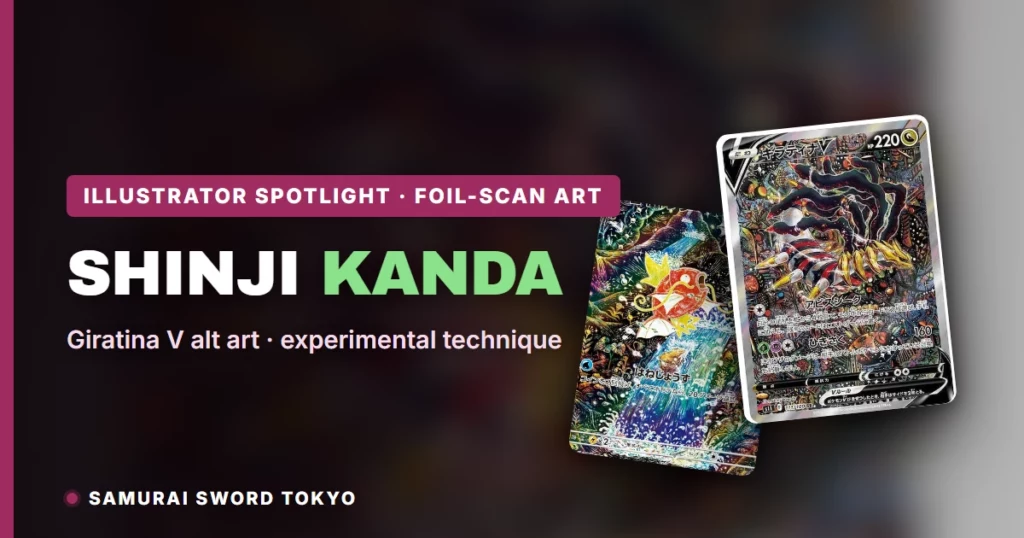
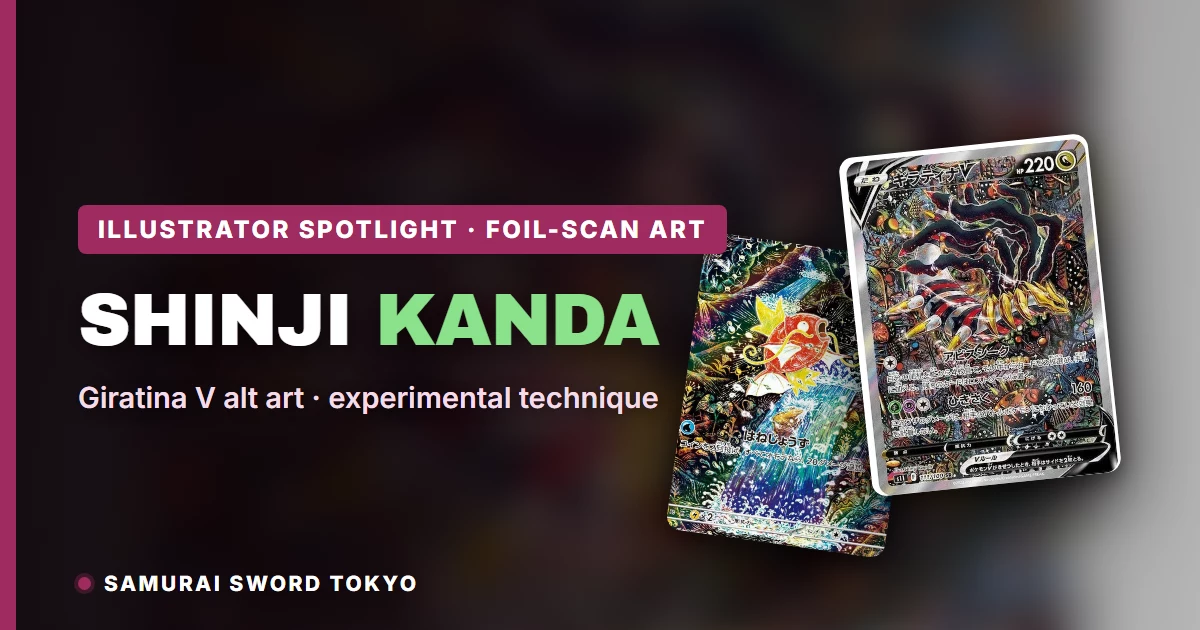
Two Shinji Kanda Pokemon cards were made using techniques you won’t find credited to any other Pokemon TCG illustrator: one drawn in colored pencil on a sheet of heat-shrink plastic and then heated so the color concentrated as the plastic contracted, the other built by scanning a crumpled sheet of aluminum foil. Both were as much card-design experiments as illustrations, and they set the tone for an artist whose TCG catalog is still small.
Kanda’s name is attached to the Giratina V special art rare from S11, alongside the heat-shrink-plastic Magmar debut, the foil-scan Magneton promo, and the Magikarp and Seismitoad art rares from the Scarlet & Violet era.
Shinji Kanda, a Kyoto-born illustrator, has built a small Pokemon TCG catalog using unconventional physical techniques — colored pencil on heat-shrink plastic for the debut, a scanned sheet of crumpled aluminum foil for the Magneton promo. His cards include the Giratina V special art rare.
- Set reference: S11 Lost Abyss card list.
- The S11 Lost Abyss booster box was listed in Sealed and No Shrink options on October 23, 2026.
Who Is Shinji Kanda?
Shinji Kanda is a digital illustrator born in Kyoto in 1986. According to Bulbapedia, Kanda’s Pokemon TCG debut came in 2022 with Magmar, card 016 from the Starbirth (S9) set — a relatively recent start compared to illustrators whose Pokemon TCG credits stretch back decades. In the years since, Kanda’s TCG output has stayed small and deliberate: 31 main-TCG cards plus 9 Pokemon Trading Card Game Pocket cards; the Limitless database lists 39 Japanese-language prints including reprints.
What sets the debut apart isn’t the subject — it’s the process. Bulbapedia records that the Magmar debut card was made by drawing in colored pencil directly onto a sheet of heat-shrink plastic, then heating it so the plastic contracted and pulled the color into a denser, more saturated finish. It’s a physical, almost craft-project technique rather than a purely digital one, and it’s an unusual way for any illustrator to introduce themselves to a card game built on a digital printing pipeline.

The technique behind the Magneton promo, SVP 159, is just as unusual and just as deliberately hands-on. Per Bulbapedia, Kanda made that card by scanning a crumpled sheet of aluminum foil — using the folds, creases, and light-catching texture of the foil itself as the raw material for the artwork rather than painting or drawing it from scratch. Between the heat-shrunk plastic and the scanned foil, these two cards read less like conventional illustration and more like physical-material experiments that happened to end up on trading cards.
Those two techniques are why Kanda’s catalog is worth knowing despite being a fraction of the size of prolific illustrators like Mitsuhiro Arita or the promo-heavy output in our Kouki Saitou guide. Kanda’s name doesn’t show up often, but when it does, the card can be made differently from everything else in the set.
The Giratina V Special Art (S11 111)

The card most collectors associate with Kanda’s name is the Giratina V special art rare, 111/100, from S11. The printing is covered in more depth in the dedicated Giratina cards guide, which tracks this printing alongside Giratina’s other special art and secret rare treatments.
Other Notable Shinji Kanda Pokemon Cards
Beyond the Giratina V, Kanda’s catalog includes a handful of other cards that show up when the artist’s name is searched, per Bulbapedia and Limitless. Roaring Moon ex, SAR, from SV8a card 218 and Galarian Moltres AR from s12a card 190 are both part of that wider catalog and worth knowing if you’re building out a fuller picture of Kanda’s work. The catalog also includes Aerodactyl (SV2a 142) and Sableye (M6 046), rounding out a body of work that spans several recent Japanese sets.

Magikarp, AR, from SV1a card 080 and Seismitoad, AR, from SV11B card 109 are also Kanda cards.
Together, the Magikarp and Seismitoad cards show Kanda’s catalog isn’t a one-card story. Both are standard alternate-art treatments rather than the hand-made techniques behind the Magmar debut and the Magneton promo.
The Shinji Kanda Card Archive
| # | Card | Number / Set | Treatment |
|---|---|---|---|
| 1 | Magmar | 016, S9 | Colored pencil on heat-shrink plastic (debut card) |
| 2 | Magneton | SVP 159 (promo) | Scanned sheet of crumpled aluminum foil |
| 3 | Giratina V | 111/100, S11 | SA (special art rare) |
| 4 | Magikarp | 080/073, SV1a | AR |
| 5 | Seismitoad | 109/086, SV11B | AR |
| 6 | Roaring Moon ex | 218, SV8a | SAR |
| 7 | Galarian Moltres | 190, s12a | AR |
| 8 | Aerodactyl | 142, SV2a | — |
| 9 | Sableye | 046, M6 | — |
For the expansion behind the Giratina V, the S11 Lost Abyss booster box had its Sealed option listed at ¥52,273 (~$339) and its No Shrink option at ¥37,271 (~$242) on October 23, 2026. USD figures convert at ¥154/USD, approximate.

Beyond the Cards: Shinji Kanda’s Wider Work
The material experiments behind the Magmar and Magneton cards make more sense once you know Kanda is also a working gallery artist in his native Kyoto. He has held repeated solo exhibitions at KUNST ARZT, a Kyoto gallery: “Painting Ovelberry” in September 2022, built around an imaginary town called Ovelberry; “Exotic Ghost” in March 2024; and “Kemono-michi,” which ran March 20–29, 2026 — his sixth solo show at the gallery in two years.
The exhibition texts describe work that expresses surreal inner worlds through minutely detailed rendering, and frame his Pokemon card illustration as one facet of a practice that sits alongside fine art. That’s the collector-relevant point: a Kanda card isn’t a detached commission — it’s an extension of an active exhibition practice, which is consistent with a TCG catalog that stays small and technique-driven rather than high-volume.
The Pokemon side has put him in front of collectors directly, too. Per Bulbapedia, Kanda held an official signing session at the Pokemon 2025 Europe International Championships on February 21, 2025. He also runs an Instagram account under @kandashinji.
Where to Buy Shinji Kanda Cards from Japan
We ship Japanese PSA 10 singles and sealed product from Tokyo. Sourcing requests for a specific card go through Quick Order.
For the wider PSA 10 catalog, browse our full PSA 10 collection, the Japanese Pokemon card collection or the PSA 10 card list to filter by set and price. Our Japanese PSA 10 price guide covers PSA 10 pricing across the wider catalog, and if you’re comparing illustrator guides, our sowsow guide and Akira Egawa guide cover two other small, high-concentration catalogs in the same vein.
Frequently Asked Questions
Who is Shinji Kanda?
Shinji Kanda is a Kyoto-born digital illustrator who debuted in the Pokemon TCG with Magmar (S9 016).
What technique was used on Shinji Kanda’s debut card?
Per Bulbapedia, the Magmar debut card was drawn in colored pencil on a sheet of heat-shrink plastic, then heated so the plastic contracted and concentrated the color.
How was the Magneton promo card (SVP 159) made?
Bulbapedia records that Shinji Kanda made the Magneton promo, SVP 159, by scanning a crumpled sheet of aluminum foil and using its texture as the basis for the artwork.
What else has Shinji Kanda worked on?
Kanda is also a gallery artist in Kyoto, with repeated solo exhibitions at KUNST ARZT.
Picked for this article

📩 Get member-only sale alerts & coupons
Sale alerts, coupons and restock notices by email — straight from Tokyo.