A Storm Emeralda box costs about the same as one Raikou ex SAR. Which one you should buy depends entirely on a question most guides skip: what do you actually want on the other side of the purchase?
Storm Emerald — or Storm Emeralda, to use its full Japanese set name — released July 31, 2026 with 113 cards and a chase hierarchy that spans from $17 Art Rares to a $1,830 gold Mega Rayquaza. That spread makes the box-versus-singles decision unusually consequential here. Buy wrong and you either pay a large premium for a card you’d have pulled, or spend box money chasing something you were never realistically going to hit.
This guide runs the actual numbers: what a box costs per card, what every chase single costs today, where the break-even sits, and when a case is the right call. We ship Japanese sealed and singles out of Tokyo daily, so these are the trade-offs we walk customers through every week.
Want one specific card? Buy the single — even the expensive ones usually beat chasing them through packs. Want to build the set or open something? Buy the box; 30 packs delivers ~4–5 AR and ~2–3 SR guaranteed. Want the SAR Rayquaza or the MUR? Singles, without close comparison — the odds don’t support chasing either.
The Quick Answer, by What You Want
Match your goal to the row:
| What you want | Buy | Why |
|---|---|---|
| One specific chase card | Single | Six different SARs share one hit slot — you can’t target |
| The Mega Rayquaza SAR or MUR | Single | ~1 SAR per 2–3 boxes across 6 cards; MUR ~1 per 50–100 boxes |
| To build the base set | Box | 150 cards per box covers most of a 76-card base set fast |
| The opening experience | Box | Release-week hits are worth the most they’ll be worth |
| Playable staples for a deck | Singles | You need specific cards in specific counts |
| To hold sealed long-term | Box or case | Sealed is the format that ages; singles are already unwrapped |
| Volume for resale | Case | Per-box economics improve and you diversify the SAR draw |
The rest of this guide shows the numbers behind those calls.
What a Sealed Box Actually Costs You Per Card
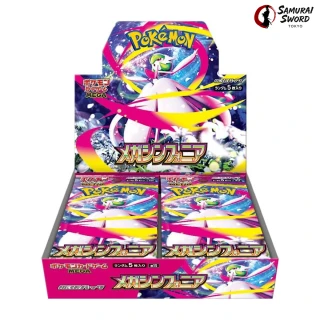
A Storm Emeralda box is 30 packs of 5 cards — 150 cards for ¥23,000–25,000 (~$141–$153) at current market prices, against a ¥6,000 MSRP.
Per card that’s roughly ¥160, but that number is meaningless on its own because the value is concentrated. Here’s what a box reliably produces:
| Layer | Estimated per box | Rough value |
|---|---|---|
| AR Art Rares | 4–5 | ¥4,000–10,000 |
| SR Super Rares | 2–3 | ¥6,000–14,000 |
| RR + base cards | ~6 RR + bulk | ¥2,000–4,000 |
| SAR | ~1 per 2–3 boxes | ¥2,980–138,000 when it hits |
| MUR | ~1 per 50–100 boxes | ¥298,000 |
Rates estimated from recent MEGA-series opening data; not officially published. Values at July 31, 2026 Japanese prices.
The guaranteed layer — the AR and SR you get every single time — lands somewhere around ¥12,000–28,000. That’s the floor you’re buying. Everything above it is the SAR coin flip, which is where boxes become good or ordinary.
For the full odds breakdown, see our Storm Emeralda pull rates guide.
What the Singles Cost Right Now
Release-day Japanese market prices for every card worth targeting:
| Card | Rarity | JPN price | USD | vs one box |
|---|---|---|---|---|
| Mega Rayquaza ex 113/076 | MUR | ¥298,000 | ~$1,830 | ~12× a box |
| Mega Rayquaza ex 110/076 | SAR | ¥138,000 | ~$850 | ~6× a box |
| Raikou ex 108/076 | SAR | ¥16,800 | ~$103 | ~0.7× a box |
| Zinnia’s Trust 112/076 | SAR | ¥9,980 | ~$61 | ~0.4× a box |
| Mega Rayquaza ex 095/076 | SR | ¥7,980 | ~$49 | ~0.3× a box |
| Mega Golisopod ex 107/076 | SAR | ¥4,480 | ~$27 | ~0.2× a box |
| Mega Golurk ex 109/076 | SAR | ¥2,980 | ~$18 | ~0.1× a box |
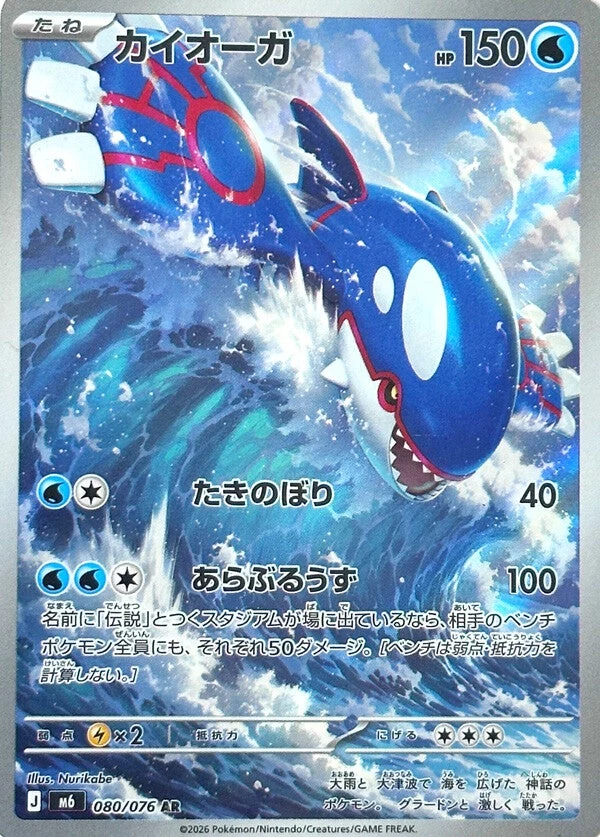
| Kyogre 080/076 | AR | ¥2,780 | ~$17 | ~0.1× a box |
Prices as of July 31, 2026, Japanese secondary market, at ¥163/USD.
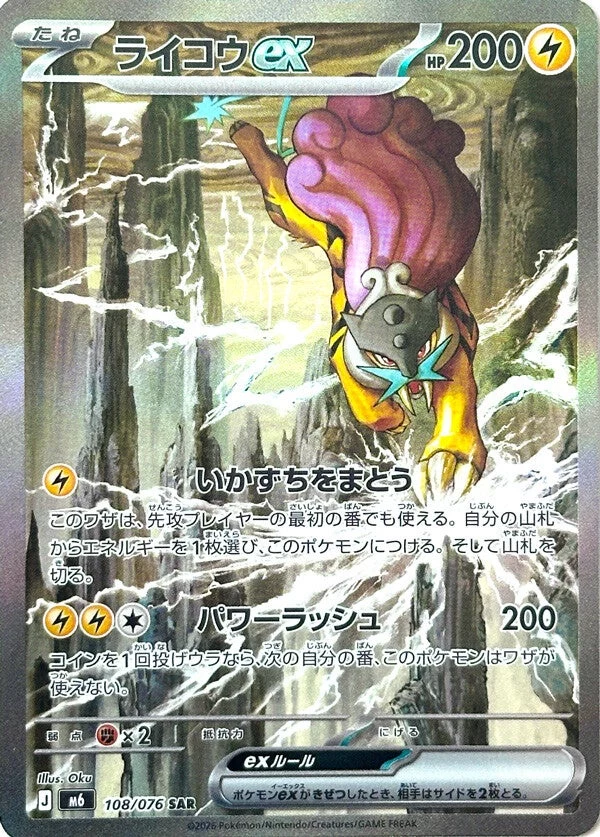
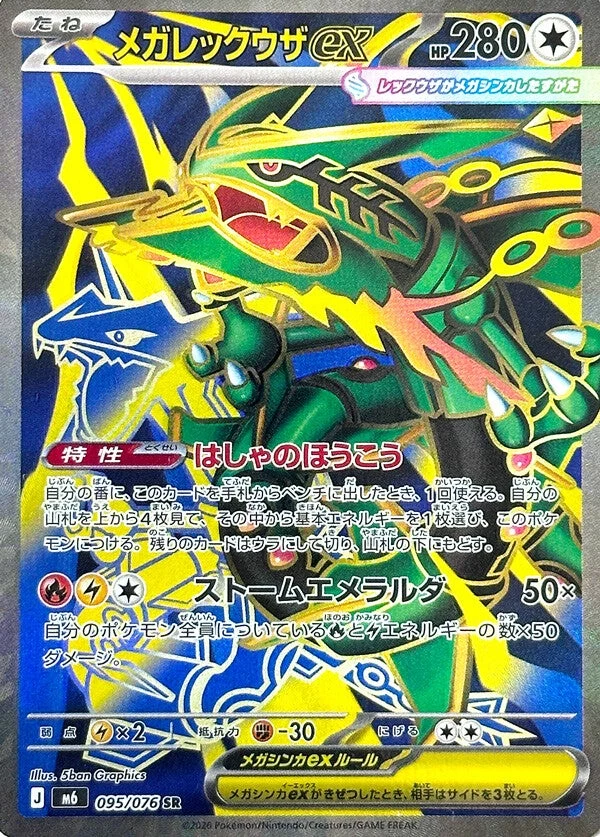
Notice the shape of that table. Four of the six SARs cost less than a single box. Only the Mega Rayquaza SAR and the MUR sit above box price — and those are precisely the two you’re least likely to pull.
Where the Break-Even Sits
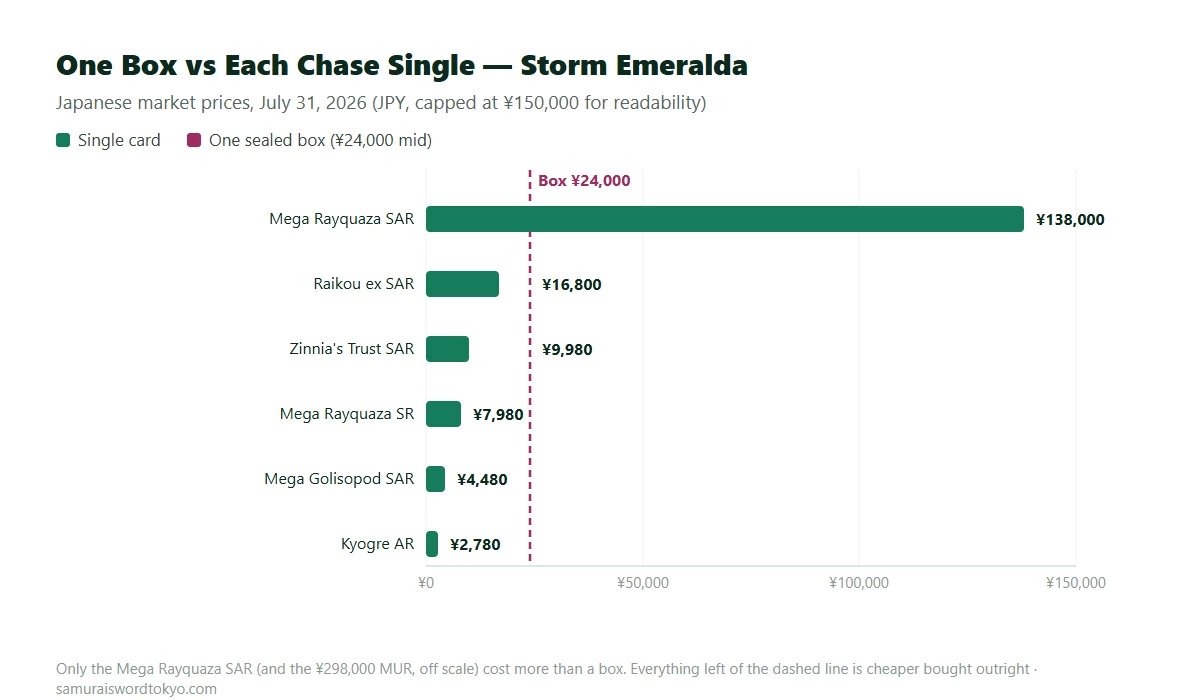
Three concrete comparisons that settle most decisions:
- Chasing a mid-tier SAR is a losing trade. The Raikou SAR costs ¥16,800. Expecting one SAR every 2–3 boxes means ¥46,000–75,000 of boxes for an SAR — and only a one-in-six chance it’s the Raikou. Buy the single.
- Buying all six SARs outright costs about ¥175,000. Pulling all six from packs would take somewhere in the region of 12–18 boxes on the estimated rates — roughly ¥276,000–450,000, with no guarantee of completion. Singles win decisively on set-completion at the SAR tier.
- Base-set building favours boxes heavily. A 76-card base set bought as singles means 76 separate transactions; one box gives 150 cards. Even at three or four boxes, the box route costs less than the fees and shipping of assembling commons and uncommons individually.
Boxes win on breadth (base set, volume, the opening itself). Singles win on precision (one named card, one playset, one grail). Storm Emeralda’s steep SAR hierarchy — ¥2,980 to ¥138,000 within the same rarity — makes that split sharper here than in most sets.
The one thing boxes offer that singles cannot: the tail. A ¥23,000 box carries a real, if small, chance at a ¥298,000 card. No single purchase has that shape. Whether that matters is a preference, not a calculation.
When a Case Makes Sense
A case is 12 boxes — roughly ¥276,000–300,000 at current prices. It makes sense in three situations:
- You’re reselling. Case-level buying improves per-box economics and gives you inventory in both sealed and singles at once.
- You want SAR diversity. Across 12 boxes you’d expect roughly 4–6 SARs on the estimated rates — enough that you’re drawing meaningfully from the six-card pool rather than hoping on a single flip.
- You’re holding sealed at scale. If the thesis is that M6 sealed ages like previous Rayquaza-halo products, a case is the position; a single box is a token.
It does not make sense as an MUR hunt. At an estimated 1 per 50–100 boxes, a 12-box case is a 12–24% shot at best. Anyone buying a case for the gold Rayquaza is paying roughly ¥290,000 for a minority chance at a ¥298,000 card — the single is the cheaper and certain route.
Storm Emerald vs Storm Emeralda — Same Set
Quick clarification, because it affects what you find when you search.
The Japanese set’s name is Storm Emeralda (M6). It’s commonly written and searched as Storm Emerald, Pokemon Storm Emerald, or Emerald Storm — all referring to the same July 31, 2026 Japanese expansion led by Mega Rayquaza ex. There is no separate “Storm Emerald” product.
Two other names worth knowing while you shop:
- Delta Reign — the English version of the same set, releasing November 6, 2026. Same cards, different language and box structure. See our Delta Reign comparison.
- M6 / ME06 — the set codes. M6 is Japanese, ME06 is English.
If you’re buying the Japanese version, searching either spelling gets you there — but listings using the full “Storm Emeralda” name are more likely to be the actual Japanese product rather than English pre-orders.
Buying From Japan: Shipping, Condition, Timing
Three practical notes if you’re ordering Japanese product from overseas:
- Sealed condition matters on arrival. Japanese boxes ship shrink-wrapped; we photograph condition before packing and pack for international transit, because a crushed corner on a sealed box affects its value even though the cards inside are fine.
- Consolidate your order. Shipping one box and shipping four costs far less than four separate shipments. If you’re buying singles alongside sealed, put them in one order.
- Release-week timing. Singles prices are at their most volatile right now and generally at their peak. If you’re buying singles rather than sealed, deciding your target price in advance beats chasing the daily move.
For singles and mixed orders across Japanese sets, use our Quick Order page. Current market context for the whole set is in our release-day price report.
Frequently Asked Questions
Is it cheaper to buy a Storm Emeralda box or singles?
It depends on the goal. For one specific card, singles are almost always cheaper — four of the six SARs cost less than a single box. For base-set building or volume, boxes win: 150 cards per box beats assembling commons individually.
How much is a Storm Emeralda booster box?
¥23,000–25,000 (~$141–$153) on the Japanese secondary market as of July 31, 2026, against a ¥6,000 MSRP. Japanese sealed product does not trade at MSRP.
How many boxes to pull the Mega Rayquaza ex MUR?
Estimated at 1 per 50–100 boxes, so no realistic box count guarantees it. A 12-box case is roughly a 12–24% chance. At ¥298,000 for the single versus ~¥290,000 for a case, the single is both cheaper and certain.
Is Storm Emerald the same as Storm Emeralda?
Yes — Storm Emerald, Pokemon Storm Emerald and Emerald Storm all refer to the Japanese set Storm Emeralda (M6), released July 31, 2026. Its English version is Delta Reign, arriving November 6, 2026.
How many cards are in a Storm Emeralda box?
150 — 30 packs of 5 cards. Expect roughly 6 RR, 4–5 AR and 2–3 SR per box, with an SAR about every 2–3 boxes.
Pull rates are community estimates from recent MEGA-series opening data and are not officially confirmed. Prices are Japanese secondary-market snapshots taken July 31, 2026 (JST) at ¥163/USD.
¥500 off, on us
- ¥500 off one order of ¥30,000 or more
- +1% extra points on that order
- One coupon per account
Sign in or create an account to claim · One use per account · One coupon per order · Not valid on pre-order items · Ends Sep 24, 2026, 23:59 JST · Import duties, taxes and customs charges are not included in the price and are collected on delivery, except for destinations we ship duty-paid.
Picked for this article
📩 Get member-only sale alerts & coupons
Sale alerts, coupons and restock notices by email — straight from Tokyo.