![Why Are Japanese Pokemon Cards Cheaper? The Real Economics [2026]](https://samuraiswordtokyo.com/wp-content/uploads/2026/08/featured-why-are-japanese-pokemon-cards-cheaper-1-1024x538.webp)

Why are Japanese Pokemon cards cheaper than their English counterparts? Anyone who has compared a Japanese booster box against its English counterpart has noticed the same thing: the Japanese version usually costs meaningfully less. Same franchise, often the same artwork, sometimes the same set — and a very different number on the invoice. The gap is real, it is structural rather than accidental, and it is not a sign that something is wrong with the Japanese product.
The internet’s usual explanations range from half-right (“it’s the yen”) to flatly wrong (“Japanese cards are lower quality”). The truth is a stack of four economic mechanisms working in the same direction: how Japanese MSRP is set, how exchange rates flow through, where you sit in the supply chain, and how Japan’s reprint culture keeps street prices anchored. None of them is exotic. Together they explain most of what you see.
We are a Tokyo-based exporter that ships Japanese sealed product worldwide every week, so the prices in this article are either official MSRPs or our own live store prices — no invented market data. By the end you will know exactly why the gap exists, why “cheaper” does not mean “worth less”, and what the gap means depending on whether you are collecting or reselling.
Japanese cards are cheaper mostly because Japanese MSRP is set lower per pack (the cleanest same-set example: One Piece OP-17 at ¥240/pack in Japan vs $4.99/pack English MSRP), because a weaker yen has lowered the USD/EUR-equivalent cost in recent years, because buying at the source cuts out re-export middlemen, and because Japan’s reprint culture keeps street prices near MSRP on modern sets. None of this makes the cards worth less — the same card graded and sold internationally trades in the same global market, which is precisely why the gap attracts resellers.
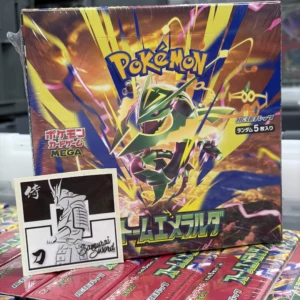
The price ladder below is refreshed for M6 Storm Emeralda, now well past its launch-week pricing.
The Price Gap Is Real — a Concrete Anchor
Vague claims about “Japanese cards being cheaper” are easy to wave away, so start with a case where the comparison is as clean as it gets: the same set, released in both languages weeks apart, with official MSRPs published for both.
| One Piece OP-17 (Japanese) | One Piece OP-17 (English) | |
|---|---|---|
| Release | August 22, 2026 | August 28, 2026 |
| Official pack MSRP | ¥240 (tax included) | $4.99 |
| Cards per pack | 6 | Larger pack (differs by line) |
| Box MSRP math | 24 packs × ¥240 = ¥5,760 | Depends on box configuration |
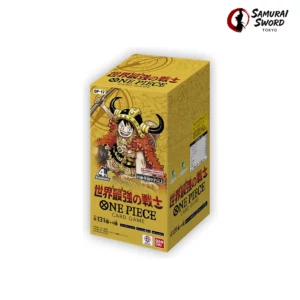
Look at the pack row. ¥240 versus $4.99 is not a subtle difference: at any exchange rate seen in the modern era, ¥240 converts to a small fraction of $4.99. Part of that gap is pack composition — Japanese packs in several lines contain fewer cards than their English counterparts, so a per-pack comparison overstates the per-card gap — but even adjusting for card count, the Japanese product enters the market at a structurally lower price point. Our OP-17 Japanese vs English comparison walks through this exact set in detail, and the OP-17 box listing shows the current price.
One honest caveat before we generalize: this anchor is One Piece, because Bandai publishes both MSRPs and the sets mirror each other almost exactly. Pokemon’s Japanese and English lines are structured differently — different set compositions, different pack sizes, different release calendars — so a single clean same-set MSRP comparison is harder to construct. But the pattern buyers observe across Pokemon sealed product is the same in direction: Japanese boxes typically land at lower prices than comparable English product. The four reasons below explain why, and they apply across the Japanese TCG lines we export — Pokemon, One Piece, Yu-Gi-Oh, and Dragon Ball alike.
Reason 1: Japanese MSRP Is Set Lower
The first mechanism is the simplest and the most overlooked: Japanese manufacturers set retail prices for the domestic Japanese market, and those prices are calibrated to Japanese retail norms — convenience stores, hobby shops, mass retail — where trading card packs have long been priced as an impulse purchase in the low hundreds of yen.
A few things follow from that:
- The per-pack sticker is low by design. The OP-17 anchor above — ¥240 tax included — is typical of how Japanese pack pricing works: a price a schoolchild can pay at a convenience store counter. English-market MSRPs are set for a different retail landscape with different margin structures and different customer expectations.
- Packs are smaller in some lines. Japanese packs often carry fewer cards per pack than English packs (OP-17’s Japanese pack is 6 cards). That means part of the headline gap is composition, not pure discount — which is worth stating plainly, because honest comparisons are per-box and per-card, not just per-pack.
- Boxes stay cheap in absolute terms. Twenty-four packs at a low per-pack price produces box MSRPs that look startlingly low to overseas buyers — ¥5,760 for an OP-17 box in MSRP terms. Even after shipping and import costs, the arithmetic frequently favors the Japanese version.
The important framing: this is not Japan “discounting” anything. It is two different products priced for two different domestic markets — and one of those markets happens to price sealed product lower at the source.
Reason 2: The Yen Does Part of the Work
The second mechanism is currency. Japanese prices are set in yen, and in recent years the yen has been weak against the dollar and euro by historical standards. When the yen weakens, every yen-denominated price gets cheaper in dollar or euro terms without a single price tag in Japan changing.
For an overseas buyer, the effect is mechanical: a ¥15,000 booster box costs fewer dollars at a weaker yen rate and more dollars at a stronger one. A sustained period of yen weakness — which is what the market has broadly seen in the mid-2020s — effectively put Japanese sealed product on sale for anyone holding dollars or euros, on top of the MSRP gap that already existed.
Two honest hedges belong here:
- Exchange rates move. Nothing guarantees the yen stays weak. A meaningful yen recovery would narrow (though not eliminate) the effective price gap for overseas buyers. If your buying decision only works at one exchange rate, it is a currency trade wearing a trading-card costume.
- FX is an amplifier, not the root cause. Even at a much stronger yen, the structural MSRP gap and the supply-chain math below would still exist. The weak yen made an existing gap wider and more visible — it did not create it.
Practical note: our catalog is priced in JPY, so what you pay in your own currency is set by the rate your payment provider applies at checkout time. That transparency cuts both ways — you capture the full benefit of a weak yen, and you carry the rate risk between order and payment like any importer does.
Reason 3: Buying at the Source Removes Middlemen
The third mechanism is supply-chain position. Official distribution of Japanese-version product serves domestic Japanese retail; there is no equivalent of walking into an official international wholesale program for Japanese-version cards. In practice, overseas shops and collectors buying Japanese product overwhelmingly source it through Japanese exporters, retailers, marketplaces, and auction or buyback channels.
That structure means every Japanese box on a shelf outside Japan has traveled some version of this chain:
| Chain | Steps between you and Japanese retail | Effect on your price |
|---|---|---|
| Buy from a local shop that imported via an intermediary | Japanese source → exporter → importer/distributor → your local shop → you | Each step adds margin, handling, and often a second leg of shipping |
| Buy from an overseas online reseller | Japanese source → reseller → you | One markup layer plus their import costs |
| Buy directly from a Japanese exporter | Japanese source → you | One margin, one international shipment |
None of these chains is illegitimate — local shops provide real value in convenience, returns handling, and zero shipping wait. But if your goal is landed cost, the arithmetic is straightforward: the fewer re-export steps between Japanese retail and your door, the closer your price sits to the Japanese street price. This is the single biggest lever a reseller controls, which is why we wrote a full guide on how to buy Japanese Pokemon cards wholesale and an honest explainer on how Japanese card distribution actually works — including why “becoming an official distributor” is not the route overseas shops actually take.
Reason 4: Reprint Culture Keeps Prices Anchored
The fourth mechanism is the one overseas buyers most often miss, because it is cultural as much as economic: Japan reprints popular modern sets, and reprints regularly, in a way that tends to keep sealed street prices closer to MSRP than the English market’s boom-and-bust hype cycles.
The pattern, stated with appropriate hedging because no manufacturer publishes print numbers: when a modern Japanese set sells out and secondary prices spike, additional print waves frequently follow, and street prices settle back toward MSRP. The practical consequences for a buyer:
- Panic premiums on modern Japanese sets are often temporary. Paying a large launch-week premium on a set that is later reprinted is a common and avoidable mistake. Patience is frequently rewarded on in-print product.
- Sustained supply keeps the baseline low. Deep, repeated supply is part of why Japanese sealed product is cheap in the first place — scarcity premiums have less room to build while a set remains in active print.
- The flip side: genuinely out-of-print sets behave differently. Once printing ends and stock drains, the anchor disappears — which is exactly the divergence you see in the price ladder later in this article, where aged boxes trade at multiples of recent ones.
One related honesty point about Japanese re-released stock: boxes from later print waves sometimes ship without the outer shrink wrap (“no shrink” in our listings). The product inside is identical factory-sealed pack content; the difference is purely the outer wrapping, and we price the two conditions separately so buyers can choose. It is a quirk of how Japanese reprint stock moves, not a defect — and it is one more reason Japanese-sourced boxes can undercut fully-wrapped export stock elsewhere.
“Cheaper” Does Not Mean “Worth Less”
This is the question behind the question. If Japanese cards are cheaper, are they worth less? Mostly, no — and understanding why is the difference between reading the gap correctly and misreading it.
Same card, different market of origin
A Japanese-printed card and its English counterpart are different collectibles, but they trade in the same global marketplace once they leave the pack. Graded Japanese cards sell internationally to the same collector base through the same channels. The purchase price being lower at the source does not force the resale value lower — value is set by global demand for that specific card in that specific language and condition. Cheaper acquisition plus globally-set resale value is, of course, the entire logic of arbitrage — and it is why so much of our volume goes to repeat overseas buyers, including card shops and resellers.
The grading angle
There is a widely held view among graders and collectors that Japanese print runs have a strong reputation for print quality and centering, which makes Japanese cards attractive candidates for grading. We state that carefully: it is a reputation and a widely shared perception, not a guarantee — no print run grades gem mint by default, and anyone who promises otherwise is selling something. But the perception itself is part of why the “buy Japanese, grade, sell globally” pattern exists. Our PSA10 singles collection is the downstream end of exactly that pipeline.
Japanese-side exclusives
Some of the most sought-after modern chase cards — certain alt-arts, SARs, and Japan-first promotional cards — exist in Japanese print before or instead of English print. For those cards, the Japanese version is not the “cheaper alternative”; it is the primary collectible. A buyer who dismisses Japanese product as a budget option has the hierarchy backwards for a meaningful slice of the modern chase pool. Our guide to the most valuable Japanese Pokemon cards of 2026 shows what the top of that market looks like.
The honest summary: “cheaper” describes the acquisition price of sealed product at the source. “Worth” is set card-by-card in a global market where Japanese product competes on equal — and sometimes favored — terms.
What This Means for Buyers vs Resellers
If you are a collector or player
The gap is simply a better entry price. You get the same opening experience, the Japanese-side exclusives, and — if you grade — a print run with a strong reputation, at a lower cost per box. The practical checklist is short: buy from sources that publish real policies and ship tracked, understand that import duties and taxes in your country are your responsibility, and learn to spot fake Japanese Pokemon cards before buying singles from unfamiliar sellers — a price gap always attracts counterfeiters to the popular chase cards.
If you are a reseller or shop owner
The gap is your margin, and the four mechanisms above are your operating manual. Source as close to Japanese retail as you can; treat FX as a real input that moves your cost basis; respect reprint culture when timing purchases (chasing launch premiums on in-print sets is how margins evaporate); and build the grading and exclusives angle into what you stock rather than treating Japanese product as a discount bin. We wrote a dedicated guide to reselling Japanese Pokemon cards that turns these mechanics into an actual sourcing playbook.
Either way: the pull-rate context matters
Japanese sets also differ from English sets in hit structure — what a box can contain and how the rare slots work — which changes what “value per box” means beyond the sticker price. If you are comparing Japanese and English boxes seriously, read how Japanese Pokemon pull rates work alongside this article; price per box only means something relative to what the box can produce.
What Japanese Boxes Actually Cost Right Now
Theory is cheap; here is what the economics above actually produce on a shelf. These are our own live store prices for currently listed Japanese Pokemon booster boxes as of August 3, 2026, except M6 Storm Emeralda, refreshed to September 1, 2026 — prices change, so treat these as a snapshot, not a quote:
| Set | Store price (JPY) | Profile |
|---|---|---|
| M2A Mega Dream ex | ¥12,408 (no shrink) / ¥13,624 (sealed) | Recent set, deep supply |
| M2 Inferno X | ¥15,300 (no shrink) / ¥21,320 (sealed) | Recent set |
| SV4A Shiny Treasure ex | ¥17,340 (no shrink) / ¥19,968 (sealed) | High-demand chase set, reprinted |
| M6 Storm Emeralda | ¥13,365–¥13,720 (Sept 1, 2026) | Released set; MSRP ¥6,000, SNKRDUNK lowest ask ¥13,300 |
| S12A VSTAR Universe | ¥30,264 | Older high-demand set |
| SV2A Pokemon 151 | ¥48,960 (no shrink) / ¥56,000 (sealed) | Aged, nostalgia-driven demand |
The ladder runs from ¥12,408 to ¥48,960 — a roughly fourfold spread between the cheapest recent box and the most aged one. That spread is Reason 4 in action: while a set is in active print, supply anchors it near the bottom of the ladder; once printing ends and demand persists, the anchor is gone. Both ends of the ladder are “Japanese prices” — the difference is where each set sits in its supply life cycle, not the country on the label. M6 Storm Emeralda is a live example: it opened near ¥18,500–¥20,000 in early August against a ¥6,000 MSRP, and by September 1, 2026 had settled to ¥13,365–¥13,720 (SNKRDUNK lowest ask ¥13,300) — a textbook case of the launch-premium fade.
Note the “no shrink” pricing on several sets: identical factory-sealed pack contents from Japanese re-released stock, sold without the outer shrink wrap at a lower price — the reprint-culture quirk explained earlier, passed through honestly. See the live M6 Storm Emeralda listing or browse the full Japanese Pokemon booster box collection for current stock and pricing.
Frequently Asked Questions
Why are Japanese Pokemon cards cheaper than English ones?
Four stacked reasons: Japanese MSRP is set lower per pack for the domestic market (and packs in some lines contain fewer cards); a weaker yen in recent years has lowered the dollar/euro-equivalent cost; buying from Japanese sources removes re-export middlemen and their margins; and Japan’s reprint culture keeps street prices on modern sets close to MSRP. The cleanest same-set anchor is One Piece OP-17: ¥240 per pack in Japan versus $4.99 per pack English MSRP.
Are Japanese Pokemon cards worth more than English cards?
It depends on the card, not the language as a category. Japanese and English versions of a card are distinct collectibles valued by global demand for each. Japanese cards benefit from a widely held reputation for print quality and centering among graders (a perception, not a guarantee), and some modern chase cards — certain alt-arts, SARs, and Japan-first promos — exist in Japanese before or instead of English, making the Japanese version the primary collectible. Cheaper sealed prices at the source do not mean lower resale value.
Are Japanese Pokemon cards lower quality?
No — if anything, the widely held view among collectors and graders runs the other way, with Japanese print runs holding a strong reputation for print quality and centering. That reputation is one reason buying Japanese cards to grade is a common strategy. It is a perception backed by community experience, not a manufacturer guarantee, and individual cards always vary.
Is it cheaper to buy Pokemon cards directly from Japan?
Often, yes — the fewer steps between Japanese retail and your door, the closer your cost sits to the Japanese street price. Compare the landed cost honestly: box price plus international shipping plus any import duties and taxes in your country (which are the buyer’s responsibility) against your local price. For single boxes the shipping share is larger; consolidating multiple boxes into one shipment is where direct buying pulls ahead.
Will the price gap between Japanese and English cards last?
The structural parts — lower Japanese MSRP, source-proximity savings, and reprint culture — are features of how the Japanese market works and are unlikely to vanish. The currency part moves: a stronger yen would narrow the effective gap for overseas buyers, a weaker yen widens it. Treat FX as a variable, not a constant, when planning purchases.
How do I buy Japanese cards from overseas safely?
Use sellers that publish real policies, ship tracked (we ship FedEx from Tokyo), and take payment methods with recourse — we accept Wise bank transfer and PayPal, with no minimum order. Be suspicious of prices far below the Japanese street market, and learn the basics of authenticating Japanese cards before buying high-value singles from unfamiliar sources.
Store prices are SST live prices as of August 3, 2026 (JST), except the M6 Storm Emeralda row, refreshed to September 1, 2026 (JST), and change with the market. MSRP figures are official published prices for One Piece OP-17 and Pokemon M6 Storm Emeralda. Exchange rates move; nothing in this article is a guarantee of future prices, grades, or resale values.
500 Points Free on Sign-Up
CREATE FREE ACCOUNT1 pt = ¥1 at checkout · Points expire 30 days after they are earned · Import duties, taxes and customs charges are not included in the price and are collected on delivery, except for destinations we ship duty-paid.
Picked for this article
📩 Get member-only sale alerts & coupons
Sale alerts, coupons and restock notices by email — straight from Tokyo.