![Reselling Japanese Pokemon Cards: What Sells & How to Source [2026]](https://samuraiswordtokyo.com/wp-content/uploads/2026/08/featured-reselling-japanese-pokemon-cards-guide-1-1024x538.webp)
Search for “sell pokemon cards online” and most of what comes back is written for someone clearing out a childhood binder. This guide is for the other reader: the person building, or scaling, an actual resale operation — and specifically one built around Japanese-version product, which is where a large share of the interesting margin structure in this hobby lives.
We are a Tokyo-based exporter, and overseas card shops and resellers are a meaningful part of our repeat business — we watch what they reorder, what they drop, and what they ask before a first purchase. This article is that accumulated view: why Japanese product is a resale category at all, what consistently moves, why sealed, singles, and PSA10 are three different businesses, and how to source and sell without the standard first-year mistakes.
One promise up front: no invented numbers. Prices here are our own live store prices at the time of writing, MSRP figures are official, and where the honest answer is “it depends”, we say so.
Japanese Pokemon product resells because of a structural price gap (lower Japanese pack pricing, FX, buying at the source) plus Japan-exclusive sets that never get an English printing. What moves consistently is modern sealed — high-class evergreens like VSTAR Universe and Shiny Treasure ex, plus new-set launches — while singles and PSA10 are separate businesses with different capital and skill needs. The operators who last treat landed cost (product + shipping + import duties), condition documentation, and supplier reliability as the core of the business, not an afterthought.
Why Japanese Product Is a Resale Category at All
A resale category exists when there is a durable reason product is cheaper or scarcer in one market than another. Japanese TCG product has both, and neither is a temporary glitch.
The price gap is structural, not accidental
The cleanest same-product comparison in print right now is One Piece OP-17, which releases in both languages weeks apart: the Japanese pack is ¥240 tax included, while the English pack carries a $4.99 MSRP. Same game, same set, and the Japanese sticker is a fraction of the English one before anyone negotiates anything. Japanese packs do contain fewer cards in some lines, so it is not a pure like-for-like discount — but even adjusted, the gap is real, and it starts at MSRP, not in the secondary market.
Three more forces stack on top. Exchange rates: a weaker yen lowers the USD or EUR-equivalent cost of everything on a Japanese shelf — though rates move, so treat any FX advantage as variable. Sourcing at origin: buying from Japan directly removes re-export middlemen who each take a margin. And Japanese reprint culture: modern Japanese sets are typically kept in supply through reprints, which in practice keeps street prices closer to MSRP than the hype cycles the English market is known for. We unpack all four mechanisms in our companion piece, why Japanese Pokemon cards are cheaper.
Exclusives: product that has no English equivalent
The second pillar: some of the most demanded Japanese products never receive a direct English printing in the same form. Japanese “high-class pack” sets — the format behind VSTAR Universe and Shiny Treasure ex — are a distinct product type with their own hit structure, and buyers who want that exact product can only get it as Japanese-version stock. Add the widely held view among graders and collectors that Japanese print quality and centering have a strong reputation for grading (a reputation, we stress, not a guarantee of any grade), and you get demand that is not simply price arbitrage: some of your future customers want Japanese product because it is Japanese product.
Price gap plus exclusives is the whole thesis. The rest is execution.
What Consistently Moves
We will not pretend to publish sales statistics we do not have. What we can tell you is what our catalog is built around, and why — an exporter’s stocking decisions are themselves a signal of what overseas buyers keep reordering.
1. Modern sealed boxes — the core of the category
Sealed Japanese booster boxes are the backbone of most resale operations we supply, for practical reasons: they are standardized, easy to describe, easy to photograph, dense to ship, and their condition story is simple compared to singles. Within sealed, two patterns dominate:
- High-class evergreen sets. VSTAR Universe (S12A) and Shiny Treasure ex (SV4A) are the archetypes: hit-dense special sets that stay in demand year after year rather than living and dying with a launch window. At the time of writing, our S12A box is ¥30,264 and SV4A is ¥17,340 without shrink or ¥19,968 sealed. Pokemon 151 (SV2A) behaves similarly as a nostalgia evergreen — ¥48,960 no-shrink / ¥56,000 sealed on our shelf right now.
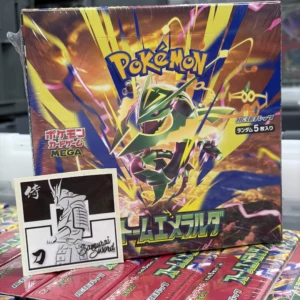
- New-set launches. Every new mainline release creates a demand window. The current example is M6 Storm Emeralda — ¥18,500 no-shrink / ¥20,000 sealed with us, shipping on or after August 5 — and our M6 pull rates and best cards guide shows what that reveal-to-release cycle looks like from the inside. Launch stock is where allocation relationships matter most; more on that in the sourcing section.
2. One Piece mainline — the second engine
One Piece is not a side note anymore. Japanese mainline OP boxes are a consistent part of what overseas shops order alongside Pokemon, and the entry price is low: our OP-16 The Time of Battle box is ¥13,860 at the time of writing. For a reseller testing a new product line, a sub-¥14,000 box from a major franchise is about as low-risk as sealed experimentation gets.
3. PSA10 graded singles — high value, different game
Graded Japanese singles move too, but as the next section argues, they are a different business wearing the same hobby’s clothes. Our PSA10 collection is where we stock ours.
What we deliberately do not build the catalog around: aged out-of-print boxes as a primary line, and raw modern singles at scale. Plenty of resellers do well in both — but they are niches, and this section is about what moves consistently.
Sealed, Singles, PSA10: Three Different Businesses
The most common structural mistake new resellers make is treating “Pokemon cards” as one business. It is at least three, differing on capital, skill, and turn speed.
| Sealed boxes | Raw singles | PSA10 graded | |
|---|---|---|---|
| Ticket size (typical) | Mid — ¥13,000–¥56,000/box on our current shelf | Low per unit, high unit count | Wide — ¥12,865 to ¥542,810 on our current shelf |
| Core skill | Set selection, timing, condition handling | Pricing at scale, condition grading by eye | Card-level market knowledge, authenticity |
| Labor per yen of inventory | Low | High — every card is its own listing | Low unit count, high diligence per unit |
| Condition risk | Box exterior; contents protected | Every surface of every card | Encapsulated; risk shifts to authenticity and case condition |
| Buyer type | Openers, collectors, other shops | Players, set collectors | Collectors, investors |
Look at that PSA10 spread, because it is the point. On our shelf at the time of writing sit a PSA10 Mew ex SR 195/165 at ¥12,865, a PSA10 Monster-Ball-holo Pikachu 025/165 at ¥41,736, and a PSA10 Pikachu AR 172/151 at ¥542,810. Same grade, same franchise, same era — a 40x price range. A sealed box’s value is mostly a function of its set; a graded card’s value is a function of the exact card, and no shortcut replaces knowing which is which. Our PSA10 guide for the current Mega era is a working example of that card-level analysis.
The practical advice: start with one business, and let it be sealed. Sealed boxes forgive inexperience in a way singles do not — the product is standardized, the market price is discoverable, and your condition obligations are about careful storage rather than expert grading. Add singles when you have listing infrastructure, and PSA10 when you have card-level conviction and the capital to hold slow-turning high-ticket inventory. There is one more sealed-specific nuance worth knowing before you price anything: sealed boxes are probability products. What a box is “worth” to an opener is a function of its hit structure, and understanding how Japanese pull rates actually work will make you noticeably better at judging which sealed products deserve your capital.
Sourcing Well
Sourcing is where resale businesses are won or lost, because your buy price is the one variable you fully control. Three disciplines matter more than the rest.
Understand condition standards — starting with “no shrink”
Japanese sealed stock comes in two forms, and an honest supplier will tell you which you are getting. “Sealed” means the box carries its outer shrink wrap. “No shrink” means the box has no outer shrink wrap — which is common and normal for Japanese re-released stock, not a defect or a sign of tampering. The packs inside are unopened either way. The two forms price differently — our Shiny Treasure ex box is ¥17,340 no-shrink versus ¥19,968 sealed at the time of writing — and the right choice depends on your customer: buyers who open product often prefer the cheaper no-shrink box; buyers who collect or re-sell sealed display product pay for the wrap. A supplier who does not distinguish the two clearly, or who cannot explain the difference, is telling you something about their standards.
Take allocations seriously on launches
New-set launch stock is allocated, not unlimited — how much product any shop receives is settled through the distribution chain, and launch-window supply can be tight on headline sets. Two consequences: a standing supplier relationship beats spot-buying when a hot set drops (suppliers fill repeat buyers first, everywhere, as ordinary commercial behavior), and chasing a hyped launch at its price peak with no allocation secured is how beginners buy the top — the mistakes section returns to this. If you want the full picture of how Japanese product actually reaches overseas shops — and why there is no official international wholesale program to sign up for — our Japanese Pokemon card distributor guide covers the channel structure honestly.
Think in landed cost, always
The number that matters is never the sticker price. It is:
| Landed cost component | What to know |
|---|---|
| Product price (JPY) | Compare against the Japanese street market, not against your home market — a price far below Japanese street level is a red flag, not a bargain |
| International shipping | Per-box shipping cost falls sharply as you consolidate; a tracked FedEx shipment costs similar money whether it carries two boxes or eight |
| Import duties and taxes | Yours, in your country, at your rates — a cost of goods line item to model before you buy, not a surprise at delivery |
| FX at payment time | You are buying in yen; your margin is in your home currency. Know the rate you transacted at |
Every one of those lines belongs in your cost basis before you commit to a purchase. Resellers who compute margin off the product price alone systematically overestimate their profitability — then blame the category. Our walkthrough of the whole cross-border process, including supplier vetting and payment recourse, is in how to buy Japanese Pokemon cards wholesale.
The Selling Side: Fees, Trust, and Unboxing Videos
This is a sourcing-side guide from a sourcing-side company, so we keep this section to what we actually observe from our position in the chain.
Platform fees decide your platform, margin decides your survival
Marketplace selling fees — final value fees, payment processing, promoted listings — typically consume a meaningful slice of every sale, and they differ enough between platforms that the same box can be profitable on one venue and marginal on another. We will not quote platform rates because they change; the discipline that does not change is modeling your full fee stack against your full landed cost per SKU before listing, not after your first month’s statement arrives.
Authenticity trust is your real inventory
In a category where fakes exist, a reseller’s reputation for selling genuine product is the asset everything else sits on — and it is easier to protect than to rebuild. Buy from suppliers you have vetted, keep your chain of custody boring and documented, and learn the verification basics yourself; our guide to spotting fake Japanese Pokemon cards is the reference we point our own customers to. When you resell Japanese product, you inherit your supplier’s integrity — choose accordingly.
Unboxing videos protect the seller too
Recording the opening of received shipments has become standard practice among serious buyers, and we would push every reseller to adopt it in both directions. As a buyer, a continuous unboxing video is your evidence if a shipment arrives damaged or short — our own published policy requires one for damage claims, and we are far from alone in that. As a seller, encouraging your customers to record their openings protects you from the small minority of fraudulent claims every operation eventually meets. It converts disputes into reviewable facts.
Common Beginner Mistakes
Every one of these is a pattern we have watched play out more than once.
- Buying hyped sets at their peak. The launch-window excitement around a headline set is precisely when premiums are largest and precisely when a beginner feels the most urgency. Japanese reprint culture makes this worse for the buyer of the top: modern Japanese sets are typically resupplied, and street prices that spiked on scarcity tend to settle when supply becomes visible. Decide your acceptable price before the hype window, not during it.
- Ignoring FX. Your buy currency is yen and your sell currency is not. A margin that looks healthy at one exchange rate can compress at another, and a reseller who never looks at the rate is running currency exposure without knowing it. You do not need to hedge like a trading desk — you need to know your rate at purchase and reprice your listings when it moves materially.
- No condition documentation. Photograph inventory on arrival, note box condition (and whether stock is sealed or no-shrink) at intake, and record your own outbound packing on higher-value orders. The one time you need this evidence, nothing else substitutes for it.
- Computing margin on product price alone. Covered above, repeated here because it is the most common spreadsheet error we see: landed cost or it does not count.
- Scaling into PSA10 before earning card-level knowledge. The ¥12,865-to-¥542,810 spread on identical grades is a warning label. High-ticket graded inventory bought on vibes is how resale capital dies quietly.
- Treating the supplier relationship as transactional. The reseller who communicates clearly and pays reliably becomes the buyer a supplier calls when allocation is tight. That is not sentiment; it is how limited product gets divided.
How We Supply Resellers
One section on us, kept honest. SAMURAI SWORD CO.,LTD. is a Tokyo retailer and exporter, and supplying overseas card shops and resellers is a large part of our daily business. The setup, concretely:
- No minimum order. There is no minimum order value. Test us with a single box; scale only if the experience earns it. Much of our volume is repeat overseas buyers, including shops and resellers, and that repeat rate — not a contract — is the relationship.
- Quick Order for bulk. The Quick Order interface on our homepage is built for exactly the sealed-box, multi-line orders resellers place: pick quantities across Pokemon, One Piece, Yu-Gi-Oh, and Dragon Ball Fusion World boxes in one pass instead of paging through product listings.
- Payment by Wise bank transfer or PayPal. All catalog prices are in JPY. Wise keeps the FX cost of a yen transfer low; PayPal offers buyer-side recourse many first-time importers want.
- FedEx from Tokyo, tracked. International Connect Plus or International Priority, worldwide. Import duties and taxes in your country are your responsibility — we say that plainly because a supplier who is vague about duties is setting you up for a surprise.
- Honest condition language. Sealed and no-shrink stock are labeled and priced separately, and damage claims are covered under our published unboxing-video policy.
View Product → (update: currently sold out — restock requests via Quick Order)
If you are still comparing suppliers — and you should be — our wholesale buying guide lists the vetting questions we think any Japanese supplier, including us, should be able to answer.
Frequently Asked Questions
Is reselling Japanese Pokemon cards profitable in 2026?
It can be, but profitability is decided by execution, not by the category. The structural advantages are real — lower Japanese pack pricing, FX, source-market buying, and Japan-exclusive sets — yet they only convert to margin if you compute full landed cost (product + international shipping + your import duties + fees), source at sensible prices, and avoid buying hyped launches at their peak. We do not publish profitability statistics because honest ones would depend entirely on the operator.
What Japanese Pokemon products sell best for resellers?
In our experience supplying overseas shops, modern sealed booster boxes are the consistent core: high-class evergreen sets like VSTAR Universe and Shiny Treasure ex, nostalgia sets like Pokemon 151, and each new mainline launch window (currently M6 Storm Emeralda). Japanese One Piece mainline boxes are a strong second line. PSA10 graded singles also move, but they are a separate, more knowledge-intensive business.
Should I start with sealed boxes, singles, or graded cards?
Sealed boxes. They are standardized, easy to price against a discoverable market, and their condition obligations are about careful storage rather than expert grading. Raw singles demand listing infrastructure and per-card labor; PSA10 demands card-level market knowledge — identical grades on our shelf currently range from ¥12,865 to ¥542,810, and telling those apart is the entire skill.
What does “no shrink” mean on Japanese booster boxes?
A “no shrink” box has no outer shrink wrap, which is common and normal for Japanese re-released stock — the packs inside are still unopened. No-shrink stock prices below fully sealed stock (our Shiny Treasure ex box is ¥17,340 no-shrink versus ¥19,968 sealed at the time of writing) and suits buyers who open product; fully sealed boxes suit collectors and sealed-product resale.
How do I source Japanese Pokemon cards for resale?
Overseas resellers overwhelmingly source through Japanese exporters, retailers, marketplaces, and auction or buyback channels — in practice there is no official international wholesale program to sign up for. Vet suppliers on company registration, tracked shipping, payment methods with recourse, published policies, and prices consistent with the Japanese street market. Then build a repeat relationship: allocation on tight launches follows reliability in both directions.
Do I need an unboxing video when buying inventory from Japan?
Treat it as mandatory. Recording a continuous video of every shipment opening is your evidence if product arrives damaged or short — our own published policy requires an unboxing video for damage claims, and that requirement is increasingly standard practice. As a reseller, encourage your own customers to do the same; it protects you against fraudulent claims just as it protects buyers against genuine problems.
All store prices are SST live prices at the time of writing (August 3, 2026, JST) and change with the market. MSRP figures are official publisher pricing. Exchange rates move. Nothing here is financial advice — sealed product, singles, and graded cards can all fall in value.
500 Points Free on Sign-Up
CREATE FREE ACCOUNT1 pt = ¥1 at checkout · Points expire 30 days after they are earned · Import duties, taxes and customs charges are not included in the price and are collected on delivery, except for destinations we ship duty-paid.
Picked for this article
📩 Get member-only sale alerts & coupons
Sale alerts, coupons and restock notices by email — straight from Tokyo.