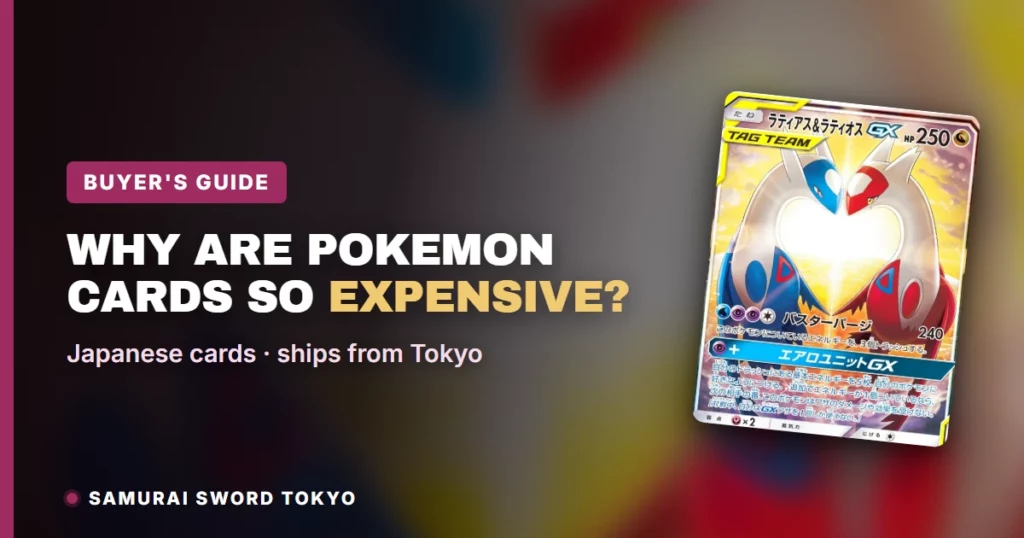
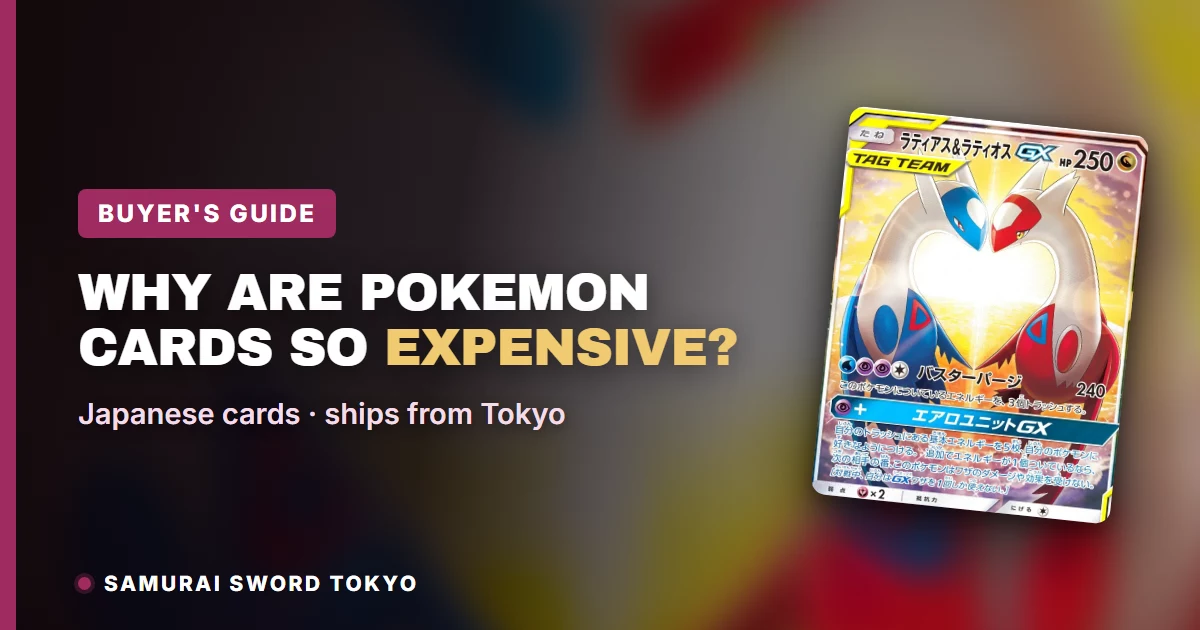
The short answer: several documented features can distinguish one card from another — including rarity tier, print treatment, physical format and grading standard. These features describe the examples below, but they do not by themselves determine a card’s price.
We sell graded Japanese Pokemon cards and sealed boxes out of Tokyo, and these features appear across our current listings. This guide walks through them using the definitions behind them, with our own listings as worked examples — no price rankings and no “most expensive card” claims.
Structural features can distinguish one card from another without setting a price by themselves: a Secret Rare is defined as a card numbered higher than the set’s printed total (e.g. 101/100); gold-finish rarity treatments can use a more elaborate print process; a LEGEND card is physically two half-cards that count as one; and PSA’s Gem Mint 10 standard requires four sharp corners and centering within roughly 55/45 on the front. Our PSA10 Mewtwo EX UR is currently listed at ¥605,000 (~$3,805), and our PSA10 Latias & Latios GX SR:SA is currently listed at ¥1,321,516 (~$8,311) (update: currently sold out — restock requests via Quick Order) — each illustrates one of these features.
Yen figures below convert at ¥159/USD (September 2026). All prices shown are our own listed prices, used only to illustrate which structural tier a card sits in — not as a ranking.
Filter One: Rarity Tier, by Definition Not by Feel
The first and biggest price filter is simply which rarity tier a card was printed into, and that tier has a hard definition — not a vibe. A secret card is defined, per Bulbapedia, as “a card whose collection number is greater than the listed number of cards in the set” — a card numbered, say, 101/100 in a 100-card set. Since Scarlet & Violet, the rule has tightened further: Bulbapedia states that “all cards with any rarity other than Common, Uncommon, Rare, Double Rare, and ACE SPEC Rare are secret cards.” In practical terms, that means most of the chase-tier cards people search for — full-art Supporters, alt-art Pokemon, gold cards — are, by the set’s own numbering, printed outside the “main” numbered run.
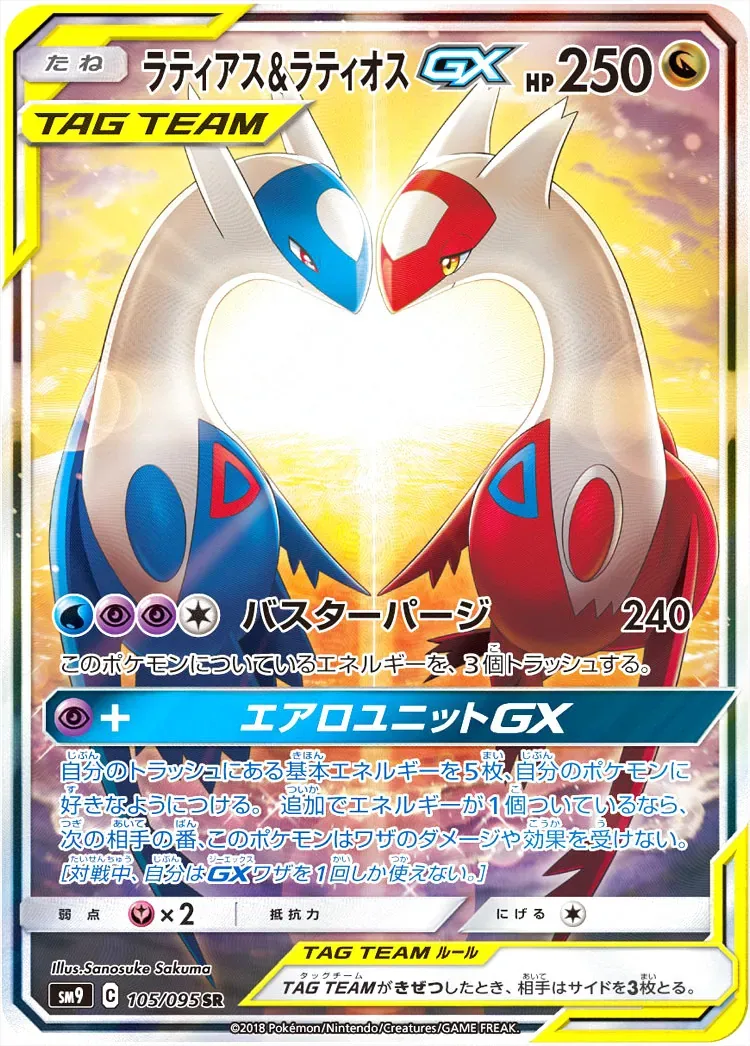
Our PSA10 Latias & Latios GX SR:SA, numbered 105/095 in Tag Bolt (SM9) (update: currently sold out — restock requests via Quick Order), is a direct example of this mechanic: the card’s own number tells you it sits outside the 95-card main set before you even look at the artwork. This is the reason “how many cards are in this set” and “how many cards are chasing collectors” are two different questions with two different answers.
Filter Two: Gold-Finish Rarity Treatments Use Different Print Processes
Being numbered as a secret card only gets a card into the pool. Within that pool, the physical treatment is a second, separate filter. Modern English Hyper Rares use gilded gold backgrounds, an additional glitter-foil layer and three gold stars in the English rarity system. Japanese Ultra Rare (UR) is a separate official rarity label, so the two terms should not be treated as automatically interchangeable across languages and eras.
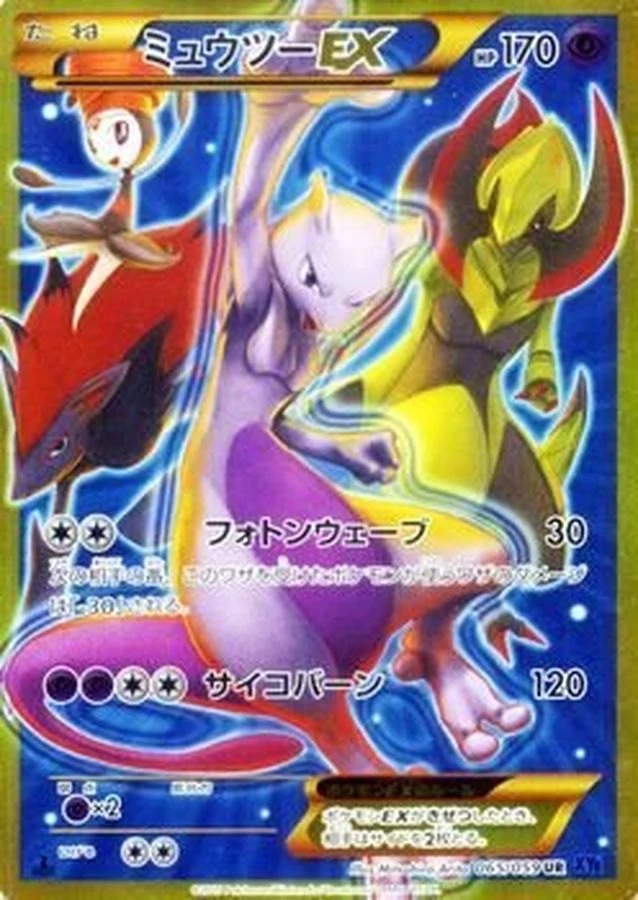
Our PSA10 Mewtwo EX UR, 065/059 from Blue Impact (XY8), is currently listed at ¥605,000 (~$3,805). It is catalogued as a Japanese UR and has a gold-background treatment; this guide does not apply the modern English three-star Hyper Rare symbol to this XY-era card.
Filter Three: When the Format Itself Is the Rarity
Occasionally, the price filter is not the foil or the number at all — it is the physical format of the card. LEGEND cards, first appearing in the HeartGold & SoulSilver era, are printed as two separate half-cards that must be played together and count as one card in play, per Bulbapedia. That is a structurally more complex product than a standard single card: two pieces of cardboard, each incomplete on its own, designed to be collected and kept as a pair.
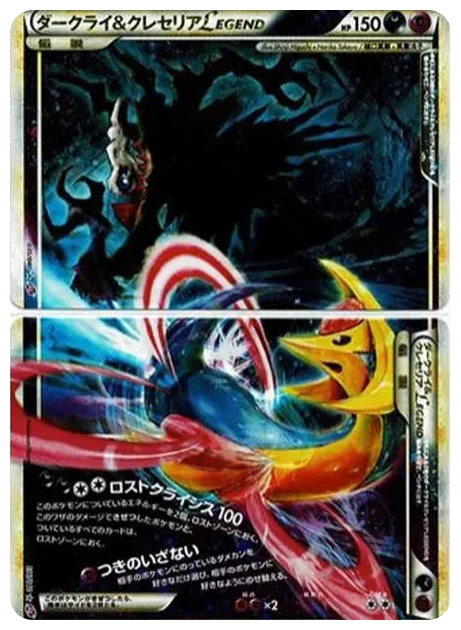
Our PSA10 Darkrai & Cresselia LEGEND, 035-036/040 from Lost Link, is currently listed at ¥770,000 (~$4,843). A complete LEGEND design uses two specific half-cards together, which makes its physical format distinct from a single full-art card.
Filter Four: Grading Stacks a Second Filter on Top
Everything above describes what a card is as printed. Grading adds an independent filter on top of that: how close an individual, physical copy comes to a printing-press ideal. PSA’s published Gem Mint 10 standard requires “four perfectly sharp corners,” a surface free of any staining, and centering “within approximately 55/45 percent on the front, and 75/25 percent on the reverse.” Those are specific, checkable thresholds, not a subjective “looks nice” call — and they are strict enough that only a fraction of raw cards submitted for grading meet all of them at once.
That strictness is a real, separate driver of the price gap between a raw copy and a PSA10 of the exact same print — the card itself hasn’t changed, but its position on a documented, narrow pass/fail scale has. For more on what the PSA10 grade specifically certifies, see our PSA10 meaning guide, and for the full grading process end to end, our Japanese Pokemon card grading guide.
A card’s rarity tier (Secret Rare, Hyper Rare, LEGEND) and its grade (PSA10 vs raw) are independent filters that stack. The same print can sit in a high rarity tier and still fail to reach Gem Mint condition — and a common card can be a perfect PSA10 and still just be a common card.
Why the Chase Card in a Box Stays Scarce
The last structural piece is distribution. Modern Japanese booster boxes are built around a documented design principle: certain higher rarities — the Secret Rares, Hyper Rares and equivalent chase cards described above — are allotted at a fixed, low rate per box. That mechanic is real and well established across modern Japanese TCG products. What we won’t do here is state a specific pull-rate number as a blanket fact, because exact odds are set-specific and change from expansion to expansion; for a given set’s actual pull rates, our set-specific breakdowns are the right source, not a generic guide like this one. See our Japanese Pokemon card rarities explained guide and our Japanese booster box guide for set-level detail.
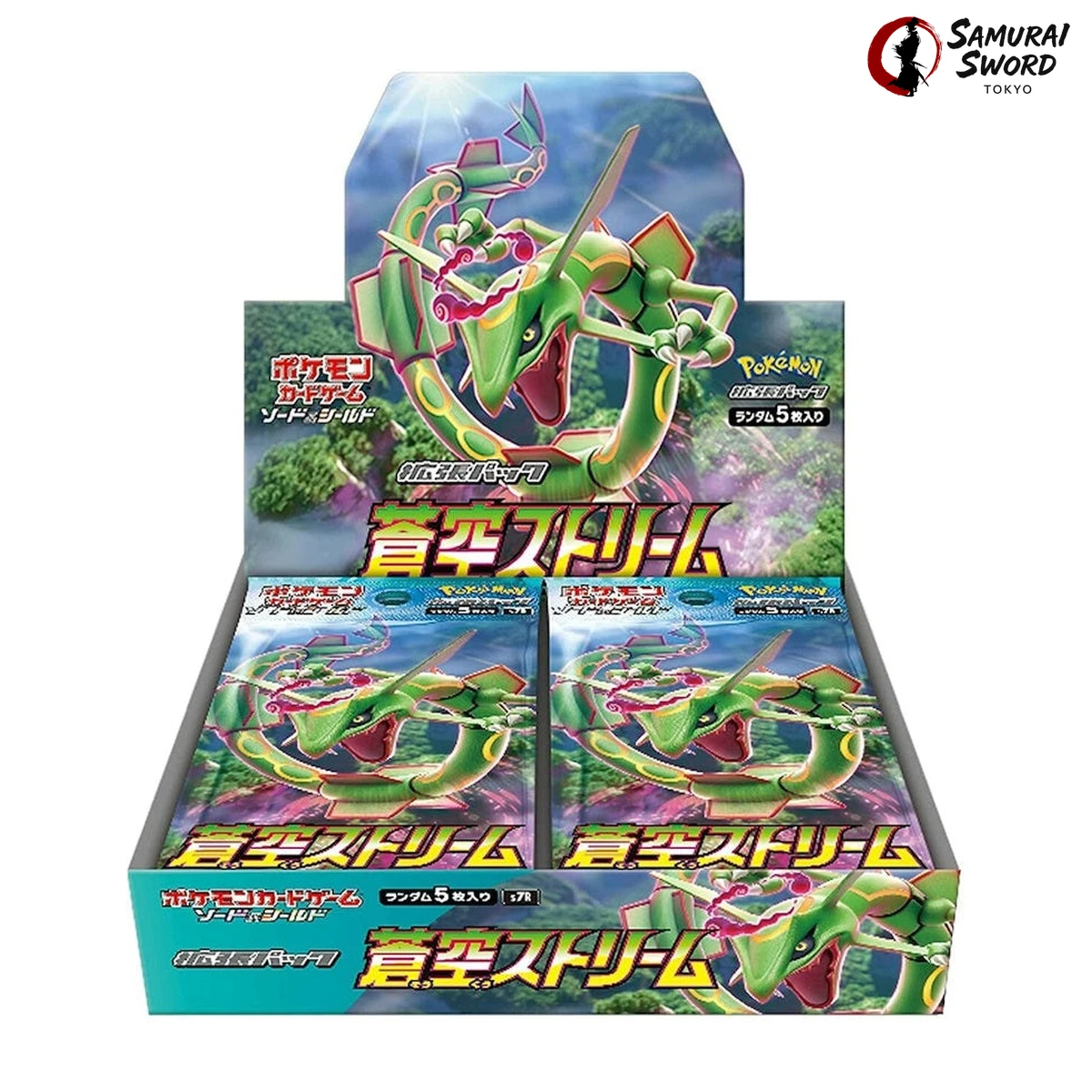
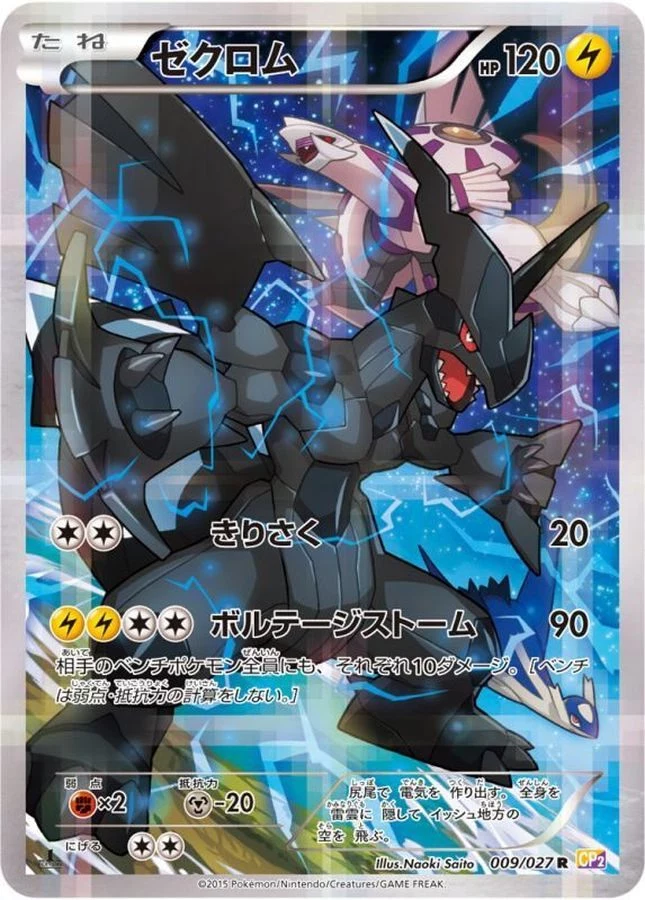
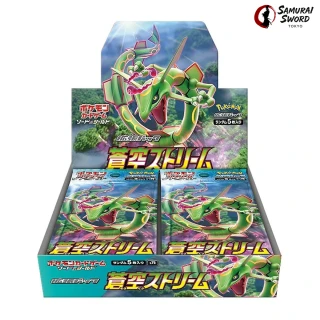
Both examples above show the same distribution mechanic from different angles. S7R Blue Sky Stream is a long out-of-print sealed box — once a set stops being printed, the total supply of unopened boxes only shrinks, which is a structural, one-way scarcity mechanic independent of anything printed on the cards inside. Zekrom 009/027 comes from a Concept Pack, a small-run product category by design, distinct from a standard main-set booster box. Neither of these facts is a pull-rate claim; both are documented facts about how the product itself was distributed.
Structural Features in Our Current Listings
Putting these features side by side against our current listings makes the distinctions easier to see than any single example on its own:
| Structural filter | What it means | Example from our current listings | Listed price |
|---|---|---|---|
| Secret Rare numbering | Card number exceeds the set’s printed total | Latias & Latios GX SR:SA 105/095 (update: currently sold out — restock requests via Quick Order) | ¥1,321,516 (~$8,311) (update: currently sold out — restock requests via Quick Order) |
| Japanese UR treatment | Gold-background treatment; not assigned the modern English three-star symbol here | Mewtwo EX UR 065/059 | ¥605,000 (~$3,805) |
| LEGEND two-card format | Two half-cards played and collected as one card | Darkrai & Cresselia LEGEND | ¥770,000 (~$4,843) |
| PSA10 grading strictness | Four sharp corners, no staining, ~55/45 front centering | Zekrom 009/027, Concept Pack 2 | ¥100,488 (~$632) |
| Sealed-product distribution | Long out-of-print box; supply only shrinks over time | S7R Blue Sky Stream Booster Box | ¥306,600 (~$1,928) |
None of these five is more “expensive” than another by design — each is simply the clearest available illustration of one specific structural filter. Our most expensive PSA10 Pokemon cards page takes a different angle: it’s a price-ladder list of our own listed cards, ranked by price, whereas this guide sticks to the definitions behind the tiers rather than ranking them.
Where to Buy These Cards from Tokyo
All five examples above are currently listed on our site, shipped from Tokyo with tracked delivery. If a Secret Rare or Japanese UR card is what you’re after, our PSA10 Mewtwo EX UR and PSA10 Latias & Latios GX SR:SA (update: currently sold out — restock requests via Quick Order) are both currently listed; for the two-card LEGEND format, see the PSA10 Darkrai & Cresselia LEGEND.
If you’d rather open sealed product than buy a graded single, our S7R Blue Sky Stream booster box is a long out-of-print example currently listed at ¥306,600 (~$1,928). For more PSA10 Japanese singles across rarity tiers, browse our PSA10 graded card collection, or build a mixed order — sealed boxes and singles together — through our Quick Order page.
Frequently Asked Questions
Why do some Pokemon cards have a number higher than the set total?
Because they’re secret cards by definition — Bulbapedia defines a secret card as one “whose collection number is greater than the listed number of cards in the set” (e.g. 101/100 in a 100-card set). Since Scarlet & Violet, all rarities other than Common, Uncommon, Rare, Double Rare and ACE SPEC Rare fall into this secret-card category.
What makes a Hyper Rare (UR) different from a normal holo card?
Modern English Hyper Rare cards use gilded gold backgrounds, an extra glitter-foil layer and three gold stars in the English rarity system. Japanese UR is a separate official rarity label, so those English identifiers are not applied automatically to older Japanese UR cards.
Why is a LEGEND card printed as two separate cards?
LEGEND cards, introduced in the HeartGold & SoulSilver era, are two half-cards that must be played together and count as a single card in play. That two-piece format is more complex than a standard single card and is part of why LEGEND cards are treated as a distinct premium category.
Why don’t more raw Pokemon cards grade PSA 10?
PSA’s published Gem Mint 10 standard requires four perfectly sharp corners, no staining, and centering within roughly 55/45 on the front and 75/25 on the reverse. Those are strict, specific thresholds, which is why only a portion of raw submissions reach the top grade.
Do all booster boxes guarantee the same chase card odds?
Booster boxes are built to allot certain higher rarities at a fixed rate per box, but the exact odds are set-specific and vary between expansions. For a given set’s actual pull structure, check our set-specific booster box and rarity guides rather than relying on a single generic number.
Is Hyper Rare the same thing as Ultra Rare?
No — the terms belong to different official rarity systems and should not be treated as automatically interchangeable across every language and era.
¥500 off, on us
- ¥500 off one order of ¥30,000 or more
- +1% extra points on that order
- One coupon per account
Sign in or create an account to claim · One use per account · One coupon per order · Not valid on pre-order items · Ends Sep 24, 2026, 23:59 JST · Import duties, taxes and customs charges are not included in the price and are collected on delivery, except for destinations we ship duty-paid.
Picked for this article

📩 Get member-only sale alerts & coupons
Sale alerts, coupons and restock notices by email — straight from Tokyo.