![How to Buy Japanese Pokemon Cards Wholesale from Japan [2026 Guide]](https://samuraiswordtokyo.com/wp-content/uploads/2026/08/featured-how-to-buy-japanese-pokemon-cards-wholesale-1-1024x538.webp)

If you run a card shop or resell sealed product, you have probably typed “wholesale pokemon cards” or “how to buy pokemon cards wholesale” into a search bar and come away confused: grey-market listing sites, closed distributor portals for English-language product, and pages that quietly assume you are buying English cards in the first place. For Japanese-version product — the boxes with the lower pack prices, the reprint-driven supply, and the print quality graders talk about — the honest answer looks different, and almost nobody spells it out.
Here is the version we give buyers who email us directly: for Japanese-version Pokemon cards, there is no practical official international wholesale program you can sign up for. Official distribution of Japanese product serves domestic Japanese retail. Overseas shops that stock Japanese sealed product overwhelmingly source it through Japanese exporters and retailers, marketplaces, and auction or buyback channels — supplier relationships, not distributor applications.
This guide covers how pokemon cards wholesale buying actually works from the Japan side: what “wholesale” realistically means, the four sourcing routes and their trade-offs, what volume buying looks like in practice (including “no shrink” and new-set allocations), the full landed-cost structure, and how to vet a supplier before wiring money. We are SAMURAI SWORD CO.,LTD., a Tokyo-based retailer and exporter; much of our volume goes to repeat overseas buyers, including card shops and resellers, so the details below come from doing this daily.
There is no official international wholesale channel for Japanese-version Pokemon product to apply to. The practical route for an overseas shop is a reliable Japanese supplier relationship — an exporter-retailer, a marketplace, or an on-the-ground buyer — plus a clear-eyed view of landed cost: product price + international shipping + import duties on your side. Vet the supplier, start with a test order, and scale the relationship, not the risk.
What “Wholesale” Actually Means in the Japanese TCG Market
In most retail categories, “wholesale” means a formal tier: register a business, get approved by a distributor, buy at a trade price list. Overseas shop owners naturally look for the same structure for Japanese Pokemon cards. For Japanese-version product sold internationally, that structure is not what you will find in practice.
Official distribution of Japanese-version product is, in practice, a domestic matter: it exists to supply Japanese retail. There is no official international wholesale program an overseas shop can simply apply to for Japanese-version sealed product. If your search intent was “how to become an official Pokemon distributor,” the honest reframe is this: for Japanese product, the realistic goal is not a distributor badge — it is a dependable Japanese supplier relationship. We cover that search question in depth in our Japanese Pokemon card distributor guide.
So what does “wholesale” mean here? In the Japanese TCG export market, it effectively means volume buying at street-market prices from a supplier who can actually deliver — multiple boxes or cartons per order, consolidated international shipping, and terms that get better as trust builds. The margin story is different from classic distribution too: instead of a trade discount off retail, your edge typically comes from the gap between Japanese street prices and what the same Japanese-version product sells for in your market. Japanese MSRPs per pack are set lower than English counterparts in some lines — One Piece OP-17, for example, is ¥240 per pack in Japan against a $4.99 English pack MSRP — and a weaker yen has, at times, widened that gap further, though exchange rates move. The mechanics of that gap are their own topic; we break them down in why Japanese Pokemon cards are cheaper.
Accept that framing — supplier relationship, not distributor application — and the question becomes practical: which kind of supplier, and how do you buy well from them?
The 4 Practical Sourcing Routes
Nearly every overseas shop stocking Japanese-version sealed product sources it through one of four routes, or a mix of them. Each has a real trade-off profile — there is no universally best answer, only a best fit for your volume, language ability, and risk tolerance.
| Route | Best for | Main strengths | Main weaknesses |
|---|---|---|---|
| 1. Japanese exporter-retailers | Shops that want English support and repeatable orders | English-language ordering, export paperwork handled, tracked shipping, consistent packing, published policies | Prices are street-market, not trade-tier; allocation limits on hyped new sets |
| 2. Marketplaces (Japanese and international) | Price-checking and opportunistic single-box buys | Wide selection, visible price competition, buyer-protection frameworks on some platforms | Seller quality varies box to box; consolidation and export logistics are your problem; volume is unreliable |
| 3. Auction and buyback channels | Experienced buyers hunting below-street pricing | Occasional genuine bargains, access to older and out-of-print stock | Usually requires Japanese language or a proxy service, condition risk, no recourse culture, time-intensive |
| 4. On-the-ground buyers in Japan | High-volume operations with established trust | Can chase stock across physical shops, react to restocks fast, negotiate in person | You are trusting an individual with your money; scaling and continuity depend entirely on that person |
Route 1: Japanese exporter-retailers
These are Japanese companies — we are one — whose business is selling Japanese product to overseas buyers directly. You order in English, pay by methods you already use, and the exporter handles domestic sourcing, transit-grade packing, and the export paperwork. For a shop that wants to place a similar order every few weeks and have it simply arrive, this is the lowest-friction route. The trade-off is honest: you pay Japanese street-market prices plus the exporter’s margin, not a formal trade discount. For most shops the JP-vs-local price gap still makes the math work — but it is your math to run, and our reselling Japanese Pokemon cards guide walks through it from the resale side.
Route 2: Marketplaces
Japanese domestic marketplaces and international platforms both carry Japanese sealed product, and they are genuinely useful — especially as a price reference: checking marketplace asks for the same box tells you where the Japanese street market sits before any volume order. As a primary volume channel, though, marketplaces are harder: seller quality is inconsistent, ten boxes may mean ten different sellers with ten packing standards, and getting product out of Japan often adds a proxy or forwarding layer with its own fees and handling risk.
Route 3: Auction and buyback channels
Japan’s auction platforms and shop buyback flows occasionally surface product below street price, and some serious buyers build a real edge here. But the route typically assumes Japanese-language ability or a proxy bidding service, condition surprises are common, and dispute resolution is thin. It rewards time and expertise more than capital — the opposite of what most busy shop owners have spare.
Route 4: On-the-ground buyers
Some overseas shops work with an individual in Japan who physically buys stock and forwards it. When it works, it is flexible and fast. The structural weakness is obvious: everything — sourcing judgment, authenticity checking, packing, and your money — rides on one person, and rarely survives that person getting busy or moving on. Treat it as a complement to a structured channel, not a substitute.
Most established shops end up with a hybrid: a primary exporter-retailer relationship for the repeatable core order, plus marketplace or auction opportunism at the edges. It is boring, which is exactly the point.
What Volume Buying Looks Like in Practice
Boxes, cartons, and why the carton is not magic
The Japanese sealed unit ladder runs pack → booster box → carton (a manufacturer case of boxes). Cartons do matter — they pack efficiently, arrive factory-sealed, and per-box shipping cost drops as the shipment gets denser. What a carton is not, in the Japanese market, is a gateway to a dramatically lower trade price. Because sourcing happens at street-market level rather than through an international trade tier, volume discounts exist but are incremental, not transformational. The bigger lever on landed cost is usually consolidation: one well-packed shipment of mixed product beats several small ones.
“No shrink” explained honestly
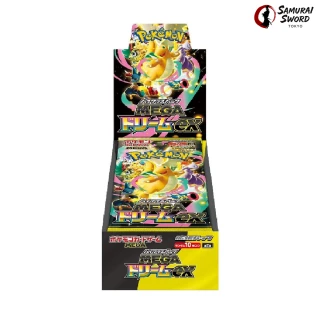
Browse Japanese sealed listings and you will see the same box offered two ways — on our shelves at the time of writing, the M2A Mega Dream ex booster box is ¥12,408 no shrink versus ¥13,624 sealed. “No shrink” means the box has no outer shrink wrap. This is common and normal for Japanese re-released stock — reprint-wave product often reaches the market without outer wrap — and the packs inside are unopened either way. For a shop whose customers open packs, no-shrink stock is frequently the better buy: same pulls, lower cost. For collectors keeping boxes sealed on a shelf, the wrap itself carries value, and sealed is worth the premium. A supplier who labels this distinction clearly is being honest with you; one who is vague about it is a flag.
| Box (Japanese, at the time of writing) | No shrink | Sealed |
|---|---|---|
| M2A Mega Dream ex | ¥12,408 | ¥13,624 |
| M2 Inferno X | ¥15,300 | ¥21,320 |
| SV4A Shiny Treasure ex | ¥17,340 | ¥19,968 |
| SV2A Pokemon 151 | ¥48,960 | ¥56,000 |
| M6 Storm Emeralda (ships on/after Aug 5) | ¥18,500 | ¥20,000 |
Note the sealed premium is not uniform — it tracks how much of a set’s demand is shelf-collector demand — and prices move; treat these as a snapshot of our live store prices, not quotes.
Allocation reality on new sets
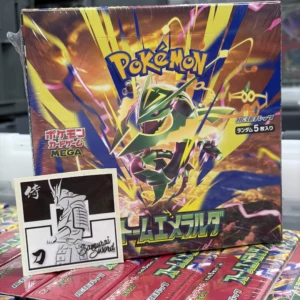
The hardest lesson for new volume buyers: on hyped new releases, nobody at any tier can promise unlimited quantity. Japanese shops receive allocations, and those allocations flow downstream. Pokemon’s M6 Storm Emeralda (shipping on or after August 5, at ¥18,500–¥20,000 per box at the time of writing) and One Piece’s OP-17 (August 22 release) are current examples: launch-window quantity depends on what suppliers are actually allocated, and launch pricing can carry a premium that settles as reprint supply arrives. Japan’s reprint culture is the counterweight — modern Japanese sets are reprinted readily, which tends to keep street prices closer to MSRP over time than English-market hype cycles. The playbook: order early, accept partial quantities on launch sets gracefully, and let reprint waves fill out your position. For set-level detail on M6, see our Storm Emeralda pull rates and best cards guide.
The Real Cost Structure: Product, Shipping, Duties
Run every buying decision on landed cost — what a box costs delivered and cleared through your customs — not sticker price. It has three layers:
| Layer | What it is | What drives it |
|---|---|---|
| 1. Product | The Japanese street price of the boxes, in JPY | Set demand, reprint status, sealed vs no shrink, your supplier’s sourcing |
| 2. International shipping | Carrier cost from Japan to you | Weight and dimensions, destination, service speed, and above all consolidation |
| 3. Import duties and taxes | What your country charges on arrival | Your local rates and thresholds — this layer is the buyer’s responsibility |
Product. All our catalog prices are in JPY, as is typical for Japanese suppliers, so exchange rate movement flows straight into your cost — a weaker yen has at times made Japanese product meaningfully cheaper in USD or EUR terms, and the reverse is equally possible. Budget with a buffer, not the spot rate.
Shipping. We ship worldwide from Tokyo by FedEx — International Connect Plus or International Priority — fully tracked. Sealed boxes are light for their volume, so dimensional weight usually governs the price, which is why consolidation is the single biggest cost lever a volume buyer controls: one dense, well-packed multi-box shipment costs far less per box than the same boxes sent separately. Speed is a real choice too — Priority costs more and arrives faster; Connect Plus trades days for cost.
Duties and taxes. Import duties, VAT/GST, and any brokerage fees on your side are the buyer’s responsibility — standard across Japanese exporters, and our published policy as well. Rates and thresholds vary widely by country, so look up yours before your first order and build them into your margin math from day one. A supplier who promises your shipment will “avoid customs” is not offering a discount; they are offering you their compliance risk.
Run all three layers on a realistic test order — say, five to ten boxes — before committing to volume. If the landed-cost math fails at ten boxes, more boxes rarely fix it; a different set mix usually does. The best Japanese booster boxes of 2026 roundup is a reasonable starting point for that mix.
How to Vet a Japanese Supplier
Scam stories in this category tend to share a shape: a price meaningfully below the Japanese street market, urgency, and payment by a method with no recourse. The vetting checklist that prevents it is short and generic — none of it requires Japanese-market expertise:
- Verify the company exists. A real Japanese supplier is a registered company with a consistent legal name, a physical base, and a track record you can find. If the entity behind the website is unclear, stop.
- Check the price against the street market. Marketplace asks for the same box tell you the Japanese street level in minutes. Slightly above street with services included is normal; far below street is the oldest red flag in the category.
- Insist on tracked shipping. Serious exporters ship tracked with a real carrier as standard. “Untracked to save you money” on a multi-box order is not a favor.
- Pay with recourse. Especially on a first order, use payment methods that give you a dispute path. A supplier who only accepts irreversible payment from a stranger is telling you how it ends.
- Read their published policies. Real operations publish real policies — shipping terms, damage-claim procedures, customs responsibility — because they need them daily. Vague or missing policies mean negotiating every problem from scratch, after your money has left.
- Start small, then scale. A test order costs a little margin efficiency and buys certainty about packing quality, communication speed, and honesty when something goes wrong.
Authenticity fears mostly attach to the wrong place: fakes concentrate in singles and too-good-to-be-true listings rather than factory-sealed product from the legitimate Japanese market. To build the checking muscle anyway, our guide on how to spot fake Japanese Pokemon cards covers the tells.
How Ordering From Us Works
One section on ourselves, kept factual, because “how do I actually place a volume order” is the question this article exists to answer:
- No minimum order. There is no minimum order value. A single test box and a multi-carton order go through the same flow, which is deliberate — we would rather you verify us small before you buy big.
- Quick Order for volume. The Quick Order interface on our homepage is a tab-based bulk-ordering surface for sealed boxes across Pokemon, One Piece, Yu-Gi-Oh, and Dragon Ball Fusion World — built for adding quantities across many sets in one pass rather than paging through product listings.
- Payment: Wise bank transfer or PayPal. All prices are in JPY. Wise typically suits larger orders; PayPal gives first-time buyers a familiar dispute path — which, per the vetting section above, is exactly what we would tell you to want from any new supplier, including us.
- Shipping: FedEx from Tokyo, tracked. International Connect Plus or International Priority, packed for international transit, consolidated into as few shipments as your order allows.
- Duties are yours; we say so upfront. Import duties and taxes are the buyer’s responsibility, and our customs-related handling policies are published rather than discovered after the fact.
- Damage claims require an unboxing video. This is our published policy, and volume buyers should welcome it: film the carton opening, and any transit-damage claim proceeds on evidence instead of argument.
- English support, nine-language storefront.
The Pokemon sealed box collection shows current stock and live JPY pricing. For a concrete anchor at the time of writing: the One Piece OP-16 booster box below is available — a settled post-launch price point and a sensible first test order.
View Product → (update: currently sold out — restock requests via Quick Order)
And if your next question is what happens after the boxes arrive — pricing for your market, sealed versus opened strategy, moving graded singles — that is the other half of the business, covered in the reselling guide.
Frequently Asked Questions
How do I buy Japanese Pokemon cards wholesale from Japan?
In practice, by building a supplier relationship rather than applying to a program: overseas shops overwhelmingly source Japanese-version sealed product through Japanese exporter-retailers, marketplaces, auction/buyback channels, or on-the-ground buyers. The lowest-friction route for most shops is a Japanese exporter-retailer with English support, tracked shipping, and published policies — start with a small test order, verify the experience, then scale volume.
Is there an official wholesale or distributor program for Japanese Pokemon cards?
For overseas buyers of Japanese-version product, no practical one: official distribution of Japanese product serves domestic Japanese retail. The realistic path is a reliable Japanese supplier relationship, with margin coming from the gap between Japanese street prices and your local market rather than from a formal trade discount.
What is the minimum order to buy pokemon cards wholesale from a Japanese exporter?
It varies by supplier. At our store there is no minimum order at all — a single box and a multi-carton order use the same Quick Order flow. We actually recommend new volume buyers start with a small test order of five to ten boxes to verify packing, communication, and landed-cost math before committing to larger quantities.
What does “no shrink” mean on Japanese booster boxes?
“No shrink” means the box has no outer shrink wrap, which is common for Japanese re-released (reprint) stock; the packs inside are unopened either way. No-shrink boxes are cheaper — for example, at the time of writing our M2A Mega Dream ex box is ¥12,408 no shrink versus ¥13,624 sealed — making them the better buy for shops whose customers open packs, while sealed boxes suit collectors who value the wrap itself.
Who pays import duties and taxes on wholesale pokemon cards shipped from Japan?
The buyer. Import duties, VAT/GST, and brokerage fees in the destination country are the buyer’s responsibility — standard practice across Japanese exporters and our published policy. Check your country’s rates and thresholds before your first order and build them into your margin calculation from day one.
How do I avoid scams when sourcing pokemon cards wholesale from Japan?
Apply generic due diligence: verify the supplier is a registered company, compare their price against Japanese marketplace asks (far-below-street pricing is the classic red flag), insist on tracked carrier shipping, pay by methods with a dispute path on early orders, confirm they publish real shipping and claims policies, and start with a small test order before scaling.
Prices quoted are SST live store prices as of August 3, 2026 (JST) and change with the Japanese market; treat them as reference anchors, not quotes. Market-structure descriptions reflect sourcing practice, not any third party’s official programs.
500 Points Free on Sign-Up
CREATE FREE ACCOUNT1 pt = ¥1 at checkout · Points expire 30 days after they are earned · Import duties, taxes and customs charges are not included in the price and are collected on delivery, except for destinations we ship duty-paid.
Picked for this article
📩 Get member-only sale alerts & coupons
Sale alerts, coupons and restock notices by email — straight from Tokyo.