Flip a Japanese Pokemon card face-down and you can date it in under a second — if you know what you’re looking at.
Japanese-print Pokemon cards use one of two documented card back designs. One was used from the game’s 1996 launch to July 2001. The other has been used on Japanese Pokemon cards since — more than 25 years and counting, across letter-rarity sets, Sun & Moon foils, Sword & Shield VMAX cards, and the current Mega-era secret rares. The sources we checked document exactly one switch, on that single date, and no further back-design change since.
This is a reference page, not a buying guide: it explains when the back changed, what actually happened on that date, how the current Japanese back relates to the English back, and why grading-focused vintage buyers treat the back as a dating tool. For collecting advice and what old-back cards are worth, see our dedicated old-back Japanese cards guide.
The Japanese card back changed exactly once: on July 19, 2001, with the release of Pokémon VS. Every Japanese card printed before that date carries the old back; every one printed since — including cards sold today — carries the current back. The two attributes collectors sometimes mix up, old back and 1st Edition, cannot both appear on the same card, because 1st Edition printing only began with Pokémon VS itself. Browse current Japanese sealed booster boxes or build a mixed order of vintage and current singles through Quick Order.
1996–2001: The Original Japanese Card Back
The Japanese Pokemon Trading Card Game launched in 1996 under the name Pocket Monsters Card Game. Per Bulbapedia, every card printed under that original branding — the base sets, Jungle-era, Fossil-era, Team Rocket-era, Neo-era and Gym-era Japanese releases — carried a card back tied to that “Pocket Monsters Card Game” design, distinct from the back used on international prints of the same period.
We won’t describe the exact artwork on that old back here. Bulbapedia doesn’t publish a verified textual description of it, and we’re not guessing on a factual reference page. If you want to see one, the reliable way is a real photograph of a graded or raw old-back card, not a rendering from memory.
What’s verified is the window: this design ran from the 1996 launch until it was replaced in mid-2001. In the hobby, that’s what “old back” means — a card printed before the switch below. On its own, it says nothing about set, rarity, or condition.
July 19, 2001: Pokémon VS and the Switch
The change point is a single expansion: Pokémon VS, released in Japan on July 19, 2001. Bulbapedia states it directly: “the back of the card was changed from the ‘Pocket Monsters Card Game’ to the ‘Pokemon’ design used in international prints.”
That’s the sourced mechanism: Pokémon VS is the release where the back changed. Everything released in Japan before July 19, 2001 has the old back; everything released on or after that date, including Pokémon VS itself, has the current back.
Pokémon VS carries two other firsts that get mentioned in the same breath as the back change, and it’s worth keeping them separate: it was also the first Japanese expansion with Secret cards and the first to include 1st Edition prints. Those are different attributes from the back design. They happen to start on the same release date, which is exactly why they get confused — see the next section.
Old Back Is Not the Same as 1st Edition
This is the mix-up worth flagging explicitly: an old-back card cannot also be a 1st Edition card. They are two separately tracked attributes of a Japanese card, and the release calendar makes them mutually exclusive.
1st Edition printing in the Japanese game only began with Pokémon VS on July 19, 2001 — the exact same expansion that switched the card back. So every card with an old back predates 1st Edition printing entirely, and every card that carries a 1st Edition mark was, by definition, printed on or after the back already changed. One does not layer on top of the other on the same card. If you see a listing claiming an “old back, 1st edition” Japanese card, that combination doesn’t exist under the verified timeline.
| Date | Event | Back | 1st Edition available? |
|---|---|---|---|
| 1996 | Pocket Monsters Card Game launch | Old back | No |
| 1997–2001 (pre-Jul 19) | Jungle / Fossil / Team Rocket / Neo / Gym-era releases | Old back | No |
| Jul 19, 2001 | Pokémon VS release | Current back (switches this date) | Yes — starts here |
| Dec 1, 2001 onward | Expedition Base Set and later | Current back | Set-dependent |
December 2001: Expedition Changed the Front, Not the Back
A second 2001 date gets folded into “the old back era” by mistake: Expedition Base Set, released in Japan on December 1, 2001 (the English version followed much later, on September 15, 2002). Bulbapedia calls it “the first main expansion from the e-Card Era of the Pokemon Card Game in Japan,” and describes a real set of visual changes — enlarged card borders to fit Dot Code technology for the Nintendo e-Reader, a rounded artwork window on the left, and removal of the Pokédex entry from the card face.
All of those changes are to the card front. By the time Expedition released, the back had already been on the current design for almost five months, since Pokémon VS in July. Do not attribute the back switch to Expedition or the e-Card era — that’s a front-layout change, five months after the back was already settled.
Put together, the verified sequence is: 1996 (Pocket Monsters Card Game launch, old back) → July 19, 2001 (Pokémon VS, back switches to the current design) → December 1, 2001 (Expedition Base Set, e-Card era front-layout changes begin, back unaffected).
One Back, Changing Fronts (2001–2026)
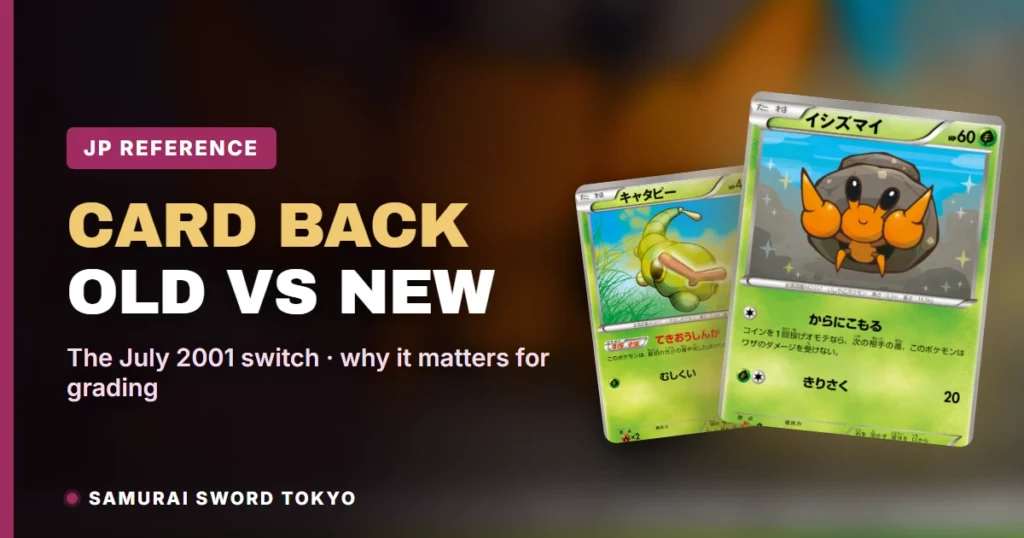
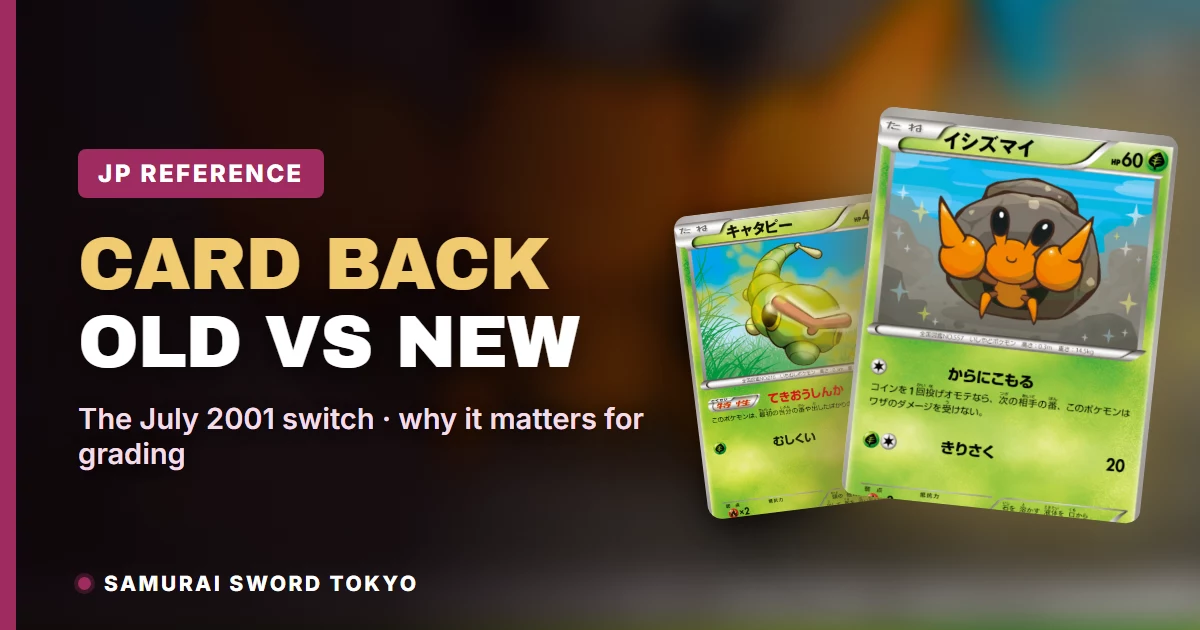
The front of Japanese Pokemon cards has changed with successive set eras since 2001; the back has not moved since the July 2001 switch. Below are Japanese card fronts from several set eras — Black & White, XY, Sun & Moon, Sword & Shield, and the current Scarlet & Violet / Mega period. We’re showing fronts because no hosted image of the back exists to publish here — but every one of these cards, whatever set it’s from, sits behind the same July 2001 back design.
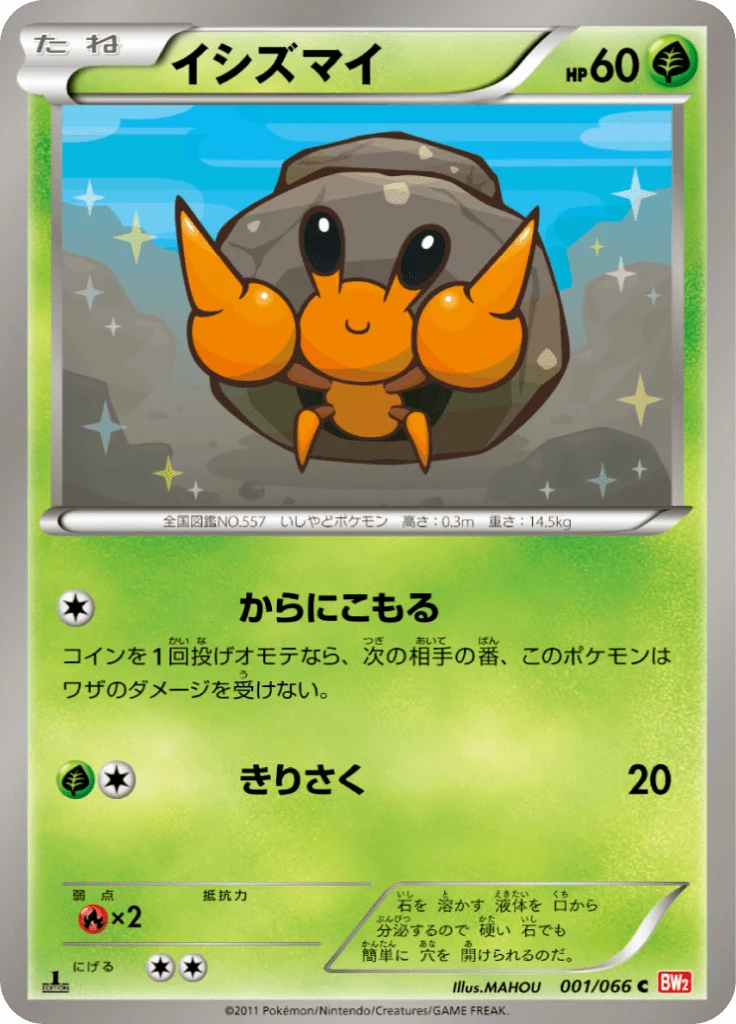
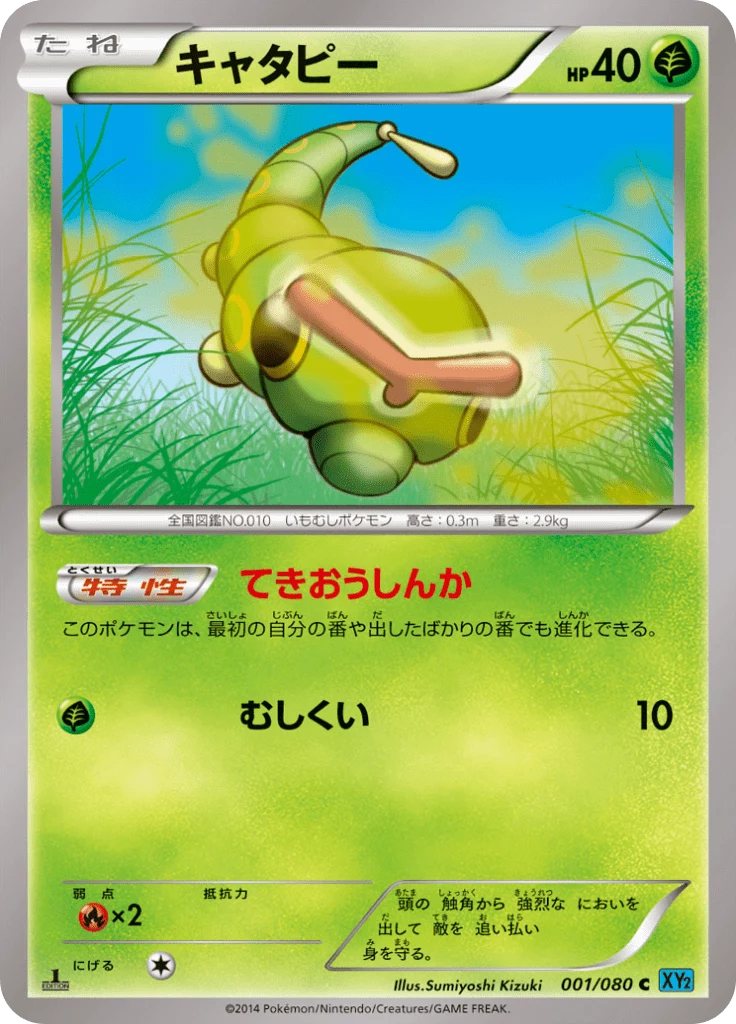
Compare either card’s back to a current release and you’re looking at the same July 2001 back design in every case, whatever changed on the front in between.
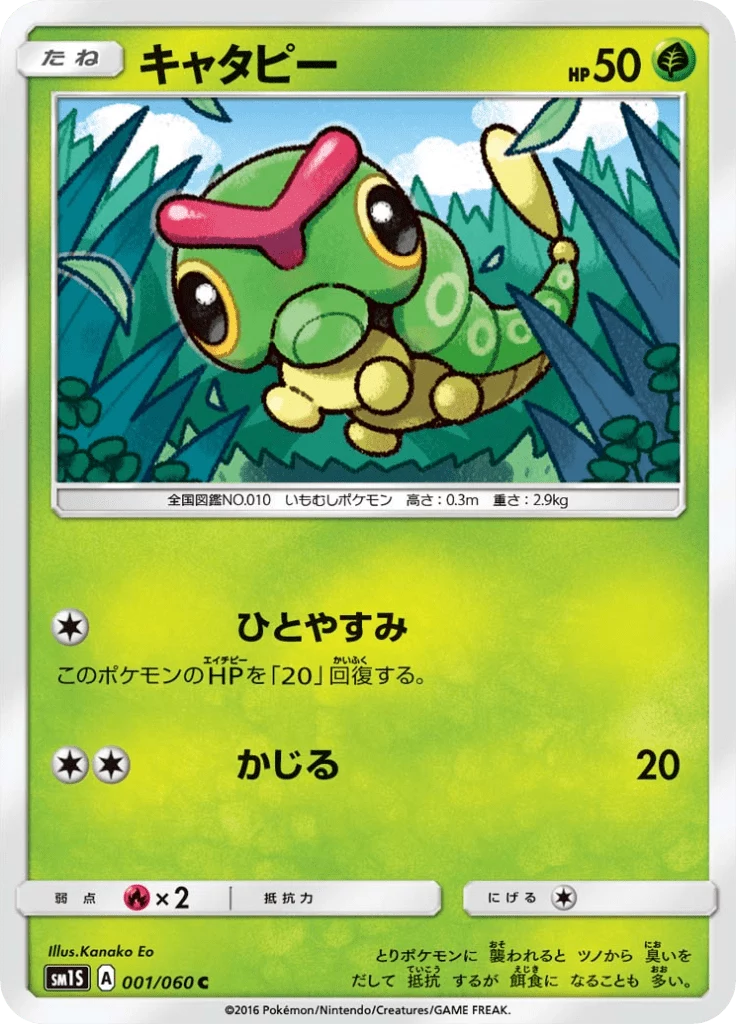
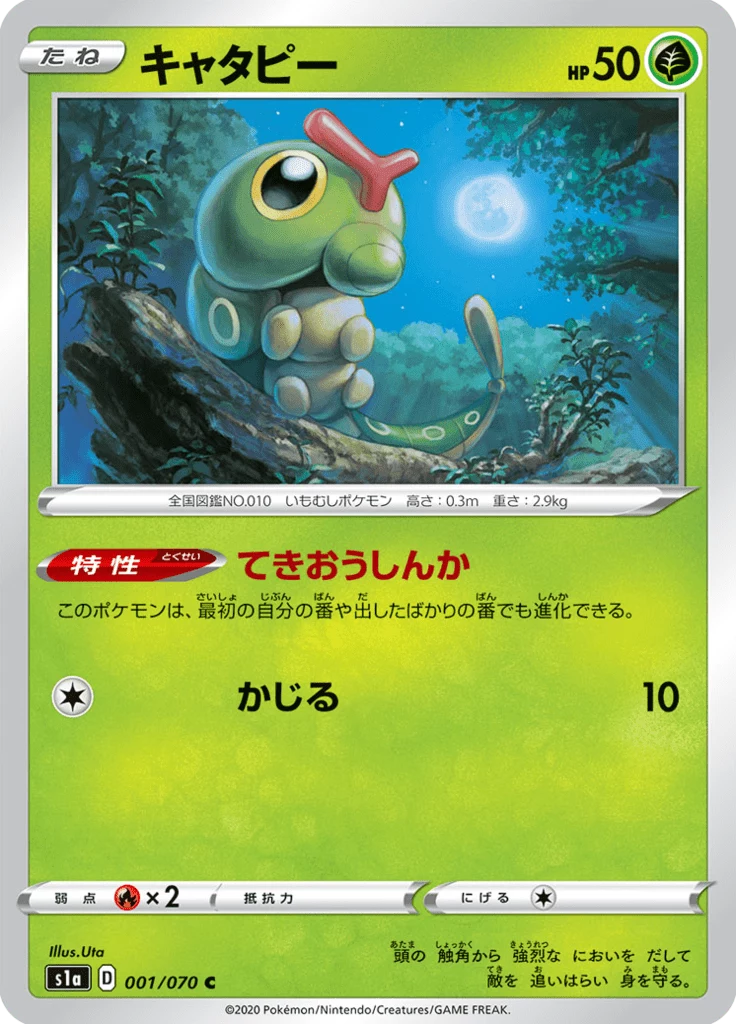
Both cards above happen to be the same species, Caterpie, printed several sets and roughly three years apart. The front designs differ across these eras. The back does not.

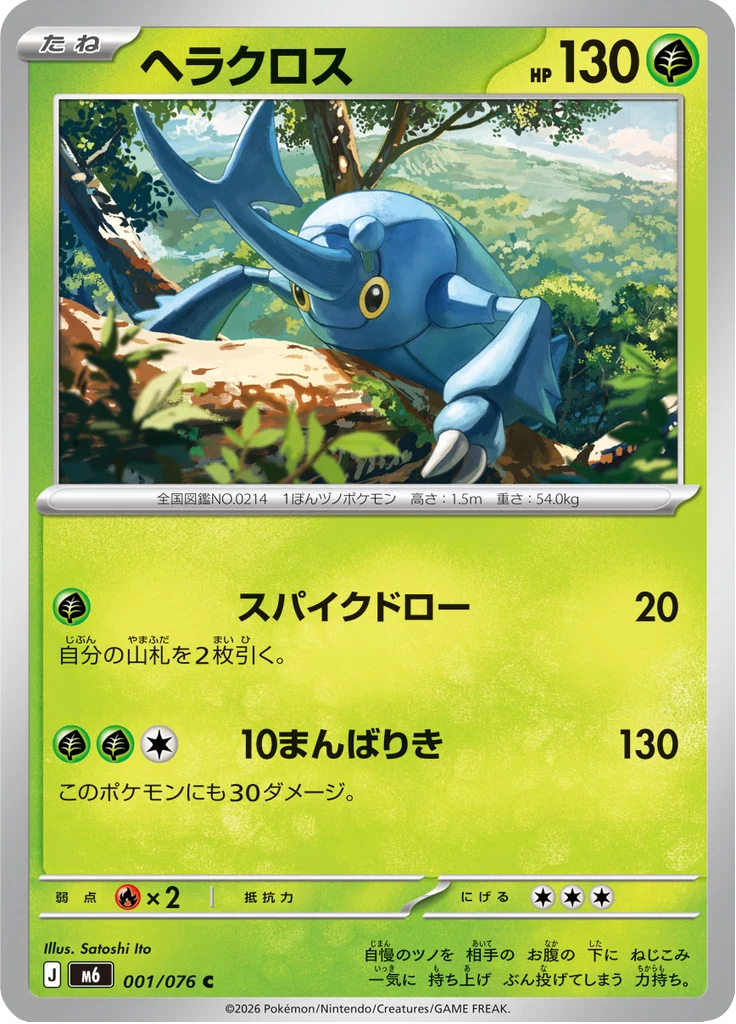
That’s several front eras spanning roughly a decade and a half. See our era guides for the Black & White era, XY era, Sun & Moon era, Sword & Shield era, and Scarlet & Violet era for what changed on the front in each. For how to read the rarity letters and set codes visible on these fronts, see how to read Japanese Pokemon cards.
Why the Back Matters for Graded Vintage Buyers
For anyone buying vintage Japanese cards — especially graded copies where the front’s condition and centring dominate the listing photos — the back functions as a fast, low-effort dating marker. A card with the pre-July-2001 back is, without needing to identify the exact set or check a card number, provably from the Pocket Monsters Card Game period: 1996 through the first half of 2001.
That’s the extent of what the back tells you on its own. It’s not a value signal, a rarity signal, or a condition signal, and it’s not proof of anything beyond print date. We won’t frame “old back” as guaranteed to carry more value or as an authenticity guarantee — no such claim is sourced, and a graded card’s price is driven by the specific set, rarity and grade, not the back alone. What the back reliably does is put a hard ceiling on how recent a print can be — a useful quick check when comparing vintage listings or verifying a grading slab’s label.
Our rarity guide for graded buyers covers the current-era rarity symbols in more depth, and if you’re specifically after graded singles, Quick Order is the fastest way to request them from our Tokyo inventory.
Where to Find Old-Back and Current Japanese Cards
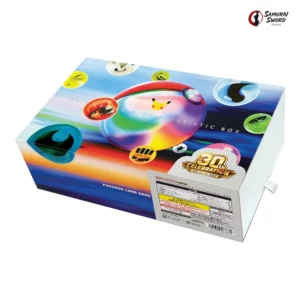
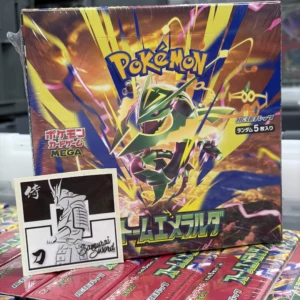
We ship Japanese sealed product and singles from Tokyo with tracked delivery worldwide. Current-era sealed boxes — Scarlet & Violet and Mega-era product like Storm Emeralda — carry the same post-2001 back covered above. Browse the Japanese booster box collection or the full shop for singles and graded cards.
For vintage old-back singles specifically, including PSA-graded copies, Quick Order is the fastest route — tell us the set, card, and grade you’re after and we’ll check current stock and pricing from Tokyo. For the buying-focused side of old-back collecting — what to look for, condition notes, and product recommendations — see our old-back Japanese cards guide and our vintage Japanese booster box guide.
Frequently Asked Questions
When did the Japanese Pokemon card back change?
Once, on July 19, 2001, with the release of Pokémon VS. Every Japanese card printed before that date carries the old back; every card printed on or after it, including current releases, carries the design used since.
Is an old-back Japanese card the same as a 1st Edition card?
No, and the two cannot appear on the same card. 1st Edition printing in Japan began with Pokémon VS — the same expansion that switched the back — so any card with the old back predates 1st Edition entirely, and any 1st Edition card was printed after the back had already changed.
Does the current Japanese card back look the same as the English card back?
Not exactly. Per Bulbapedia, the July 2001 switch moved the Japanese back to “the ‘Pokemon’ design used in international prints,” so today’s Japanese and English backs share the same design family. But collector references say the two still differ in visible details even now — most commonly cited is how the Poké Ball’s “button”/opening is illustrated. Before 2001, the Japanese back was a separate, Japan-only design entirely.
Did the Expedition Base Set change the Japanese card back?
No. Expedition (December 1, 2001) began the e-Card era’s front-layout changes — larger borders, a rounded artwork window, and removal of the Pokédex entry from the face. The back had already switched five months earlier, with Pokémon VS in July 2001.
Why do collectors care about the old back at all?
It’s a fast, reliable way to confirm a Japanese card was printed before July 2001 without checking the specific set or card number. It’s a dating marker, not a value or authenticity guarantee — the card’s actual price still depends on the specific set, rarity, and grade.
Picked for this article


📩 Get member-only sale alerts & coupons
Sale alerts, coupons and restock notices by email — straight from Tokyo.