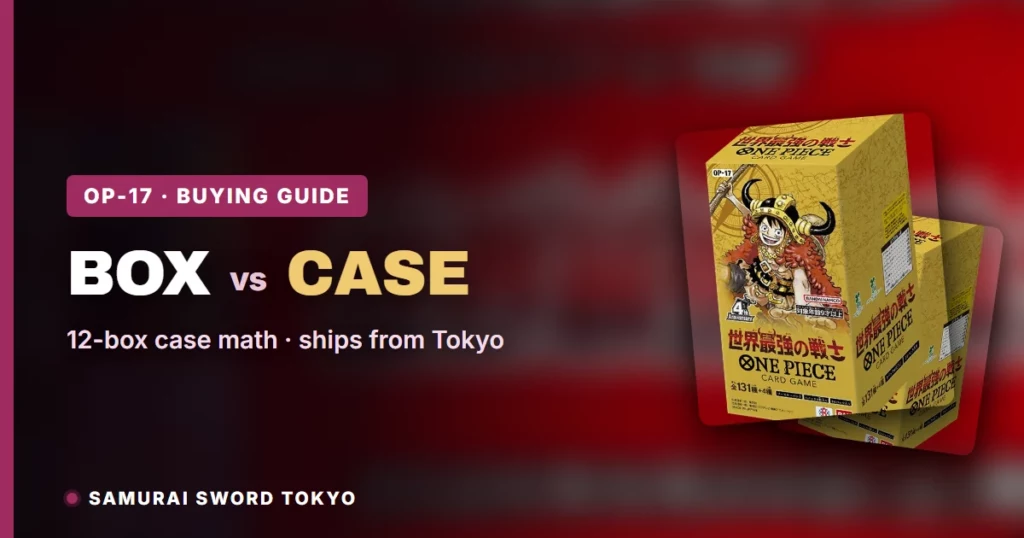

In the run-up to OP-17, search interest had a very specific shape: buyers were not just searching for the set — they were searching shop by shop, checking who had cases. That pattern shows up every time a One Piece Card Game release looks supply-constrained before launch, and it played out again ahead of the Japanese release on August 22, 2026. The set has now been out for launch weekend, and the case question has shifted from allocation anxiety to a new one: what is a box actually asking on the secondary market, and does that change the box-versus-case math?
If you are one of those buyers, this guide is the framework we walk customers through from our warehouse in Tokyo. It covers what a Japanese OP-17 case actually is, the exact MSRP math, why case demand concentrated before release, the Japanese-versus-English case question, and — most importantly — whether a case is genuinely the right purchase for you or whether one or two boxes does the same job with less capital locked up.
A Japanese OP-17 case is 12 booster boxes — 288 packs — at a combined MSRP of ¥69,120 (24 packs × ¥240 × 12). Cases suit resellers, case-hit hunters, and buyers holding sealed at scale. A single box (¥5,760 MSRP) suits almost everyone else. Now that the set is out and secondary-market asks exist, the discipline is the same as ever: know the MSRP math, set your ceiling, and don’t let a launch-weekend ask price talk you into a premium you haven’t sized on purpose. Our own Japanese OP-17 booster box is currently listed at ¥17,000.
Launch weekend is in the books. Sealed boxes are asking ¥15,699–¥16,000 on snkrdunk — about 2.7–2.8× the ¥5,760 MSRP. Scale that single-box ask by 12 and you land near ¥190,000 — that’s ask-based arithmetic against the current box market, not a real case listing, but it shows how far launch-weekend pricing has already moved above the ¥69,120 case-MSRP math. No official reprint has been announced; retailer restock lotteries are running instead (JUMP SHOP Aug 24–27, GEO Aug 31–Sep 3). Full breakdown, including the USD conversion, in the market check below.
The English version of OP-17 is now released (August 28, 2026) alongside the Japanese version (August 22, 2026). Our own Japanese OP-17 booster box is currently listed at ¥17,000; a standalone case product is not listed on the store — case allocations go through Quick Order (no timing given). OP-16 boxes remain currently listed at ¥12,600.
What a Japanese OP-17 Case Is: The Exact Math
Start with the unit everyone actually understands: the pack. A Japanese OP-17 pack costs ¥240 tax included and contains 6 random cards from a pool of 131 card types plus 4. From there, the sealed hierarchy stacks cleanly:
| Unit | Contents | MSRP math | Cards inside |
|---|---|---|---|
| Pack | 6 random cards | ¥240 | 6 |
| Booster box | 24 packs | 24 × ¥240 = ¥5,760 | 144 |
| Case | 12 booster boxes | 12 × ¥5,760 = ¥69,120 | 1,728 |
Those MSRP figures stay the fixed reference point for OP-17 sealed product. Street pricing on the secondary market already runs well above MSRP — sometimes substantially — and we break down where it actually sits in the market check below. But when you are comparing offers across shops, ¥5,760 per box and ¥69,120 per case is the baseline every quote should be measured against.

A few practical notes on what “case” means in the Japanese market, because the word gets used loosely:
- A case is a factory carton, not a display item. Japanese distribution ships boxes to shops in cartons of 12. When a shop sells you a “sealed case,” you are buying the distribution unit itself — 12 boxes that have not been picked over, opened, or reassembled.
- Case-sealed matters to some buyers and not to others. If you are opening everything, 12 loose boxes and 1 sealed case are identical products. If you are holding sealed long term or reselling, an unopened factory carton is the cleaner unit of provenance.
- The listings you see as “12x” or “x12” are cases. The long tail of shop searches for “op17 case 12x” is buyers looking for exactly this unit — twelve Japanese boxes moving as one allocation.
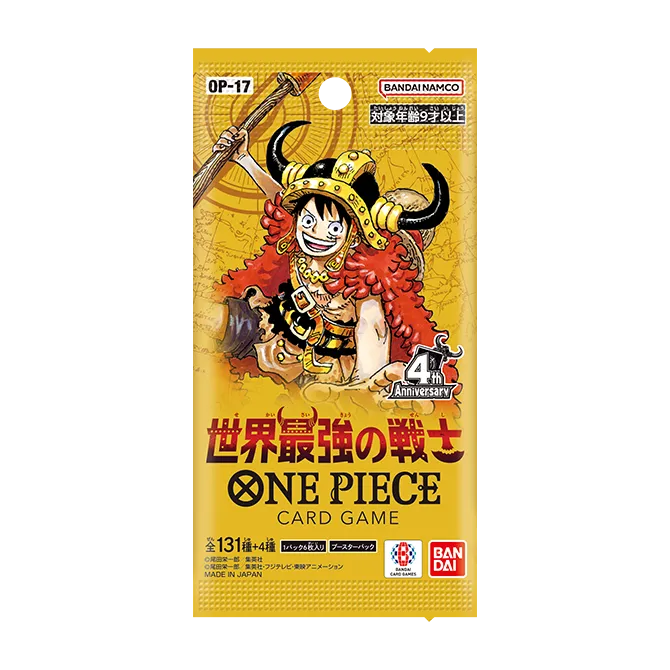
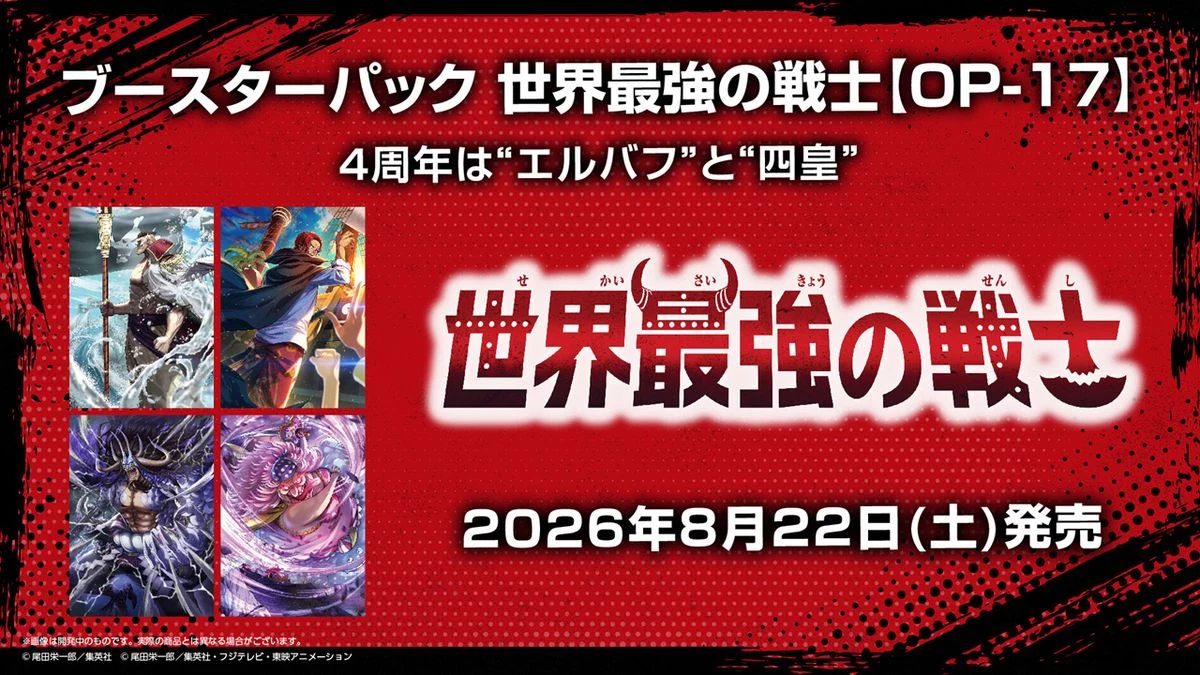
One more piece of context worth having: in Japan the set is searched by its Japanese name, 「世界最強の戦士」, rather than by the “OP-17” code most overseas buyers use. If you are cross-checking Japanese sources or listings, that is the name to look for.
Why Case Demand Spikes Before Release
Every recent mainline One Piece release has followed the same pre-launch rhythm, and OP-17 followed it precisely. Understanding the mechanism still matters after launch, too — it explains why the asks you’re seeing right now look the way they do, and it’s the same pattern that will play out again for whatever set comes after this one.
Allocation is decided before you ever see a listing
Japanese sealed product does not work like an open tap. Shops receive allocations from distribution, and those allocations are finite and largely fixed before release week. A shop that receives, say, a limited number of cases cannot simply order more when they sell through — restocks depend on later print waves that may or may not reach the same channels. That is why sealed availability at launch is genuinely scarce rather than artificially scarce: the pipeline has a ceiling.
Case buyers move first because cases disappear first
A shop with a tight allocation faces a choice: sell twelve boxes to twelve customers, or one case to one customer. Cases are operationally easier to sell but represent a much bigger bite of the allocation, so most shops list only a few — and those few go to the buyers who committed earliest. Box buyers can usually still find product at launch. Case buyers who wait often cannot, at least not at reasonable pricing.
The search behavior itself is the market signal
Here is the generic pattern worth internalizing: when buyers stop searching for a product and start searching for which shop still has the product, demand has outrun visible supply. Shop-by-shop case queries — dozens of small searches naming individual retailers — are exactly that behavior. At the time, it didn’t tell you what OP-17 would actually be worth — nothing does before a set is in hand. What it told you was that case-level demand ahead of this release was broad, international, and already in motion, and that’s exactly the emotional pricing environment that produced the launch-weekend asks we cover below.
Scarcity pressure was real ahead of release, and it’s exactly the condition under which buyers overpay. The two disciplines that protected you then still apply now that boxes have a real ask: know the MSRP math (¥69,120 per case), and decide your maximum acceptable premium before you start chasing a listing — not while staring at a “few left” notice.
Box vs Case: The Decision Framework
Now the core question. Twelve boxes or one? Here is the side-by-side, followed by the reasoning:
| Factor | One booster box | One case (12 boxes) |
|---|---|---|
| Cost (MSRP math) | ¥5,760 | ¥69,120 |
| Hit variance | High — one box can whiff the top slots entirely | Smoothed — 12 draws across the rarity distribution |
| Case-level chase slots | Not realistically in play | In play — the scarcest treatments historically appear at case-level rates |
| Storage | Trivial — fits on a shelf | A real carton needing dry, dark, stable storage |
| Resale granularity | One unit — all-or-nothing when you sell | Twelve units — sell boxes individually over time, keep some sealed |
| Capital committed | Low — easy to add a second box later | Significant — and locked before the card list is even public |
| Provenance if held sealed | Shrink-wrapped box | Unopened factory carton — the cleaner long-term unit |
Buy a single box if:
- You mainly want the opening experience of a new mainline set in release week.
- You are a collector targeting a few specific cards — a box gives you the ride, and singles later give you the precision.
- This is your first Japanese One Piece purchase and you are still learning how the rarity ladder feels in hand.
- You would rather stay flexible and add a second box after early openings reveal how the set actually pulls.
Buy a case if:
- You resell. A case gives you twelve sellable units, better per-unit economics than assembling twelve boxes retail, and the option to move sealed boxes and opened singles in parallel.
- You are chasing the scarcest slots. OP-17’s confirmed top tier is now known: two Pirate-Crew Super Parallels (Rocks D. Xebec and Luffy EB04-061), four Manga finals (Newgate, Shanks, Kaido, Linlin), and a Luffy Super Leader Parallel. Community pull-rate estimates — unofficial, conflicting across sources, not confirmed by Bandai — put the pirate-crew super parallel around 1 in 338 boxes, the Manga tier at roughly 1 in 65–100 boxes, and the leader parallel near 1 in 6 boxes. No case guarantees any of them, but one box essentially opts out of the top of that layer entirely. Our OP-17 pull rates guide covers the full structure.
- You are holding sealed at meaningful scale. If your thesis is that strong Japanese One Piece sets age well sealed — more on the actual track record below — a case is a position; a single box is a souvenir.
- You run a shop. Case and multi-case quantities are a wholesale conversation, and we do that directly — see our Japanese TCG wholesale guide for card shops.
Boxes buy you the experience; cases buy you the distribution. If your goal is fun plus a lottery ticket, a box does the whole job at one-twelfth the commitment. If your goal is smoothed variance, resale inventory, or a real shot at case-level chase slots, only a case delivers that shape.
And one honest subtraction: if what you actually want is one specific card, neither a box nor a case is the efficient route — a targeted single after launch almost always is. The case-versus-box question is only interesting once you have decided sealed is the right format for you.
How Japanese One Piece Boxes Have Aged: Our Own Shelf
The most common justification for buying cases is “sealed boxes go up.” That claim deserves better evidence than vibes, so here is our own store’s current price ladder for Japanese One Piece booster boxes — real listed prices on our shelf as of August 2026, not surveyed marketplace guesses. Most older sets are out of stock, so treat those figures as our most recent store prices:
| Set | Original MSRP era | SST price (Aug 2026) | Note |
|---|---|---|---|
| OP-01 Romance Dawn | Launch-era pricing | ¥43,050 | Recent store price (out of stock) |
| OP-05 | Launch-era pricing | ¥67,200 | Recent store price (out of stock) |
| OP-11 | Launch-era pricing | ¥36,575 | Recent store price (out of stock) |
| OP-16 The Time of Battle | ¥5,280 MSRP (24 × ¥220) | ¥12,600 | Live product (update: currently sold out — restock requests via Quick Order) |
Read that ladder carefully, because it argues for two things at once.
First: the strongest sets have aged far above launch pricing. OP-01, OP-05, and OP-11 boxes on our shelf price at multiples of what any box cost at release. A sealed case of a set that turns out to be one of the era-defining ones has historically been a very good thing to have owned. This is the real, verifiable core of the “sealed ages well” argument — it is not a myth.
Second: not every set is OP-01. OP-16 — a strong, Marineford-themed set that released in May 2026 — currently sits at ¥12,600, well above its MSRP but nowhere near the older icons yet, because aging takes years and only some sets earn it. The ladder is a historical observation about which sets the market ultimately crowned, observed with full hindsight. It is not a promise that OP-17 cases follow the same path, and nobody selling you a case at a steep premium can honestly tell you otherwise.
What the ladder does support is the structural point from the framework above: if you believe in a set enough to hold it sealed, the case is the instrument that expresses that belief with resale granularity — twelve boxes you can sell one at a time into whatever the market becomes, rather than one box that forces a single all-or-nothing exit.
The Launch-Weekend Market Check
Here is the current state of play, updated August 24, 2026 — two days after release:
- The hit lineup is confirmed. Secondary card-shop listings (yuyu-tei, Akihabara Card Shop, TCG Portal — consistent across sites) now show the full rarity structure: two Secret Rares in Rocks D. Xebec (OP17-118) and Loki (OP17-119), a Pirate-Crew Super Parallel treatment on Luffy (EB04-061) sitting alongside Rocks as a third secret-rarity-tier slot, the Treasure Rare Lucky Roux (OP17-033), and the four confirmed Manga finals (Newgate, Shanks, Kaido, Linlin). The official product page confirms the set total (“131 + 4 types”) but doesn’t publish a per-card list, so treat card-shop aggregation as the best available source rather than an official count.
- Boxes are currently listed and asking a real premium. Our own Japanese OP-17 booster box is currently listed at ¥17,000 (update: currently sold out — restock requests via Quick Order). On the open secondary market, snkrdunk asks for sealed boxes are running ¥15,699–¥16,000 (12 recent asks measured, floor ¥15,999) — roughly 2.7–2.8× the ¥5,760 MSRP, or about USD 99–101 at ¥159/USD. Scaling that single-box ask by 12 lands near ¥190,000; that is ask-based arithmetic against the box market, not an actual case listing, but it puts a number on how far launch-weekend pricing has already moved from the ¥69,120 case-MSRP math.
- No reprint, but restock lotteries. There is no official reprint announcement as of 8/24. What’s running instead is retailer restock lotteries — JUMP SHOP August 24–27 and GEO August 31–September 3 — a step below a straight reprint, but real additional supply for buyers willing to enter a draw instead of paying today’s ask.
- The chase tier is pricing exactly where the structure predicted. Snkrdunk floors on 8/24: the Luffy Pirate-Crew Super Parallel is asking seven figures (¥1,300,000); Rocks D. Xebec’s SEC-SP sits at ¥540,000; the Manga tier runs roughly ¥80,000–184,000 (Linlin lowest, Shanks highest); the Luffy leader parallel is at ¥115,000; and the Luffy SR-SPC insert (ST31-004) is at ¥75,000. Some shop marketplaces (yuyu-tei, torecamap) list the same top cards at even higher asks — Luffy’s pirate-crew parallel up to roughly ¥2.2M — but we use snkrdunk’s continuously-updating asks as the reference figure here. Worth noting: the base Secret Rares themselves are cheap by comparison — Loki SEC around ¥1,399, Rocks SEC around ¥2,750 — which is the twist of this set: the value concentrates almost entirely in the two Pirate-Crew Super Parallels and the Manga tier, not in the SEC slot itself.
Everything above is an asking price, not a confirmed sale — snkrdunk listings and shop tags, not closed transactions. Launch weekend is also the most emotional pricing window in a set’s life cycle: supply is at its tightest, and buyers who missed a box are the ones setting the tone. Three defenses still apply: (1) measure every offer against the MSRP math (¥5,760 a box, ¥69,120 a case) rather than against yesterday’s ask; (2) remember restock lotteries and later print waves both exist and can soften pricing; (3) if a listing pressures you with countdown urgency, that pressure is the product being sold.
None of this means “don’t buy.” It means buy with the numbers in front of you. For the full release timeline, confirmed card list, and our running market tracker, keep the OP-17 release date, card list and pre-order guide bookmarked — that hub is updated as new information lands.
What Is Confirmed Inside OP-17 So Far
Now that the set has released, here is what’s confirmed as of August 24, 2026 — official reveals plus, where noted, secondary card-shop listings that are consistent across multiple independent sources; no leaks, no speculation:
- All three secret-rarity-tier cards are now confirmed: Secret Rares Loki (OP17-119) and Rocks D. Xebec (OP17-118), plus a third slot filled by a new “海賊団スーパーパラレル” (Pirate-Crew Super Parallel) treatment on Luffy (EB04-061) — a 4th-anniversary pairing with the Rocks card. Bandai’s official terminology for how this third slot counts is still unclear, so we describe it as the set’s third secret-rarity-tier card rather than assert an official SEC count.
- Four Manga treatments, now confirmed as final: Edward Newgate (Whitebeard) OP17-005, Shanks OP17-022, Kaido OP17-062, and Charlotte Linlin OP17-112 — the treatment tier that has historically defined a set’s top chase layer, and which is asking ¥80,000–184,000 on the secondary market as of 8/24.
- A Super Leader Parallel: Luffy OP17-079, plus the full 10-card SP roster: New Emperor SP treatments (Luffy ST31-004, Shanks OP13-028, Buggy P-084, Teach ST27-005) and Haki-style SP pairs (Garp OP12-056/Roger P-107, Yamato OP16-098/Rayleigh OP14-108, Zoro EB04-007/Oden ST32-002), card numbers per Japanese reveal trackers.
- All six Leaders are now known per Japanese reveal trackers: Newgate OP17-001 (red), Shanks OP17-020 (green), Rocks D. Xebec OP17-039 (blue), Kaido OP17-058 (purple), Luffy OP17-079 (black), and Charlotte Linlin OP17-099 (yellow) — an Emperor-heavy lineup.
- Further premium slots, now confirmed: the Treasure Rare Lucky Roux OP17-033 and a special Kaido parallel illustrated by Keisuke Itagaki (Baki).
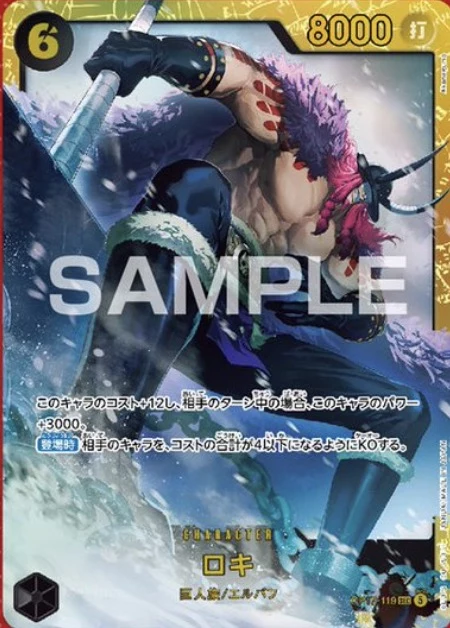

The “SAMPLE” watermark visible on preview imagery is standard on official reveal material — it does not indicate anything unusual about the cards.
For case buyers, the relevant signal is the treatment structure: four Manga rares plus two Pirate-Crew Super Parallels plus a Super Leader Parallel plus the SP tier is a deep chase hierarchy, and deep hierarchies are precisely where the case’s smoothed variance earns its keep. Pull rates for OP-17 are still not official — the estimates in circulation (roughly 1 in 338 boxes for the pirate-crew super parallel, 1 in 65–100 for the Manga tier, 1 in 6 for the leader parallel) come from individual community sources and conflict with each other, so treat them as directional, not guaranteed. We maintain the fuller breakdown in the OP-17 pull rates and best cards guide.
How Ordering From Tokyo Works
We are a Japanese trading card exporter based in Tokyo, shipping Japanese sealed product and singles worldwide with tracked delivery. Here is how OP-17 — and Japanese One Piece sealed generally — works with us:
- The OP-17 booster box is currently listed. We do not list sealed product we cannot guarantee. The Japanese OP-17 booster box (update: currently sold out — restock requests via Quick Order) is currently listed at ¥17,000, shipping from Tokyo. The OP-17 hub guide stays the fastest way to catch further availability and market updates.
- Quick Order is the fastest route for mixed and bulk requests. The Quick Order page lets you request boxes and singles across sets in one pass — it is the tool our repeat sealed buyers use.
- Case and multi-case quantities are a wholesale conversation. If you run a card shop or buy at volume, contact us through the wholesale channel described in our wholesale guide for card shops — allocation-sized requests are handled directly rather than through the storefront.
- Everything ships from Tokyo, tracked. Sealed boxes are packed for international transit with condition in mind, because a crushed corner matters on a box you intend to keep sealed. New to importing from Japan? Our guide to buying One Piece cards from Japan walks through the whole process.
OP-17 itself is now the live, listed option — no more waiting on allocation:
View Product → (update: currently sold out — restock requests via Quick Order)
Want to round out an order at a lower price point, or compare against the prior mainline set? OP-16 is currently listed:
View Product → (update: currently sold out — restock requests via Quick Order)
Frequently Asked Questions
How many boxes are in an OP-17 case?
A Japanese OP-17 case contains 12 booster boxes. Each box holds 24 packs of 6 cards, so a full case is 288 packs and 1,728 cards.
How much does an OP-17 case cost?
The MSRP math is ¥69,120 — 12 boxes at ¥5,760 each (24 packs × ¥240 tax included). On the secondary market as of August 24, 2026, single boxes are asking ¥15,699–¥16,000 on snkrdunk; scaling that ask by 12 lands near ¥190,000, though that’s ask-based arithmetic against the box market, not an actual case listing. MSRP remains the only hard, official number — measure any case offer against ¥69,120 first.
When does OP-17 release?
The Japanese version released Saturday, August 22, 2026. The English version follows on August 28, 2026, with pre-release events that began August 21 — an unusually short six-day gap for a mainline One Piece set.
Should I buy an OP-17 booster box or a case?
Buy a box if you want the opening experience, are targeting specific cards, or want to stay flexible — it delivers most of the fun at one-twelfth the commitment. Buy a case if you resell, want smoothed variance across 12 boxes, are chasing case-level treatment slots, or are holding sealed at scale.
Is a Japanese OP-17 case the same as an English case?
No. They are separate products in different languages, though both versions carry the same 131+4 card types. The Japanese version released August 22 at ¥240 per pack; the English version releases August 28 at USD 4.99 per pack. We are a Tokyo exporter and sell the Japanese version, shipped worldwide with tracking.
Can I buy OP-17 from Samurai Sword Tokyo?
Yes — OP-17 is currently listed at ¥17,000 per box, shipping from Tokyo. We only list sealed product we can guarantee. For case and multi-case quantities, contact us via the wholesale channel.
Do sealed Japanese One Piece boxes go up in value?
The strongest sets historically have: on our own shelf, OP-01 recently priced at ¥43,050, OP-05 at ¥67,200, and OP-11 at ¥36,575 — multiples of launch-era pricing — while the recent OP-16 sits at ¥12,600. That is a historical observation about sets the market ultimately favored, not a promise about OP-17; aging takes years and only some sets earn it.
What is the Japanese name of OP-17?
In Japan the set is known by its Japanese set name (romanized as “Sekai Saikyo no Senshi” — the world’s strongest warriors) rather than the OP-17 code, which is worth knowing when checking Japanese sources or listings.
What is OP-17 selling for right now?
As of August 24, 2026, sealed boxes are asking ¥15,699–¥16,000 on snkrdunk — roughly 2.7–2.8× the ¥5,760 MSRP. These are asking prices from an active marketplace, not confirmed sales. Our own box is currently listed at ¥17,000. No official reprint has been announced; retailer restock lotteries (JUMP SHOP, GEO) are running instead.
Product details from official Japanese and English announcements as of August 3, 2026 (JST); confirmed-contents, market asks, and SST availability facts updated August 24, 2026 (JST). MSRP figures are official; secondary-market ask prices (snkrdunk, yuyu-tei, torecamap) are asking prices, not confirmed sales, and are not official figures. SST store prices are live listed prices on samuraiswordtokyo.com; out-of-stock sets shown at most recent store price. Community pull-rate estimates are unofficial, single-source or conflicting across sources, and not confirmed by Bandai. Past sealed-box performance is a historical observation, not a prediction.
¥500 off, on us
- ¥500 off one order of ¥30,000 or more
- +1% extra points on that order
- One coupon per account
Sign in or create an account to claim · One use per account · One coupon per order · Not valid on pre-order items · Ends Sep 24, 2026, 23:59 JST · Import duties, taxes and customs charges are not included in the price and are collected on delivery, except for destinations we ship duty-paid.
Picked for this article

📩 Get member-only sale alerts & coupons
Sale alerts, coupons and restock notices by email — straight from Tokyo.