美品 (bihin), 傷あり (kizu ari), PSA 10, “Damaged Box” — a single Japanese Pokemon listing can carry several different condition labels at once, and they are not interchangeable. Some are precise, third-party certifications. Others are ordinary marketplace shorthand with no official definition behind them at all.
This guide separates the two. We cover what PSA actually certifies when it assigns a numeric grade, what our own Damaged Box listing says about sealed product, and why the common Japanese marketplace terms for raw-card condition do not map onto either system.
The store has listed one Damaged Box per set since early October 2026, and the store prices below are as of October 7, 2026. Marketplace and PSA facts keep the dates printed next to them.
美品 (“good condition”) and 傷あり (“has damage/scratches”) are common marketplace usage, not standardised terms defined by PSA or by any official body we could find — treat them as a seller’s own description, not a grade. PSA’s numeric scale and the written wording on our Damaged Box listing, such as the SV2A-Pokemon 151 Damaged Box, currently listed at ¥44,041 (~$286), are both set out in writing, and we quote that wording below.
Every definition below is quoted from PSA’s own pages or our own product and policy pages, each with its source and date printed. Where a Japanese marketplace term has no official definition we could find, we say so rather than assigning it one. USD figures convert at ¥154/USD, approximate.
美品 and 傷あり: Marketplace Terms, Not Official Grades
美品 (bihin, roughly “fine item” or “good condition”) and 傷あり (kizu ari, “has scratches/damage”) show up constantly in Japanese secondary-market listings for raw, ungraded cards. They function the way “near mint” or “played” do in English-language marketplaces: as a seller’s own shorthand for how a card looks.
We could not find either term defined by PSA, by any official Pokemon card body, or on any of our own pages as of September 18, 2026. That means there is no fixed standard behind them — one seller’s 美品 may not match another’s. If condition certainty matters to you, a PSA-graded card gives you a published definition to check against, and our Damaged Box listing states its terms in writing; a raw card marked 美品 or 傷あり gives you the seller’s own judgment and nothing more.
Our own condition guide article makes a related point about raw cards generally: “A ‘raw’ Pokemon card is simply one that hasn’t been submitted to a grading company — the term describes its status, not its condition.” (samuraiswordtokyo.com condition guide, as printed on September 18, 2026) The same logic applies to 美品 and 傷あり: they describe a seller’s opinion of a raw card’s status, not a certified condition.
Where PSA’s Grade Actually Comes From
PSA’s grade, by contrast, is a written, published definition. For a Gem Mint 10, PSA’s Grading Standards page states: “A PSA Gem Mint 10 card is a virtually perfect card. Attributes include four perfectly sharp corners, sharp focus and full original gloss. A PSA Gem Mint 10 card must be free of staining of any kind… The image must be centered on the card within a tolerance not to exceed approximately 55/45 percent on the front, and 75/25 percent on the reverse.” (psacard.com/gradingstandards, as printed on September 18, 2026)
Our own condition guide breaks that same standard into four checks: “Centering — How evenly the printed image sits within the card’s border, front and back,” “Corners — Sharpness of all four corners,” “Edges — Condition of the card’s cut edges, checked for whitening, chipping, or roughness,” and “Surface — Gloss, print quality, and freedom from staining, scratches, or print defects.” (samuraiswordtokyo.com condition guide, as printed on September 18, 2026; the four-pillar labels are our own article’s wording, corroborating PSA’s published standard)
Before any of that, PSA also authenticates the card: “Authentication is the process of verifying the originality or genuineness of a trading card. Grading is assessing the quality and condition of a trading card using PSA’s 10-point grading scale. Grading can only take place after a trading card has been deemed authentic.” (psacard.com/services/tradingcardgrading, as printed on September 18, 2026) That is a formal process a 美品 or 傷あり listing simply does not go through. Our own Japanese Pokemon card grading guide covers PSA, BGS and CGC side by side if you want the fuller picture of how third-party grading works.
Our Damaged Box Listing: One Listing per Set
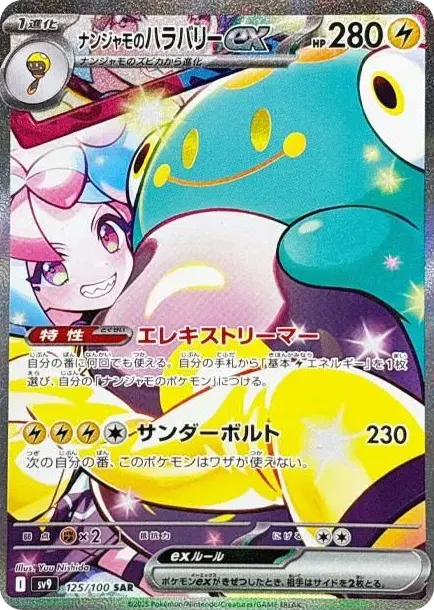
For sealed booster boxes, the store runs a Damaged Box listing, and it is about the outer box, not the cards inside. Until early October 2026 the store listed two grades; it now lists one Damaged Box per set. The product page opens with the heading “Damaged Box — Discounted Item” and explains: “It is discounted because of cosmetic damage to the outer box (e.g., dents or scratches). The cards inside are unaffected.” (our Damaged Box product page, as printed on October 6, 2026)
A second block of wording describes the damage in general terms: “Damaged boxes have dents, creases, scuffs, or other cosmetic damage to the outer box. The type and extent of damage vary by item. Photos are samples.” The same notice is printed on the DAMAGED BOX tab of Quick Order, together with “Sold as-is: no returns or refunds.” (as printed on October 6, 2026)
The page also tells you how to read its photos: “Photos are samples. The first image shows the regular product so you can identify the set. The condition photos that follow are sample photos of damaged boxes from the same stock and show the typical level of damage. The actual item you receive may differ from the photos.” And it sets the terms of sale: “This item is sold as-is. We do not respond to inquiries about this item, and returns and refunds are not accepted.”
| Listing | What it describes | Example, as of October 7, 2026 |
|---|---|---|
| Sealed box | The regular listing for a set, described by our Product Condition Guide page | SV2A-Pokemon 151 Booster Box (Sealed), ¥44,961 (~$292) |
| Damaged Box | Cosmetic damage to the outer box; sample photos; sold as-is | SV2A-Pokemon 151 Damaged Box, ¥44,041 (~$286) |
| No Shrink Damaged Box | A separate Damaged Box listing that some sets carry | SV11W-White Flare No Shrink Damaged Box, ¥17,052 (~$111) |

Our product condition guide adds context that applies to every sealed box we list: “The following occur normally in manufacturing and distribution and are not defects and not grounds for a return, refund, or discount: minor wrinkles, air bubbles, or looseness in the shrink wrap; minor corner wear, pressure marks, or printing variations on the outer box; and labels or sticker residue applied during official distribution in Japan.” (samuraiswordtokyo.com product condition guide, “Last updated: July 23, 2026”, as printed on September 18, 2026)
The practical difference is the one the wording above spells out. Normal manufacturing and distribution marks on a regular sealed box are not grounds for a discount, while a box listed as a Damaged Box is sold at its own discounted price, as-is, with sample photos to show the typical level of damage. For the full wording and the per-set prices, see our Damaged Box explainer.
Sealed Box Condition vs PSA Slab Condition
Our product condition guide draws one more distinction worth knowing if you are comparing a Damaged Box listing to a PSA-graded card: the grade on a slab covers the card, not its case. “A PSA grade is an assessment of the card itself, not of the slab (case) it is sealed in,” and “Light surface scratches on the slab, minor whitening or cloudiness, and molding variations are commonly present from the time PSA ships the slab and are not defects.” (samuraiswordtokyo.com product condition guide, as printed on September 18, 2026)
Our PSA 10 product pages repeat the same point card by card: “Please note that the PSA case may have minor scratches or marks on its surface.” (our PSA 10 Darkrai & Cresselia LEGEND product page, as printed on September 18, 2026) So a Damaged Box listing describes the outer packaging of a sealed product; a PSA grade describes the card itself, separately from the holder around it. They are two different objects being described, even when both use the word “condition.”
Putting the Three Systems Together
Lined up side by side, the three systems that show up on a Japanese Pokemon listing are not equivalent, and none of them substitutes for the others:
- 美品 / 傷あり — common marketplace usage for raw, ungraded cards; no official definition we could find; treat it as one seller’s own description.
- PSA grade (e.g., PSA 10) — a formal, published standard covering centering, corners, edges and surface, applied after authentication, and printed on a sealed PSA LightHouse™ label.
- Damaged Box — our own written wording for the cosmetic condition of a sealed box’s outer packaging: one listing per set, sample photos, sold as-is; the cards inside are described as unaffected.
If you want written proof of a card’s condition rather than a seller’s description, a PSA-graded example is the one of the three with a published, third-party standard behind it. If you want a sealed box at a discounted price and you accept outer-box damage, the Damaged Box listing tells you in writing what you are agreeing to.
Where to Buy
We list Damaged Boxes and PSA-graded singles, and we ship from Tokyo with tracked delivery.
Our regular sealed SV2A-Pokemon 151 Booster Box is currently listed at ¥44,961 (~$292) (Sealed); the No Shrink option is sold out at the time of this update. That is the comparison point if you would rather avoid the Damaged Box listing, which sits at ¥44,041 (~$286) for the same set. Browse the Damaged Box collection, the Japanese Pokemon card collection or the PSA 10 collection, or use Quick Order, where the DAMAGED BOX tab has Pokemon and One Piece sub-tabs and PSA10 has its own top-level tab. See also our guide to how much a Damaged Box actually saves.
Frequently Asked Questions
What does 美品 mean on a Japanese card listing?
Roughly “good condition.” It is common marketplace usage for a raw, ungraded card, not a term defined by PSA or any official body we could find — it reflects the seller’s own description of how the card looks, so check the photos yourself.
What does 傷あり mean?
“Has damage” or “has scratches.” Like 美品, it is marketplace shorthand with no official, standardised definition — it describes what a seller says they see, not a certified grade, so the extent of the damage is left to the listing photos and text.
Is 美品 the same as a PSA grade?
No. A PSA grade follows a published standard covering centering, corners, edges and surface, applied after PSA authenticates the card. 美品 has no equivalent published standard behind it, so two sellers can use the word for cards in quite different condition.
What does the Damaged Box listing say about the box?
It says the box is discounted because of cosmetic damage to the outer box, such as dents or scratches, and that the cards inside are unaffected. It adds that the photos are samples, so the actual item may differ from the photos shown on the product page.
Does the store still split Damaged Boxes into two grades?
No. The store lists one Damaged Box per set. Each set has a single Damaged Box page with one set of terms and one price, and some sets also carry a separate No Shrink Damaged Box listed on its own page.
Can I return a Damaged Box?
No. The product page states: “This item is sold as-is. We do not respond to inquiries about this item, and returns and refunds are not accepted.” Quick Order repeats it as “Sold as-is: no returns or refunds,” so read the sample photos and the damage notice before ordering.
Does a PSA grade cover the plastic case the card ships in?
No. Our product condition guide states a PSA grade is an assessment of the card itself, not of the slab it is sealed in, and that minor scratches or cloudiness on the case itself are not defects. The grade belongs to the card inside the holder.
Where do I find a Damaged Box on the store?
Open the DAMAGED BOX tab in Quick Order on the home page, which has Pokemon and One Piece sub-tabs, or use the Damaged Box collection. Each product page carries the same notice about dents, creases and scuffs, and the same as-is terms before you order.
Picked for this article
📩 Get member-only sale alerts & coupons
Sale alerts, coupons and restock notices by email — straight from Tokyo.